
Life, 1909-11-25 · page 14 of 32
Life — November 25, 1909 — page 14: what you’re looking at
What you’re looking at
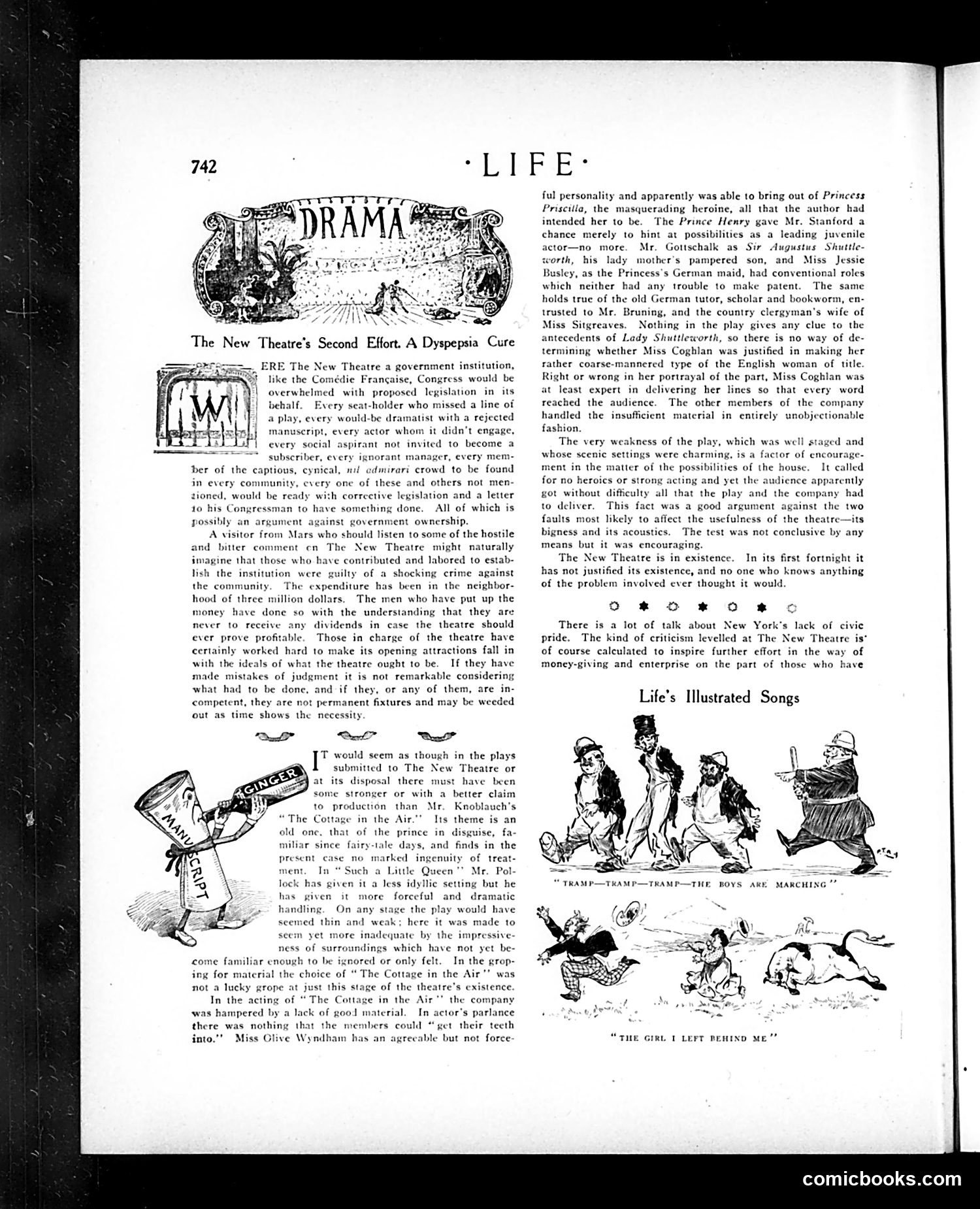
This page critiques **The New Theatre's** second production, "The Cottage in the Air," a play about a disguised princess. The reviewer argues the production is weak despite impressive staging and resources. **The Satire:** The opening section mocks government arts funding by imagining if The New Theatre were publicly owned—Congress would be flooded with complaints from disgruntled theatergoers, failed playwrights, and rejected actors demanding legislation. This satirizes democratic tendency toward frivolous complaints and bureaucratic interference. **The Criticism:** The play itself is dismissed as derivative (a tired "prince in disguise" fairy tale). The reviewer notes impressive sets and conscientious effort don't compensate for thin material. Actors like Miss Wyndham performed well with limited roles, but the script gave them little to work with. **The Point:** Even well-intentioned, well-funded theatrical ventures fail with poor material—a critique of The New Theatre's judgment, not its mission.
📄 Transcribed text from this page (OCR, searchable)
Machine-transcribed from the original scan — historical spelling and the odd misread are preserved.
zs bale 2 The New Theatre’s Second Effort. A Dyspepsia Cure ERE The New Theatre a government institution, like the Comédie Francaise, Congress would be overwhelmed with proposed legislation in its behalf. Every seat-holder who missed a line of a play, every would-be dramatist with a rejected manuscript, every actor whom it didn't engage, every social aspirant not invited to become a subscriber, every ignorant manager, every mem- der of the captious, cynical, mi cdmirari crowd to be found in every community, every one of these and others not men- tioned, would be ready with corrective legislation and a letter to his Congressman to have something done. All of which is possibly an argument inst government ownership. A visitor from Mars who should listen to some of the hostile d bitter comment cn The New Theatre might naturally imagine that those who have contributed and labored to estab- lish the institution were guilty of a shocking crime against the community, The expenditure has been in the neighbor- hood of three million dollars. The men who have put up the money have done so with the understanding that they are never to receive any dividends in case the theatre should ever prove profitable. Those in charge of the theatre have certainly worked hard to make its opening attractions fall in with the ideals of what the theatre ought to be. If they have made mistakes of judgment it is not remarkable considering what had to be done, and if they, or any of them, are in- competent, they are not permanent fixtures and may be weeded out as time shows the necessity Bal Ce " would seem as though in the play: submitted to The New Theatre or at its disposal there must have been some stronger or with a better claim Knoblauch’s Its theme is an production than Mr ein the Air.” old one, that of the prince in di: miliar since fairy-tale days, and finds in the present case no marked ingenuity of tre ment. In “Such a Little Queen”? Mr. Pol- lock has given it a less idyllic setting but he forceful and dramatic On any stage the play would have here it was made to has given it more handling seemed thin and weak seem yet more inadequate by the impressive ness of surroundings which have not yet be come fan In the grop- ing for material the choice of “ The Cottage in the Air'’ was not a lucky grope tre’s existence In the acting of “The Cottage in the Air’? the company was hampered by a lack of good material. In actor's parlance there was nothing the members could “get their teeth into." Miss Olive Wyndham has an agreeable but not force iar enough to be ignored or only felt ful personality and apparently was able to bring out of Princess Priscilla, the masquerading heroine, all that the author had intended her to be. The Prince gave Mr. Stanford a chance merely to hint at possibilities as a leading juvenile actor—no more. Mr. Gottschalk as Sir Augustus Shuttle- worth, his lady mother’s pampered son, and Miss Jessie Busley, as the Princess's German maid, had conventional roles which neither had any trouble to make patent. The same holds truce of the old German tutor, scholar and bookworm, en- trusted to Mr. Bruning, and the country clergyman's wife of Miss Sitgreaves. Nothing in the play gives any clue to the antecedents of Lady Shuttleworth, so there is no way of de- termining whether Miss Coghlan was justified in making her her coarse-mannered type of the English woman of title Right or wrong in her portrayal of the part, Miss Coghlan was at least expert in delivering her lines so that every word reached the audience. The other members of the company handled the insufficient material in entirely unobjectionable fashion. The very weakness of the play, which was well staged and whose scenic settings were charming, is a factor of encourage- ment in the matter of the possibilities of the house. It called for no heroics or strong acting and yet the audience apparently got without difficulty all that the play and the company had to deliver. This fact was a good argument against the two faults most likely to affect the usefulness of the theatre—its bigness and its acoustics, The test was not conclusive by any means but it was encouraging. ‘The New Theatre is in existence. In its first fortnight it has not justified its existence, and no one who knows anything of the problem involved ever thought it would. o *£ DOD *e 0 ®& There is a lot of talk about New York's lack of civic pride. The kind of criticism levelled at The New Theatre is* of course calculated to inspire further effort in the way of money-giving and enterprise on the part of those who have Life’s Illustrated Songs BOYS ARE “THE GIRL T LEFT REMIND ste’? comicbooks.com