
Life, 1909-11-25 · page 18 of 32
Life — November 25, 1909 — page 18: what you’re looking at
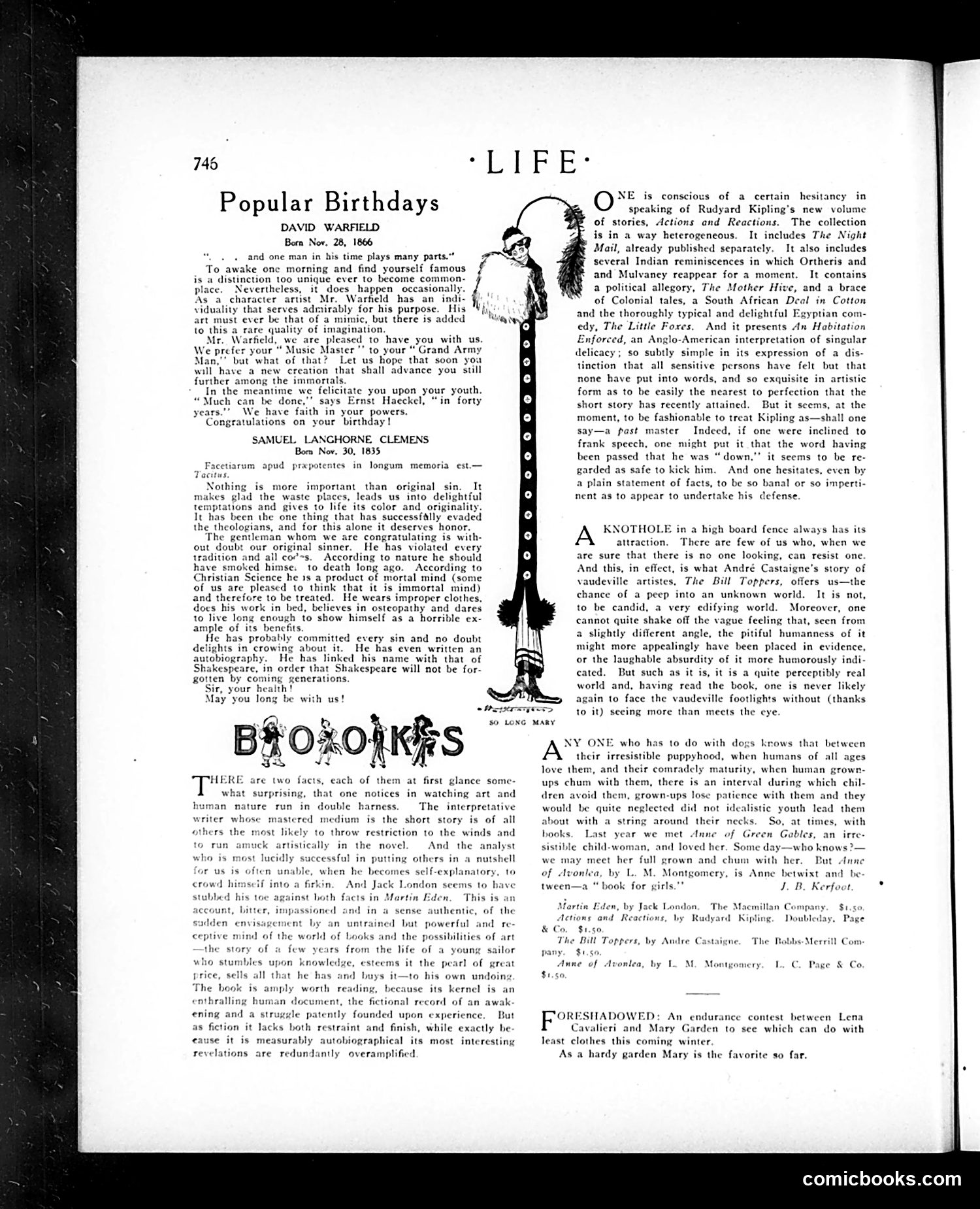
What you’re looking at
This page from *Life* magazine contains birthday congratulations to three notable figures: actor David Warfield, author Samuel Clemens (Mark Twain), and—based on the visible text—likely Rudyard Kipling. The satire here is affectionate rather than cutting. The Clemens entry especially mocks his legendary rule-breaking: he smoked excessively, dressed poorly, worked in bed, believed in osteopathy, and—most amusingly—"linked his name with that of Shakespeare, in order that Shakespeare will not be forgotten by coming generations." This playfully suggests Twain's outsized ego and unconventional life made him a living scandal to respectable society, yet somehow he thrived anyway. The Warfield entry praises his skill as a character actor while gently ribbing his repertoire choices. The magazine's tone is one of affectionate ribbing toward celebrated figures who violated Victorian social conventions while achieving fame—treating their nonconformity as endearingly audacious rather than condemnable.
📄 Transcribed text from this page (OCR, searchable)
Machine-transcribed from the original scan — historical spelling and the odd misread are preserved.
746 Popular Birthdays DAVID WARFIELD Born Nov. 28, 1866 + and one man in his time plays many parts.” To awake onc morning and find yourself famous is a distinction too unique ever to become common- place. Nevertheless, it does happen occasionally. As a character artist. Mr. Warfield has an indi- viduality that serves admirably for his purpose. His art must ever be that of a mimic, but there is added to this a rare quality of imagination. tr. Warfield, we are pleased to have you with us. We prefer your “ Music Master "’ to your “Grand Army Man,” but what of that? Let us hope that soon you will ‘have a new creation that shall advance you Still further among the immortals. In the meantime we felicitate you upon your youth. “Much can be done,’ says Ernst Haeckel, “in forty years."” We have faith in your powers. Congratulations on your birthday! SAMUEL LANGHORNE CLEMENS Bom Nov. 30, 1835 m apud prepotentes in longum memoria est.— Facetia Nothing is more important. than original sin, It makes glad the waste places, leads us into delightful temptations and gives to life’ its color and originality. It has been the one thing that has successfally evaded the theologians, and for this alone it deserves honor. The gentleman whom we are congratulating is with- out doubt our original sinner. He has violated every tradition and all co’*s. According to nature he should have smoked himse. to death long ago. According to Christian Science he 1s a product of mortal mind (some of us are pleased to think that it is immortal mind) and therefore to be treated. He wears improper clothes, does his work in bed, believes in osteopathy and dares 10 live long enough to show himself as a horrible ex- ample of its benefits. He has probably committed every hts in crowing about it. He has even written an autobiography. He has linked his name with that of Shakespeare, in order that Shakespeare will not be for- gotten by coming generations. Sir, your health! May you long be with us! B¥0} HERE are two facts, each of them at first glance some- sin and no doubt what surprising, that one notices in watching art and man nature run in double harness. ‘The interpretative writer whose mastered medium is the short story is of all others the most likely to throw restriction to the winds and to run amuck artistically in the novel. And the analyst who is most lucidly successful in putting others in a nutshell rus is often unable, when he And Jack London seems to have stubbed his toe against both facts in Martin E becomes self-explanatory, to crowd himseif into a firkin This is an of the ntrained but powerful and re account, bitter, impassioned and in a sense authentic, sadden envisagement by an ceptive mind of the world of Looks and the possibilities of art the story of x few years from the life of young sailor who stumbles upon knawlee , eSteems it the pearl of great price, sells all that he has and buys it—to his own undoing. The book is amply worth reading, because its kernel is an enthr: h ening ile patently founded upon experience, But as fiction it lacks both restraint and finish, while exactly be autobiographical its most revelations are redundantly overamplified. an document, the fictional record of an awak cause it is measurably teresting soles = is conscious of a certain hesitancy in speaking of Rudyard Kipling’s new volume of stories, Actions and Reactions. The collection is in a way heterogeneous. It includes The Night Mail, already published separately. It also includes several Indian reminiscences in which Ortheris and and Mulvaney reappear for a moment. It contains a political allegory, The Mother Hive, and a brace of Colonial tales, a South African Deal in Cotton and the thoroughly typical and delightful Egyptian com- edy, The Little Foxes. And it presents An Habitation Enforced, an Anglo-American interpretation of singular delicacy ; so subtly simple in its expression of a dis- tinction that all sensitive persons have felt but that none have put into words, and so exquisite in artistic form as to be easily the nearest to perfection that the short story has recently attained, But it seems, at the moment, to be fashionable to treat Kipling as—shall one say—a past master Indeed, if one were inclined to frank specch, one might put it that the word having been passed that he was “down,” it seems to be re- garded as safe to kick him. And one hesitates, even by a plain statement of facts, to be so banal or so imperti- nent as to appear to undertake his defense. KNOTHOLE in a high board fence always has its attraction. There are few of us who, when we are sure that there is no one looking, can resist one And this, in effect, is what André Castaigne’s story of vaudeville artistes, The Bill Toppers, offers us—the chance of a peep into an unknown world. It is not, to be candid, a very edifying world. Moreover, one cannot quite shake off the vague feeling that, seen from a slightly different angle, the pitiful humanness of it might more appealingly have been placed in evidence, or the laughable absurdity of it more humorously indi- cated. But such as it is, it is a quite perceptibly real world and, having read the book, one is never likely again to face the vaudeville footlights without (thanks to it) s ing more than meets the eye NY ONE who has to do with dogs knows that between DA cis teratanitle puppyhood, when humans of all ages love them, and their comradely maturity, when human grown- ups chum with them, there is an interval during which chil- dren avoid them, grown-ups lose patience with them and they would be quite neglected did not idealistic youth lead them out with a string around their necks. es, hooks. Last year we met Anne of Gre sistible child-woman, and loved her. Some day—who knows ?— we may meet her full grown and chum with her. But Anne of Avonlea, by L. M. Montg is Anne betwixt and be. tween—a “book for girls.’* J. B. Kerfoot rtin Eden, by Ja on, The Macmillan Company. $1.50. Actions Rudyard Kipling. Doubleday, Page & Co. $1.50, The Bil 7 pany. $4.50. Anne of A C. Page & Co. by Andre Castaig The Robbs-Merrill Com: $ Fore SHADOWED: An endurance contest betw Lena Cavalieri and Mary Garden to see which can do with least clothes this coming winter. As a hardy garden Mary is the favorite so far. comicbooks.com