
Life, 1909-11-25 · page 12 of 32
Life — November 25, 1909 — page 12: what you’re looking at
What you’re looking at
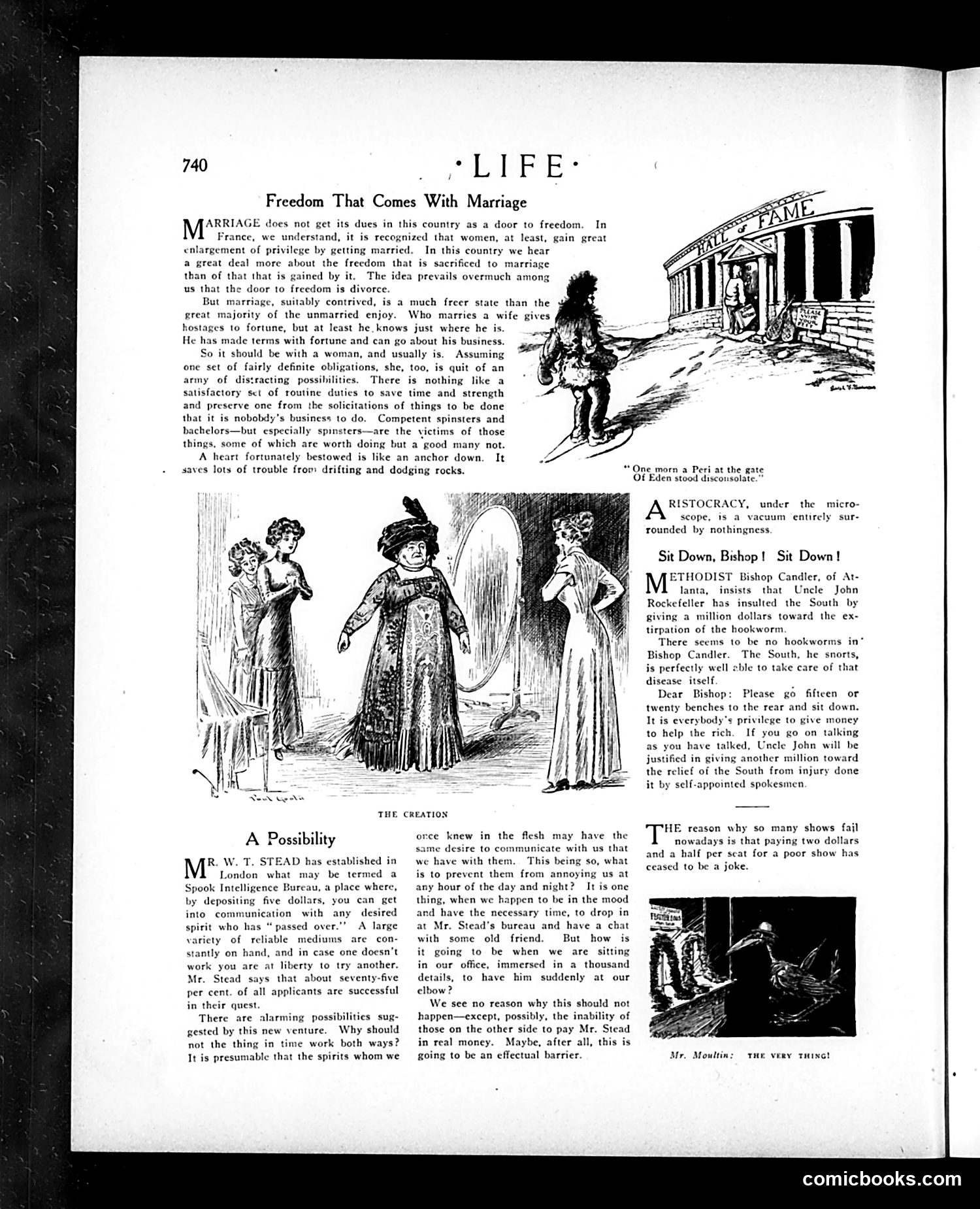
This Life magazine page satirizes early 20th-century social issues through three pieces: **"Freedom That Comes With Marriage"** argues marriage paradoxically restricts freedom more than it liberates, especially for women. The text claims married men gain more freedom than unmarried men enjoy, but married women lose significantly. **"The Creation"** illustration depicts a woman admiring herself in a mirror—a classical artistic reference to vanity, likely satirizing female narcissism. **"A Possibility"** discusses Mr. Stead's "Spook Intelligence Bureau"—apparently a spiritualist séance service in London where clients pay to communicate with deceased spirits. The satire questions why this dubious venture hasn't already failed, suggesting gullibility about supernatural claims. The page reflects Progressive-era skepticism toward both traditional marriage constraints and spiritualist fraud.
📄 Transcribed text from this page (OCR, searchable)
Machine-transcribed from the original scan — historical spelling and the odd misread are preserved.
740 REE * Freedom That Comes With Marriage M“®8 SE does not get its dues in this country as a door to freedom. In France, we understand, it is recognized that women, at least, gain great ment of privilege by getting married. In this country we hear a great deal more about the freedom that is sacrificed to marriage than of that that is gained by it. The idea prevails overmuch among us that the door to freedom is divorce. But marriage, suitably contrived, is a much freer state than the great majority of the unmarried enjoy. Who marries a wife gives hostages to fortune, but at least he. knows just where he is He has made terms with fortune and can go about his business. o it should be with a woman, and usually is. Assuming one set of fairly definite obligations, she, too, is quit of an army of distracting possibilities. There is nothing like a satisfactory set of routine duties to save time and strength and preserve one from the solicitations of things to be done that it is nobobdy’s business to do. Competent spinsters and bachelors—but especially spinsters—are the victims of those things, some of which are worth doing but a good many not. A heart fortunately bestowed is like an anchor down. It saves lots of trouble from drifting and dodging rocks. “One morn a Peri at the gate Of Eden stood disconsolate.”” RISTOCRACY, under the micro- scope, is a vacuum entirely sur- rounded by nothingness. Sit Down, Bishop! Sit Down! THODIST Bishop Candler, of At- lanta, insists that Uncle John Rockefeller has insulted the South by giving a million dollars toward the ex- tirpation of the hookworm There seems to be no hookworms in* Bishop Candler. The South, he snorts, is perfectly well cble to take care of that disease itself Dear Bishop: Please go fifteen or twenty benches to the rear and sit down, It is everybody’s privilege to give money to help the rich. If you go on talking as you have talked, Uncle John will be justified in giving another million toward the relief of the South from injury done it by self-appointed spokesmen THE CREATION once knew in the flesh may have the HE reason why so many shows fail Possibility R. W. T. STEAD has established in London what may be termed a Spook Intelligence Bureau, a place where, five dollars, you can get into communication with any desired spirit who has “passed over.” A large variety of reliable mediums are con- stantly on hand, and in case one doesn’t work you are at liberty to try another. Mr. Stead says that about seventy-five per cent. of all applicants are successful in their quest. There are alarming possibilities sug- gested by this new venture. Why should not the thing in time work both ways? It is presumable that the spirits whom we by depositin same desire to communicate h us that we have with them. This being so, what is to prevent them from annoying us at any hour of the day and night? It is one thing, when we happen to be in the mood and have the necessary time, to drop in at Mr. Stead’s bureau and have a chat with some old friend. But how is it going to be when we are sitting in our office, immersed in a thousand details, to have him suddenly at our elbow? We see no reason why this should not happen—except, possibly, the inability of those on the other side to pay Mr. Stead in real money. Maybe, after all, this is going to be an effectual barrier. nowadays is that paying two dollars and a half per seat for a poor show has ceased to be a joke. Mr, Moultin: rue very tHixa! comicbooks.com