
A complete issue · 28 pages · 1909
Life — August 26, 1909
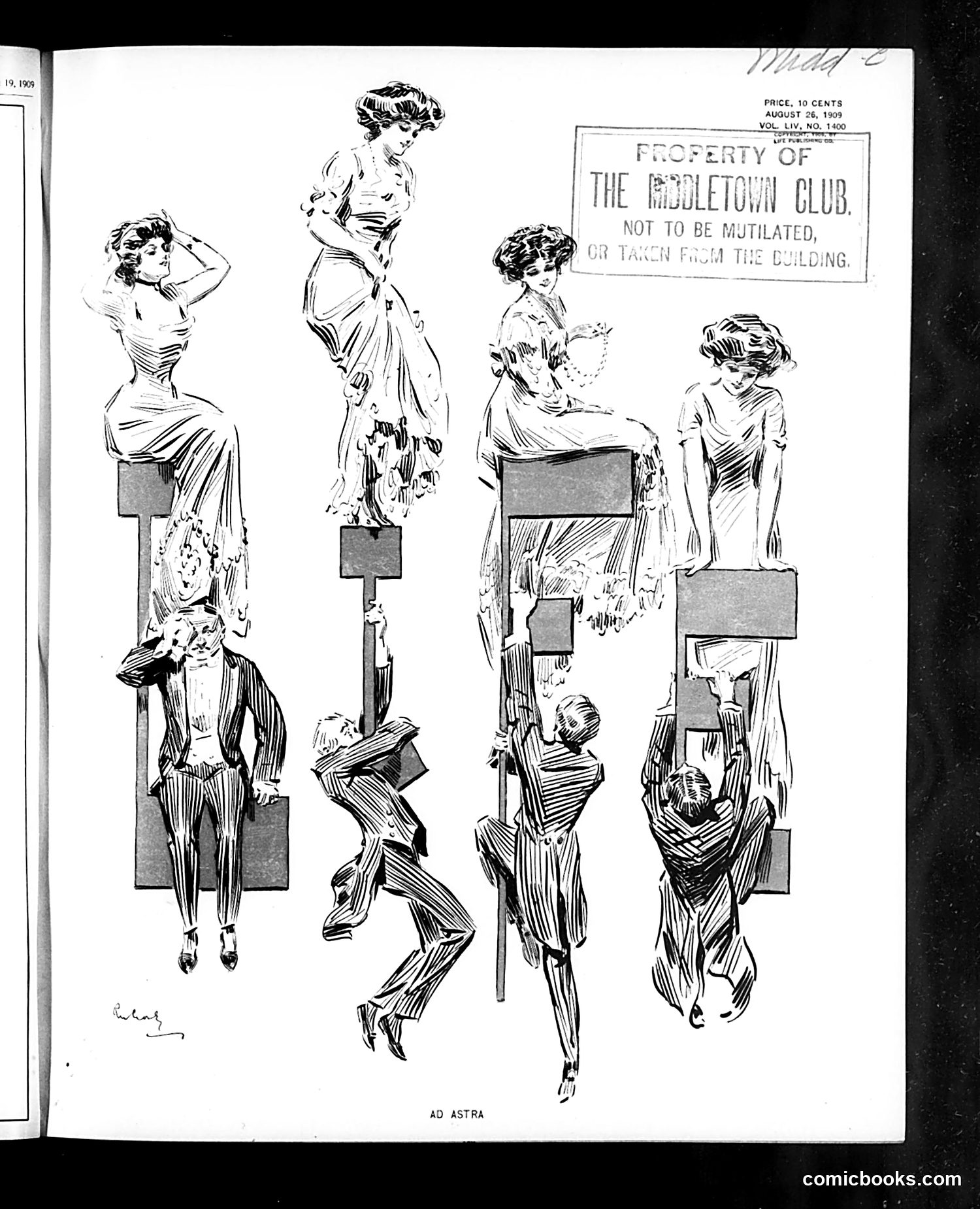
This page from Life magazine (August 26, 1909) is primarily **advertising content** rather than political commentary. It displays four fashion illustrations of women in Edwardian dress, each paired with a man in a suit carrying a large placard or sign. The figures appear to be modeling clothing styles of the period. The stamp marking it "PROPERTY OF THE MIDDLETOWN CLUB" indicates this was a library copy. The caption "AD ASTRA" (Latin: "toward the stars") is the only thematic text, though its specific meaning here is unclear. This represents typical early 20th-century magazine advertising that used illustrated models to showcase contemporary fashion trends. Without additional context or clearer visual details identifying specific figures, the precise satirical intent—if any—cannot be determined.
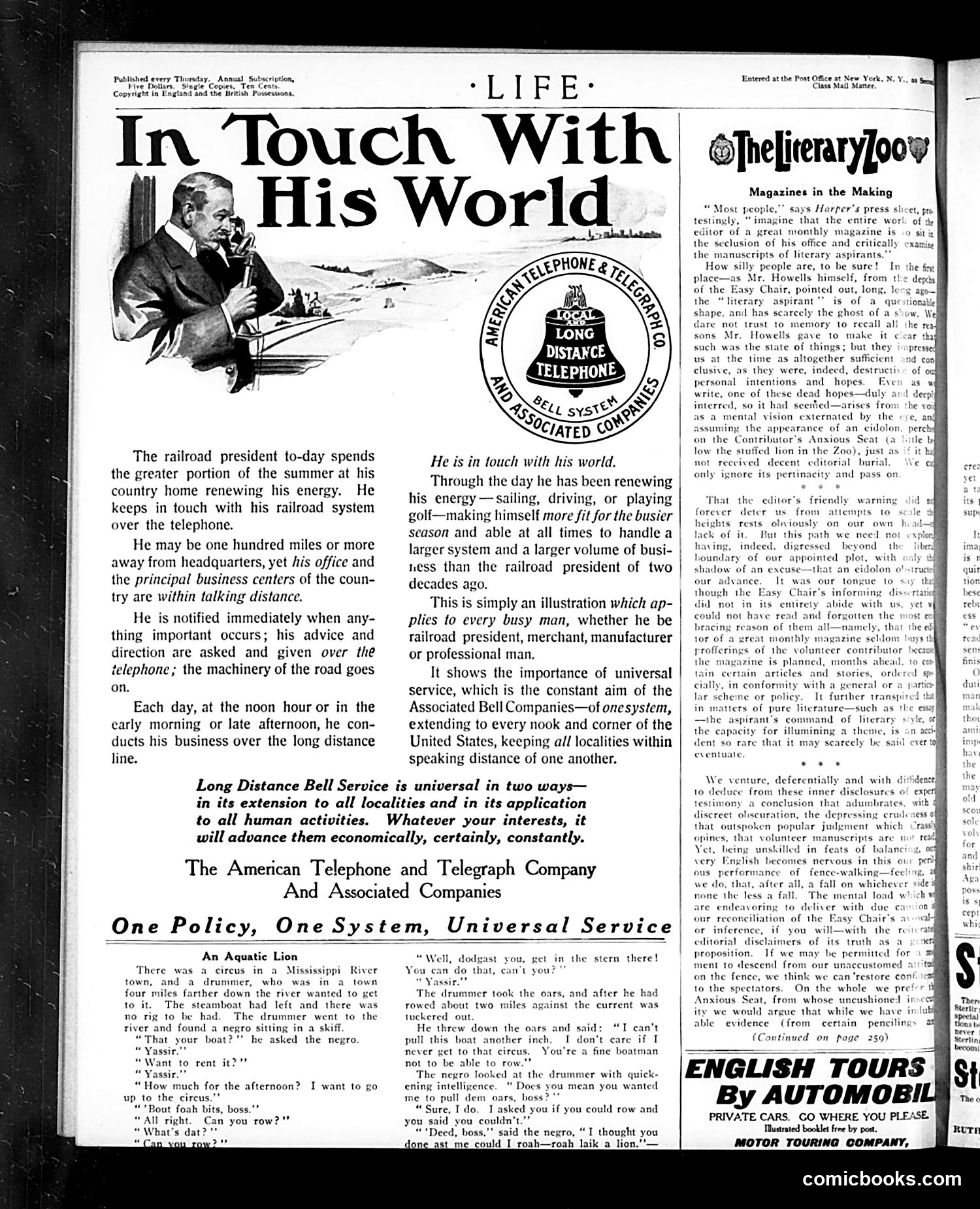
This page is primarily **advertising content**, not satirical editorial material. The main feature is a Bell Telephone System advertisement titled "In Touch With His World," depicting a railroad president conducting business remotely via telephone while at his country home. The advertisement's central message promotes long-distance telephone service as essential infrastructure for business efficiency. It argues that telephone connectivity enables executives to manage operations across distances, using the railroad president as an exemplary figure. The small illustration at bottom—"An Aquatic Lion"—appears to be a humorous anecdote about a drummer and a boatman on the Mississippi River, unrelated to the telephone advertisement. The page reflects early-20th-century corporate messaging emphasizing technological progress and modern business communication.
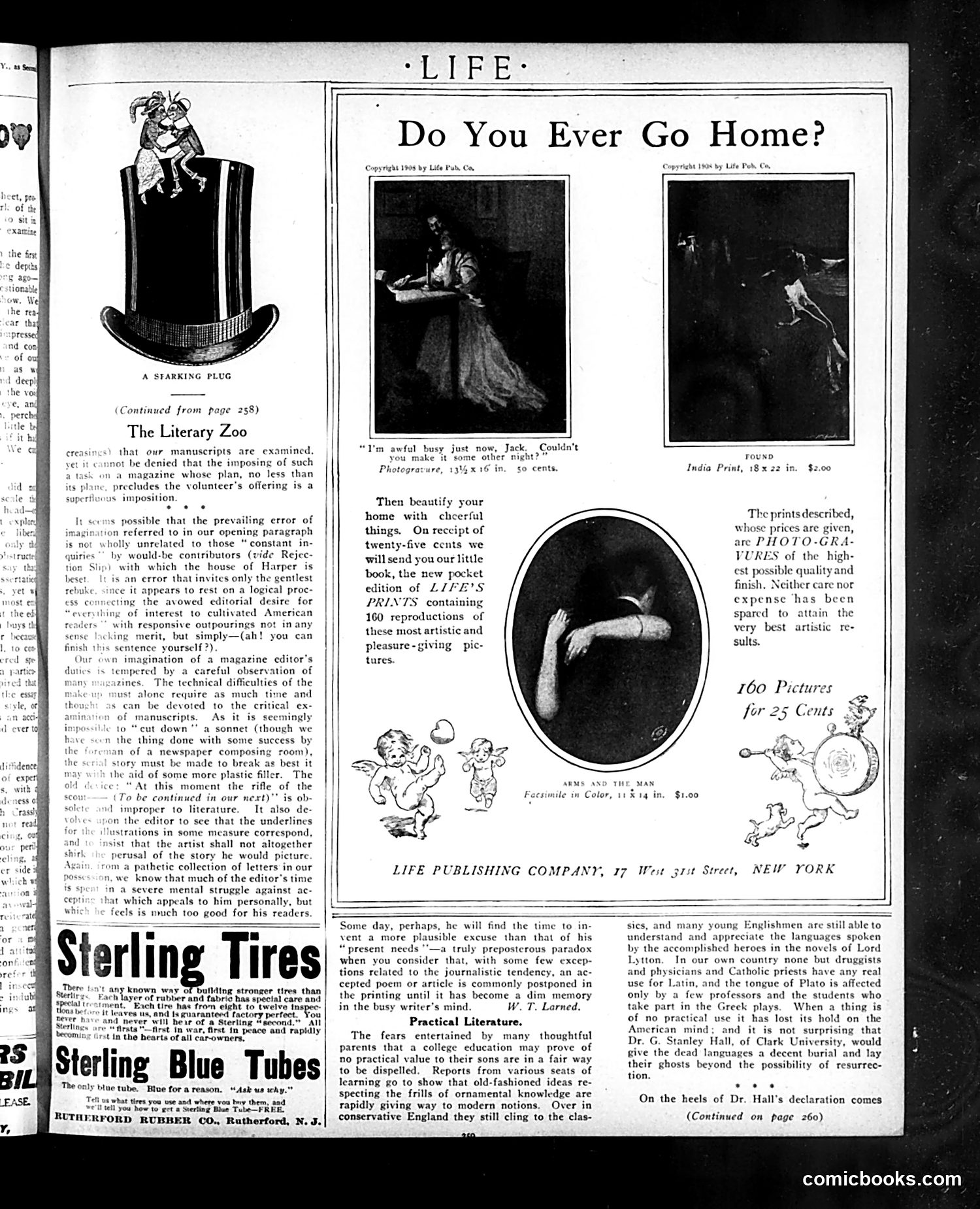
This page is primarily **advertising and editorial content** rather than political satire. The main feature advertises Life Publishing Company's new 25-cent pocket edition of *Life* magazine containing 160 reproductions of "most artistic and pleasure-giving pictures." The top images appear to be **theatrical or literary scenes** — the left shows a woman at a writing desk; the right shows a dramatic pose. The title "Do You Ever Go Home?" likely references the serialized story or literary content within the magazine itself. The page also includes advertisements for **Sterling Tires** and **Sterling Blue Tubes**, using period marketing language about product quality and durability. This represents Life's mid-20th-century function as an upscale magazine blending humor, literature, and advertising for middle-class readers.
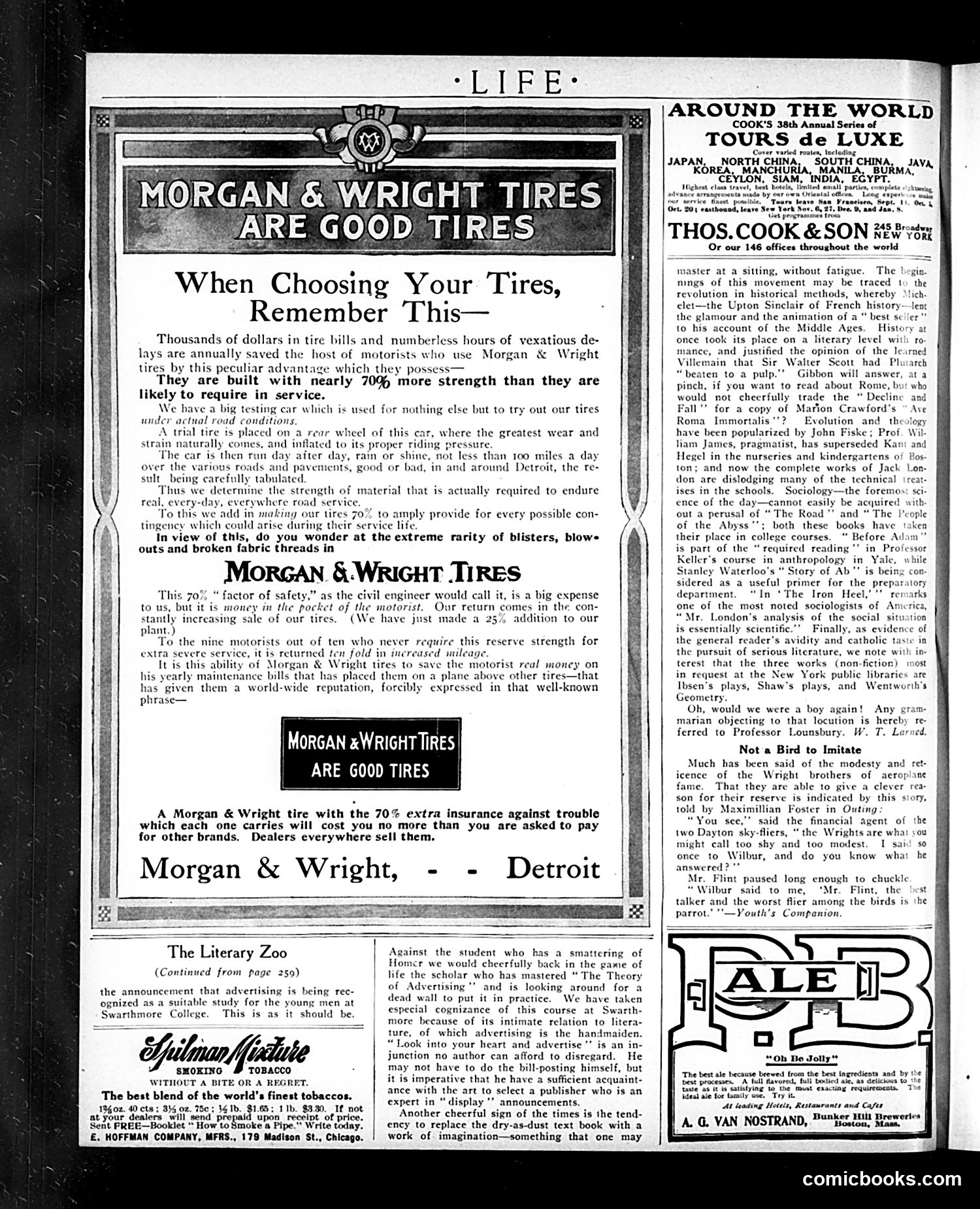
This page is primarily **advertising and editorial content** rather than political satire. The dominant content is a Morgan & Wright Tires advertisement emphasizing the brand's reliability and durability—highlighting their "70% extra insurance against trouble" and claiming their tires require less maintenance than competitors. The ad appeals to motorists by suggesting Morgan & Wright tires save money long-term. The right column contains literary and educational commentary, including discussion of sociology courses and references to literary works. Below are smaller advertisements for Tailman Mixture tobacco and Alep brand products. **No clear political cartoon or satire is visible** on this page. It reflects early 20th-century consumer advertising and magazine editorial content typical of *Life* during this period, mixing commerce with cultural commentary.
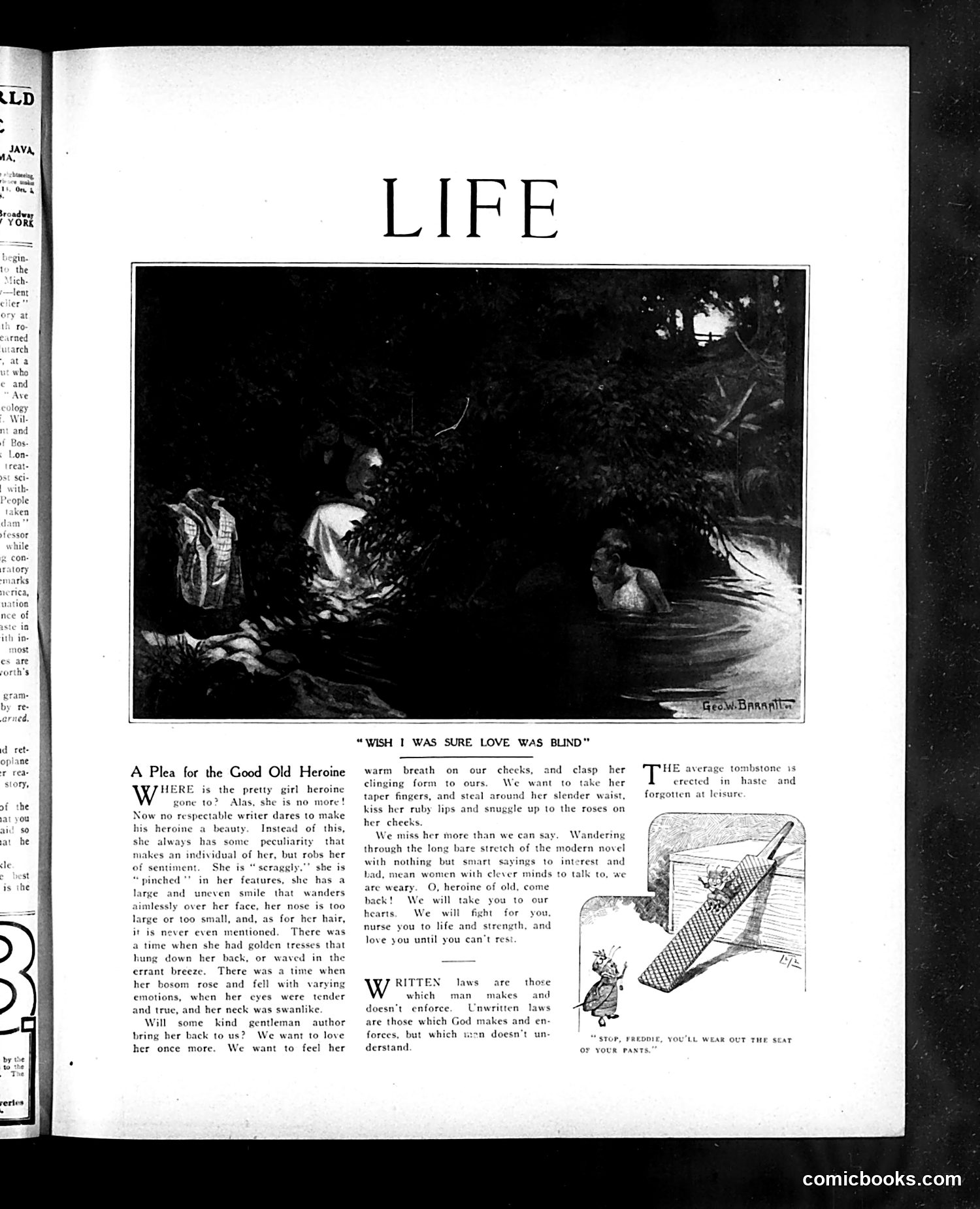
This satirical piece critiques modern literary heroines by nostalgically praising older fictional female characters. The text laments that contemporary heroines lack the idealized qualities of their predecessors—they're described as having peculiar features, ungainly proportions, and being "weary" or difficult. The article argues for a return to traditional heroines: selfless, devoted women who inspire love and devotion rather than critical analysis. It contrasts this with current literature featuring "mean women with clever minds" who are "weary" and unappealing. The accompanying illustration labeled "Wish I Was Sure Love Was Blind" shows a couple by water, humorously depicting the disconnect between romantic ideals and reality. This reflects early 20th-century anxieties about changing female characterization and the perceived loss of feminine ideals in modern fiction.
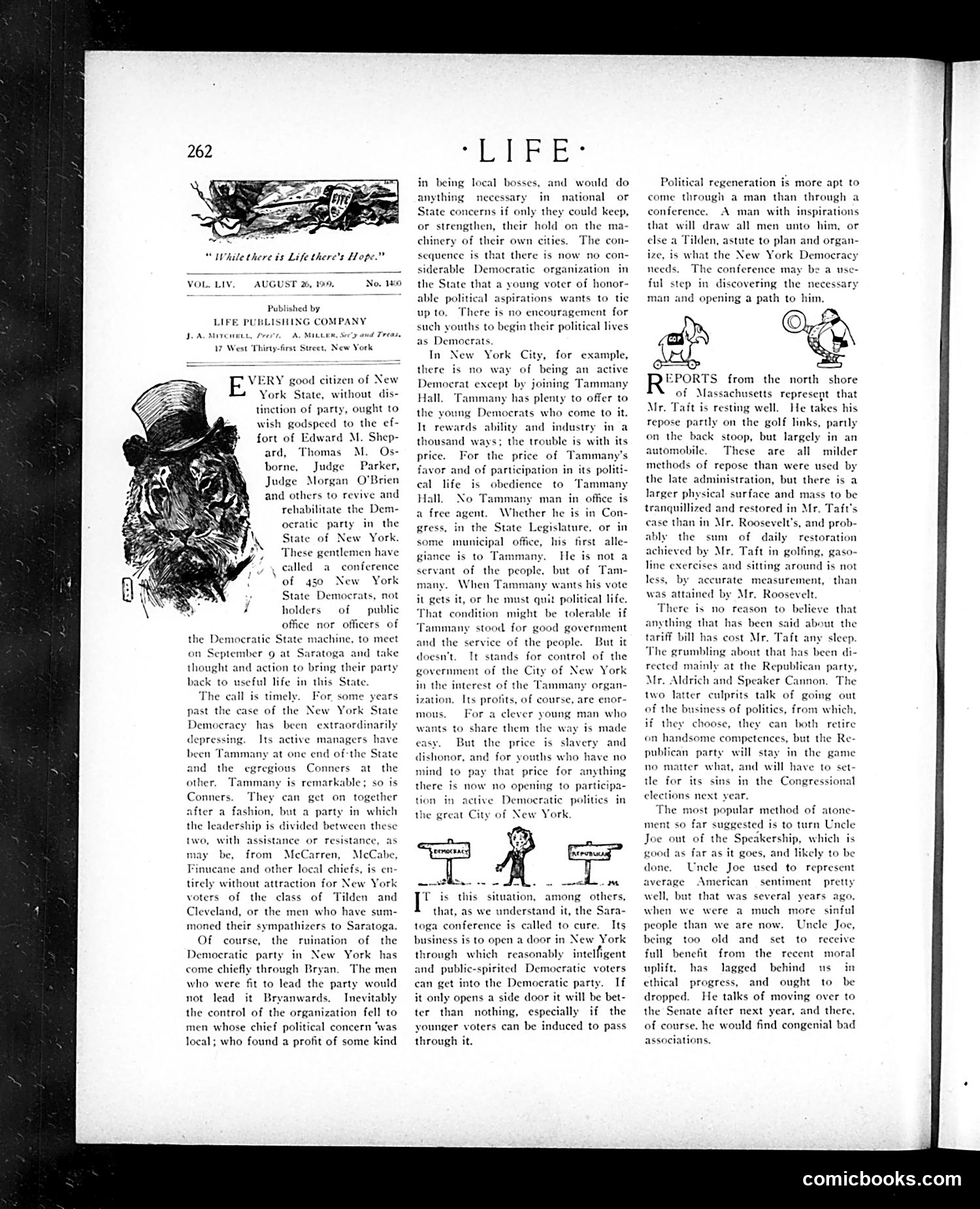
This page critiques Democratic Party leadership in New York State, particularly Tammany Hall's control over Democratic politics. The text argues that young, idealistic Democrats have no real path to political participation except through Tammany Hall, which demands absolute obedience to its bosses. The cartoon appears to show a figure being manipulated like a puppet or controlled by unseen forces—likely representing how Tammany Hall constrains Democratic youth. The accompanying illustrations depict the tension between individual political ambition and organizational control. The satire targets how Tammany Hall's stranglehold on New York Democratic politics prevents genuine democratic participation and reform, forcing aspiring politicians into a corrupt system rather than offering them autonomous political agency.
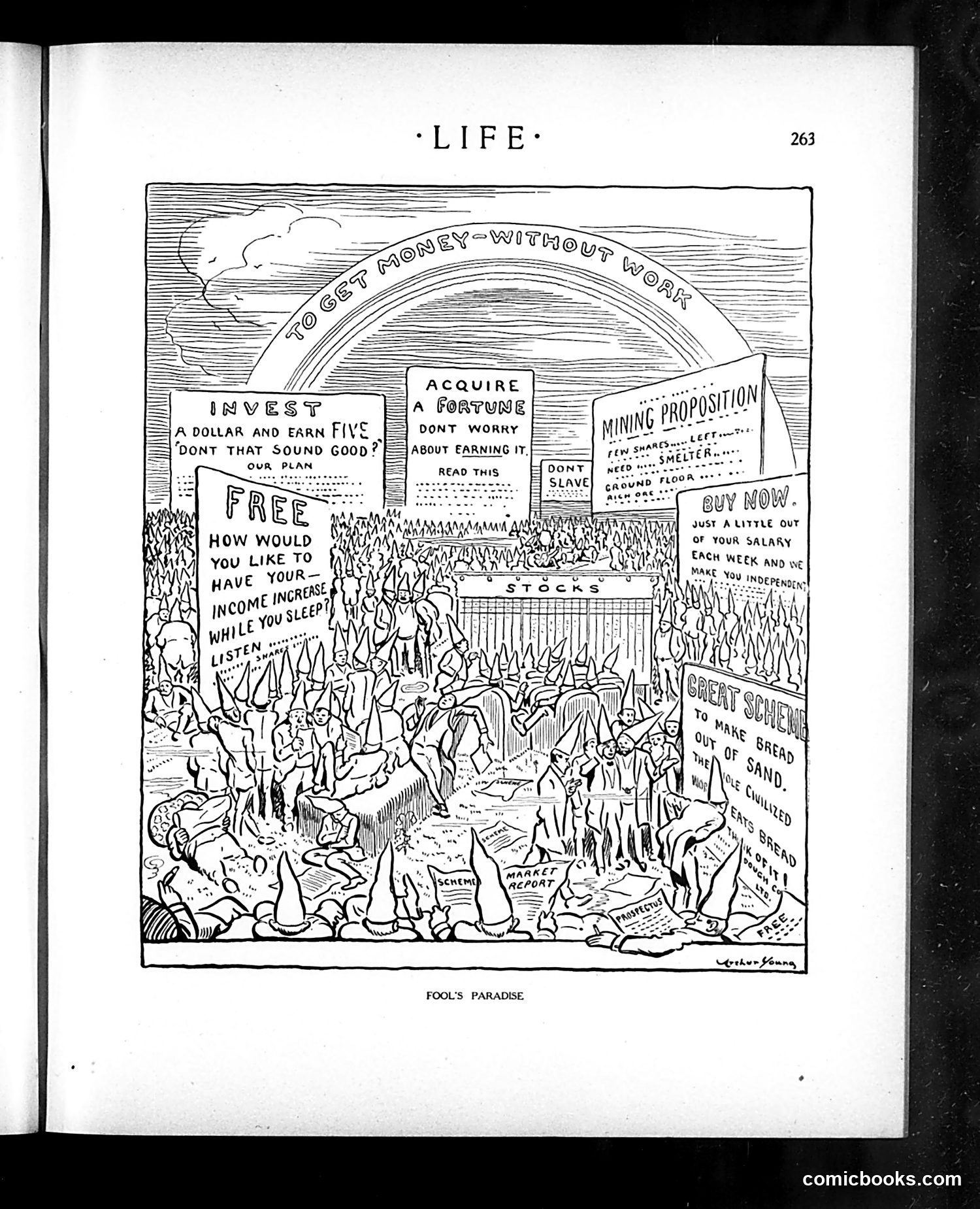
This political cartoon satirizes financial schemes targeting ordinary workers. The image depicts a massive crowd of people gathered around various investment pitches arranged in a circus-like setting. The satire attacks get-rich-quick promises: "Invest a dollar and earn five," "Income increase while you sleep," "Mining proposition," and "Stock" schemes all compete for attention. A rainbow arch promises "To get money without work"—the central absurdity being mocked. The cartoon warns against financial naiveté, depicting citizens as gullible "fools" easily seduced by unrealistic promises of easy wealth. The crowded, chaotic composition emphasizes how widespread such schemes are. This likely reflects post-WWI American anxieties about financial manipulation and the proliferation of fraudulent investment schemes targeting working people during economic uncertainty.
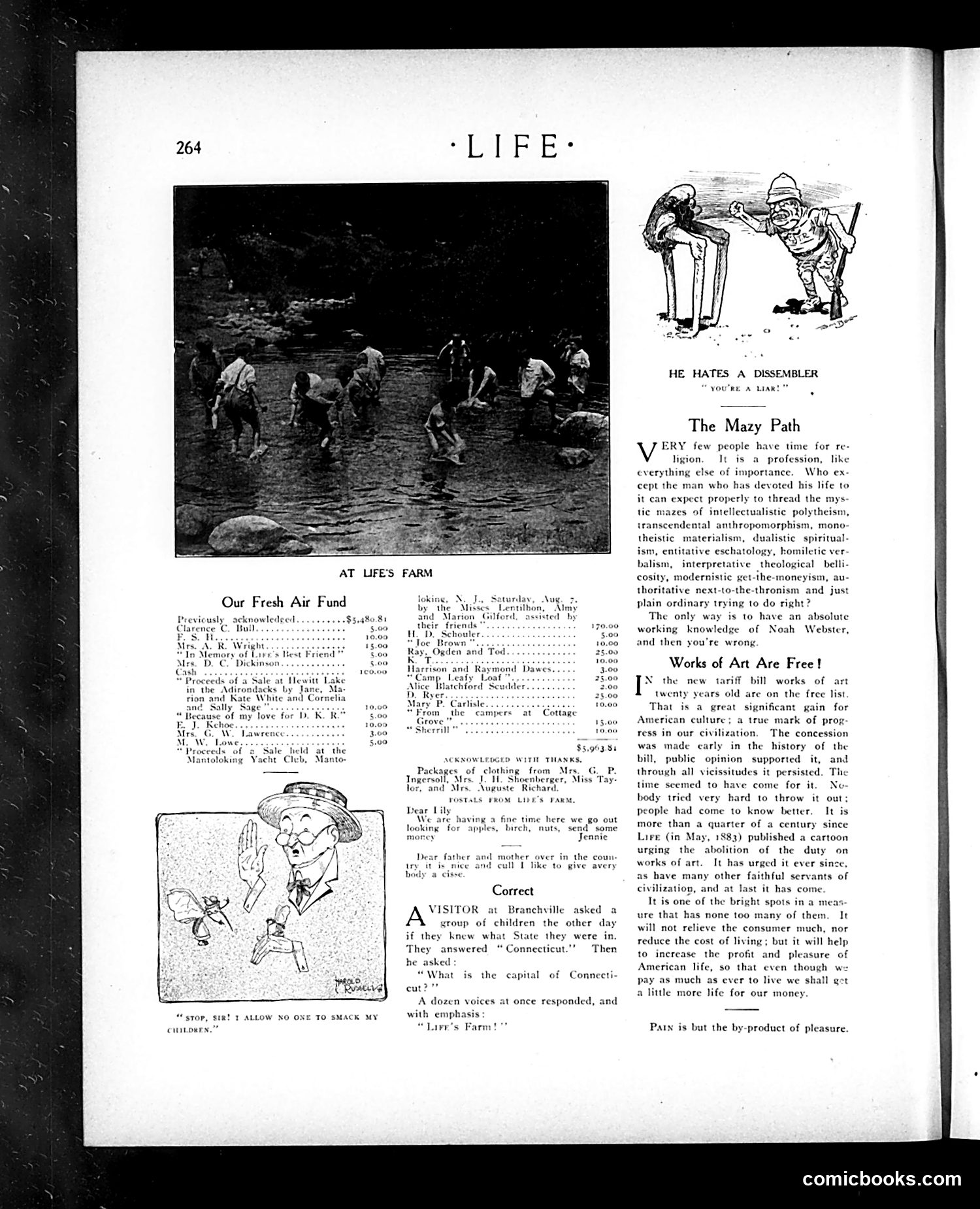
This page contains three distinct elements: 1. **"At Life's Farm" photograph**: Shows people wading in water, likely depicting rural recreation or farm life activities that Life magazine documented. 2. **"Our Fresh Air Fund"**: A charitable fundraising list showing donations collected for sending urban children to the countryside—a common early 20th-century progressive initiative to improve children's health through outdoor exposure. 3. **"Correct" cartoon**: Depicts a visitor asking Connecticut children what state they're in. When told "Liri's Farm," the visitor corrects them—the joke being these children, sent from cities for fresh air, don't know their actual location, only their temporary rural destination. The satire gently mocks both the children's disconnect from geography and perhaps the well-intentioned but somewhat sheltered nature of charitable "fresh air" programs.
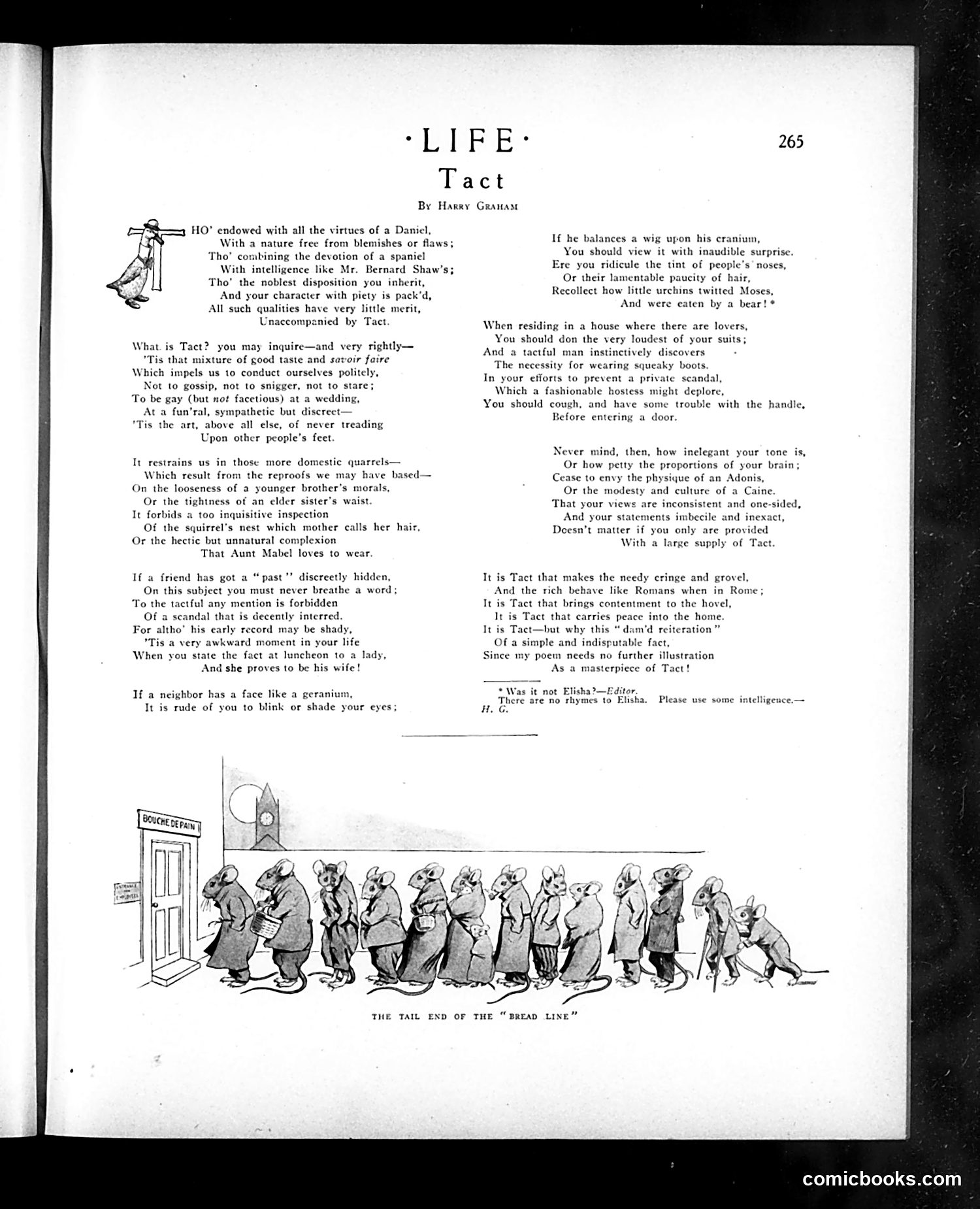
This is a humorous poem about social etiquette and good manners. Graham defines "Tact" as the art of navigating social situations with discretion—avoiding gossip, not mentioning others' physical flaws, and maintaining composure in awkward moments. The cartoon at bottom, captioned "THE TAIL END OF THE 'BREAD LINE,'" depicts a long queue of people (appearing to be unemployed or poor) waiting at what's labeled a "Soup Kitchen." This illustrates economic hardship, likely referencing Depression-era welfare lines. The cartoon contrasts with the poem's focus on upper-class etiquette by showing those struggling to survive—a satirical juxtaposition suggesting that while the wealthy worry about polite behavior, ordinary people face hunger and poverty.
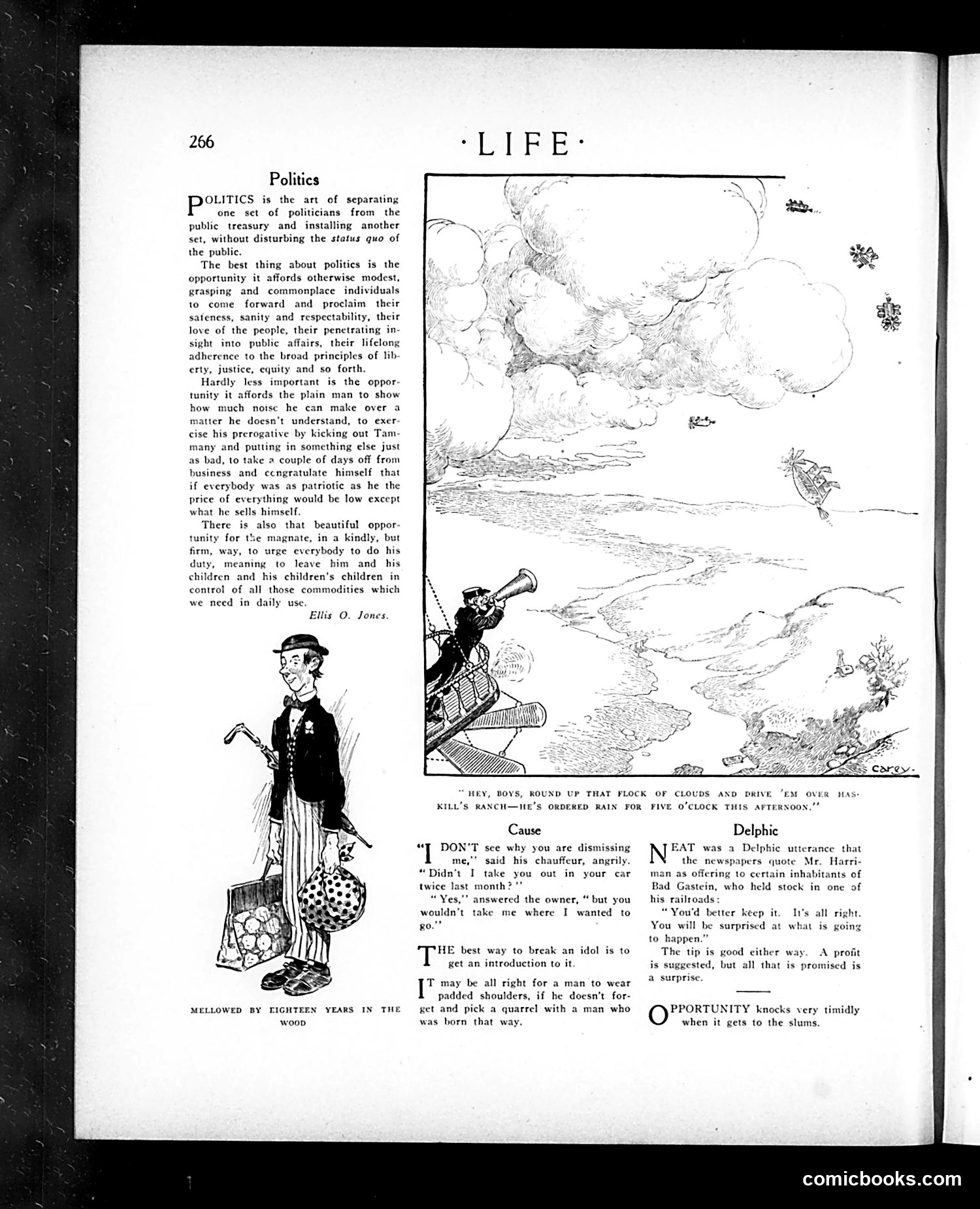
The page features a "Politics" essay by Elis O. Jones defining politics as redistributing public money without disrupting the status quo. The accompanying cartoon depicts a figure labeled "MELLOWED BY EIGHTEEN YEARS IN THE WOOD"—a man with a large belly holding bottles and produce, caricatured as someone who has become complacent and self-interested. The satire suggests that politicians, like fine spirits that age in wooden barrels, become corrupted over time in office. The figure's bloated appearance and possessive clutching of goods implies that long-serving politicians prioritize personal gain over public service—the very hypocrisy the essay describes about politics claiming patriotism while actually serving self-interest. The joke: political experience breeds moral decay.
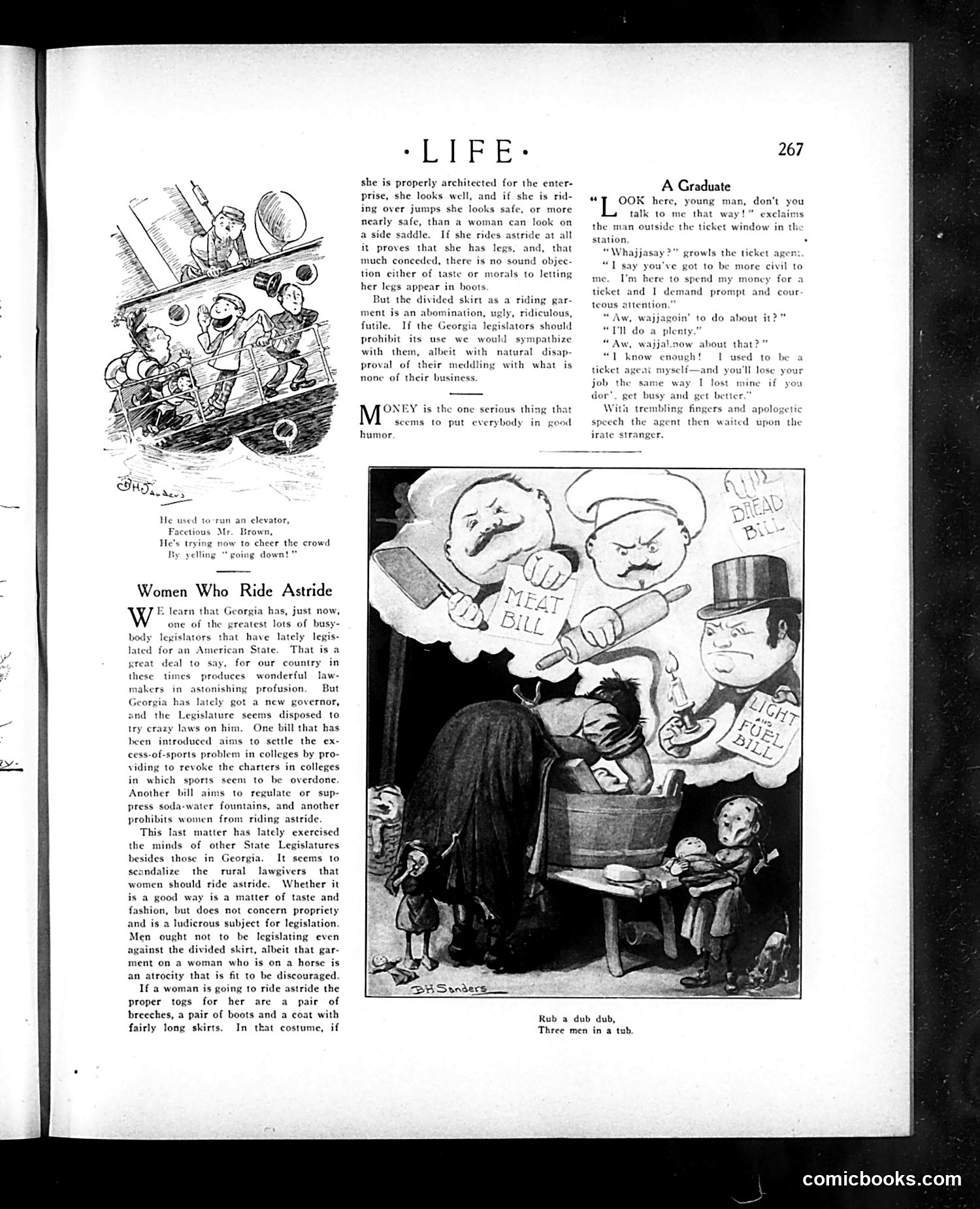
This page contains two distinct pieces of satire: **"A Graduate"** (top right) mocks a ticket agent's condescending interaction with a young man, suggesting the agent thinks the graduate is naive or foolish about purchasing train tickets—poking fun at generational or class attitudes. **"Women Who Ride Astride"** (bottom) criticizes Georgia legislators attempting to ban women from riding horses in divided skirts. The accompanying cartoon shows angry men (labeled with "MEAT BILL," "BREAD BILL," "FUEL") drowning under women's concerns, suggesting lawmakers are absurdly prioritizing trivial restrictions on women's attire over serious economic issues. The satire condemns both the legislative proposal and rural lawmakers' apparent obsession with controlling women's clothing.
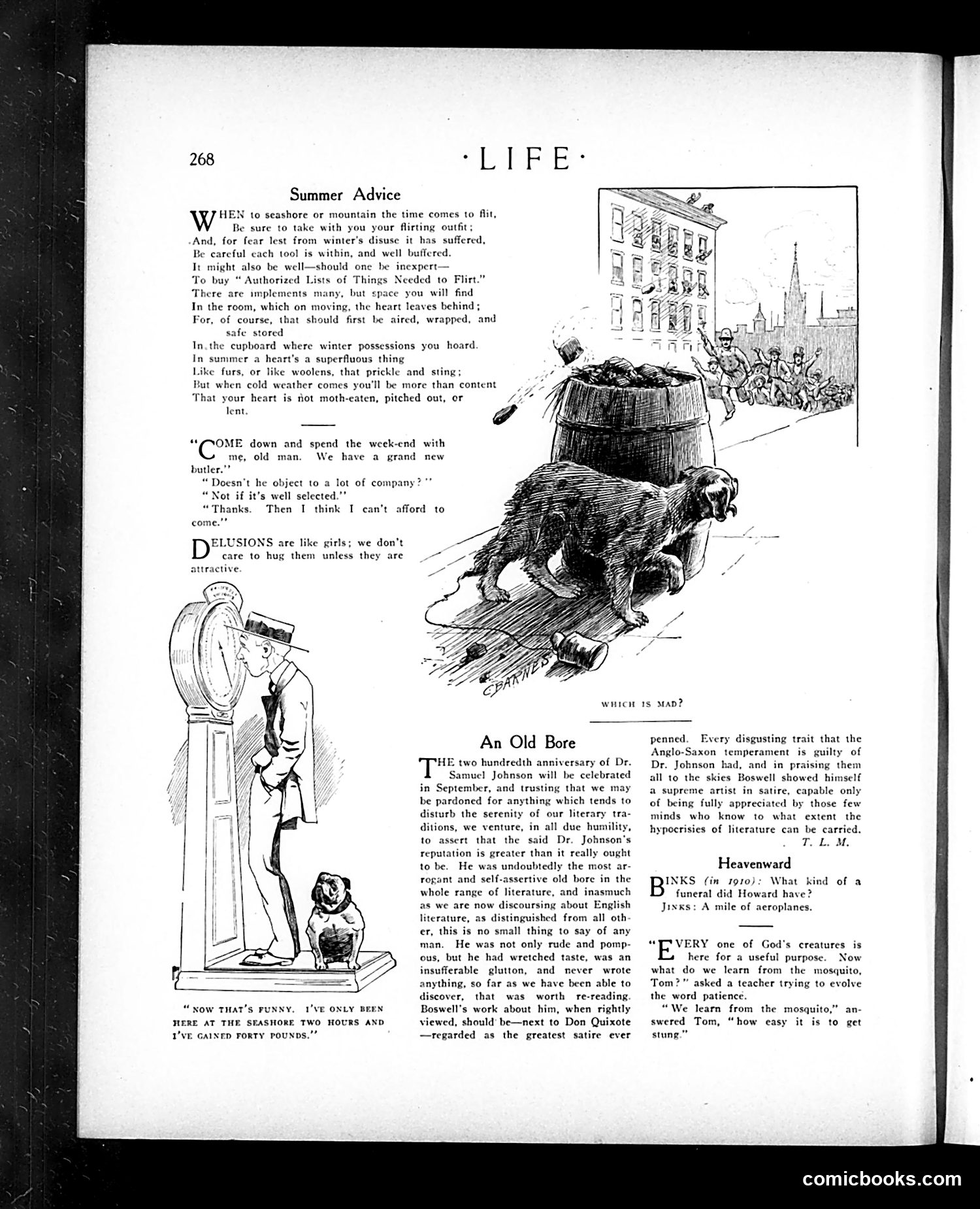
The main cartoon depicts a dog pulling a heavily-laden barrel or container up a steep street toward a city building—the caption asks "WHICH IS MAD?" This appears to be visual satire about the absurdity of summer burdens or preparations. The text sections offer humorous "advice" about seaside travel and flirting, written in mock-serious verse. Below, there's commentary on Dr. Samuel Johnson's approaching bicentennial (noted for September), praising his satirical work while admitting his reputation as a "rule and pompous" bore. The joke centers on Johnson being simultaneously celebrated as a great literary figure yet acknowledged as insufferably tedious—a contradiction the author finds amusing rather than damning. The small illustration of "An Old Bore" with a clock shows the stereotype humorously.
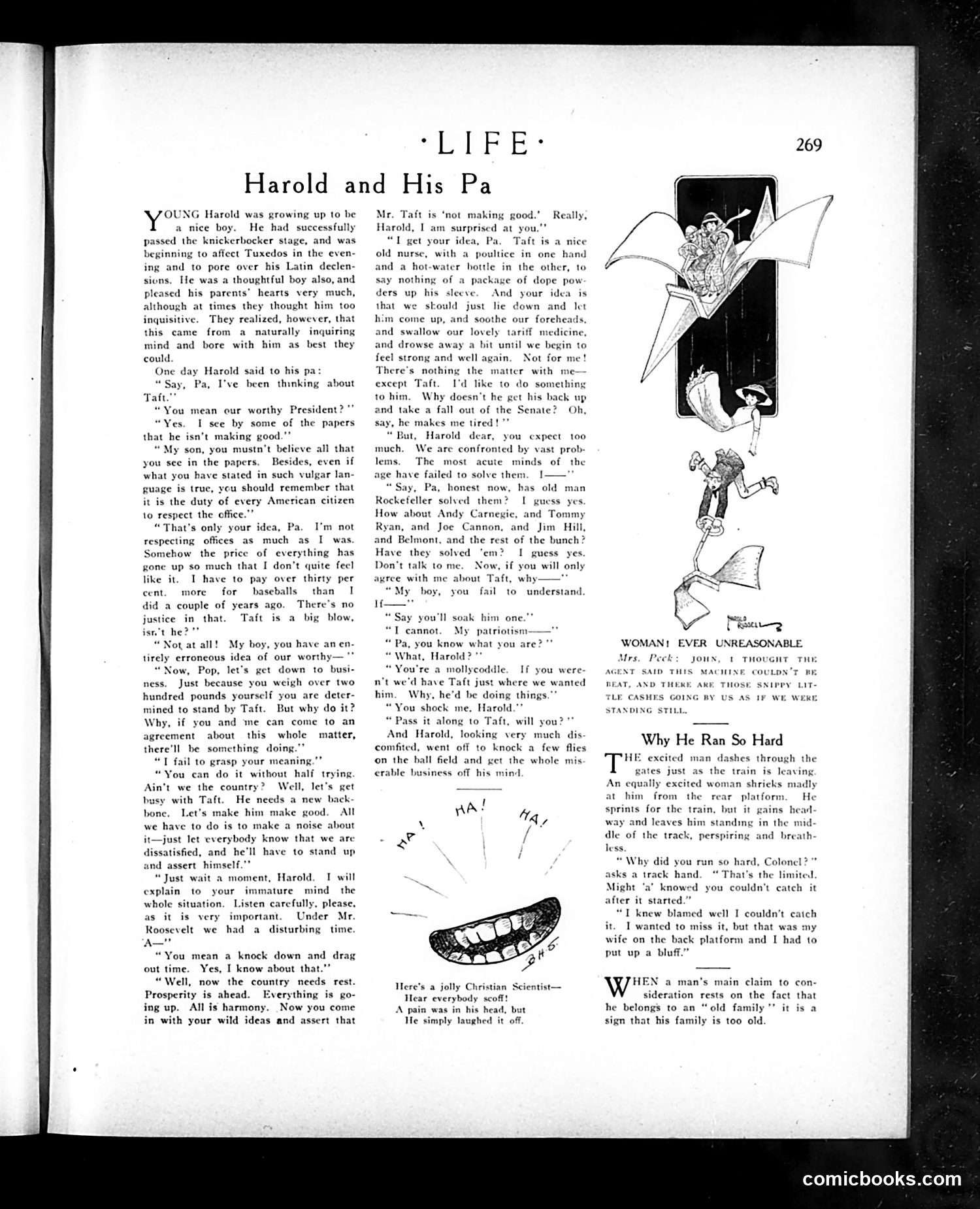
This page contains two separate stories. The main article, "Harold and His Pa," depicts a conversation between young Harold and his father about President Taft, who "is not making good." The father defends Taft against Harold's criticism, arguing the presidency involves vast problems beyond one man's control. He lists prominent figures (Rockefeller, Carnegie, Ryan, Hill, Belmont) as examples of powerful men also struggling with problems. The cartoon titled "Woman! Ever Unreasonable" satirizes a woman's illogical complaint to her husband, suggesting she's being irrational. Below is a brief story, "Why He Ran So Hard," about a man fleeing a train platform. The page appears designed to present political and social commentary through fictional domestic dialogue and humor typical of early 20th-century Life magazine.
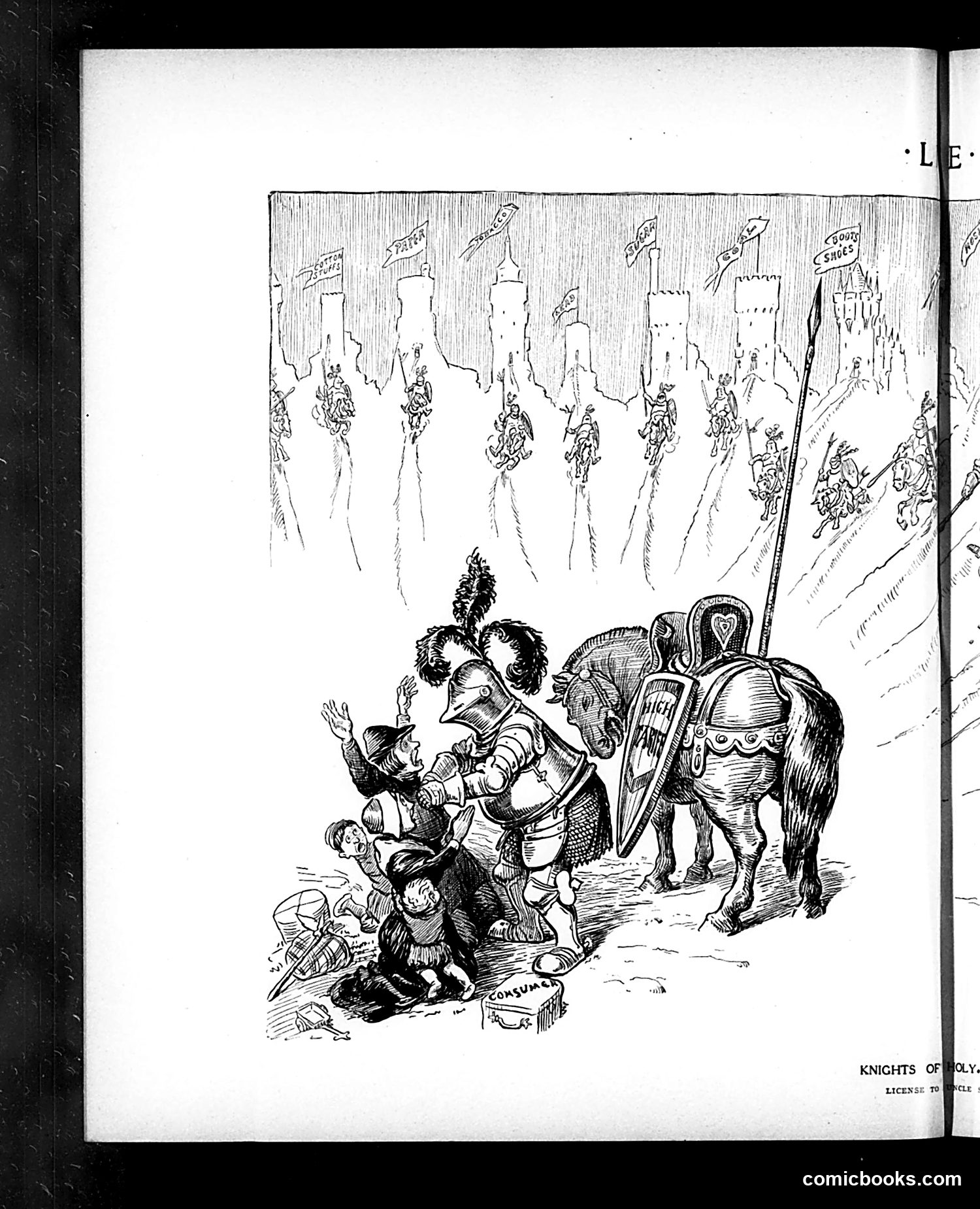
This cartoon depicts a medieval knight on horseback looming over small figures below, with castle towers visible in the background. The title "Knights of [unclear]" and reference to "License To [unclear]" suggests satire about authority figures or monopolistic power. The massive armored figure towering over diminutive people appears to satirize an imbalance of power—likely critiquing wealthy industrialists, corrupt officials, or monopoly holders who wielded disproportionate control during the Gilded Age or Progressive Era. The medieval imagery may mock these figures as feudal lords oppressing common citizens. The exact political target remains unclear from the visible text, but the visual metaphor is unmistakable: those holding power operate under a different set of rules ("license") than ordinary people below them.
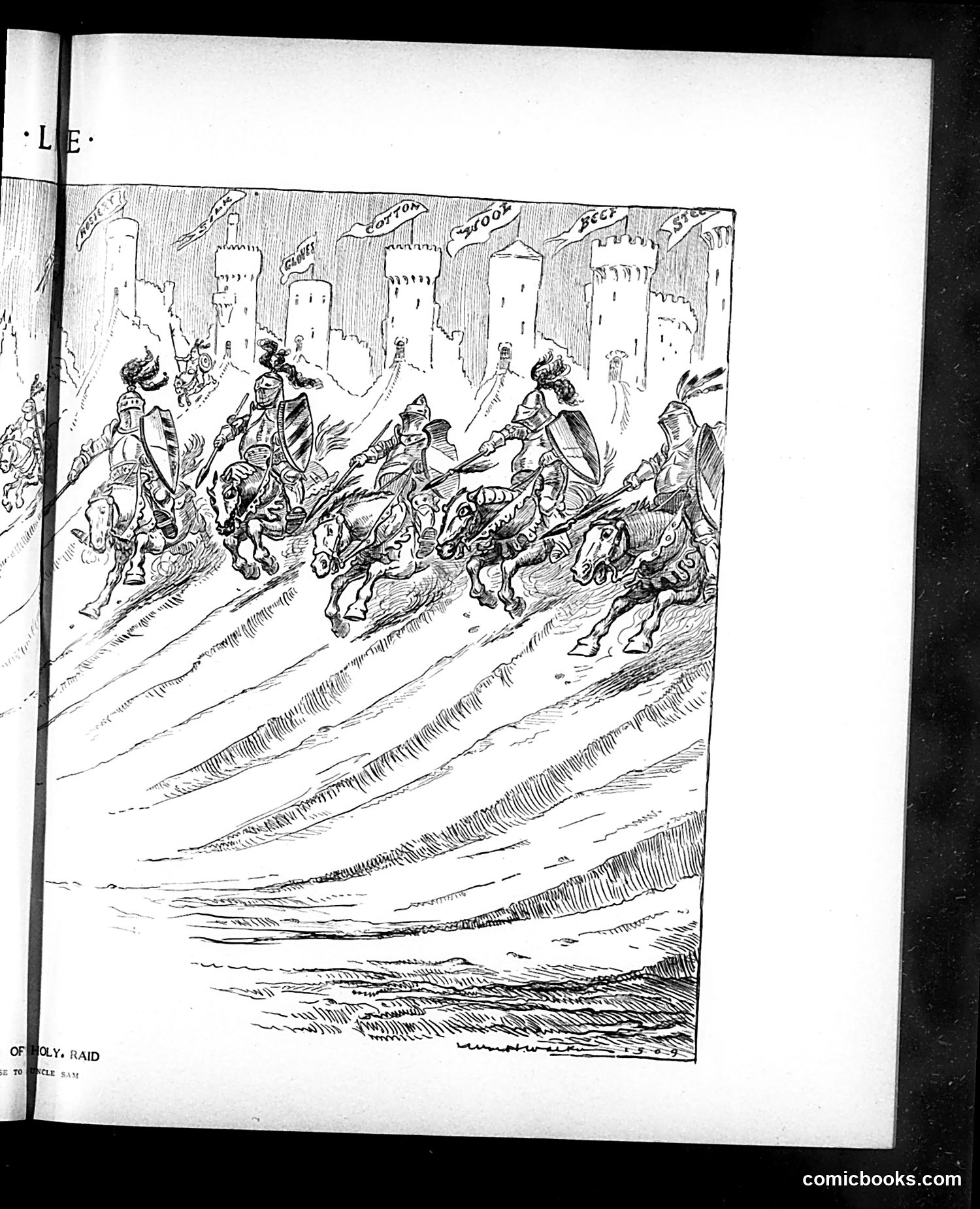
This illustration depicts a medieval military raid scene with armored knights on horseback attacking a fortified castle. The OCR text mentions "OF MOLLY. RAID," though the complete caption is unclear due to image quality. The cartoon appears to be satirizing a contemporary political or military event through historical allegory—a common technique in *Life* magazine. By depicting modern conflicts in medieval terms, the artist comments on the nature of the action (perhaps questioning its justification or characterizing it as barbaric or outdated). Without a clear, readable caption, I cannot definitively identify which specific "raid" or political figures are being referenced. The style and presentation suggest early-to-mid 20th century American political satire, but the exact target remains uncertain from this image alone.
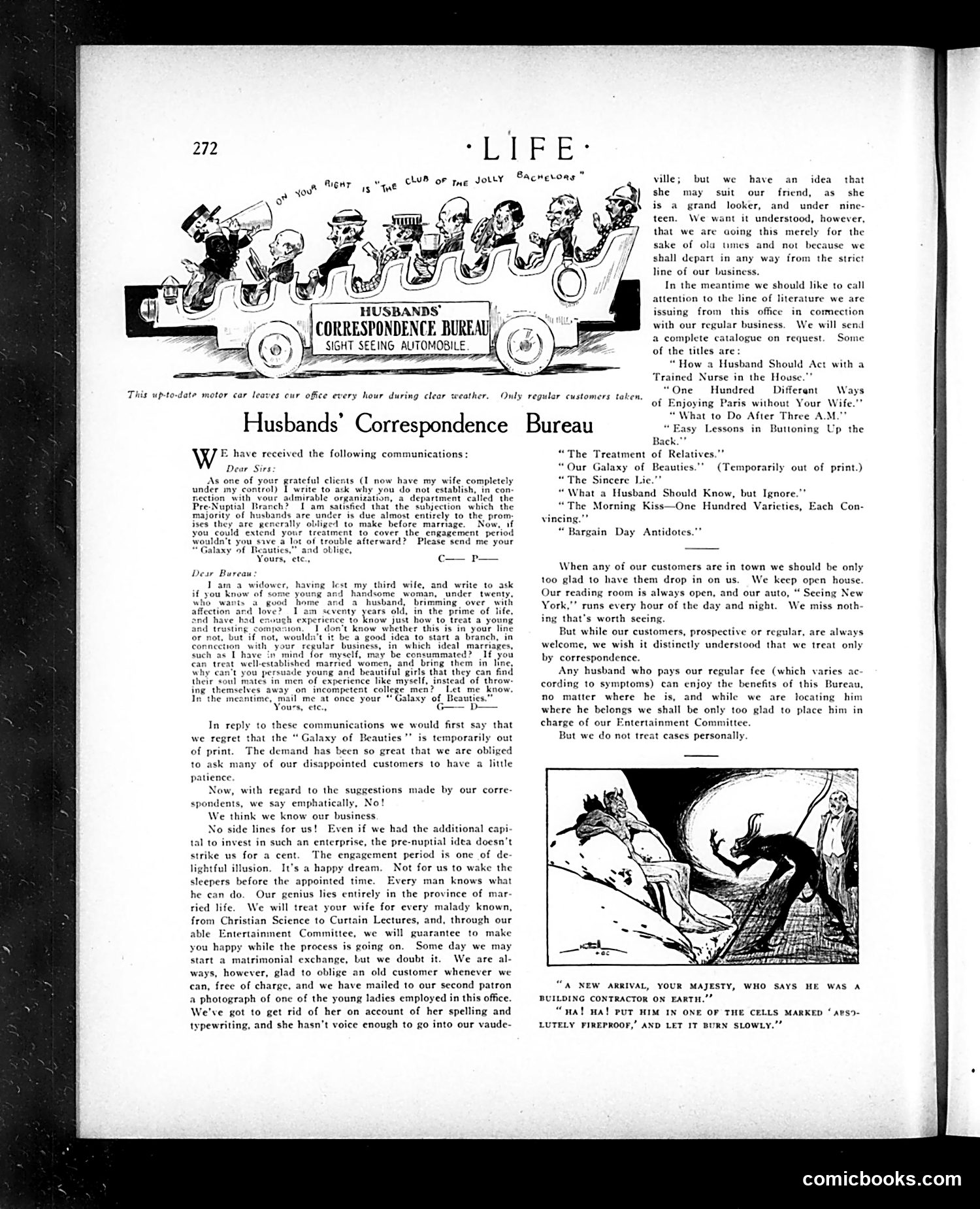
This satirical piece mocks turn-of-the-century attitudes toward marriage and male infidelity. The "Husbands' Correspondence Bureau" is a fictional service offering married men various entertainments and companion services—a thinly veiled escort operation. The automobile illustration shows husbands enjoying an outing labeled "the club of the jolly bachelors," suggesting married men seek to recapture bachelor freedom. The letters parody actual customer requests: one asks for a "pre-nuptial branch" to control fiancées before marriage; another—a 70-year-old widower—seeks a young bride under twenty, revealing predatory age-gap expectations of the era. The bureau's satirical response advertises publications like "Enjoying Paris without Your Wife" and "Easy Lessons in Buttoning Up the Back," mocking how husbands treat marriage as a trap to escape rather than a partnership. The joke exposes the hypocrisy and misogyny embedded in contemporary marriage culture, where men openly sought ways to evade spousal company and companionship.
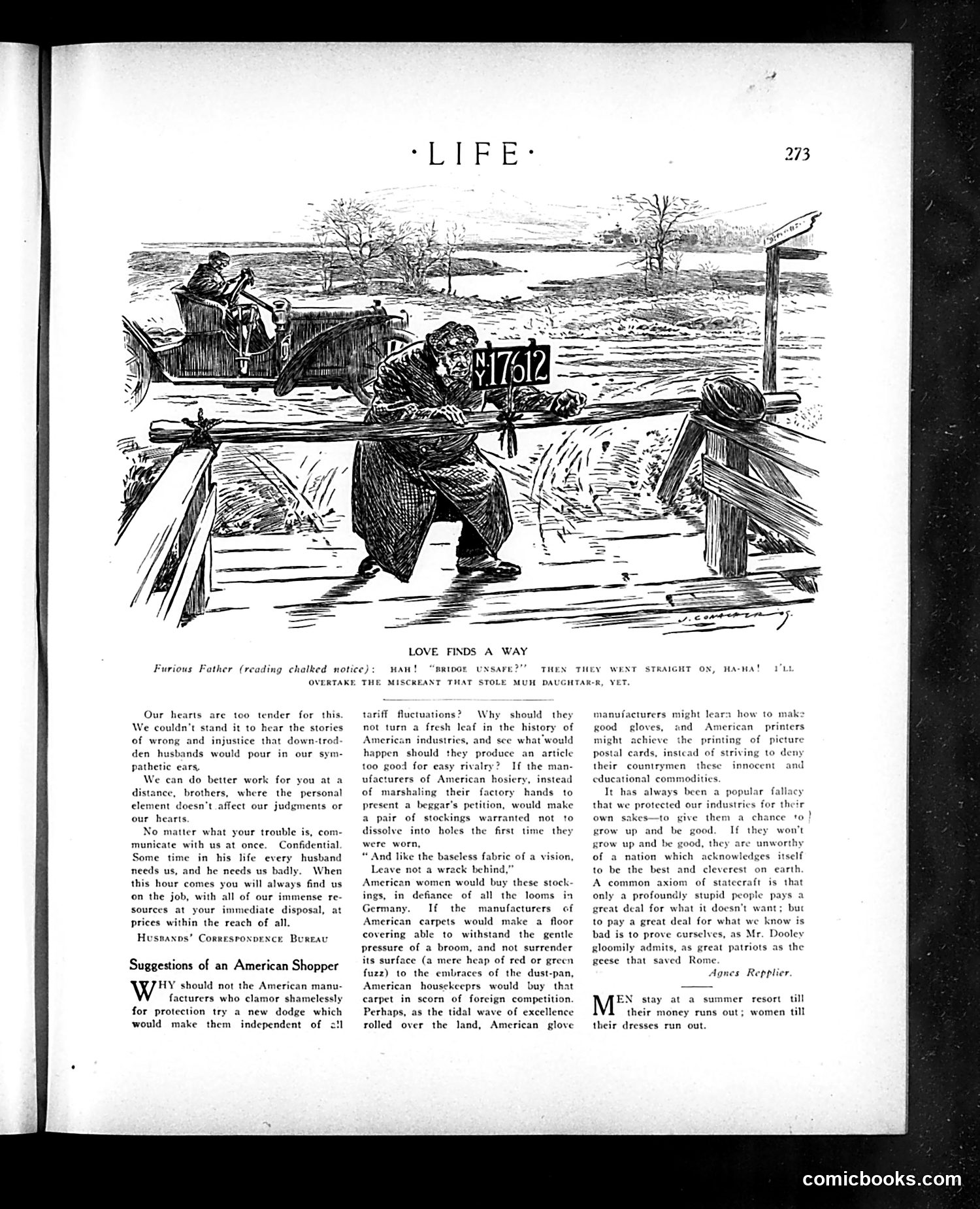
This cartoon satirizes a "Furious Father" discovering his daughter has eloped with an unsuitable suitor (marked "1712," possibly indicating a disreputable character or debt). The father, reading a "chalked notice," pursues them in a car while the couple escapes by jumping a fence—hence the caption's ironic title: love overcomes paternal objections. The accompanying editorial pieces mock American business and gender relations. "Suggestions of an American Shopper" criticizes domestic manufacturers who demand tariff protection yet produce inferior goods (hosiery that dissolves, carpets that shed). The author argues American companies should improve quality rather than lobby Congress. The final snippet mocks consumer habits: men exhaust money at resorts; women exhaust their wardrobes—a period stereotype about female materialism. The overall tone is characteristic of *Life's* early-20th-century satirical stance: pro-consumer, skeptical of protectionism, and lightly misogynistic.
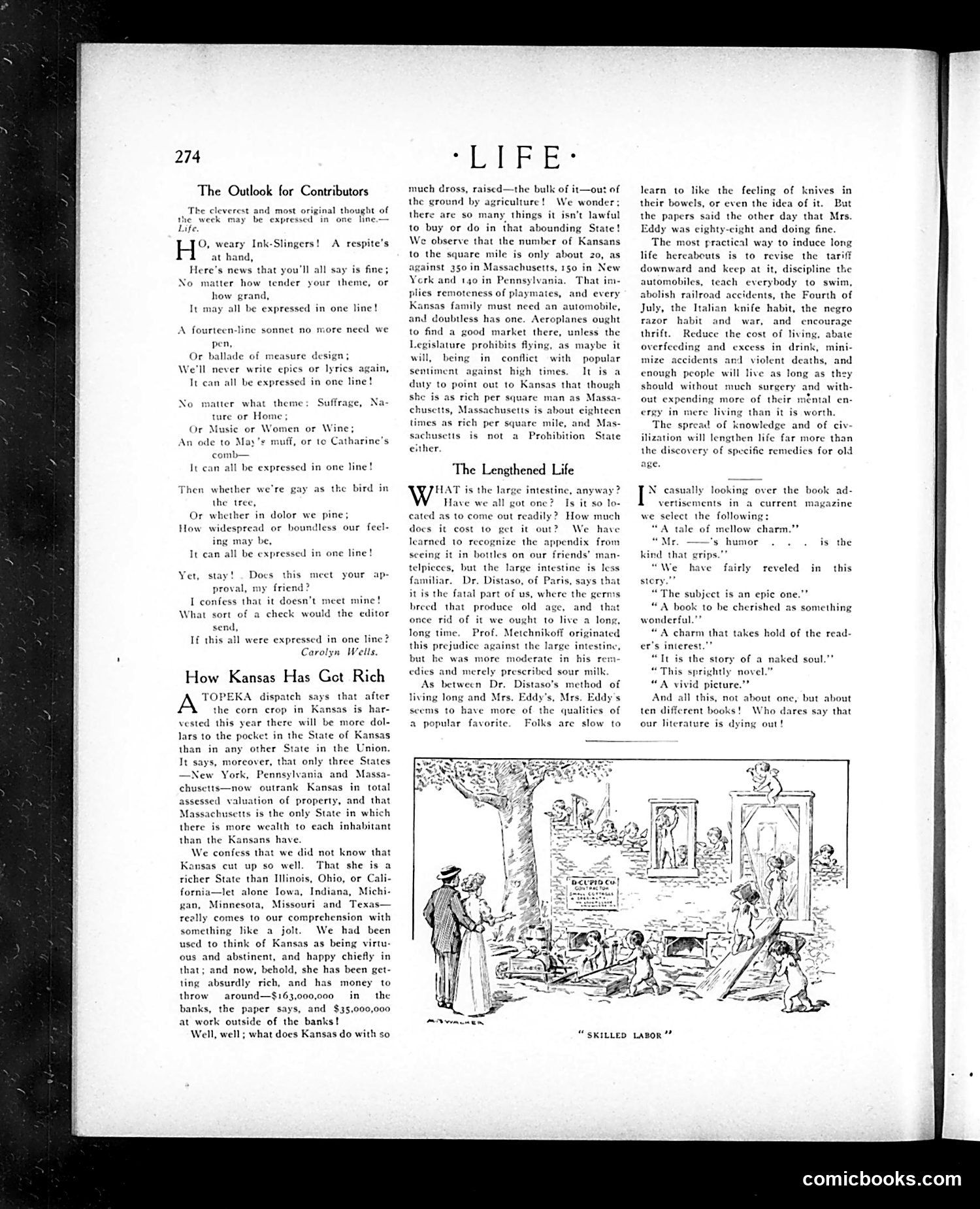
This page contains satirical commentary on contemporary American issues circa 1910s. **"The Outlook for Contributors"** (top): A humorous poem by Carolyn Wells mocking Life magazine's editorial constraints. Writers complain that complex themes—suffrage, romance, philosophy—must be reduced to single-line submissions. The satire targets both the magazine's penny-pinching (implying editors won't pay for longer pieces) and the era's trend toward brevity in mass media. **"How Kansas Has Got Rich"** (left): Commentary on Kansas's unexpected wealth from agricultural corn production. The satire lies in the contradiction: Kansas is prosperous yet restrictive ("Prohibition State"), so what does it do with its money? The piece mocks Kansas's puritanical reputation versus its newfound riches, questioning whether a state that prohibits alcohol and "high times" can sensibly spend $163 million. **"The Lengthened Life"** (right): Satirizes contemporary medical fads. French doctor Distaso claims the large intestine causes aging; removing it extends life. The satire questions this dubious claim while acknowledging earlier theorist Metchnikoff's similar (but more moderate) ideas about intestinal health and longevity—poking fun at pseudo-scientific health trends.
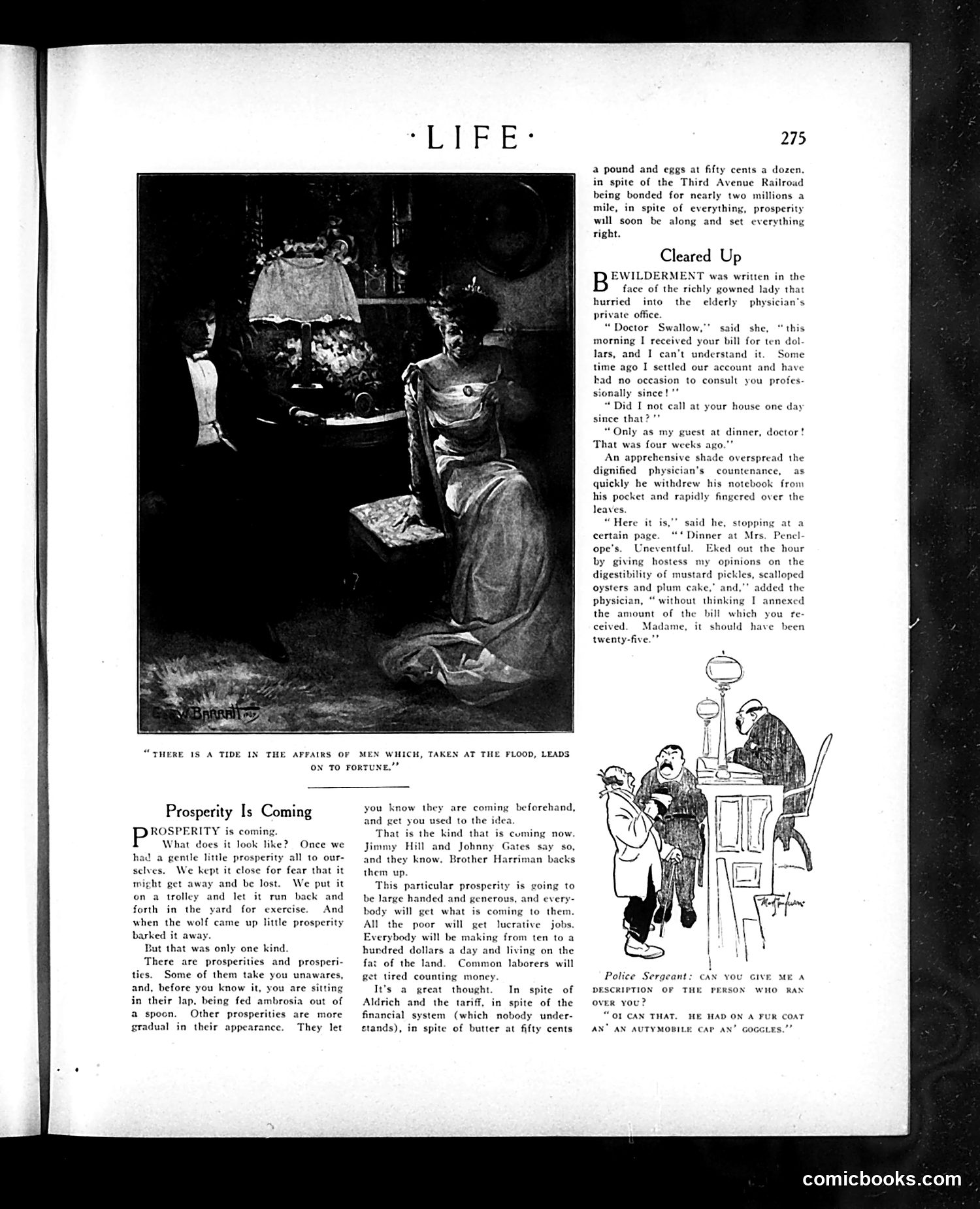
This page contains two satirical pieces reflecting early 20th-century American concerns: **"Prosperity Is Coming"** mocks optimistic predictions of economic boom by prominent figures (Jimmy Hill, Johnny Gates, and Brother Harriman appear to be contemporary business/political leaders). The satire undercuts their promises—despite real hardships (expensive butter at fifty cents, railway over-bonding, tariff disputes under Aldrich)—by suggesting prosperity will magically "set everything right" without addressing systemic problems. It's cynical commentary on unfounded economic optimism. **"Cleared Up"** is a doctor-patient billing joke: a wealthy woman questions a ten-dollar charge for a dinner visit where the doctor merely socialized. His notebook reveals he billed her for "opinions on digestibility" of foods—satirizing medical professionals padding bills for non-professional services disguised as medical advice. The bottom cartoon about an automobile accident victim with humorous description reflects early-automobile-era novelty and class markers (fur coat, goggles).
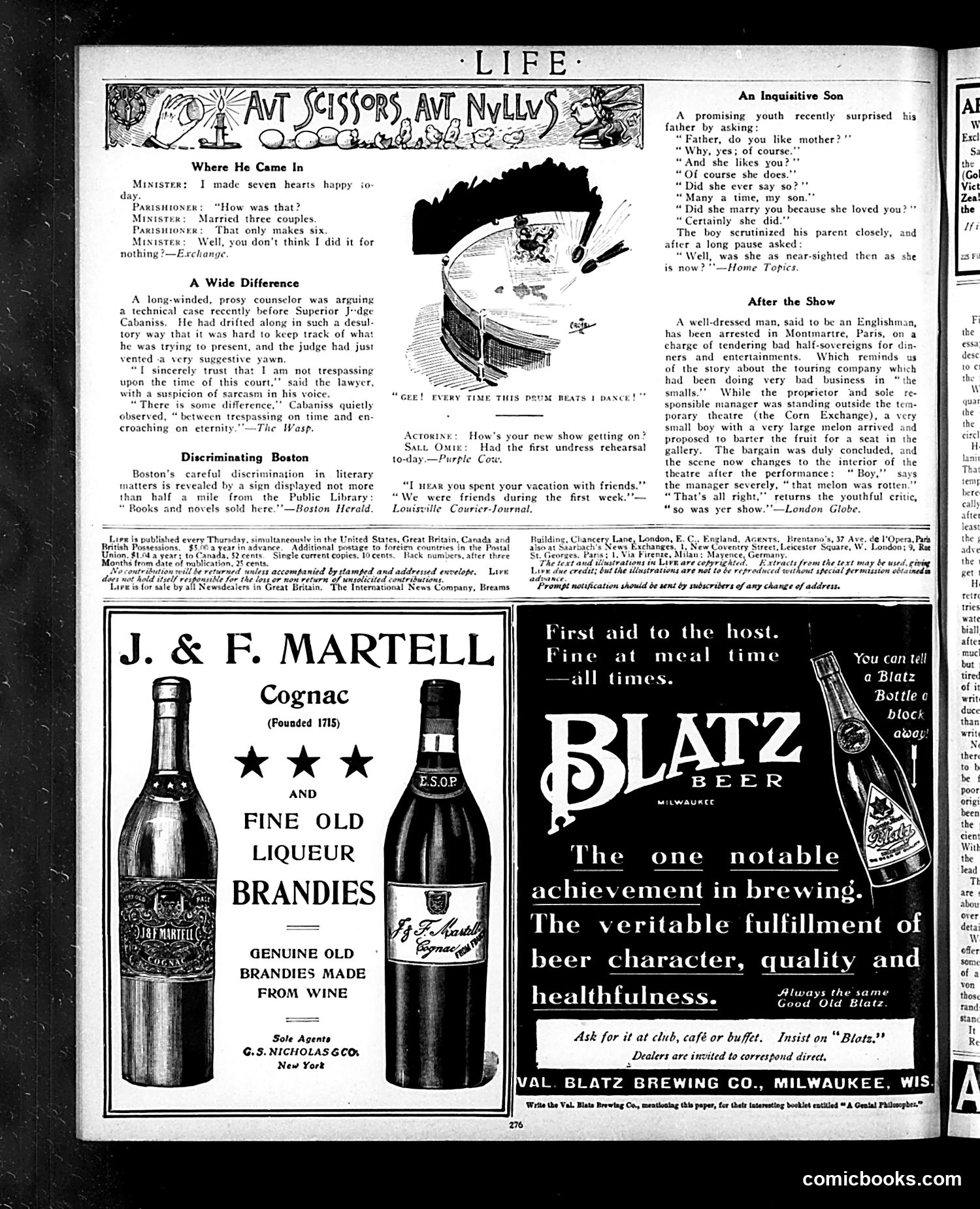
This page contains **multiple short humorous anecdotes and advertisements** rather than a single cartoon. The jokes mock human nature and logic: - **"Where He Came In"**: A minister claims credit for making "seven hearts happy" by marrying three couples—the joke being his self-serving arithmetic (counting himself). - **"A Wide Difference"**: A judge rebukes a long-winded lawyer by distinguishing between wasting court time versus "encroaching on eternity"—mocking verbose legal arguments. - **"An Inquisitive Son"**: A boy discovers his mother married his father despite not actually liking him, asking if she was "near-sighted"—satire on romantic delusions in marriage. - **"After the Show"**: A touring theater company receives criticism from a boy who traded a rotten melon for admission, who says the show was equally bad—mutual mediocrity. The page also contains period **advertisements for J. & F. Martell Cognac and Blatz Beer**, typical of Life's revenue model. These anecdotes represent the magazine's satirical approach to middle-class social pretensions and human foibles.
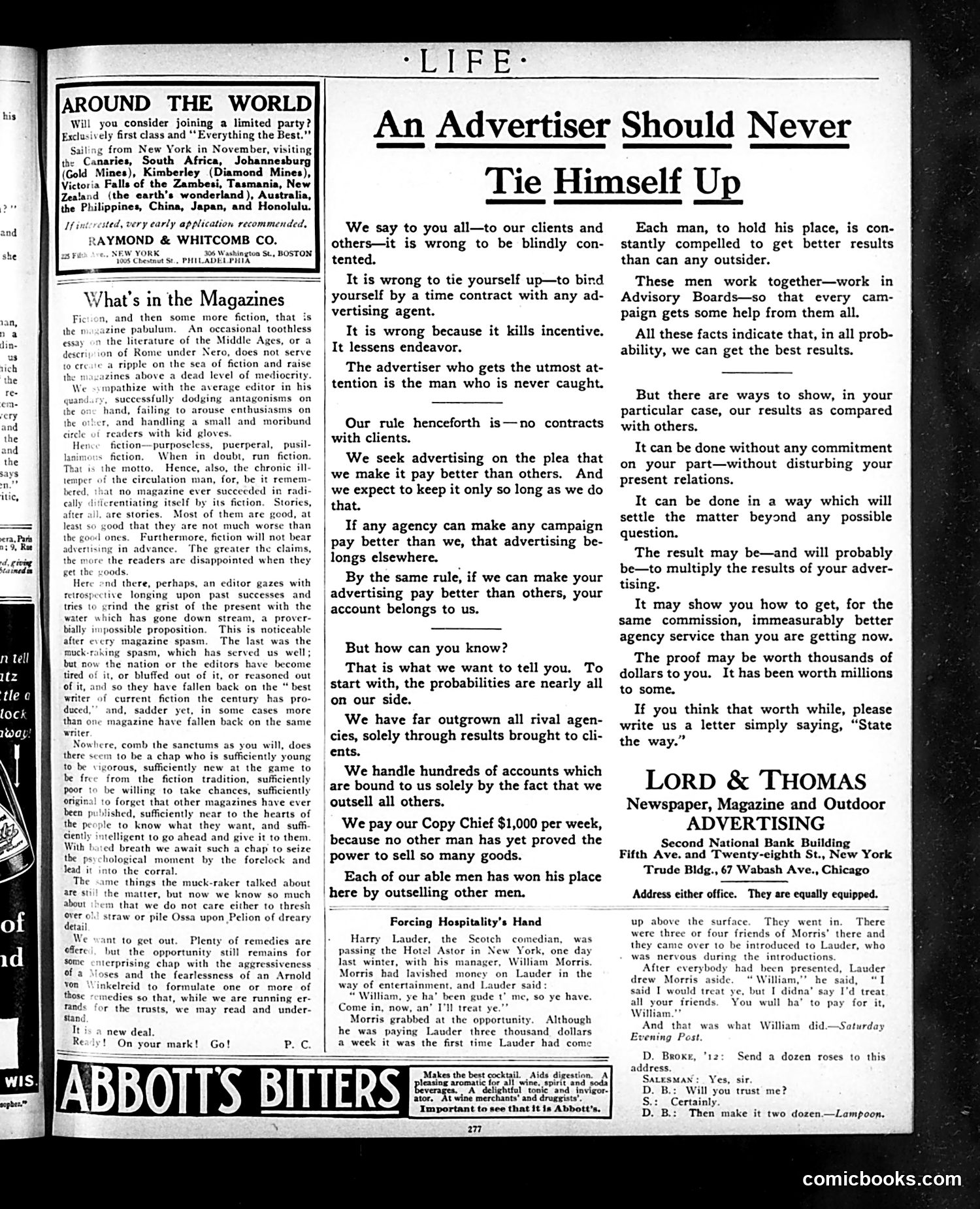
This page is primarily a **Lord & Thomas advertising agency advertisement**, not political satire. The main content is a business pitch to potential clients. The agency argues against long-term advertising contracts, claiming that exclusivity reduces motivation and incentive. They assert their competitive advantage: their staff consistently outperforms rivals because they must earn accounts through superior results rather than contractual obligation. The rhetoric is competitive boasting typical of early 20th-century business advertising. Lord & Thomas positions itself as the superior choice by claiming their salesmen "have far outgrown all rival agencies" through proven performance metrics. The secondary content includes magazine criticism and travel advertisements—standard Life magazine filler. The page contains **no political cartoons or satirical commentary** worth analyzing; it's straightforward commercial persuasion dressed in the language of business philosophy.
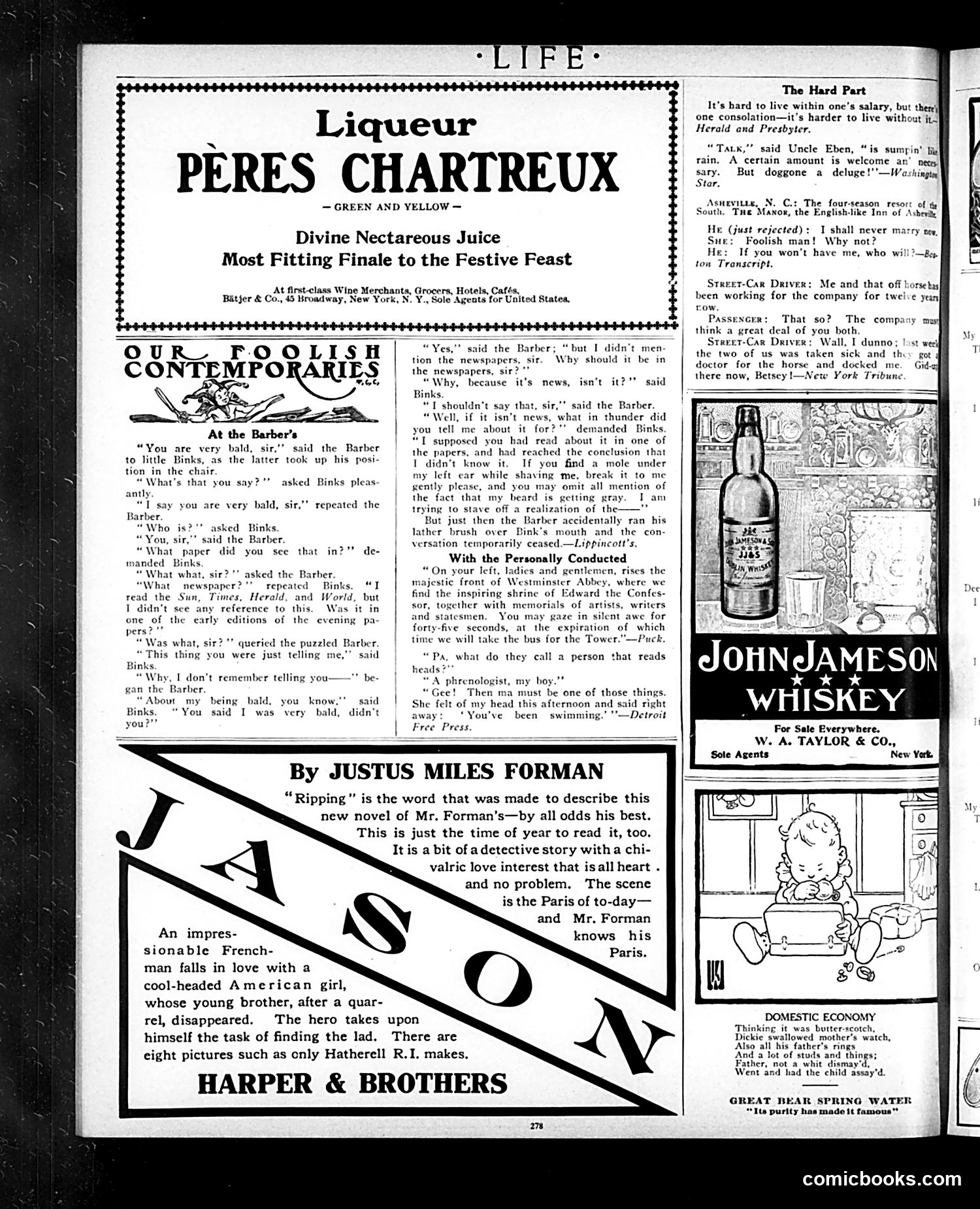
This page primarily contains **advertisements and humorous fiction**, not political cartoons. The main content includes: 1. **Liqueur Advertisement** (top): Promotes Pères Chartreux liqueur as an elegant after-dinner drink. 2. **"Our Foolish Contemporaries" Humor Section**: A dialogue between a barber and his customer "Binks" about baldness. The joke relies on Binks' literalism—when the barber mentions reading about his baldness in newspapers, Binks demands to know which paper reported this as "news." It's absurdist humor playing on the customer's obtuse misunderstanding of casual conversation. 3. **Book Advertisement**: Justus Miles Forman's novel "Jaso," described as a detective story set in Paris involving a Frenchman and American girl. 4. **John Jameson Whiskey Advertisement**: Standard liquor promotion. 5. **Small comic panels and brief humor items** scattered throughout. The page is primarily **advertising and light entertainment**—typical of Life magazine's mixed content approach—rather than political satire or social commentary.
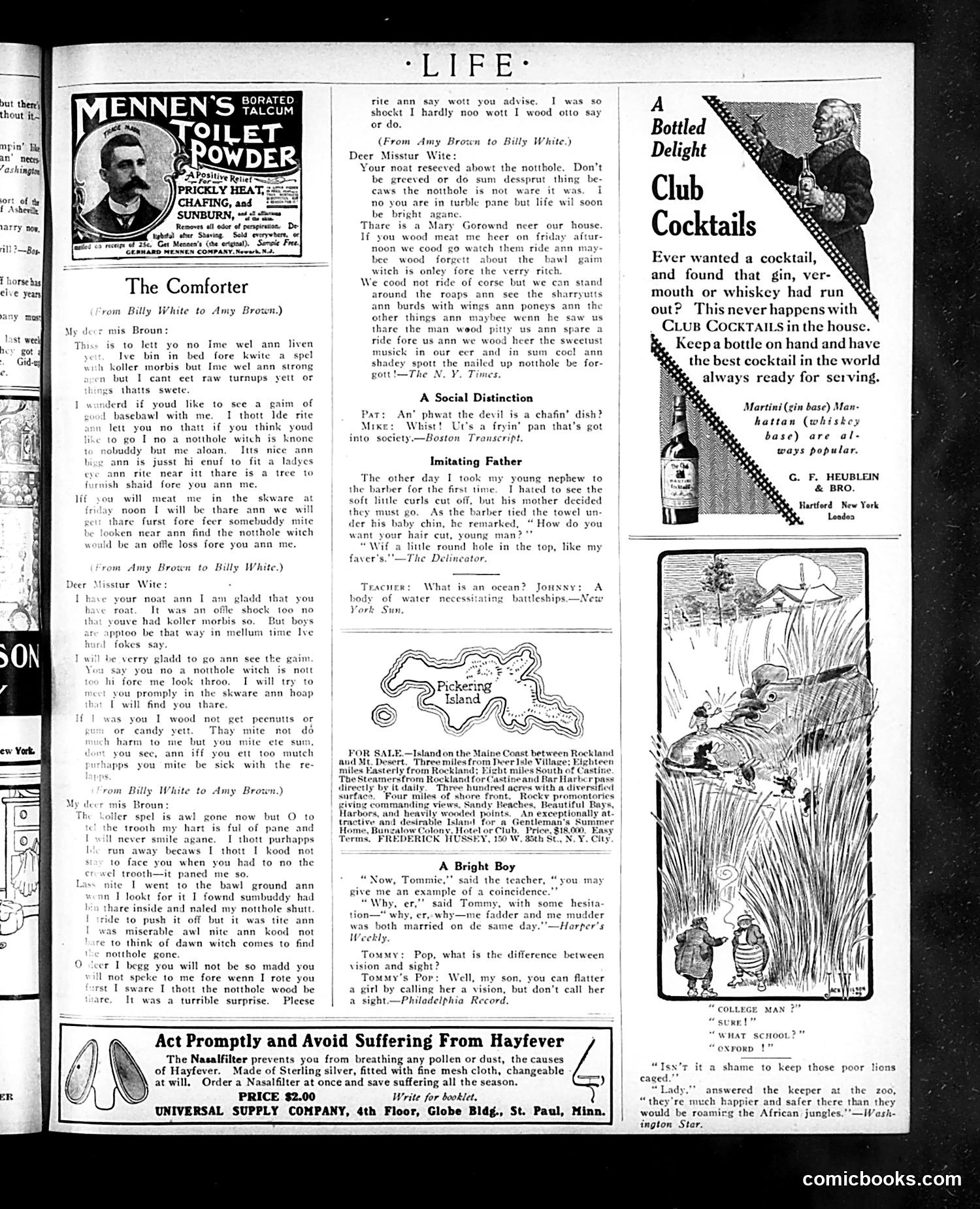
This page contains humorous correspondence between two fictional characters—Amy Brown and Billy White—written in deliberately misspelled, phonetic dialect to create comedy. The letters discuss mundane domestic concerns: a missing "notthole" (knothole), plans to watch horse-drawn carriages, and a baseball game. The satire targets the sentimental, melodramatic tone of advice columns popular in early 20th-century magazines. By using exaggerated working-class dialect and trivial subject matter, Life ridicules both the overwrought emotional responses to minor problems and the earnest publishing of such correspondence. The page also includes period advertisements (Mennen's Talcum Powder, hayfever remedies, Club Cocktails) and unrelated humorous snippets about social distinctions and children's innocent misunderstandings—typical filler content for magazines of this era.
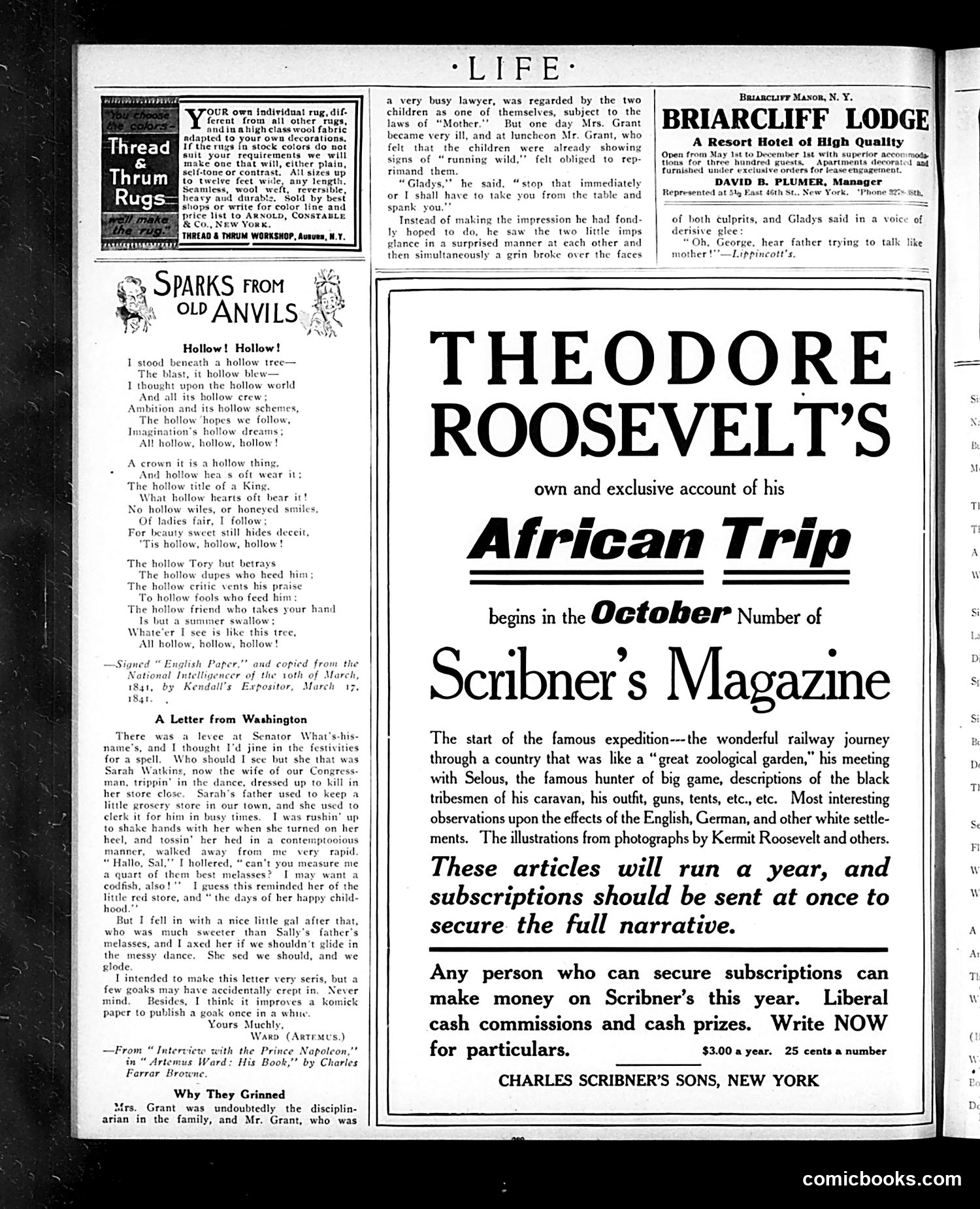
This page is primarily **advertising and filler content** for Life magazine, circa 1909. The main feature is a **full-page advertisement for Scribner's Magazine** announcing Theodore Roosevelt's serialized account of his African safari expedition. The ad emphasizes the expedition's exotic appeal—railway journeys through "a great zoological garden," encounters with African tribesmen and famous hunter Selous, and photographs by Roosevelt's son Kermit. It promises the series will run a year and encourages subscription agents to solicit readers for commissions. The page also contains: - A rug advertisement (top left) - "Sparks from Old Anvils," a humorous poem about hollow things (likely social satire) - Two brief satirical pieces: a letter from "Washington" mocking social climbers, and "Why They Grinned," a anecdote about President Grant's failed attempt to discipline his children None of these items constitute serious political commentary—they're typical magazine filler and advertising copy of the era.
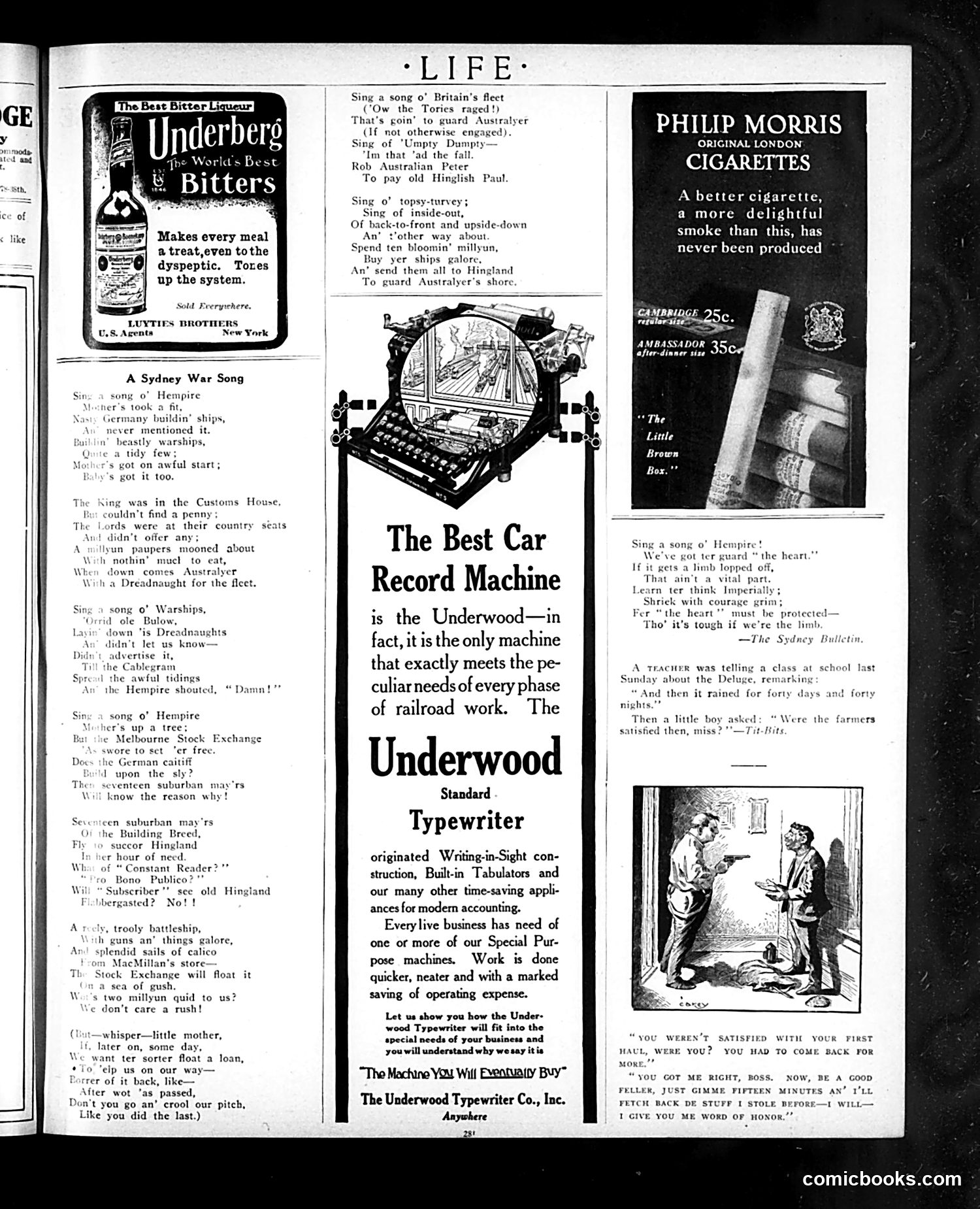
This page is primarily **advertising with a satirical song**, not a political cartoon. **Main Content: "A Sydney War Song"** The extended satirical poem mocks British imperial naval policy, specifically Australia's financial contribution to British warship construction. The song uses colloquial Australian dialect ("'Umpty Dumpty," "Hempire") to lampoon how Britain exploited colonial resources—Australia spent millions on ships to "guard" British interests rather than protect itself. The refrain "Rob Australian Peter / To pay old Hinglish Paul" explicitly criticizes this arrangement. The song references the Melbourne Stock Exchange and contemporary political figures (Bülow), suggesting this addresses early 20th-century defense debates. **Advertisements:** - Underberg Bitters (left) - Underwood Typewriter (center) - Philip Morris Cigarettes (right) **Cartoon (bottom right):** A brief comedic exchange where someone jokingly confesses to theft, using exaggerated dialect humor typical of period humor. The page reflects Australian resentment toward imperial financial demands during the pre-WWI era.
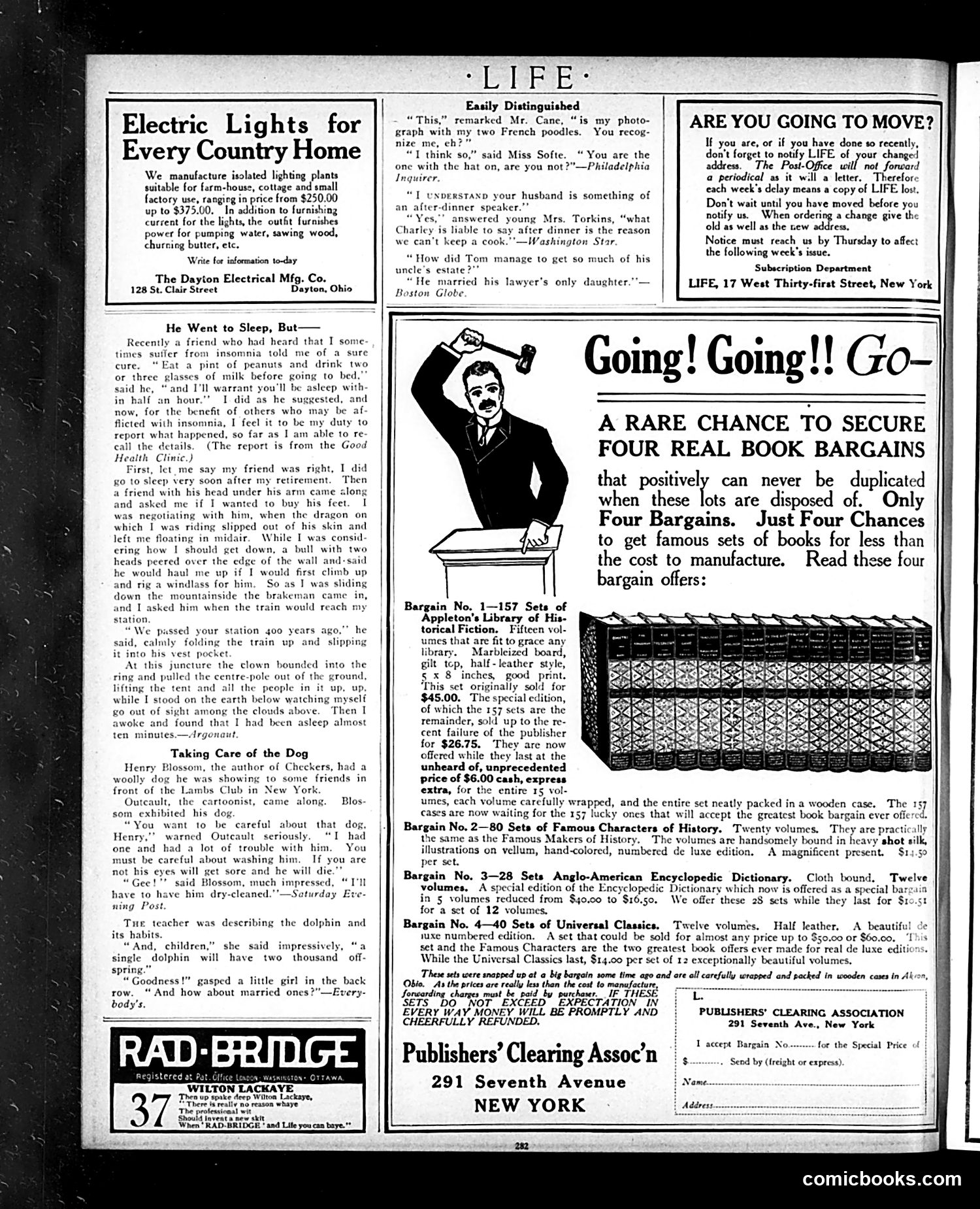
This page from Life magazine consists primarily of **advertisements and humorous anecdotes** rather than political cartoons. The main content includes: **Advertisements:** Electric lighting plants for rural homes (Dayton Electrical), Rad-Bridge product endorsement by actor Wilton Lackaye, and a Publishers' Clearing Association book sale. **Humor pieces:** Mostly brief, domesticated jokes about everyday life—a man's surreal dream after taking a sleep aid, a story about caring for a woolly dog, and short quips about photography, after-dinner speakers, and marriages. These reflect genteel, middle-class concerns typical of early 20th-century American periodicals. **Practical notice:** A subscription department reminder for readers to update their address when moving. The page lacks identifiable political satire or caricature. The jokes are gentle, apolitical observations about bourgeois life, suitable for the magazine's general readership. The overall tone emphasizes consumer products, domestic humor, and respectability—characteristic of Life during this era as a family-oriented satirical publication.
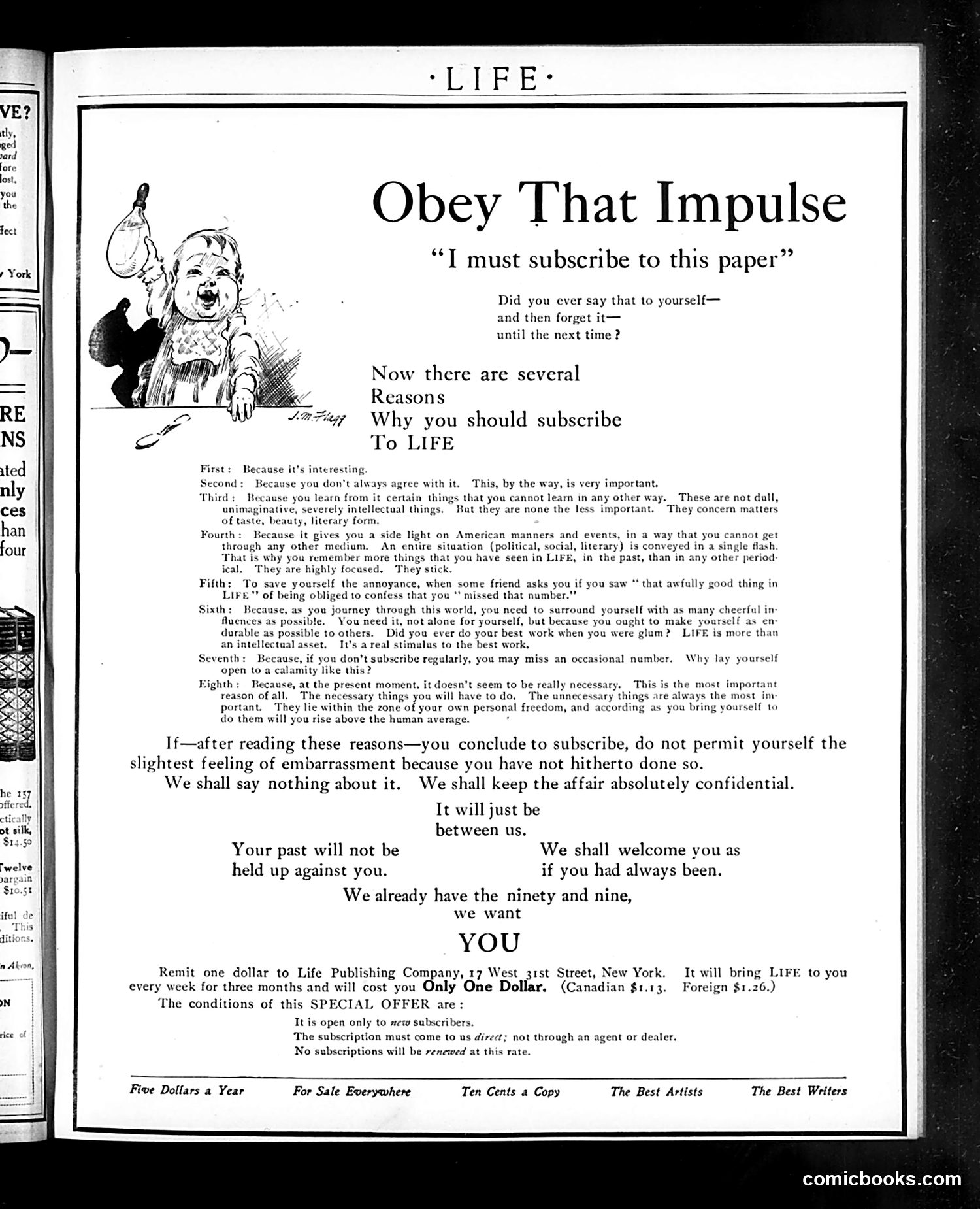
This is a subscription solicitation rather than a political cartoon. The single illustration—a cheerful baby or cherub holding a pear—serves as a charming visual hook for the advertisement's humorous tone. The ad employs playful psychology to encourage subscriptions, addressing the reader's procrastination ("Did you ever say that to yourself—and then forget it"). It lists eight reasons to subscribe, mixing genuine appeals (the magazine provides social commentary, literary content, and intellectual stimulation) with tongue-in-cheek arguments (that missing an issue is a "calamity"; that unnecessary luxuries matter more than necessities). The final section reassures potential new subscribers that their past non-subscription won't be held against them, using the biblical metaphor of the "ninety and nine" to position new subscribers as valued additions. The $1 offer for three months (roughly 12 issues) was notably cheap for 1910s-era magazine publishing, targeting cost-conscious readers.
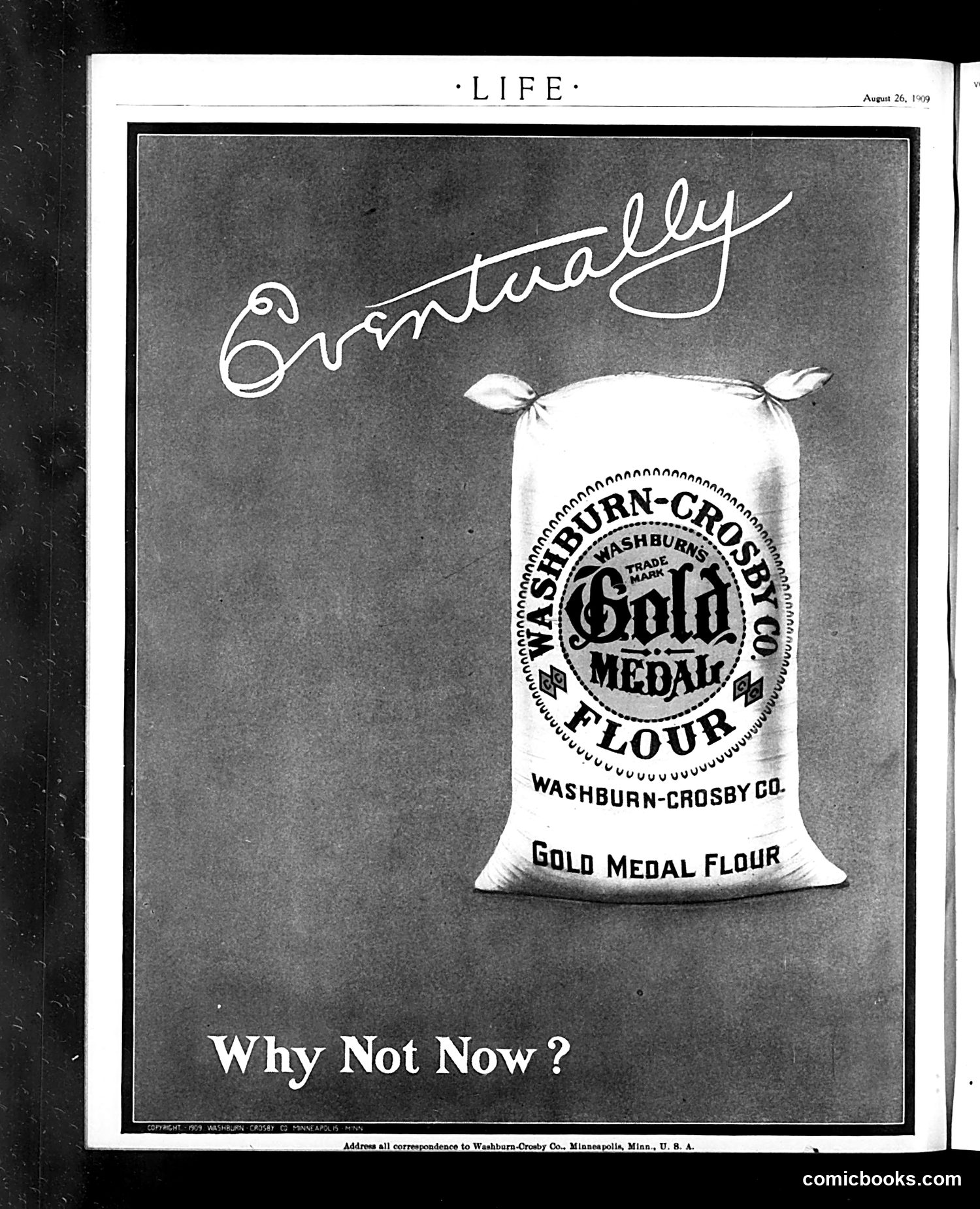
This is a **straightforward advertisement**, not a political cartoon or satirical content. The page features an ad for Gold Medal Flour by the Washburn-Crosby Company (which later became General Mills). The ad uses the word "Eventually" at the top, suggesting that consumers will eventually choose Gold Medal Flour as their preferred brand. The bottom tagline asks "Why Not Now?" — a common advertising strategy encouraging immediate purchase rather than waiting. The image shows a flour sack with the Gold Medal branding and trade mark clearly displayed. This is a vintage print advertisement from Life magazine, dated August 26, 1909, promoting a consumer product with a simple persuasive message rather than containing political or social satire.