
Life, 1909-08-26 · page 9 of 28
Life — August 26, 1909 — page 9: what you’re looking at
What you’re looking at
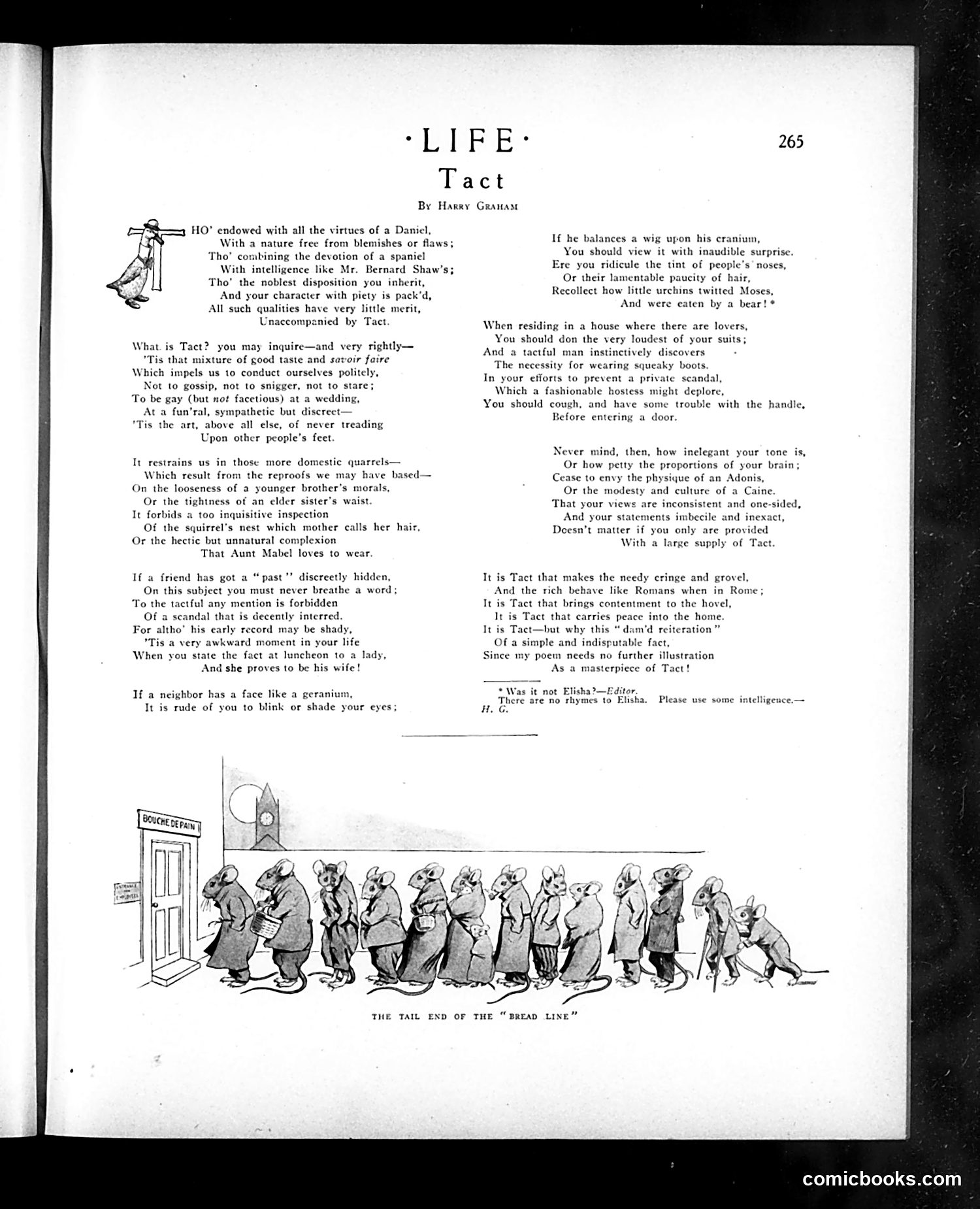
This is a humorous poem about social etiquette and good manners. Graham defines "Tact" as the art of navigating social situations with discretion—avoiding gossip, not mentioning others' physical flaws, and maintaining composure in awkward moments. The cartoon at bottom, captioned "THE TAIL END OF THE 'BREAD LINE,'" depicts a long queue of people (appearing to be unemployed or poor) waiting at what's labeled a "Soup Kitchen." This illustrates economic hardship, likely referencing Depression-era welfare lines. The cartoon contrasts with the poem's focus on upper-class etiquette by showing those struggling to survive—a satirical juxtaposition suggesting that while the wealthy worry about polite behavior, ordinary people face hunger and poverty.
📄 Transcribed text from this page (OCR, searchable)
Machine-transcribed from the original scan — historical spelling and the odd misread are preserved.
EERE Tact By Harry Granast HO’ endowed with all the virtues of a Daniel, With a nature free from blemishes or flaws; Tho’ combining the devotion of a spaniel With intelligence like Mr. Bernard Shaw's; Tho’ the noblest disposition you inherit, And your character with piety is pack’d, All such qualities have very little merit, Unaccompanied by Tact What. is Tact? you may inquire—and very rightly— Tis that mixture of good taste and savoir faire Which impels us to conduct ourselves politely, Not to gossip, not to snigger, not to stare; To be gay (but not facetious) at a wedding, ta fun’ral, sympathetic but discreet— is the art, above all else, of never treading Upon other people’s feet. It restrains us in those more domestic quarrels— Which result from the reproofs we may have based— On the looseness of a younger brother’s morals, Or the tightness of an elder sister's waist. It forbids a too inquisitive inspection Of the squirrel’s nest which mother calls her Or the hectic but unnatural complexion That Aunt Mabel loves to wear. If a friend has got a “ past’? discreetly hidden, On this subject you must never breathe a word ; To the tactful any mention is forbidden Of a scandal that is decently interred. For altho’ his early record may be shady, "Tis a very awkward moment in your life When you state the fact at luncheon to a lady, And she proves to be his wife! If a neighbor has a face like a geranium, It is rude of you to blink or shade your eyes; If he balances a wig upon his cranium, You should view it with inaudible surprise. Ere you ridicule the tint of people’s’ noses, Or their lamentable paucity of hair, Recollect how little urchins twitted Moses And were eaten by a bear When residing in a house where there are lover You should don the very loudest of your suits; And a tactful man instinctively discovers The necessity for wearing squeaky boots In your efforts to prevent a private scandal, Which ashionable hostess might deplore, ‘ou should cough, and have some trouble with the handle, Before entering a door. Never mind, then, how inelegant your tone is, Or how petty the proportions of your brain; Cease to envy the physique of an Adonis, Or the modesty and culture of a Caine. That your views are inconsistent and one-sided, And your statements imbecile and inexact, Doesn't matter if you only are provided With a large supply of Tact. It is Tact that makes the needy cringe and grovel, And the rich behave like Romans when in Rome; It is Tact that brings contentment to the hovel, It is Tact that carries peace into the home. It is Tact—but why this “dam'd reiteration” Of a simple and indisputable fact, Since my poem needs no further illustration As a masterpiece of Tact! * Was it not Elisha?—Editor. There are no rhymes to Elisha. Please use some intelligence.— HG. THE TAIL END OF THE “BREAD LINE” comicbooks.com