
Life, 1909-08-26 · page 21 of 28
Life — August 26, 1909 — page 21: what you’re looking at
What you’re looking at
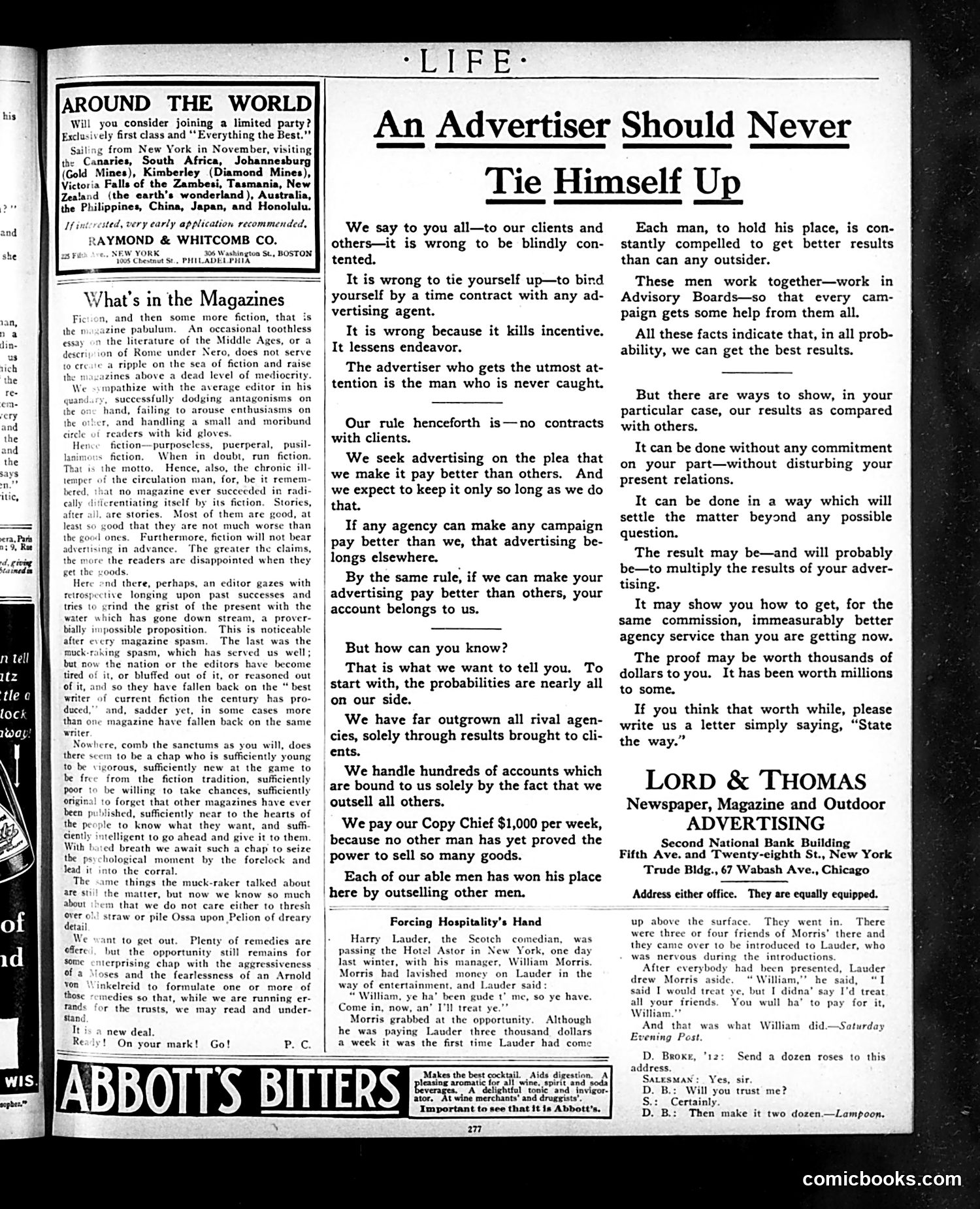
This page is primarily a **Lord & Thomas advertising agency advertisement**, not political satire. The main content is a business pitch to potential clients. The agency argues against long-term advertising contracts, claiming that exclusivity reduces motivation and incentive. They assert their competitive advantage: their staff consistently outperforms rivals because they must earn accounts through superior results rather than contractual obligation. The rhetoric is competitive boasting typical of early 20th-century business advertising. Lord & Thomas positions itself as the superior choice by claiming their salesmen "have far outgrown all rival agencies" through proven performance metrics. The secondary content includes magazine criticism and travel advertisements—standard Life magazine filler. The page contains **no political cartoons or satirical commentary** worth analyzing; it's straightforward commercial persuasion dressed in the language of business philosophy.
📄 Transcribed text from this page (OCR, searchable)
Machine-transcribed from the original scan — historical spelling and the odd misread are preserved.
cab diE Jee AROUND THE WORLD Will you consider joining a limited party? Exclusively first class and “Everything the Best." Sailing from New York in November, visiting the Canaries, South Africa, Johannesburg (Gold Mines), Kimberley (Diamond Mines), Victoria Falls of the Zambesi, Tasmania, New Zealand (the earth's wonderland), Australia, the Philippines, China, Japan, and Honolulu. Mf interested, very early application recommended, AYMOND & WHITCOMB CO. e. NEW YORK 306 Washington St., BOSTON 1005 Chestnut St, PHILADELPHIA What's in the Magazines Fiction, and then some more Sction, that is the mezazine pabulum. An occasional toothless essay on the literature of the Middle cs, or a deserij ion of Rome under Nero, does not serve a ripple on the sea of fiction and raise es above a dead level of mediocrity. hize with the average editor in his , successfully dodging antagonisms on hand, failing to arouse enthusiasms on and handling a small and moribund readers with kid gloves. fiction—purposcless, puerperal, pusil- s fiction. When in doubt, run fiction. is the motto, Hence, also, the chronic ill pe the circulation in, for, be it remem: bered, that no magazine ever succeeded in radi- cally «tlerentiating itself by its fiction. after are stories. Most of them are least good that they are not much worse than lones. Furthermore, fiction will not bear in advance. The greater the claims, the more the readers are disappointed when they get the voods. Here ond there, perhaps, editor gazes with reiroepective longing’ dpon. past successes. and tries to grind the grist of the present with the water which has gone down stream, a prover- bially impossible proposition. T! noticeable filter every magazinesspasm. The last was the muck-raking spasm, which has served us well; but now the nation or the editors have become tired it, or bluffed out of it, or reasoned out of it, and so they have fallen back on the “ best feriter of current fiction the century has pro- duced,” and, sadder yet, in some cases. more than one magazine have fallen back on the same siiter, Nowhere, comb the sanctums as you will, does there scem to be a chap who is sufficiently young to be vigorous, sufficiently new at the game to be free from the fiction tradition, sufficiently poor to be willing to take chances, sufficiently original to forget that other magazines have ever been published, sufficiently near to the hearts of the people to know what they want, and sufh- Gently jntell and give it to them. With boied breath we await such a chap to seize the psychological moment by the forelock and lead it into the corral. ame things the muck-raker talked about matter, but now we know so much em that we do not care either to thresh straw or pile Ossa upon Pelion of dreary circle Her unt to get out. Plenty of remedies are eferc), but the opportunity still remains for some cnterprising chap with the a iveness of a Moses and the fearlessness of an Arnold Yon \Vinkelreid to formulate one or more of those comedies so that, while we are running er- rand: for the trusts, ‘we may read and under- stand It new deal Rely! On your mark! Go! P.C. An We say to you all—to our clients and others—it is wrong to be blindly con- tented. It is wrong to tie yourself up—to bind yourself by a time contract with any ad- vertising agent. | It is wrong because it kills incentive. It lessens endeavor. The advertiser who gets the utmost at- tention is the man who is never caught. Our rule henceforth is—no contracts with clients. We seek advertising on the plea that we make it pay better than others. And we expect to keep it only so long as we do that. If any agency can make any campaign pay better than we, that advertising be- longs elsewhere. By the same rule, if we can make your advertising pay better than others, your account belongs to us. But how can you know? That is what we want to tell you. To start with, the probabilities are nearly all on our side. | We have far outgrown all rival agen- cies, solely through results brought to cli- ents. We handle hundreds of accounts which | are bound to us solely by the fact that we outsell all others. | We pay our Copy Chief $1,000 per week, because no other man has yet proved the | power to sell so many goods. | Each of our able men has won his place | here by outselling other men. Forcing Hospitality’s Hand |; Harry Lauder, the Scotch comedian, | passing the Hotel Astor in New York, one day | last winter, with his manager, William Morris. Morris had lavished money on Lauder in the f entertainment, and Lauder said: liam, ye ha’ been gude t’ me, so ye have. in, now, an’ I'll treat ye.’" abbed at the opportunity. Although aying Lauder three thousand dollars a week it was the first time Lauder had co was ABBOTTS ‘Makes the best cocktail. Aids pleasing aromatic for all wine. ve A. delightfol toni ator, At wine merchants’ and druggists’ Important to see that it is Abbott's. invigor- Advertiser Should Never Himself Each man, to hold his place, is con- stantly compelled to get better results than can any outsider. These men work together—work in Advisory Boards—so that every cam- paign gets some help from them all. All these facts indicate that, in all prob- ability, we can get the best results. But there are ways to show, in your particular case, our results as compared with others, It can be done without any commitment on your part—without disturbing your present relations. It can be done in a way which will settle the matter beyond any possible question. The result may be—and will probably be—to multiply the results of your adver- tising. It may show you how to get, for the same commission, immeasurably better agency service than you are getting now. The proof may be worth thousands of dollars to you. It has been worth millions to some. If you think that worth while, please write us a letter simply saying, “State the way.” LorD & THOMAS Newspaper, Magazine and Outdoor ADVERTISING Second National Bank Building Fifth Ave. and Twenty-eighth St., New York Trude Bldg., 67 Wabash Ave., Chicago Address either office. They are equally equipped. up above the surface. They went in: were three or four friends of Morris’ there and they came over to be introduced to Lauder, who was nervous during the introductions. After everybody had been presented, Lauder drew Morris aside. “William,” he said, “I d I would treat ye, but I didna’ say I'd treat all your friends. You wull ha’ to pay for it, William.” And. that ening Post was what William did.—Saturday D. Broxe, '12: Send a dozen roses to this address. Saresman: Yes, sir. D. B.: Will you trust me? S.:_ Certainly D. B.: Then make it two dozen—Lampoon. comicbooks.com