
A complete issue · 28 pages · 1909
Life — August 19, 1909
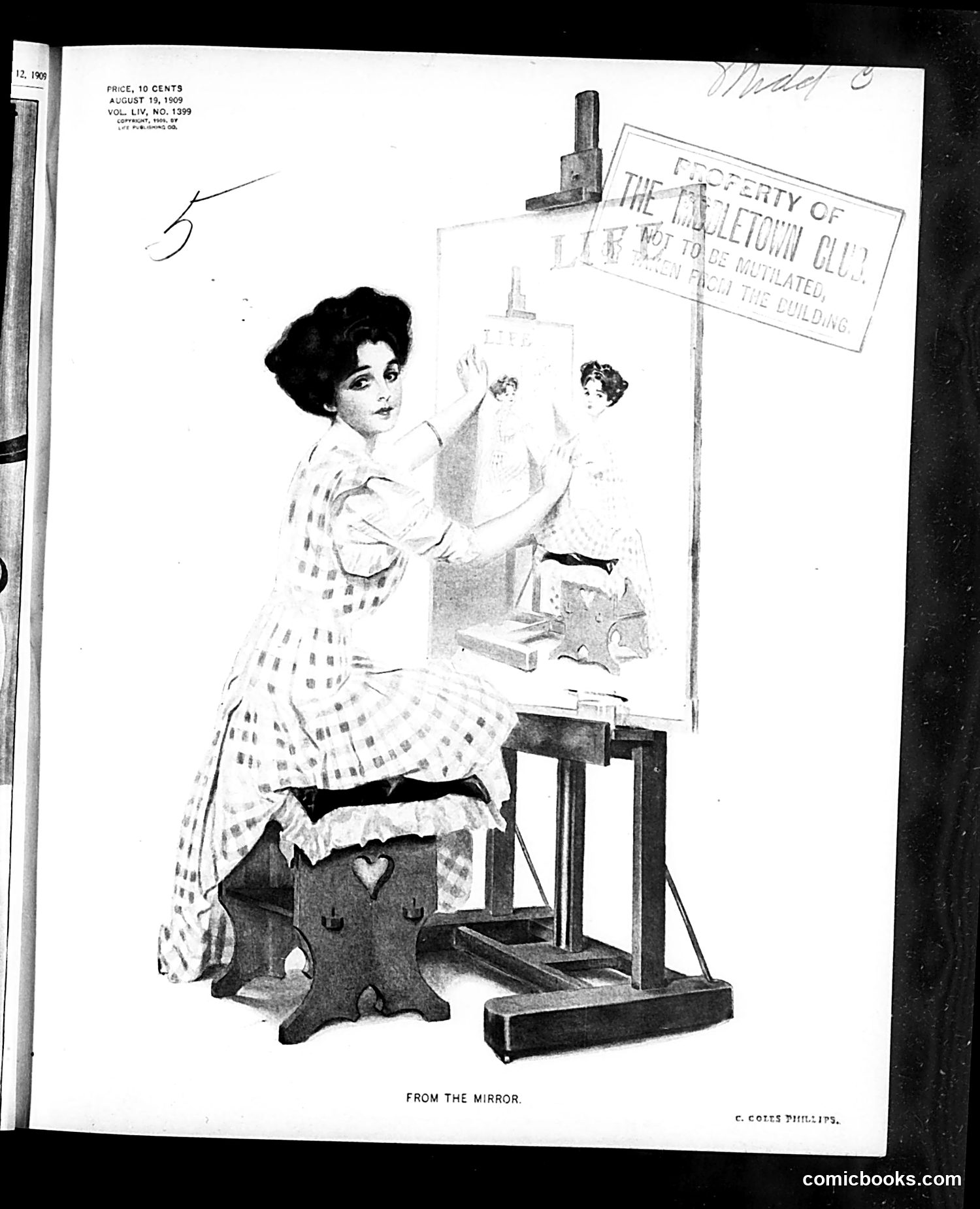
This cover illustration by C. Coles Phillips depicts a fashionable woman at an easel, painting or sketching. The caption reads "FROM THE MIRROR," suggesting she's creating artwork based on her own reflection. The satire likely comments on **vanity and self-absorption** among wealthy women of the Edwardian era—a common target of Life's humor. The woman's elaborate, patterned dress and absorbed expression reinforce this theme of narcissism. The stamp reading "PROPERTY OF THE MIDDLETOWN OLD" (partially visible) appears to be a library or archive marking, unrelated to the cartoon's meaning. The illustration exemplifies the Gibson Girl aesthetic popular in early 1900s American illustration, depicting idealized feminine beauty and leisure.
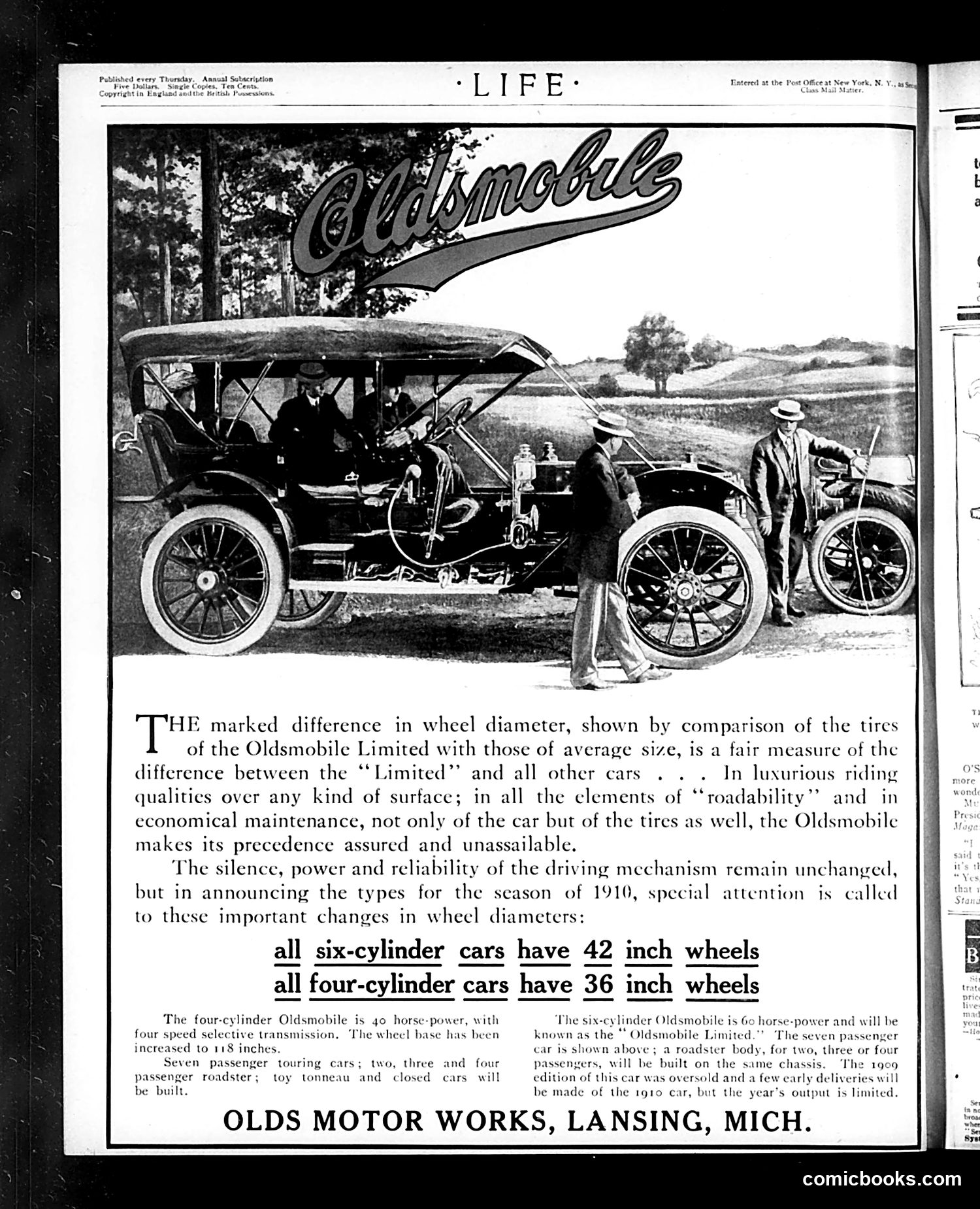
This is **not a political cartoon or satire** — it's a straightforward automobile advertisement for Oldsmobile, published in *Life* magazine (around 1910, based on the date reference in the text). The image shows two early automobiles with men in period dress standing beside them, emphasizing their wheel sizes as a key selling point. The advertisement compares the Oldsmobile Limited's larger 42-inch wheels favorably against competitors' standard 36-inch wheels. The text highlights mechanical specifications (six-cylinder vs. four-cylinder engines, horsepower ratings, chassis details) and passenger configurations. This was typical early automotive advertising that stressed technical specifications and reliability to a public still learning about motor vehicles. There is no satirical content or political messaging here — just period advertising.
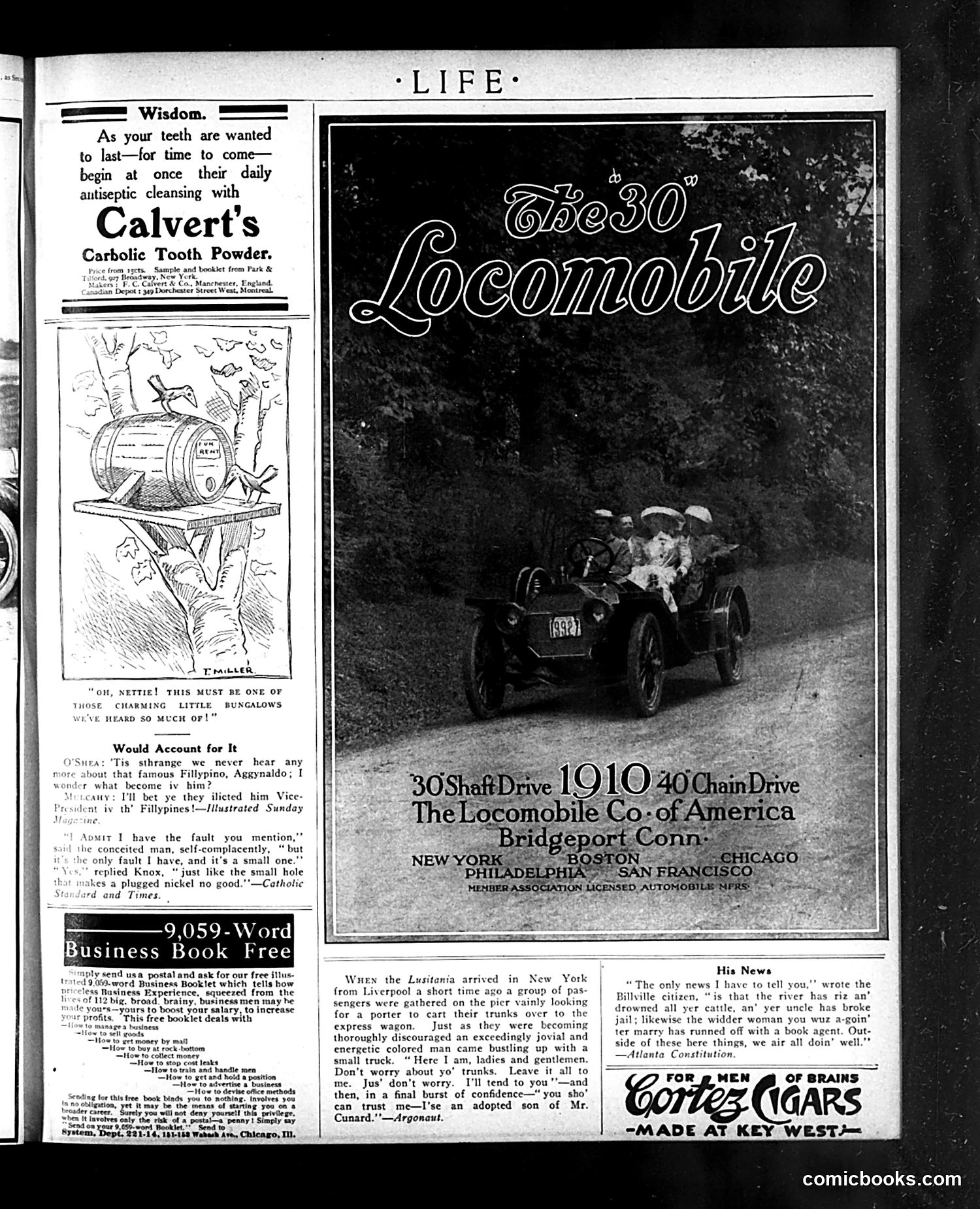
This page is primarily **advertising**, not political satire. The dominant content is a large advertisement for the Locomobile automobile (center-right), showing an early motorcar on a country road. The ad lists specifications: "30 Shaft Drive 1910 40 Chain Drive" and company offices in New York, Boston, Philadelphia, Chicago, and San Francisco. The left column contains a "Wisdom" section advertising Calvert's Carbolic Tooth Powder, a "Business Book Free" offer, and an anecdote titled "Would Account for It" about a mysterious Philippine disappearance—typical filler content for the era. A small Cortez Cigars advertisement appears at bottom right. **No political cartoons appear on this page.** It's a straightforward magazine issue mixing advertisements with light editorial content.
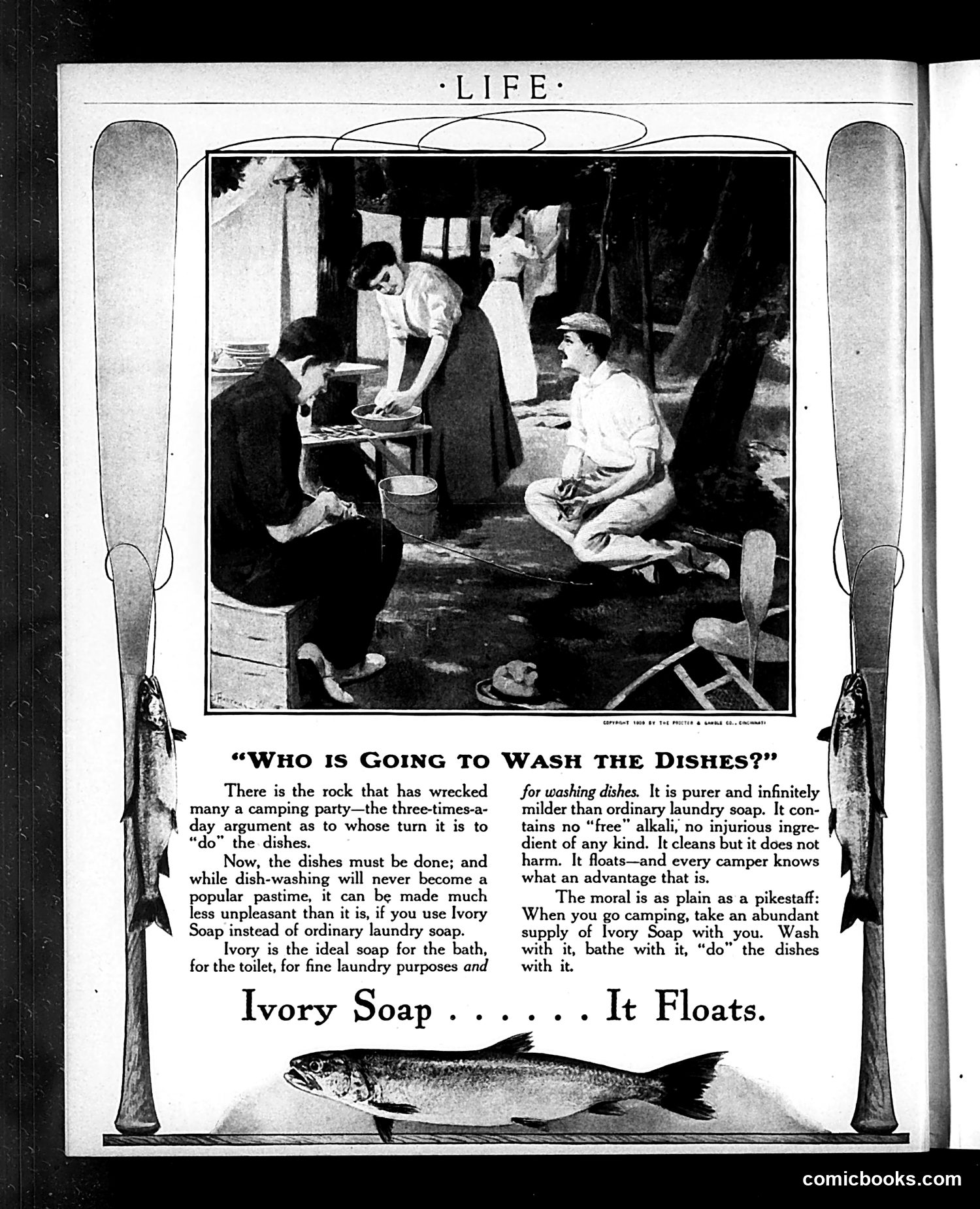
This is primarily an **Ivory Soap advertisement**, not political satire. The page appeared in *Life* magazine during the early 20th century. The ad addresses a practical camping problem: "Who is Going to Wash the Dishes?" The photograph shows campers at an outdoor site, with the humor deriving from the universal domestic chore nobody wants to do while camping. The advertisement's pitch emphasizes Ivory Soap's practical advantages for campers—it's mild, floats (a distinctive Ivory marketing claim), works for bathing and laundry, and requires no special water conditions. The moral lesson presents camping preparedness as common sense: bring Ivory Soap. The fish illustration at bottom and decorative oars frame the ad, reinforcing the outdoor/camping theme. This reflects early-1900s consumer marketing targeting middle-class recreational camping culture.
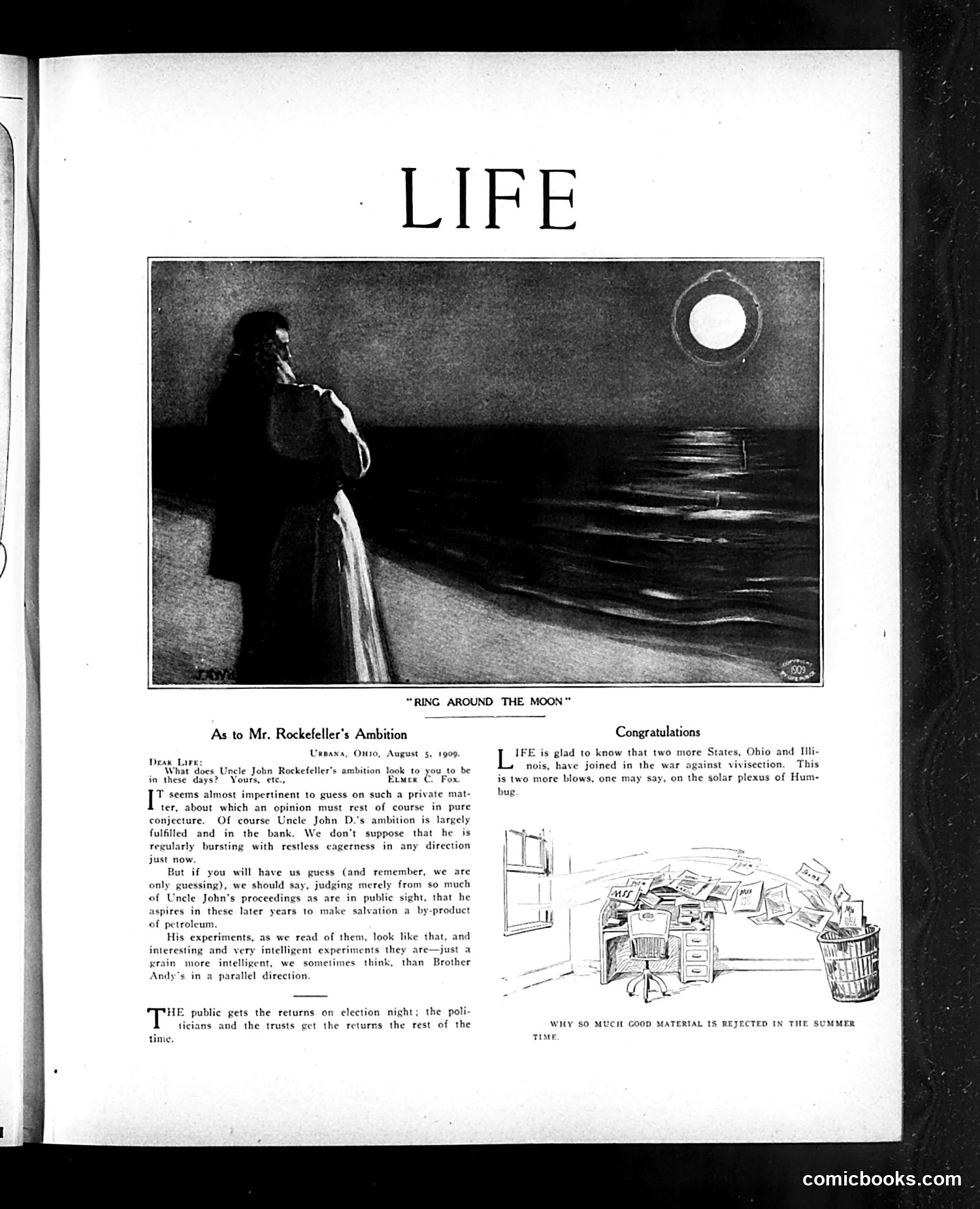
This page contains two distinct pieces: **Top image ("Ring Around the Moon"):** A silhouetted figure gazes at a moonlit seascape—likely illustrative rather than satirical. **Left column ("As to Mr. Rockefeller's Ambition"):** A satirical letter suggesting John D. Rockefeller Sr. pursues petroleum production with relentless ambition. The writer humorously speculates about Uncle John's competitive drive, comparing his experimental ventures to those of "Brother Andy" (likely Andrew Carnegie). The tone is affectionate mockery of wealthy industrialists' obsessive business pursuits. **Right section ("Congratulations"):** Celebrates two U.S. states joining "war against vivisection"—animal testing. A cartoon shows rejected laboratory materials, satirizing rejected research during summer months when institutions slow operations. The implication: good scientific work gets discarded due to seasonal closures. The page reflects Progressive-era concerns about both industrial monopolies and animal welfare advocacy.
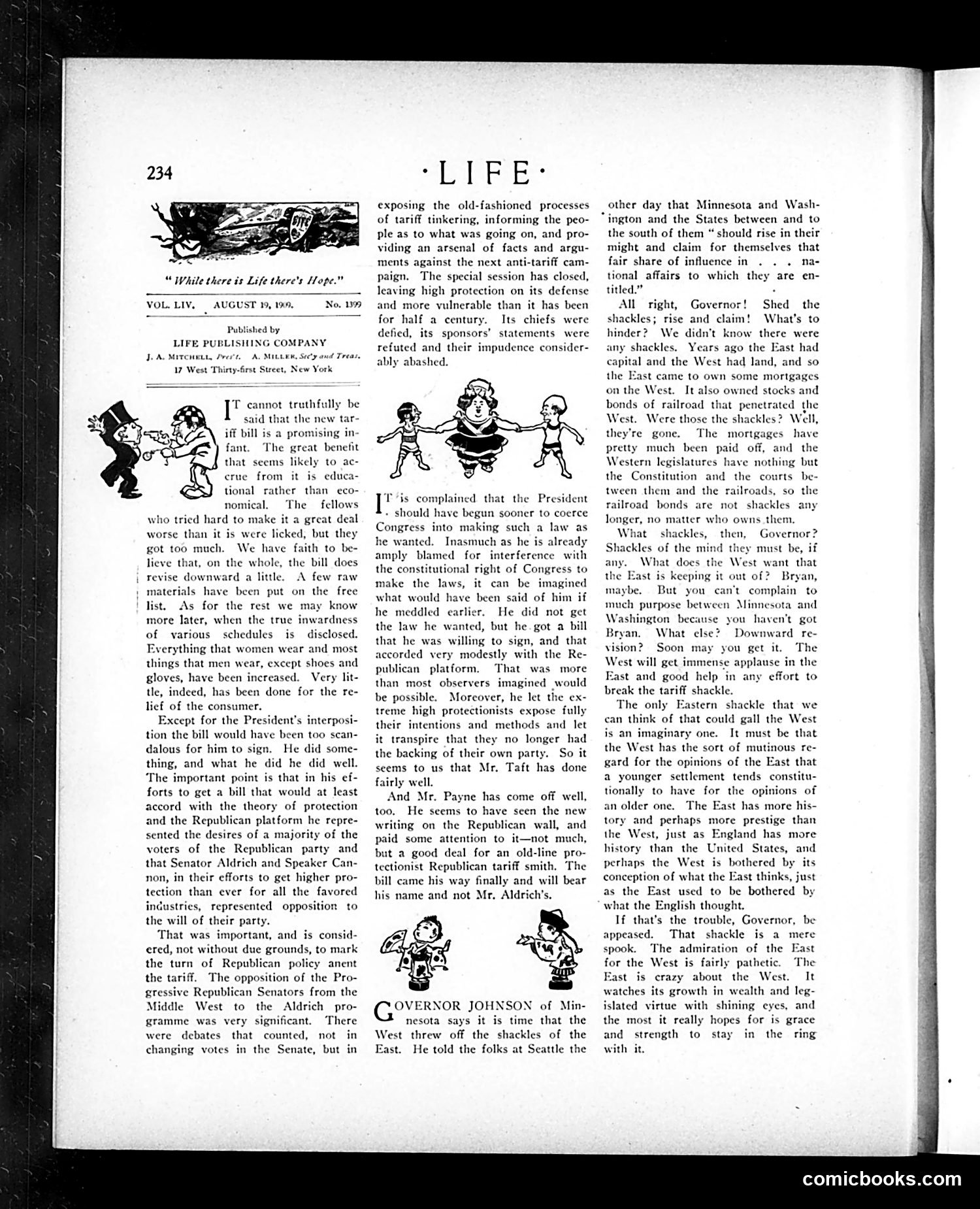
This page satirizes the tariff debate of the early 1900s. The main cartoon depicts a rotund figure (likely a wealthy industrialist or politician) being pulled in opposite directions by two smaller figures, representing competing interests in the tariff controversy. The text discusses President Taft's handling of tariff legislation and contrasts Eastern and Western perspectives. It references "shackles"—a metaphor for how tariffs constrain commerce and growth. Governor Johnson of Minnesota is mentioned as advocating the West "throw off the shackles of the East." The satire targets high-protectionist Republicans who oppose free trade, portraying the tariff debate as a struggle between Eastern industrial interests and Western agricultural/progressive ones. The cartoon visualizes this political tension through physical exaggeration and comic imagery typical of *Life* magazine's style.
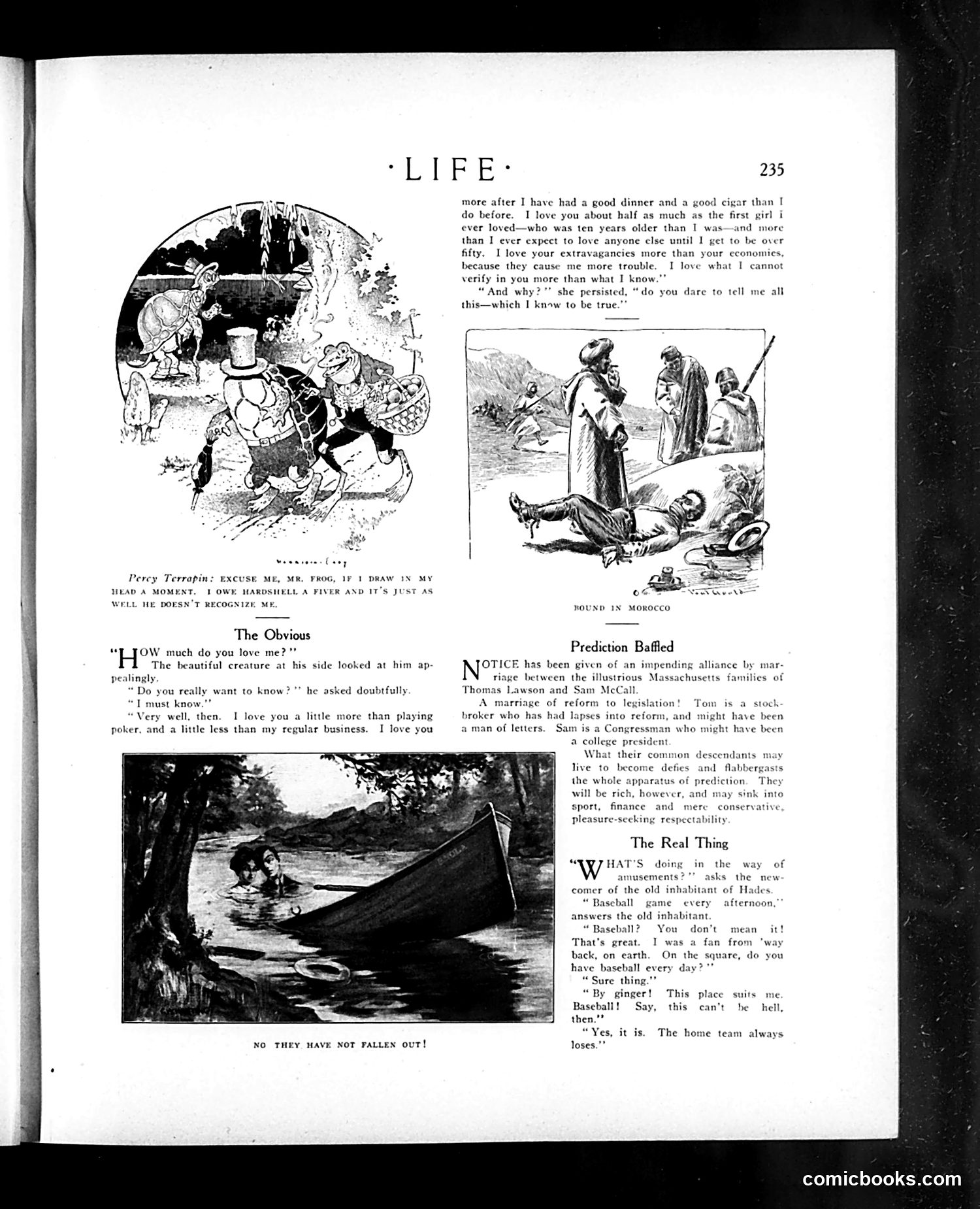
This page contains three distinct comedic pieces: 1. **"The Obvious"** - A dialogue between two figures (one appears to be a dandy or fashionable man) about love and relationships. The humor relies on the man's evasive answers to direct questions about his feelings. 2. **"Bound in Morocco"** - A cartoon depicting what appears to be colonial or travel-related humor, showing figures in North African dress in a rural setting. 3. **"Prediction Baffled" and "The Real Thing"** - These sections discuss Massachusetts families and baseball culture. The baseball piece satirizes an old inhabitant of Hades who claims baseball is hell—suggesting the sport's ubiquity and the speaker's nostalgic preference for earthly pastimes. The humor throughout relies on period-specific references to courtship customs, colonial attitudes, and American leisure culture.
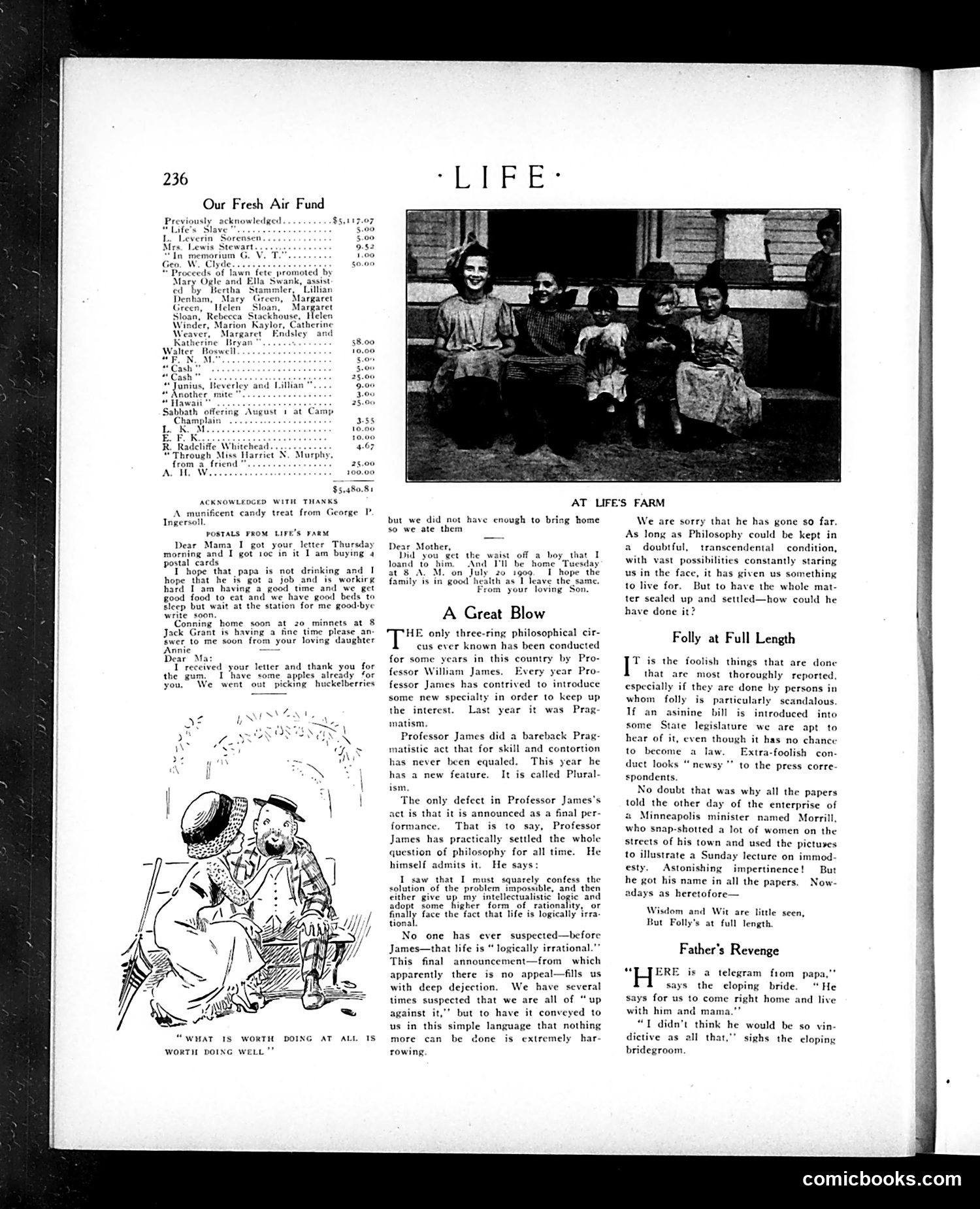
This page contains several unrelated items typical of Life's satirical magazine format. The main cartoon shows two figures in what appears to be a domestic scene, with the caption "WHAT IS WORTH DOING AT ALL IS WORTH DOING WELL." The cartoon's humor likely targets either marital dynamics or work ethic of the era. The page also includes several article sections: "At Life's Farm" (personal correspondence), "A Great Blow" (discussing Professor William James's philosophical circus acts), and "Father's Revenge" (a brief humorous anecdote about an eloping bride). The top features a photograph labeled "At Life's Farm" showing children and adults outdoors. The overall tone is lighthearted domestic and philosophical humor typical of early 20th-century American satirical magazines.
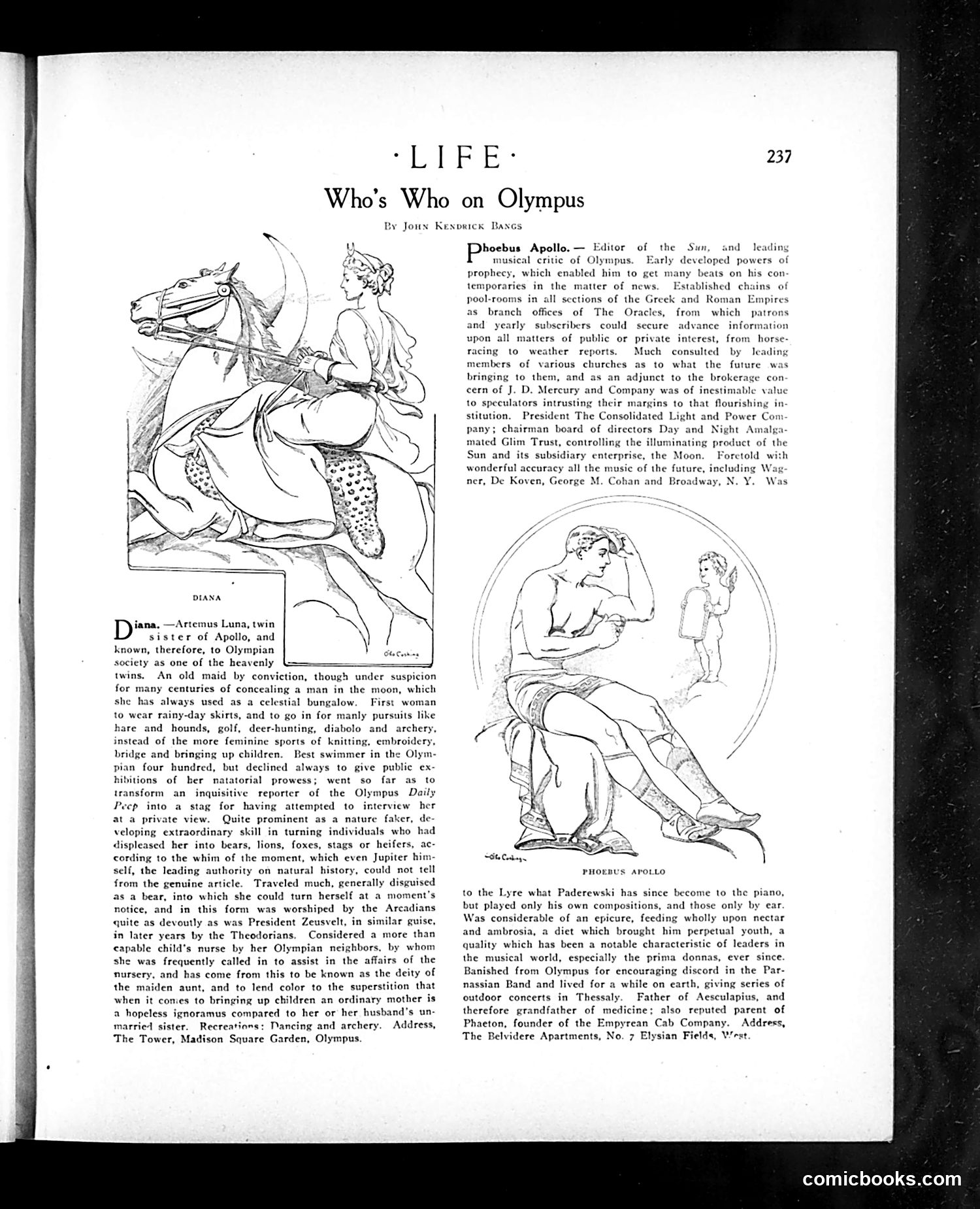
This page presents satirical profiles of prominent New York figures circa early 1900s, treating them as Greek gods. The illustration shows Diana (Artemis Luna) depicted as a woman on horseback—referencing a female society figure known for masculine pursuits like hunting and golf, activities considered unconventional for women at the time. The accompanying text mocks her as an "old maid by conviction" who conceals "a man in the moon" and famously attempted to interview people while disguised as a reporter for the *Olympus Daily Poop*. Below, Phoebus Apollo appears as a musical figure. The satire humorously elevates ordinary New Yorkers to mythological status, poking fun at high society's pretensions and gender-norm violations.
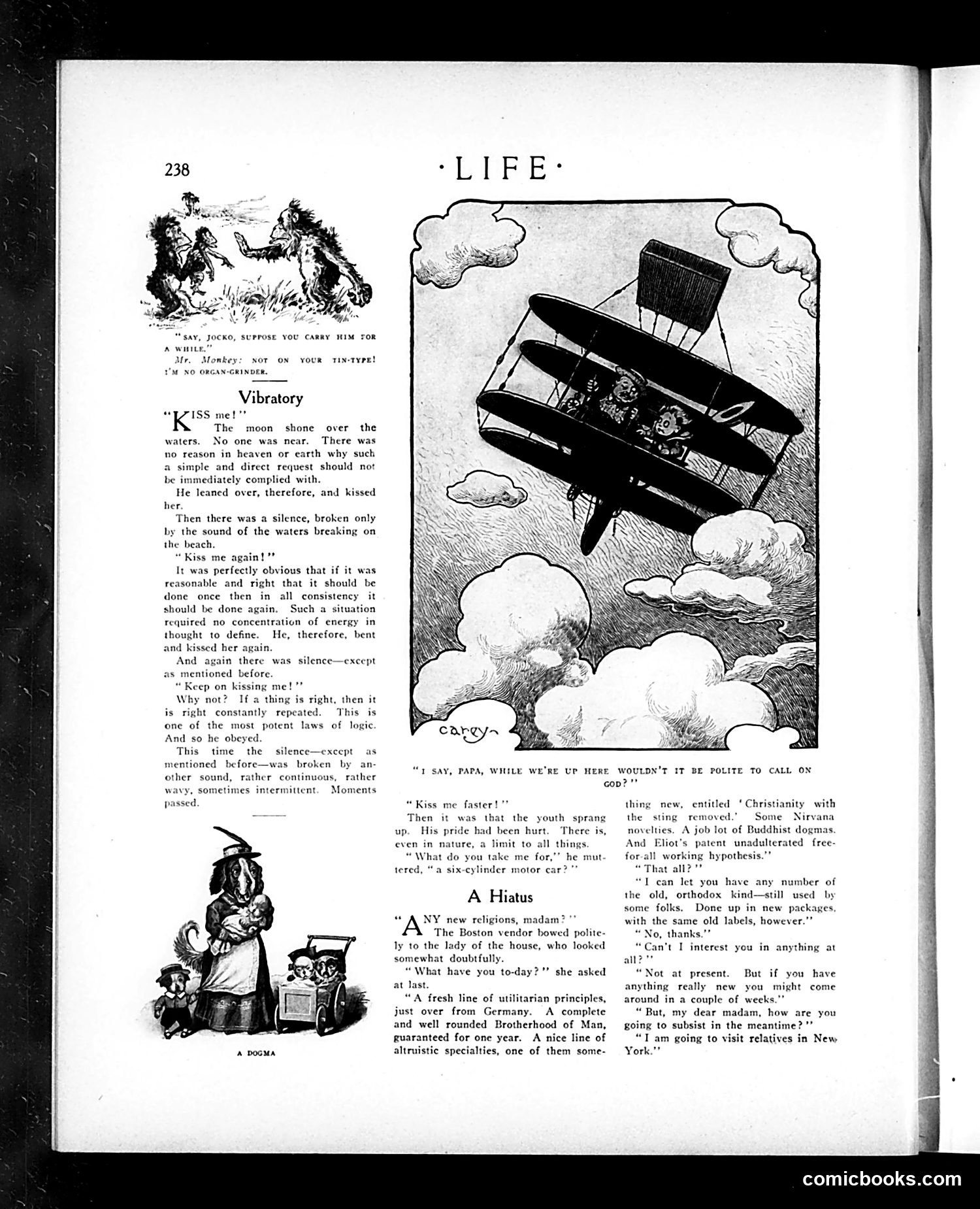
This page contains two satirical pieces. "Vibratory" is a romantic story about kissing by moonlight, satirizing sentimental Victorian literature through excessive repetition of the phrase "kept on kissing." "A Hiatus" mocks the "religion" of utilitarianism and commercialism, particularly German efficiency crazes. A Boston vendor pitches a "Brotherhood of Man" subscription service—a complete, guaranteed system for one year—as if human brotherhood were a product to purchase. The satire targets how consumer capitalism and mechanized thinking reduce meaningful human connection to marketable commodities. The accompanying illustration of a woman with a child emphasizes the domestic context where such empty commercialism conflicts with genuine human relationships. This reflects early 20th-century American anxiety about industrialization's spiritual costs.
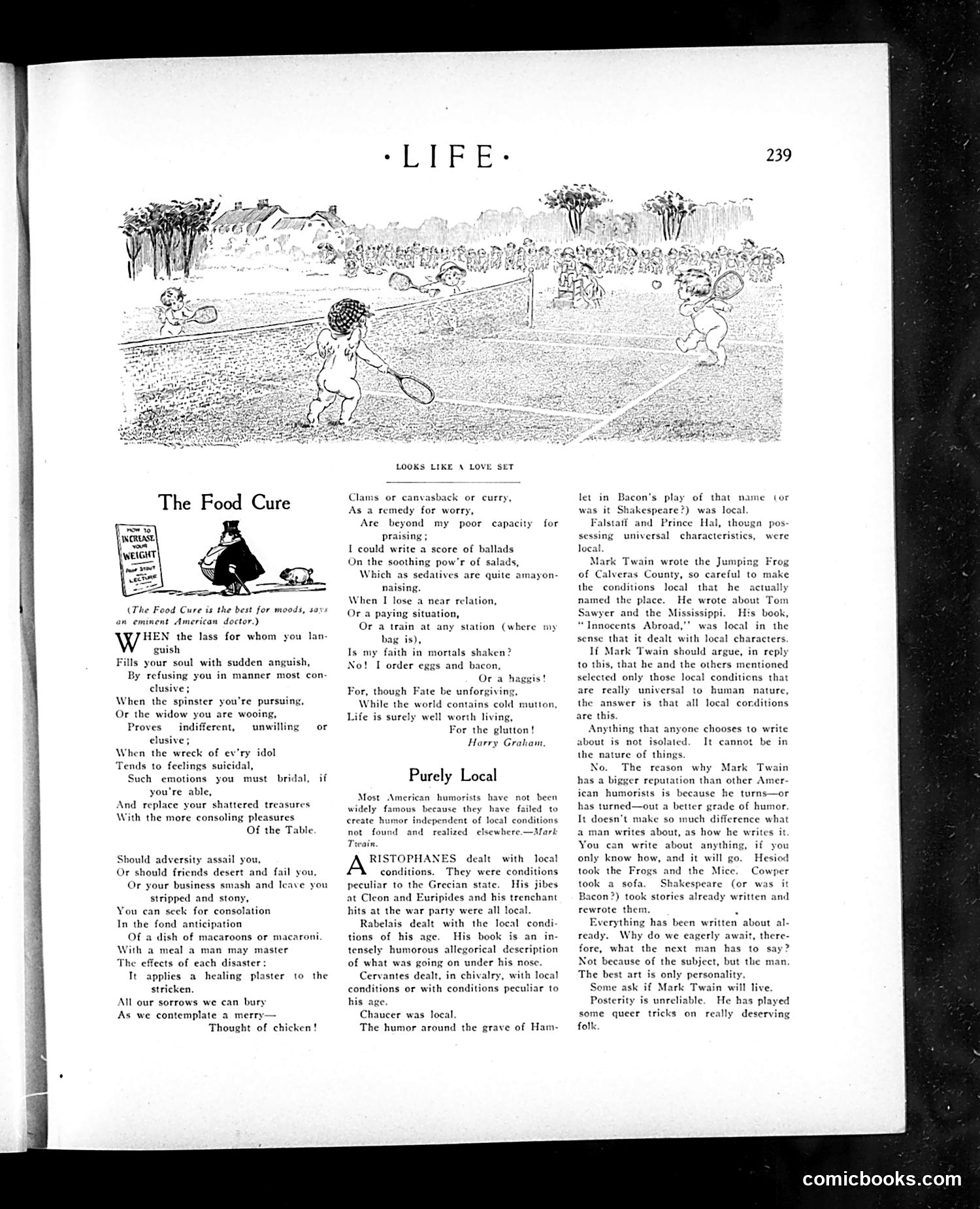
**The Cartoon ("The Food Cure"):** Shows a rotund doctor prescribing food as medicine for various ailments—worry, financial trouble, relationship problems. The satire mocks the absurdity of recommending overeating as a cure-all, likely reflecting early 20th-century medical quackery. **The Articles:** Two pieces discuss American humor and local conditions. "Looks Like a Love Set" comments on writers who base work on universal versus purely local themes. The "Purely Local" section argues that Mark Twain succeeded by grounding his humor in specific regional characteristics, suggesting the best American comedy emerges from particular places rather than generalized observations. The page critiques both medical pseudoscience and debates literary authenticity.
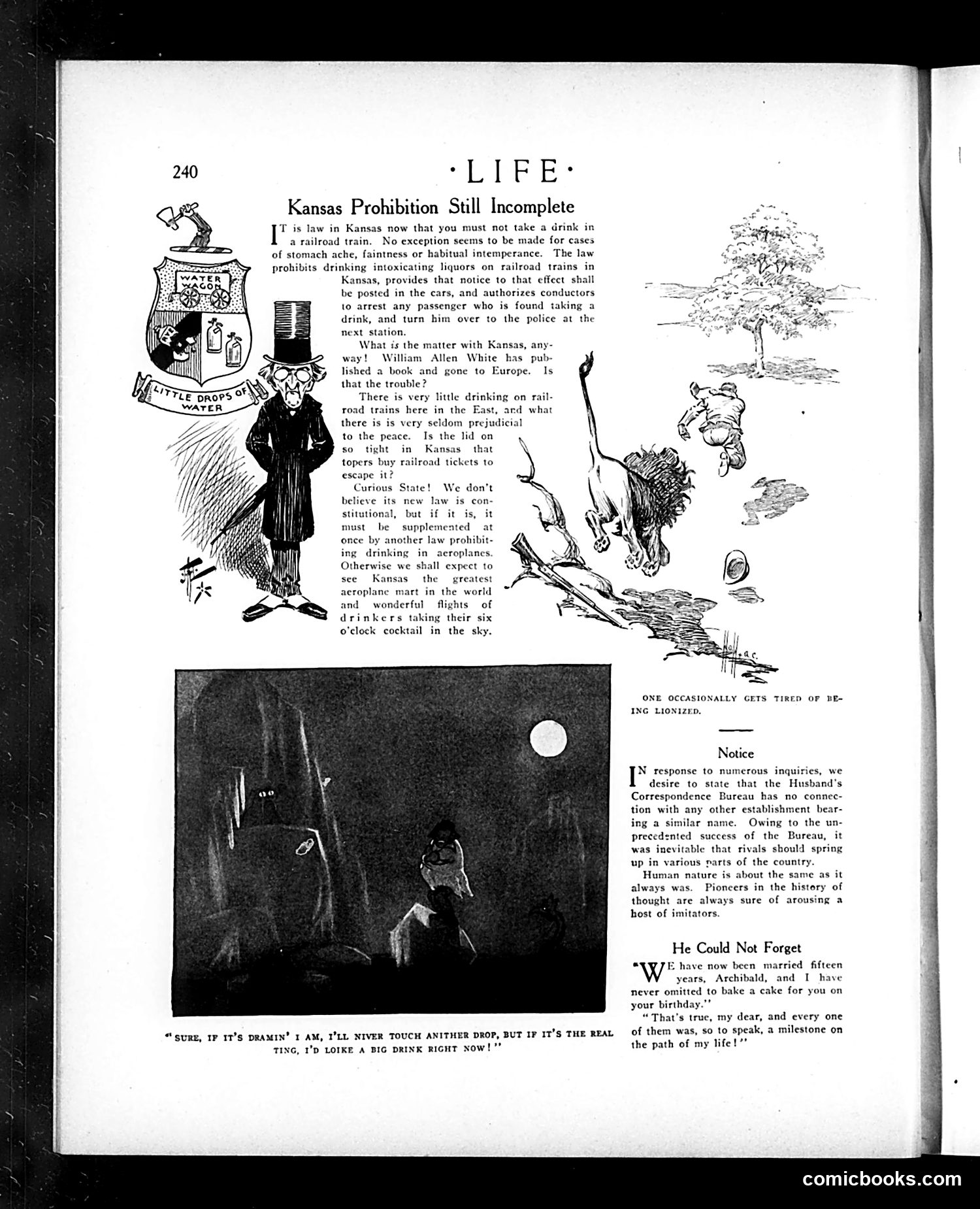
This *Life* magazine page satirizes Kansas's incomplete prohibition laws. The main article mocks Kansas's alcohol ban as full of loopholes—it prohibits drinking on trains and in public, but apparently leaves other venues unregulated. The cartoon shows a thin, top-hatted figure (representing Kansas or its prohibition enforcement) pouring water, captioned "Little Drops of Water," a reference to a temperance hymn. The satire suggests Kansas's law is ineffectual—merely symbolic gestures rather than comprehensive prohibition. The article's author questions the law's logic: if Kansas truly wanted to prevent drinking, why not also ban alcohol in aeroplanes? The humor lies in exposing the contradiction between prohibition's strict intent and its selective, easily circumvented actual enforcement.
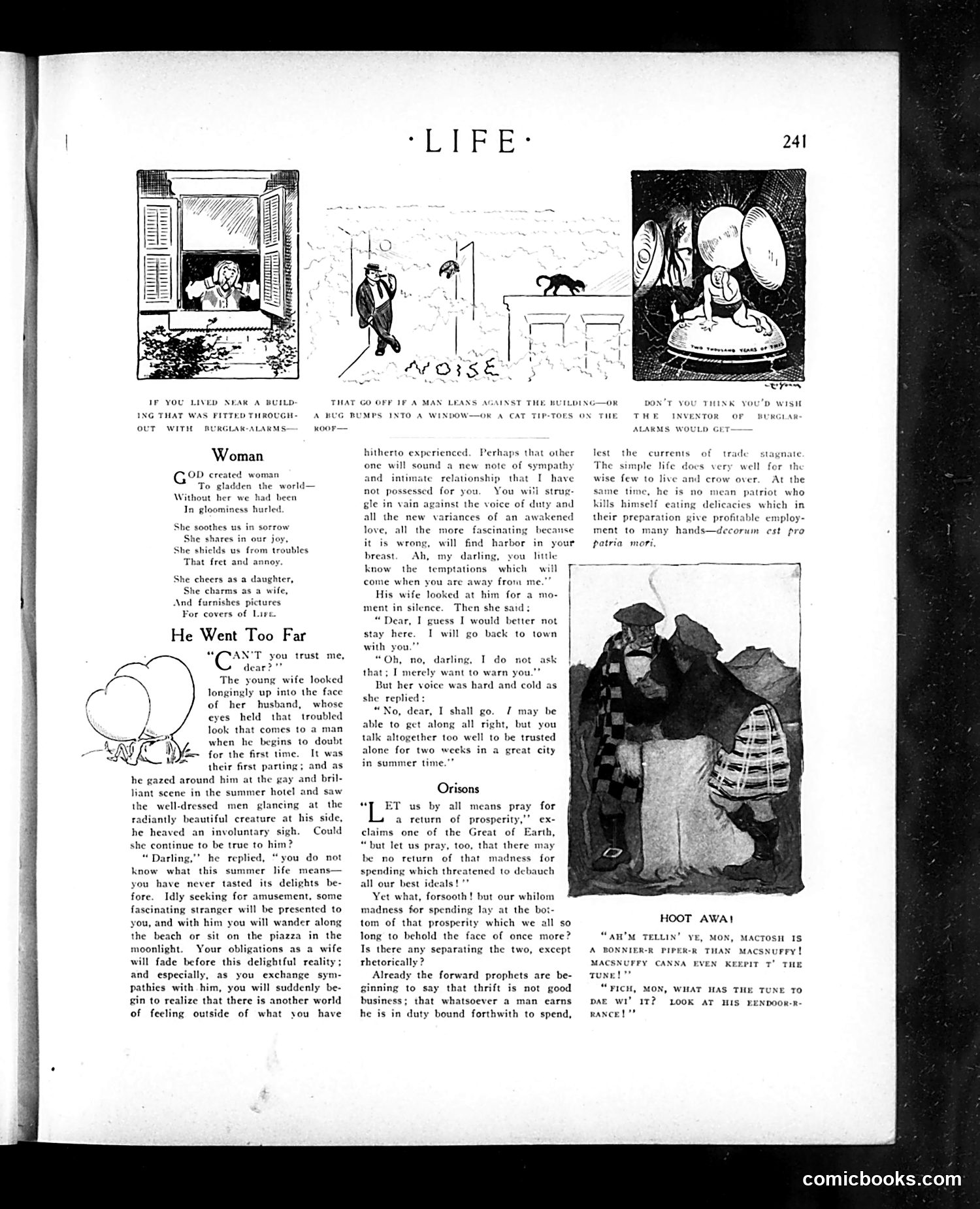
This page contains three editorial cartoons and accompanying text satirizing domestic life and social expectations. The leftmost cartoon ("He Went Too Far") depicts a young wife questioning her husband's trustworthiness during summer—a commentary on marital fidelity anxieties of the era. The center cartoon shows a man being evicted for making noise, labeled "NOISE"—likely satirizing urban living complaints and neighbor disputes in densely populated areas. The rightmost cartoon features burglars with large plates, captioned "Don't you think you'd wish an electric alarm would get—," mocking home security concerns among the wealthy and the false sense of safety such devices provide. The accompanying prose pieces ("Woman," "Orisons") offer satirical observations on gender roles, marriage dynamics, and economic anxiety during prosperity—suggesting these were written during a period of social transition and class consciousness.
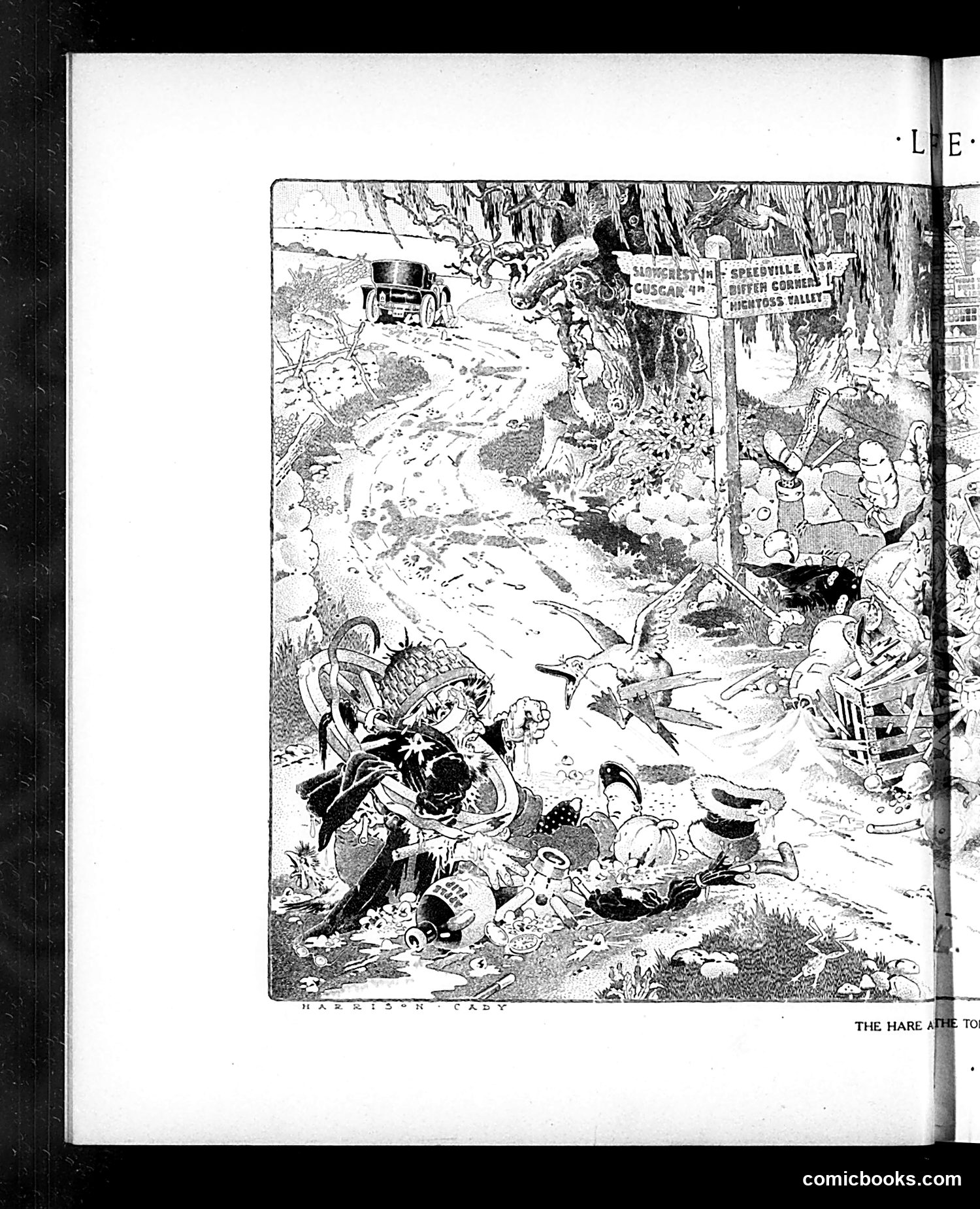
This appears to be a satirical cartoon titled "Harrison Cady" (visible at bottom). The scene depicts a chaotic landscape with exaggerated characters in what seems to be a rural or mountainous setting. A roadside sign points toward locations including "Spesonville," "Piffer Corner," and "Hightoss Valley"—fictional places suggesting backwoods Americana. The cartoon uses caricature and slapstick comedy typical of early-to-mid 20th century *Life* magazine humor. Characters appear to be engaged in some form of comedic mishap or conflict. The style and subject matter suggest satire of rural American life, possibly mocking rustic stereotypes, though without clearer text or publication date, the specific political or social target remains unclear. The overall tone is one of broad, visual comedy rather than pointed political commentary.
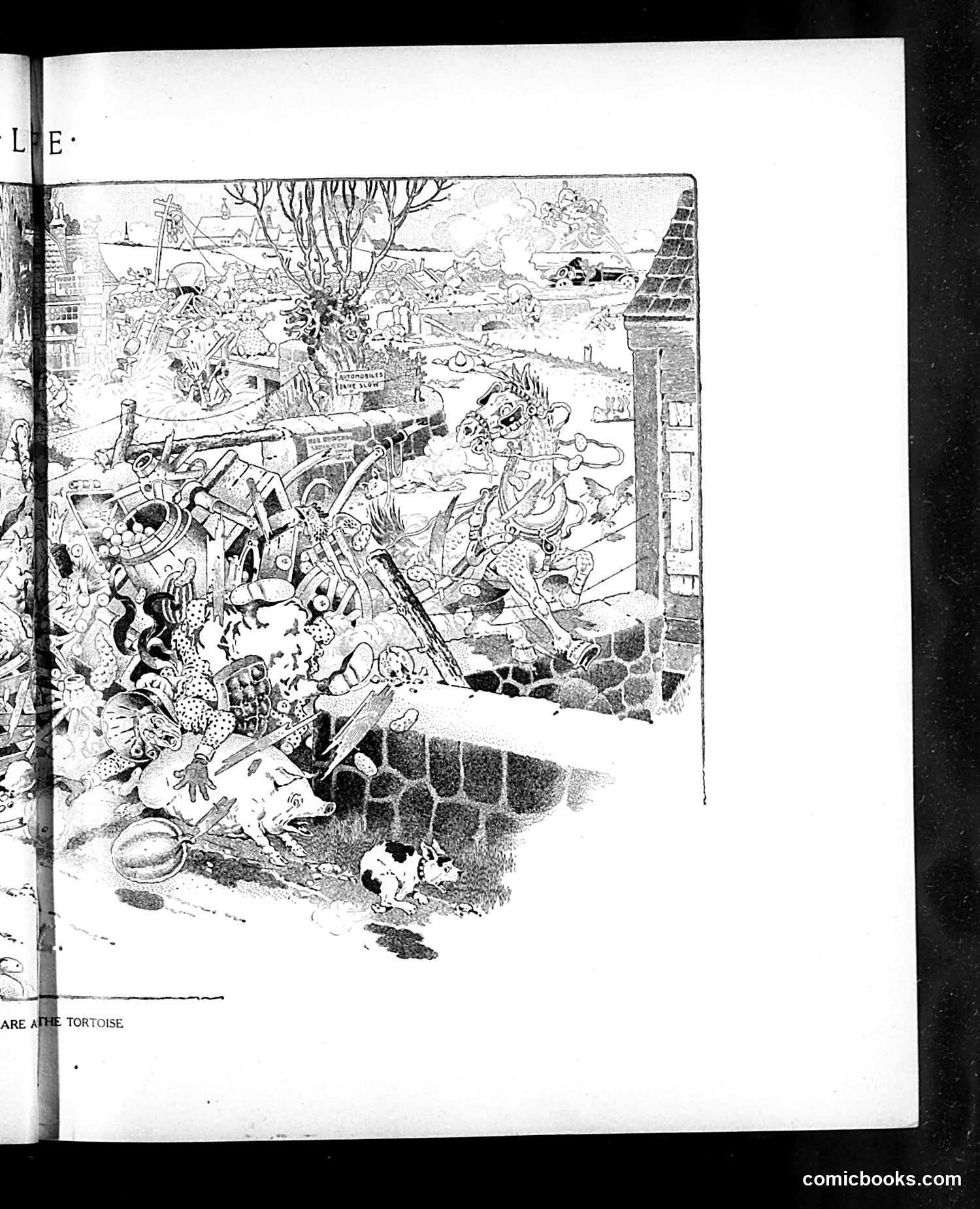
This appears to be a satirical illustration depicting a chaotic battle or conflict scene. The image shows numerous figures engaged in combat around fortifications, with cannons, weapons, and military activity scattered throughout a landscape. The caption references "THE TORTOISE," suggesting this may be an Aesop's Fables reference—possibly satirizing slow military progress or a lengthy conflict. The densely packed, frenzied composition emphasizes chaos and disorder in warfare. Without clearer text or date attribution visible, I cannot definitively identify the specific historical conflict being satirized. The style and print quality suggest late 19th or early 20th-century American satire from *Life* magazine, but the specific political or military event remains unclear from this page alone.
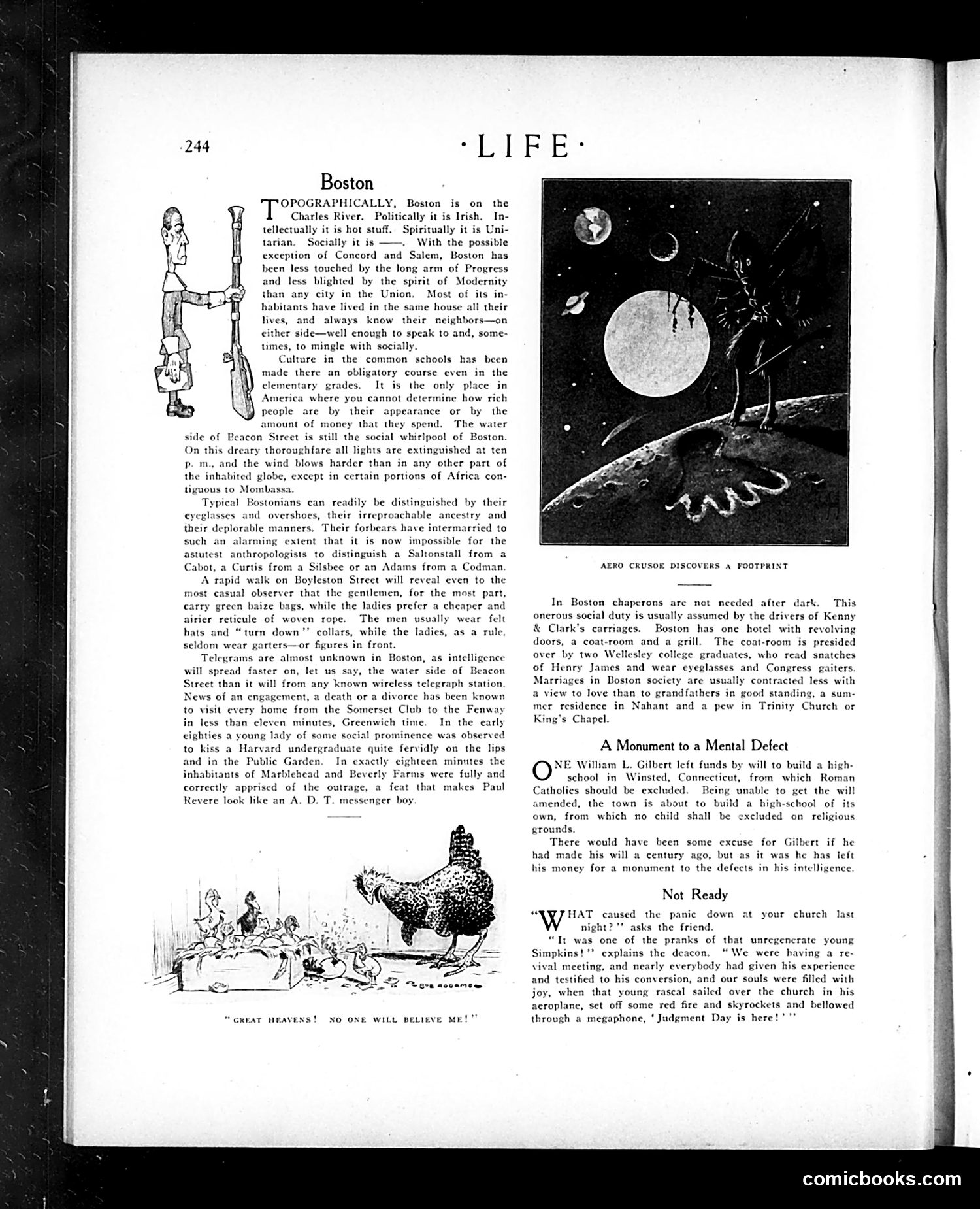
This page satirizes Boston society through exaggerated social commentary. The main text mockingly describes Bostonians as intellectually pretentious yet socially backward—obsessed with ancestry (families so intermarried that genealogists cannot distinguish Saltonstalls from Cabots), wearing conspicuous markers of old money (green baize bags, eyeglasses, overshoes), and conducting marriages based on grandfather prominence rather than love. The cartoon below depicts a rooster with the caption "Great Heavens! No one will believe me!"—likely mocking Bostonian gossip culture, which the text emphasizes spreads faster than telegrams (news travels eighteen minutes to Marblehead). The "Aero Crusoe Discovers a Footprint" illustration appears unrelated, possibly continuing a serialized story. The final section ridicules William L. Gilbert's will excluding Catholics from his Connecticut school—calling it "a monument to mental defect"—suggesting his religious prejudice reflects intellectual inadequacy rather than principle.
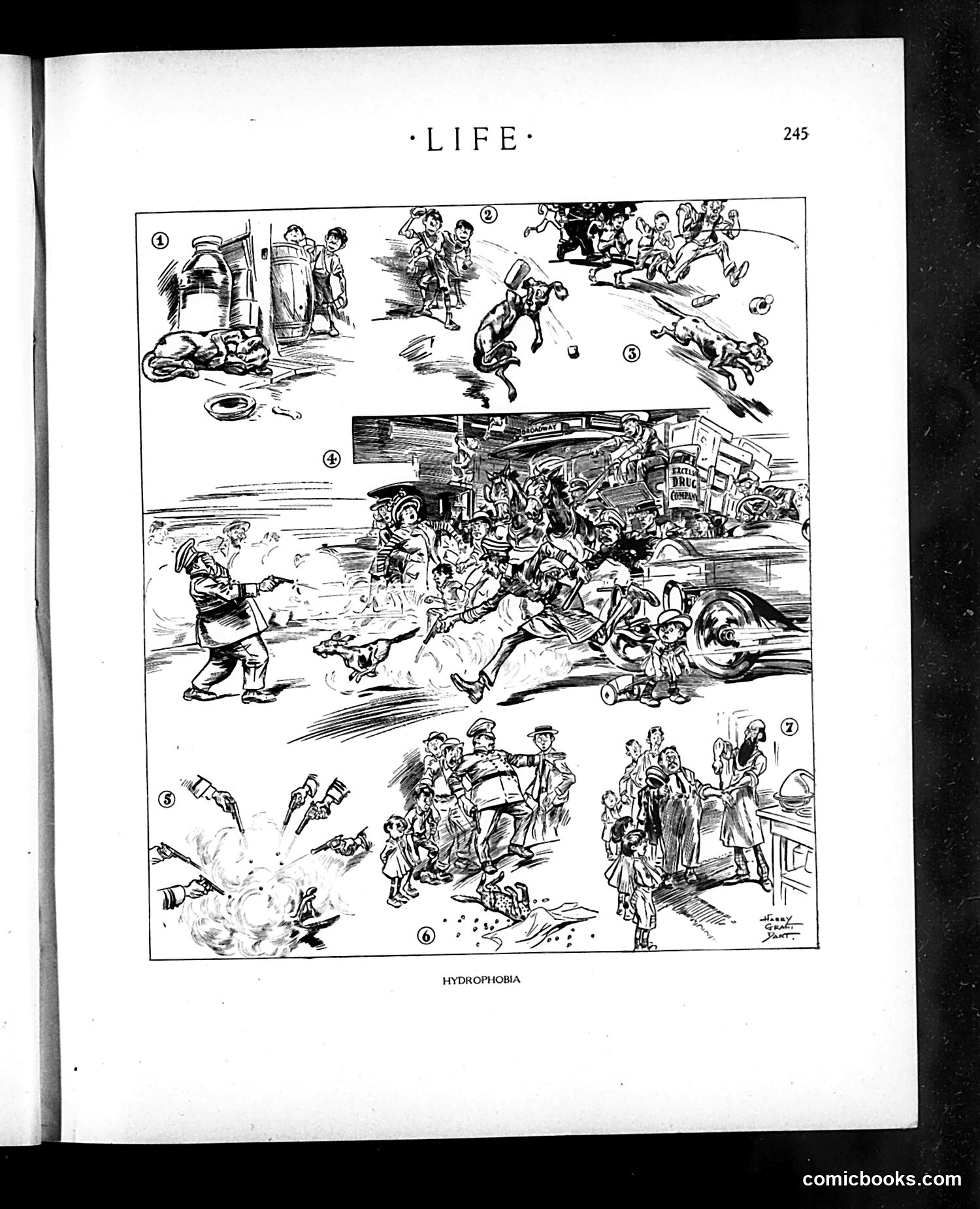
This is a satirical comic strip illustrating the phobia of water (hydrophobia). The numbered panels depict increasingly absurd scenarios where people avoid water or panic around it: Panel 1 appears to show someone avoiding a puddle or water source. Panels 2-3 show chaotic scenes of people fleeing or reacting fearfully. Panel 4 depicts a large crowded scene near what appears to be a beach or waterfront, with people in disarray. Panel 5 shows someone actively avoiding water contact. Panel 6 features an explosion or violent reaction to water. Panel 7 shows what appears to be an indoor domestic scene with water-related anxiety. The satire mocks irrational fear of water through exaggerated physical comedy and visual escalation, typical of early 20th-century Life magazine humor.
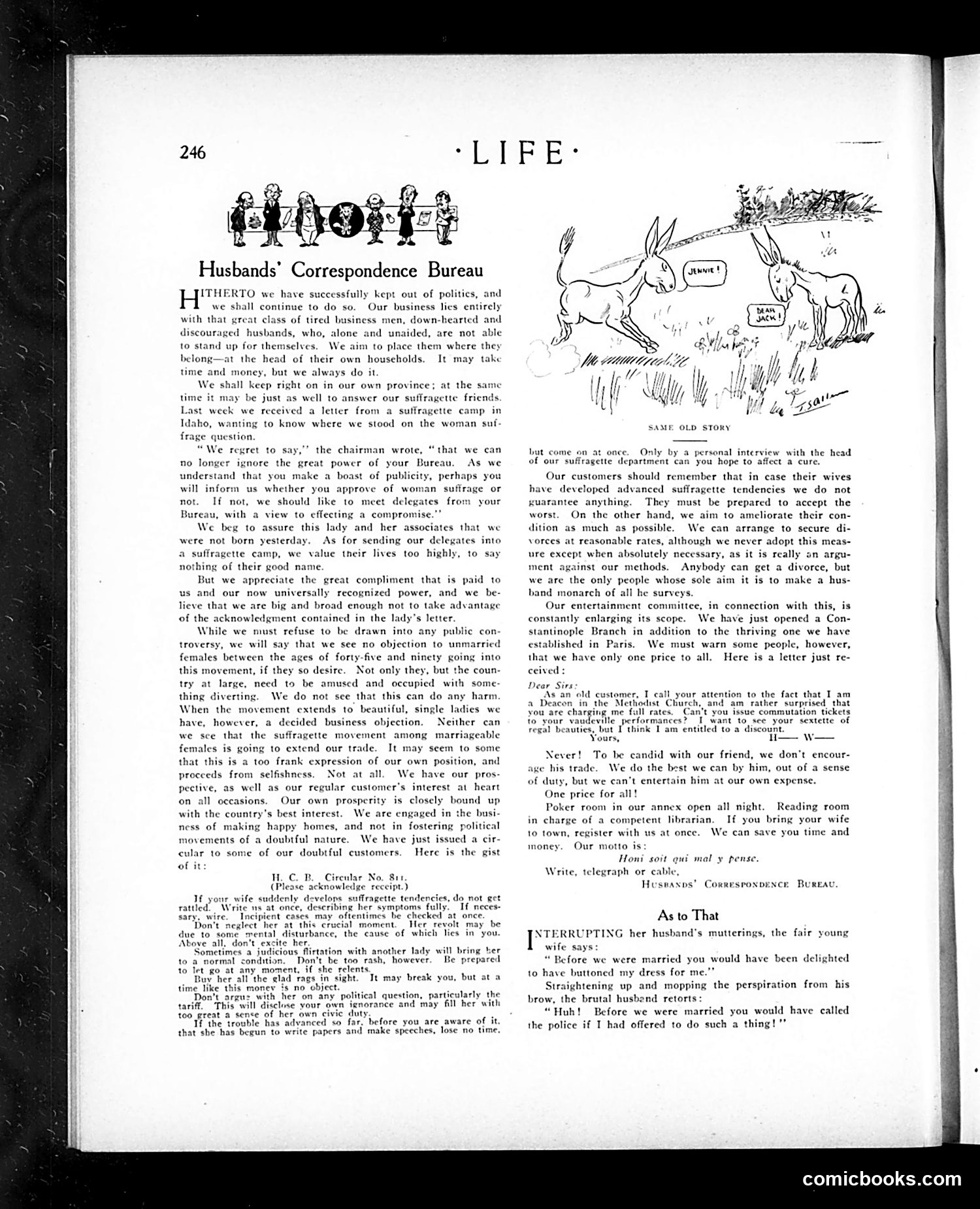
This page satirizes early 20th-century gender politics and the women's suffrage movement. The "Bureau" is a fictional service that helps husbands reassert domestic dominance over their wives—presented as their proper role. The satire mocks anti-suffrage arguments by having the Bureau sardonically claim they don't interfere in politics, only in keeping wives subordinate at home. When suffragettes challenge them, the Bureau dismissively suggests the movement is merely entertainment for unmarried women over 45, revealing the sexist logic: women's rights activism is acceptable only when it doesn't threaten marriages or the male-headed household. The "circular" offers comedic advice to husbands whose wives develop "suffragette tendencies"—framing women's political interest as a mental disturbance requiring "treatment" through flirtation, shopping, or avoiding political discussion. The cartoon shows rabbits labeled with suffrage-related topics, supporting the overall message that such movements are absurd. The satire targets both the suffragettes and, more sharply, the attitudes of men who viewed women's political engagement as a threat to male authority.
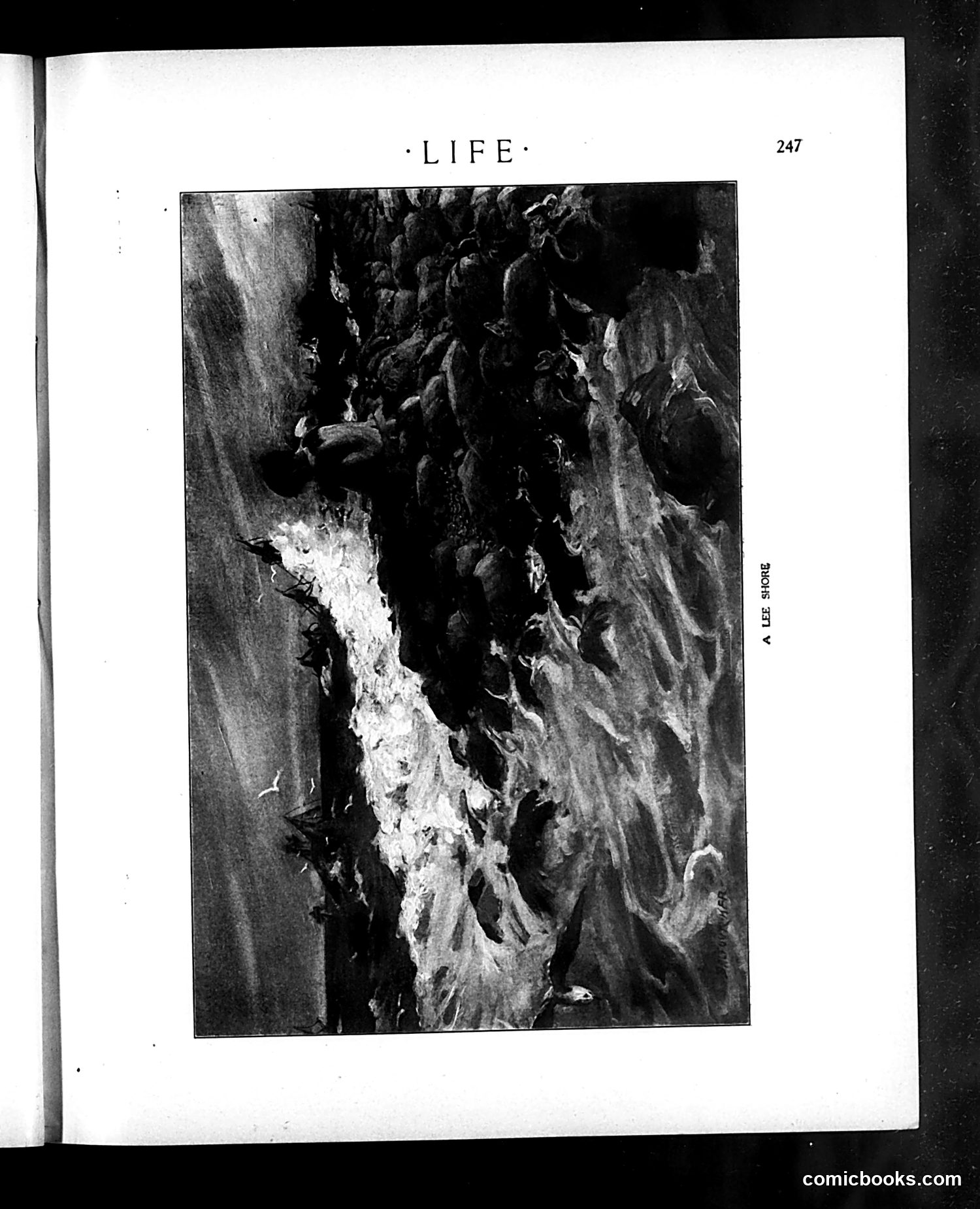
The image shows a dark, dramatic black-and-white photograph or artwork rather than a traditional cartoon. It appears to depict figures in some kind of chaotic or violent scene, possibly with flames or smoke, but the details are too obscured and low-contrast to identify specific individuals or read any accompanying text clearly. Without legible captions, labels, or clearer imagery, I cannot reliably identify the figures, determine the historical event being referenced, or explain the satirical intent. The OCR text provided ("comicbooks.com") appears to be a watermark rather than page content. To accurately analyze this Life magazine page, I would need either a clearer image or visible text identifying the subject matter and date of publication.
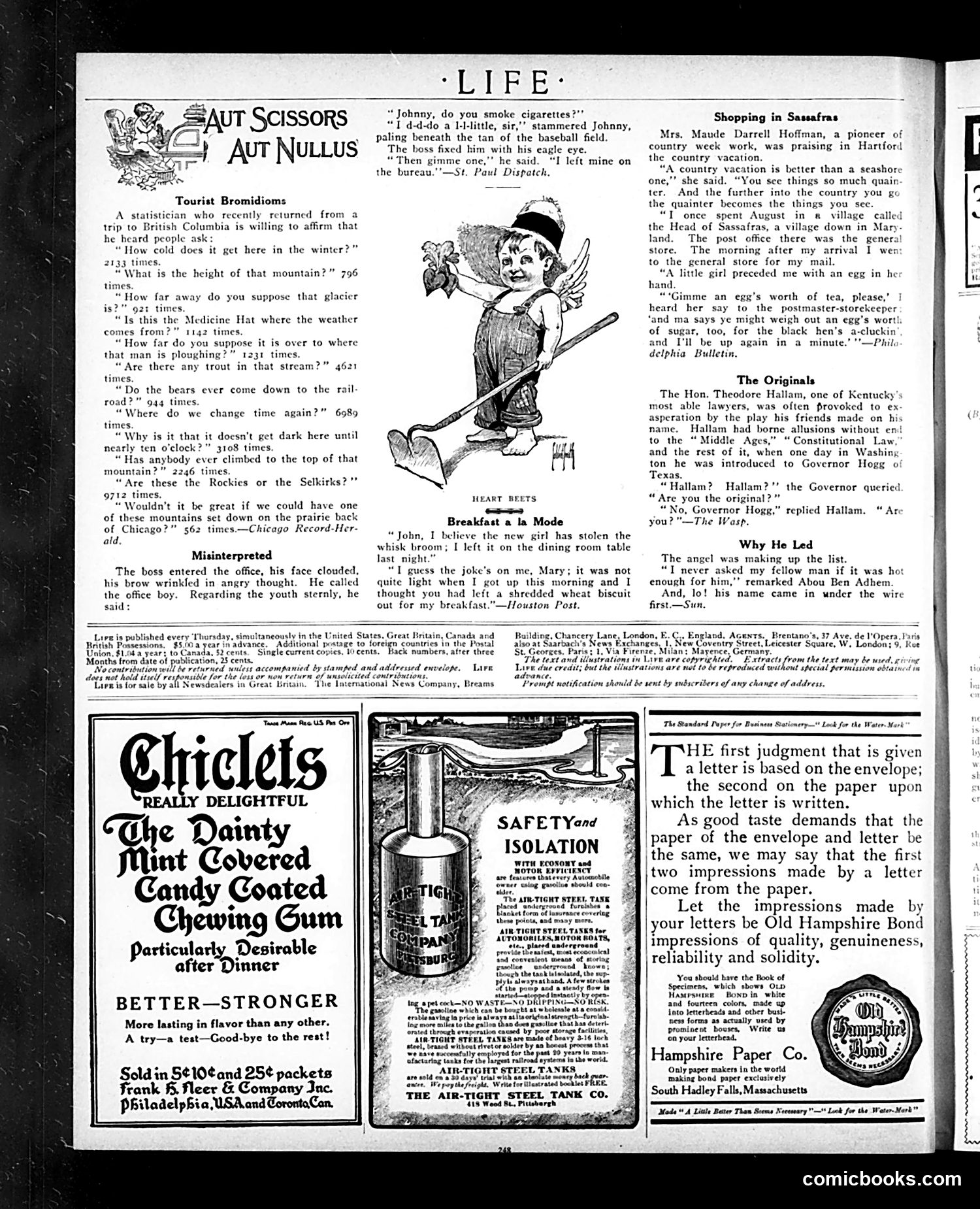
This page from *Life* magazine contains humor pieces typical of early 20th-century American satire: **"Tourist Bromidiums"** mocks tired clichés tourists repeat in British Columbia—the same predictable questions asked thousands of times (e.g., "How cold does it get?" 2,133 times; "Are these the Rockies or Selkirks?" 9,712 times). The satire targets tourist banality and regional stereotypes. **"Misinterpreted"** is a workplace joke where a boss mishears the office boy's stammering admission about smoking as permission to take a cigarette the boss left on his desk. **"Breakfast à la Mode"** plays on a wife's accusation that a new maid stole a whisk broom—the husband jokes he thought it was a shredded wheat biscuit left for him. **"The Originals"** features Theodore Hallam, a Kentucky lawyer repeatedly subjected to puns on his name (Medieval/constitutional law references). When introduced to Texas Governor Hogg, Hallam turns the table with wordplay. The page emphasizes gentle domestic and social humor rather than political satire, reflecting *Life*'s focus on manners and everyday absurdities.
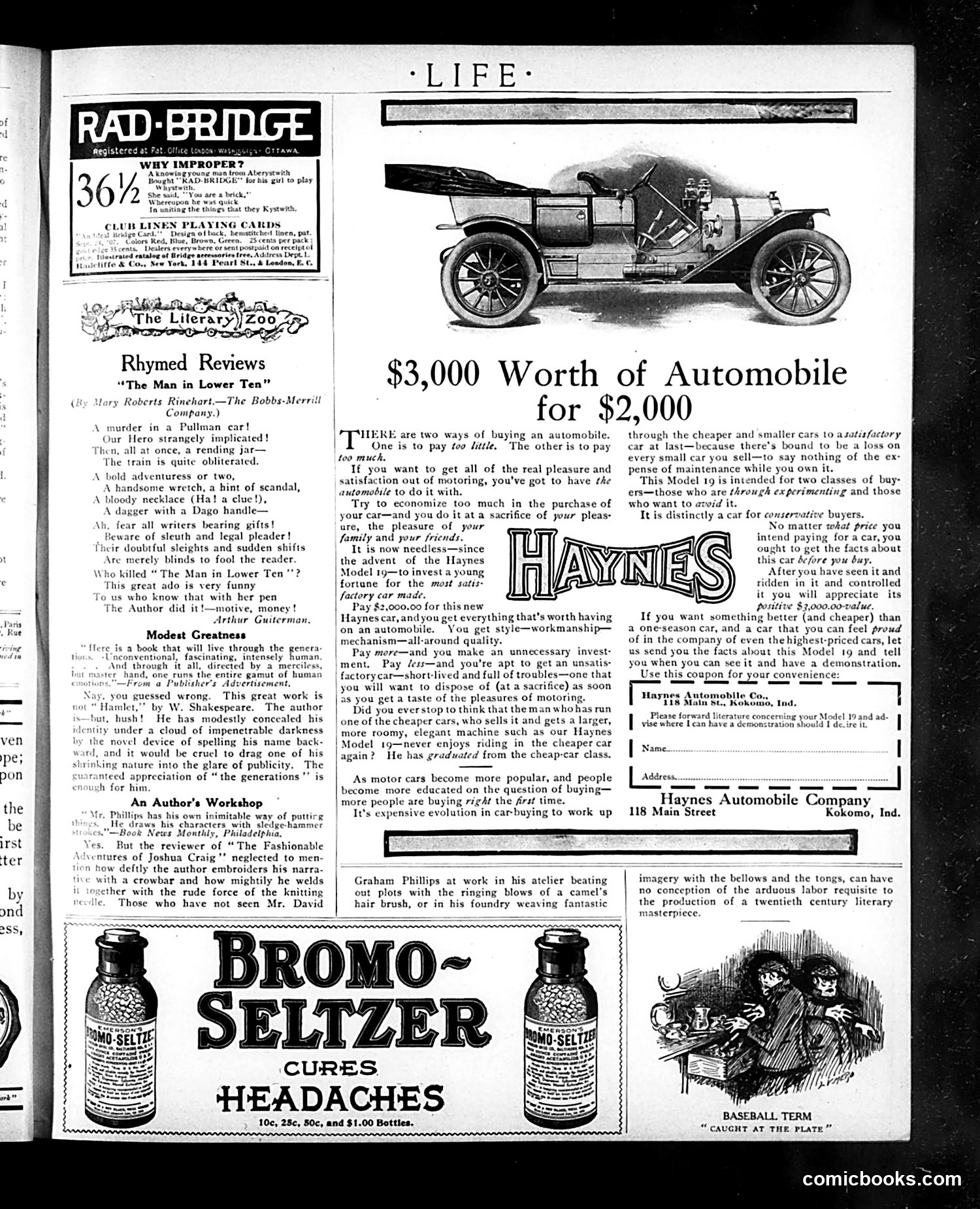
This page is primarily **advertising-focused**, with the main content being a Haynes automobile advertisement claiming "$3,000 Worth of Automobile for $2,000." ## Key Elements: **The Haynes Ad**: Argues that buying a car involves choosing between overpaying and underpaying. The Model 19 supposedly offers premium quality at mid-range cost—targeting "conservative buyers" who want reliability without excessive expense. The pitch emphasizes that cheaper cars prove costly through maintenance and depreciation. **"Rad Bridge" Card Game Ad**: A modest advertisement for playing cards, with a mildly risqué joke about an improper gift ("knowing young man"). **Literary Content**: Book reviews and author commentary, including discussion of a mystery novel "The Man in Lower Ten" and analysis of literary works by Arthur Guiterman and others. **Bromo-Seltzer Ad**: A small patent medicine advertisement at page bottom. For modern readers: This reflects early 1900s consumer culture where automobiles were luxury items, and magazines relied heavily on advertisements. The Haynes pitch is essentially modern marketing—positioning a mid-market product as smart consumption that avoids both cheap and expensive extremes.
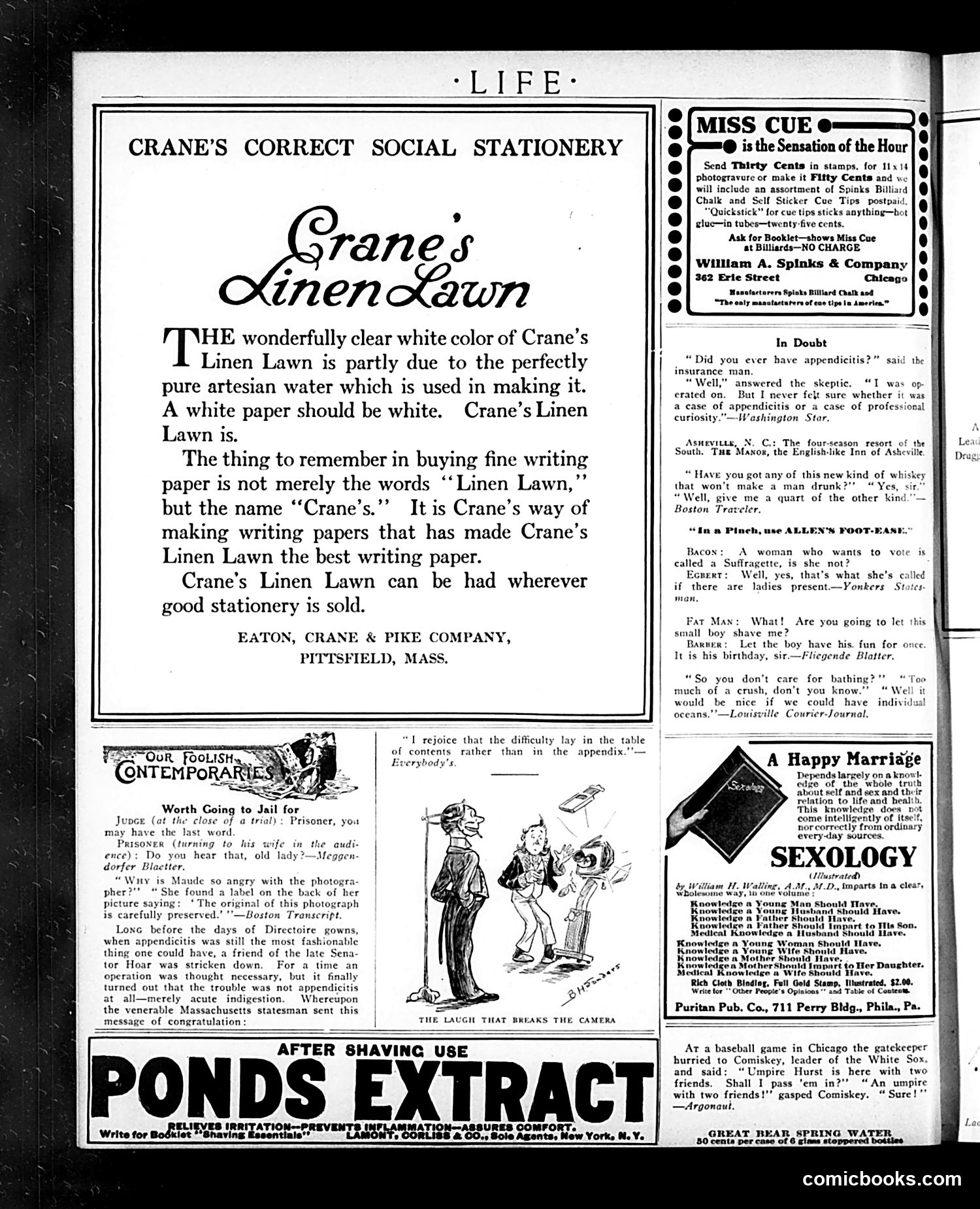
This page is primarily **advertising**, with small humorous filler content typical of early 20th-century magazines. The main advertisement promotes **Crane's Linen Lawn stationery**, emphasizing its pure white color and quality as a mark of social respectability—reflecting the era's concern with "correct social stationery" for formal correspondence. The cartoon section, "Our Foolish Contemporaries," collects brief jokes from other publications, mostly playing on contemporary anxieties: **appendicitis** (then fashionable as a diagnosis), **photography** (new technology causing vanity concerns), and **whiskey quality**. One anecdote references Senator Hoar, a recognizable Massachusetts politician of that time. Additional ads include **Pond's Extract** (a popular patent remedy), **Miss Cue billiards product** (capitalizing on women's emerging public activities), and **Sexology** (a self-help book addressing marital concerns). The humor is gentle, class-conscious satire targeting urban middle-class pretensions and modern anxieties rather than sharp political commentary.
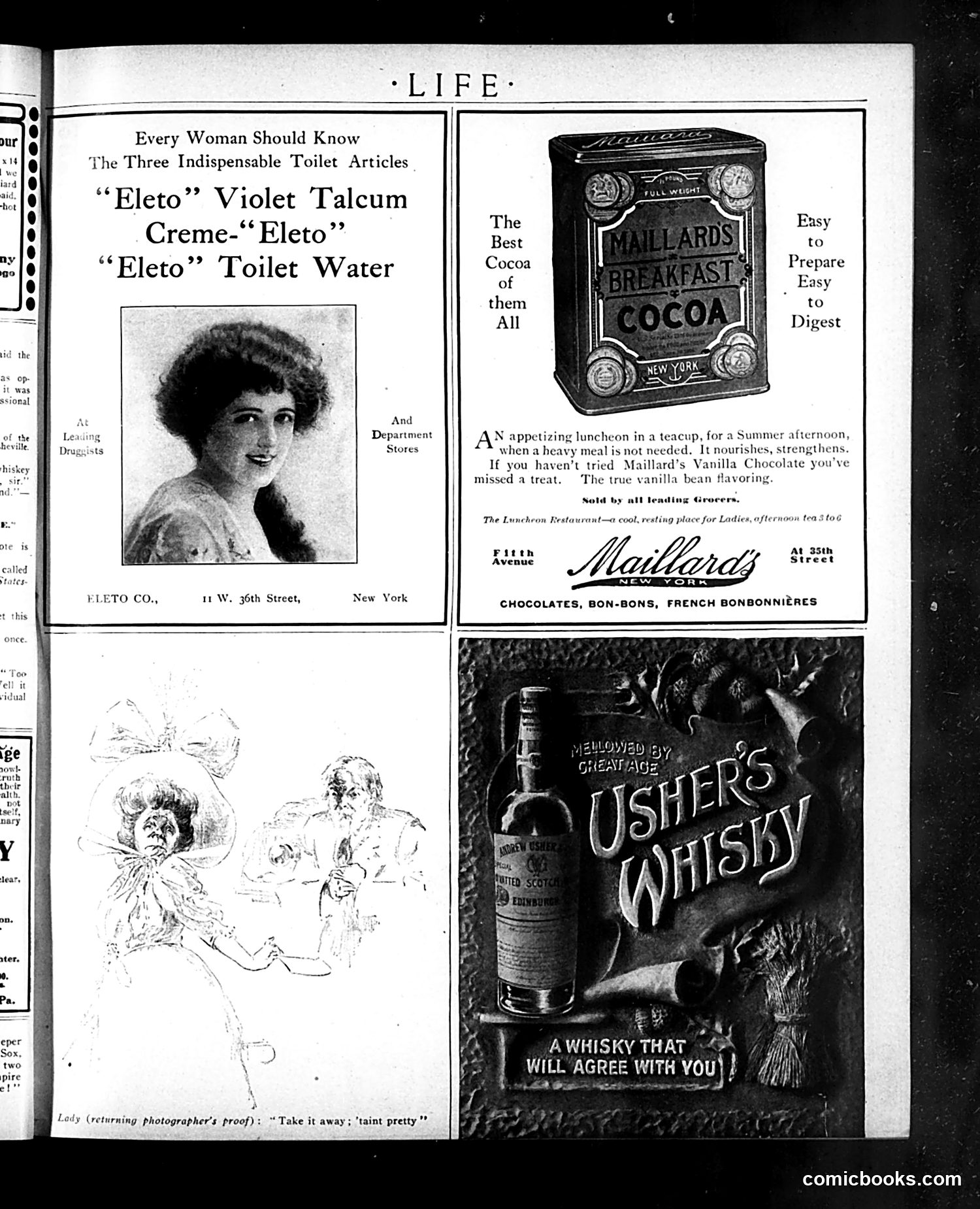
This page consists primarily of **advertisements**, not political satire. The content includes: 1. **Eleto toiletries ad** (top left): Promotes three "indispensable" beauty products for women—talcum creme and toilet water—reflecting early 20th-century beauty marketing. 2. **Maillard's Cocoa ad** (top right): Advertises chocolate/cocoa as a light, nourishing luncheon option, emphasizing the "Luncheon Restaurant" as a ladies' social space. 3. **Cartoon sketch** (bottom left): Shows caricatured figures with the caption "Take it away; 'taint pretty," suggesting satirical commentary on photographer's proofs, though the specific reference is unclear. 4. **Usher's Whisky ad** (bottom right): Promotes Scottish whisky with the tagline "A whisky that will agree with you"—likely targeting male consumers. The page reflects **period advertising aimed at gendered consumer markets**: beauty and refined dining for women, alcohol for men.
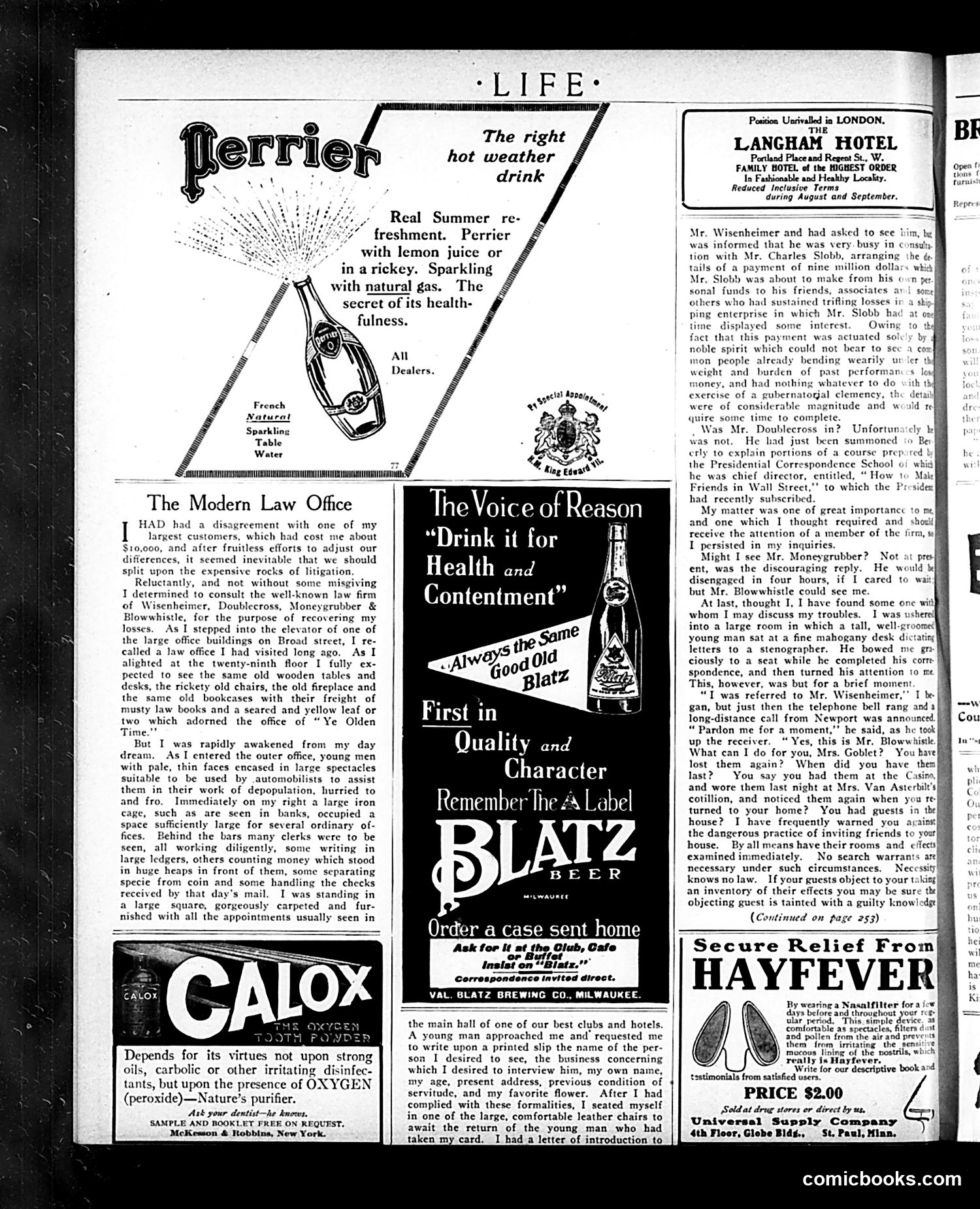
This page features a satirical narrative mocking modern law firms' pretentious transformation. The story describes visiting a prestigious law office expecting "Ye Olden Time" with rustic wooden furniture, but instead finding an operation resembling a bank—complete with iron cages, clerks counting enormous money heaps, and clerks handling checks. The satire targets the commercialization and depersonalization of legal practice. The narrative voice is deliberately obtuse, noting lawyers now require clients to fill forms listing their "previous condition of servitude" and "favorite flower"—absurd bureaucratic additions. The punchline involves a lawyer (Wisenheimer) being too busy arranging a wealthy client's (Charles Slobb) nine-million-dollar charitable gift to see the narrator, satirizing how modern law firms prioritize wealthy clients' interests over ordinary people's legitimate disputes. The broader critique: law has become a money-obsessed business more concerned with the wealthy's financial maneuvering than actual justice.
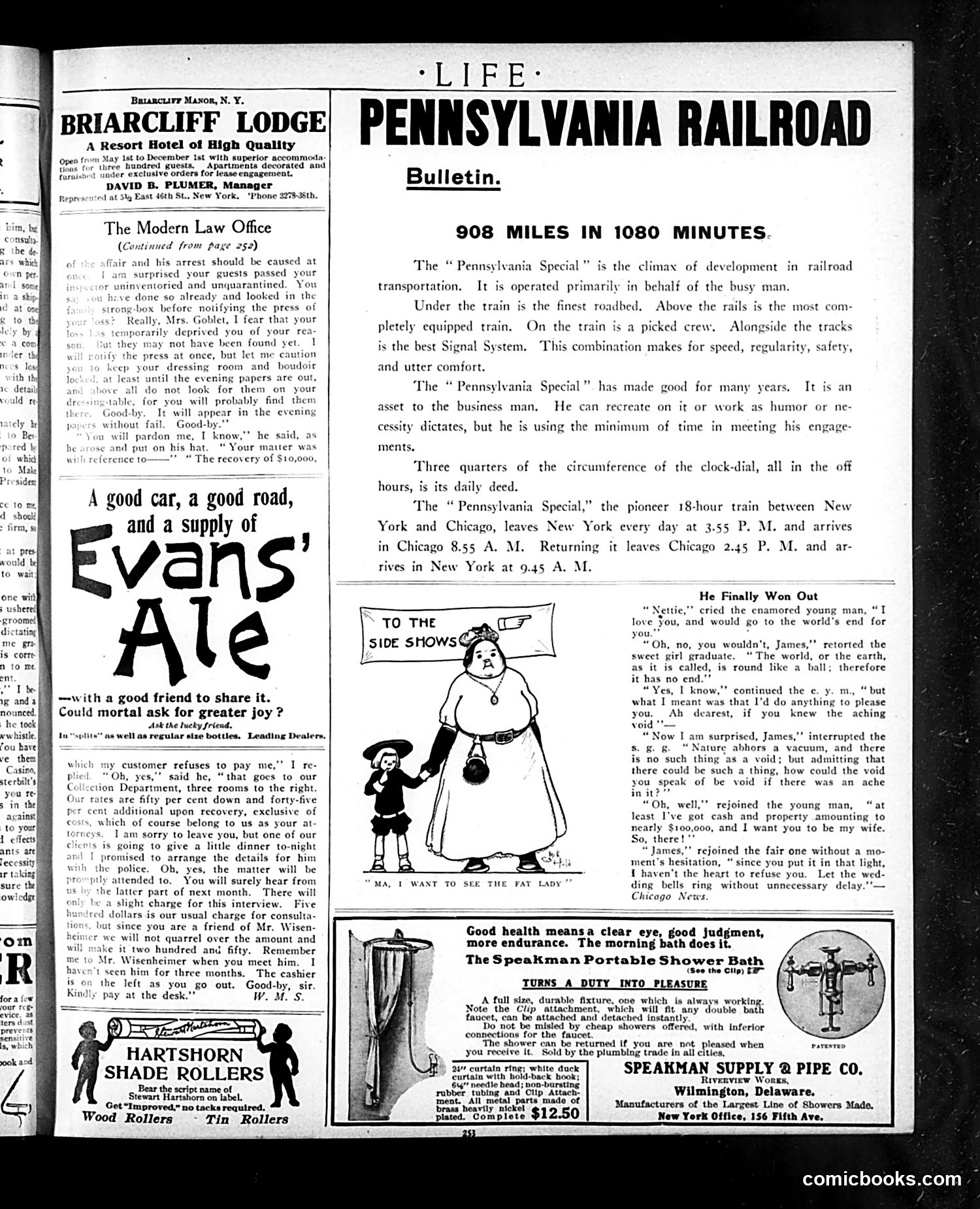
This page contains primarily **advertisements and light humor** rather than political satire. The main content includes: 1. **Pennsylvania Railroad advertisement** promoting the "Pennsylvania Special" train (908 miles in 1080 minutes between New York and Chicago)—emphasizing speed and efficiency for businessmen. 2. **Evans' Ale advertisement** with a simple slogan about quality products. 3. **"He Finally Won Out"** — a brief romantic comedic story where a young man persists in courting a skeptical woman who counters his romantic declarations with logical arguments (the earth has no "end," there's no such thing as a "void"). He ultimately wins by offering practical support. 4. **Product advertisements** for Hartshorn Shade Rollers and the Speakman Portable Shower Bath. The cartoons are minimal—mainly illustrative rather than satirical. The page reflects early 20th-century Life magazine's mix of light entertainment, courtship humor, and business-focused advertising. No significant political commentary is present.
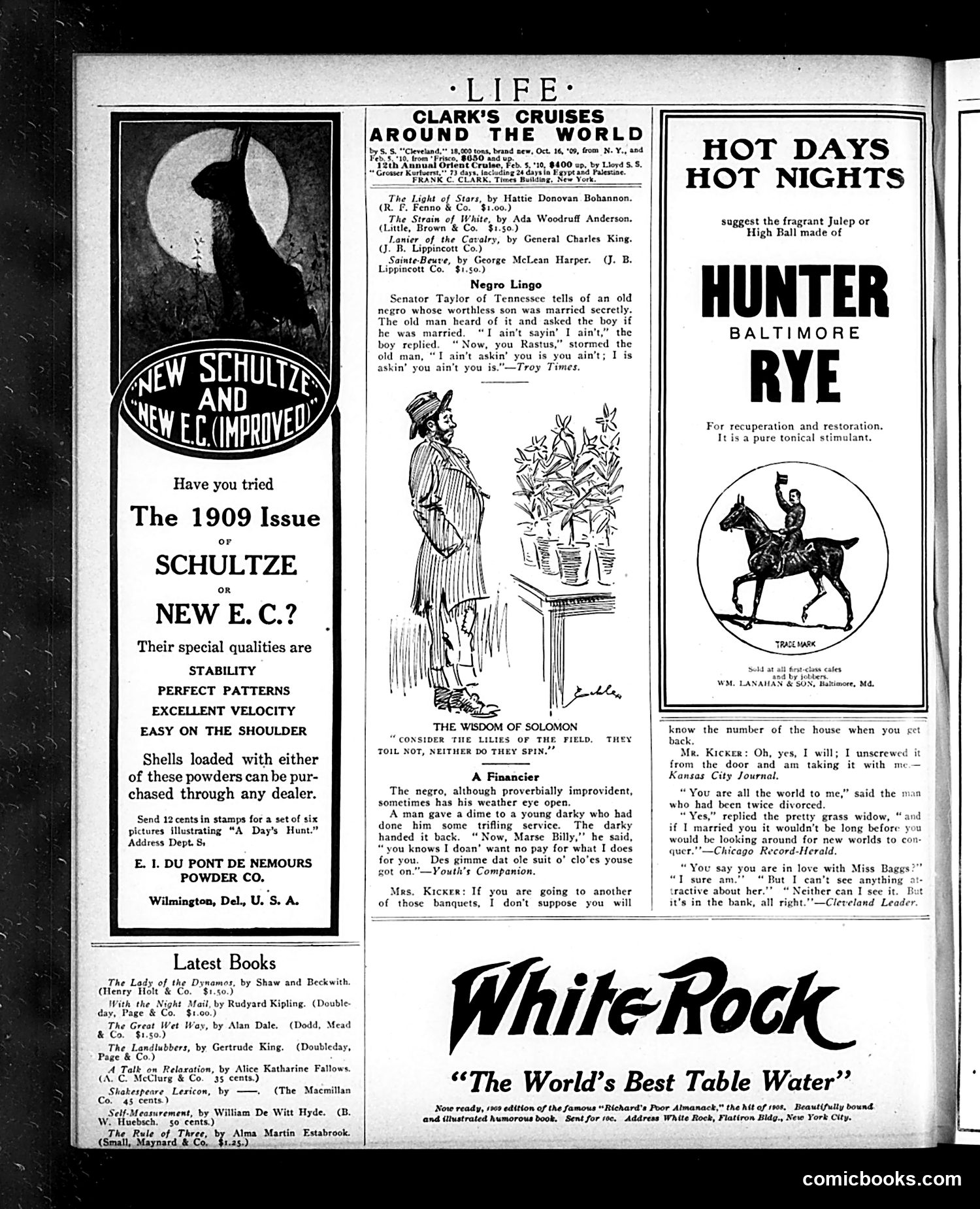
This is primarily an **advertising and book review page** rather than editorial satire. The main elements are: **Advertisements:** - **Du Pont Powder Company**: Promotes 1909 ammunition ("Schultze" and "New E.C." brands) with claimed superiority in stability, accuracy, and recoil management. This reflects early 1900s hunting culture. - **Hunter Baltimore Rye**: Whiskey ad marketing itself as restorative, targeting hot-weather consumption. - **White Rock water**: Claims to be "The World's Best Table Water." **Humorous Content:** The page includes brief comedic anecdotes—some employing **racial stereotypes typical of the era**. One titled "Negro Lingo" features dialect humor about a freedman negotiating wages. Another titled "The Wisdom of Solomon" uses similar stereotyping around a financial transaction. **Book Reviews:** Lists recently published titles with publishers and prices ($1-$1.50 range). The racial material reflects **period attitudes** but isn't presented as explicit satire—rather as stock humor conventions of 1909 Life magazine. The page overall documents early 20th-century consumer culture and publishing.
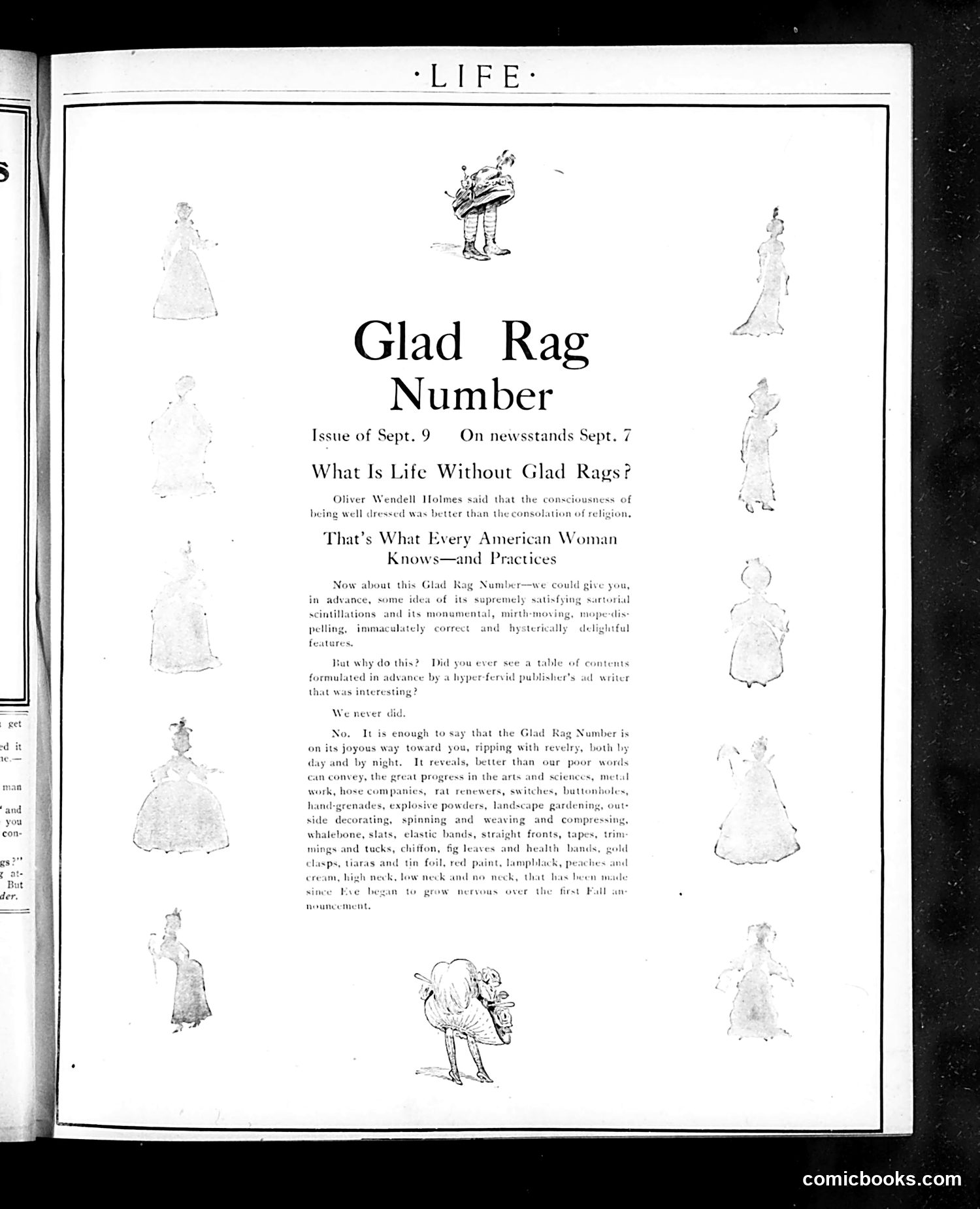
This is a promotional page for *Life* magazine's "Glad Rag Number" (issue of September 9), celebrating women's fashion and grooming. "Glad rags" is period slang for stylish clothing. The page uses satirical humor typical of early 20th-century *Life* magazine. It opens with an Oliver Wendell Holmes quote suggesting that feeling well-dressed provides psychological satisfaction equal to religion—mocking both excessive materialism and the earnestness of the quote itself. The illustrations show women in various fashionable dresses arranged around the text. The satire lies in the breathless catalog of fashion details (corsets, switches, explosives powder, "fig leaves," health bands) presented as if they're profound scientific achievements. The joke targets both the fashion industry's marketing hype and women's supposed obsession with appearance, presented in the irreverent, mocking tone *Life* was known for.
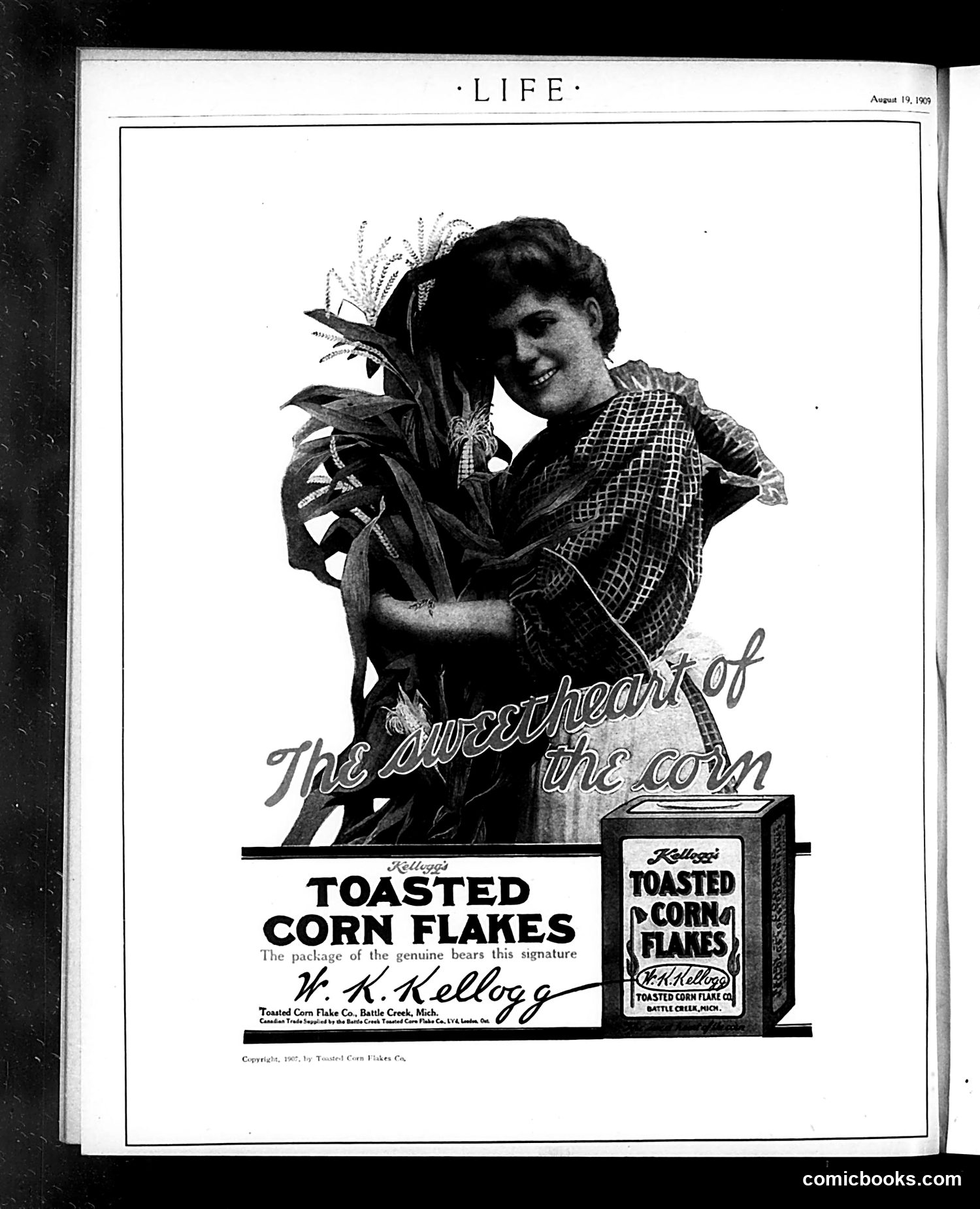
This is a **Kellogg's Toasted Corn Flakes advertisement**, not a political cartoon. It appears from the August 19, 1909 *Life* magazine and shows a young woman in a checkered dress holding a corn stalk, smiling at the viewer. The tagline reads "The Sweetheart of the Corn." The ad emphasizes the product's authenticity by featuring W.K. Kellogg's signature on the cereal box, positioned prominently beside the image. This early 20th-century marketing strategy used an attractive female figure and romanticized agricultural imagery to appeal to consumers, associating the breakfast cereal with wholesome American farming values and natural ingredients. The advertisement is a straightforward commercial promotion rather than satirical content.