
Life, 1909-08-19 · page 6 of 28
Life — August 19, 1909 — page 6: what you’re looking at
What you’re looking at
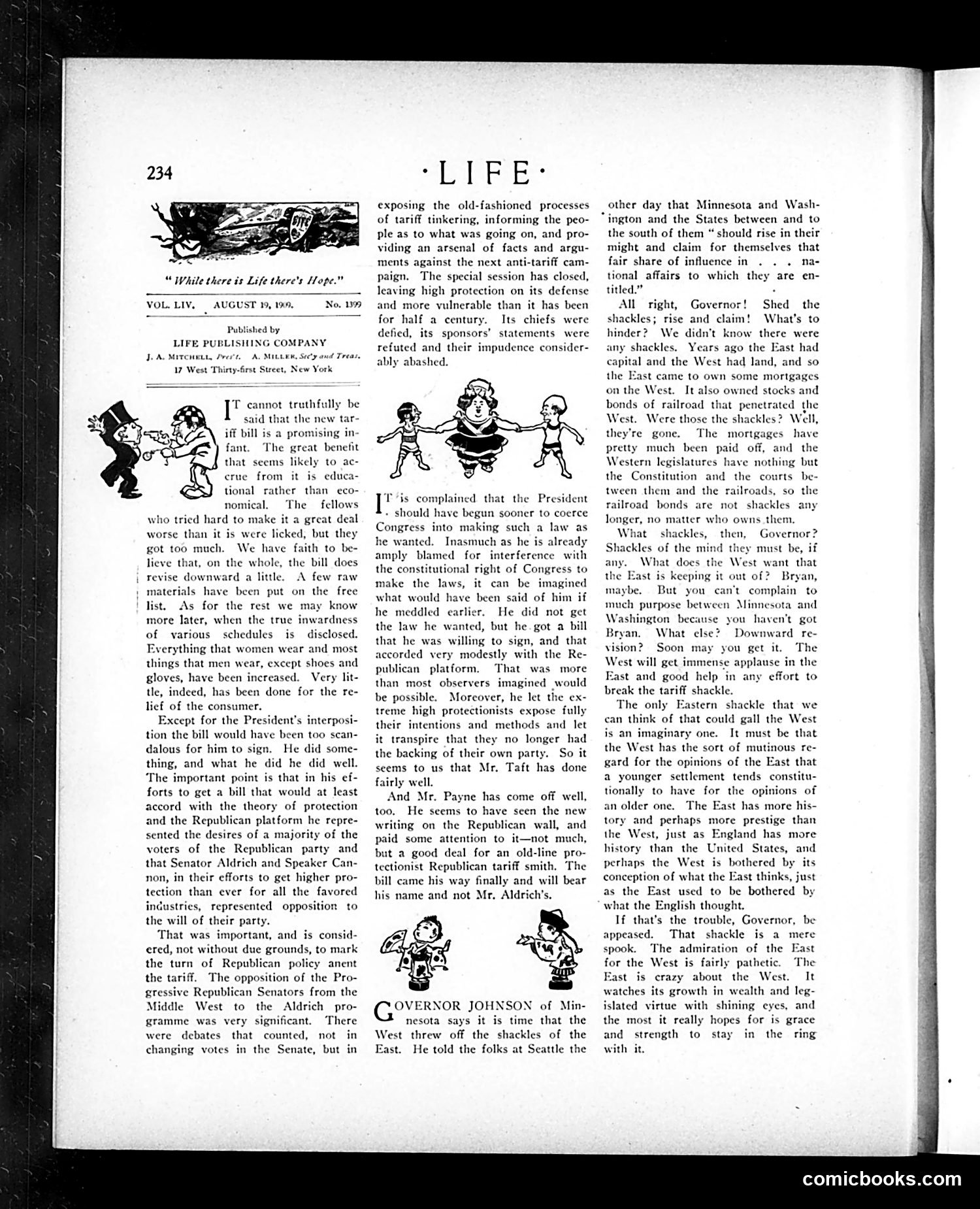
This page satirizes the tariff debate of the early 1900s. The main cartoon depicts a rotund figure (likely a wealthy industrialist or politician) being pulled in opposite directions by two smaller figures, representing competing interests in the tariff controversy. The text discusses President Taft's handling of tariff legislation and contrasts Eastern and Western perspectives. It references "shackles"—a metaphor for how tariffs constrain commerce and growth. Governor Johnson of Minnesota is mentioned as advocating the West "throw off the shackles of the East." The satire targets high-protectionist Republicans who oppose free trade, portraying the tariff debate as a struggle between Eastern industrial interests and Western agricultural/progressive ones. The cartoon visualizes this political tension through physical exaggeration and comic imagery typical of *Life* magazine's style.
📄 Transcribed text from this page (OCR, searchable)
Machine-transcribed from the original scan — historical spelling and the odd misread are preserved.
“ While there is Life there's Hope.” No. U9 VOL. LI ST 19, 190, Published by LIFE PUBLISHING COMPANY JeA MITCHELL, Pret, 17 West Thirty-first Suet, New York A. MILL, See’y end Treas. T cannot truthfully be said that the new tar- iff bill is a promising in fant. The great benefit that seems likely to ac- crue from it is tional rather than nomical. The fellows who tried hard to make it a great deal educa- eco- worse than it is were licked, but they got too much. We have faith to b lieve that, on the whole, the bill does revise downward a little. A few raw materials have been put on the free list. As for the rest we may know more later, when the true inwardness of various schedules is disclosed. Everything that women wear and most things that men wear, except shoes and gloves, have been increased. Very lit- tle, indeed, has been done for the re- lief of the consumer. Except for the President's interposi- tion the bill would have been too scan- dalous for him to sign. He did some- thing, and what he did he did well. The important point is that in his ef- forts to get a bill that would at least accord with the theory of protection and the Republican platform he repre- sented the desires of a majority of the voters of the Republican party and that Senator Aldrich and Speaker Can- non, in their efforts to get higher pro- tection than ever for all the favored industries, represented opposition to the will of their party. That was important, and is consid- ered, not without due grounds, to mark the turn of Republican policy anent the tariff. The opposition of the Pro- gressive Republican Senators from the Middle West to the Aldrich pro- gramme was very significant. There were debates that counted, not in changing votes in the Senate, but in >DlkGABS exposing the old-fashioned processes of tariff tinkering, informing the peo- ple as to what was going on, and pro- viding an arsenal of facts and argu- ments against the next anti-tariff cam- paign. The special session has closed, leaving high protection on its defense and more vulnerable than it has been for half a century. Its chiefs were defied, its sponsors’ statements were refuted and their impudence consider- ably abashed. Tis complained that the President + should have begun sooner to coerce Congress into making such a law as he wanted. Inasmuch as he is already amply blamed for interference with the constitutional right of Congress to make the laws, it can be imagined what would have been said of him if he meddled earlier. He did not get the law he wanted, but he. got a bill that he was willing to sign, and that accorded very modestly with the Re- publican platform. That was more than most observers imagined would be possible. Moreover, he let the e treme high protectionists expose fully their intentions and methods and let it transpire that they no longer had the backing of their own party. So it seems to us that Mr. Taft has done fairly well. And Mr. Payne has come off well, too. He seems to have seen the new writing on the Republican wall, and paid some attention to it—not much, but a good deal for an old-line pro- tectionist Republican tariff smith, The bill came his way finally and will bear his name and not Mr. Aldrich’s. OVERNOR JOHNSON of Min- nesota says it is time that the threw off the shackles of the He told the folks at Seattle the West East. other day that Minnesota and Wash- “ington and the States between and to the south of them “ should rise in their might and claim for themselves that fair share of influence in . . . ma- tional affairs to which they are en- titled.” . All right, Governor! Shed the shackles; rise and claim! What's to hinder? We didn’t know there were ny shackles. Years ago the East had capital and the West had land, and so the East came to own some mortgages on the West. It also owned stocks and bonds of railroad that penetrated the West. Were those the shackles? Well, they're gone. The mortgages have pretty much been paid off, and the Western legislatures have nothing but the Constitution and the courts tween them and the railroads, so the railroad bonds are not shackles any longer, no matter who owns them. W shackles, then, Governor? Shackles of the mind they must be, if any. What does the West want that the East is keeping it out of? Bryan, maybe. But you can't complain to much purpose between Minnesota and Washington because you haven't got Bryan. What else? Downward re- vision? Soon may you get it. The West will get immense applause in the East and good help in any effort to break the tariff shackle. The only Eastern shackle that we can think of that could gall the West is an imaginary one. It must be that the West has the sort of mutinous re- gard for the opinions of the East that a younger settlement tends constitu- tionally to have for the opinions of an older one. The East has more his- tory and perhaps more prestige than the West, just as England has more history than the United States, and perhaps the West is bothered by its conception of what the East thinks, just as the East used to be bothered by what the English thought. If that’s the trouble, Governor, be appeased. That shackle is a mere spook. The admiration of the East for the West is fairly pathetic. The fast is crazy about the West. It watches its growth in wealth and leg- islated virtue with shining eyes, and the most it really hopes for is grace and strength to stay in the ring with it, De- comicbooks.com