
A complete issue · 28 pages · 1909
Life — April 29, 1909
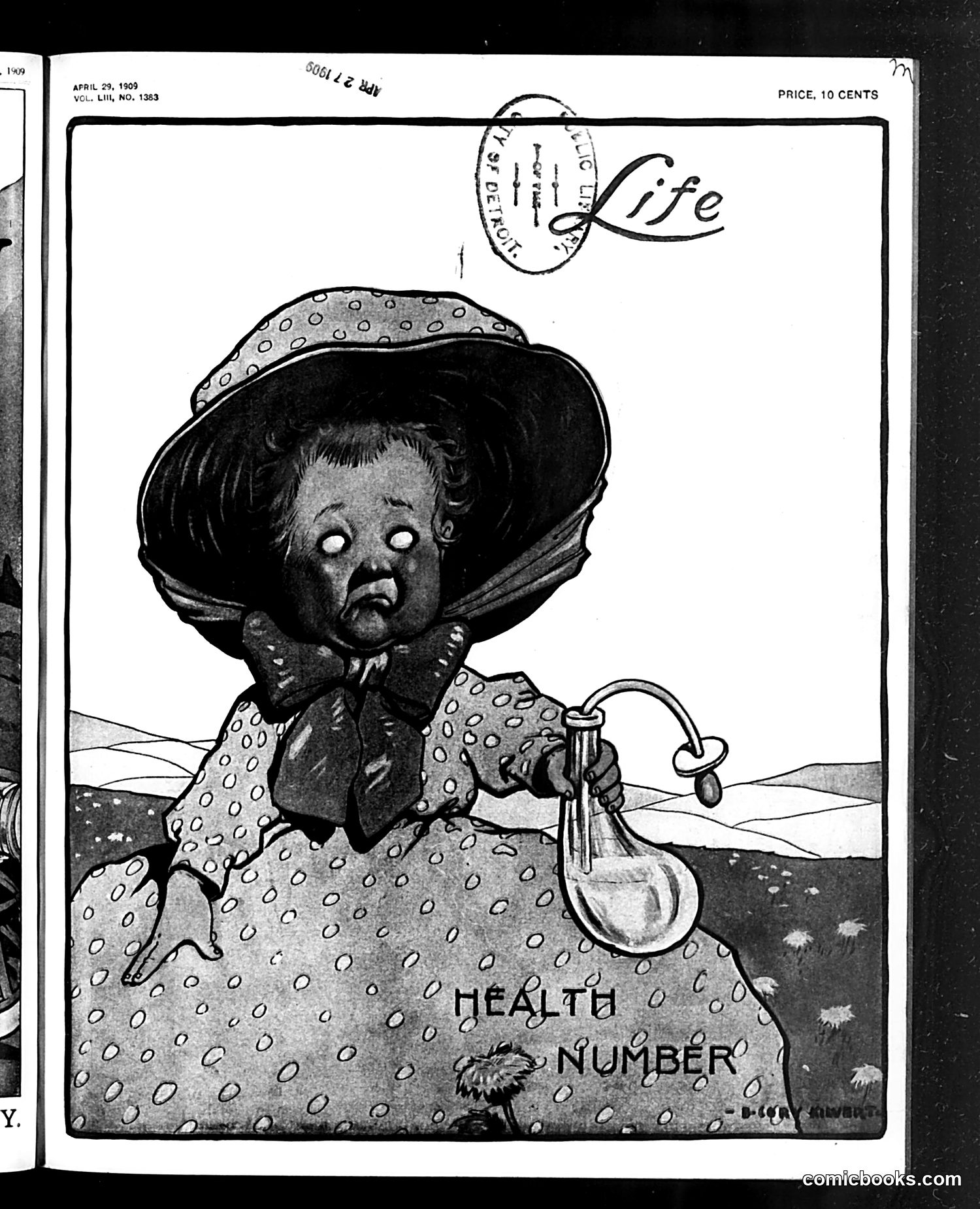
**April 29, 1909** This satirical cover depicts a caricatured figure—likely representing a woman or society type—labeled "HEALTH NUMBER," holding a purse or medical apparatus. The exaggerated features, wide hat, and polka-dotted outfit suggest mockery of contemporary fashion or health fads popular among wealthy women in the early 1900s. The satire appears to critique the era's obsession with "health" movements, patent medicines, or fashionable wellness trends among the upper classes. The grotesque facial expression and comic styling mock what Life likely viewed as pretentious or absurd health consciousness among society women. The title "Health Number" indicates this issue focused on health-related topics, using caricature to ridicule trendy health practices of the period.
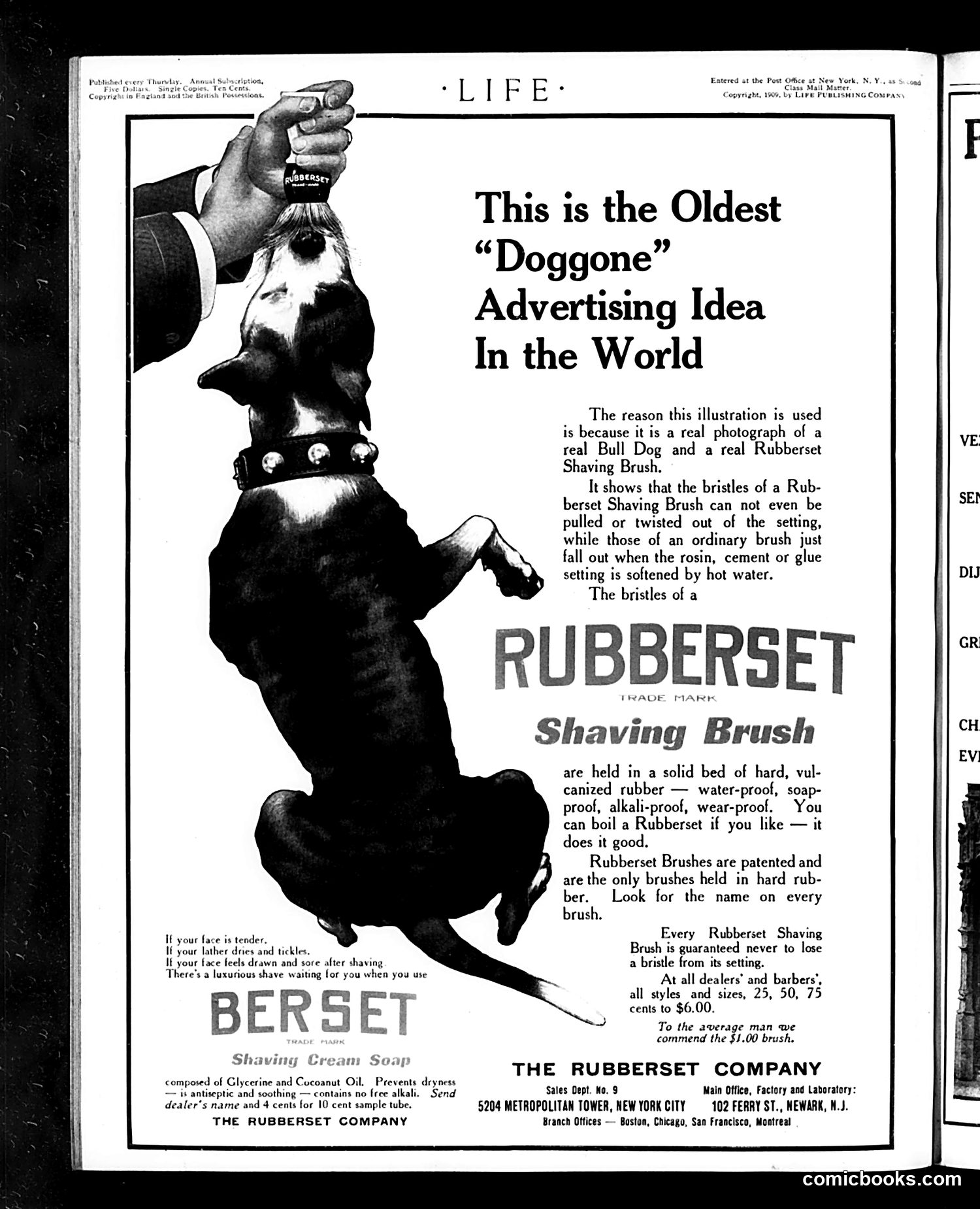
This page is **primarily an advertisement**, not satire or political commentary. The Rubberset Company is advertising their shaving brush and soap products. The "oldest doggone advertising idea in the world" refers to the visual gimmick itself—using a bull dog held aloft to demonstrate product durability. The ad claims this is an actual photograph of a real bulldog and Rubberset brush to prove the brush's bristles cannot be pulled or twisted out, unlike ordinary brushes. The accompanying text emphasizes durability: the bristles are set in vulcanized rubber that is "water-proof, soap-proof, alkali-proof, wear-proof." The page includes pricing ($1-$6) and retail information. There is no political or social satire here—it's straightforward vintage advertising using a memorable visual concept (holding a dog by its collar) to advertise grooming products.
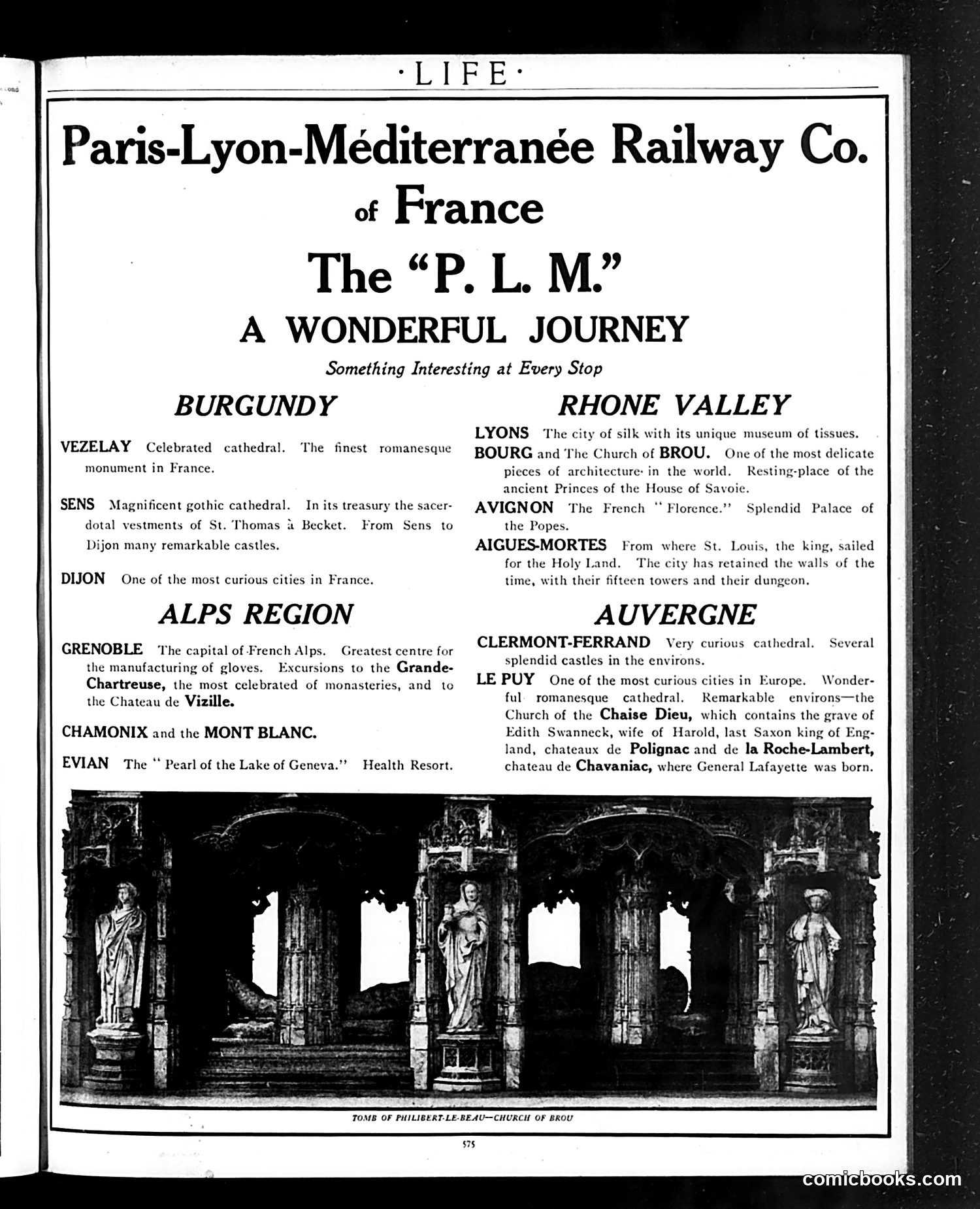
This is **not a political cartoon or satirical content**—it's a straightforward travel advertisement for the Paris-Lyon-Méditerranée Railway Company (the "P.L.M."). The page promotes a scenic railway journey through France, highlighting tourist attractions in various regions: Burgundy (cathedrals at Vezelay, Sens, Dijon), the Alps (Grenoble, Chamonix, Mont Blanc), the Rhone Valley (Lyons, Avignon), and Auvergne (Clermont-Ferrand, Le Puy). The large photograph shows the Tomb of Philibert le Beau at the Church of Brou—an architectural landmark featured along the route. This is **period travel advertising** meant to encourage rail tourism by showcasing France's historical and natural wonders. There is no satire or political commentary present.
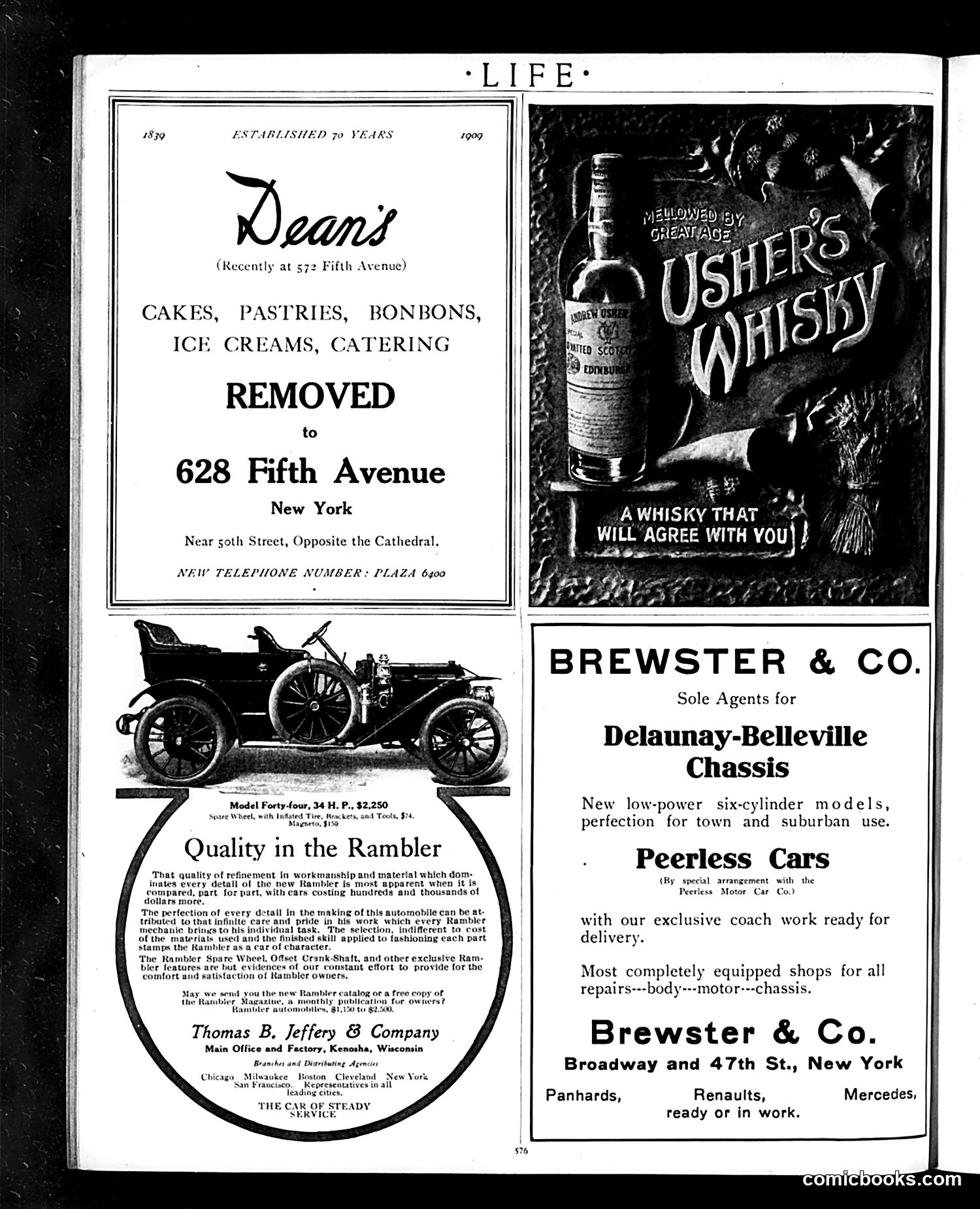
This page is primarily **advertising**, not satire or political commentary. It contains four separate ads: 1. **Dean's** (top left): A bakery/caterer announcement of a location move from 572 to 628 Fifth Avenue, New York, near 50th Street opposite the Cathedral. 2. **Usher's Whisky** (top right): A product advertisement claiming the whisky "will agree with you." 3. **Rambler automobiles** (bottom left): Promoting the "Model Forty-four" car, emphasizing quality craftsmanship and mechanical excellence. 4. **Brewster & Co.** (bottom right): Advertising as sole agents for Delaunay-Belleville chassis and "Peerless Cars," offering repair services and coach work. There is **no political cartoon or satirical content** on this page—it's a standard magazine advertising section from the early 1900s.
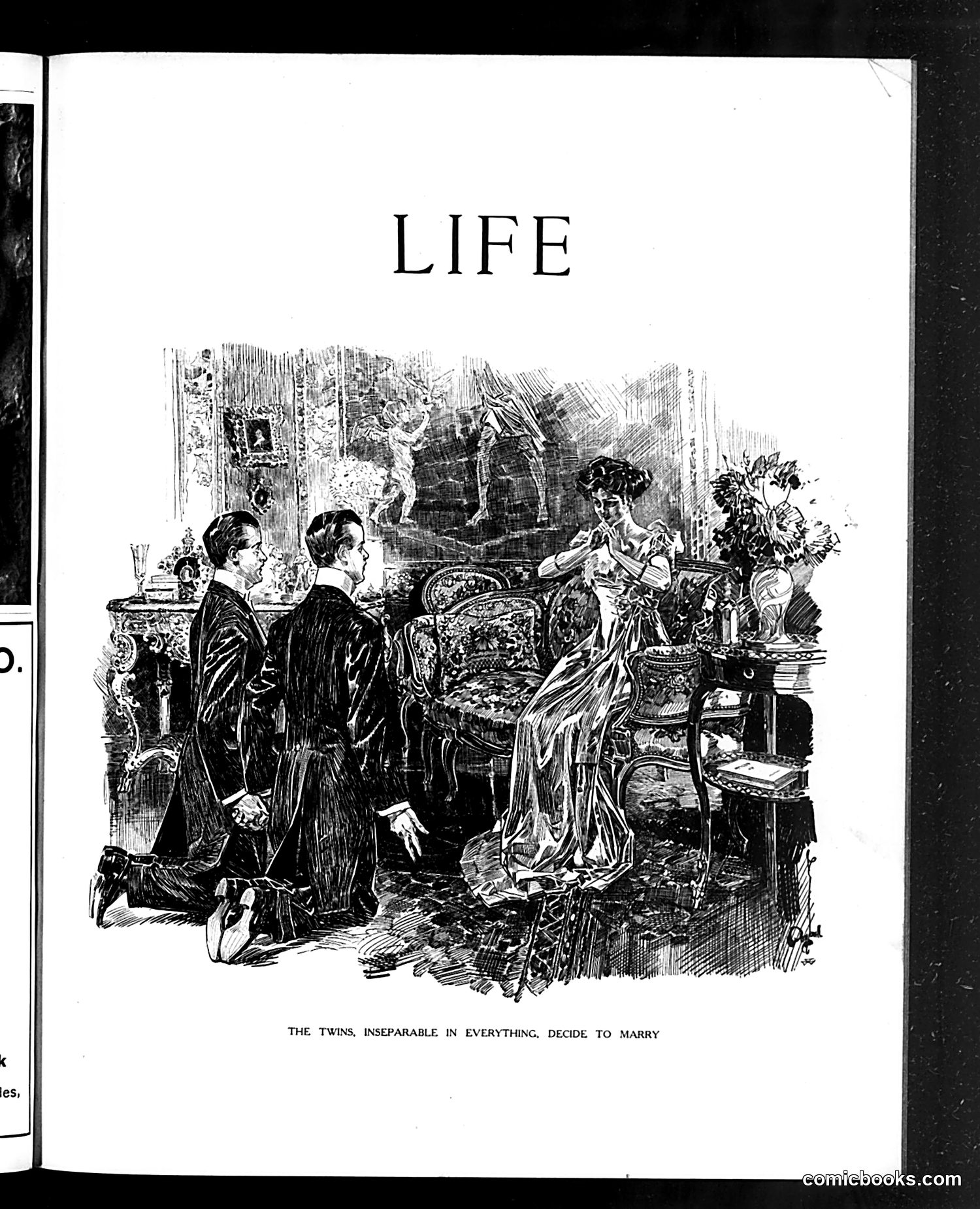
This page is titled "LIFE" and presents a satirical illustration with the caption: "THE TWINS, INSEPARABLE IN EVERYTHING, DECIDE TO MARRY." The cartoon depicts an elegant interior scene with two fashionably-dressed men in dark suits approaching a woman in a flowing gown. The satire appears to target the social phenomenon of identical twins whose close relationship prompts speculation about marriage prospects. The joke likely plays on period attitudes about twins being unusually dependent on each other—the caption's irony suggests that even marriage won't separate them, implying either their inseparable bond is comical or critiquing assumptions about their relationship. The refined artistic style and upper-class setting are typical of *Life* magazine's satirical commentary on high society social customs and conventions of the early 20th century.
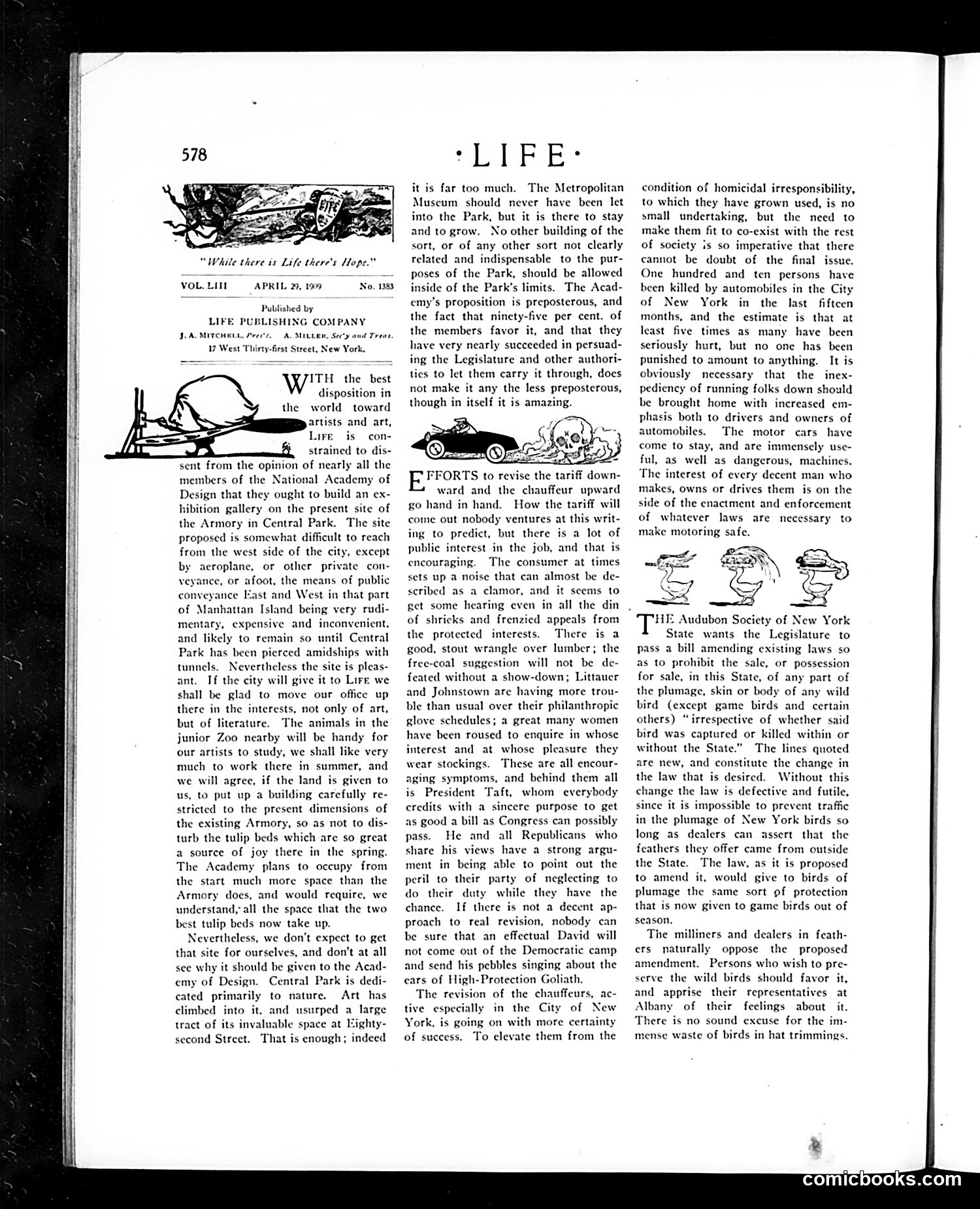
The page contains editorial commentary rather than political cartoons. The small illustrations show early automobiles and their dangers—depicted as threatening figures with skull-like imagery. The text discusses several 1909 issues: the Metropolitan Museum's expansion into Central Park (controversial), automobile safety and fatalities in New York City, tariff reform debates, and bird protection legislation. There's mention of President Taft's administrative efforts. The satirical tone critiques society's tolerance of automobile deaths while debating less urgent matters, and questions whether tariff revision will succeed despite political rhetoric. The bird protection discussion addresses plumage hunting for the millinery industry. The overall message: American priorities seem misaligned—cars kill citizens but lack regulation, while political energy focuses elsewhere.
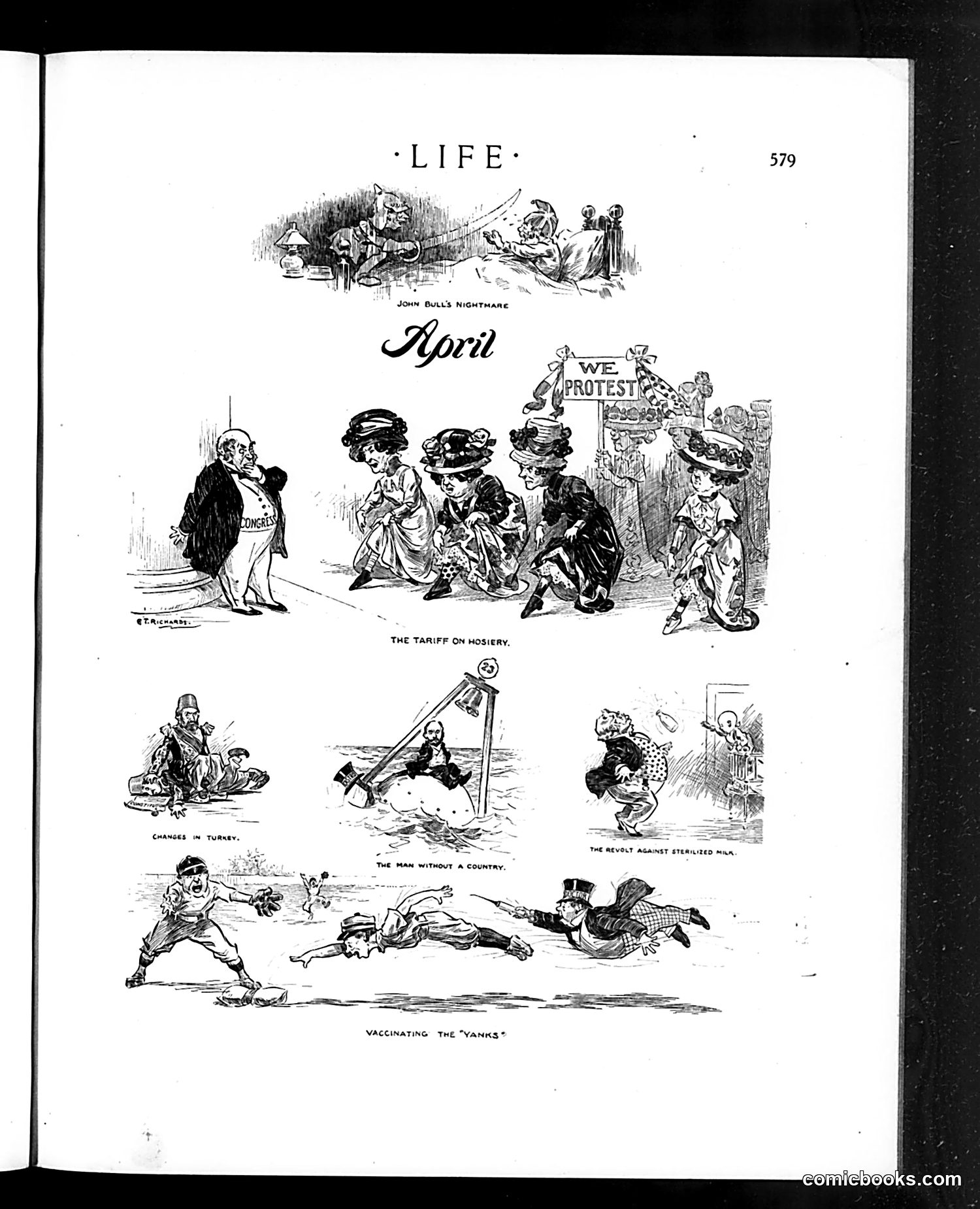
This page presents six political cartoons satirizing early 20th-century American controversies: **"The Tariff on Hosiery"** depicts women protesting trade policy, suggesting tariffs affected household goods prices. **"Charmed Turkey"** appears to mock a political figure or situation through animal allegory. **"The Man Without a Country"** likely references someone stateless or exiled, a recurring political theme. **"The Revolt Against Sterilized Milk"** satirizes public resistance to public health measures. **"Vaccinating the 'Yanks'"** shows figures forcibly vaccinating unwilling subjects, critiquing mandatory health interventions or perhaps American military/imperial policies. The cartoons collectively mock political protests, trade disputes, and resistance to government health mandates—suggesting public anxiety about regulatory authority during this Progressive Era period.
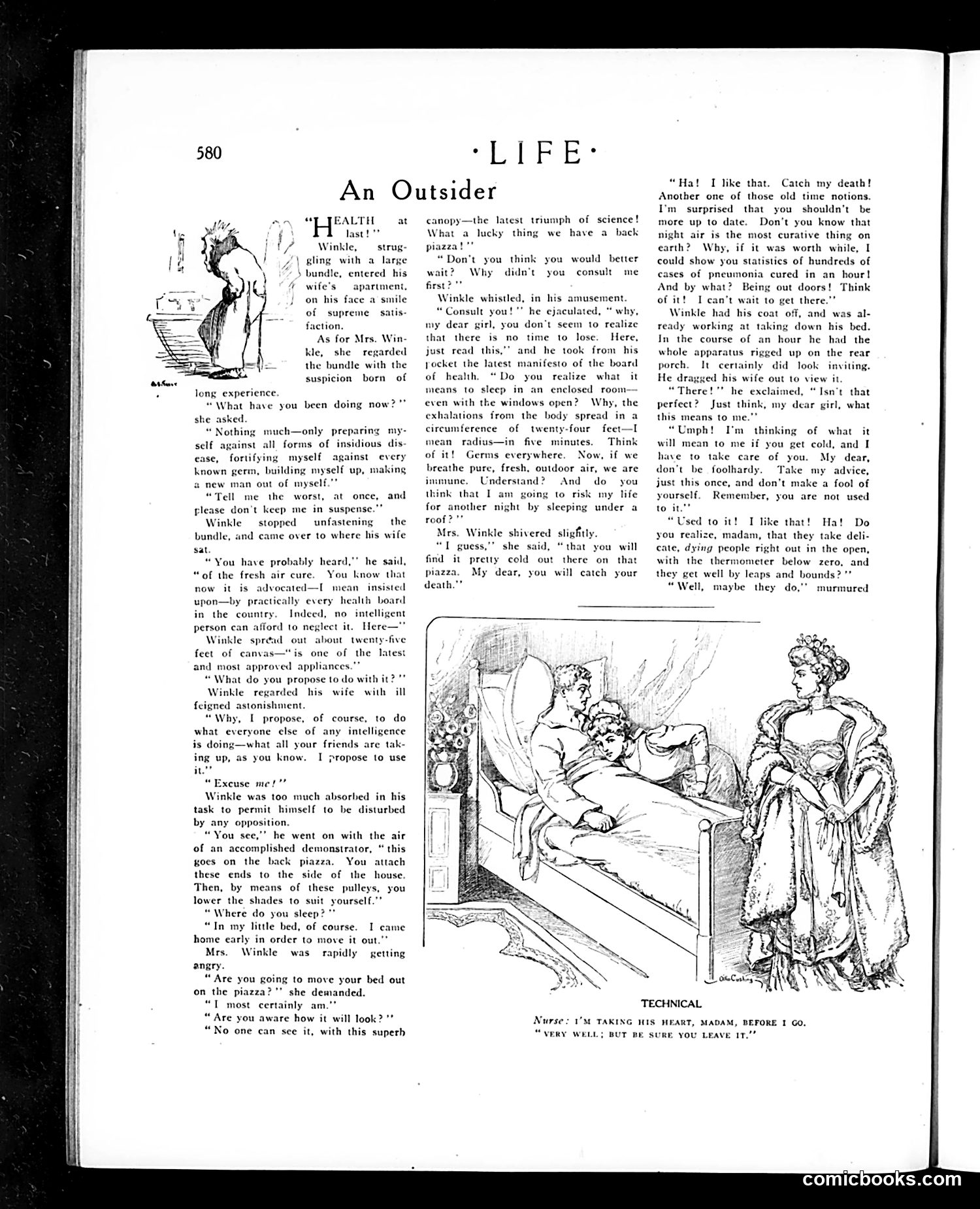
This piece satirizes a man named Winkle who advocates for sleeping outdoors to improve health through fresh air exposure. His wife is skeptical and frustrated by his enthusiasm for this "latest manifesto of the board of health." The satire mocks pseudo-scientific health fads of the era—Winkle enthusiastically claims outdoor sleeping prevents germs and promotes immunity, citing statistics about pneumonia cases. His wife counters with practical concerns: the cold weather will make him sick, and he'll catch his death. The accompanying sketch shows a nurse attending to a bedridden patient, with the caption "I'M TAKING HIS HEART, MADAM, BEFORE I GO"—darkly suggesting Winkle's health scheme has failed. The humor targets credulous acceptance of trendy health theories without common sense.
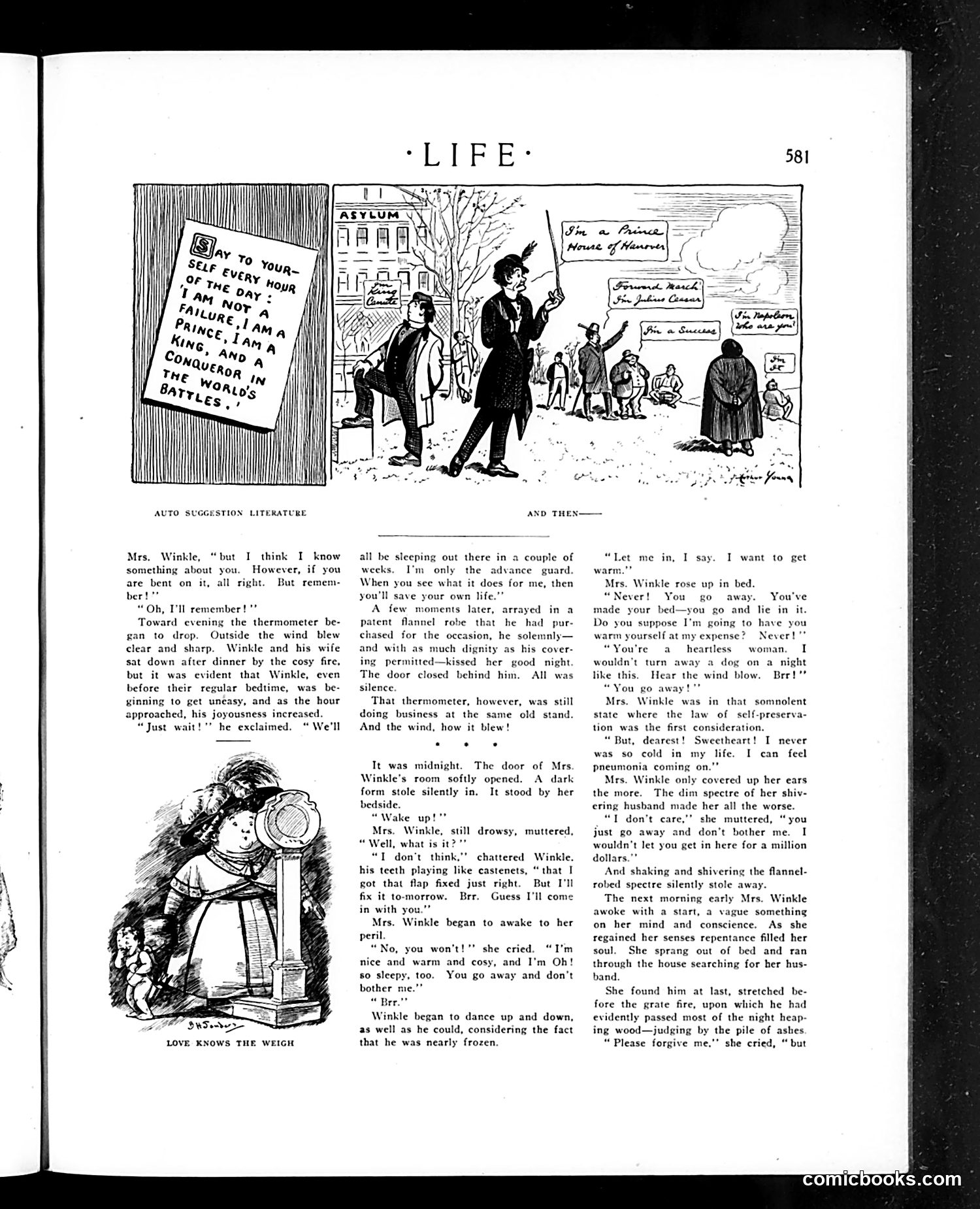
The page contains two distinct pieces: **Top cartoon ("Auto Suggestion Literature"):** A man outside an asylum reads a self-help sign declaring himself "a conqueror of fate's battles" while ignoring reality—an actual asylum building behind him. This satirizes the popular "auto-suggestion" self-help movement of the early 20th century, mocking people who use positive affirmations to deny obvious problems. The irony is visual: his mental pep talk cannot change his actual circumstances. **Bottom story ("Love Knows the Weight"):** A domestic drama where a bedridden Mrs. Winkle suffers while her husband prioritizes staying warm by the fire. The illustration shows him weighing himself on a scale. This appears to satirize male selfishness and indifference to wives' suffering during illness—a common social criticism of the era.
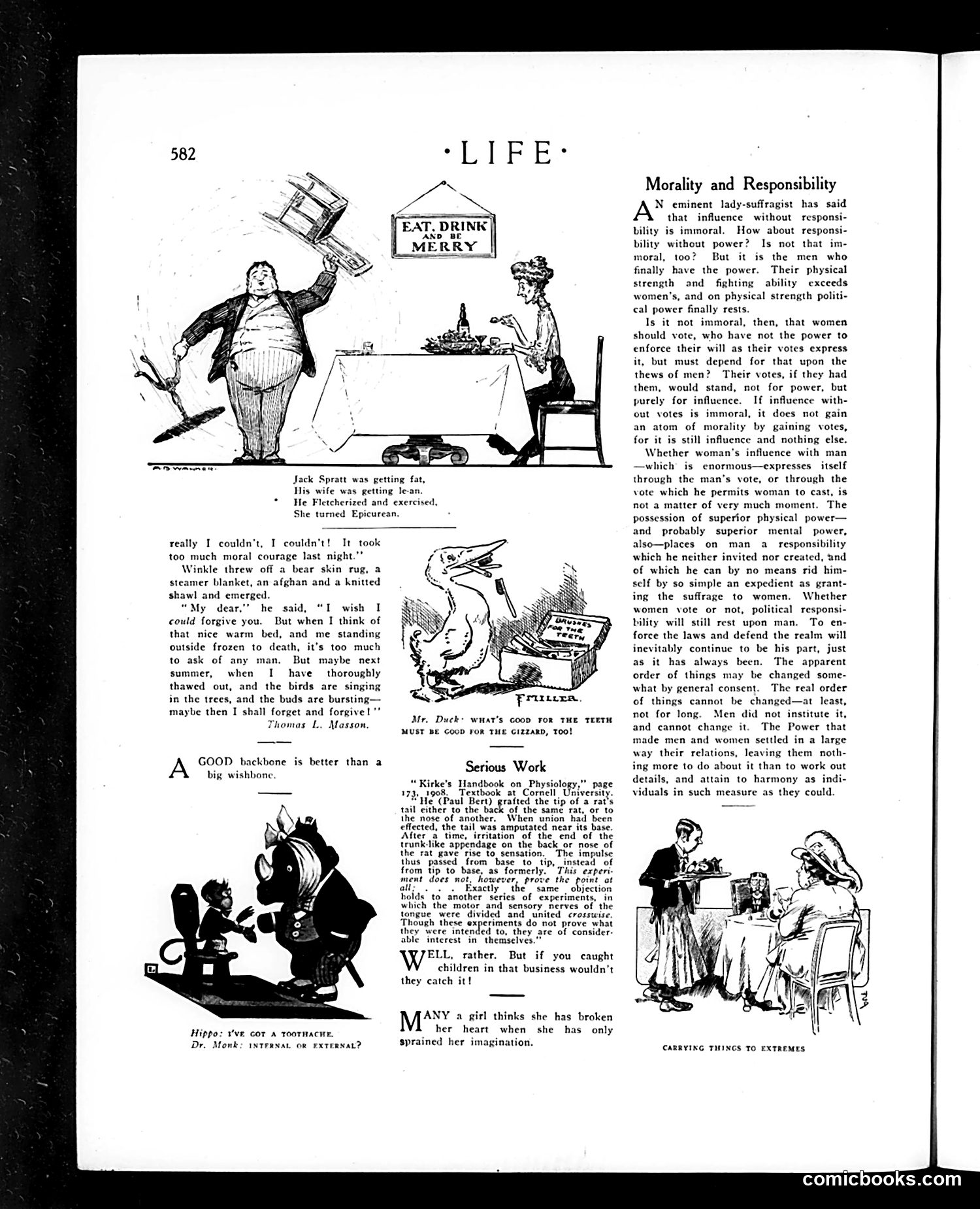
This page contains several cartoons and satirical pieces on "Morality and Responsibility." **Top cartoon**: Shows a man (Jack Spratt) serving food while his wife sits at table. The caption references the nursery rhyme "Jack Spratt could eat no fat / His wife could eat no lean," satirizing domestic role reversals and dietary habits. **Middle section**: Includes a joke about a toothache and a cartoon about rat anatomy, with the caption "What's good for the teeth must be good for the gizzard, too!"—likely mocking pseudo-scientific claims. **Main article** (right): Discusses women's suffrage, arguing that women voting wouldn't gain "power" but merely "influence," and debates whether political responsibility rests with voters regardless of gender. This reflects early 20th-century anti-suffrage rhetoric. **Bottom cartoon**: Titled "Carrying Things to Extremes," shows domestic exaggeration humor.
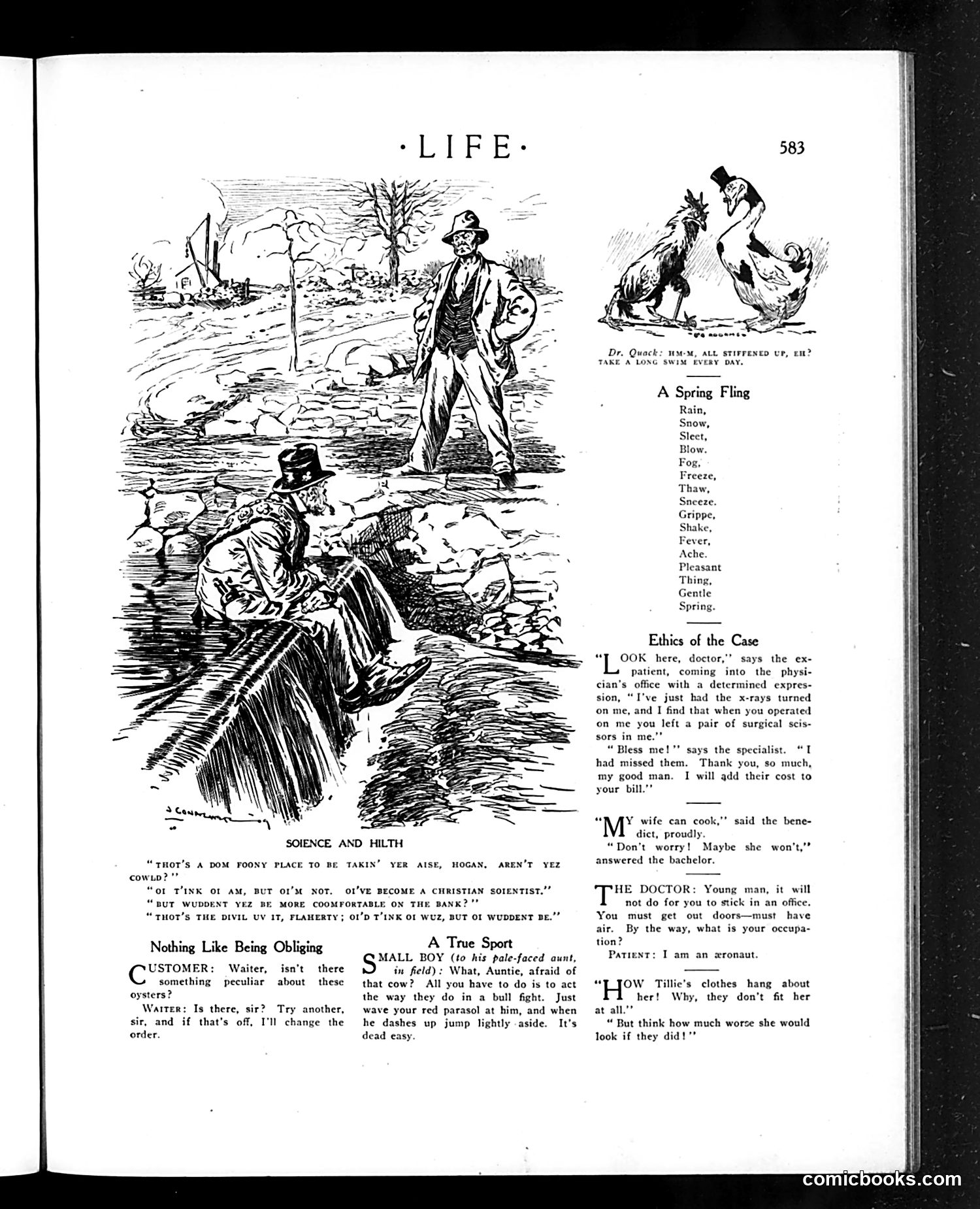
This page contains three separate satirical pieces with accompanying illustrations: **"Science and Health"** mocks a man uncomfortable about Christian Science, with dialogue about becoming a "Christian scientist" versus sitting on a bank. **"A True Sport"** depicts a small boy being instructed to provoke a cow by waving a red parasol at it—satirizing a bullfighting scenario as entertainment, with the implication that this "sport" is foolishly dangerous. **"Ethics of the Case"** shows a doctor billing a patient for surgical scissors left inside him—a dark humor joke about medical malpractice and the audacity of charging for mistakes. The page also includes "A Spring Fling," a poem listing seasonal weather conditions, and separate comic dialogues about oysters and clothing. These pieces represent Life's typical early-20th-century format: satirizing social pretensions, medical incompetence, and absurd human behavior through brief, illustrated humorous scenarios.
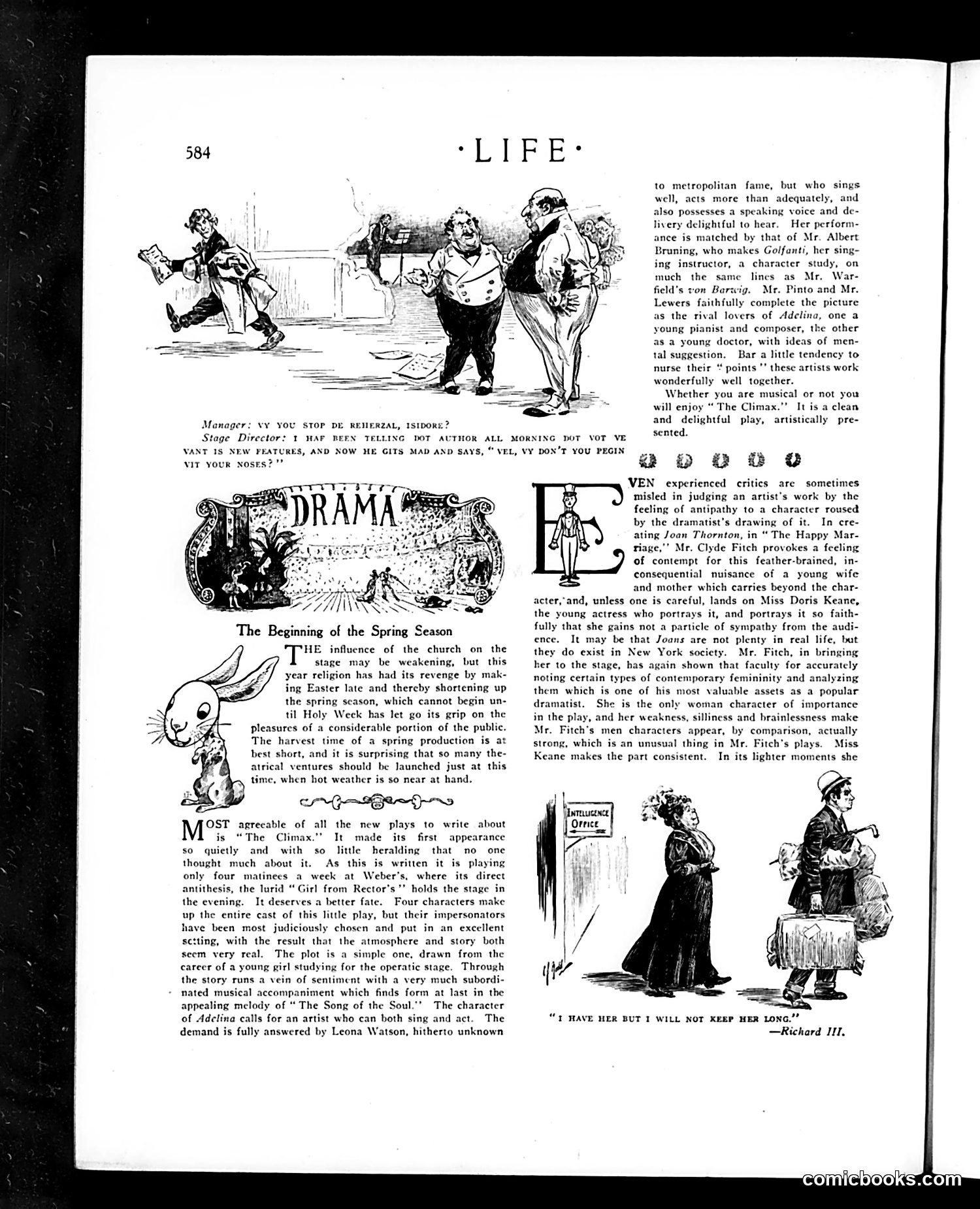
This page reviews theatrical productions, primarily "The Beginning of the Spring Season." The top sketch shows a stage manager confronting a director about artistic decisions, with comedic exaggeration typical of Life's drama criticism. The main article discusses "The Climax," praising its artistic presentation. Below, it reviews a play featuring an actress named Joana (likely Joan Thorton based on context), noting she's the "only woman character of importance" and criticizing her "weakness and brainlessness." The bottom illustration shows a man at what appears to be a theatrical office, captioned with a Shakespeare quote: "I have her but I will not keep her long" (Richard III). The satire targets both theatrical productions and gender representation in contemporary drama, reflecting early 20th-century attitudes about women's stage roles.
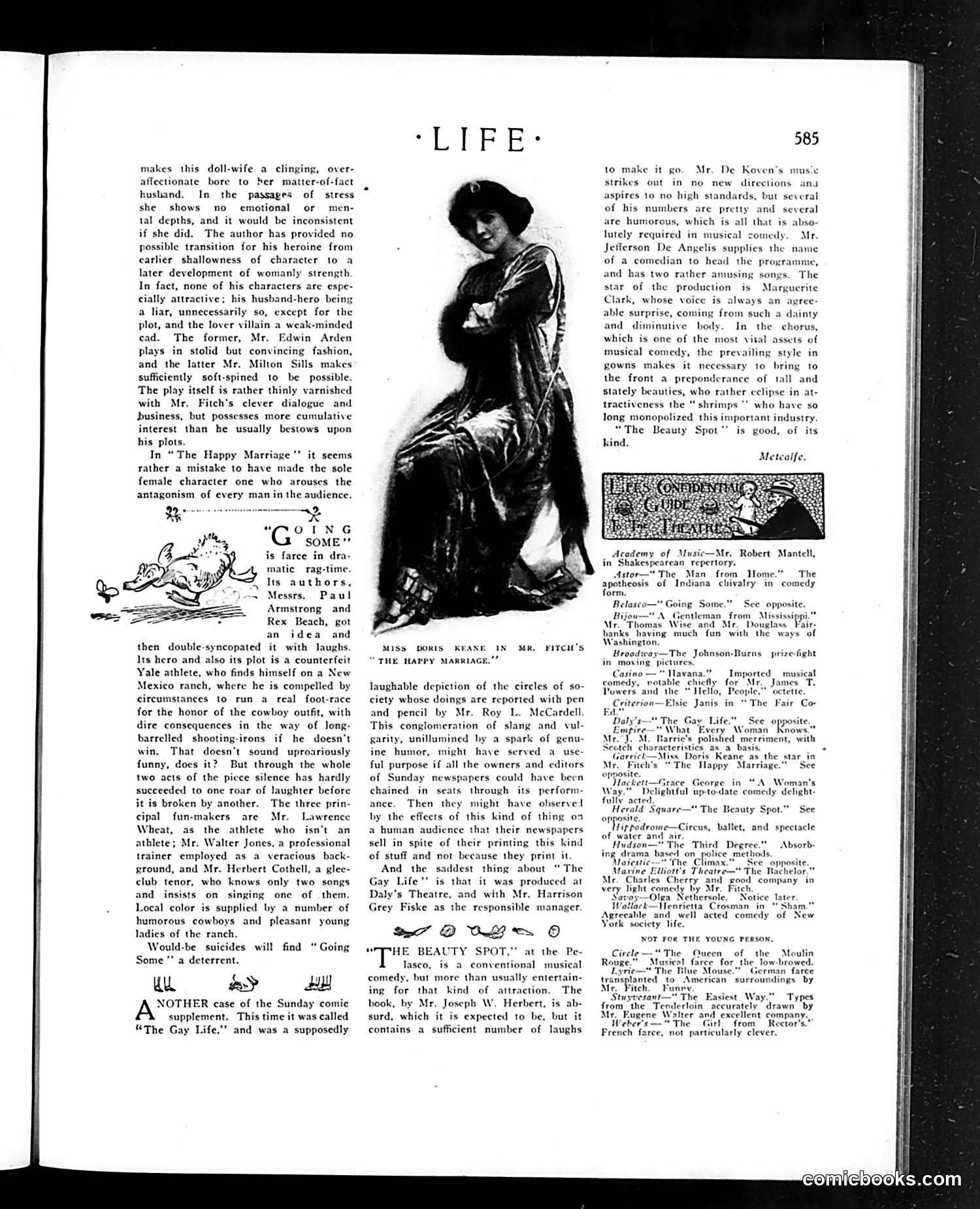
This page discusses theatrical reviews, primarily focusing on "The Happy Marriage" and "Going Some," Broadway productions. The central image shows **Miss Doris Keane** in a dramatic pose from "The Happy Marriage," depicting a female character meant to provoke antagonism from male audience members. The text critiques the play's characterization, noting the female lead is deliberately designed to be unlikeable and argumentative. The reviews discuss various performers and their comedic abilities. A small cartoon at bottom-left appears to show crude figures in a comedic scenario, likely illustrating physical humor or slapstick comedy—common in early 20th-century theatrical criticism. The page is primarily **theater criticism rather than political satire**, focusing on Broadway entertainment quality and character development in contemporary plays.
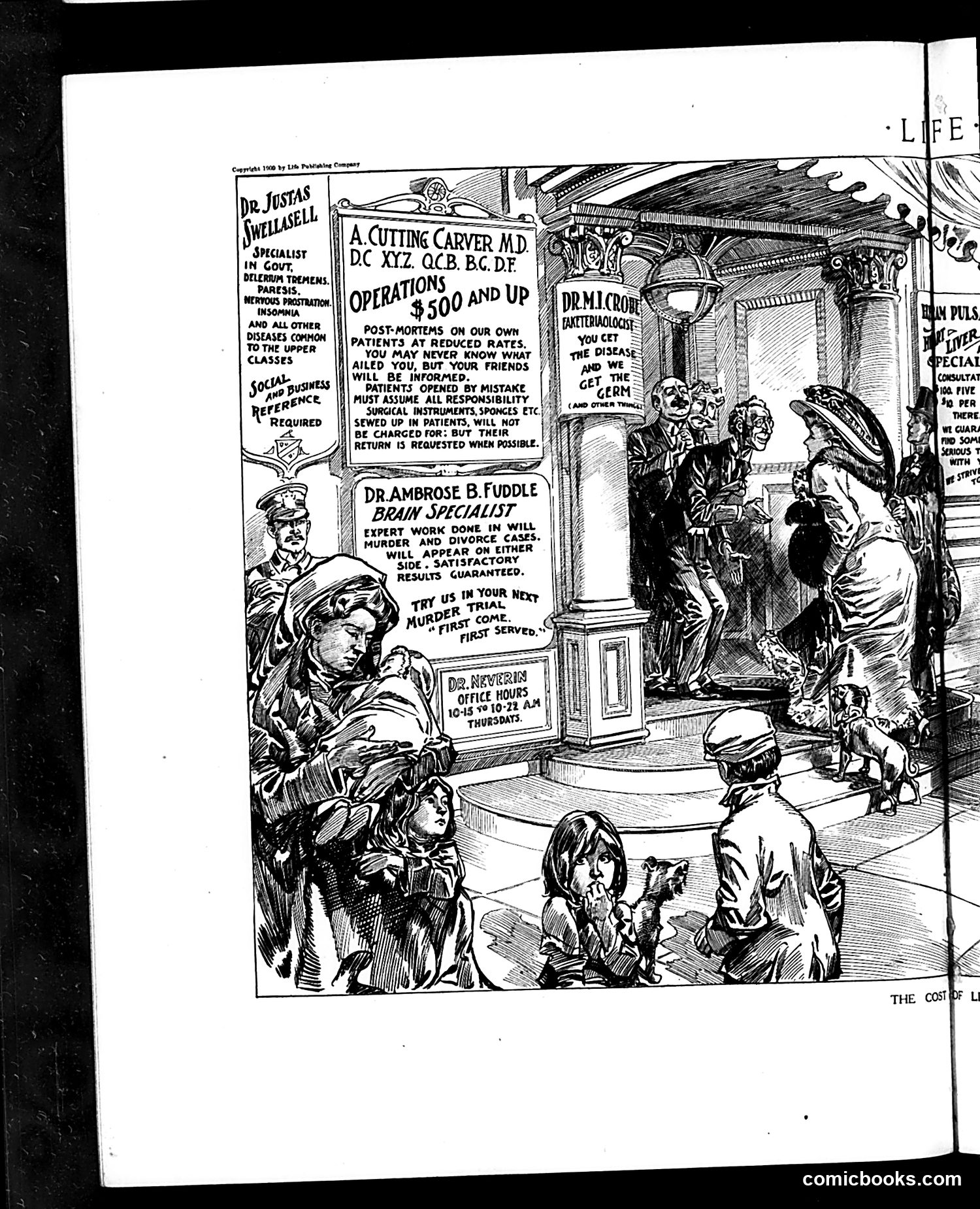
This is a satirical illustration mocking unqualified or fraudulent medical practitioners operating in early 20th-century America. The page displays fake advertisements for several bogus doctors: **Dr. Josias Swellasell** advertises dubious treatments for ailments like paralysis and insomnia, requiring "social business reference"—suggesting he preys on the gullible. **"A Cutting Carver M.D."** offers cheap surgeries at "$50 and up" with deliberately absurd disclaimers: patients assume liability for surgical instruments accidentally left inside them. **Dr. Ambrose B. Fuddle**, a "brain specialist," advertises expertise in murder and divorce cases—implying he'll provide convenient medical testimony. The accompanying street scene shows desperate people (including children and mothers) seeking these services, highlighting how poverty and lack of regulation enabled medical charlatans to exploit vulnerable populations. This reflects real Progressive Era concerns about unlicensed practitioners and the need for medical regulation.
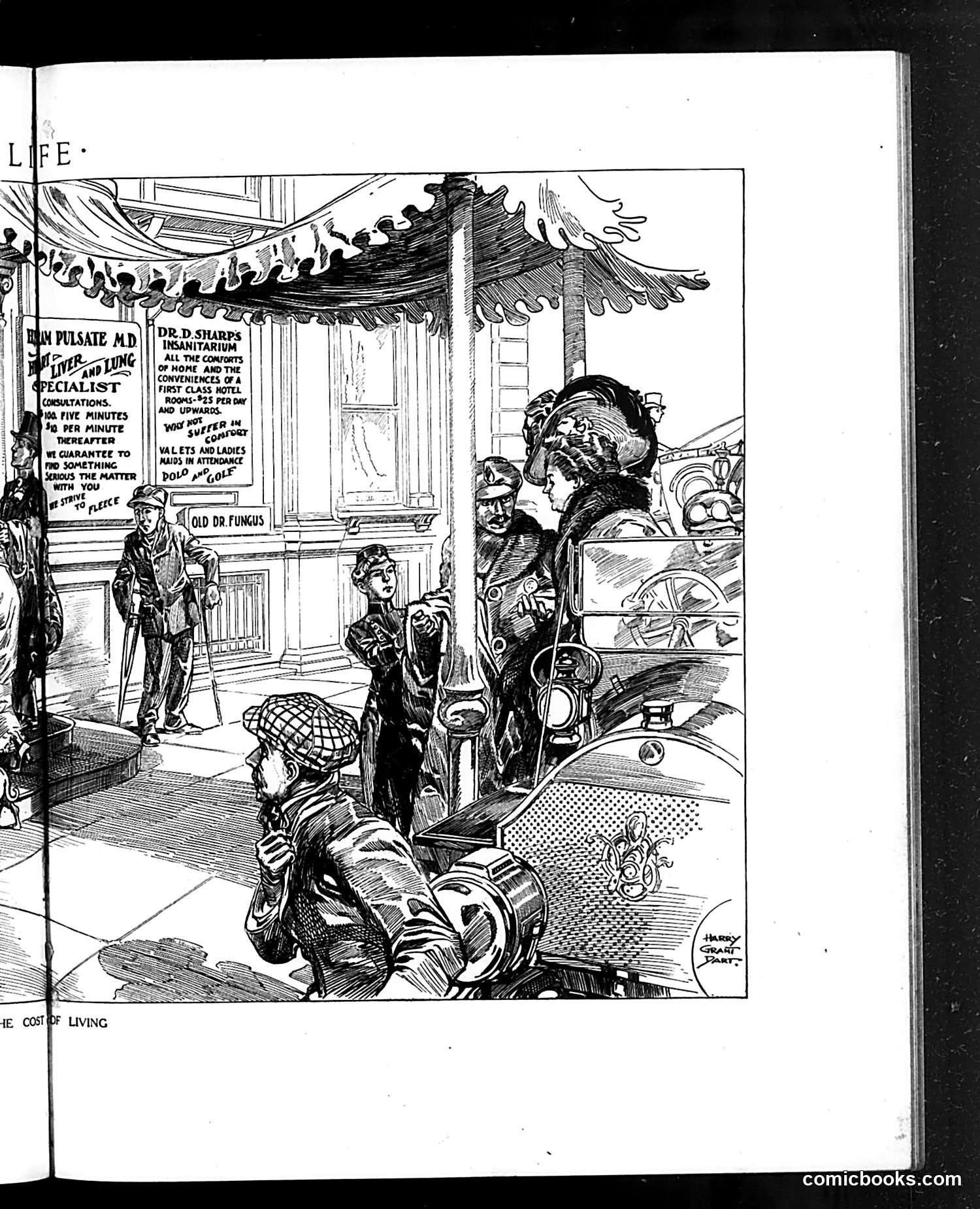
This Life magazine page satirizes quack medical practices and dubious healthcare providers of the early 20th century. The main illustration depicts a street scene outside "Dr. D. Sharp's Insanitarium," advertising treatments for "diseases of heart and lung" with promises of quick consultations and guaranteed results. The cartoon mocks the proliferation of fraudulent doctors and bogus medical establishments that preyed on urban populations. The storefront signage—visible on the left—exemplifies exaggerated medical claims typical of the era's unregulated healthcare marketplace. The diverse crowd gathered outside suggests these establishments attracted desperate patients. The page title "The Cost of Living" indicates this satire comments on how ordinary people were financially exploited by medical charlatans, making healthcare access a socioeconomic concern during this period.
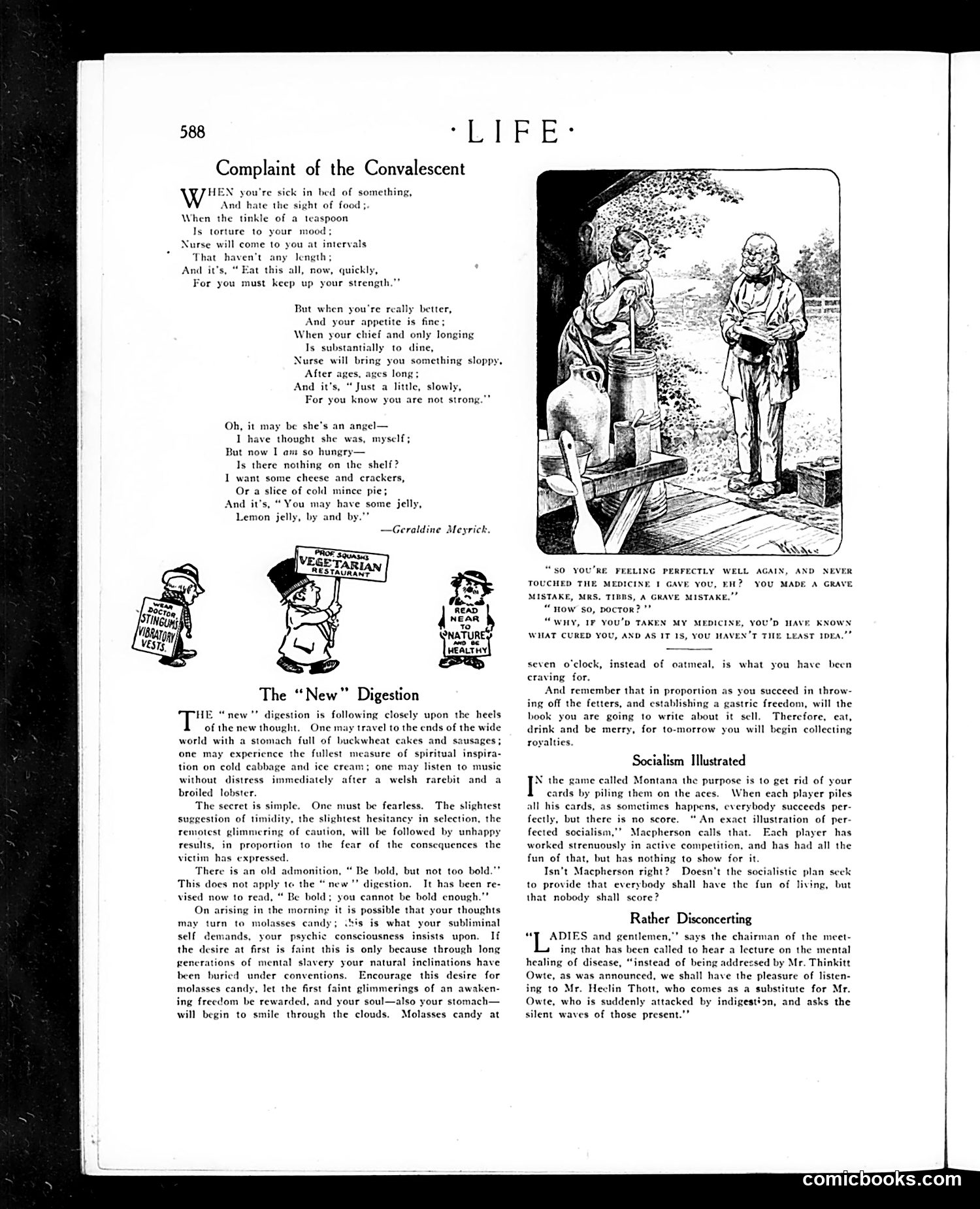
This page from *Life* magazine contains three satirical pieces mocking early 20th-century trends: **"Complaint of the Convalescent"**: A poem lampooning nurses' contradictory instructions to patients—withholding food when sick, then restricting it once appetite returns. The humor lies in the frustration of recovery's illogical dietary rules. **"The 'New' Digestion"**: Satire on the "New Thought" movement (a contemporary spiritual/psychological philosophy). It mocks the notion that fearless thinking alone can overcome physical limitations—one can eat anything if mentally bold enough. The final joke suggests writing a bestselling book about this pseudoscience. **"Socialism Illustrated"**: Uses a card game ("Montana") as metaphor: players work hard but end with no score—presented as mockery of socialism's promise of equal results despite individual effort. The small cartoon figures promote health fads (vegetarian diet, exercise). All pieces target contemporary intellectual trends as foolish or impractical.
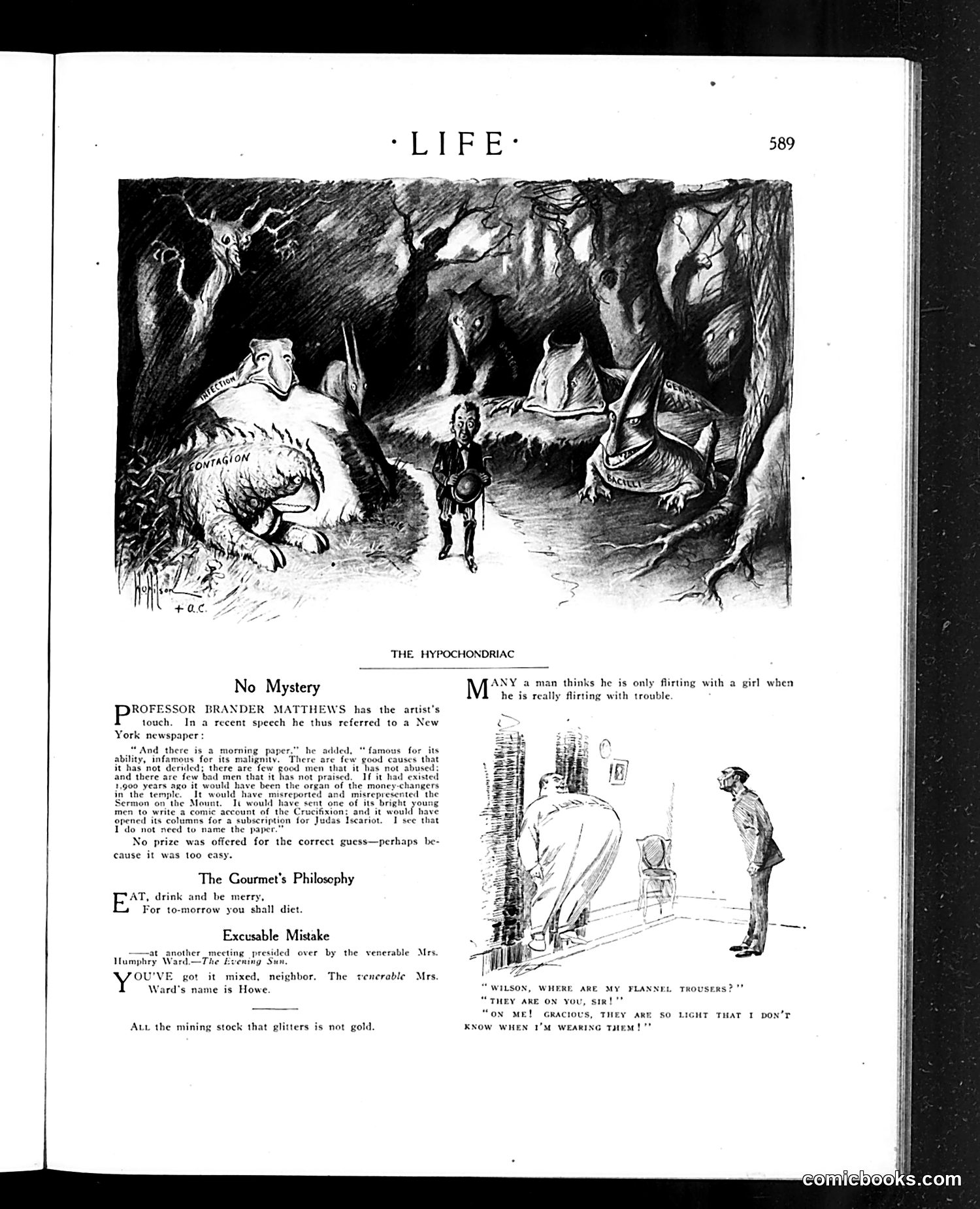
This page contains several short satirical pieces typical of Life's format: **"No Mystery"** quotes Professor Brander Matthews attacking a New York newspaper for its sensationalism and malice. Matthews sarcastically claims if the paper existed in biblical times, it would have misrepresented Christ's teachings and solicited funds for Judas. The piece mocks the paper's consistently negative coverage without naming it—"no prize was offered for the correct guess—perhaps because it was too easy," suggesting the target newspaper was obviously identifiable to contemporary readers. **"The Hypochondriac"** cartoon shows a domestic dispute: a man can't find his flannel trousers because his valet Wilson claims they're so lightweight Wilson is wearing them without noticing. The humor relies on physical comedy about invisible garments. The page also includes brief joke sections ("The Gourmet's Philosophy," "Excusable Mistake," and observations about mining stock and romantic flirtation). The top illustration depicts fantastical woodland creatures in a surreal scene, likely accompanying a story or poem not fully visible on this page.
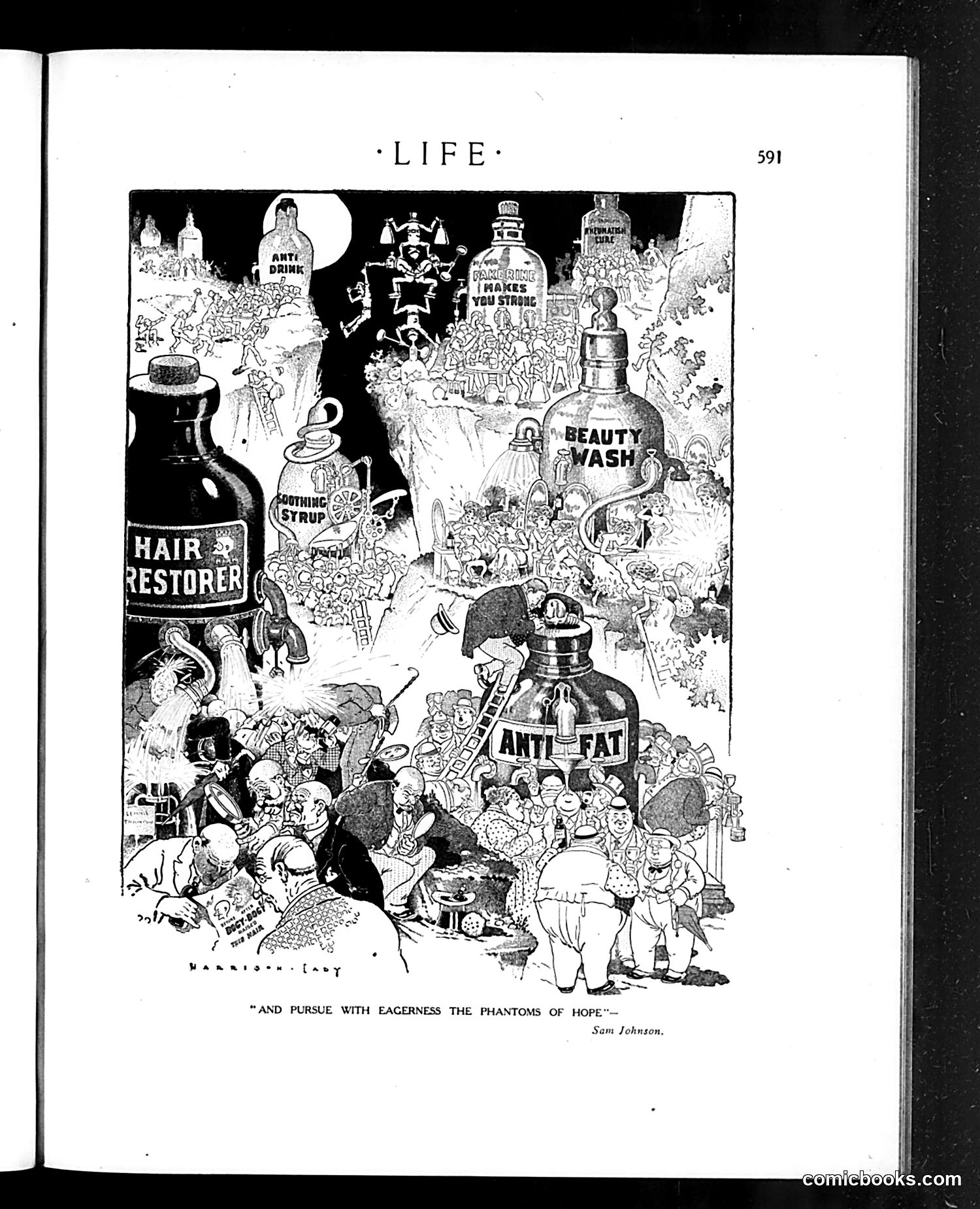
This is a satirical cartoon by Cesare (visible signature) depicting a crowded marketplace of false promises and quack remedies. Giant bottles labeled "Hair Restorer," "Anti-Fat," "Beauty Wash," and "Cough Syrup" tower over masses of eager consumers pursuing impossible dreams—hence the Sam Johnson quote about chasing "phantoms of hope." The satire targets the patent medicine industry's deceptive advertising and Americans' gullible pursuit of quick fixes for physical imperfections. The teeming crowds represent ordinary people desperately buying into fraudulent cure-all products. This reflects genuine Progressive Era concerns about unregulated pharmaceutical claims and consumer exploitation—a major reform issue before FDA oversight regulations. The cartoon mocks both the predatory manufacturers and the public's willingness to believe miracle solutions.
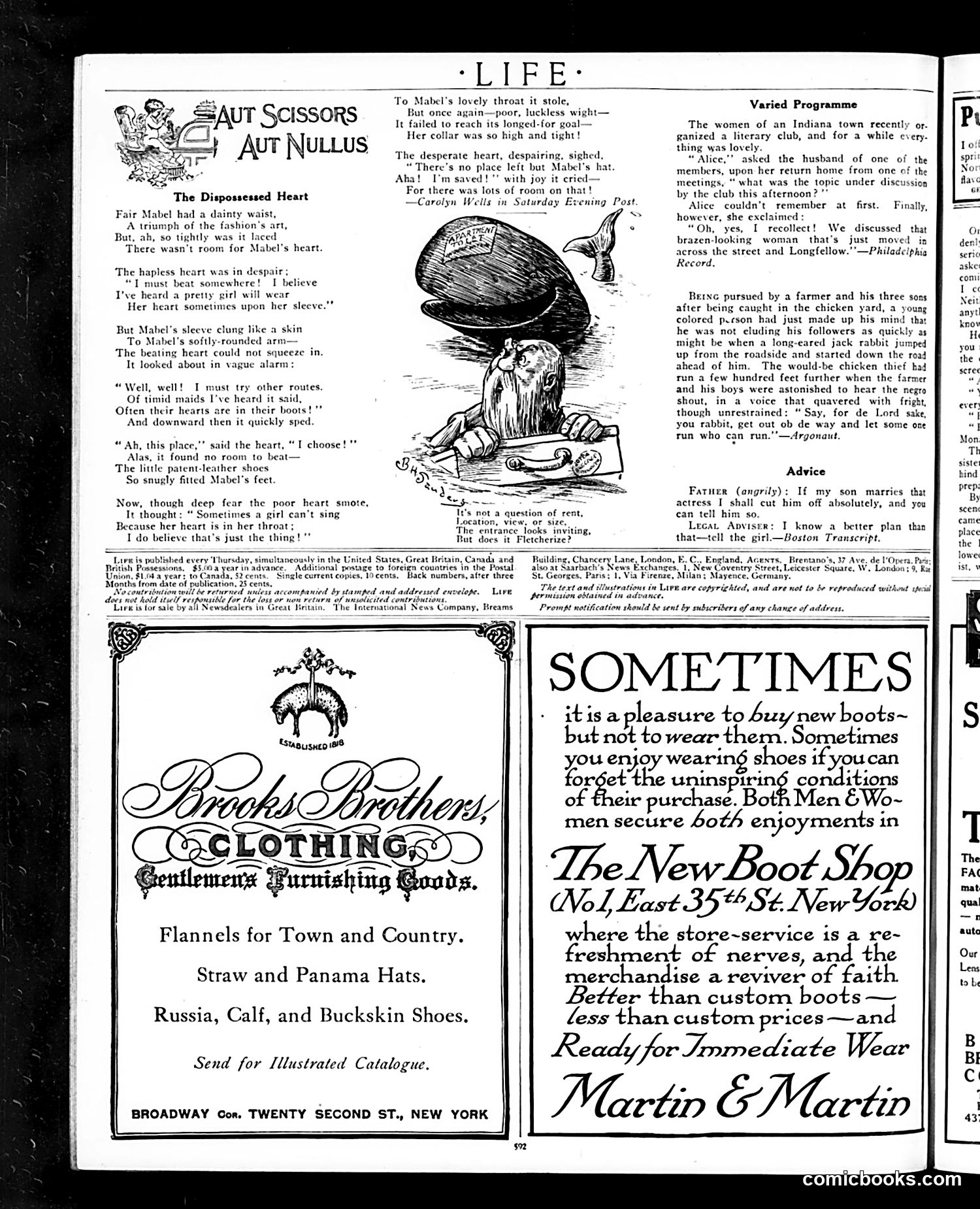
This page contains **satirical poetry and humor pieces** typical of Life magazine's early 20th-century format. **"The Dispossessed Heart"** is a comic poem mocking extreme Victorian fashion constraints on women. A young woman named Mabel is so tightly corseted that her literal heart has nowhere to fit in her body—it tries her throat (blocked by a high collar), her sleeve (too tight), her boots (too snug), and finally settles in her throat anyway. The joke ridicules the absurd restrictiveness of fashionable dress that prioritized aesthetic silhouette over bodily comfort or sense. The accompanying **illustration** shows a heart character desperately searching for space in Mabel's heavily constrained form. Below are brief **humorous anecdotes**: one about a literary club that discusses gossip instead of literature, and another depicting a racist stereotype of a Black man being chased by farmers, shouting at a rabbit to move so someone faster can run. The page also contains period **advertisements** for Brooks Brothers clothing and The New Boot Shop, promoting ready-made shoes and men's furnishings.
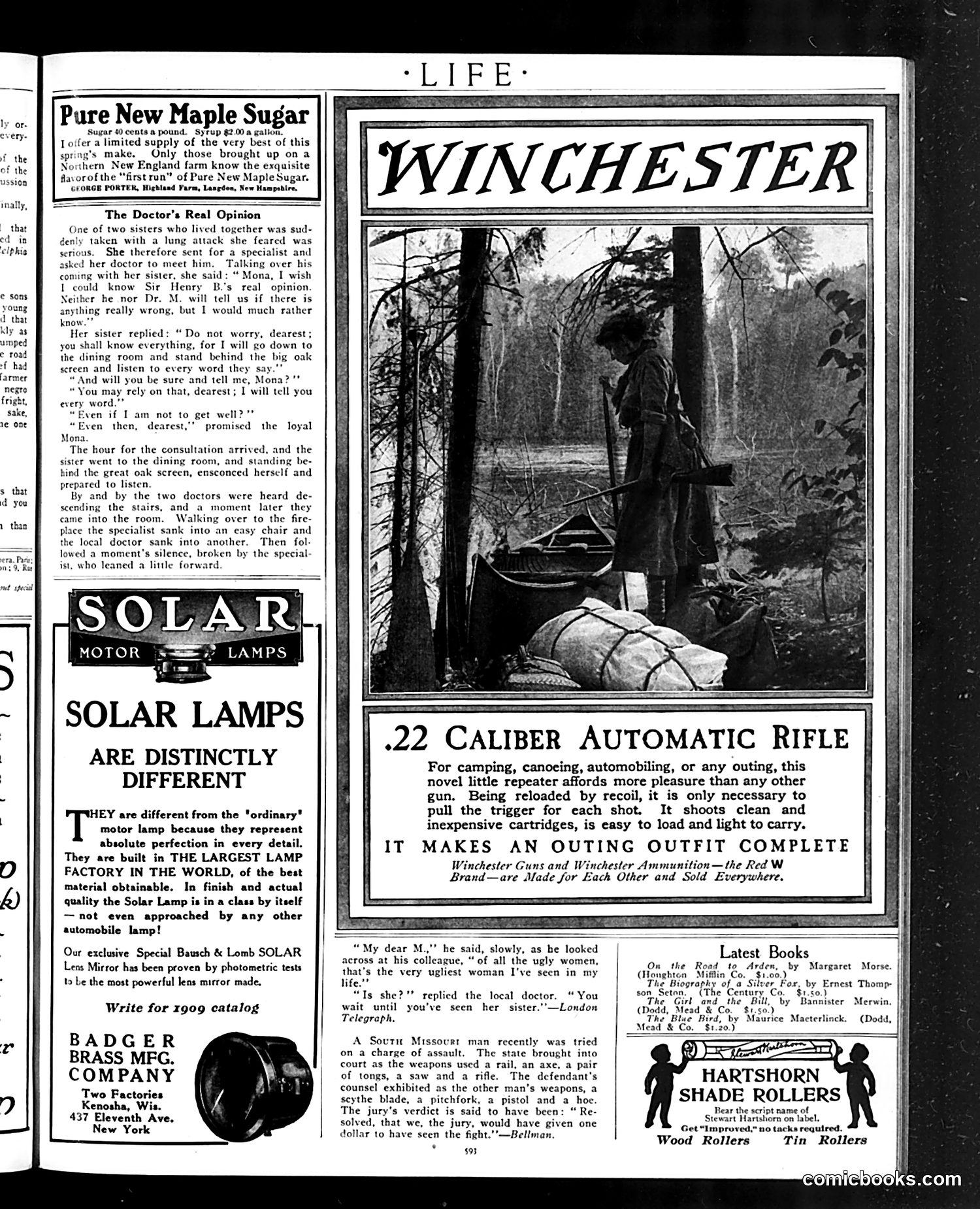
This page is primarily **advertisements and brief humorous anecdotes**, not political cartoons. **"The Doctor's Real Opinion"** is a joke about a woman eavesdropping on two doctors' consultation about her health. The humor relies on a common period trope: the specialist insults the patient's appearance (calling her "ugly"), then the local doctor delivers the punchline—her sister is even uglier. It's gentle, appearance-based humor typical of early 1900s magazines. **The second anecdote** describes a Missouri assault trial where both parties brought absurd weapons (rails, axes, pitchforks). The jury's response—wishing they'd witnessed the fight—satirizes frontier violence through exaggeration, suggesting the brutality was comically extreme. The **advertisements** for Solar Lamps, Winchester rifles, maple sugar, and other products dominate the page, reflecting Life's mixed editorial-commercial format. These are straightforward period product pitches with minimal satirical content. No significant political satire or caricature appears here.
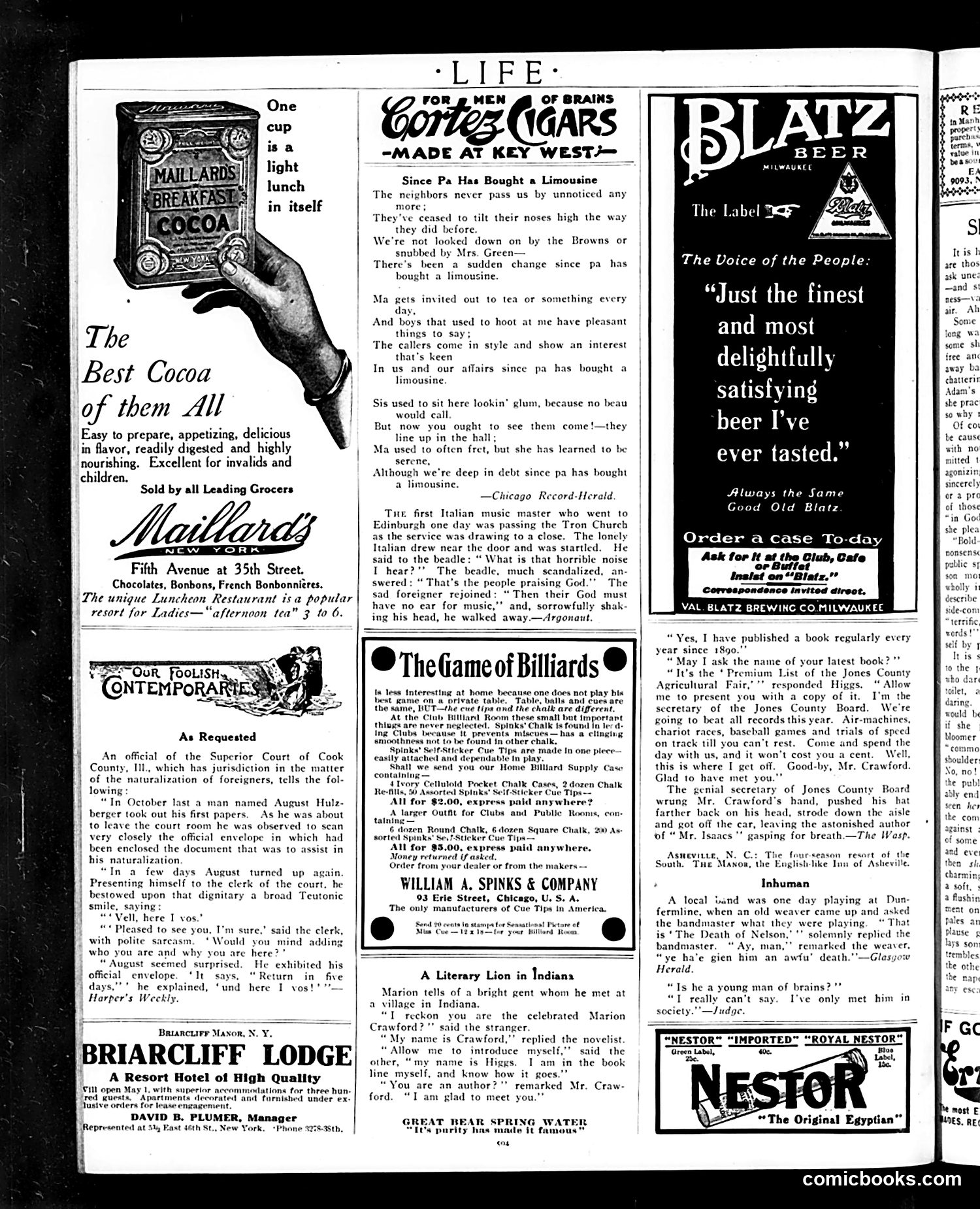
This section contains a humorous anecdote mocking German immigrants' literal-mindedness. A man named August Hulzberger obtains naturalization papers from Cook County Court (Illinois), then returns days later saying "here I vos" — appearing to interpret the document's instruction to "return in five days" as a literal summons rather than understanding it was merely procedural language. The satire targets early-20th-century German immigrants' perceived inability to grasp American bureaucratic nuance and English language idioms. The heavy German accent ("Vell," "vos") and the character's confused literalism are presented as comic evidence of foreigners' unsuitability for citizenship. This reflects common anti-immigrant sentiment of the era, when Life magazine frequently ridiculed newcomers through stereotyped dialect humor.
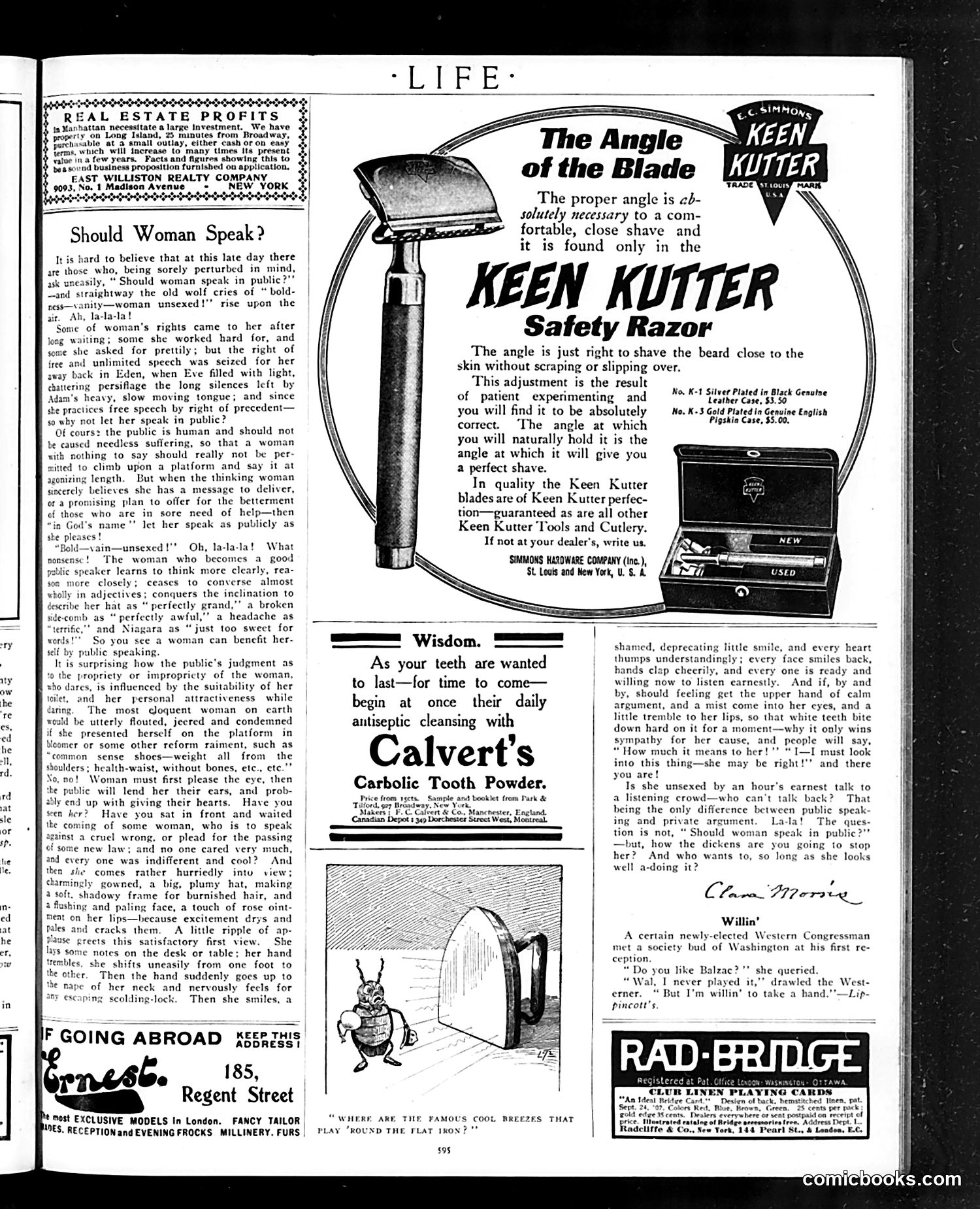
This page is primarily **advertising and product promotion** rather than political satire. The dominant content includes: 1. **"Keen Kutter" Safety Razor advertisement** — A large commercial promoting the proper blade angle for shaving, emphasizing comfort and precision. 2. **"Calvert's Carbolic Tooth Powder" advertisement** — A dental hygiene product pitch. 3. **"Should Woman Speak?" essay** — A satirical opinion piece arguing *for* women's public speaking rights, mocking the objection that women speaking publicly is "unsexed" or improper. The author defends women's right to public speech dating back to Eve in Eden, while humorously noting that public reception depends partly on female speakers being attractively dressed and composed. 4. **"Wisdom" column by Clara Morris** — A brief advice piece about listening and argument. 5. **Miscellaneous advertisements** — Including Ernest travel services and Rad-Bridge playing cards. The page reflects early-20th-century debates about women's public roles, but is primarily a commercial publication vehicle.
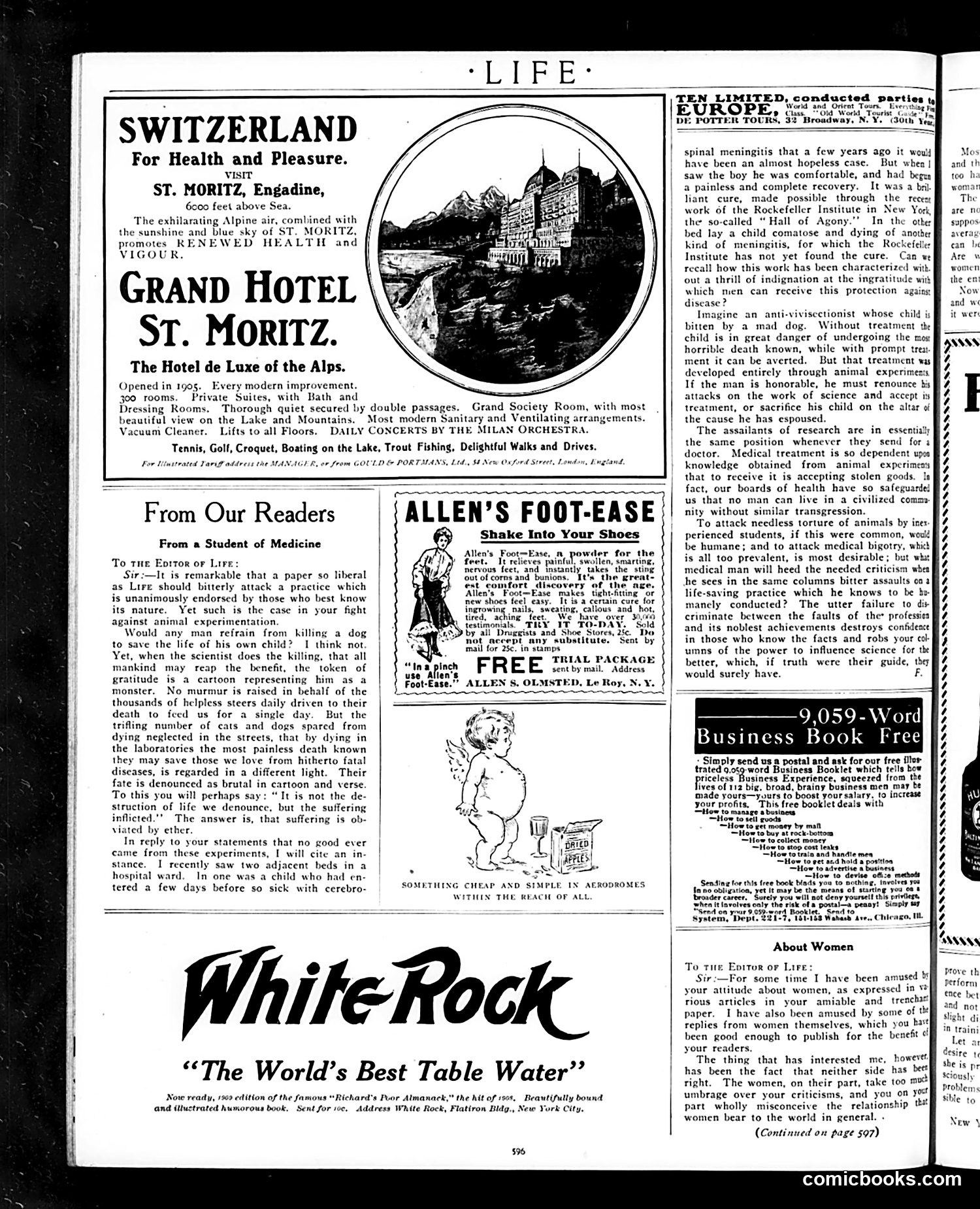
This page primarily contains **advertisements and reader letters** rather than political cartoons. The main content includes: **Advertisements:** Swiss hotel promotions (Grand Hotel St. Moritz), Allen's Foot-Ease powder, White Rock table water, and a business book offer dominate the page. **Reader Letters:** A medical student defends animal experimentation against Life's prior criticism, arguing that laboratory animals (given anesthesia) save human lives—citing a specific case where Rockefeller Institute research cured a child's meningitis. He contrasts this with society's indifference to livestock slaughter. A separate letter critiques Life's coverage of women's issues. **The "Aerodromes" illustration** (bottom center) appears to be a light satirical drawing about cheap flying devices, though details are unclear. This represents typical early 1900s Life content: mixing consumer advertising with reader debate on contemporary social issues like medical ethics and feminism.
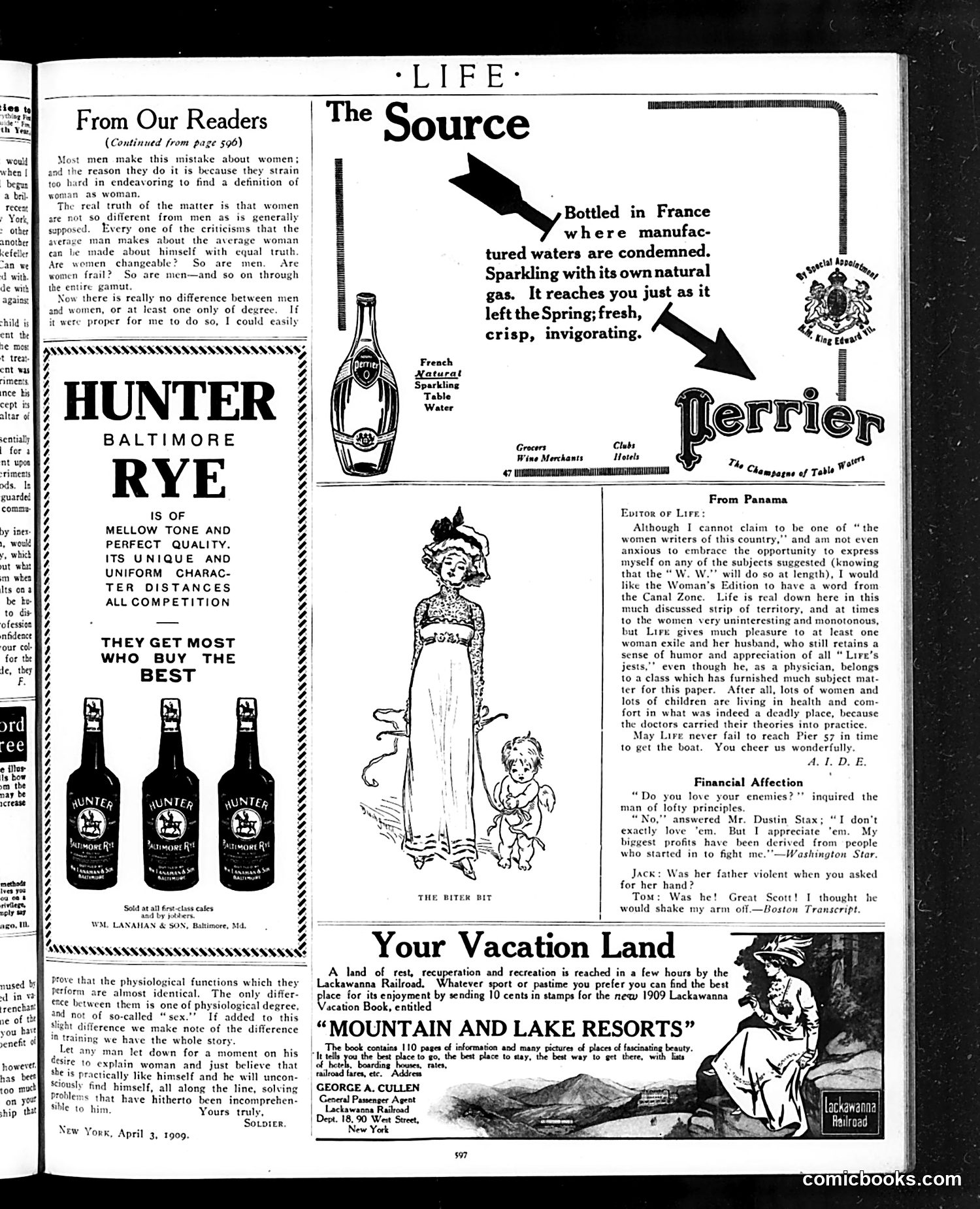
This Life magazine page (April 3, 1909) mixes advertisements with reader correspondence. **The main content** is a "From Our Readers" section debating whether women differ from men. A writer argues women are essentially similar to men—equally changeable, frail, etc.—differing only in degree, not kind. This reflects early 20th-century feminist argumentation against essentialist gender claims. **"The Biter Bit"** cartoon depicts a woman and child, illustrating a humorous domestic anecdote about courtship, then marriage—a common magazine filler joke of the era. **Reader from Panama** describes life in the Canal Zone (under U.S. control since 1904), praising *Life* magazine for providing humor and solace while her physician husband works there. **Advertisements** for Hunter Rye whiskey, Perrier water (imported from France), and the Lackawanna Railroad's vacation resorts occupy significant space—typical for *Life's* revenue model. The page reflects Progressive-era debates about gender roles while showcasing how magazines funded themselves through advertising and entertainment content.
This page contains **no political cartoon or satire**—it's primarily advertising and book promotion from *Life* magazine's early automotive era. The content includes: 1. **Dixon's pencil ad** and **Joseph Dixon Crucible Company** lubricant advertisement—typical early 1900s product marketing emphasizing "motor wisdom" 2. **"Lay of a Lazy Man"**—a humorous poem by Walt Mason describing a farmer's reluctance to leave bed during various seasons, published in the *Emporia Gazette*. The satire is gentle social humor about rural laziness, not political. 3. **Book review** for *Katrine* by Elinor Macarriney Lane, a romantic novel set in North Carolina, Paris, and New York 4. **MoToR magazine promotional offers**—aggressive subscription marketing ("special time-limited offer") bundling a driving manual, French automobile posters, and discounted subscription The page reflects turn-of-the-century American consumer culture centered on automobiles as novel luxury goods requiring instruction manuals for buyers.
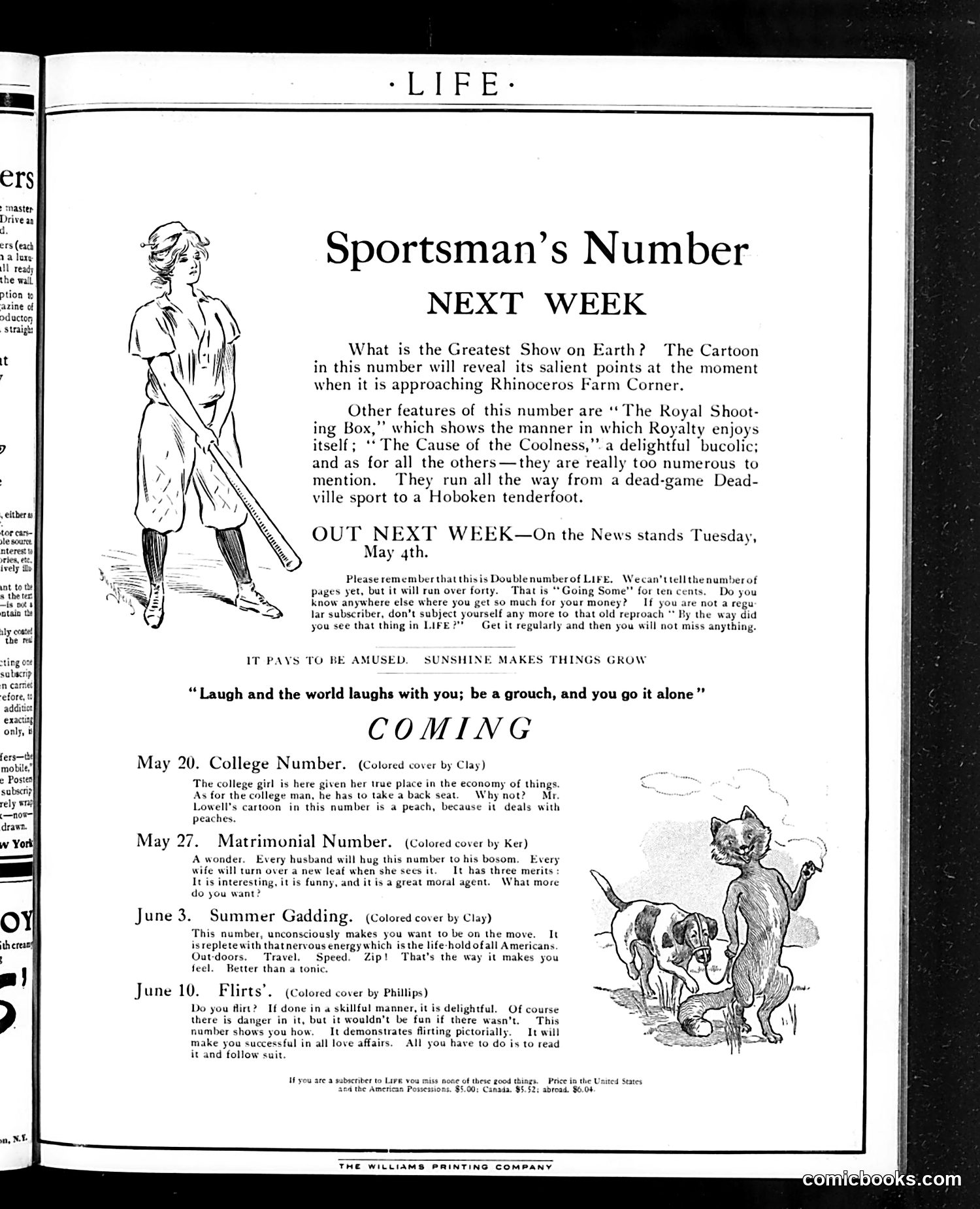
This is a promotional page advertising next week's issue of *Life* magazine—a satirical weekly featuring cartoons, humor, and social commentary. The main illustration depicts a female golfer or athlete, representing the "Sportsman's Number." The page teases upcoming content: a cartoon about "the Greatest Show on Earth" (likely referencing Barnum & Bailey Circus) near "Rhinoceros Farm Corner," plus features on royal hunting and rural life. The tone is self-promotional, emphasizing that this double-issue runs over 40 pages for just ten cents. Below, the page previews upcoming special issues: College Number (celebrating college girls), Matrimonial Number (humorous marital content), Summer Gadding (travel and outdoor adventure), and Flirts' Number (dating humor). The overall message: *Life* offers satirical, illustrated entertainment for modern Americans interested in contemporary leisure, romance, and social trends. The animals illustrated on the right appear decorative rather than editorial commentary.
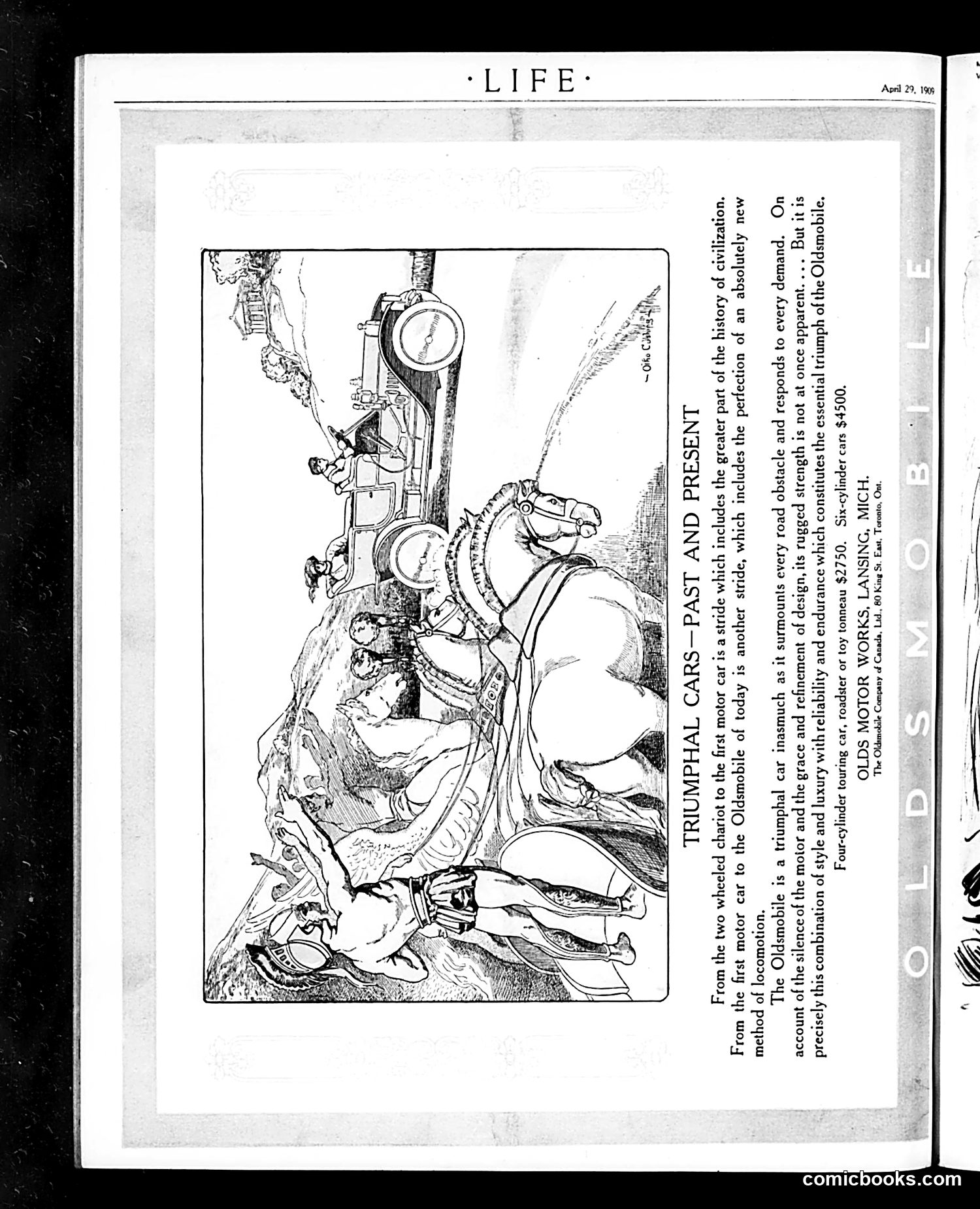
This page from *Life* magazine (dated April 29, 1909) features a political cartoon titled "Triumphal Cars—Past and Present." The illustration contrasts two wheeled vehicles: a classical Roman chariot (left) with an early automobile (right). The satire appears to compare modern automotive technology to ancient Roman military achievement. The text explains that the cartoon draws a historical parallel, suggesting that the automobile represents contemporary civilization's triumphant engineering—comparable to Rome's greatest accomplishments. The joke likely critiques American industrial pride and consumerism of the early 1900s: the newfangled motorcar is presented with grandiose historical significance, inflating what is essentially a consumer product to the level of imperial conquest. This reflects *Life* magazine's characteristic skepticism toward American boosterism and the emerging automobile industry's cultural impact during this period of rapid industrialization.