
Life, 1909-04-29 · page 6 of 28
Life — April 29, 1909 — page 6: what you’re looking at
What you’re looking at
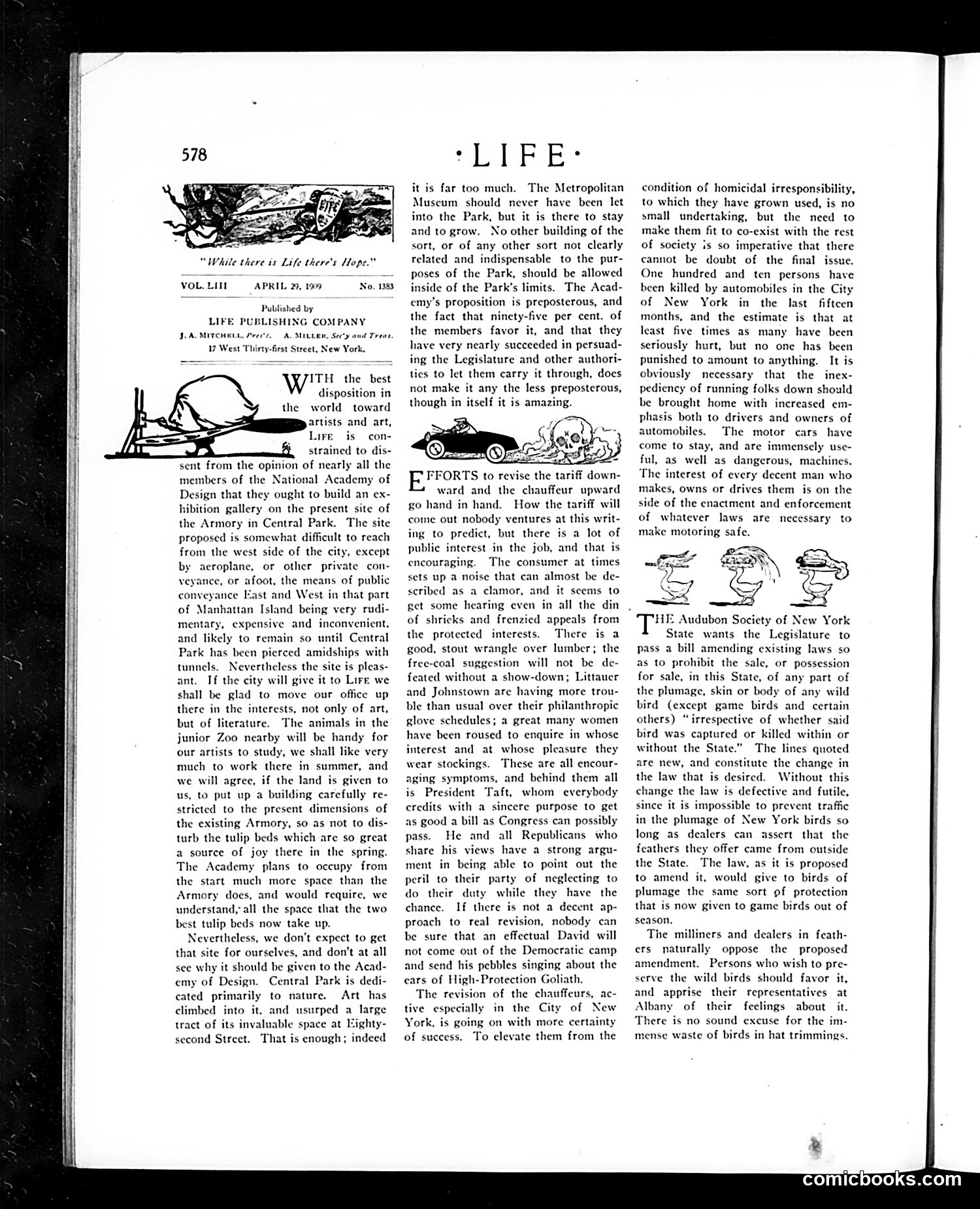
The page contains editorial commentary rather than political cartoons. The small illustrations show early automobiles and their dangers—depicted as threatening figures with skull-like imagery. The text discusses several 1909 issues: the Metropolitan Museum's expansion into Central Park (controversial), automobile safety and fatalities in New York City, tariff reform debates, and bird protection legislation. There's mention of President Taft's administrative efforts. The satirical tone critiques society's tolerance of automobile deaths while debating less urgent matters, and questions whether tariff revision will succeed despite political rhetoric. The bird protection discussion addresses plumage hunting for the millinery industry. The overall message: American priorities seem misaligned—cars kill citizens but lack regulation, while political energy focuses elsewhere.
📄 Transcribed text from this page (OCR, searchable)
Machine-transcribed from the original scan — historical spelling and the odd misread are preserved.
“While there is Life there's Hope.” ‘OL. LIT APRIL 27, 191 No. 1383 Published by LIFE PUBLISHING COMPANY JA MITCHELL, Pree. 17 West Thirty-first Street, AL MILLER, See'y and Treat ‘ew York, ITH the best disposition in the world toward artists and art, Lire is con- strained to dis sent from the opinion of nearly all the members of the National Academy of Design that they ought to build an ex- hibition gallery on the present site of the Armory in Central Park. The site proposed is somewhat difficult to reach from the west side of the city, except by aeroplane, or other private con- veyance, or afoot, the means of public conveyance East and West in that part of Manhattan Island being very rudi- mentary, expensive and inconvenient, and likely to remain so until Central Park has been pierced amidships with tunnels. Nevertheless the site is pleas ant. If the city will give it to Lire we shall be glad to move our office up there in the interests, not only of art, but of literature. The animals in the junior Zoo nearby will be handy for our artists to study, we shall like very much to work there in summer, and we will agree, if the land is given to us, to put up a building carefully re- stricted to the present dimensions of the existing Armory, so as not to dis- turb the tulip beds which are so great a source of joy there in the spring. The Academy plans to occupy from the start much more space than the Armory does, and would require, we understand, all the space that the two best tulip beds now take up. Nevertheless, we don't expect to get that site for ourselves, and don’t at all see why it should be given to the Acad- emy of Design. Central Park is dedi- cated primarily to nature. Art has climbed into it, and usurped a large tract of its invaluable space at Eighty- second Street. That is enough; indeed “PE * it is far too much. The Metropolitan Muscum should never have been let into the Park, but it there to stay and to grow. No other building of the sort, or of any other sort not clearly related and indispensable to the pur- poses of the Park, should be allowed inside of the Park's limits. The Acad- emy’s proposition is preposterous, and the fact that ninety-five per cent. of the members favor it, and that they have very nearly succeeded in persuad- ing the Legislature and other authori- ties to let them carry it through, docs not make it any the less preposterous, though in itself it is amazing. FFORTS to revise the tariff down- ward and the chauffeur upward go hand in hand. How the tariff will come out nobody ventures at this writ- ing to predict, but there is a lot of public interest in the job, and that is encouraging. The consumer at times sets up a noise that can almost be de- scribed as a clamor, and it scems to get some hearing even in all the din of shricks and frenzied appeals from the protected interests. There is a good, stout wrangle over lumber; the free-coal suggestion will not be de- feated without a show-down; Littauer and Johnstown are having more trou- ble than usual over their philanthropic glove schedules; a great many women have been roused to enquire in whose interest and at whose pleasure they wear stockings. These are all encour- aging symptoms, and behind them all is President Taft, whom everybody credits with a sincere purpose to get as good a bill as Congress can possibly pass. He and all Republicans who share his views have a strong argu- ment in being able to point out the peril to their party of neglecting to do their duty while they have the chance. If there is not a decent ap- proach to real revision, nobody c: be sure that an effectual David will not come out of the Democratic camp and send his pebbles singing about the ears of High-Protection Goliath. The revision of the chauffeurs, ac- tive especially in the City of New York, is going on with more certainty of success. To elevate them from the condition of homicidal irresponsibility, to which they have grown used, is no small undertaking, but the need to make them fit to co-exist with the rest of society is so imperative that there cannot be doubt of the final issue. One hundred and ten persons have been killed by automobiles in the City of New York in the last fifteen months, and the estimate is that at least five times as many have been seriously hurt, but no one has been punished to amount to anything. It is obviously necessary that the inex- pediency of running folks down should be brought home with increased em- phasis both to drivers and owners of automobiles. The motor cars have come to stay, and are immensely use- ful, as well as dangerous, machines. The interest of every decent man who makes, owns or drives them is on the side of the enactment and enforcement of whatever laws are SS to make motoring safe. udubon Society of New York State wants the Legislature to pass a bill amending existing laws so as to prohibit the sale, or possession for sale, in this State, of any part of the plumage, skin or body of any wild bird (except game birds and certain others) “irrespective of whether said bird was captured or killed within or without the State.” The lines quoted are new, and constitute the change in the law that is desired. Without this change the law is defective and futile, since it is impossible to prevent traffic in the plumage of New York birds so long as dealers can assert that the feathers they offer came from outside the State. The law, as it is proposed to amend it, would give to birds of plumage the same sort of protection that is now given to game birds out of season. The milliners and dealers in feath- ers naturally oppose the proposed amendment. Persons who wish to pre- serve the wild birds should favor it, and apprise their representatives at Ibany of their feelings about it. here is no sound excuse for the im- mense waste of birds in hat trimmings. comicbooks.com