
Life, 1909-04-29 · page 12 of 28
Life — April 29, 1909 — page 12: what you’re looking at
What you’re looking at
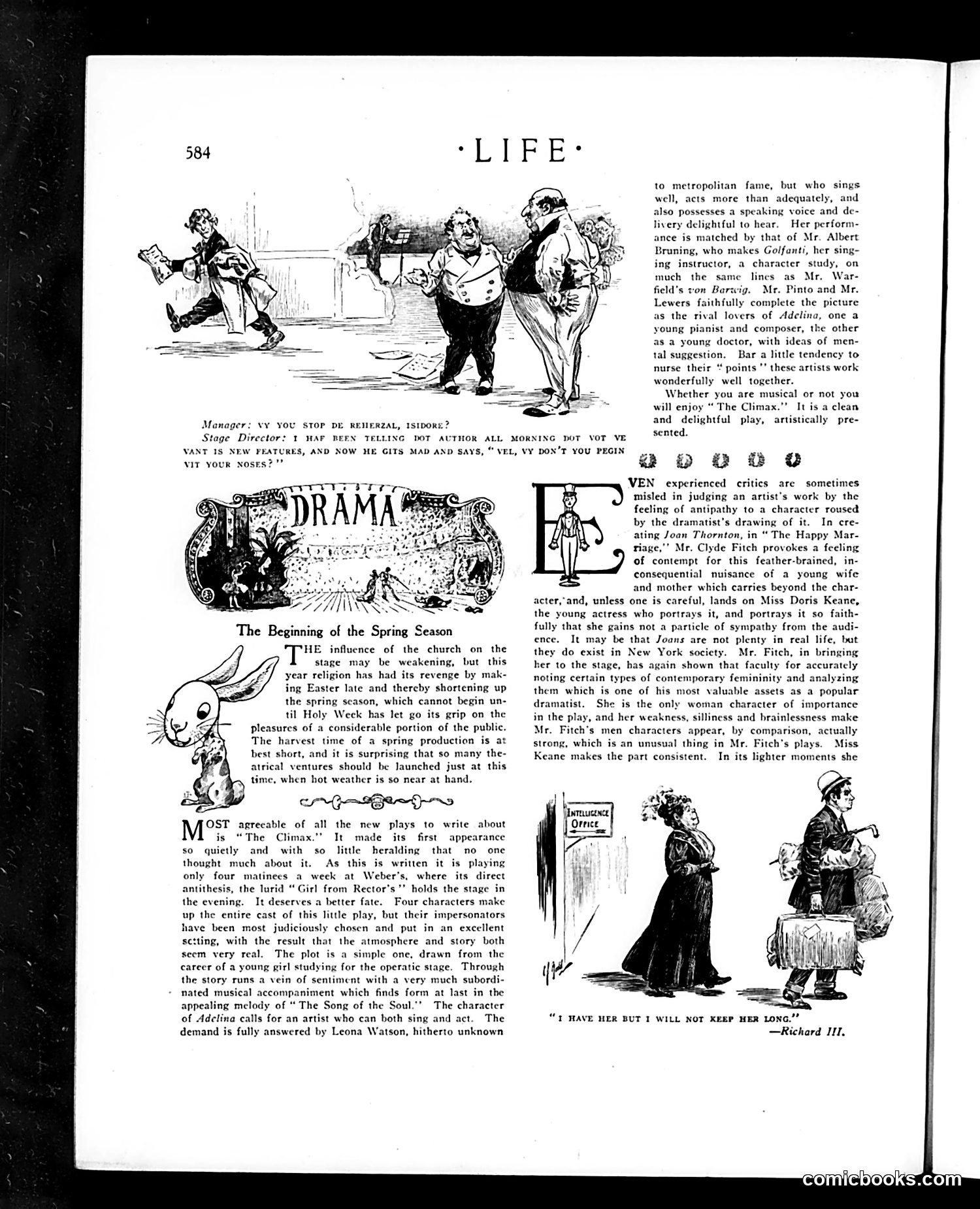
This page reviews theatrical productions, primarily "The Beginning of the Spring Season." The top sketch shows a stage manager confronting a director about artistic decisions, with comedic exaggeration typical of Life's drama criticism. The main article discusses "The Climax," praising its artistic presentation. Below, it reviews a play featuring an actress named Joana (likely Joan Thorton based on context), noting she's the "only woman character of importance" and criticizing her "weakness and brainlessness." The bottom illustration shows a man at what appears to be a theatrical office, captioned with a Shakespeare quote: "I have her but I will not keep her long" (Richard III). The satire targets both theatrical productions and gender representation in contemporary drama, reflecting early 20th-century attitudes about women's stage roles.
📄 Transcribed text from this page (OCR, searchable)
Machine-transcribed from the original scan — historical spelling and the odd misread are preserved.
Monager: vy You stop DE REMERZAL, 18100 Stage Director: 1 WAP REEN TELLING DOT AUTHOR ALL VANT 18 NEW FEATURES, AND NOW ME GITS MAD AND SAYS, “ VE! vit your Noses?” The Beginning of the Spring Season HE influence of the church on the stage may be weakening, but this year religion has had its revenge by mak- ing Easter late and thereby shortening up the spring scason, which cannot begin un- til Holy Week has let go its grip on the pleasures of a considerable portion of the public. The harvest time of a spring production is at best short, and it is surprising that so many the- atrical ventures should be Jaunched just at this time, when hot weather is so near at hand. ereGnaGengyns OST agrecable of all the new plays to write about is “The Climax.” It made its first appearance so quietly and with so little heralding th: no one thought much about it. As this is written it is playing only four matinees a week at Weber's, where its ect antithesis, the lurid “Girl from Rector’s’* holds the stage in the evening. It deserves a better fate. Four characters make up the entire cast of this little play, but their impersonators have been most judiciously chosen and put in an excellent sciting, with the result that the atmosphere and story both seem very real. The plot is a simple one, drawn from the career of a young girl studying for the operatic stage. Through the story runs a vein of sentiment with a very much subordi- nated musical accompaniment which finds form at last in the appealing melody of “The Song of the Soul.’ The character of Adelina calls for an artist who can both sing and act. The demand is fully answered by Leona Watson, hitherto unknown to metropolitan fame, but who sings well, acts more than adequately, and also possesses a speaking voice and de- livery delightful to hear. Her perform- ance is matched by that of Mr. Albert Bruning, who makes Golfanti, her sing- ing instructor, a character study, on much the same lincs as Mr. War- field’s von Barwig. Mr. Pinto and Mr. Lewers faithfully complete the picture as the rival lovers of Adelina, one a young pianist and composer, the other as a young doctor, with ideas of men- tal suggestion. Bar a little tendency to nurse their ‘ points '? these artists work wonderfully well together. Whether you are musical or not you will enjoy “The Climax.” It is a clean and delightful play, artistically pre- sented. ae © @ @ VEN experienced critics are sometimes misled in judging an artist’s work by the feeling of antipathy to a character roused by the dramatist’s drawing of it. In cre- ating Joan Thornton, in “The Happy Mar- riage,”’ Mr. Clyde Fitch provokes a feeling of contempt for this feather-brained, in- consequential nuisance of a young wife and mother which carries beyond the char- acter,'and, unless one is careful, lands on Miss Doris Keane, the young actress who portrays it, and portrays it so faith- fully that she gains not a particle of sympathy from the aud ence. It may be that Joans are not plenty in real life, but they do e: in New York society. Mr. h, in bringing her to the stage, has again shown that faculty for accurately noting certain types of contemporary femininity and analyzing them which is one of his most valuable assets as a popular dramatist. She is the only woman character of importance in the play, and her weakness, silliness and brainlessness make Mr. Fitch's men characters appear, by comparison, actually strong, which is an unusual thing in Mr. Fitch’s plays. Miss Keane makes the part consistent. In its lighter moments she MORNING DOT VOT VE ial “1 HAVE HER BUT I WILL NOT KEEP HER LONG. —Richard III.