
A complete issue · 28 pages · 1909
Life — February 11, 1909
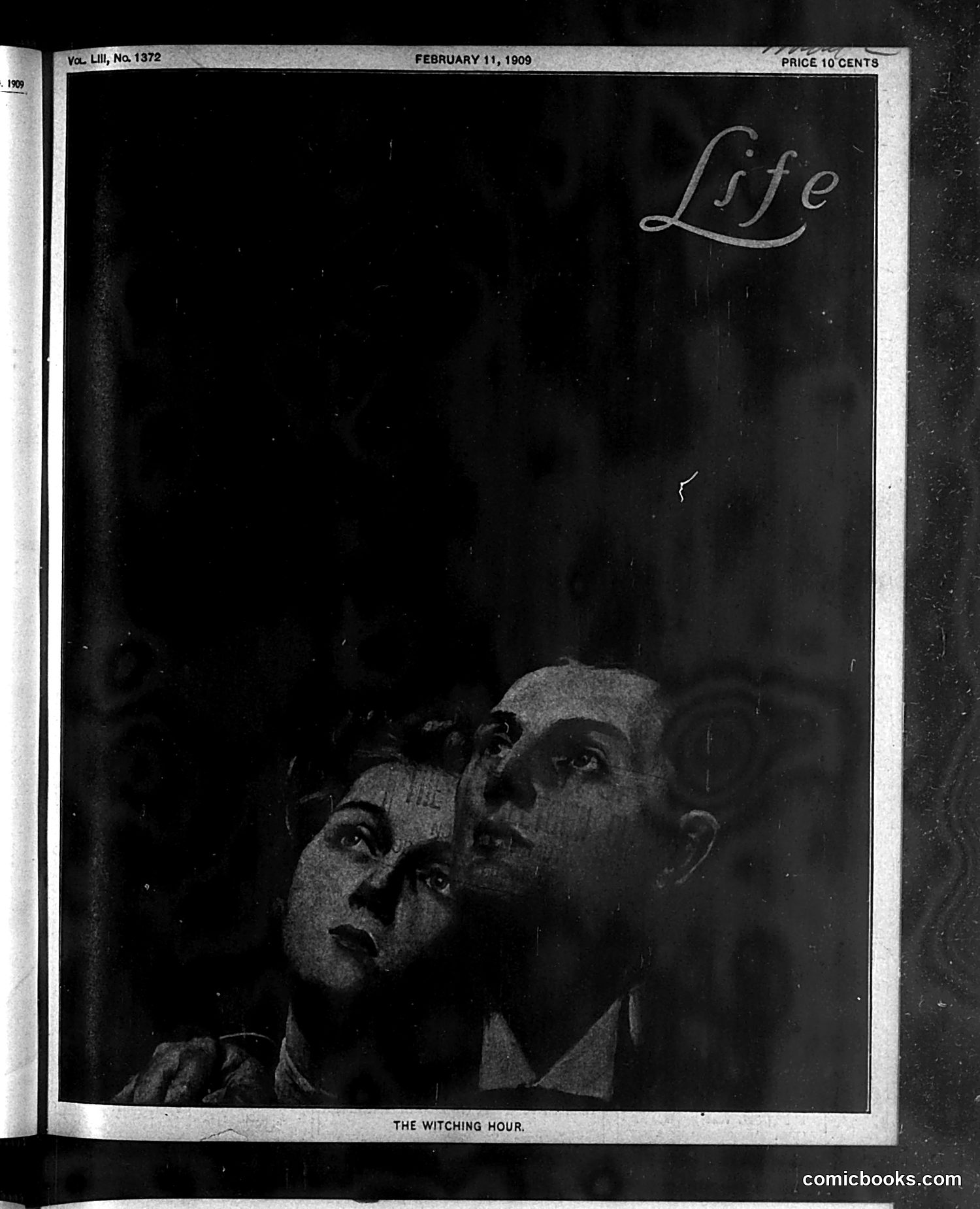
This appears to be the cover or an illustration from Life magazine's satirical commentary. The image shows two figures gazing upward in what seems to be a dramatic or mystical moment, titled "The Witching Hour." Without additional context from the magazine's text or surrounding articles, the specific political or social reference remains unclear from the image alone. The "witching hour" traditionally refers to midnight or times associated with supernatural activity. Given Life's satirical nature, this likely comments on contemporary anxieties—possibly about spiritualism (popular in the early 1900s), social concerns, or political matters of 1909. The dramatic composition and upward gaze suggest foreboding or anticipation, typical of Life's visual rhetoric for social commentary.
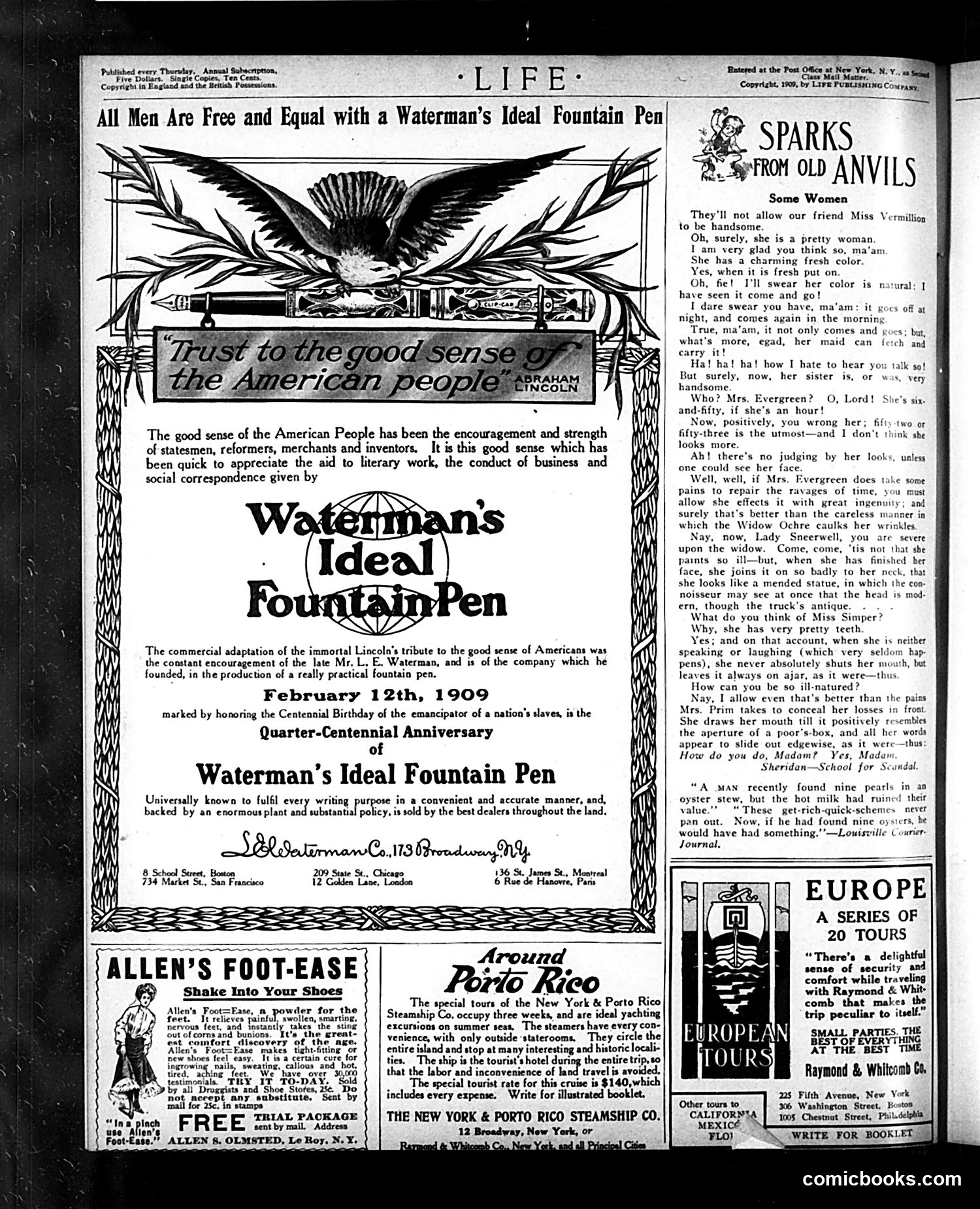
This page is primarily **advertising**, not satire or political commentary. The dominant content is a **Waterman's Ideal Fountain Pen advertisement** celebrating the product's "Quarter-Centennial Anniversary" (1909). The ad appeals to American values by invoking Lincoln's legacy and the "good sense of the American people," positioning the pen as practical and accessible. The accompanying content includes minor advertisements: Allen's Foot-Ease powder, a Porto Rico steamship cruise, and European tour packages. On the right, "Sparks from Old Anvils" is a **gossip column** satirizing society women—particularly their vanity (concerns about complexions and appearance) and pretentiousness. The humor targets wealthy female socialites' self-absorption. No specific political figures or events are referenced. This reflects Life magazine's typical mix of commercial advertising and lighthearted social satire circa 1909.
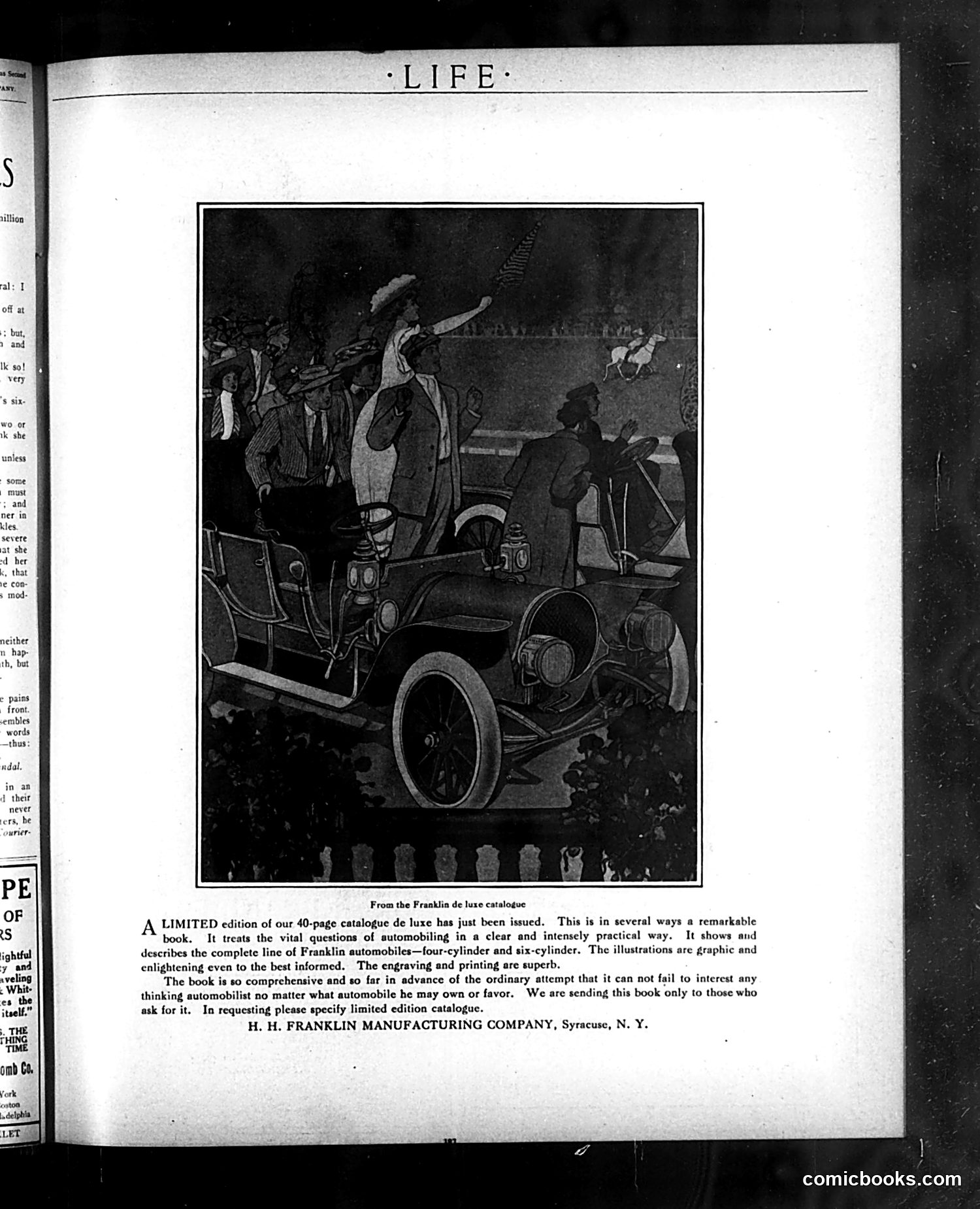
This page is primarily **advertising**, not political satire. It features a Franklin Manufacturing Company advertisement for their de luxe automobile catalogue. The image shows a early 1900s automobile with multiple well-dressed passengers in period clothing, appearing to be arriving at or departing from an event (possibly a social gathering or race, given figures visible in the background). The advertisement emphasizes that Franklin's new 40-page catalogue comprehensively details their automobile line—four and six-cylinder models—with superior printing and engraving. The copy appeals to automobile enthusiasts and potential buyers, positioning the catalogue as a must-have resource for anyone considering a Franklin automobile purchase. This reflects early automotive marketing targeting affluent consumers during the automobile industry's growth period.
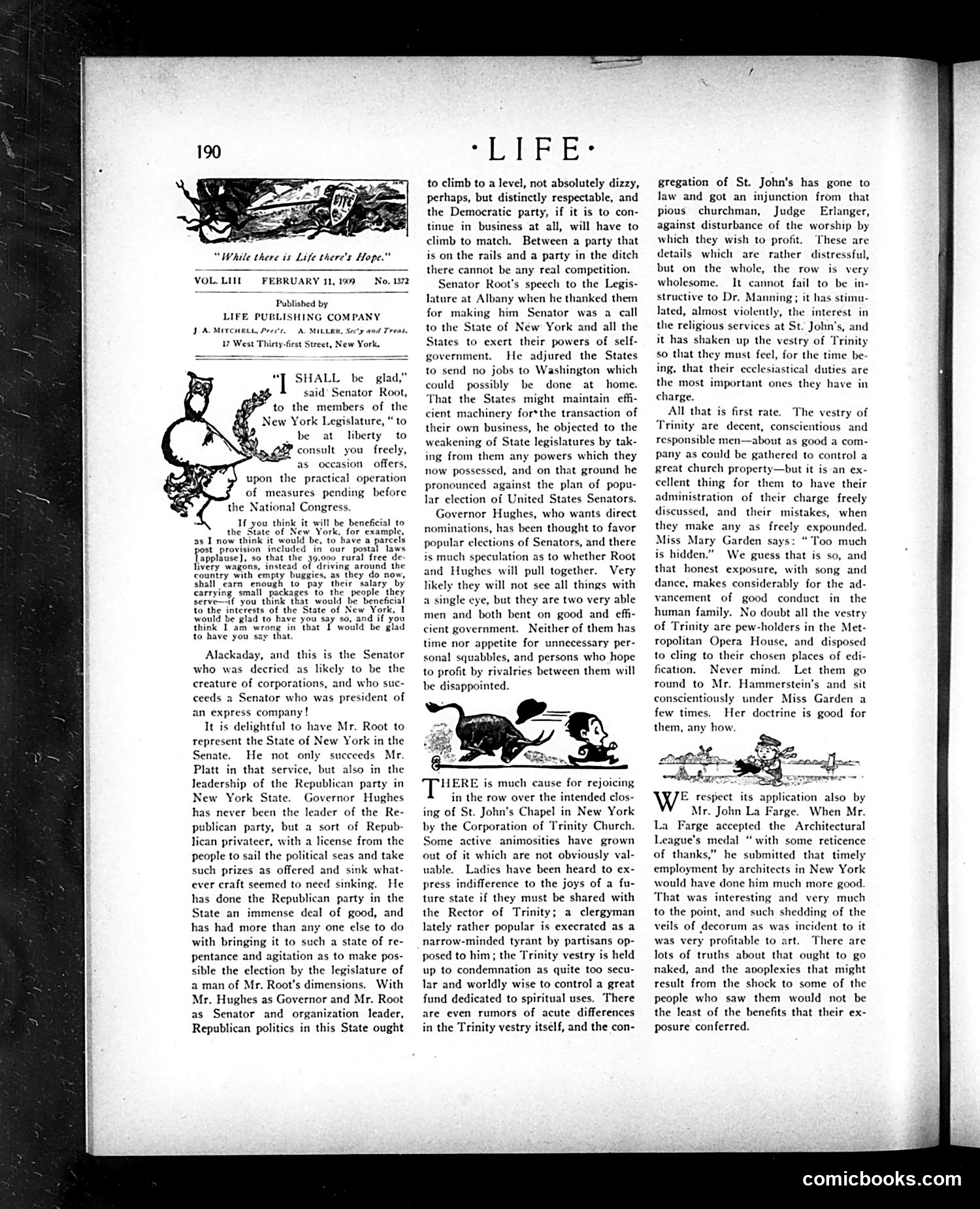
This page contains two political cartoons and editorial commentary about New York State politics. The main text discusses Senator Root's speech to the Legislature, praising his support for State independence versus federal overreach. The editorial argues Root is a strong Republican leader who, alongside Governor Hughes, represents capable governance. The cartoons appear satirical toward political rivals. One depicts a dog chasing its tail—likely representing political infighting or circular partisan disputes. Another section discusses Trinity Church's closing in New York and architectural concerns, plus commentary on Miss Mary Garden and theater conduct. The overall tone defends Republican leadership while mocking Democratic or opposing political maneuvering as self-serving and circular rather than substantive.
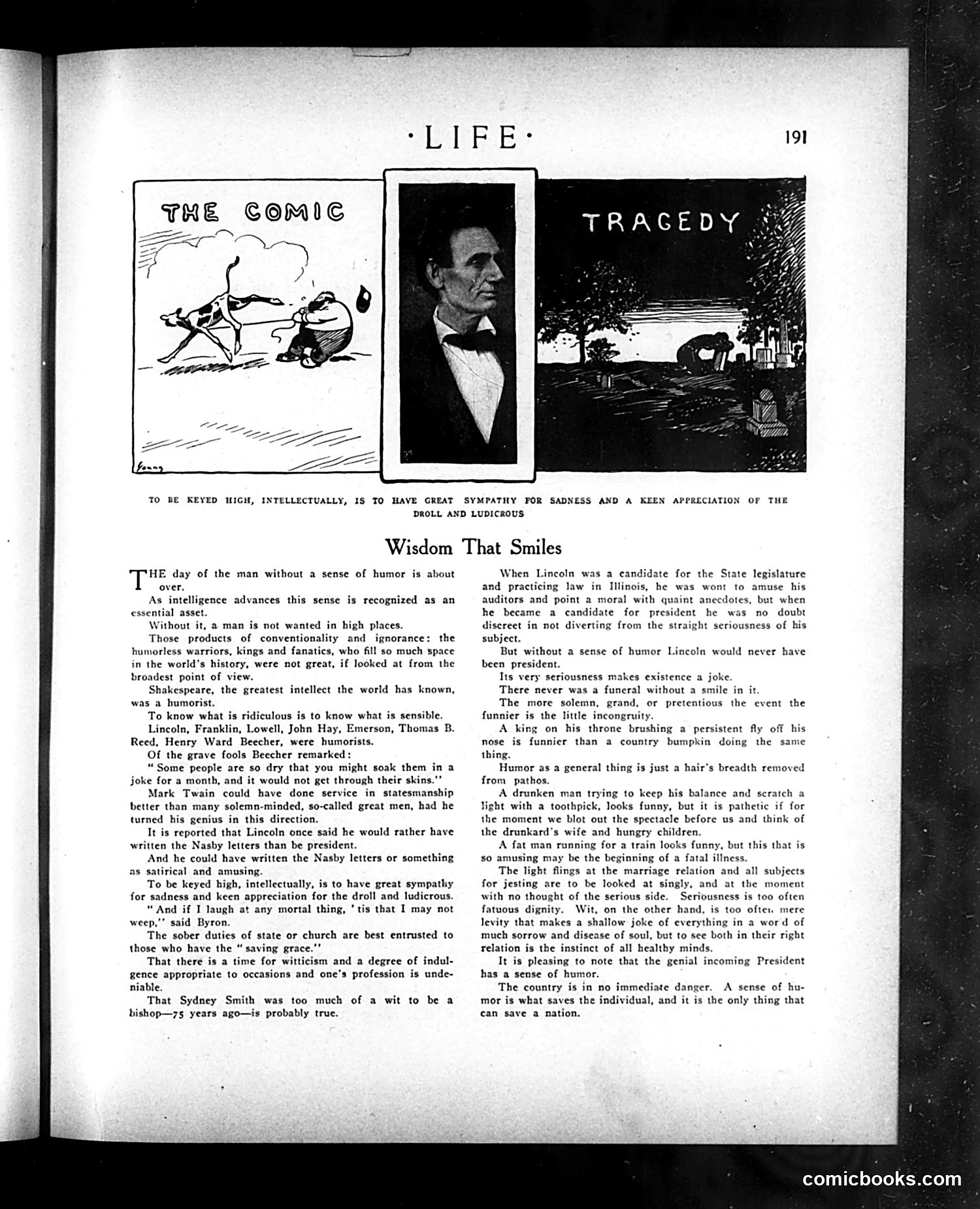
This page from *Life* magazine features two cartoons flanking a portrait, under the heading "Wisdom That Smiles." **Left cartoon ("The Comic"):** Shows a slapstick scene of physical comedy—figures in exaggerated motion, suggesting pratfalls or absurd mishaps. **Center:** A formal portrait of a serious-faced man in formal dress. **Right cartoon ("Tragedy"):** A dark, moody landscape scene. The article argues that a sense of humor is essential to leadership and wisdom. It specifically references **Lincoln**, praising his ability to balance serious duties with humor—noting that without his comedic sensibility, he wouldn't have become president. The piece suggests that humor provides necessary psychological relief and demonstrates intellectual sophistication, contrasting the "droll and ludicrous" with grave responsibility as marks of wisdom rather than unsuitability for high office.
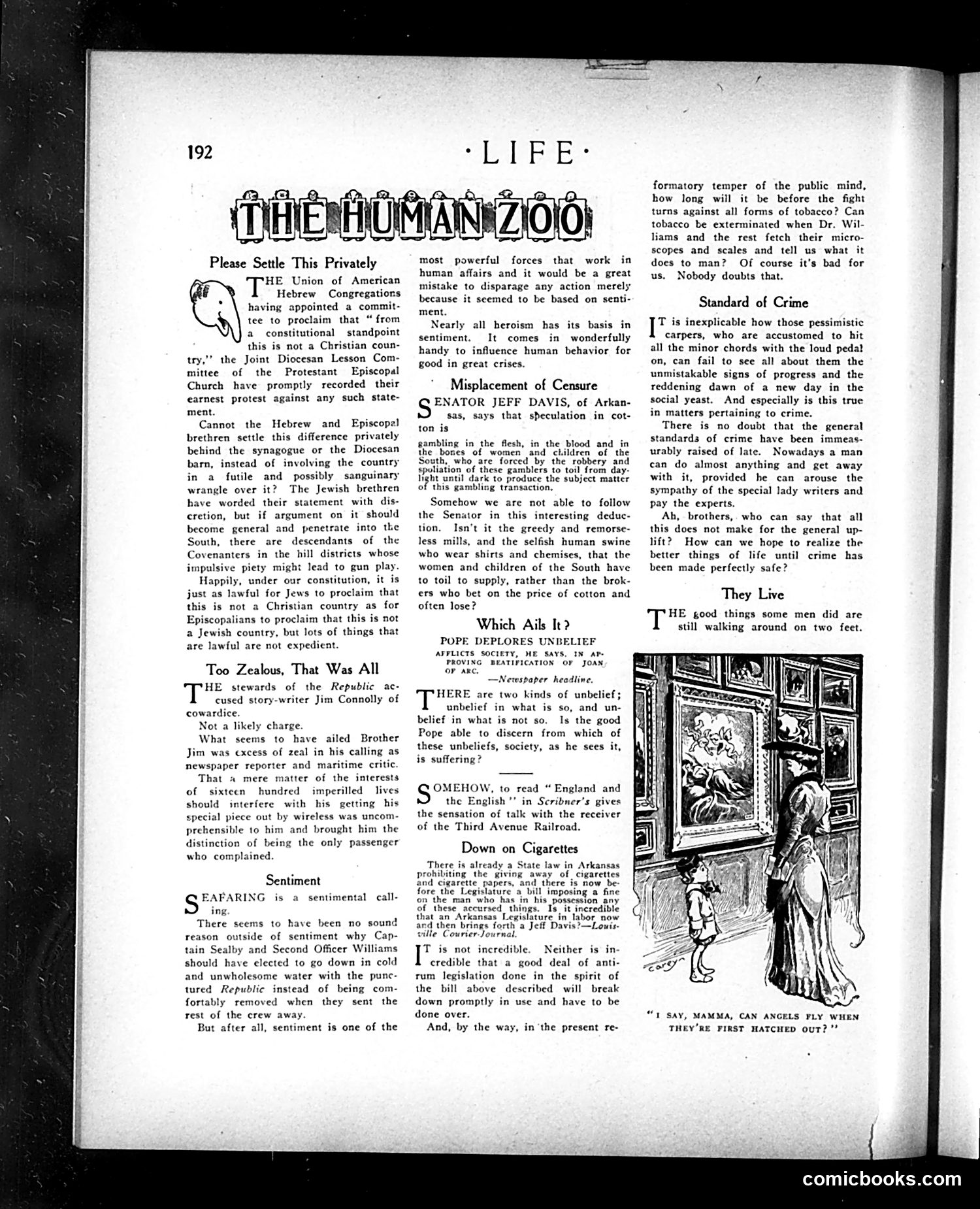
This page contains several editorial commentaries and one illustration. The main cartoon shows a woman looking out a window at two figures outside—likely representing ordinary people as subjects of observation, hence "the human zoo." The text sections critique various social issues: one attacks sensationalist newspaper coverage of crime by Jim Connolly; another defends Senator Jeff Davis of Arkansas against charges of encouraging gambling and exploitation of poor Southern workers and children; a third discusses Catholic versus Episcopal theological differences; and another addresses anti-rum legislation and cigarette restrictions. The overall tone is satirical commentary on contemporary social crusades, moral panics, and journalistic excess—suggesting that reformers and critics treat ordinary people as curiosities to be observed and judged rather than understood.
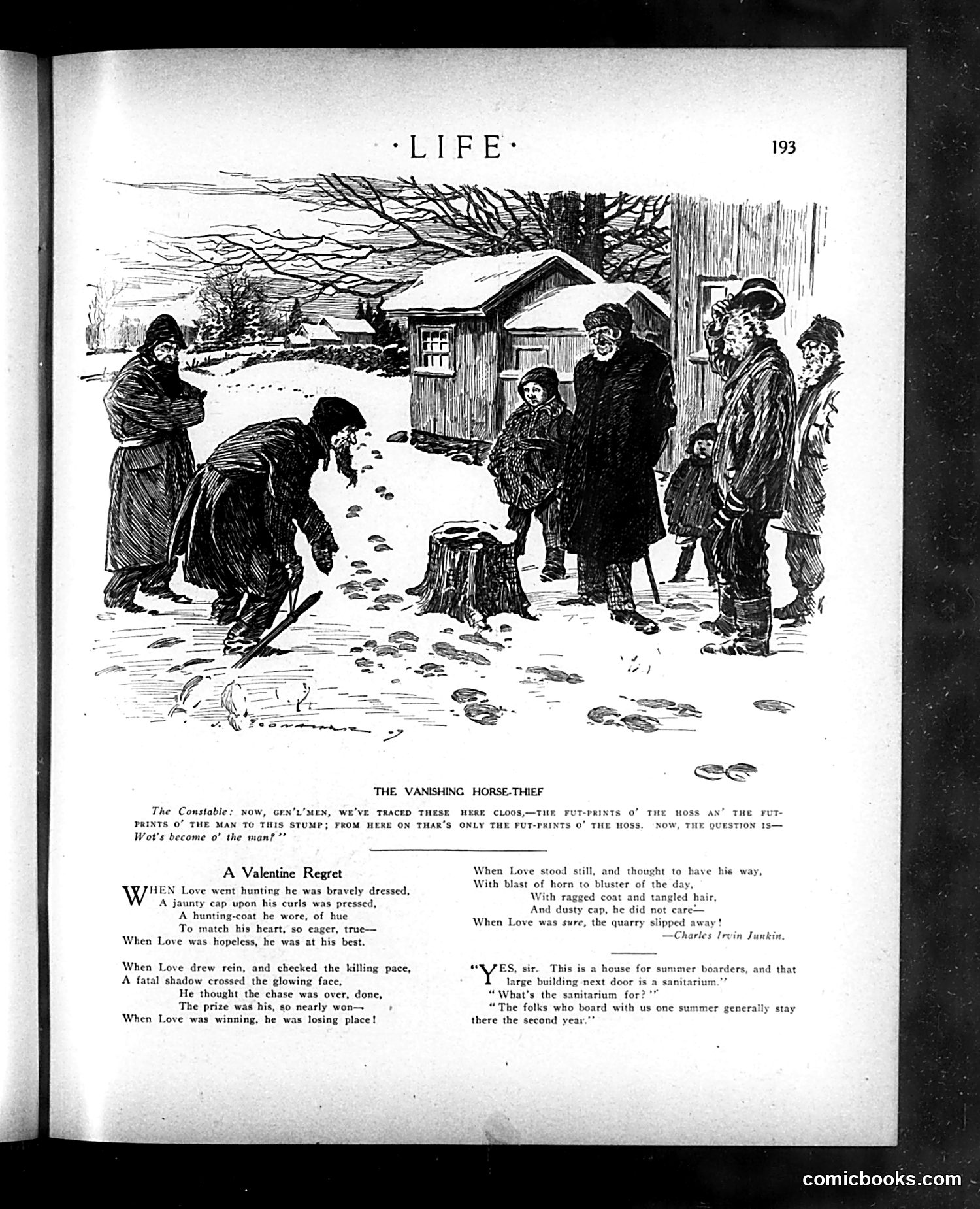
This page contains two distinct pieces: **"The Vanishing Horse-Thief"** — A cartoon showing a constable with townspeople examining footprints in snow. The caption suggests they've traced a horse thief's prints that vanish mysteriously, leaving only the horse's prints continuing. The joke appears to be a visual pun about an impossible disappearance—likely satirizing either criminal incompetence or implausible detective work. **"A Valentine Regret"** — A poem by Charles Irish Jankin about a failed romantic hunt. It describes a man losing a chase for love, with the woman proving faster and the pursuer "losing place." The tone suggests satire of romantic disappointment and masculine failure in courtship—typical Victorian-era humor mocking unsuccessful suitors. Both pieces use winter/outdoor settings and physical misadventure for comedic effect.
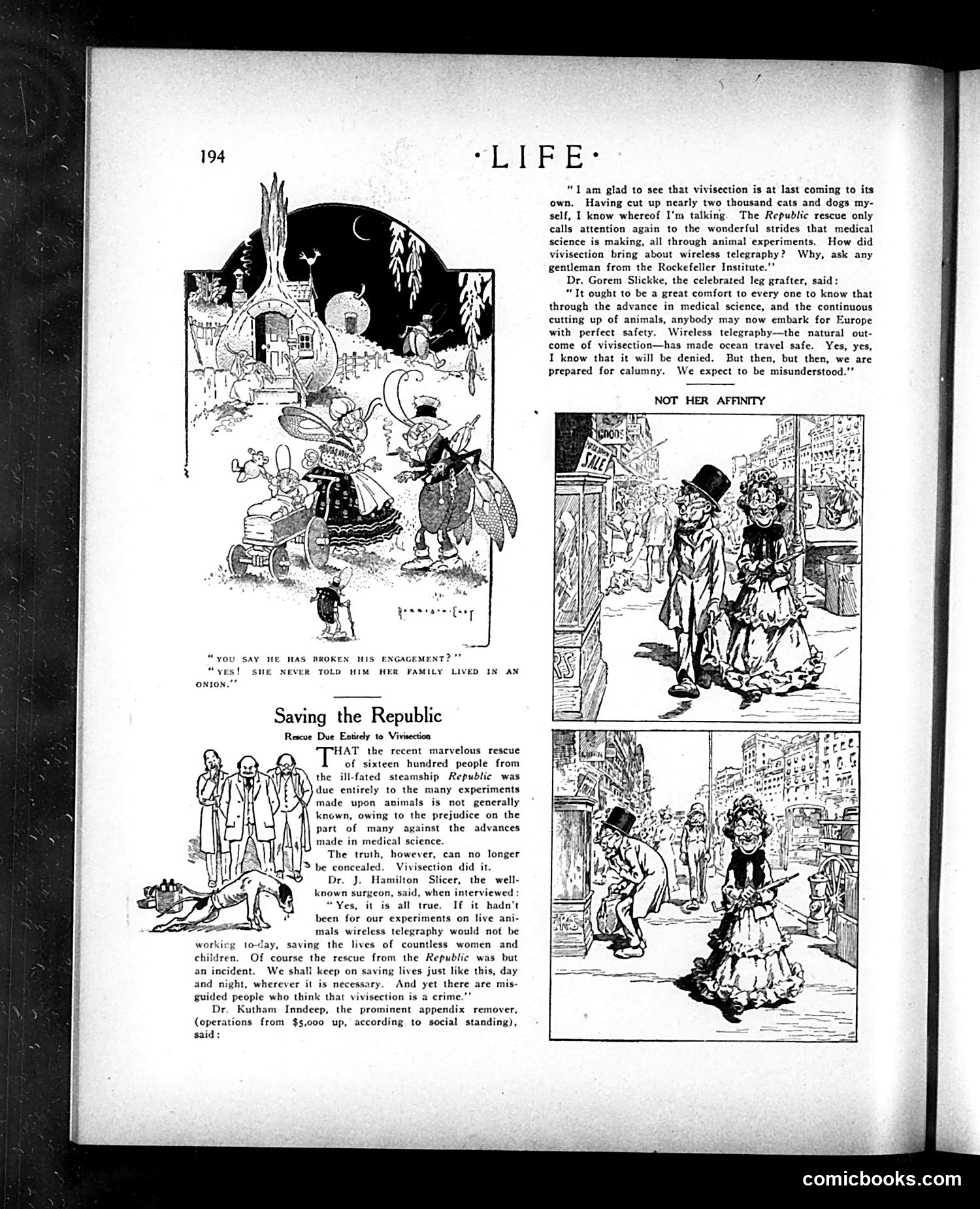
This page satirizes the medical practice of **vivisection** (animal experimentation). The top illustration shows a fantastical nighttime laboratory scene with grotesque animal-human hybrids, mocking the public's fears about what happens in research facilities. The text presents quotes defending vivisection's scientific value—mentioning wireless telegraphy and ocean travel safety—while acknowledging public opposition and "misunderstanding." Dr. Gorem Slicke and Dr. Hamilton Sleer are satirical names for vivectionists. "**Saving the Republic**" mocks this defense by claiming vivisection rescued 1,600 people aboard the *Republic* ship. The accompanying comic strip "**Not Her Affinity**" appears unrelated—a separate humor piece about class or romantic miscommunication. The page ridicules both vivisectionists' rationalizations and public squeamishness about animal research.
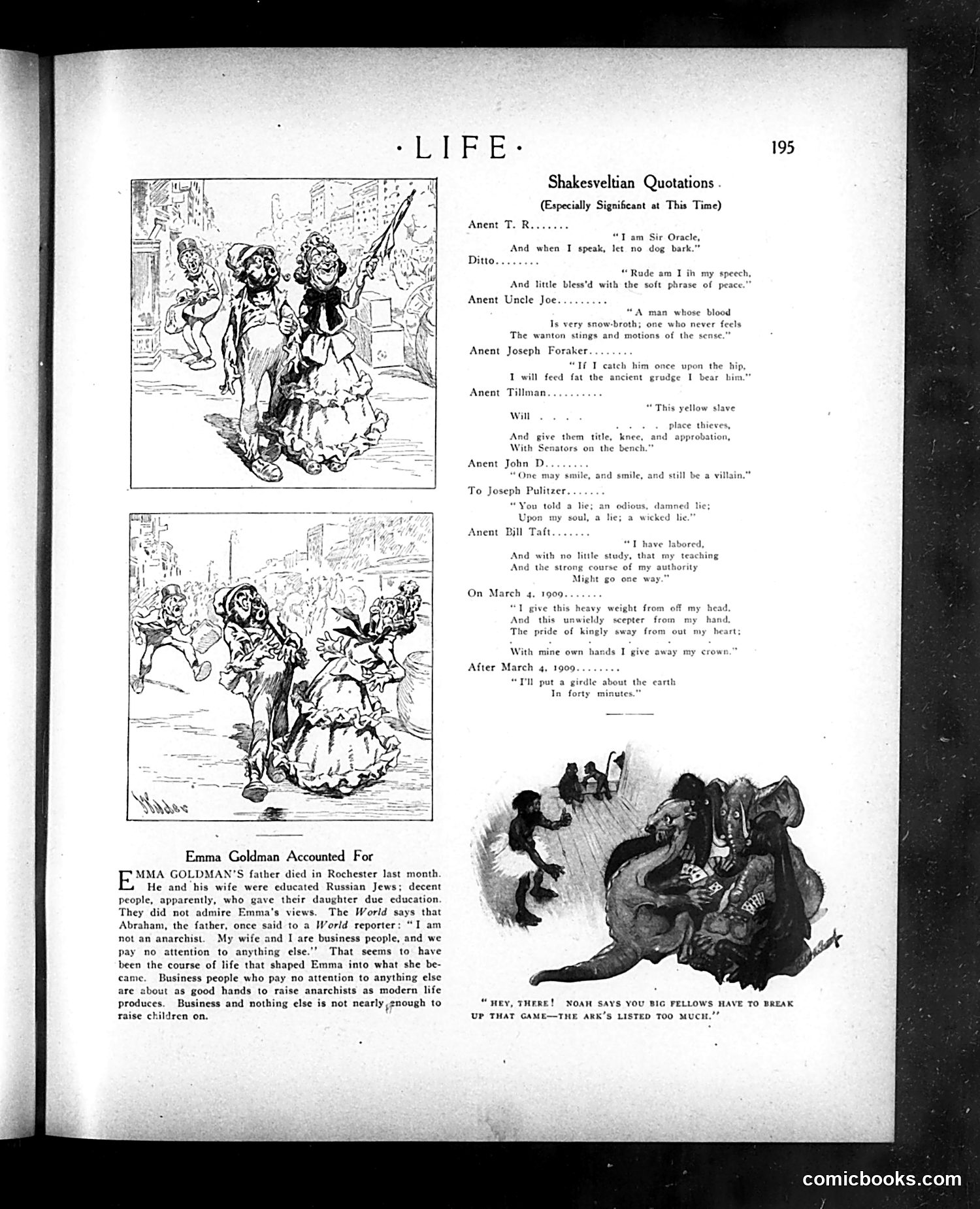
This page contains **Shakespearean quotations attributed to contemporary political figures** (labeled "Especially Significant at This Time"), followed by a section titled "Emma Goldman Accounted For." The cartoons and quotes satirize **anarchists and radical figures** of the era. The Shakespearean passages are cynically assigned to figures like "Anent T.R." and "Anent Joseph Forsaker," using Shakespeare to mock their statements and positions. The "Emma Goldman Accounted For" section discusses the death of Emma Goldman's father and sarcastically critiques anarchist ideology, suggesting that anarchists are poor influences on children—a common anti-radical trope of the early 20th century. The bottom illustration shows what appears to be **Noah's ark scene**, satirizing radical or immigrant figures, with a caption about "big fellows" breaking up a game. This reflects American anxieties about anarchism and immigration during the Progressive era.
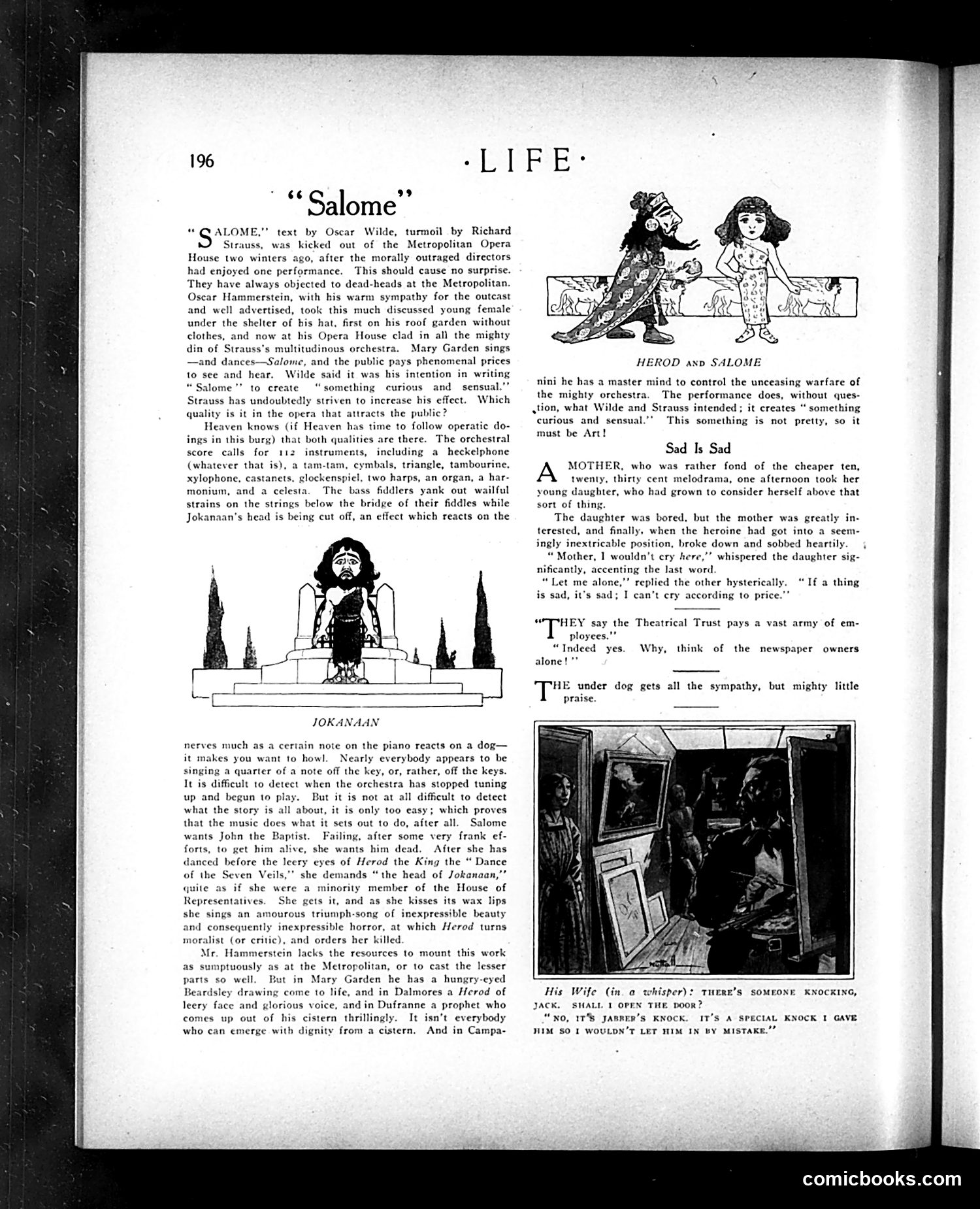
This page reviews Richard Strauss's operatic adaptation of Oscar Wilde's *Salome*, performed at the Metropolitan Opera House. The text critiques the production's sensationalism, noting that the Metropolitan Opera's directors have "always objected to dead-heads" (non-paying attendees) yet staged this morally controversial work. The illustrations show: - **Herod and Salome**: Characters from the biblical narrative adapted by Wilde - **Jokanan**: The beheaded prophet whose severed head Salome demands The satirical angle mocks the opera's graphic violence and sexual content—the "Dance of the Seven Veils" and demand for Jokanan's head—suggesting that despite moral objections elsewhere, sensational material attracts audiences and revenue. The small sidebar jokes about theater employment and sympathy for "under dogs" continue the satirical commentary.
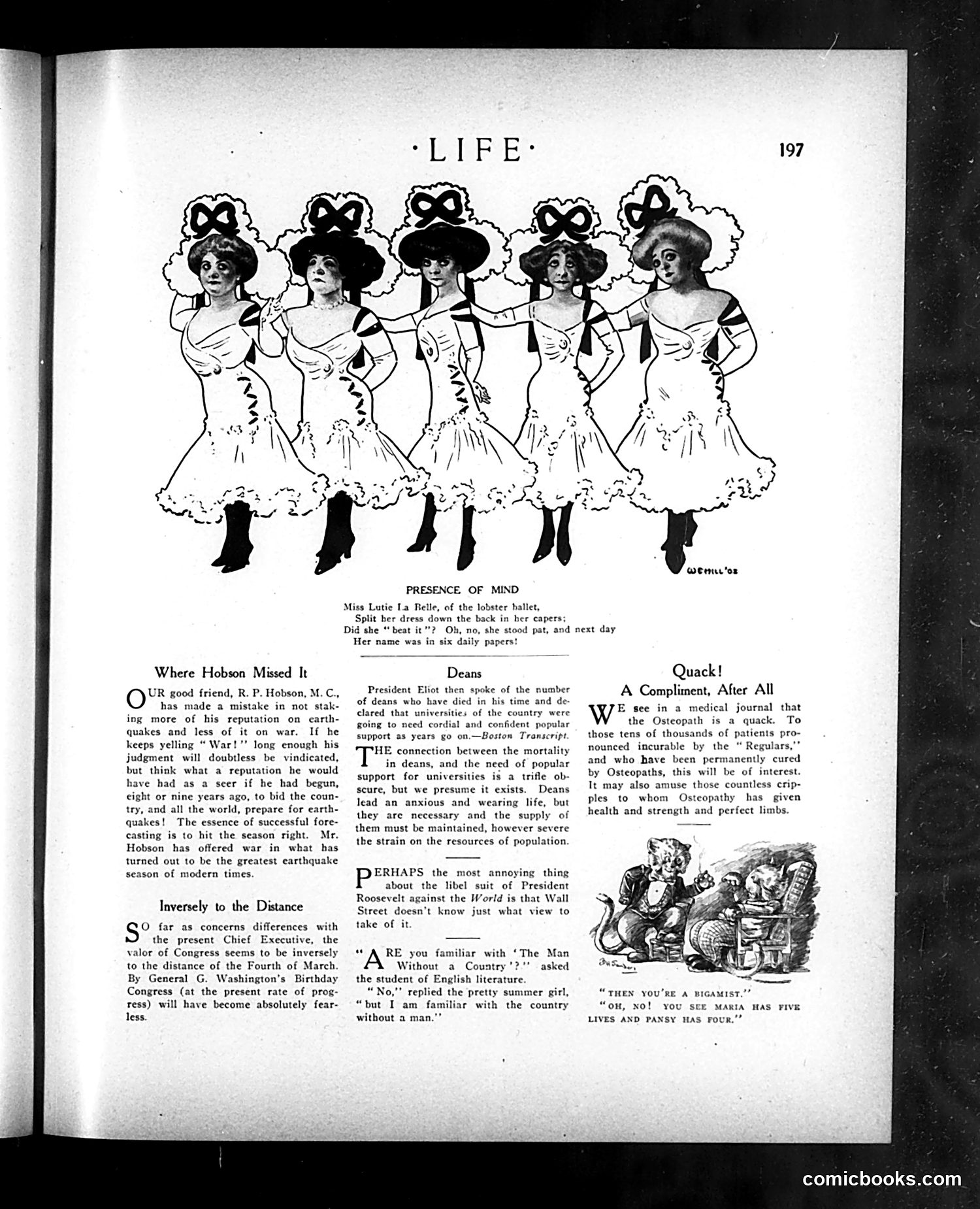
**Top Illustration ("Presence of Mind"):** Five women in elaborate Edwardian dress with large hats perform a synchronized pose. The caption references "Miss Lucie La Belle, of the lobster ballet," who allegedly split her dress during performance but maintained composure—her name appearing in newspapers the next day. This satirizes both theatrical vanity and press obsession with celebrity scandals. **Articles:** - "Where Hobson Missed It": Criticizes Admiral Hobson's war preparation views - "Deans": Discusses university financial strain - "Quack!": Mocks medical journal claims about "Osteopathy" **Bottom Cartoon:** A domestic scene with unclear specific reference, though the caption suggests marital tension about family size ("bigamist," "five lives"). The page combines social satire with political commentary typical of early 20th-century Life magazine humor.
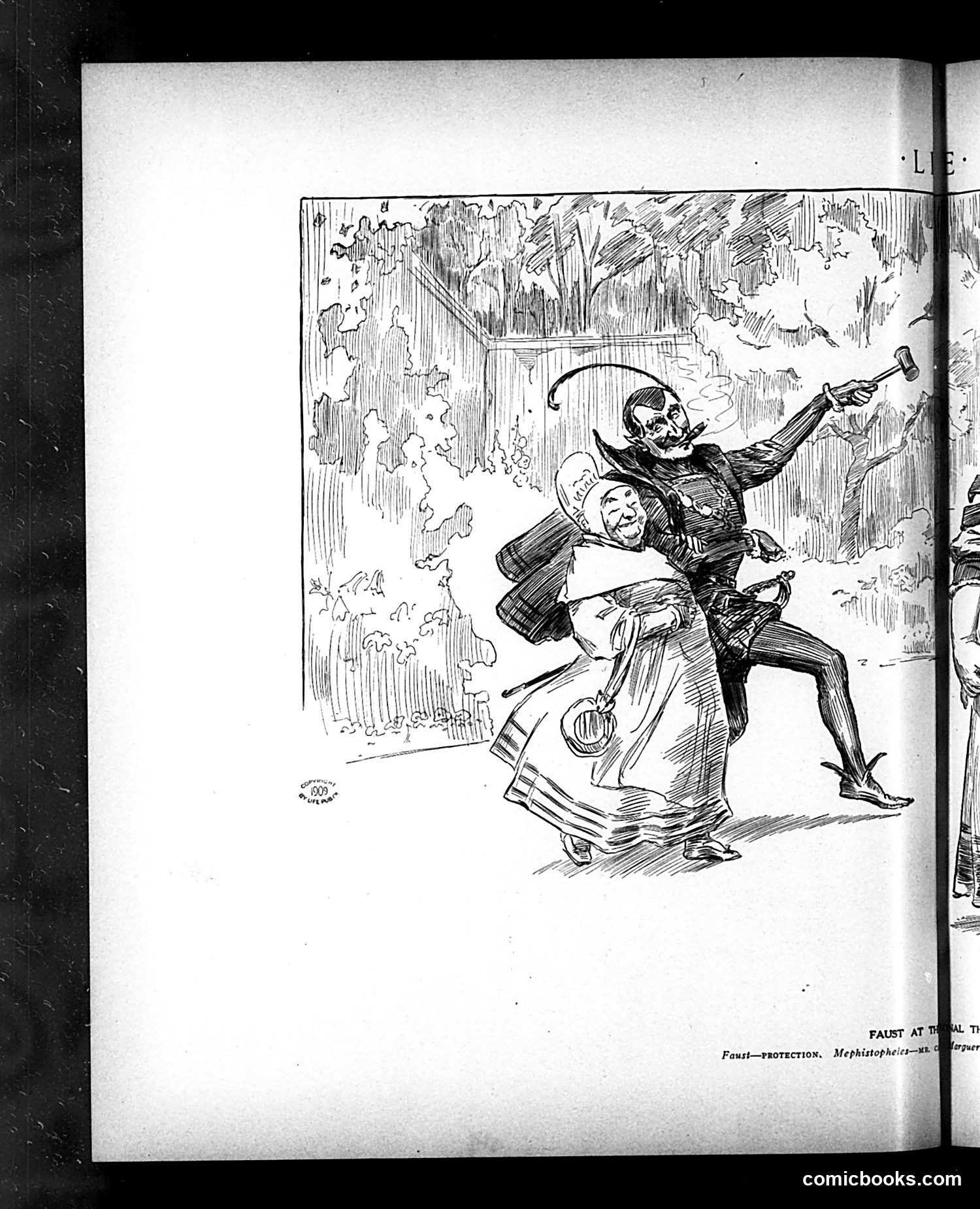
This appears to be a satirical cartoon titled "FAUST—PROTECTION. Mephistopheles" (partially visible). The image depicts two figures in a Faustian bargain scenario: a rotund, well-dressed man (likely representing a political or business figure) sits while a skeletal, demonic character perches on his shoulders, wielding a hammer or gavel. The satire references Goethe's *Faust* legend, where a man trades his soul for power and protection. Here, the cartoon suggests a corrupt alliance—the powerful figure gains "protection" (possibly from prosecution or competition) by making a deal with malevolent forces (represented by Mephistopheles). Without clearer text or dating information, the specific political target remains unclear, but the cartoon criticizes backroom deals and moral compromise in pursuit of power or security.
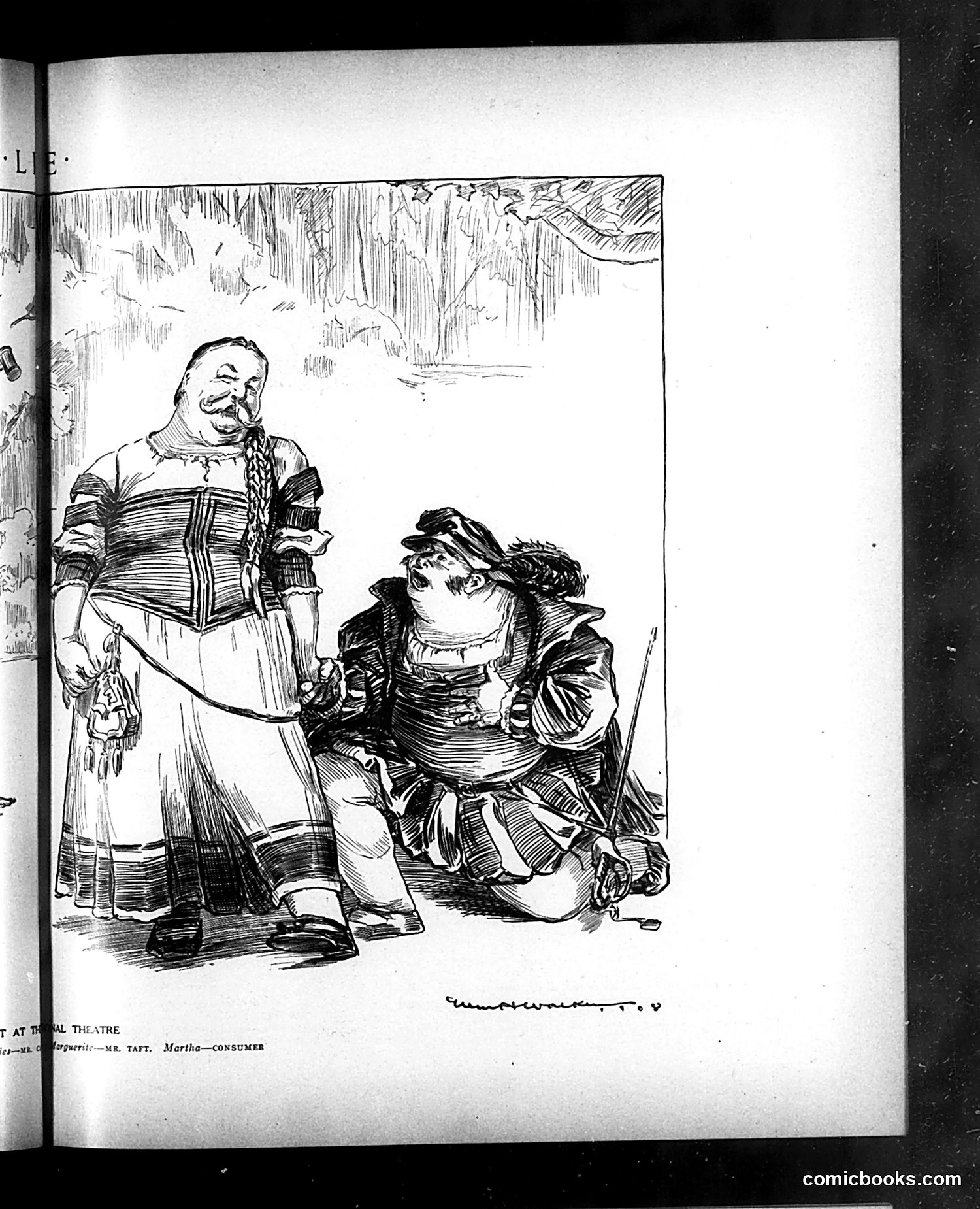
This appears to be a satirical illustration from *Life* magazine depicting two figures in an unequal economic exchange. The OCR text identifies them as "Mr. Taft" and "Martha—Consumer." The cartoon likely critiques the relationship between big business (represented by the larger, dominant figure on the left) and ordinary consumers like Martha (the smaller figure on the right). The caricatured style suggests mockery of wealth disparity or exploitative commercial practices. Without clearer dating or additional context, the specific historical reference remains uncertain. However, the "consumer" label and the power imbalance depicted suggest commentary on industrial-era economic inequality and potentially unfair business practices affecting ordinary Americans. The artistic style is consistent with early 20th-century American political cartooning.
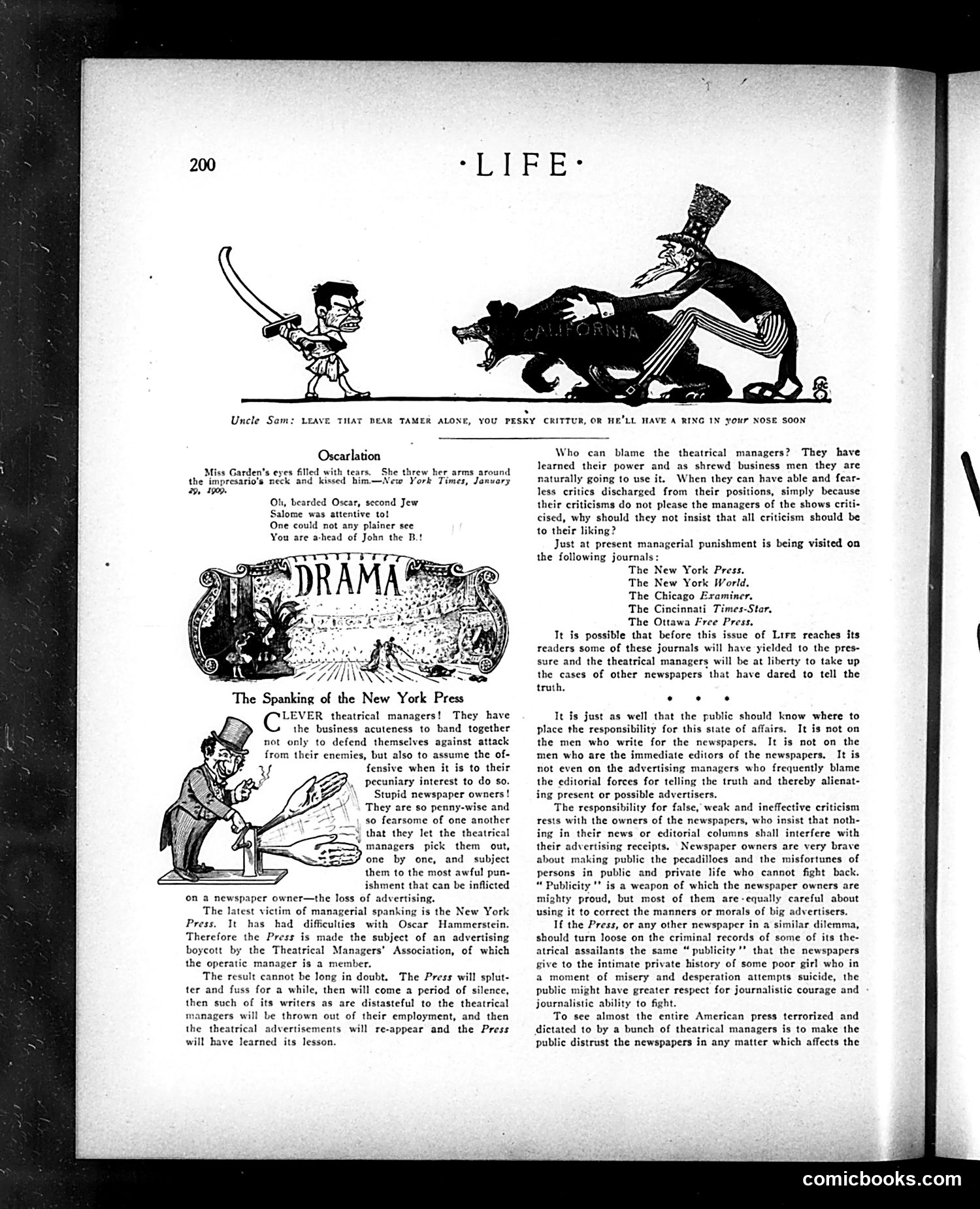
This 1906 Life magazine page satirizes **theatrical managers' censorship of newspapers** through advertising boycotts. **The Cartoon:** Uncle Sam (representing the public interest) warns a small figure labeled "Press" against a bear-like creature labeled "California" (representing theatrical interests), threatening he'll get "a ring in your nose"—meaning loss of editorial independence. **The Issue:** Oscar Hammerstein and the Theatrical Managers' Association punished the *New York Press* (and other papers) by withdrawing advertising because these publications published unfavorable theater reviews. The boycott forced newspapers to either silence critics or lose revenue. **The Satire's Point:** Life mocks both theatrical managers' economic coercion and newspaper owners' cowardice in abandoning editorial integrity for profit. The article argues newspapers fearlessly expose ordinary citizens but cave to powerful advertisers—hyocritical "publicity" that serves wealth over truth. The cartoon warns that yielding to such pressure threatens press freedom itself.
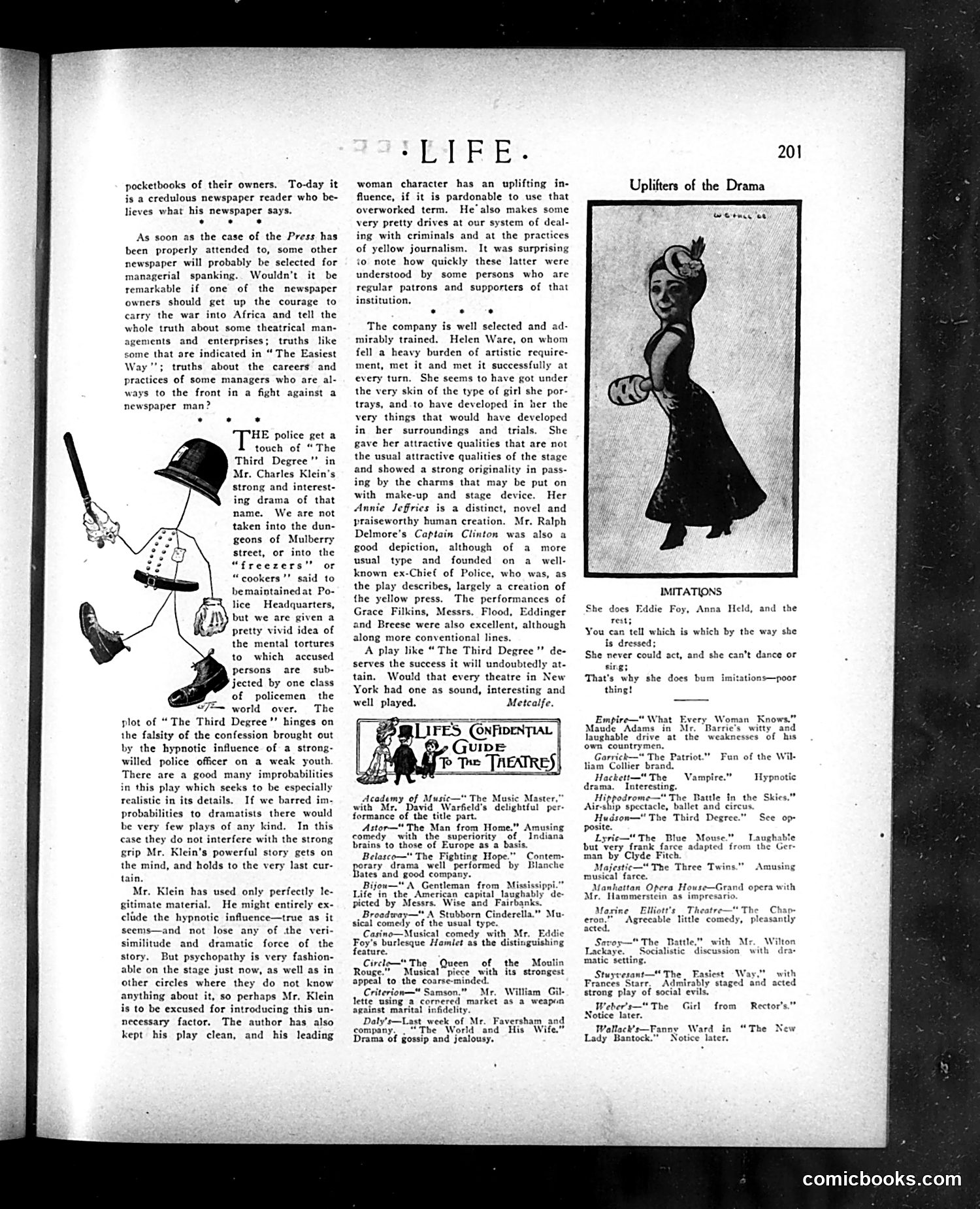
This page reviews Charles Klein's play "The Third Degree," a drama about police brutality and false confessions. The cartoon (left) satirizes police interrogation tactics—showing a figure being subjected to mental torture through the "third degree," a contemporary term for aggressive police questioning. The review praises the production for tackling serious social issues: police coercion of confessions from vulnerable suspects, and yellow journalism's role in manufacturing criminals' public personas. The critic notes the play critiques "our system of dealing with criminals" while remaining dramatically compelling. The satire targets both corrupt police practices and sensationalist newspapers that distort criminal cases for circulation. For modern readers: this reflects Progressive Era concerns about police misconduct and media manipulation—issues that remain relevant today, though the specific reference to "hypnotic influence" reflects period-specific pseudoscience about interrogation.
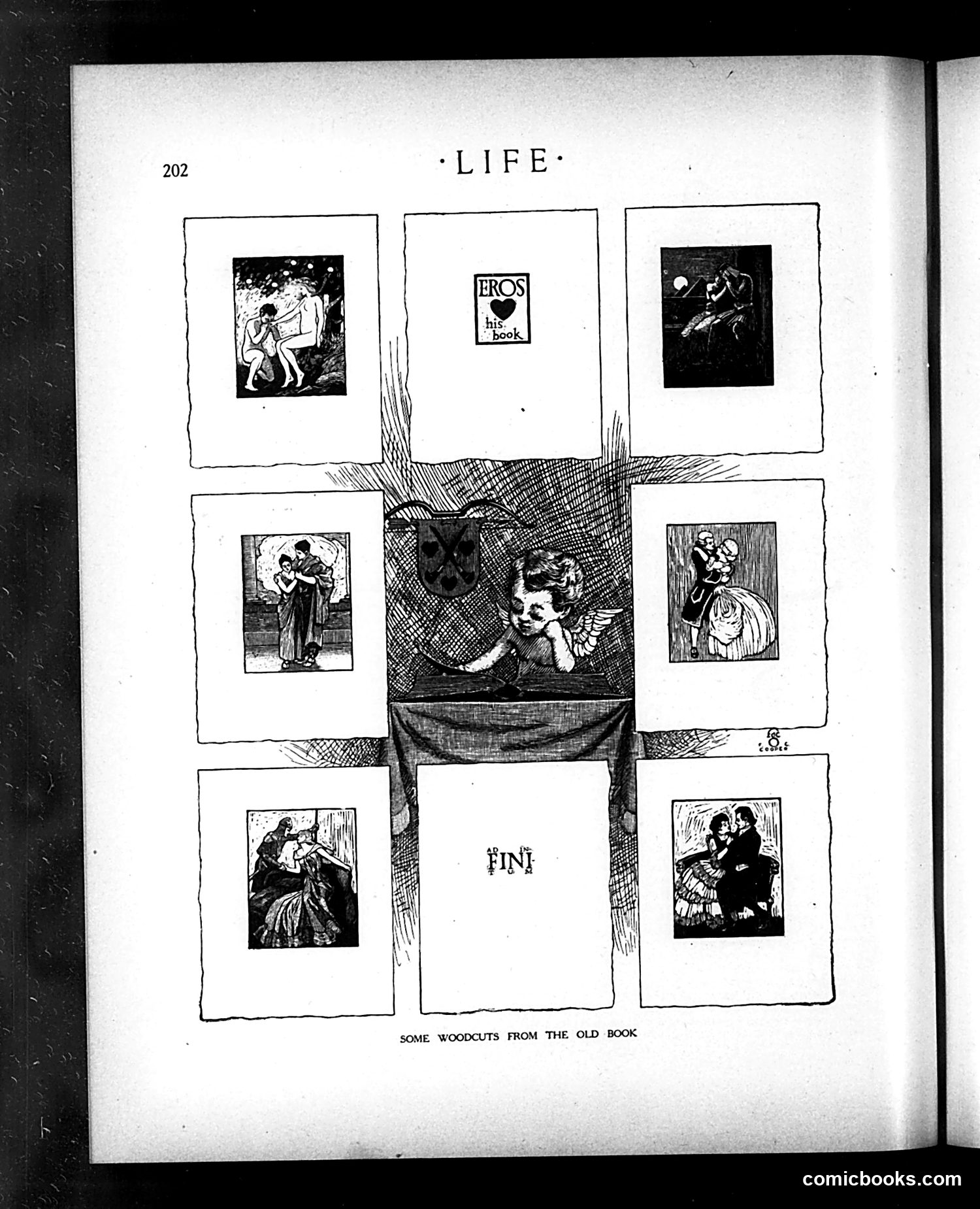
This page displays a collection of classical woodcut illustrations arranged around a central cherub figure, with the title "EROS his book" visible in the upper center panel. The caption identifies these as "SOME WOODCUTS FROM THE OLD BOOK." The layout appears to be a decorative anthology page rather than political satire. The woodcuts depict romantic and classical scenes—couples embracing, angelic figures, and intimate moments—suggesting this is presenting historical artistic representations of love and desire ("Eros" being the Greek god of love). The page number (202) and "LIFE" header indicate this appeared in the magazine as a cultural/arts feature. Rather than satirizing current events, this seems to celebrate classical artistic traditions, likely appealing to *Life's* educated readership through appreciation of historical printmaking and romantic themes.
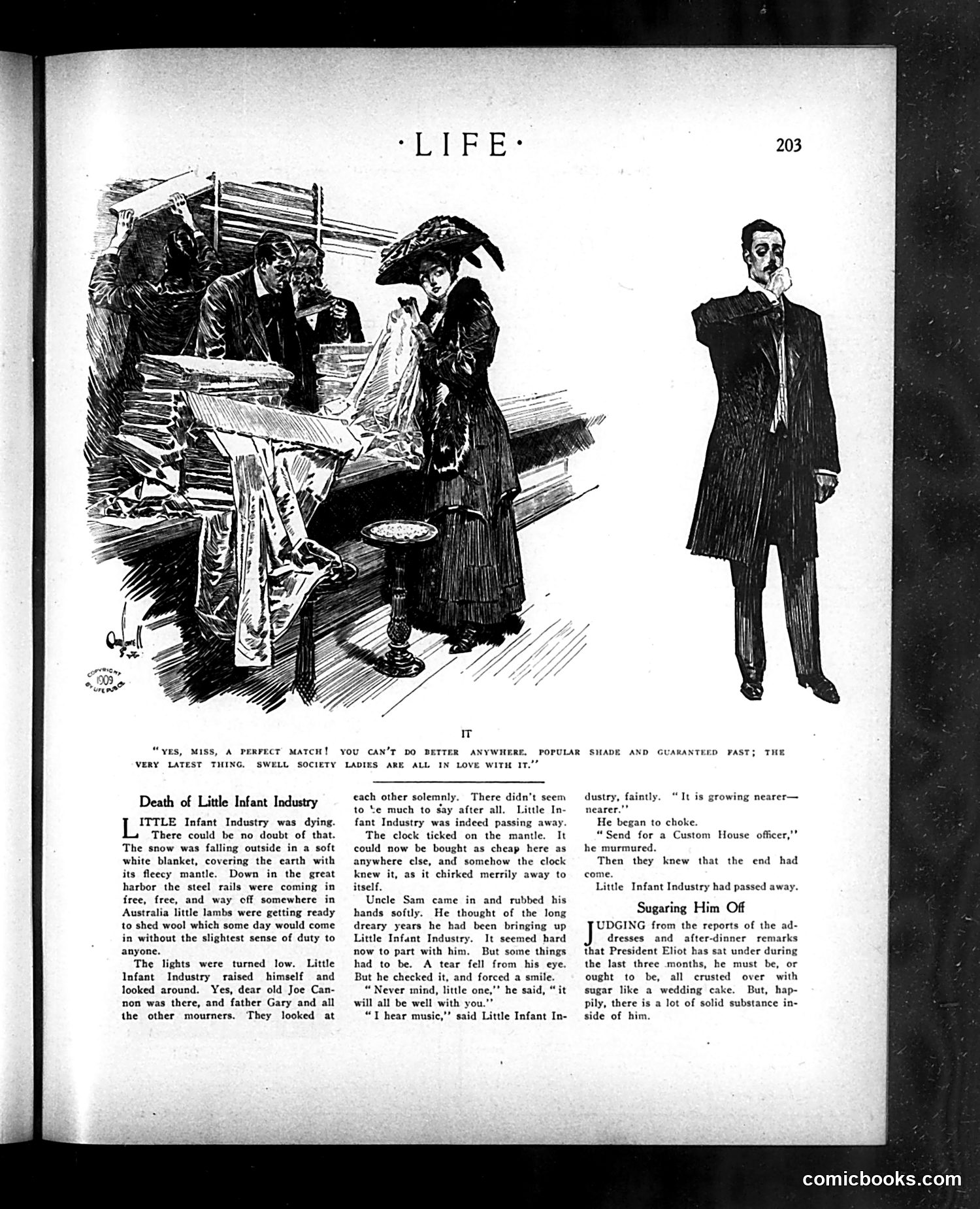
This page contains two satirical pieces from *Life* magazine: **Top cartoon**: Shows a tailor fitting a woman's dress, with dialogue about a "perfect match" and "popular shade"—likely satirizing high society's obsession with fashion trends and superficial matching. **"Death of Little Infant Industry"**: An allegorical story mourning the decline of American domestic manufacturing. "Little Infant Industry" represents protected American businesses; "Uncle Sam" tends it like a dying child. The imagery of free-falling steel rails and cheap Australian wool references tariff debates of the era. "Joe Cannon" (likely Speaker Joseph Cannon) and "father Gary" appear as mourners. The satire critiques free trade policies undermining American industry protection—a major political debate in early 20th-century America. **"Sugaring Him Off"**: A brief satirical jab at President Charles Eliot, suggesting he's been excessively flattered during recent speeches, yet retains substance beneath the flattery. The page reflects Progressive-era anxieties about trade policy and industrial decline.
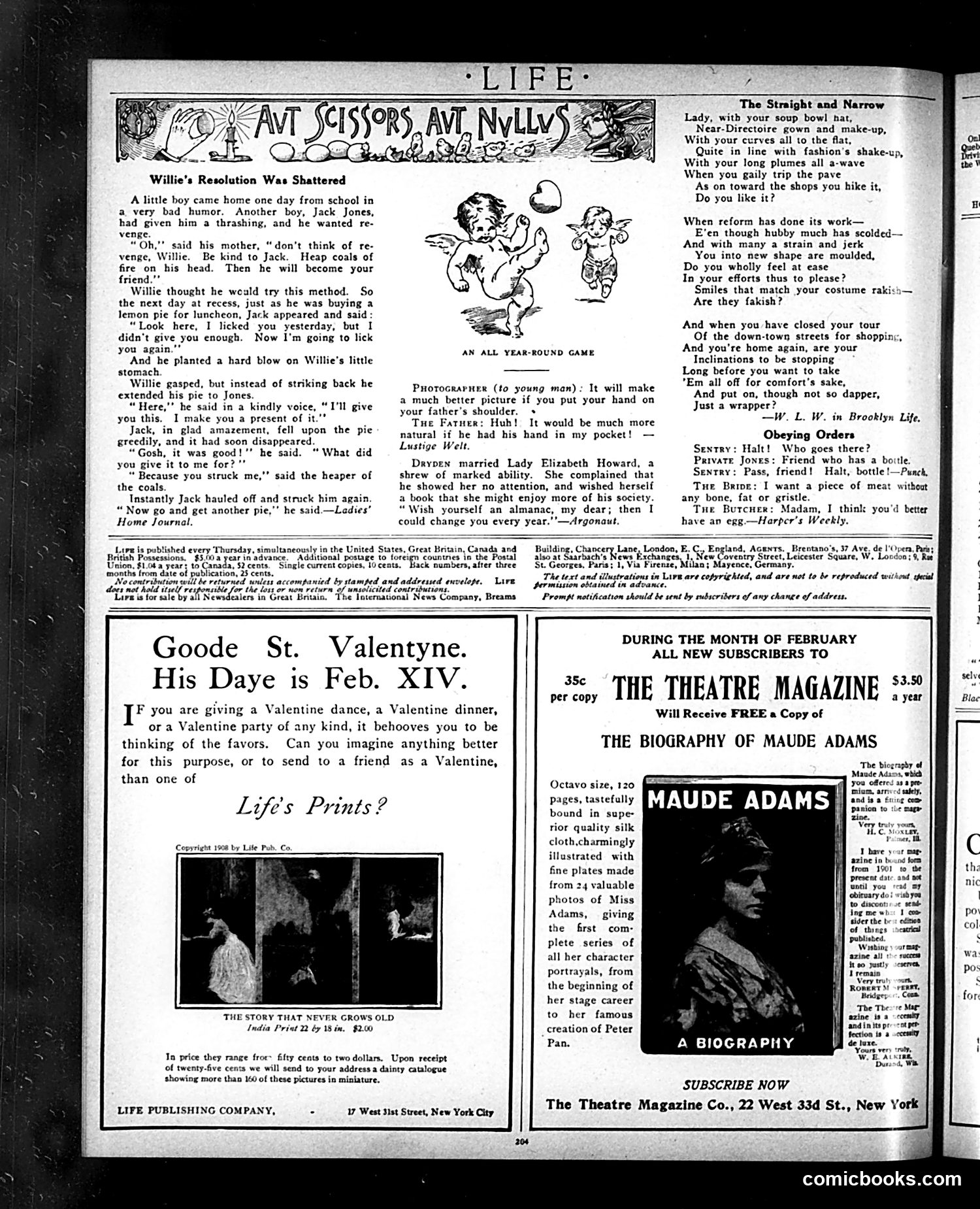
This page contains three separate humorous pieces from *Life* magazine (an early 20th-century satirical publication): **"Willie's Resolution Was Shattered"**: A moral lesson story about a boy who tries the Christian virtue of "heaping coals of fire" (returning kindness for cruelty). The joke: it backfires badly. After Willie gives his bully Jack a pie, Jack simply demands more pies through repeated violence. The satire mocks naive idealism—the boy's mother's well-intentioned moral teaching produces the opposite result. **"An All Year-Round Game"**: A photographer's comedic struggle getting a young man to pose naturally with his father. The humor: the father would naturally have his hand *in his pocket* (implying stinginess), not on his son's shoulder. **Additional short pieces**: Brief jokes about marriage, military hierarchy, and butcher shop transactions—typical period humor emphasizing domestic friction, class dynamics, and wordplay. The page is primarily **satirical commentary on social behavior and morality**, not political cartoons. It reflects early 20th-century attitudes about family dynamics, obedience, and social expectations.
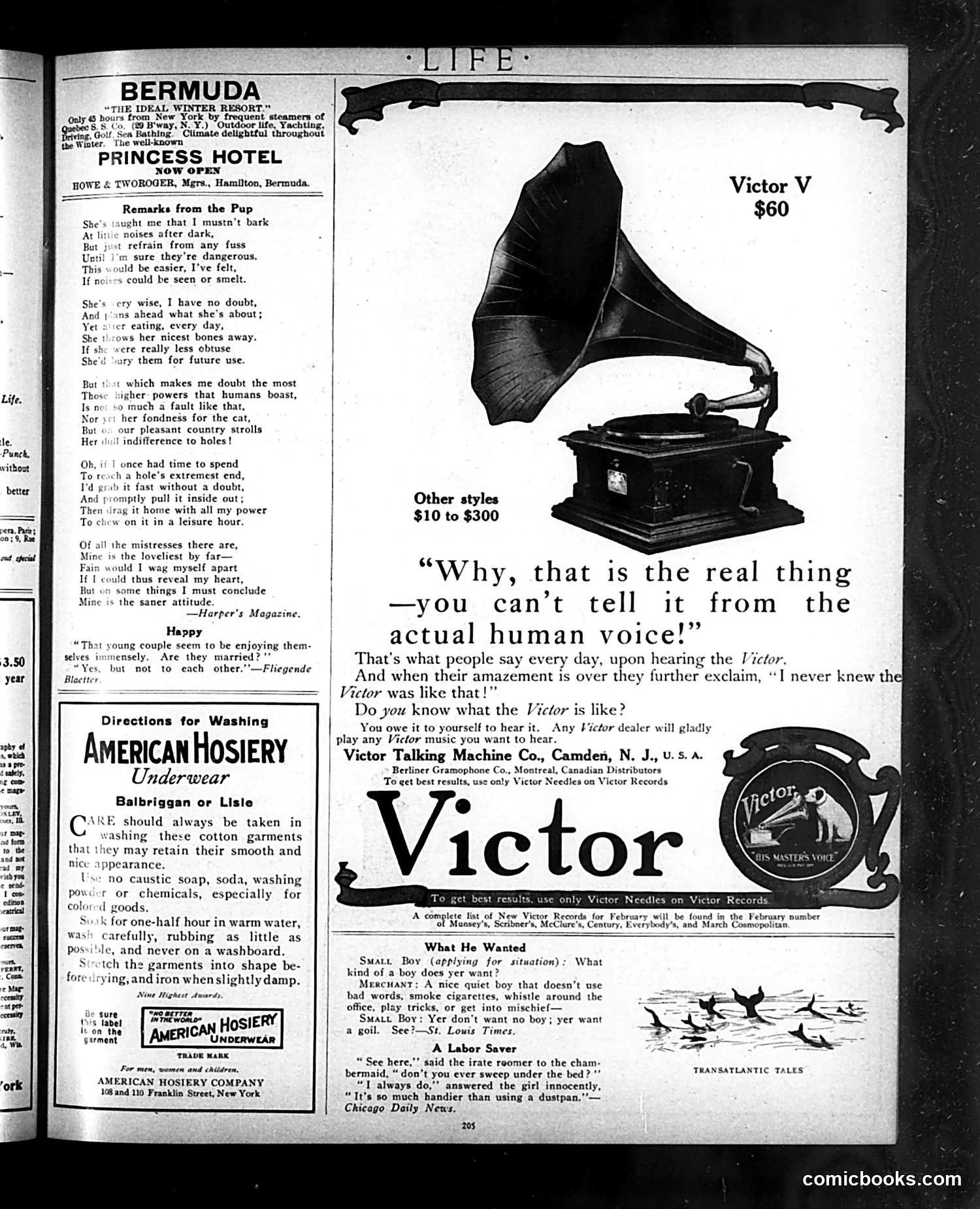
This page is primarily **advertising and humor**, not political satire. The dominant content is a Victor Talking Machine advertisement (a phonograph/gramophone player), priced at $60, emphasizing its realistic sound quality that users claim is indistinguishable from actual human voices. The page includes several unrelated humor pieces: 1. **"Remarks from the Pup"** — a dog's observations about his mistress's behavior, gently satirizing human illogic 2. **"Happy"** — a brief joke about a married couple enjoying themselves "but not to each other" 3. **"What He Wanted"** — a boy applicant cleverly suggests the employer wants a girl, not a boy 4. **"A Labor Saver"** — a chambermaid's innocent misunderstanding about sweeping under beds Additionally, there's instructional content on **American Hosiery** underwear care and an advertisement for the **Princess Hotel** in Bermuda. The page reflects early 20th-century consumer culture and light domestic humor typical of Life magazine's format.
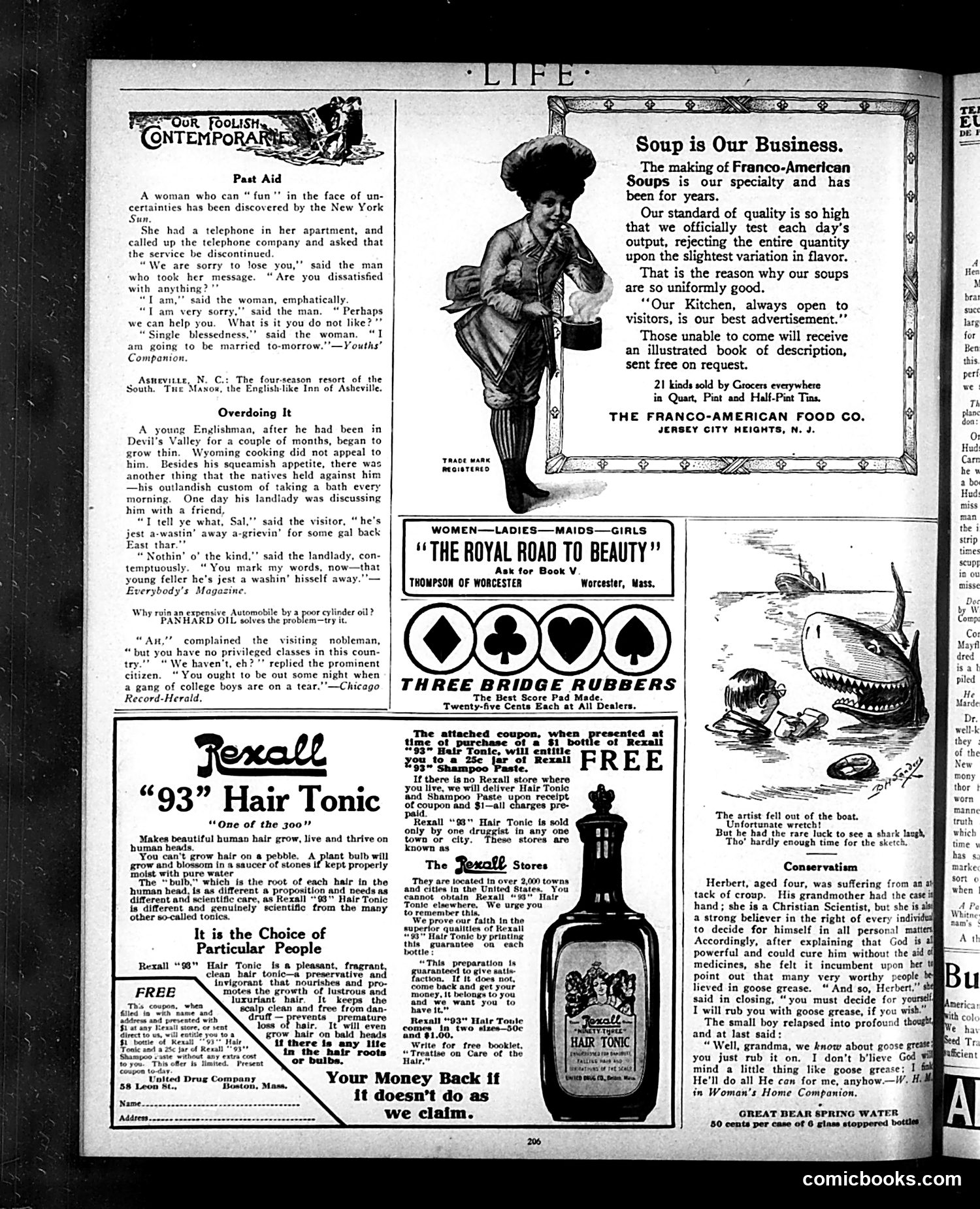
This page contains primarily **advertisements and humorous anecdotes**, not political cartoons. The main content includes: **"Our Foolish Contemporaries"** section: Three brief satirical stories mocking social behaviors—a woman discontinuing her phone to avoid married life, an Englishman wasting away in Wyoming, and a nobleman complaining about America's lack of class distinctions. These are gentle social satire about modern life's absurdities. **Advertisements** dominate the page: Franco-American Soup emphasizing quality control, Rexall "93" Hair Tonic (one of many patent medicines popular in this era), Three Bridge Rubbers (a card game score pad), and others. **Small cartoon** (lower right): Shows a man falling from a boat—a simple visual gag about poor sketching speed. The page reflects early 20th-century American culture: consumer product marketing, casual xenophobia toward immigrants, faith in patent medicines, and light domestic humor. No significant political content is present.
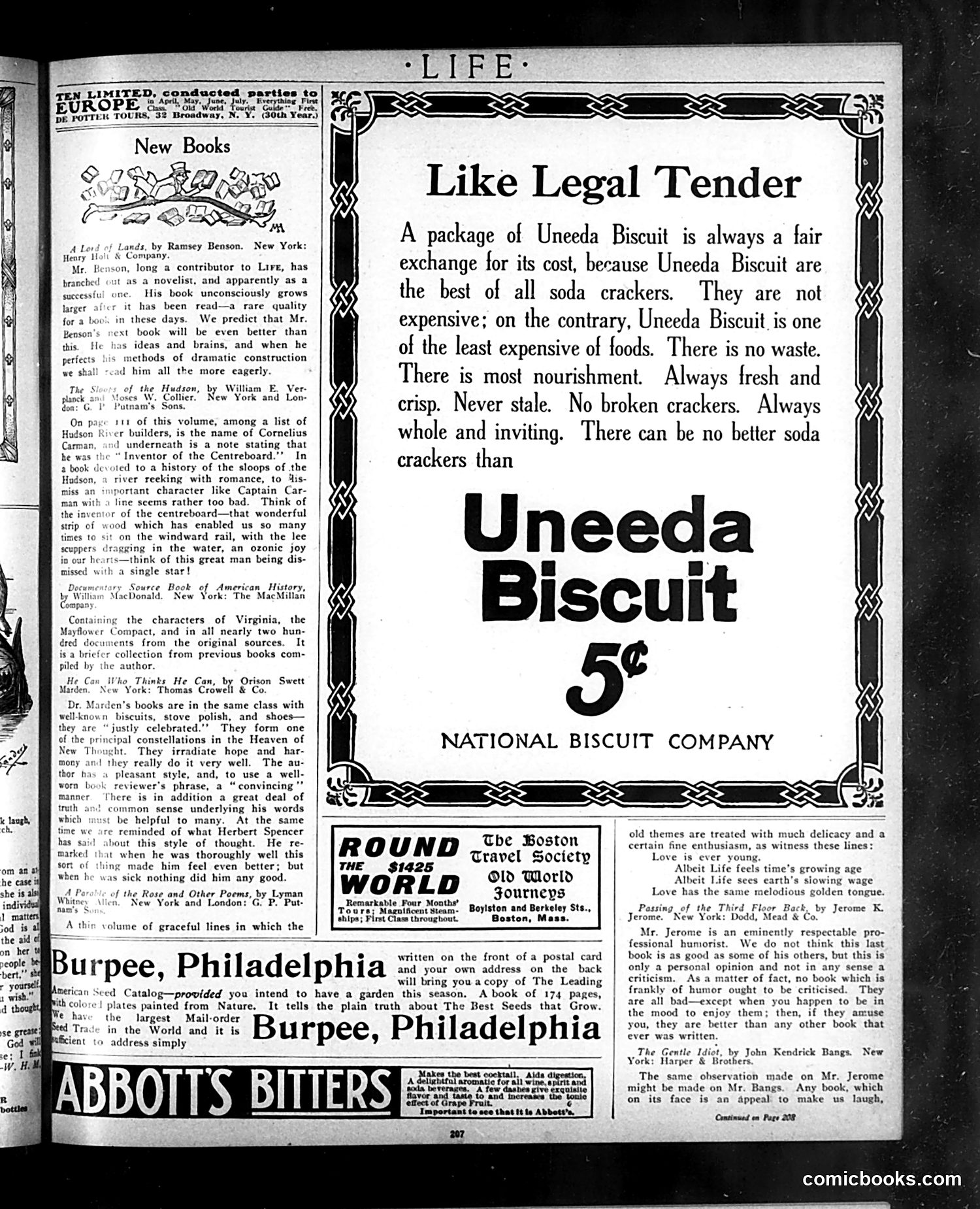
This page is primarily **advertising and book reviews** rather than political satire or editorial cartooning. The main content features a large **Uneeda Biscuit advertisement** (National Biscuit Company) employing the phrase "Like Legal Tender"—comparing the crackers' reliability and universal acceptance to currency. This reflects early 20th-century advertising rhetoric emphasizing product trustworthiness and value. The left column contains book reviews of contemporary works, including titles on American history and New Thought philosophy. Bottom advertisements include **Burpee Seeds** (Philadelphia seed catalog) and **Abbott's Bitters** (a patent medicine). There are **no political cartoons** on this page. The decorative border around the Uneeda ad and small illustrations accompanying book titles are ornamental rather than satirical. This represents typical LIFE magazine content from its era: mixing serious literary criticism with commercial advertising in an aesthetically designed layout.
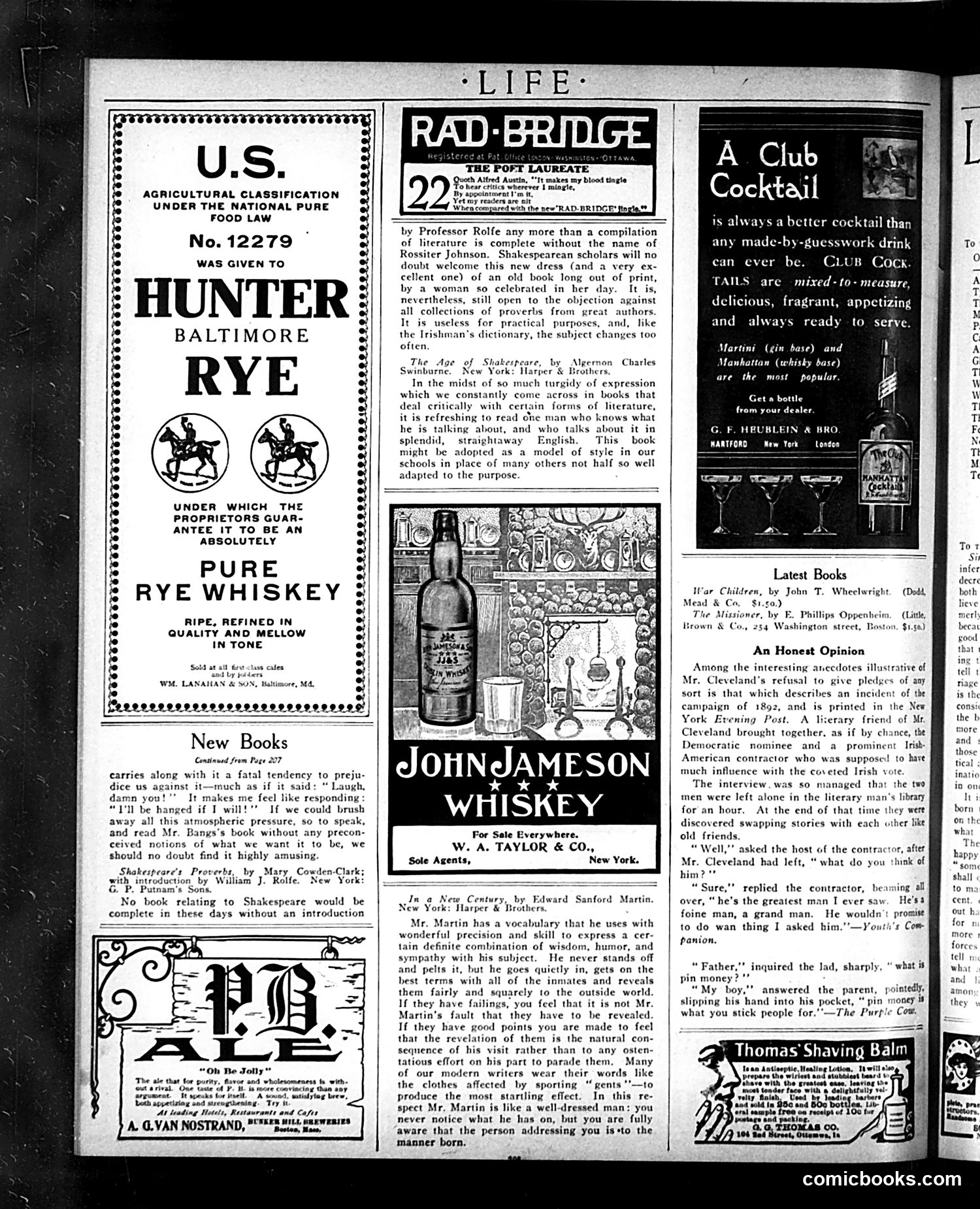
This page is primarily **advertising and book reviews**, not political satire. The main content includes: **Advertisements:** Hunter Baltimore Rye Whiskey (left), John Jameson Whiskey (center), and Club Cocktails (right) dominate the layout. These reflect Prohibition-era advertising (pre-1920), promoting alcohol openly. **Book Reviews:** The "New Books" section discusses literary works including Shakespeare scholarship and Edward Sanford Martin's "In a New Century," with favorable critical commentary. **"Rad Bridge" Reference:** A small item mentions Alfred Austin as Poet Laureate, comparing his work unfavorably to something called "Rad Bridge" (likely a serialized story or poem in *Life*). The page lacks political cartoons or sharp satire—it's a standard magazine layout mixing paid advertising with cultural commentary typical of early-1900s *Life* magazine, which balanced humor with consumer products and literary discussion.
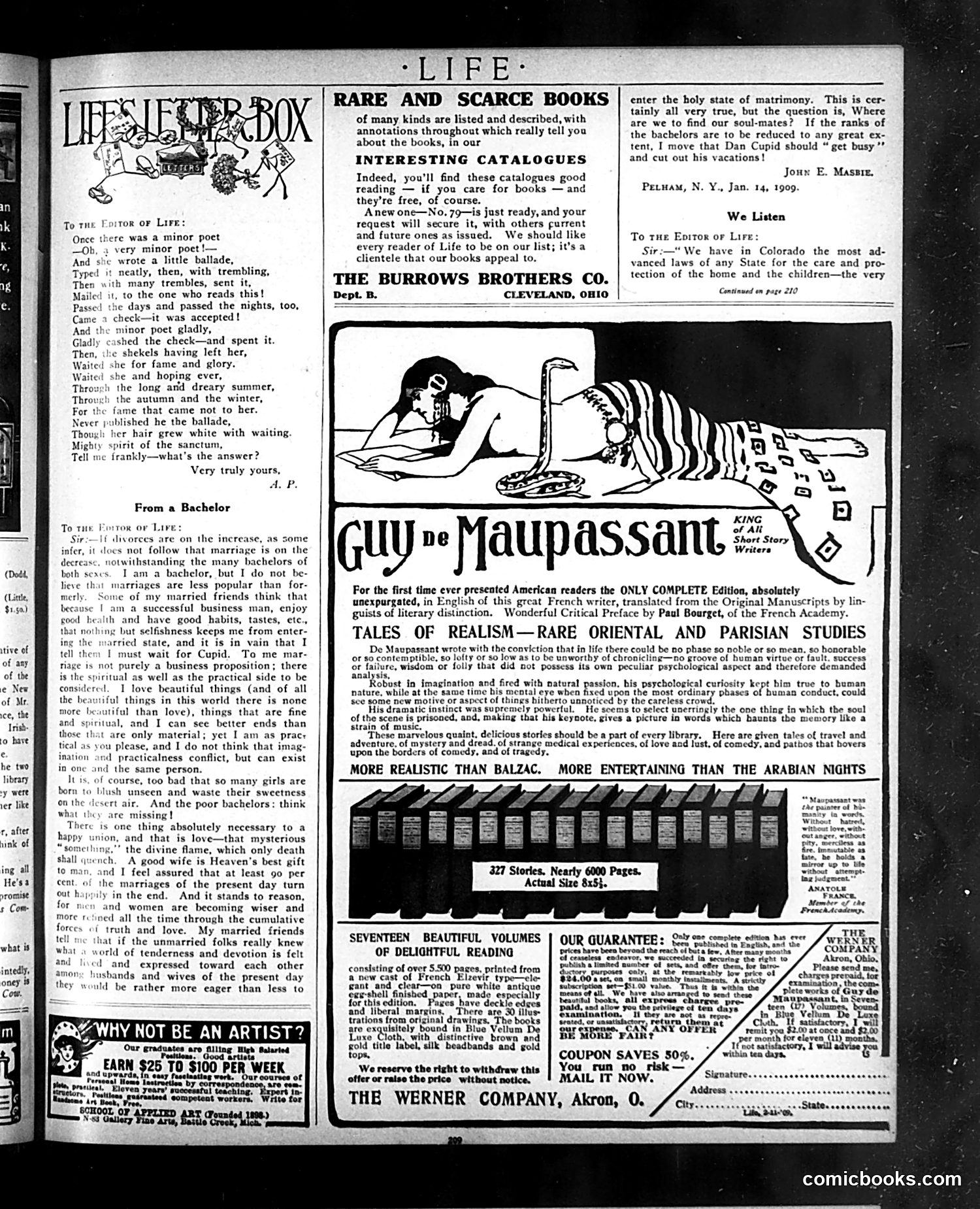
This is primarily a **letters-to-the-editor page** from *Life* magazine, with interspersed advertisements. The content reflects early 1900s social anxieties. The letters address two concerns: (1) A poet's frustration that her accepted ballad was never published despite payment—satirizing editorial negligence. (2) A bachelor's defense of remaining unmarried, arguing that marriage requires spiritual compatibility ("soul-mates"), not just practical compatibility. He notes divorce rates are rising and complains that "Cupid" isn't doing his job finding suitable matches. The advertisements below—for rare books, art instruction, and Guy de Maupassant's complete works—target *Life*'s educated, literary readership. The bachelor's letter reveals period anxieties about **changing marriage rates and gender roles** (noting women going "unseen," bachelors being judged). His invocation of romantic love as essential, not mere convenience, reflects contemporary debates about matrimony's purpose in an era of increasing social mobility.
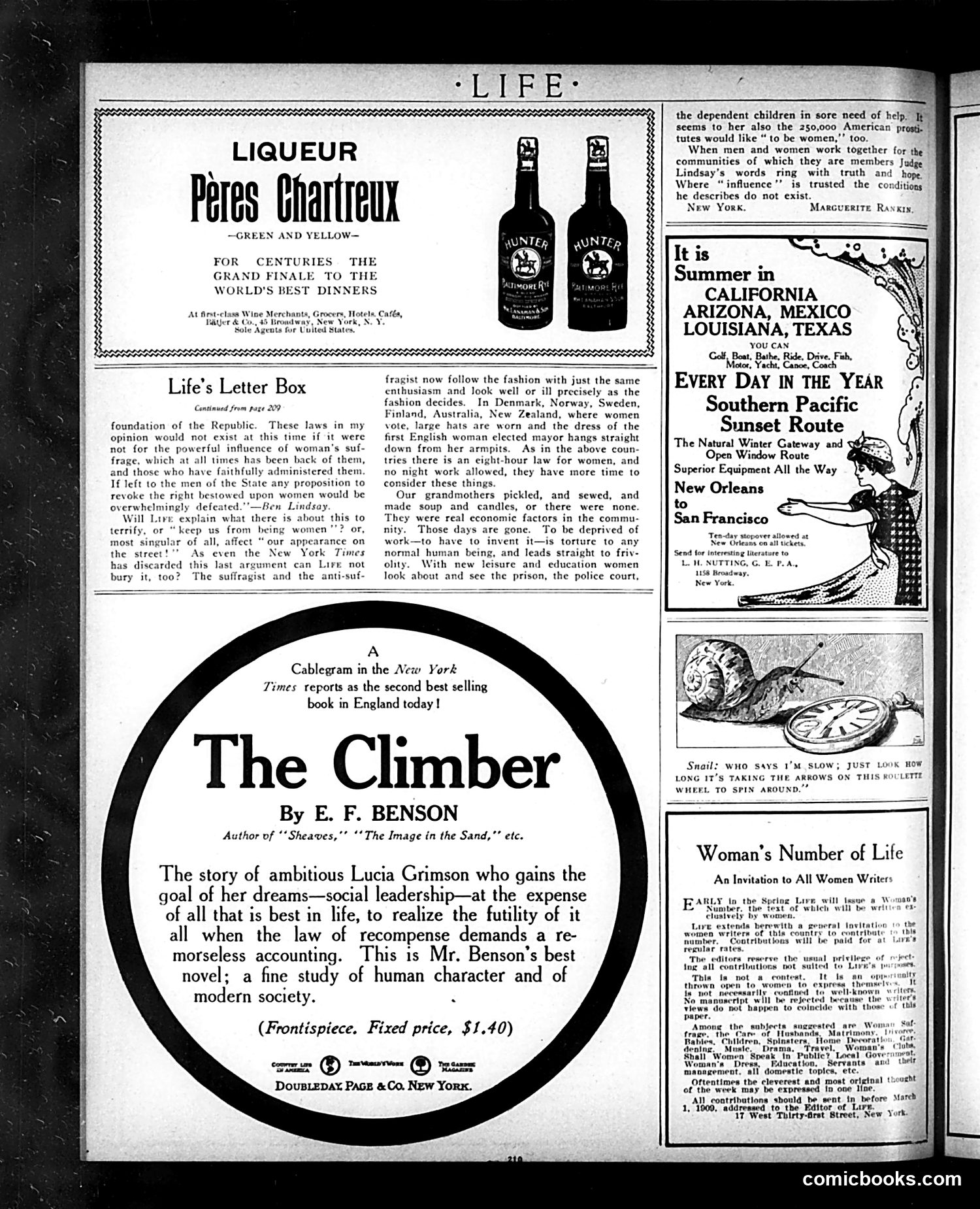
This is primarily an **advertising and announcements page** from Life magazine, with minimal editorial cartooning. The notable content includes: **"Life's Letter Box"** discusses women's suffrage, featuring Judge Ben Lindsey's quote defending women's right to vote. The editorial responds to anti-suffrage arguments that voting would make women "unfeminine" or affect their appearance. It argues these fears are unfounded, pointing to women voting in Denmark, Norway, and Australia without abandoning fashion or femininity. The piece critiques the outdated notion that women should be confined to domestic work ("pickling, sewing, making soup"). **The cartoon** shows a snail on a roulette wheel, captioned "WHO SAYS I'M SLOW"—a simple visual joke about speed and luck. The page otherwise contains liqueur advertisements, book promotions (notably *The Climber* by E.F. Benson), travel advertisements for the Southern Pacific railroad, and an invitation for women writers to contribute to an upcoming "Woman's Number" of Life. The suffrage discussion reflects early 1900s debates about women's rights and social roles.
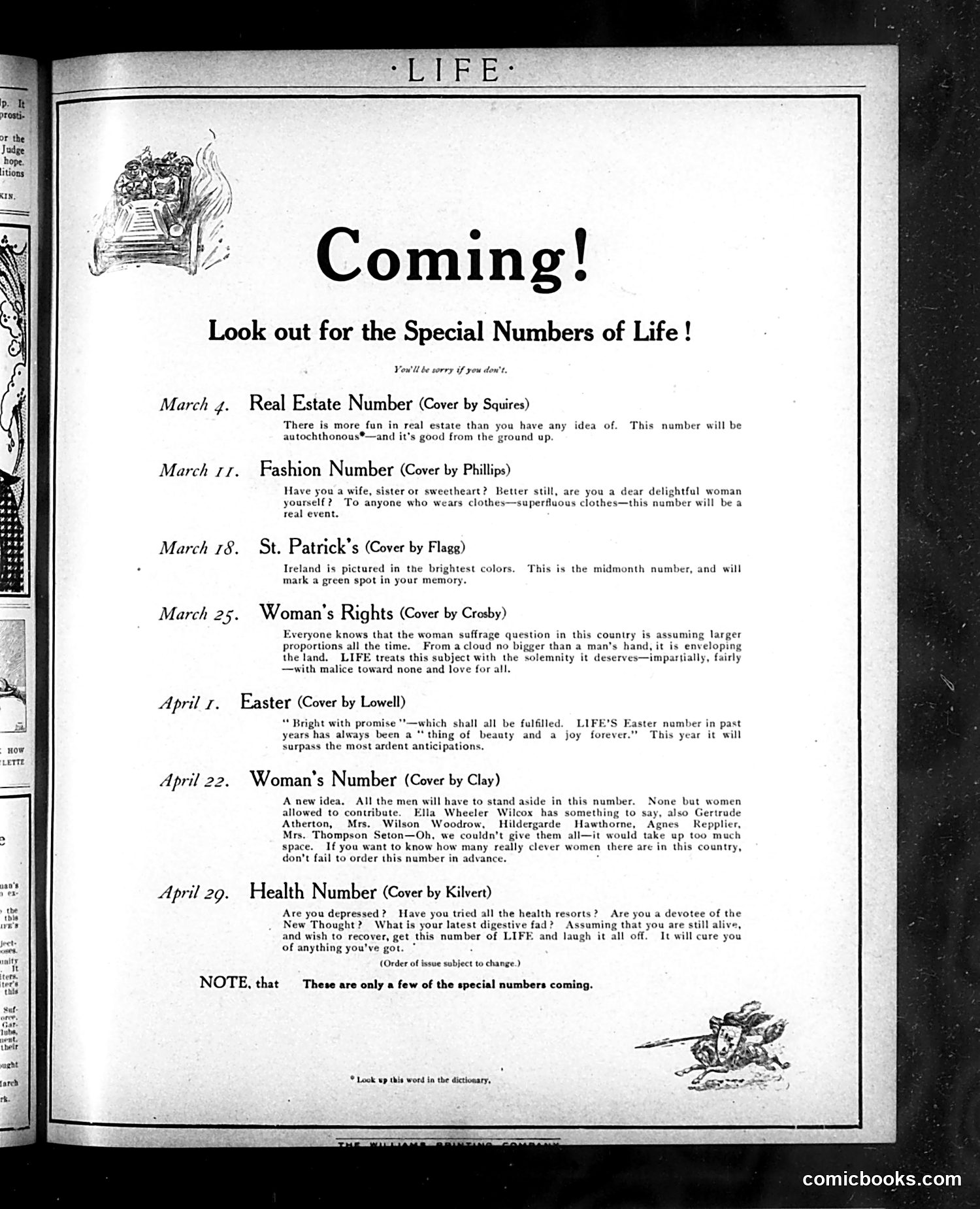
This is a promotional page advertising upcoming themed issues of *Life*, the American satirical magazine. It announces seven special numbers from March through April, each with different cover artists and focuses. The page reveals contemporary preoccupations: real estate speculation, fashion for women, St. Patrick's Day celebrations, and notably, **women's suffrage**—described as a growing cloud enveloping the land. The March 25 "Woman's Rights" issue promises serious treatment "with malice toward none," indicating suffrage was a contentious but increasingly significant political issue. Later issues target women readers directly—the April 22 "Woman's Number" exclusively features female contributors (including Ella Wheeler Wilcox and Gertrude Atherton), suggesting women were recognized as both readers and writers. The Health and Easter numbers appeal to general audiences with humor. The overall tone mixes self-promotion with gentle mockery typical of *Life*'s satirical style.
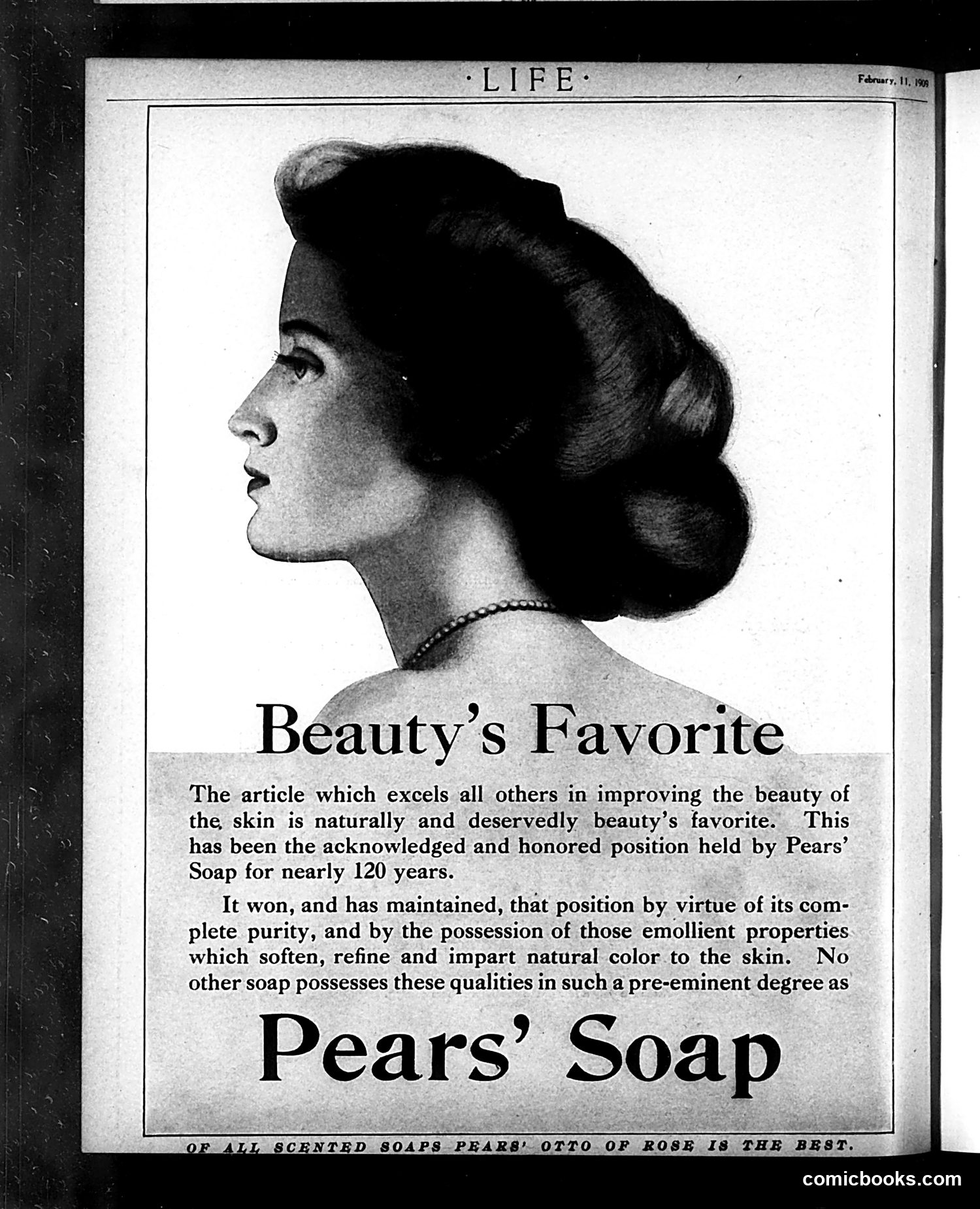
This is **not a political cartoon or satire**—it's a straightforward **advertisement for Pears' Soap** from *Life* magazine (dated February 11, 1908). The page features a classical profile portrait of a woman with 1900s-era styling (waves, pearl necklace) and promotes Pears' Soap as "beauty's favorite" based on its 120-year reputation. The ad emphasizes the product's "complete purity" and skin-softening properties, claiming no competitor matches it. The tagline notes "Of all scented soaps Pears' Otto of Rose is the best." This represents typical early-20th-century advertising strategy: using refined imagery and heritage claims to market luxury grooming products to affluent readers. The *Life* magazine audience would recognize Pears' as an established, prestigious British brand worth premium pricing.