
Life, 1909-02-11 · page 17 of 28
Life — February 11, 1909 — page 17: what you’re looking at
What you’re looking at
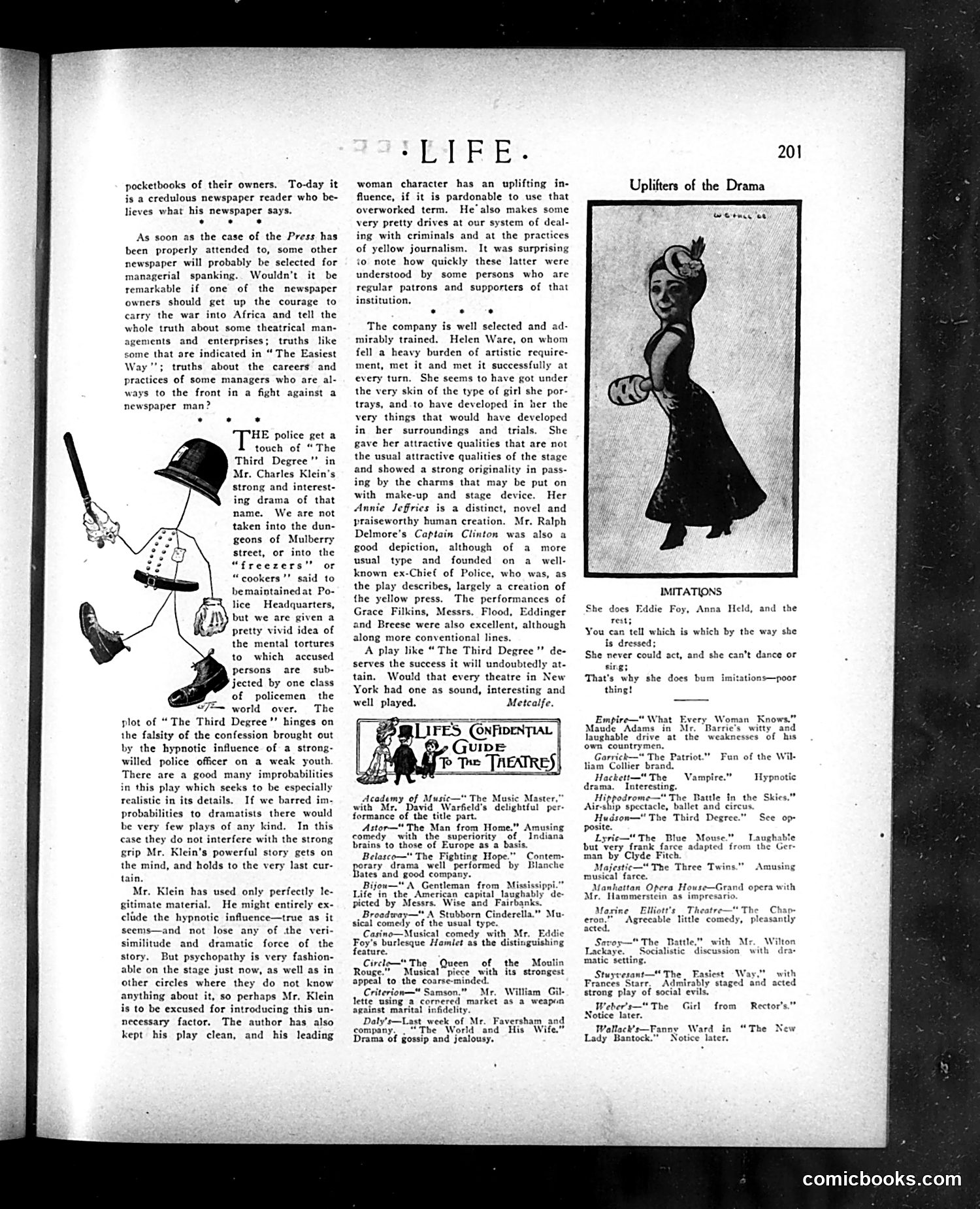
This page reviews Charles Klein's play "The Third Degree," a drama about police brutality and false confessions. The cartoon (left) satirizes police interrogation tactics—showing a figure being subjected to mental torture through the "third degree," a contemporary term for aggressive police questioning. The review praises the production for tackling serious social issues: police coercion of confessions from vulnerable suspects, and yellow journalism's role in manufacturing criminals' public personas. The critic notes the play critiques "our system of dealing with criminals" while remaining dramatically compelling. The satire targets both corrupt police practices and sensationalist newspapers that distort criminal cases for circulation. For modern readers: this reflects Progressive Era concerns about police misconduct and media manipulation—issues that remain relevant today, though the specific reference to "hypnotic influence" reflects period-specific pseudoscience about interrogation.
📄 Transcribed text from this page (OCR, searchable)
Machine-transcribed from the original scan — historical spelling and the odd misread are preserved.
pocketbooks of their owners. To-day it is a credulous newspaper reader who be~ lieves what his newspaper says. surient ve As soon as the case of the Press has been properly attended to, some other newspaper will probably be selected for managerial spanking. Wouldn't it be remarkable if one of the newspaper owners should get up the courage to carry the war into Africa and tell the whole truth about some theatrical man- agements and enterprises; truths like some that are indicated in “ The Easiest Way"; truths about the careers and practices of some managers who are al- ways to the front in a fight against a newspaper man? . * HE police get a touch of “The Third Degree" in Mr. Charles Klein's Strong and interest- ing drama of that name. We are not taken into the dun- geons of Mulberry Street, or into the freezers” or “ cookers" said to bemaintainedat Po- lice Headquarters, but we are given a pretty vivid idea of the mental tortures to which accused persons are sub- jected by one class r. of policemen the “7=— world over, The plot of “The Third Degree’ hinges on the falsity of the confession brought out by the hypnotic influence of a strong- willed police officer on a weak youth. There are a good many improbabilities in this play which seeks to be especially realistic in its details. If we barred im- probabilities to dramatists there would be very few plays of any kind. In this case they do not interfere with the strong grip Mr. Klein's powerful story gets on the mind, and holds to the very last cur- tain, Mr. Klein has used only perfectly le- gitimate material. He might entirely ex- clade the hypnotic influence—true as it seems—and not lose any of the veri- similitude and dramatic force of the story. But psychopathy is very fashion- able on the stage just now, as well as in other circles where they do not know anything about it, so perhaps Mr. Klein is to be excused for introducing this un- necessary factor, The author has also kept his play clean, and his leading ERE. woman character has an uplifting in- fluence, if it is pardonable to use that overworked term. He’ also makes some very pretty drives at our system of deal- ing with criminals and at the practices of yellow journalism. It was surprising io note how quickly these latter were understood by some persons who are regular patrons and supporters of that institution, eile te The company is well selected and ad- mirably trained. Helen Ware, on whom fell a heavy burden of artistic require- et it and met it successfully at turn, She seems to have got under the very skin of the type of girl she por- trays, and to have developed in her the very things that would have developed in her surroundings and trials. She gave her attractive qualities that are not the usual attractive qualities of the stage and showed a strong originality in pass- ing by the charms that may be put on with make-up and stage device. Her Annie Jefries is a distinct, novel and praiseworthy human creation. Mr. Ralph Delmore’s Captain Clinton was also a good depiction, although of a more usual type and founded on a well- known ex-Chief of Police, who was, as the play describes, largely a creation of the yellow press. The performances of Grace Filkins, Messrs. Flood, Eddinger and Breese were also excellent, although along more conventional lines. A play like “The Third Degree” de- serves the success it will undoubtedly at- tain. Would that every theatre in New York had one as sound, interesting and well played. Metcalfe. LIFES (nxfpentiaL GuipE ‘Tee THEATRES ment, ) Academy of Music—* The Music Maste: with Mr. David Warfeld’s delightful p: formance of the title part. Astor—" The Man from Home.” Amusing comedy with the superiority of Indiana brains to those of Europe as a basis. Belasco—" The Fighting Hope.” Contem- rary drama well performed by Blanche Rates and good Company. Bijou—" A Gentleman from Mississippi.” Life in the American capital laughably de- picted by Messrs. Wise and Fairbanks Broedway—" A Stubborn Cinderella.” Mu- sical comedy of the usual type. Casino—Musical comedy with Mr. Foy’s burlesque Hamict as the distinguishing feature. Circlo—"The Queen of the Moulin Rouge.” Musical picce with its strongest appeal to the coarse-minded. Criterion—" Samson.” Mr. William Gil- lette using a cornered market as a weapun against marital infidelity. Daly’s—Last_week of Mr. company, . “The World and His Drama of gossip and jealousy. ‘aversham and Wife.” 201 Uplifters of the Drama IMITATIONS She does Eddie Foy, Anna Held, rest; You can tell which is which by the way she fs dressed; She never could act, and she can’t dance or sir ‘That's why she does bum imitations—poor thing! and the Empire—* What Every Woman Knows.” Maude Adams in Mr. Barrie's witty and laughable drive at the weaknesses of his own countrymen, Garrick—“ The Patriot.” liam Collier brand. Hackett—" The drama. Interesting. Hippodrome—"The Tattle in the Skies." Airship spectacle, ballet and circus. Hudson—"The Third Degree.” posite. Lyrie— The Blue Mouse.” Taughal but very frank farce adapted from th man by Clyde Fitch, Majestic—" The Three Twins.” musical farce. Manhattan Opera House—Grand opera with Mr. Hammerstein as impresario. Marine Elliott's Theatre— The Chai eron,” Agrecable little comedy, pleasantly Fun of the Wil- Vampire Hypnotic See op- Amusing with Mr. Wilton with dra "The Tattle.” ocialistic discussion setting. Stuyvesant— Easiest. Way," with Frances Starr. Admirably staged and acted strong play of social evils. Weber’s—"The Girl Notice later. Wellack’s—Fanny Ward in Lady Bantock.’ Notice later. from Rector’s."” “The New comicbooks.com