
Life, 1909-02-11 · page 16 of 28
Life — February 11, 1909 — page 16: what you’re looking at
What you’re looking at
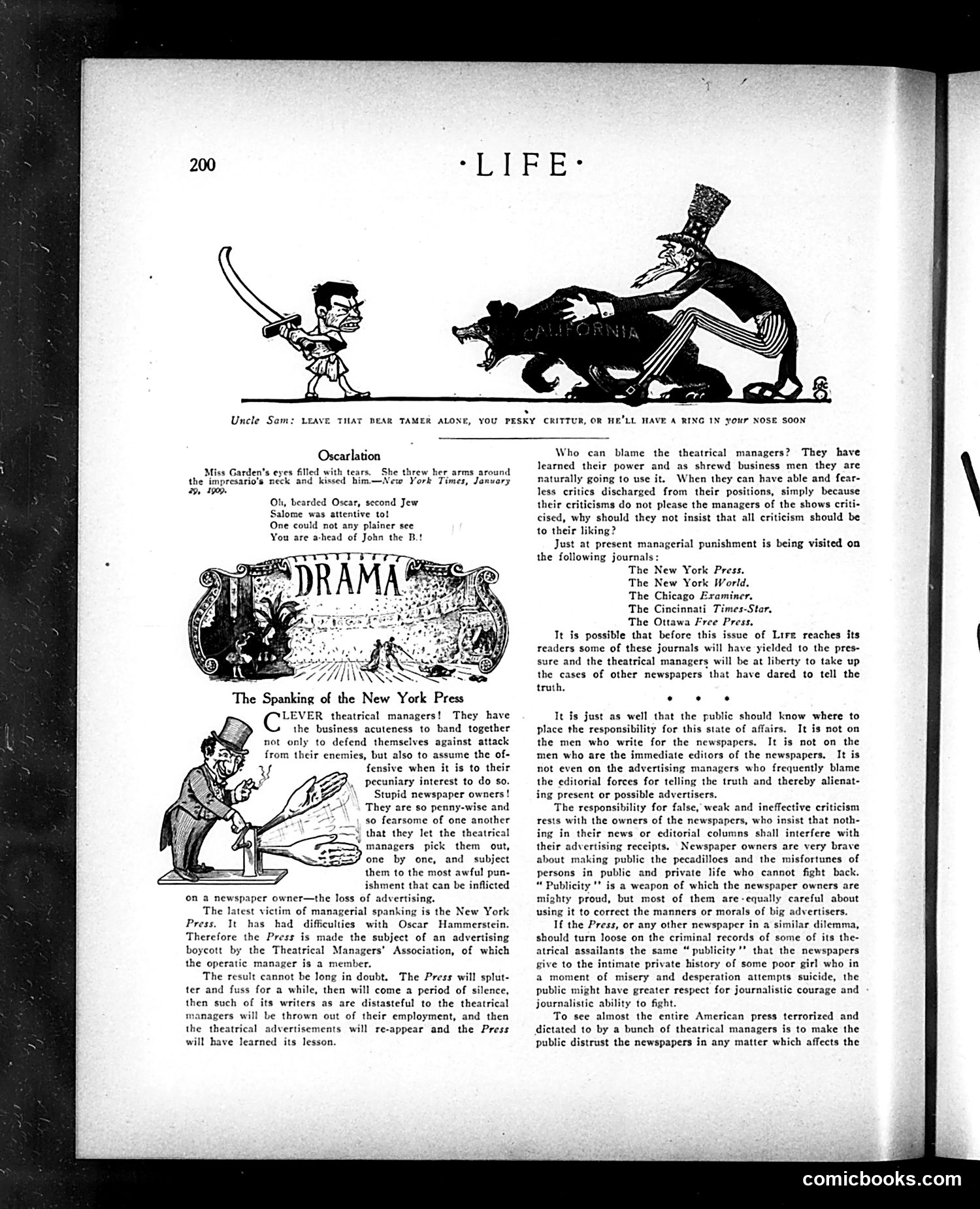
This 1906 Life magazine page satirizes **theatrical managers' censorship of newspapers** through advertising boycotts. **The Cartoon:** Uncle Sam (representing the public interest) warns a small figure labeled "Press" against a bear-like creature labeled "California" (representing theatrical interests), threatening he'll get "a ring in your nose"—meaning loss of editorial independence. **The Issue:** Oscar Hammerstein and the Theatrical Managers' Association punished the *New York Press* (and other papers) by withdrawing advertising because these publications published unfavorable theater reviews. The boycott forced newspapers to either silence critics or lose revenue. **The Satire's Point:** Life mocks both theatrical managers' economic coercion and newspaper owners' cowardice in abandoning editorial integrity for profit. The article argues newspapers fearlessly expose ordinary citizens but cave to powerful advertisers—hyocritical "publicity" that serves wealth over truth. The cartoon warns that yielding to such pressure threatens press freedom itself.
📄 Transcribed text from this page (OCR, searchable)
Machine-transcribed from the original scan — historical spelling and the odd misread are preserved.
Uncle Sam: Leave THAT DEAR TAMER ALONE, YOU PESKY CRITTUR, OR HE'LL HAVE A RING IN your NOSE SOON Oscarlation Miss Garden's eyes filled with tears. the impresario’s neck and kissed him. 29 190%. She threw her arms around New York Times, January Oh, bearded Oscar, second Jew Salome was attentive to! One could not any plainer see You are a-head of John the B.t LEVER theatrical managers! They have the business acuteness to band together not only to defend themselves against attack from their enemies, but also to assume the of- fensive when it is to their pecuniary interest to do so. Stupid newspaper owners! They are so penny-wise and so fearsome of one another 4S that they let the theatrical managers pick them out, one by one, and subject them to the most awful pun- ishment that can be inflicted on a newspaper owner—the loss of advertising. The latest victim of managerial spanking is the New York Press. It has had difficulties with Oscar Hammerstein. Therefore the Press is made the subject of an advertising boycott by the Theatrical Managers’ Association, of which the operatic manager is a member, The result cannot be long in doubt. The Press will splut- ter and fuss for a while, then will come a period of silence, then such of its writers as are distasteful to the theatrical managers will Le thrown out of their employment, and then the theatrical advertisements will re-appear and the Press will have learned its lesson. Who can blame the theatrical managers? They have learned their power and as shrewd business men they are naturally going to use it. When they can have able and fear- less critics discharged from their positions, simply because their criticisms do not please the managers of the shows criti- cised, why should they not insist that all criticism should be to their liking? Just at present managerial punishment is being visited on the following journals: The New York Press. The New York World. The Chicago Examiner. The Cincinnati Times-Star. The Ottawa Free Press, It is possible that before this issue of Lire reaches its readers some of these journals will have yielded to the pres- sure and the theatrical managers will be at liberty to take up the cases of other newspapers that have dared to tell the truth. o 8 6 It is just as well that the public should know where to place the responsibility for this state of affairs. It is not on the men who write for the newspapers. It is not on the men who are the immediate editors of the newspapers. It is not even on the advertising managers who frequently blame the editorial forces for telling the truth and thereby alienat- ing present or possible advertisers. The responsibility for false, weak and ineffective criticism rests with the owners of the newspapers, who insist that noth- ing in their news or editorial columns shall interfere with their advertising receipts. Newspaper owners are very brave about making public the pecadilloes and the misfortunes of persons in public and private life who cannot fight back. “ Publicity " is a weapon of which the newspaper owners are mighty proud, but most of them are -equally careful about using it to correct the manners or morals of big advertisers. If the Press, or any other newspaper in a similar dilemma, should turn loose on the criminal records of some of its the- atrical assailants the same “publicity” that the newspapers give to the intimate private history of some poor girl who in a moment of misery and desperation attempts suicide, the public might have greater respect for journalistic courage and journalistic ability to fight. To see almost the entire American press terrorized and dictated to by a bunch of theatrical managers is to make the public distrust the newspapers in any matter which affects the comicbooks.com