
Life, 1909-02-11 · page 12 of 28
Life — February 11, 1909 — page 12: what you’re looking at
What you’re looking at
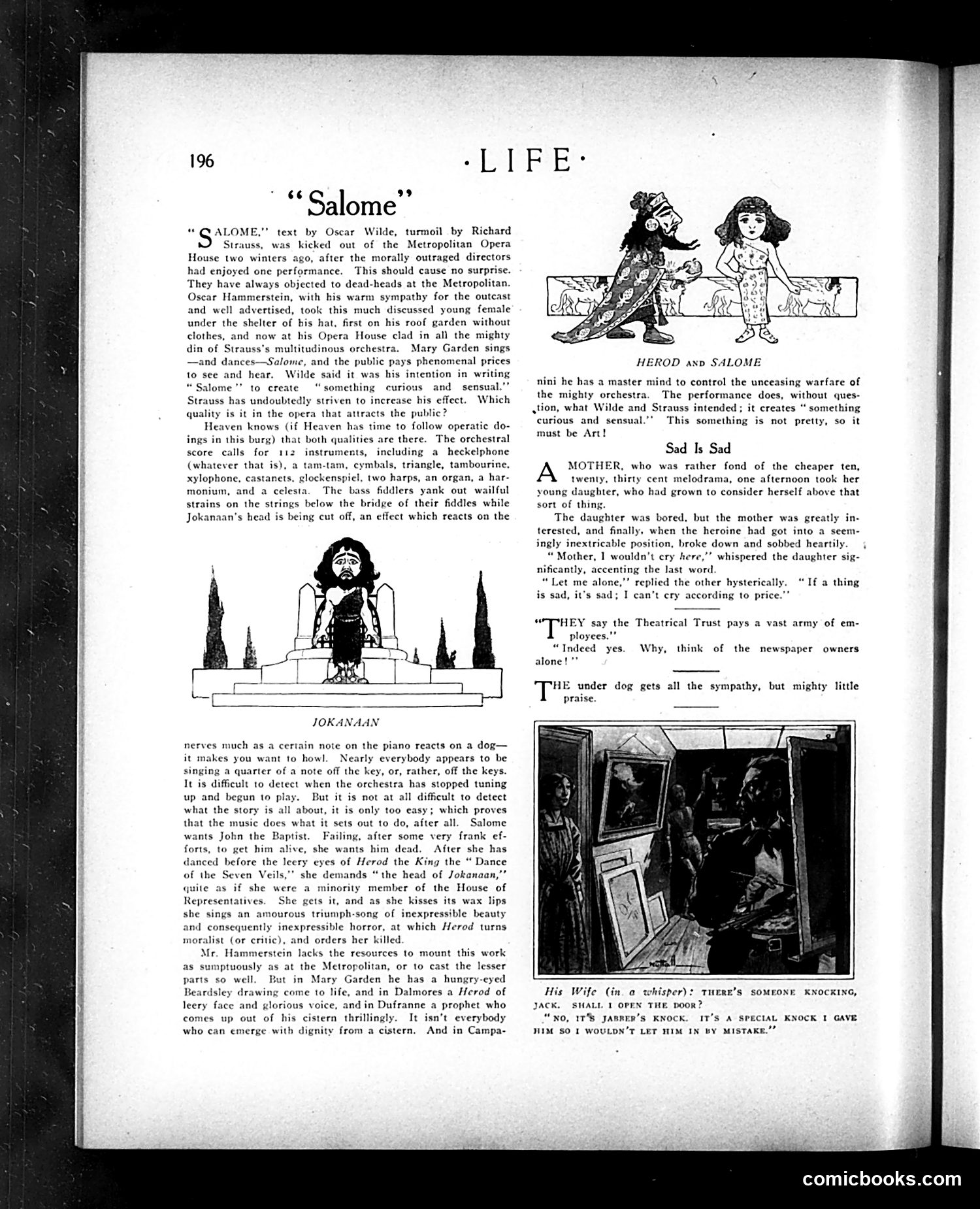
This page reviews Richard Strauss's operatic adaptation of Oscar Wilde's *Salome*, performed at the Metropolitan Opera House. The text critiques the production's sensationalism, noting that the Metropolitan Opera's directors have "always objected to dead-heads" (non-paying attendees) yet staged this morally controversial work. The illustrations show: - **Herod and Salome**: Characters from the biblical narrative adapted by Wilde - **Jokanan**: The beheaded prophet whose severed head Salome demands The satirical angle mocks the opera's graphic violence and sexual content—the "Dance of the Seven Veils" and demand for Jokanan's head—suggesting that despite moral objections elsewhere, sensational material attracts audiences and revenue. The small sidebar jokes about theater employment and sympathy for "under dogs" continue the satirical commentary.
📄 Transcribed text from this page (OCR, searchable)
Machine-transcribed from the original scan — historical spelling and the odd misread are preserved.
SEE 7 Salome’ , ALOME," text by Oscar Wilde, turmoil by Richard Strauss, was kicked out of the Metropolitan Opera House two winters ago, after the morally outraged directors had enjoyed one performance. This should cause no surprise. They have always objected to dead-heads at the Metropolitan. Oscar Hammerstein, with his warm sympathy for the outcast and well advertised, took this much discussed young female under the shelter of bis hat, first on his roof garden without clothes, and now at his Opera House clad in all the mighty din of Strauss's multitudinous orchestra. Mary Garden sings —and dances—Salome, and the public pays phenomenal prices HEROD axp SALOME to see and hear. Wilde said it was his intention in writing alome"? to create “something curious and sensual.”” Strauss has undoubtedly striven to increase his effect. Which quality is it in the opera that attracts the public? 3 ae viene Heaven knows (if Heaven has time to follow operatic do- Curious and sensual Bis "something isnot pretty, $0 it ; ; be must be Art! ings in this burg) that both qualities are there. The orchestral ore calls for 112 instruments, including a heckelphone Sad Is Sad (whatever that is), a tam-tam, cymbals, triangle, tambourine, MOTHER, who was rather fond of the cheaper ten, xylophone, castanets, glockenspicl, two harps, an organ, a har- twenty, thirty cent melodrama, one afternoon took her monium, and a celesta. The bass fiddlers yank out wailful young daughter, who had grown to consider herself above that strains on the strings below the bridge of their fiddles while sort of thing. Jokanaan’s head is being cut off, an effect which reacts on the The daughter was bored, but the mother was greatly in- terested, and finally, when the heroine had got into a seem- ingly inextricable position, broke down and sobbed heartily. Mother, 1 wouldn't cry here,” whispered the daughter sig nificantly, accenting the last word. “Let me alone,’ replied the other hysterically. “If a thing is sad, it's sad; I can't cry according to price.”” nini he has a master mind to control the unceasing warfare of the mighty orchestra. The performance does, without ques- tion, what Wilde and Strauss intended ; it creates “ something “THEY say the Theatrical Trust pays a vast army of em- ployees.”” “Indeed yes. Why, think of the newspaper owners alone!” HE under dog gets all the sympathy, but mighty little praise, JOKANAAN nerves much as a certain note on the piano reacts on a dog— it makes you want to howl. Nearly everybody appears to be singing a quarter of a note off the key, or, rather, off the keys. It is difficult to detect when the orchestra has stopped tuning up and begun to play. But it is not at all difficult to detect what the story is all about, it is only too easy; which proves that the music does what it sets out to do, after all. Salome wants John the Baptist. Failing, after some very frank ef- forts, to get him alive, she wants him dead, After she has danced before the leery eyes of Herod the King the “ Dance of the Seven Veils," she demands “the head of Jokanaan,’” quite as if she were a minority member of the House of Representatives. She gets it, and as she kisses its wax lips she sings an amourous triumph-song of inexpressible beauty and consequently inexpressible horror, at which Herod turns moralist (or critic), and orders her killed Mr. Hammerstein lacks the resources to mount this work as sumptuously as at the Metropolitan, or to cast the lesser parts so well. But in Mary Garden he has a hungry-eyed Beardsley drawing come to life, and in Dalmores a Herod of His Wife (in @ whisper): TuERE’s SOMEONE KNOCKING, leery face and glorious voice, and in Dufranne a prophet who JACK. SHALL. 1 OPEN THE DOOR? comes up out of his cistern thrillingly. It isn’t everybody “xo, 17'S JARRER’S KNOCK. IT’S A SPECIAL KNOCK 1 GAVE who can emerge with dignity from a cistern, And in Campa- HIM SO 1 WOULDN’T LET IM IN BY MISTAKE.’ comicbooks.com