
Life, 1909-02-11 · page 7 of 28
Life — February 11, 1909 — page 7: what you’re looking at
What you’re looking at
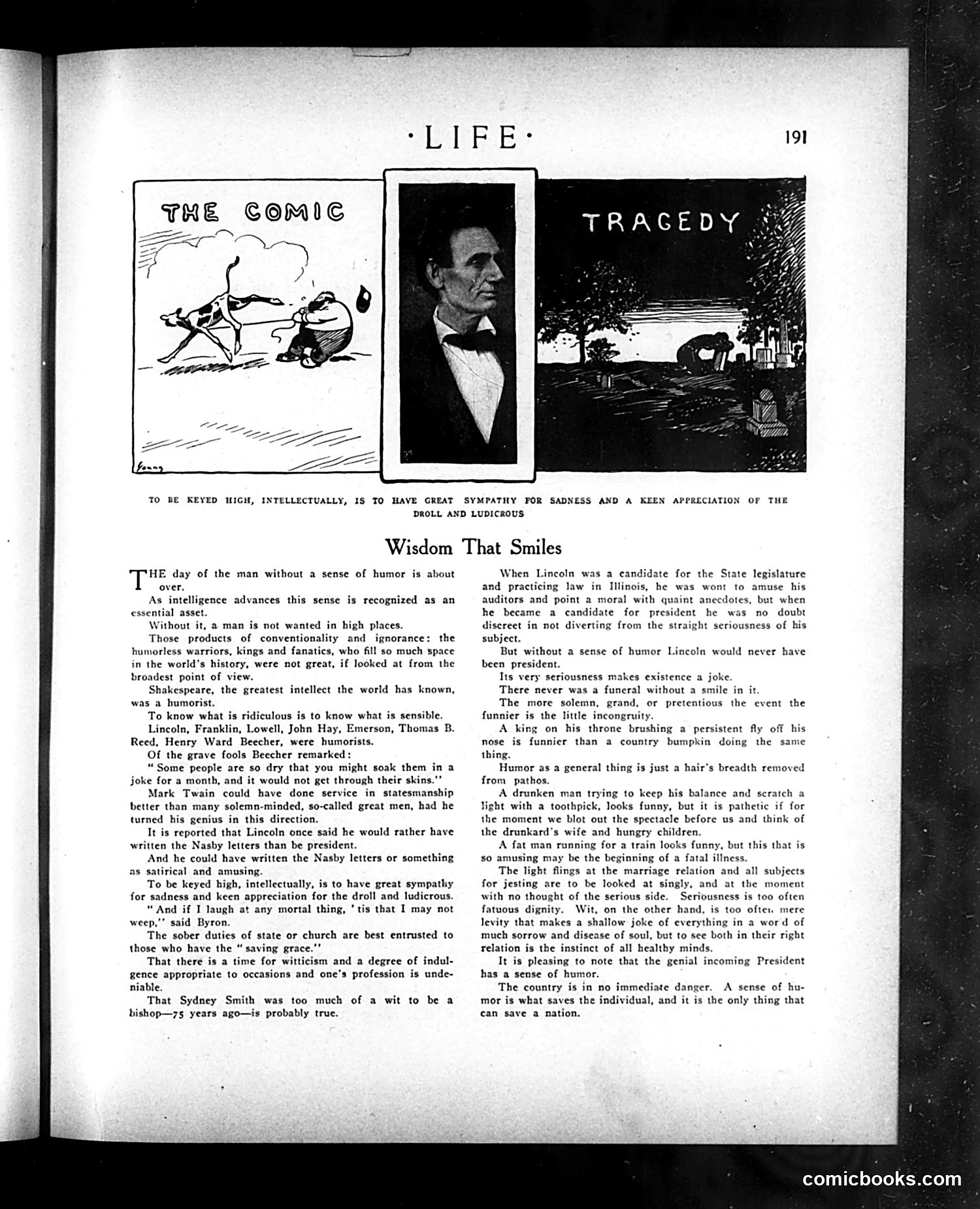
This page from *Life* magazine features two cartoons flanking a portrait, under the heading "Wisdom That Smiles." **Left cartoon ("The Comic"):** Shows a slapstick scene of physical comedy—figures in exaggerated motion, suggesting pratfalls or absurd mishaps. **Center:** A formal portrait of a serious-faced man in formal dress. **Right cartoon ("Tragedy"):** A dark, moody landscape scene. The article argues that a sense of humor is essential to leadership and wisdom. It specifically references **Lincoln**, praising his ability to balance serious duties with humor—noting that without his comedic sensibility, he wouldn't have become president. The piece suggests that humor provides necessary psychological relief and demonstrates intellectual sophistication, contrasting the "droll and ludicrous" with grave responsibility as marks of wisdom rather than unsuitability for high office.
📄 Transcribed text from this page (OCR, searchable)
Machine-transcribed from the original scan — historical spelling and the odd misread are preserved.
"Yili: To BE KEYED HIGH, INTELLECTUALLY, 1S TO HAVE GREAT SYMPATHY FOR SADNESS AND A KEEN APPRECIATION OF THE DROLL AND LUDICROUS Wisdom That Smiles HE day of the man without a sense of humor is about over. As intelligence advances this sense is recognized as an essential asset. Without it, a man is not wanted in high places. Those products of conventionality and ignorance: the humorless warriors, kings and fanatics, who fill so much space in the world’s history, were not great, if looked at from the broadest point of view. Shakespeare, the greatest intellect the world has known, was a humorist. To know what is ridiculous is to know what is sensible. Lincoln, Franklin, Lowell, John Hay, Emerson, Thomas B. Reed, Henry Ward Beecher, were humorists. Of the grave fools Beecher remarked: “Some people are so dry that you might soak them joke for a month, and it would not get through their skins. Mark Twain could have done service in statesmanship better than many solemn-minded, so-called great men, had he turned his genius in this direction. It is reported that Lincoln once said he would rather have written the Nasby letters than be president. And he could have written the Nasby letters or something as satirical and amusing. To be keyed high, intellectually, is to have great sympathy for sadness and keen appreciation for the droll and ludicrous. “And if I laugh at any mortal thing, ’ tis that I may not weep,”’ said Byron. The sober duties of state or church are best entrusted to those who have the “ saving grace.’’ That there is a time for witticism and a degree of indul- gence appropriate to occasions and one’s profession is unde- niable. That Sydney Smith was too much of a wit to be a bishop—7s years ago—is probably true. When Lincoln was a candidate for the State legislature and practicing law in Illinois, he was wont to amuse his auditors and point a moral with quaint anecdotes, but when he became a candidate for president he was no doubt discreet in not diverting from the straight seriousness of his subject. But without a sense of humor Lincoln would never have been president. Its very seriousness makes existence a joke. There never was a funeral without a smile in it. The more solemn, grand, or pretentious the event the funnier is the little incongruity. A king on his throne brushing a persistent fly off his nose is funnier than a country bumpkin doing the same thing. Humor as a general thing is just a hair's breadth removed from pathos A drunken man trying to keep his balance and scratch a light with a toothpick, looks funny, but it is pathetic if for the moment we blot out the spectacle before us and think of the drunkard’s wife and hungry children. A fat man running for a train looks funny, but this tbat is so amusing may be the beginning of a fatal illness. The light flings at the marriage relation and all subjects for jesting are to be looked at singly, and at the moment with no thought of the serious side. Seriousness is too often fatuous dignity. Wit, on the other hand, is too ofter. mere levity that makes a shallow joke of everything in a word of much sorrow and disease of soul, but to see both in their right relation is the instinct of all healthy minds. It is pleasing to note that the genial incoming President has a sense of humor. The country is in no immediate danger. A sense of hu- mor is what saves the individual, and it is the only thing that can save a nation. comicbooks.com