
Life, 1909-02-11 · page 6 of 28
Life — February 11, 1909 — page 6: what you’re looking at
What you’re looking at
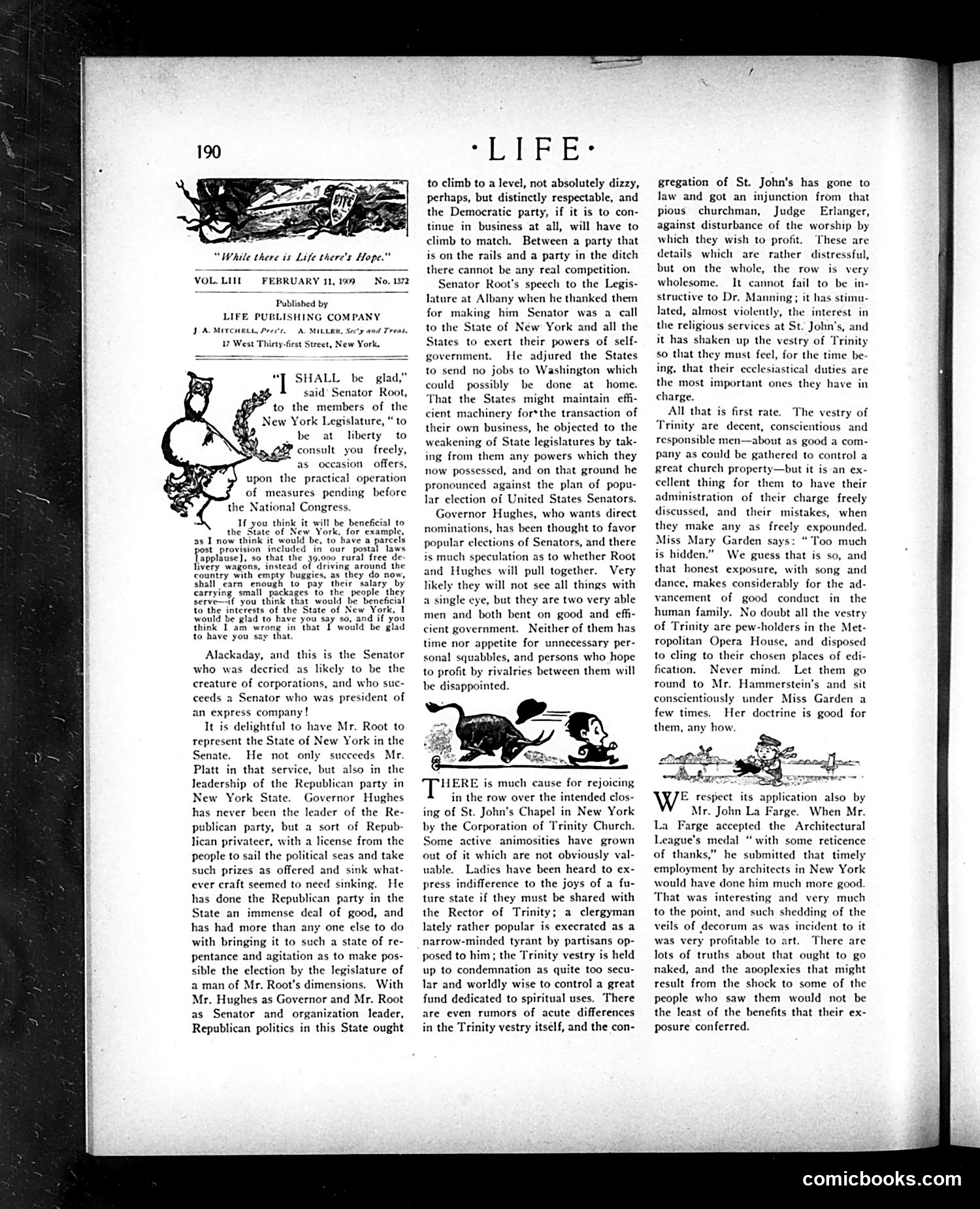
This page contains two political cartoons and editorial commentary about New York State politics. The main text discusses Senator Root's speech to the Legislature, praising his support for State independence versus federal overreach. The editorial argues Root is a strong Republican leader who, alongside Governor Hughes, represents capable governance. The cartoons appear satirical toward political rivals. One depicts a dog chasing its tail—likely representing political infighting or circular partisan disputes. Another section discusses Trinity Church's closing in New York and architectural concerns, plus commentary on Miss Mary Garden and theater conduct. The overall tone defends Republican leadership while mocking Democratic or opposing political maneuvering as self-serving and circular rather than substantive.
📄 Transcribed text from this page (OCR, searchable)
Machine-transcribed from the original scan — historical spelling and the odd misread are preserved.
“While there is Life there's Hope.” VOL.LIL FEBRUARY 11, 199 Published by LIFE PUBLISHING COMPANY JA Merce 17 West T No. 172 Li Pret, A. MILLER, Secty and Treat, irty-first Street, New York, “T SHALL be glad, said’ Senator Root, to the members of the New York Legislature, “to be at liberty to consult you freely, as occasion offers, upon the practical operation of measures pending before the National Congress. If you think it will be beneficial to the State of New York, for example, as I now think it would be, to have a parcels post provision included in our postal laws ‘applause}, so that the 39.000 rural free de livery wagons, instead of driving around the country with empty buggies, as they do now, shall earn enough to pay’ their salary by g small packages to the people they { you think that would be beneficial to the interests of the State of New York, I would be glad to have you say so, and if you think Iam wrong in that I would be glad to have you say that Alackaday, and this is the Senator who was decried as likely to be the creature of corporations, and who suc- ceeds a Senator who was president of an express company! It is delightful to have Mr. Root to represent the State of New York in the Senate. He not only succeeds Mr. Platt in that service, but also in the leadership of the Republican party in New York State. Governor Hughes has never been the leader of the Re- publican party, but a sort of Repub- lican privateer, with a license from the people to sail the political seas and take such prizes as offered and sink what- ever craft seemed to need sinking. He has done the Republican party in the State an immense deal of good, and has had more than any one else to do with bringing it to such a state of re- pentance and agitation as to make pos- sible the election by the legislature of a man of Mr. Root’s dimensions. With Mr. Hughes as Governor and Mr. Root as Senator and organization leader, Republican politics in this State ought to climb to a level, not absolutely dizzy, perhaps, but distinctly respectable, and the Democratic party, if it is to con- tinue in business at all, will have to climb to match. Between a party that is on the rails and a party in the ditch there cannot be any real competition. Senator Root’s speech to the Legis- lature at Albany when he thanked them for making him Senator was a call to the State of New York and all the States to exert their powers of self- government. He adjured the States to send no jobs to Washington which could possibly be done at home. That the States might maintain effi- cient machinery for*the transaction of their own business, he objected to the weakening of State legislatures by tak- ing from them any powers which they now possessed, and on that ground he pronounced against the plan of popu- lar election of United States Senators. Governor Hughes, who wants direct nominations, has been thought to favor popular elections of Senators, and there is much speculation as to whether Root and Hughes will pull together. Very likely they will not see all things with a single eye, but they are two very able men and both bent on good and effi- cient government. Neither of them has time nor appetite for unnecessary per- sonal squabbles, and persons who hope to profit by rivalries between them will be disappointed. HERE is much cause for rejoicing in the row over the intended clos- ing of St. John’s Chapel in New York by the Corporation of Trinity Church. Some act animosities have grown out of it which are not obviously val- uable. Ladies have been heard to ex- press indifference to the joys of a fu- ture state if they must be shared with the Rector of Trinity; a clergyman lately rather popular is execrated as a narrow-minded tyrant by partisans op- posed to him; the Trinity vestry is held up to condemnation as quite too secu- lar and worldly wise to control a great fund dedicated to spiritual uses. There are even rumors of acute differences the Trinity vestry itsélf, and the con- gregation of St. John’s has gone to law and got an injunction from that pious churchman, Judge Erlanger, against disturbance of the worship by which they wish to profit. These are details which are rather distressful, but on the whole, the row is very wholesome. It cannot fail to be in- structive to Dr. Manning; it has stimu- lated, almost violently, the interest. in the religious services at St. John's, and it has shaken up the vestry of Trinity so that they must feel, for the time be- ing, that their ecclesiastical duties are the most important ones they have in charge. All that is first rate. The vestry of Trinity are decent, conscientious and responsible men—about as good a com- pany as could be gathered to control a great church property—but it is an ex cellent thing for them to have their administration of their charge freely discussed, and their mistakes, when they make any as freely expounded. Miss Mary Garden says: “Too much is hidden.” We guess that is so, and that honest exposure, with song and dance, makes considerably for the ad- vancement of good conduct in the human family. No doubt all the vestry of Trinity are pew-holders in the Met- ropolitan Opera House, and disposed to cling to their chosen places of edi- fication, Never mind. Let them go round to Mr. Hammerstein's and sit conscientiously under Miss Garden a few times. Her doctrine is good for them, any how perc a See E respect its application also by Mr. John La Farge. When Mr. La Farge accepted the Architectural League’s medal “ with some reticence of thanks,” he submitted that timely employment by architects in New York would have done him much more good. That was interesting and very much to the point, and such shedding of the veils of decorum as was incident to it was very profitable to art. There are lots of truths about that ought to go naked, and the avoplexies that might result from the shock to some of the people who saw them would not be the least of the benefits that their ex- posure conferred. comicbooks.com