
A complete issue · 28 pages · 1909
Life — January 21, 1909
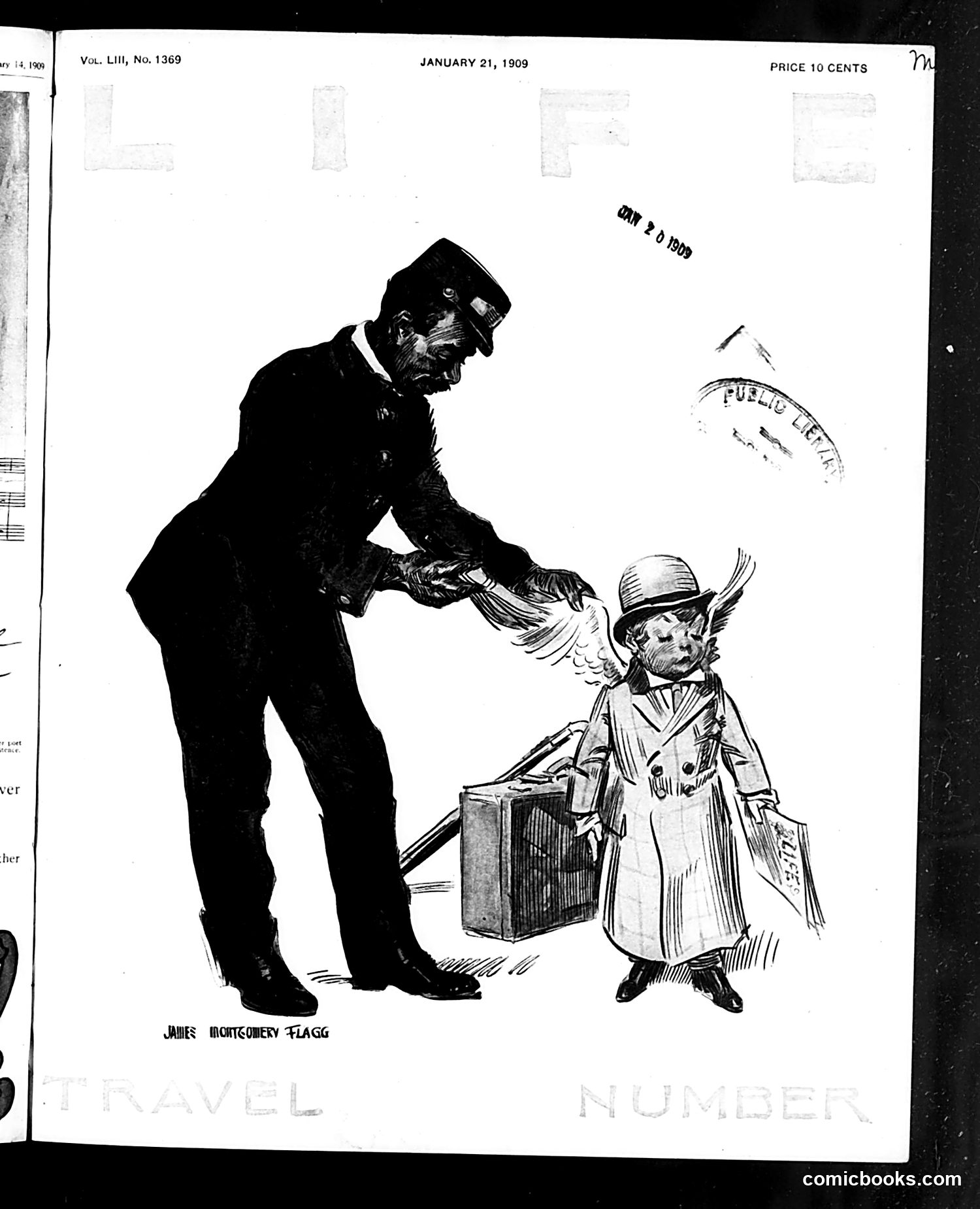
This cartoon by James Montgomery Flagg depicts a tall figure in dark clothing and military-style cap appearing to hand or pass a small winged cherub figure holding a suitcase. The cherub wears a hat and coat, appearing as a child or personified innocent figure. The artwork likely satirizes American foreign policy or military intervention of the early 1900s. The tall figure appears to represent either a government official or military authority, while the small winged figure likely represents a nation or territory being "handed off" or transferred. The suitcase suggests displacement or forced departure. Without additional context text from the page, the specific political situation being critiqued remains unclear, though it appears to comment on American imperial or interventionist practices of the Theodore Roosevelt era.
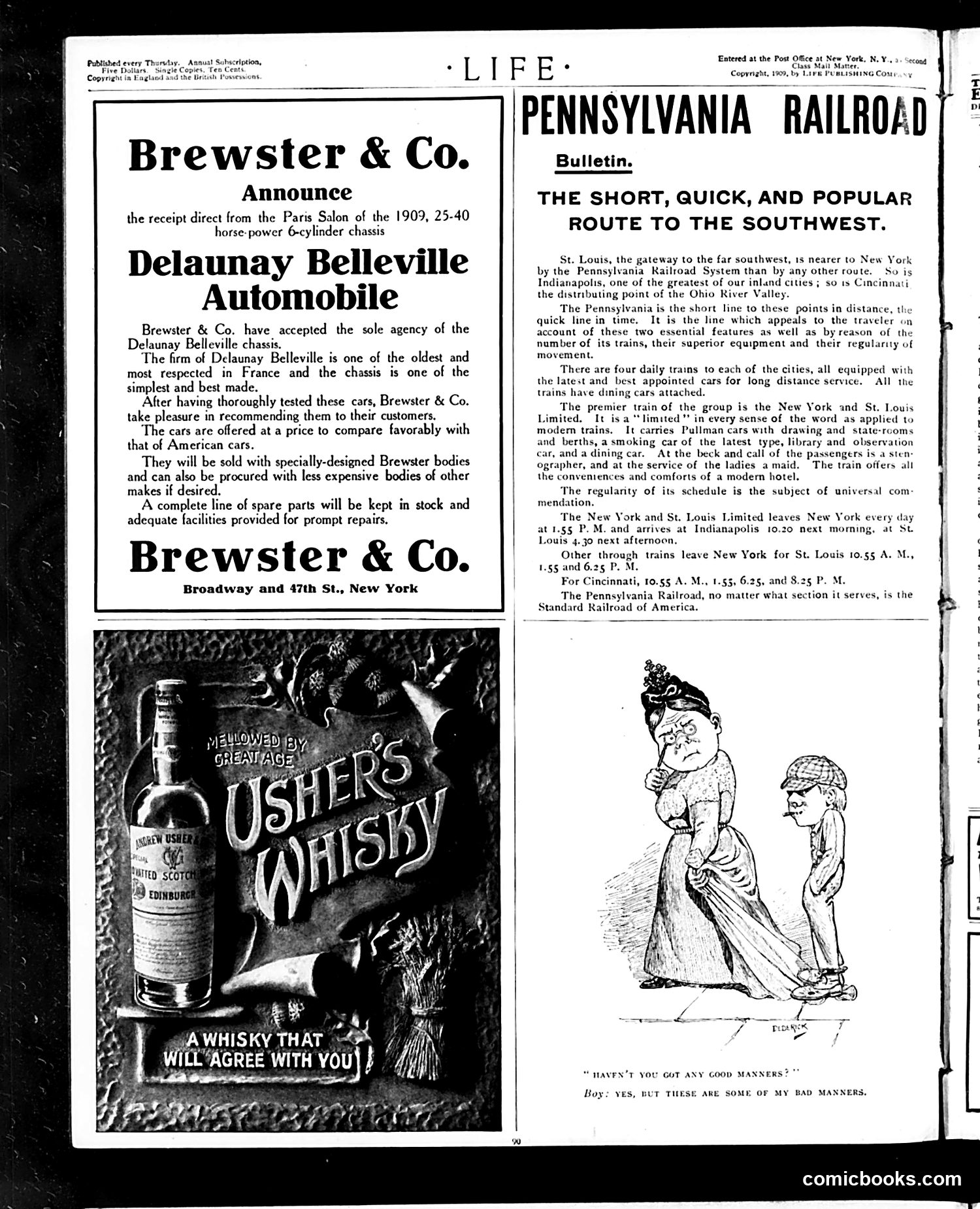
This Life magazine page is primarily **advertising** with one small cartoon. The ads promote a **Delaunay Belleville automobile** (a French luxury car brand) through Brewster & Co., and **Usher's Whisky**. The cartoon at bottom right depicts a woman scolding a small boy, captioned: "HAVEN'T YOU GOT ANY GOOD MANNERS?" / "YES, BUT THESE ARE SOME OF MY BAD MANNERS." This is a **humor piece about childhood misbehavior**—the joke being that the boy possesses good manners but chooses to exhibit bad ones instead. It reflects early 20th-century concerns about children's etiquette and discipline, presented as gentle domestic satire rather than political commentary. The cartoon has no deeper meaning beyond this simple joke about youthful rudeness.
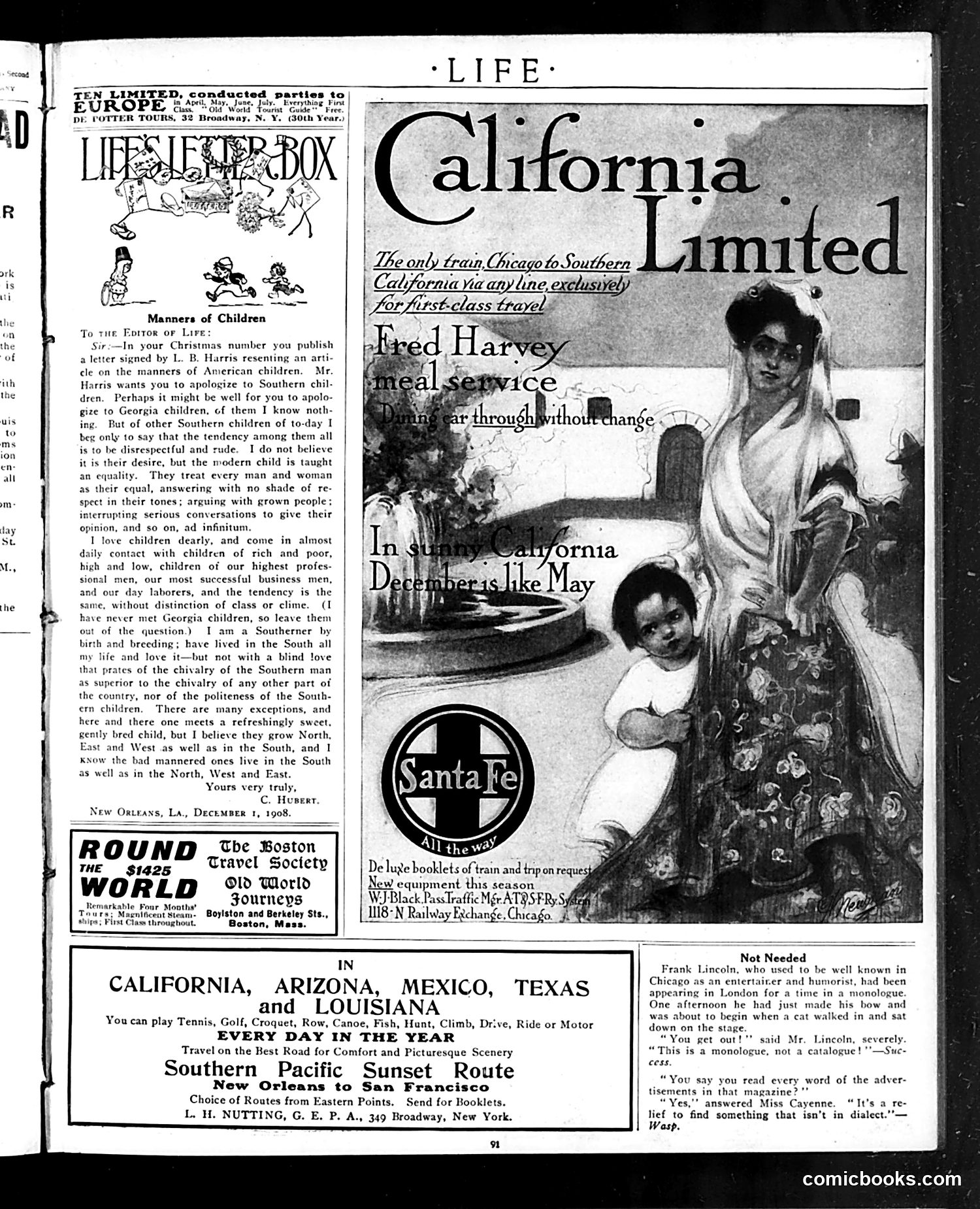
This page is primarily **advertising and travel promotion** rather than political satire. The dominant content features a large advertisement for the "California Limited" train service, highlighting first-class travel from Chicago to Southern California with "Alfred Harvey meal service" and Santa Fe Railway branding. The accompanying illustration shows an elegantly dressed woman, likely representing the luxury and refinement associated with first-class rail travel. The left side contains a brief letter column titled "Manners of Children," where a Southern writer defends Southern children against claims of rudeness, asserting they're raised with proper respect for social hierarchy. Below are additional travel advertisements for the Boston Travel Society and Southern Pacific Sunset Route, emphasizing year-round recreation in warm climates—typical early 20th-century leisure marketing targeting affluent audiences.
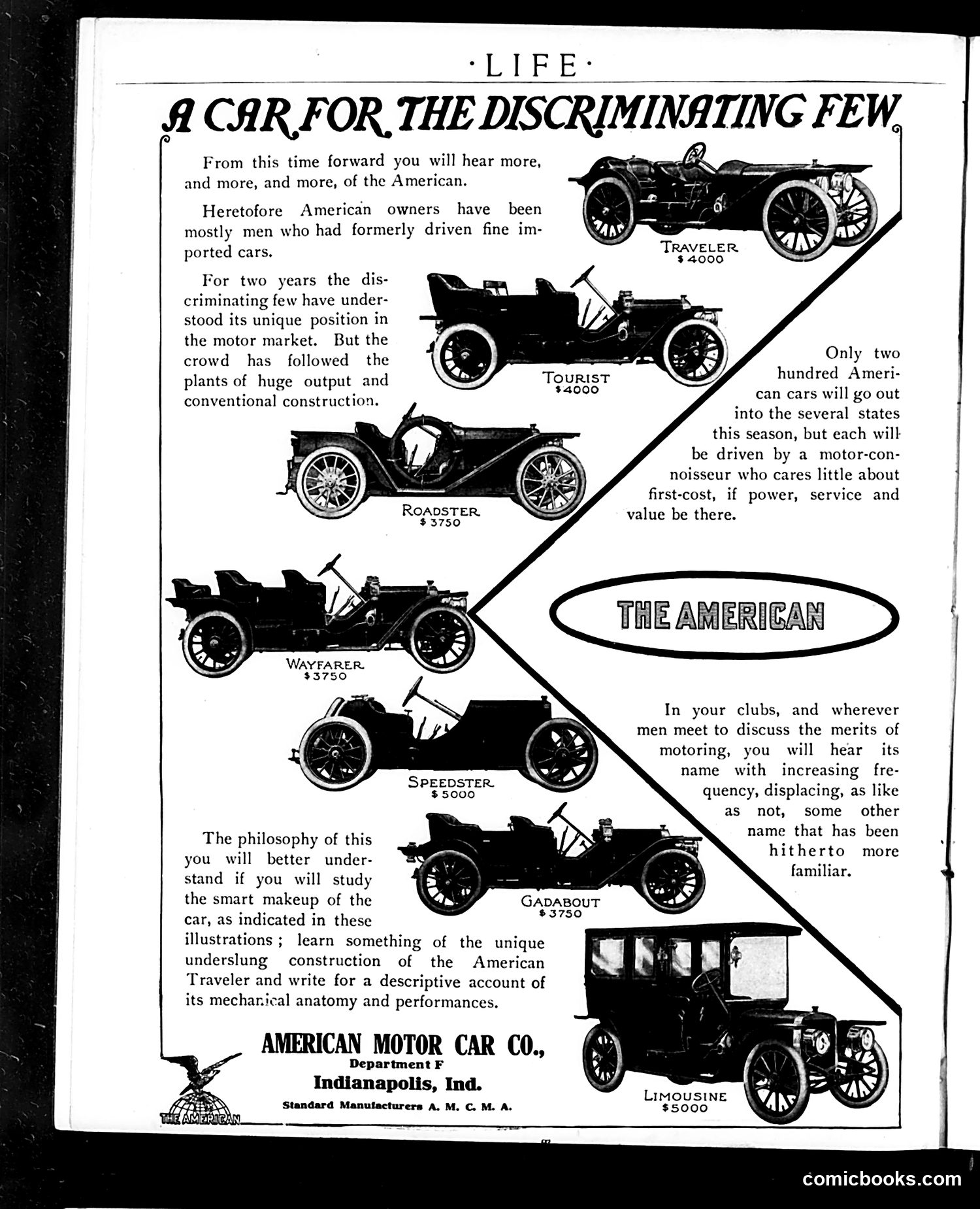
This is primarily **advertising**, not satire or political commentary. The American Motor Car Company is promoting their "American" automobile brand through a full-page Life magazine advertisement. The headline "A Car for the Discriminating Few" ironically frames the American as exclusive, though the text reveals the actual pitch: the car appeals to wealthy buyers who previously owned imported European vehicles. The advertisement showcases six American models (Traveler, Tourist, Roadster, Wayfarer, Speedster, Gadabout, and Limousine) at various price points ($3,750–$5,000). The satirical angle appears subtle: the ad suggests American cars deserve recognition alongside imported competitors, positioning domestic manufacturing as sophisticated enough for elite buyers. The "discriminating few" reference gently mocks pretension while selling American automotive pride during an era of growing domestic car production.
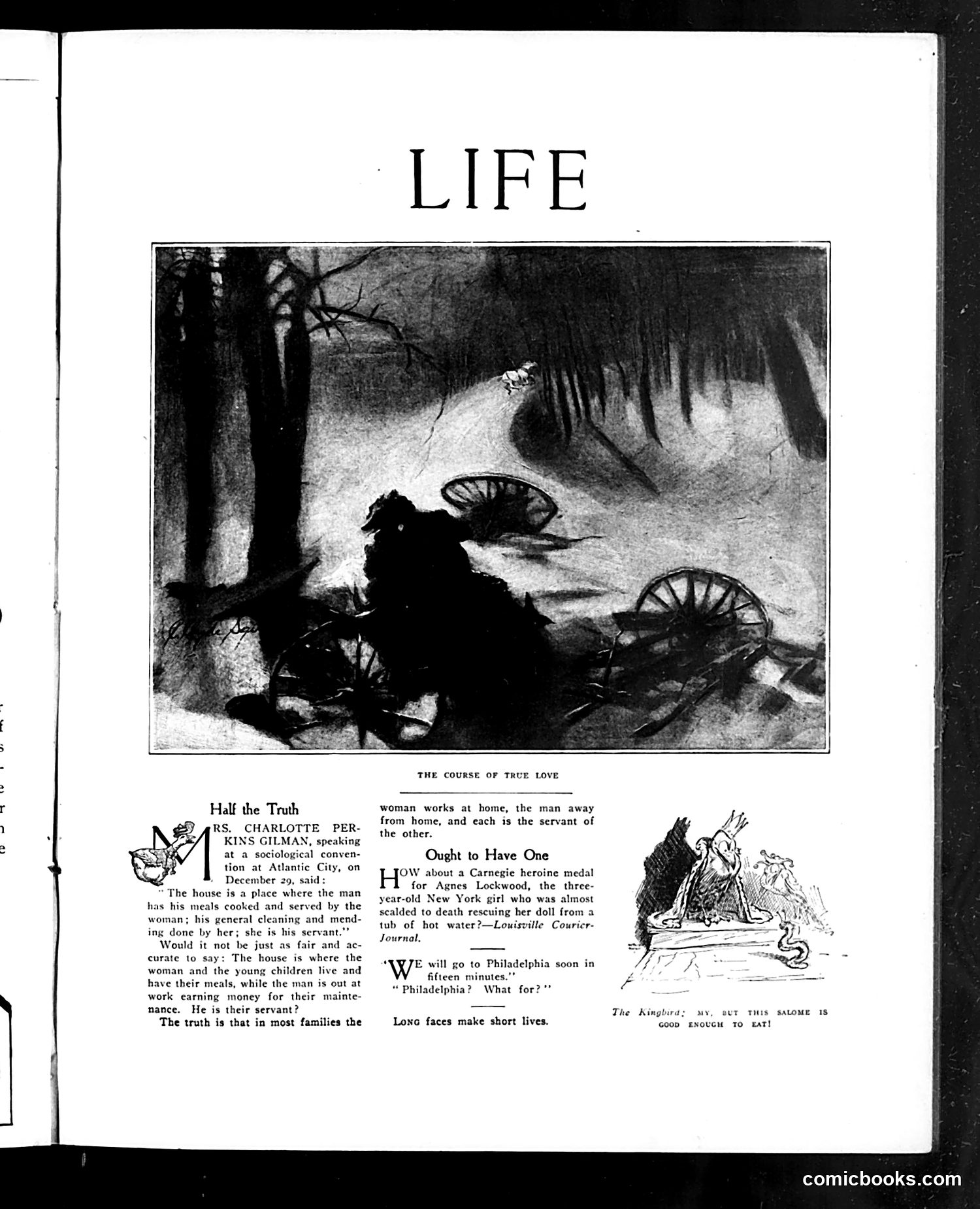
This page critiques gender roles and domestic labor through Charlotte Perkins Gilman's commentary titled "Half the Truth." Gilman, a prominent social reformer, argues that the traditional division of labor—where women work unpaid at home while men earn wages outside—is fundamentally unfair. She challenges the notion that women are merely "servants" to their families, asserting instead that domestic work should be recognized as genuine labor deserving compensation or respect. The accompanying illustrations and brief anecdotes (about a Carnegie heroine and a Philadelphia trip) appear designed to reinforce her argument about the undervalued nature of women's household contributions. This reflects early 20th-century feminist discourse questioning traditional domestic arrangements.
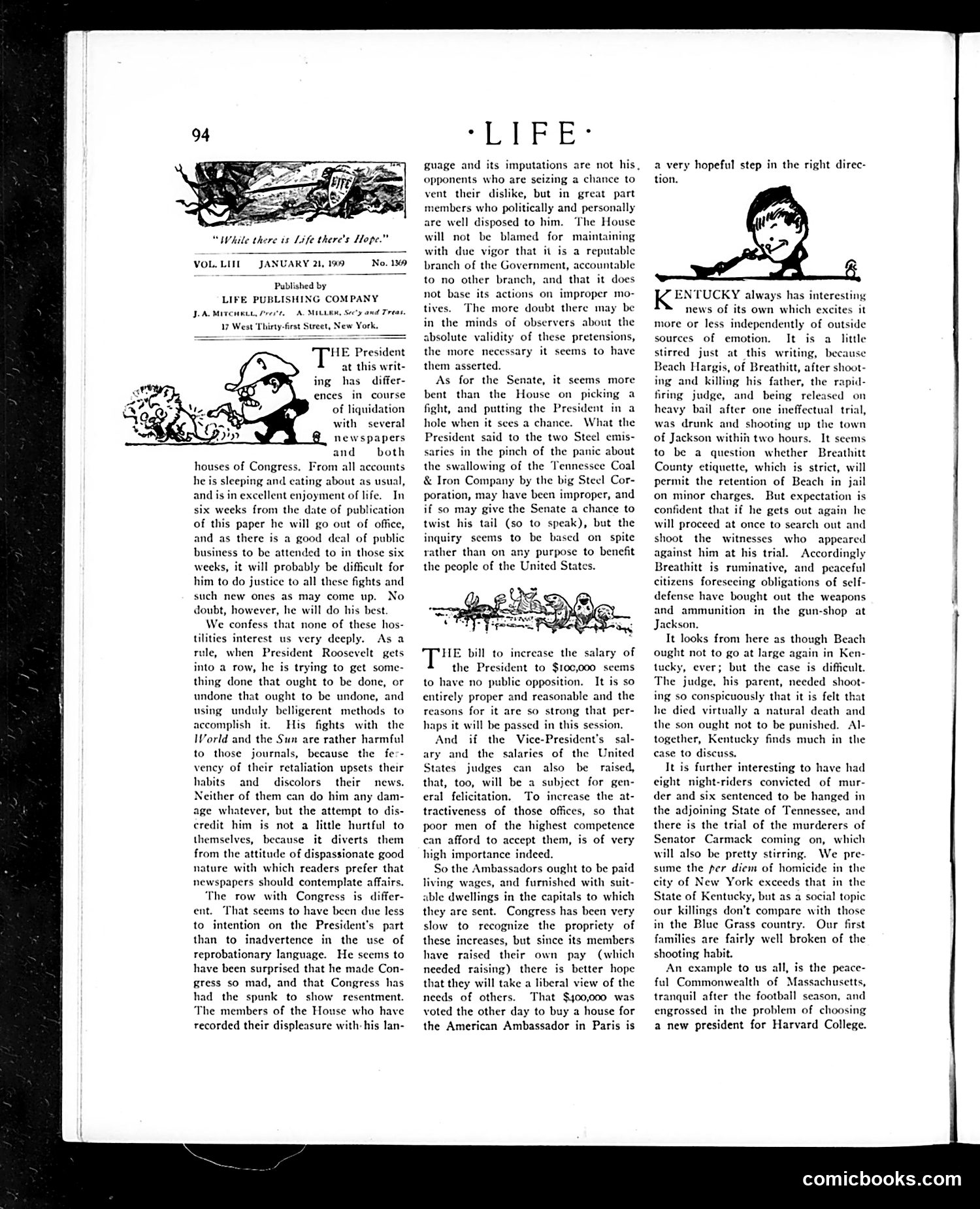
**The Main Cartoon:** The top illustration depicts President Theodore Roosevelt as a figure in a cowboy hat, drawn in caricature. The accompanying editorial discusses Roosevelt's various controversial actions and his relationship with Congress, particularly regarding House and Senate conflicts over matters like the Tennessee Coal & Iron Company acquisition and presidential salary increases. **The Satire's Point:** Life criticizes Roosevelt's methods as overly aggressive and his use of "unscrupulous" tactics to achieve his agenda. The cartoonist suggests Roosevelt operates somewhat independently of proper congressional oversight, comparing his approach unfavorably to standard governmental procedure. **Context:** This reflects Roosevelt's final year as president (before Taft took office) and public anxiety about executive overreach during his progressive reform era.
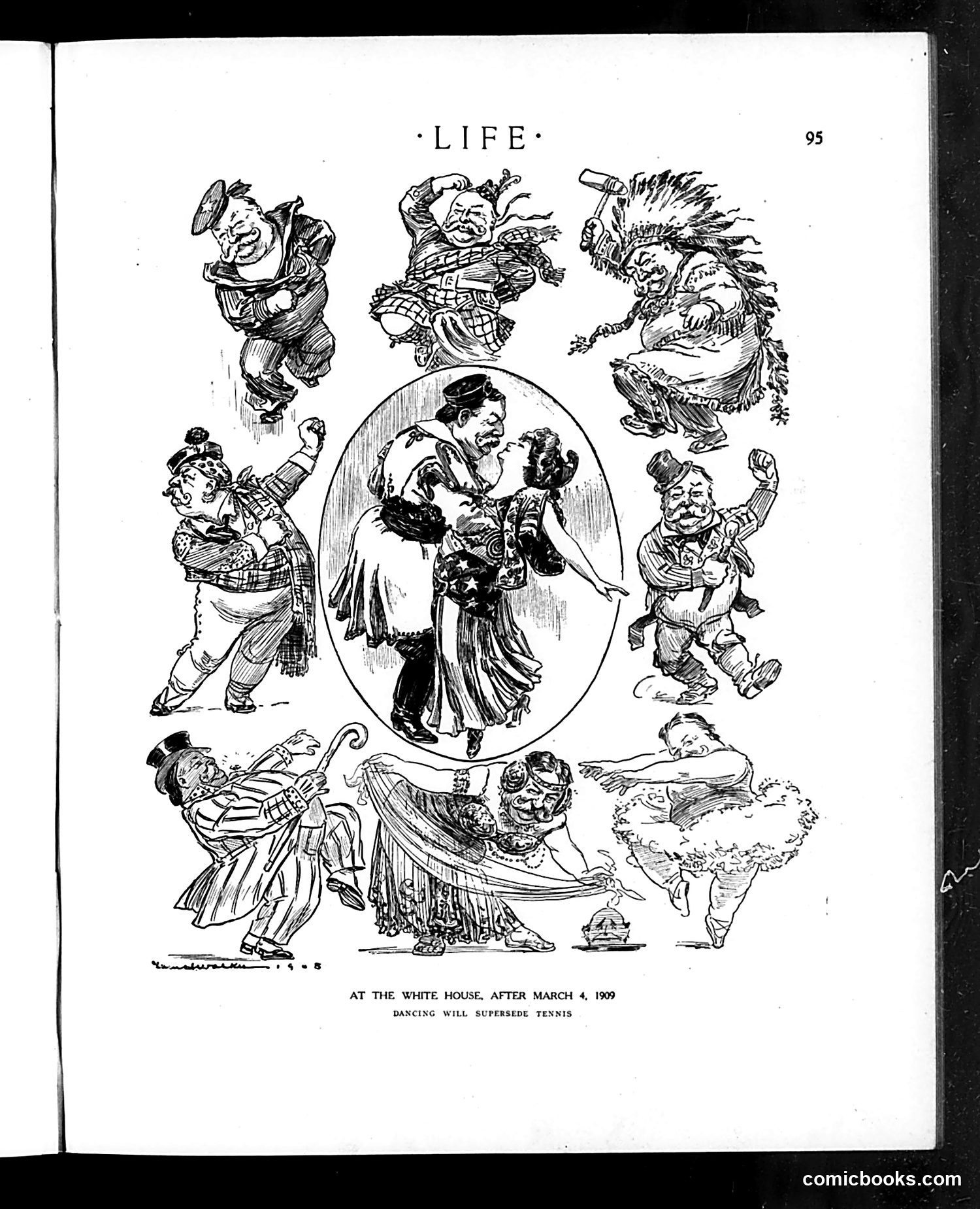
This 1909 Life magazine cartoon satirizes social life at the White House following March 4, 1909—Theodore Roosevelt's final day as president before William Howard Taft's inauguration. The central oval depicts a couple dancing, surrounded by caricatured figures engaged in various activities: some dancing, some appearing wild or intoxicated, others in exaggerated poses suggesting chaos and revelry. The caption states "Dancing will supersede tennis," mocking the contrast between Roosevelt's well-known athletic pursuits (particularly tennis) and Taft's anticipated social style. The surrounding grotesque figures suggest anxieties about how White House culture would change under new leadership—implying Taft's administration would be less vigorous, more frivolous and socially chaotic than Roosevelt's robust, sport-focused regime.
This page contains several satirical commentary sections rather than traditional political cartoons. The main pieces critique: **"Likely Preachers"**: Mocks Brother Andrew and others joining Life's editorial staff, suggesting they're abandoning theology for journalism—a commentary on religious figures entering secular media. **"Chronicles of a Great Man"**: Satirizes J.P. Morgan's wealth and social influence, noting his ability to host lavish banquets while claiming democratic values. The satire points out the contradiction between his aristocratic behavior and democratic pretensions. **"Women and Education"**: Challenges the fallacy that education removes class distinctions in women, arguing it doesn't eliminate inherent social hierarchies. The page employs sarcasm and irony to critique wealth inequality, religious hypocrisy, and social pretensions of the era.
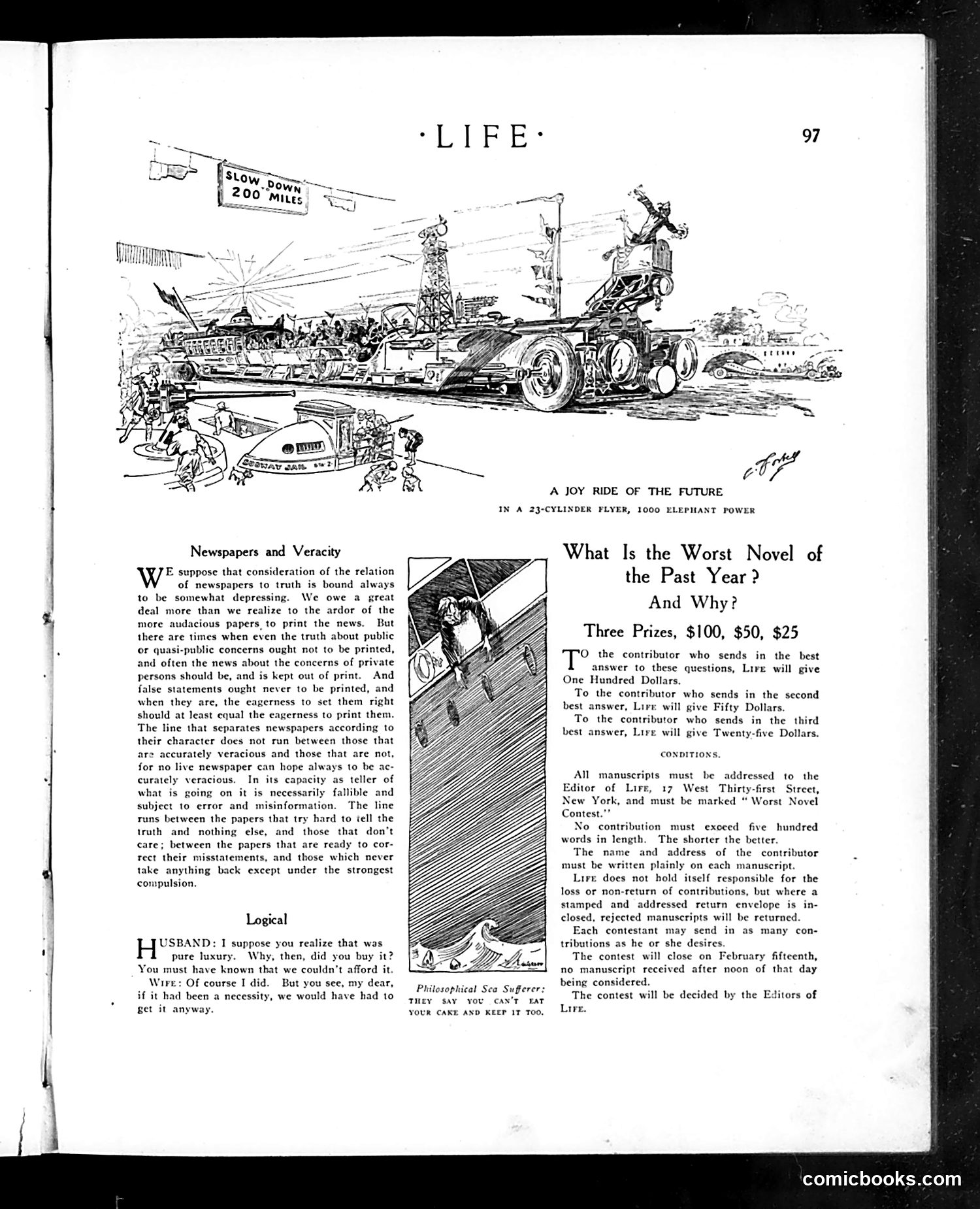
This page contains three distinct elements: **Top illustration:** A futuristic vehicle labeled "A Joy Ride of the Future" features an elaborate contraption with a 23-cylinder engine and "1000 Elephant Power." The satire mocks early 20th-century technological excess—the absurdly over-engineered machine is impractical and ridiculous, poking fun at manufacturers' obsession with adding power and complexity rather than utility. **"Newspapers and Veracity" section:** Critiques newspaper reliability, arguing papers print sensational stories without adequate verification. The piece suggests newspapers balance profit motives against truthfulness, noting the difficulty of always achieving accuracy. **"Local" joke:** A husband justifies buying a luxury item by claiming necessity, while the wife sarcastically counters that they couldn't afford it anyway—a commentary on consumer behavior and marital financial disagreements. The page also advertises a writing contest about "the worst novel of the past year."
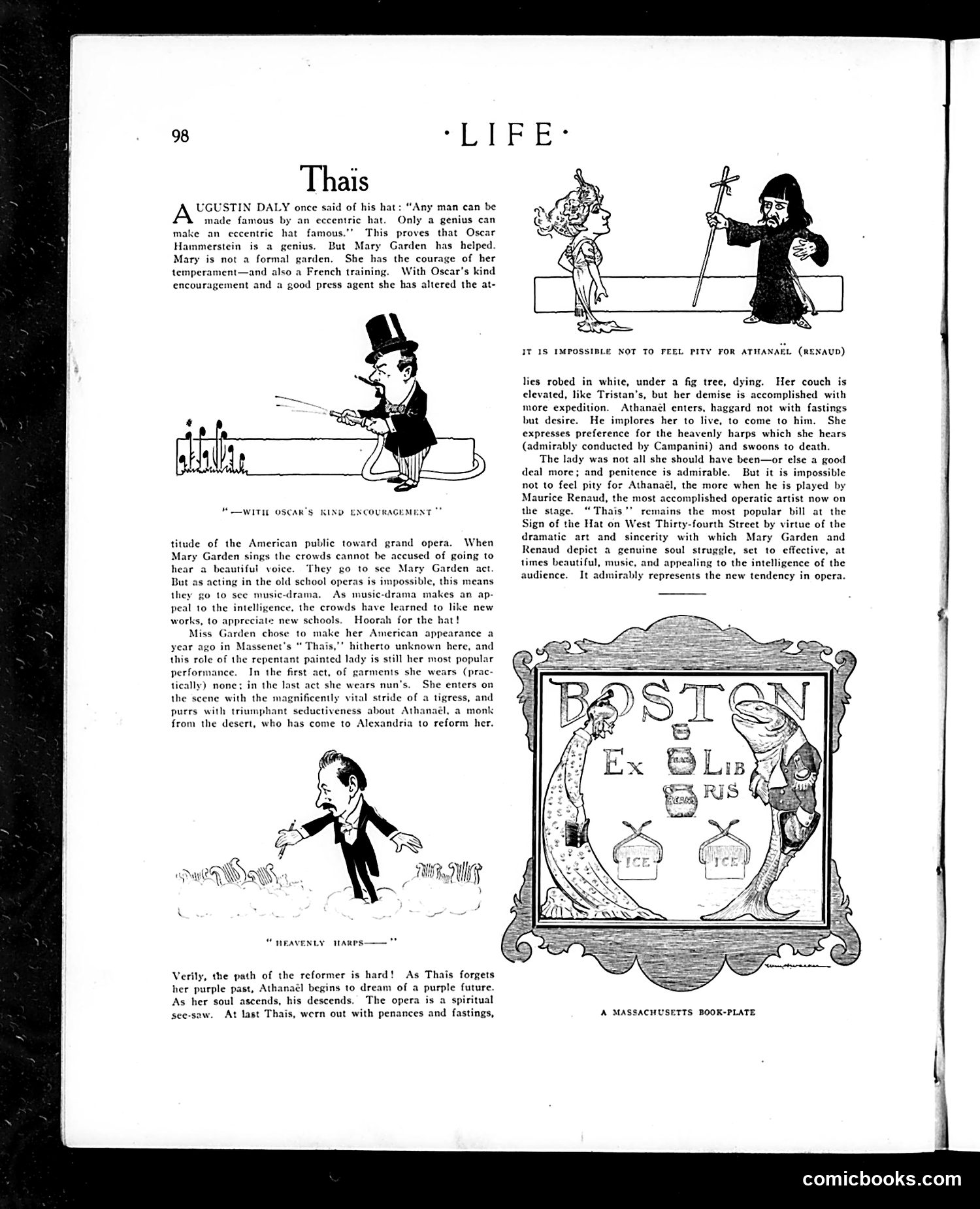
This page discusses the opera "Thais," praising Mary Garden's American performance. The cartoons satirize grand opera's pretensions and appeal. The top cartoon shows a figure in a top hat conducting an orchestra with exaggerated gestures, labeled "WITH OSCAR'S KIND ENCOURAGEMENT"—likely referencing Oscar Hammerstein's support of Mary Garden. The middle cartoon, "HEAVENLY HARPS," depicts a man conducting with dramatic flair amid floating harps, mocking the grandiose, ethereal staging conventions of opera. The text notes that opera attracts mass audiences despite being "impossible" as serious art, celebrating that "Thais" succeeds through genuine artistry rather than pretension. The satire gently mocks opera's theatrical excess while ultimately endorsing this particular production's artistic merit.
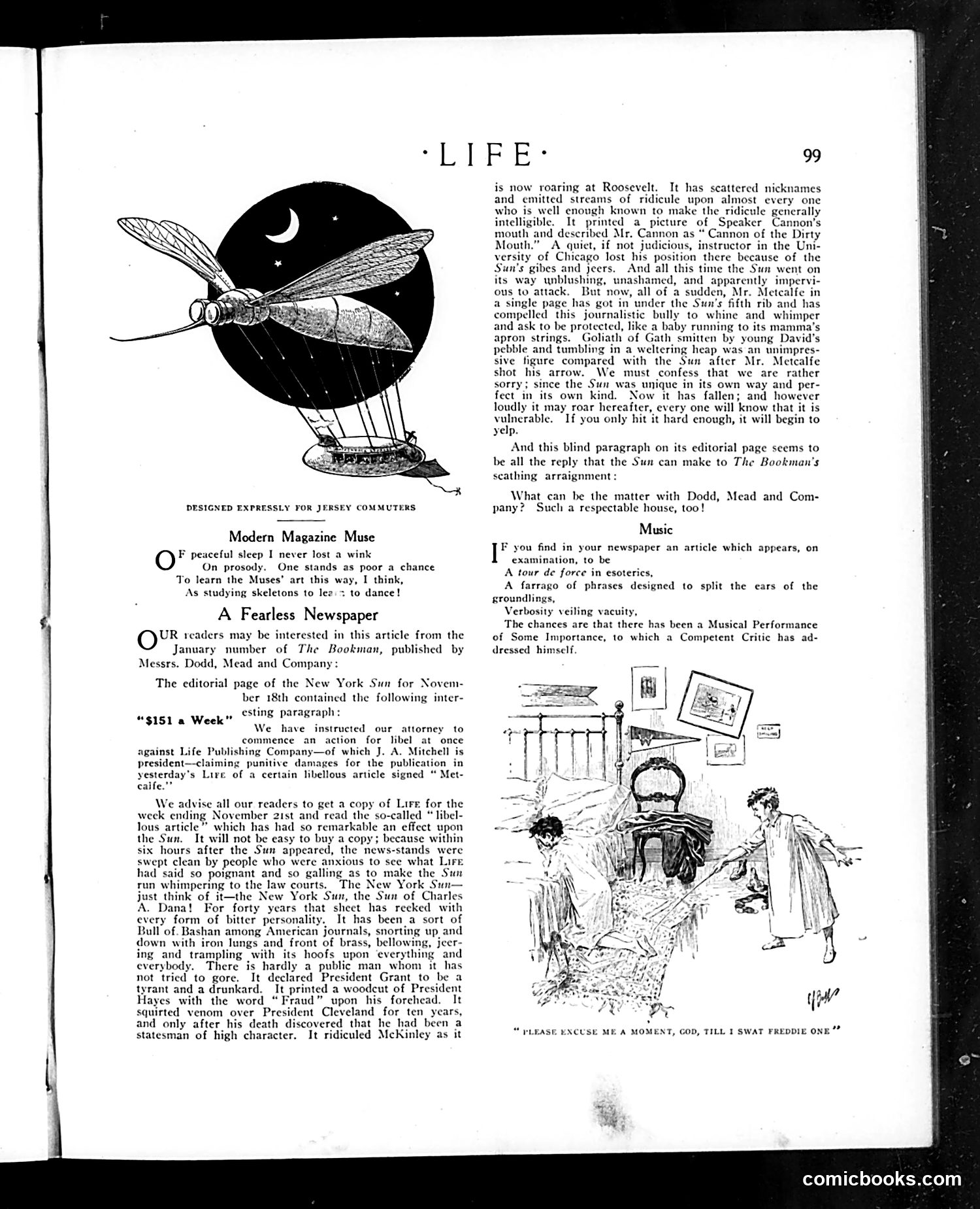
This page contains two distinct sections: **Top Illustration:** A airship/dirigible labeled "DESIGNED EXPRESSLY FOR JERSEY COMMUTERS" satirizes commuter transportation, suggesting absurdly impractical aerial vehicles for daily travel. **Main Articles:** The text discusses a dispute between *Life* magazine and the *New York Sun* newspaper. The *Sun* published an article titled "Metcalfe" criticizing *Life's* publisher. The editorial describes the *Sun* as historically sensationalist—comparing it to a "bull of Bashan," mocking its past coverage of political figures including Presidents Hayes and Cleveland, and its ridicule of McKinley. **Bottom Cartoon:** An interior scene with someone exclaiming "PLEASE EXCUSE ME A MOMENT, GOD, TILL I SWAT FREDDIE ONE!" depicts frustration during prayer, likely satirizing religious hypocrisy or domestic tension. The page reflects early-20th-century media feuds and social satire.
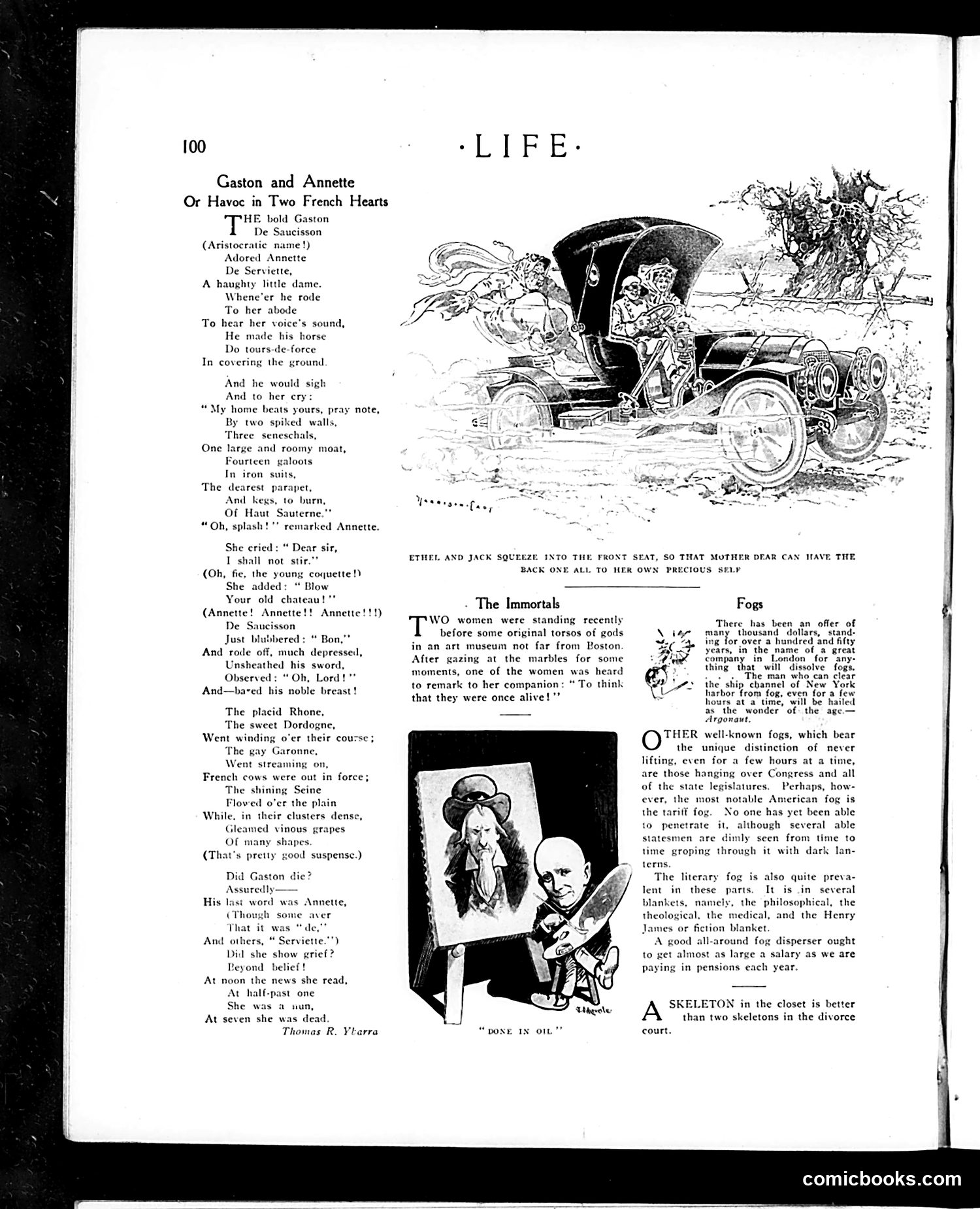
This page contains three distinct pieces: 1. **"Gaston and Annette"** — A narrative poem by Thomas R. Ytarra about a French couple and their automobile, illustrated with a sketch of an early motorcar. The humor appears to derive from the woman's refusal to sit still during the ride. 2. **"The Immortal"** — A brief anecdote about two museum visitors remarking that marble statues were "once alive," accompanied by a caricature illustration labeled "LOVE IN OIL" (unclear what specific reference this makes). 3. **"Frogs"** — A humorous piece mocking bog-related legislative obstruction, using "frogs hanging over Congress" as metaphor for perpetually stalled bills. The page represents typical early 20th-century Life magazine satirical humor mixing domestic comedy, art commentary, and political jabs.
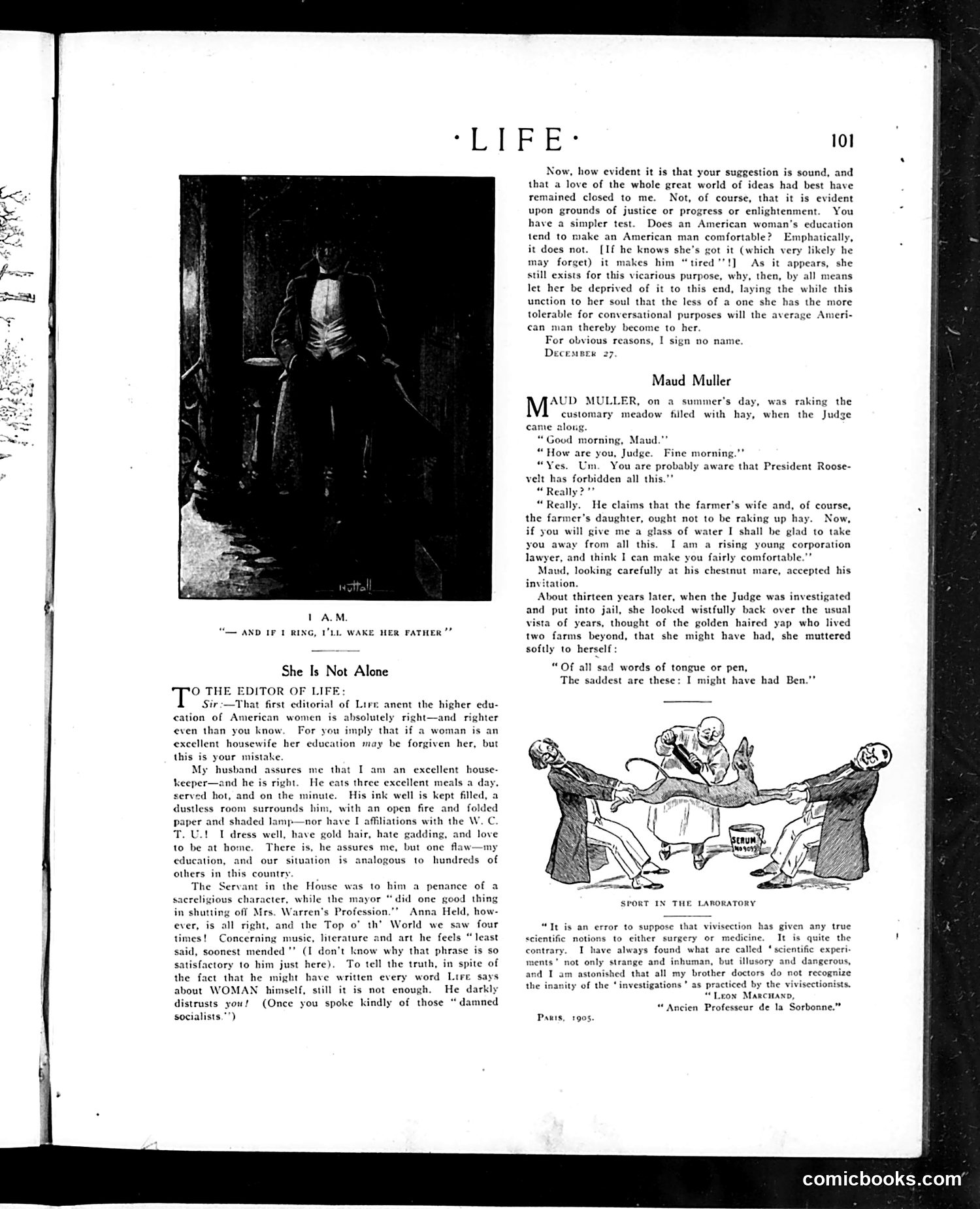
This page contains satirical commentary on women's education and roles. The left side features a letter titled "She Is Not Alone" responding to an earlier *Life* editorial supporting higher education for American women. The author argues that an educated woman makes men "tired" and questions whether education truly benefits women. The illustration labeled "SPORT IN THE LABORATORY" appears to satirize scientific or medical investigations, showing figures in what seems to be a laboratory setting, likely mocking contemporary pseudo-scientific practices. The Maud Muller story recounts a woman who, decades after being denied education by a judge's order, regrets the lost opportunity. The satire critiques restrictions on women's advancement and education, suggesting such limitations cause lasting harm and regret.
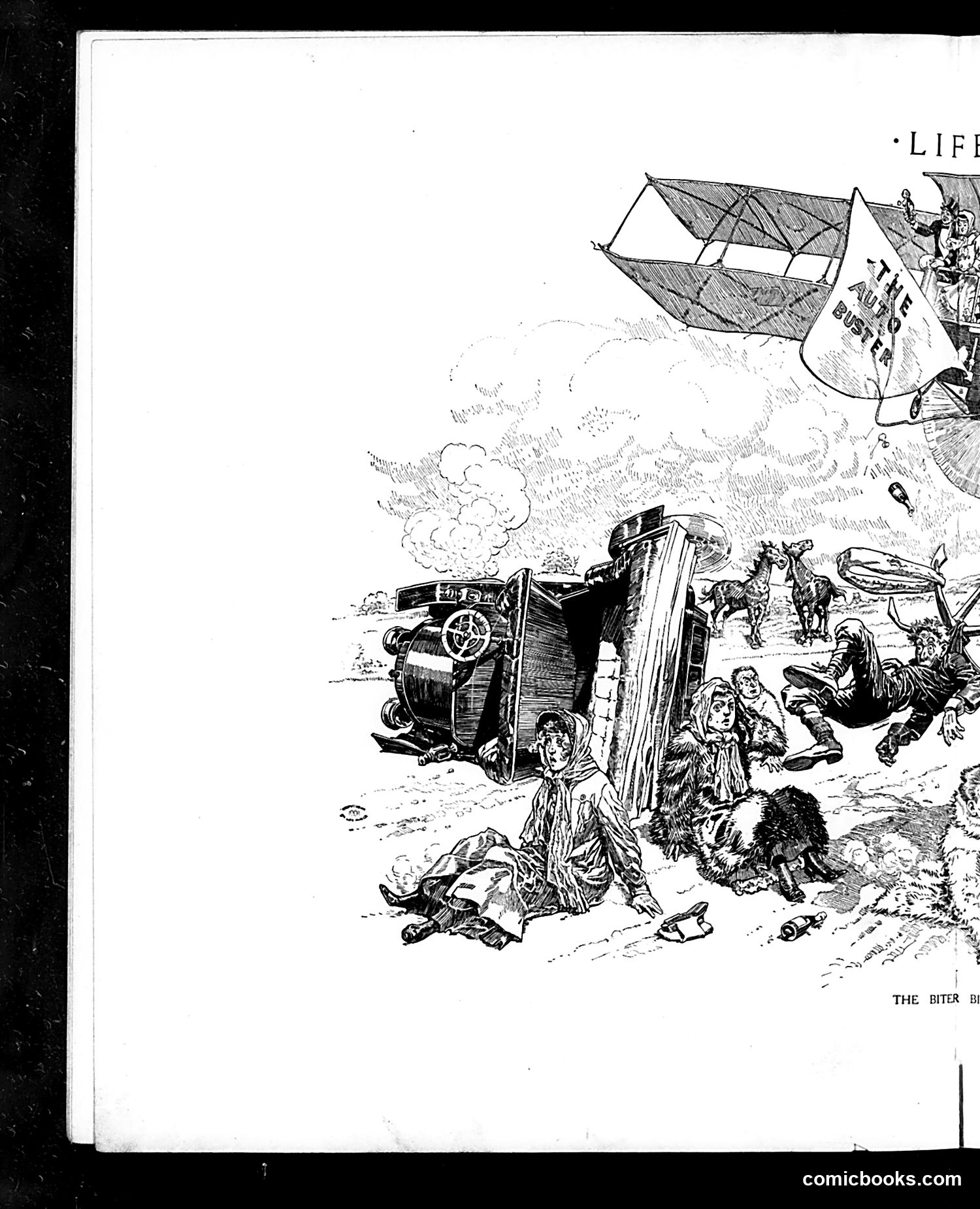
This satirical cartoon depicts a chaotic shipwreck or disaster scene. A capsized automobile lies damaged on a beach, while a lifeboat labeled "LIFE" and "BUSTED" floats above. Scattered survivors and onlookers populate the scene—some appearing distressed or injured. The title "The Biter Bit" (a phrase meaning someone who schemes gets their comeuppance) suggests this is political satire about unexpected consequences. The "BUSTED" lifeboat and wrecked car likely reference failed schemes or broken promises, possibly related to early automotive industry or political corruption circa Life magazine's satirical heyday (early 1900s). Without additional context, the specific political figures or events remain unclear, though the composition emphasizes ironic misfortune befalling those depicted.
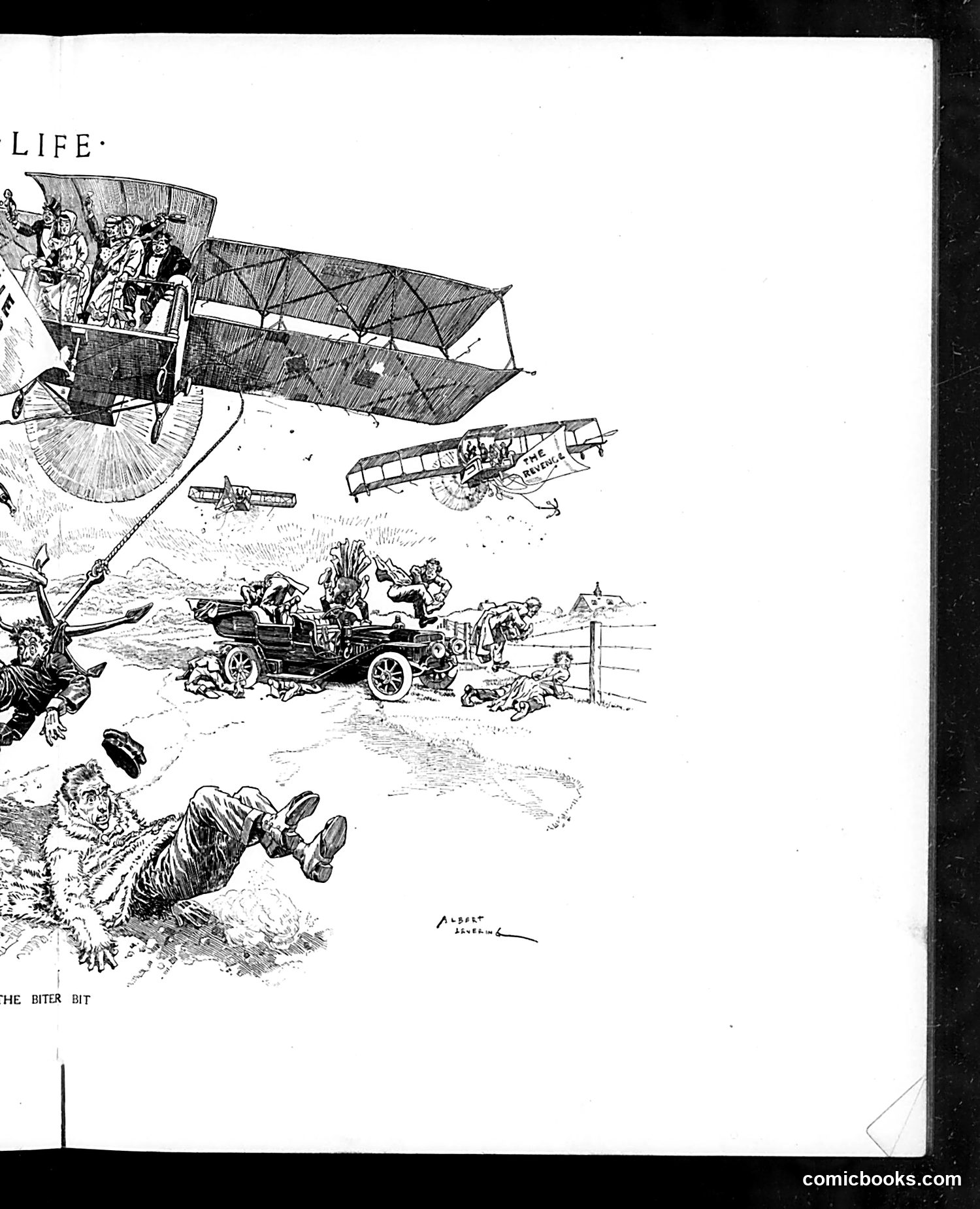
This satirical cartoon depicts the consequences of aggressive warfare or conflict. The composition shows a chaotic scene where modern instruments of destruction—aircraft, military vehicles, and artillery—rain down upon civilians and soldiers alike. The title "The Bitter Bit" suggests ironic comeuppance: those who initiate violence experience it in return. The cartoon appears to critique militarism by showing how warfare ultimately harms everyone involved, including perpetrators. The surreal, nightmarish quality—with figures fleeing in panic and mayhem everywhere—emphasizes the absurdity and human cost of armed conflict. The artist's signature appears to read "Albert" (partially visible). Without a specific date, the exact historical conflict referenced remains unclear, though the imagery suggests early-to-mid 20th century concerns about aerial bombardment and modern warfare's indiscriminate destruction.
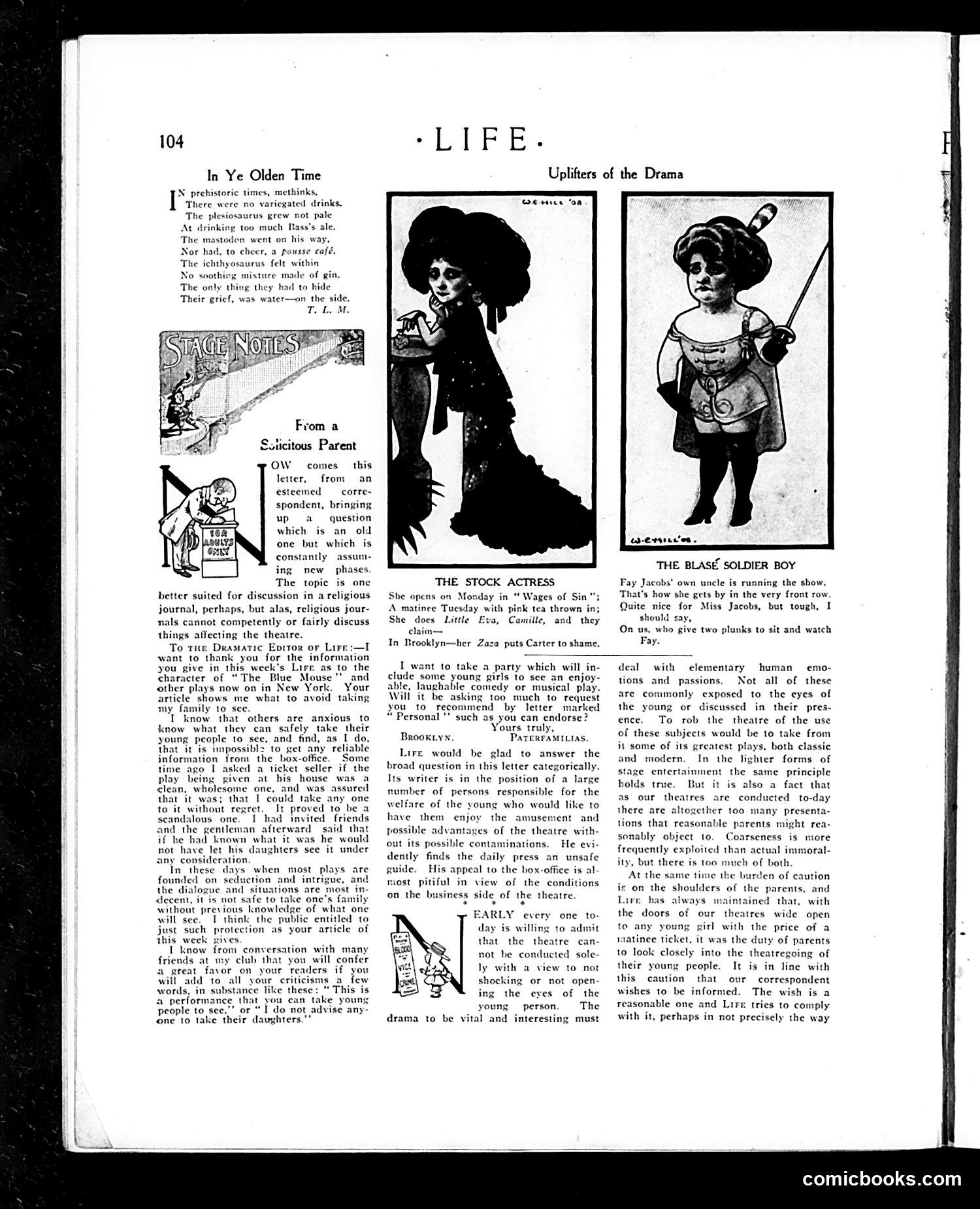
This page addresses theatrical content and parental concerns about what's appropriate for young audiences—a major cultural debate of the early 20th century. **Main Content:** The "Solicitous Parent" section features a letter from "Paterfamilias" (Brooklyn) complaining that he cannot reliably determine which plays are morally safe for his family. He requests that *Life's* drama critics explicitly label reviews as either suitable or unsuitable for young people. **The Satire:** The two illustrated caricatures mock theatrical types: - **"The Stock Actress"** ridicules a mediocre performer who cycles through cheap roles (melodrama, classics, risqué contemporary pieces), claiming Brooklyn audiences praise her highly - **"The Blasé Soldier Boy"** jokes about a young man who attends shows only because his uncle produces them, getting free seats while ordinary patrons pay **The Point:** *Life* satirizes both anxious parents seeking moral gatekeeping and the theater industry's actual lack of standards. The magazine acknowledges legitimate concerns about theatrical "contaminations" while suggesting that drama—to remain vital—must address adult human experience, not merely protect young sensibilities.
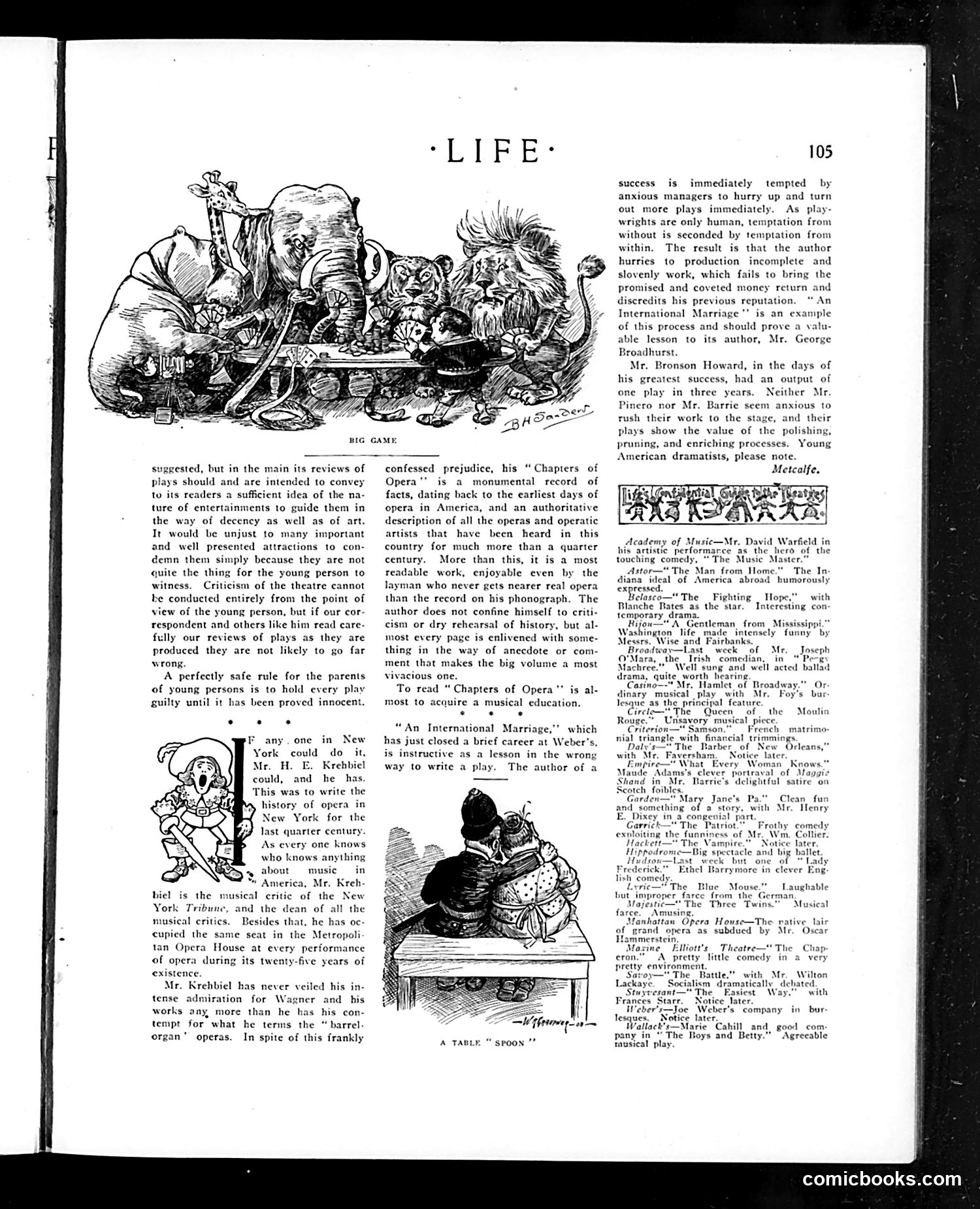
This page discusses American theatrical criticism and play production, featuring two cartoons satirizing the theater world. **"Big Game" (top cartoon):** Shows animals at a table laden with theatrical props and scripts, likely satirizing the competitive, predatory nature of theater management and producers fighting over plays and actors. **"A Table Spoon" (bottom cartoon):** Depicts a figure at a small table with a spoon, appearing to mock either underfunded productions or the meager offerings of certain theaters. **Main text content:** Critiques playwright George Broadhurst for rushing "An International Marriage" to production after early success, rather than following the deliberate approach of established playwrights like Pinero and Barrie. The piece warns young American dramatists against producer pressure to quickly capitalize on success, arguing that hasty work damages reputations and returns. The page also praises H.E. Krehbiel's opera history book as authoritative and readable, contrasting with his known Wagner admiration and contempt for popular "barrel-organ" operas.
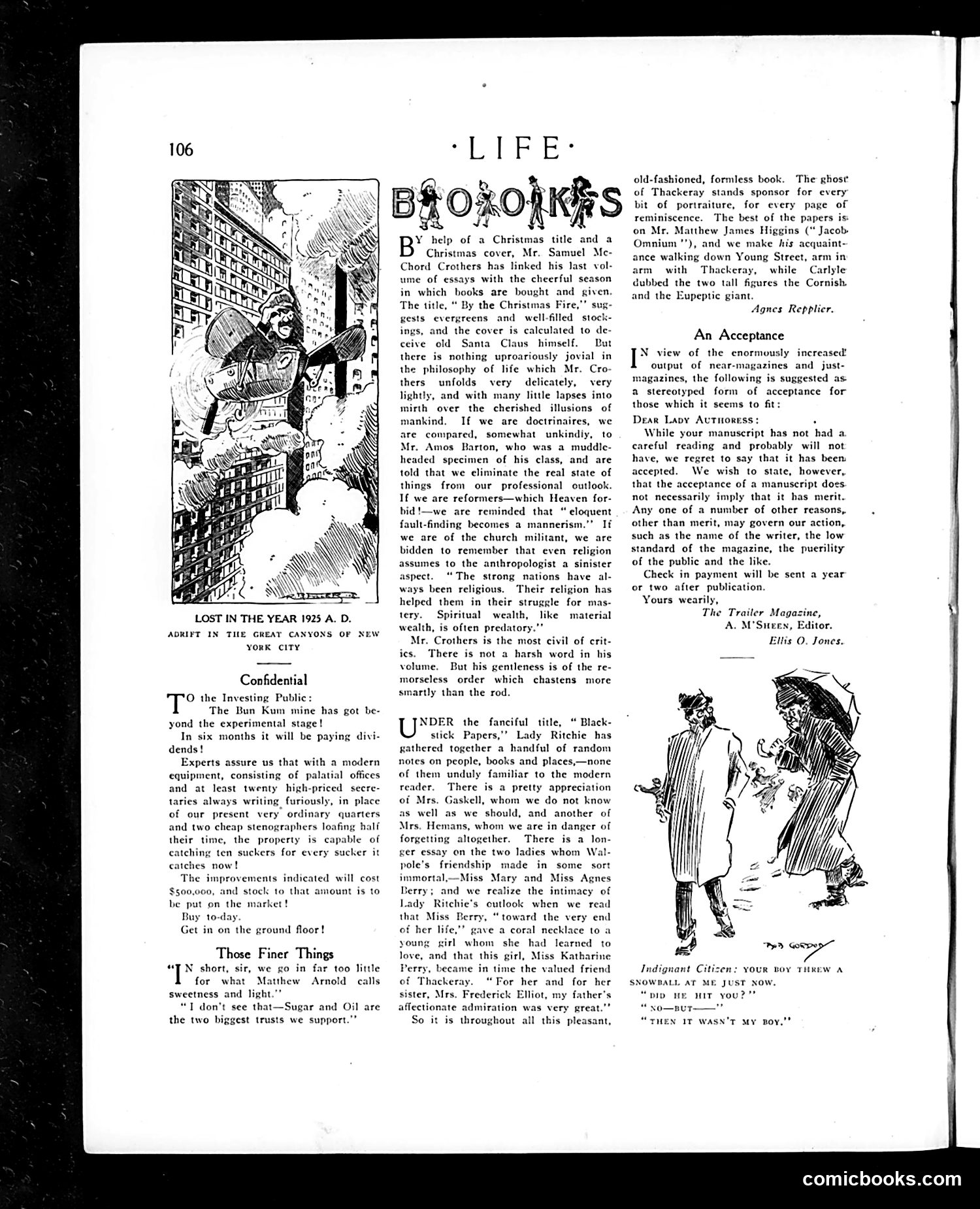
This page contains two distinct satirical pieces: **Left Column - Stock Scheme Satire ("Bun Kum Mine")**: A fictional "confidential" investment pitch mocking stock fraud. The scheme promises dividends after acquiring expensive offices and secretaries—essentially proposing to spend investment capital on overhead rather than actual operations. The joke: catching "ten suckers for every sucker it catches now" reveals the con explicitly. This satirizes the get-rich-quick schemes and investment fraud rampant in the 1920s pre-Crash era. **Right Column - Book Reviews**: Discusses Samuel McChord Crothers's essay collection and Lady Ritchie's "Blackstick Papers," noting their gentle but penetrating social criticism. The review praises their refined, non-harsh approach to examining human folly. **Cartoon (top right)**: Illustrates someone apparently lost among New York's tall buildings—likely commenting on urban disorientation or the chaos of modern city life in the Jazz Age. The page reflects 1920s concerns: financial chicanery, urbanization, and cultural criticism through literature.
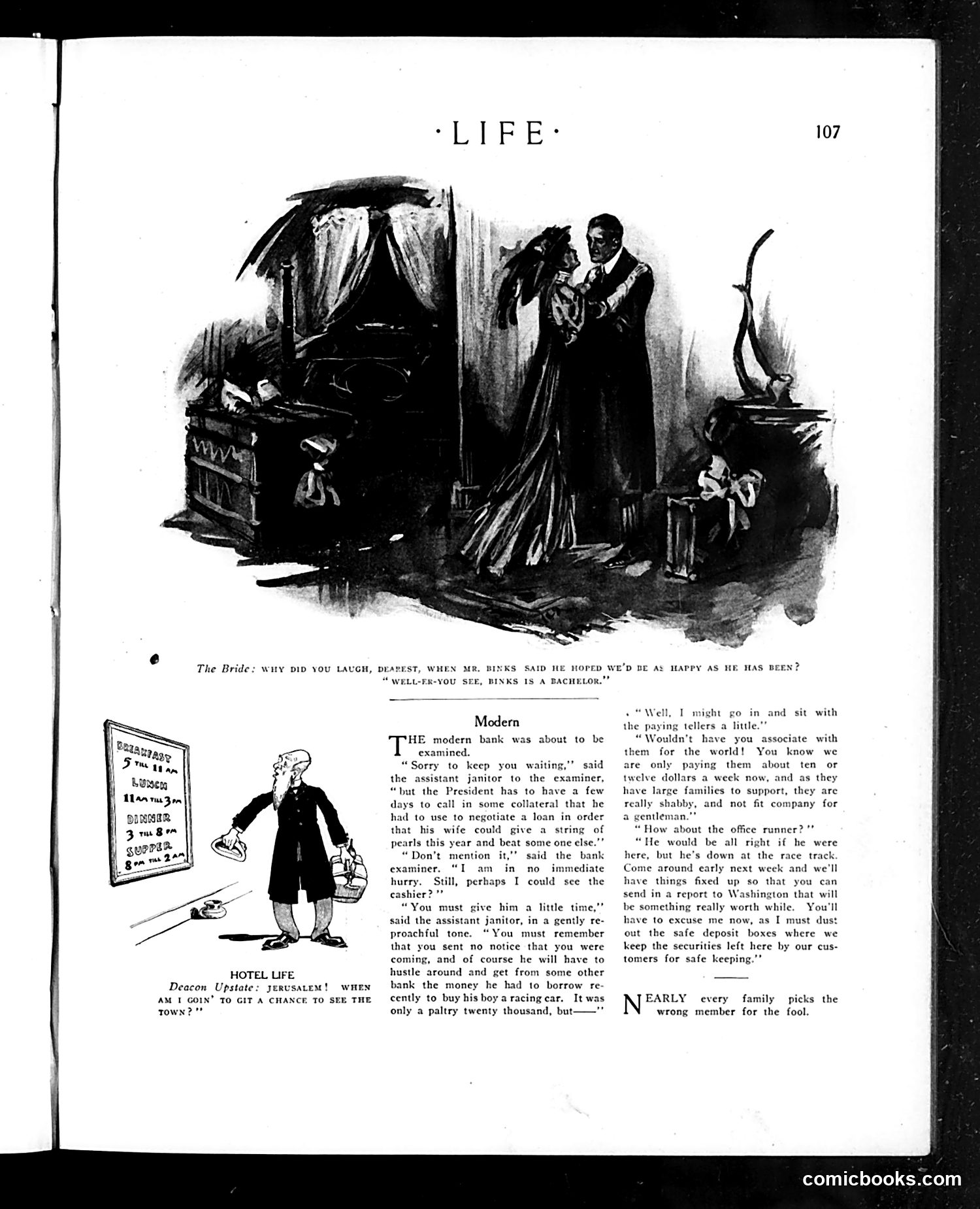
This page contains two brief satirical pieces about early 20th-century American social pretension and financial mismanagement. The top cartoon mocks newlyweds: a bride questions her husband's laughter when a bachelor friend hoped they'd be "as happy as he has been"—the implication being that marriage makes people unhappy. The longer "Modern" section satirizes bank corruption and embezzlement. When a bank examiner arrives unannounced, staff frantically explain delays: the president needs time to retrieve collateral he'd loaned out so his wife could buy pearls to outdo rivals; the cashier must borrow money from competitors to repay funds he'd borrowed to buy his son a racing car. The joke exposes how bank officials routinely misappropriated depositor funds for personal luxuries while maintaining respectable facades. The closing caption suggests foolish financial decisions run in families. The satire targets both wealthy excess and institutional corruption during the pre-Depression banking era.
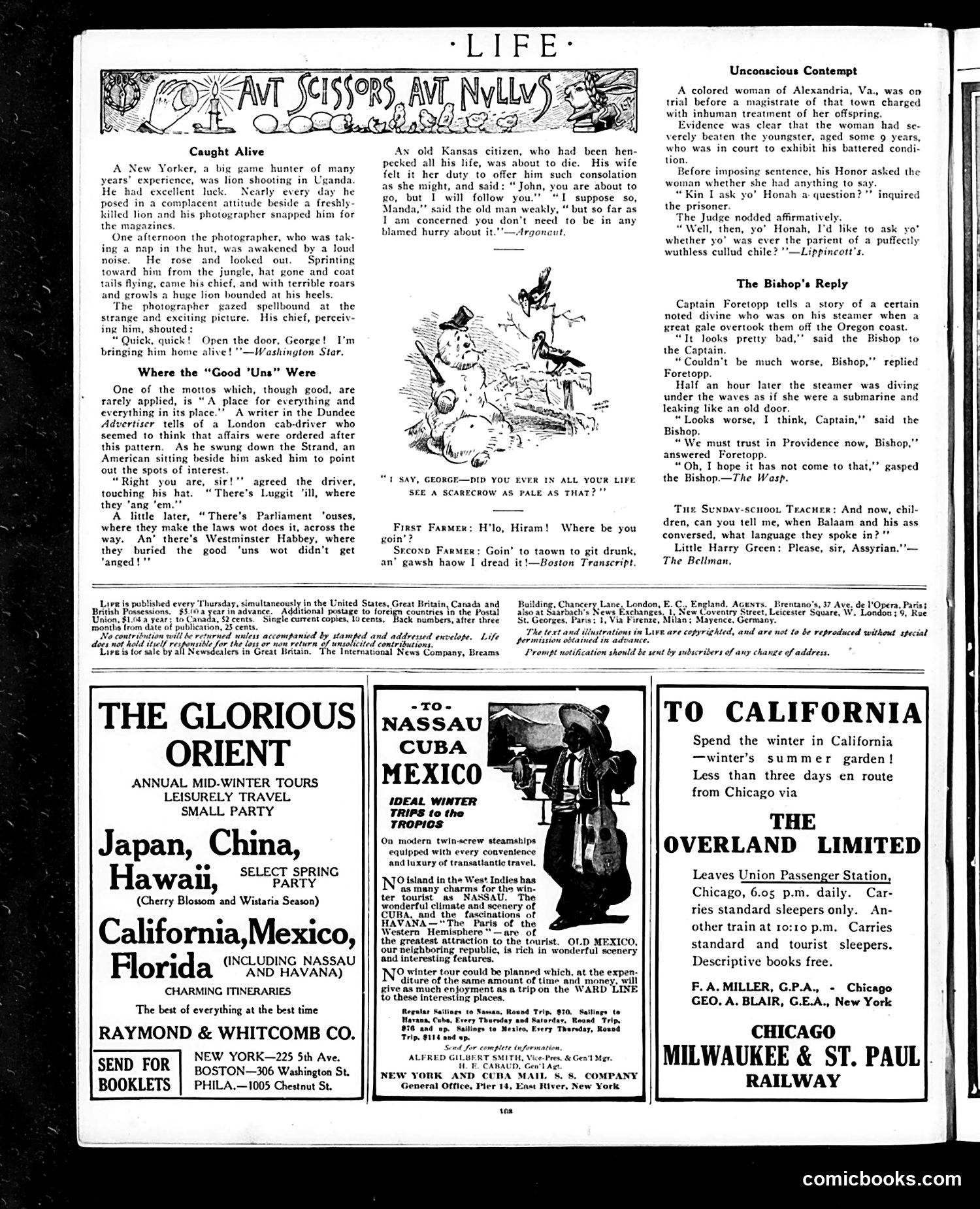
This page contains humorous anecdotes and satirical short stories typical of early 20th-century American humor magazines. The main pieces include: **"Caught Alive"**: A joke about a big-game hunter so obsessed with photographing himself with kills that he fails to notice real danger—here, a charging lion. The satire mocks vanity and obliviousness to authentic peril. **"Where the 'Good 'Uns' Were"**: A London cab driver's cynical tour commentary equating Parliament with lawmaking and Westminster Abbey with burying those "wot didn't get 'anged"—satirizing British class attitudes and corruption. **Other brief jokes** mock: a dying man's relief at escaping his nagging wife, a bishop's false piety when facing actual disaster (preferring divine intervention to maritime safety), and a magistrate's interaction with a Black woman defendant using period-appropriate but now offensive dialect. The cartoon depicts the lion-chase scenario. These pieces represent mainstream American humor of the era—often relying on ethnic/racial caricature, misogyny, and schadenfreude now considered offensive.
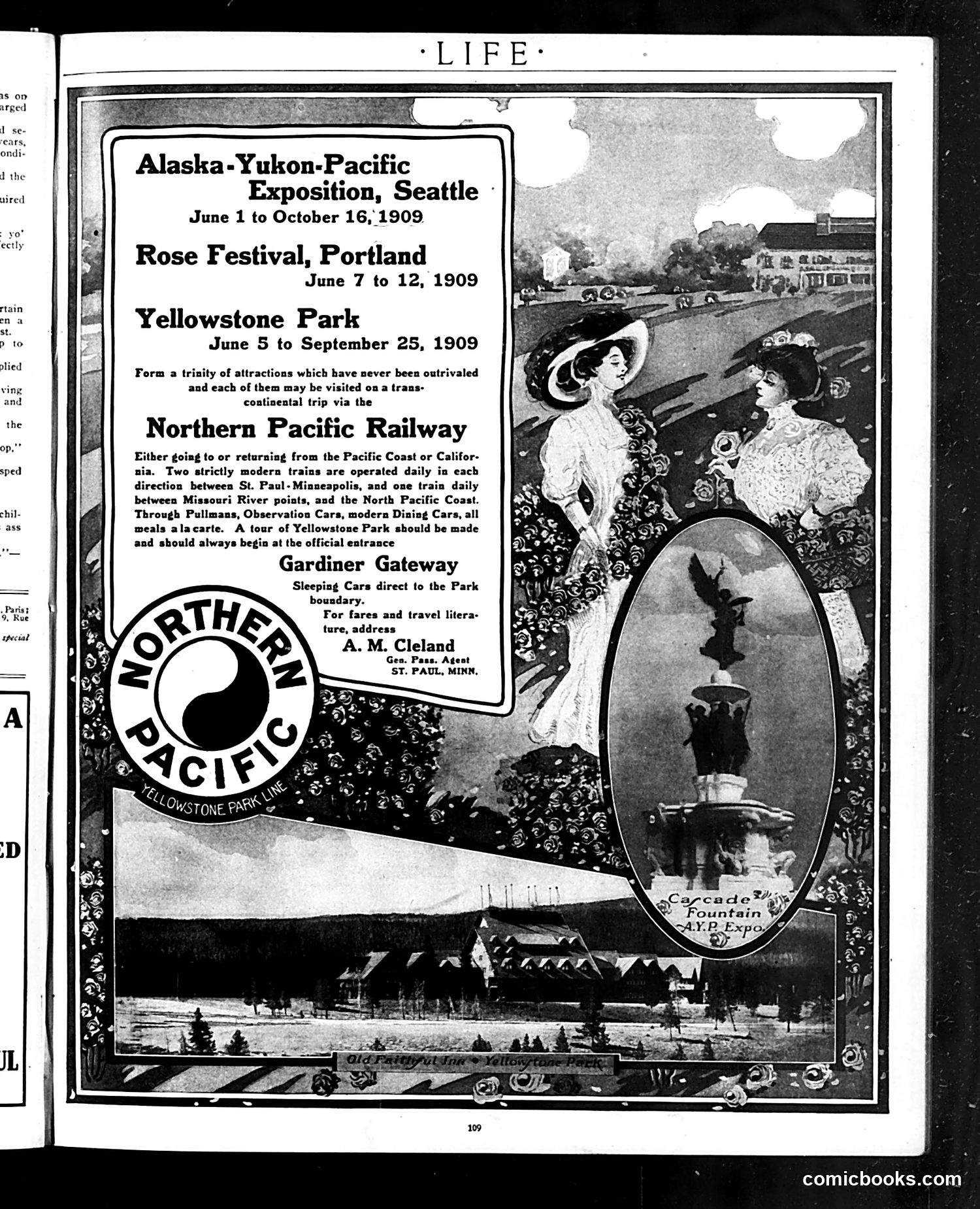
This is primarily a **railroad advertisement**, not a political cartoon. The Northern Pacific Railway promotes a 1909 transcontinental tour combining three major attractions: the Alaska-Yukon-Pacific Exposition in Seattle, Portland's Rose Festival, and Yellowstone Park. The decorative illustrations feature **fashionable Edwardian-era travelers** (a woman and man in period dress) and the Cascade Fountain from the A-Y-P Expo, representing the modern leisure travel experience the railway offered. The "trinity of attractions" messaging emphasizes that all three destinations were accessible via one convenient railway route—a significant selling point when cross-country travel was still relatively novel for American tourists. The mention of "strictly modern trains," Pullman cars, and dining cars highlights the railway's amenities for comfortable long-distance travel, targeting affluent travelers of the 1909 period. This reflects the Progressive Era's celebration of American industrial achievement and leisure tourism infrastructure.
This page mixes advertisements with brief humorous anecdotes. The main content is advertising for Crane's stationery products, but the upper right corner contains a satirical historical anecdote about **Andrew Jackson before his presidency**. The joke: Jackson allegedly gave a political speech in rural Tennessee that wasn't warming the audience. The event chairman reportedly urged him to impress voters with Latin phrases—claiming his rival candidate "Smith" had done so. Jackson thereupon shouted three Latin phrases: "E pluribus unum" (from the U.S. seal), "Sic semper tyrannis" (Virginia's motto), and "Habeas corpus" (a legal term). The audience applauded, and Jackson won the county. The satire mocks **frontier political culture**—the implied humor is that backwoods voters were impressed by Latin they didn't understand, that politicians cynically deployed learned-sounding phrases to manipulate voters, and that Jackson succeeded by simply bellowing incomprehensible Latin rather than meaningful ideas. It's a commentary on democratic rhetoric and mass persuasion tactics.
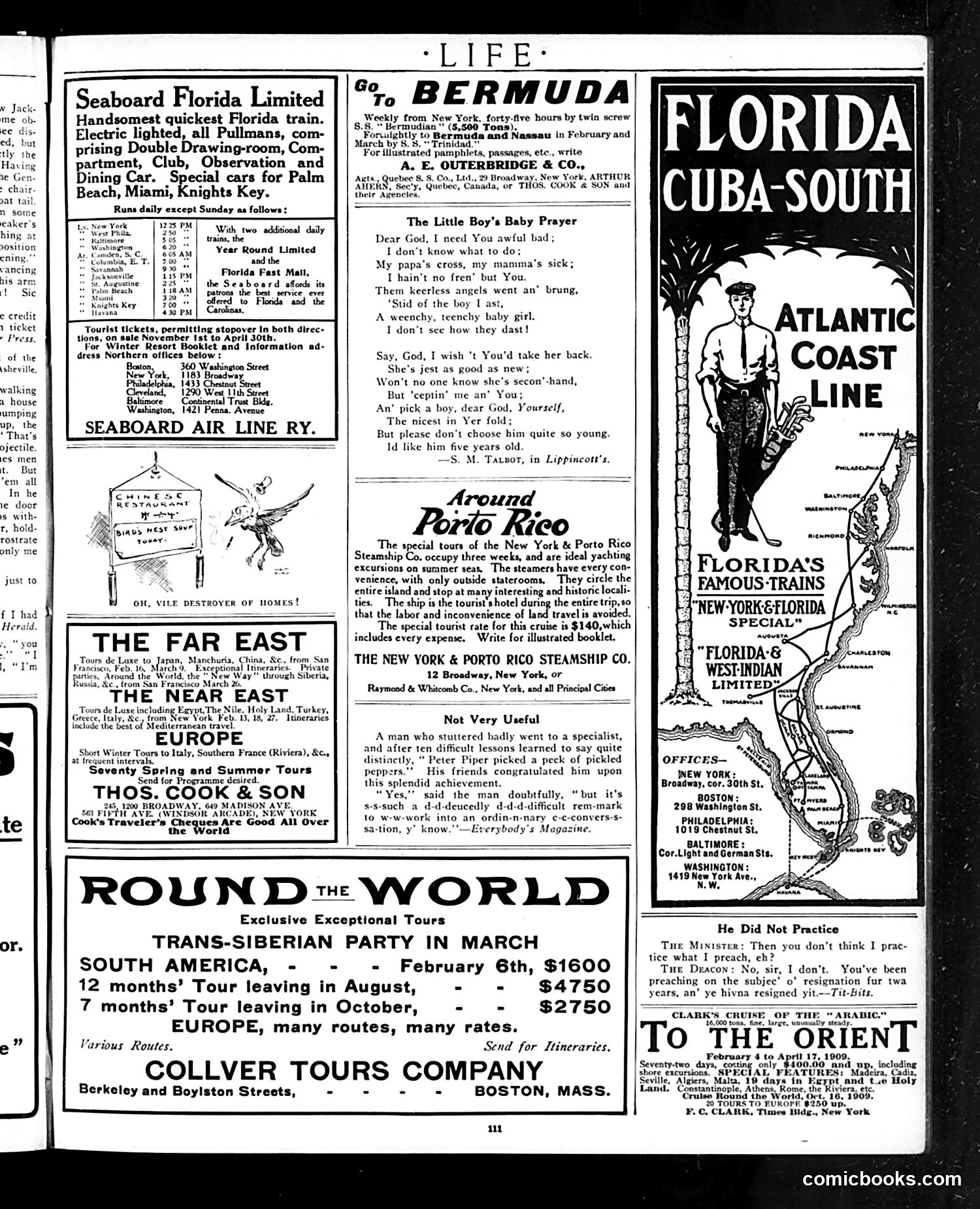
This page is primarily **advertising and travel content** with minimal satirical cartooning. The main elements are: **Travel Advertisements:** Multiple cruise and tour companies dominate the page—Seaboard Air Line Railway, Thomas Cook & Son, Atlantic Coast Line, and steamship companies offering trips to Bermuda, Porto Rico, Europe, and the Far East. These reflect early 1900s leisure travel for affluent Americans. **The Cartoon:** "OH, VILE DESTROYER OF HOMES!" depicts a Chinese restaurant, likely satirizing contemporary anti-Chinese sentiment and xenophobia. The stereotype portrays Chinese establishments as morally corrupting to American families—a common prejudice of the era. **Light Humor:** "The Little Boy's Baby Prayer" and "Not Very Useful" are sentimental/comedic verses rather than political satire, typical of Life's humor content. **Context:** This page reflects Gilded Age America's fascination with exotic travel, while simultaneously revealing deeply prejudiced attitudes toward immigrants and other cultures.
This page is primarily **advertisements** with some humorous anecdotes. The "cartoons" are actually **comedic stories** rather than visual satire: **"Everybody Lucky"** is a dialectal joke about a Durham farmer who wins a lottery despite claiming poverty—the humor relies on regional English accent/dialect ("naught in ma pocket," "oor Sam") that would have amused early-1900s readers. **"The Heights of Luxury"** satirizes nouveau-riche pretension: Canadian miners celebrate a wedding by wearing "Prince Albert pants" and "real ginger ale"—treating cheap status symbols as ultimate luxury, mocking working-class aspiration. **"Misunderstood"** references Mark Twain (famous American writer) carrying a cigar box, with a woman misinterpreting it as evidence of smoking excess rather than mere possession. The page demonstrates how *Life* magazine mixed **advertisements** (cigarettes, water, bitters, ale) with **genteel humor** based on dialect, class anxiety, and literary references—targeting educated, affluent readers.
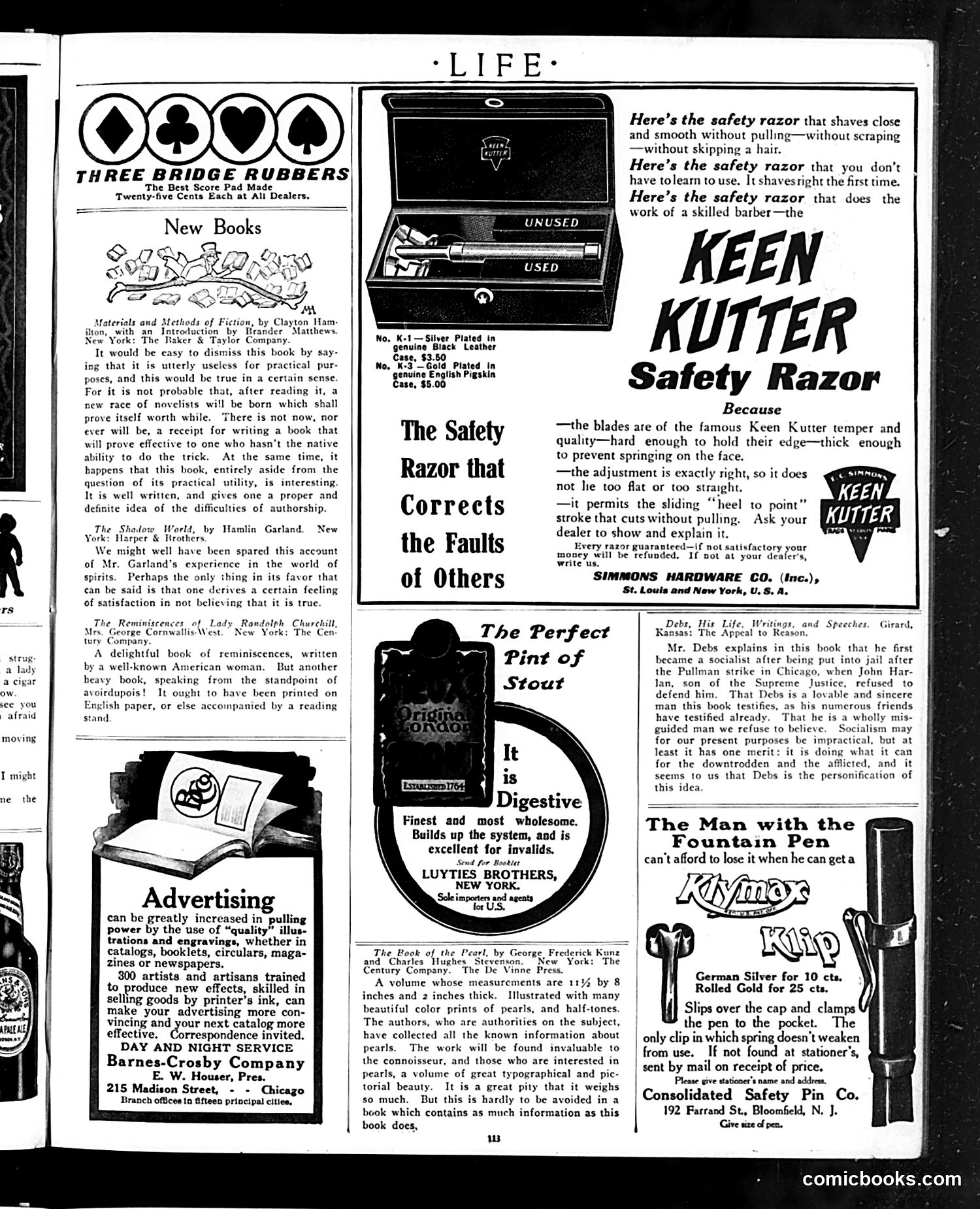
This is primarily a **product advertisement page** from Life magazine's early 20th century era, with minimal editorial cartoon content. The page features various commercial ads interspersed with book reviews. The main visual elements are product advertisements for: - **Keen Kutter Safety Razor** (large central ad) — emphasizing its superiority over competitors by claiming it doesn't pull, skip, or scrape hair - **Pint of Stout** digestive drink - **Klip fountain pen** - **Bridge rubber game score pads** The book reviews discuss fiction writing techniques and historical memoirs, including works by Hamlin Garland and Lady Randolph Churchill. There is **no political satire or cartoon** visible here. The "advertising" section discusses marketing techniques generally, not satirizing any particular advertiser. This appears to be a standard commercial/editorial page typical of early Life magazine content, where advertising and book reviews shared space without significant commentary or humor directed at either.
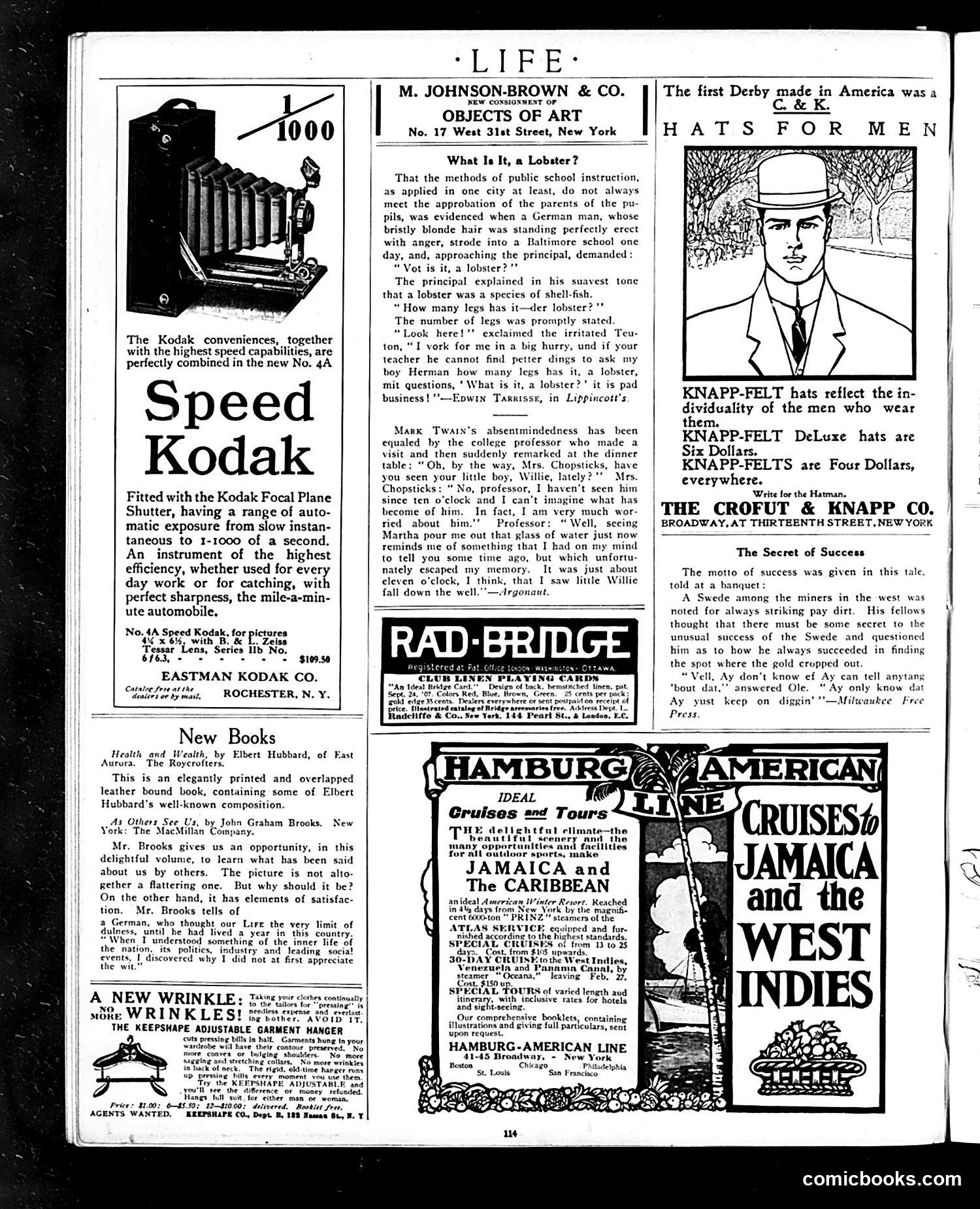
This page is primarily **advertising and light humor**, not political satire. The main content includes: **The "Lobster" Anecdote**: A humorous story about an angry German immigrant father who storms into a Baltimore school, demanding why the teacher is asking his son Herman trivial questions ("how many legs has a lobster?") instead of teaching useful subjects. The father's exasperation and thick accent ("Vot is it?" "petter dings") provide the comedic effect. This reflects turn-of-century American attitudes toward German immigrants and immigrant frustration with perceived ineffective education. **Supporting Stories**: Brief anecdotes about Mark Twain's absentmindedness and a college professor's oddness—typical light magazine filler. **Advertisements dominate**: Kodak cameras, clothing hangers, book promotions, and cruise lines occupy most space. There is **no political cartoon** on this page—just commercial advertising and gentle, stereotypical humor reflecting early 1900s attitudes toward foreigners and education.
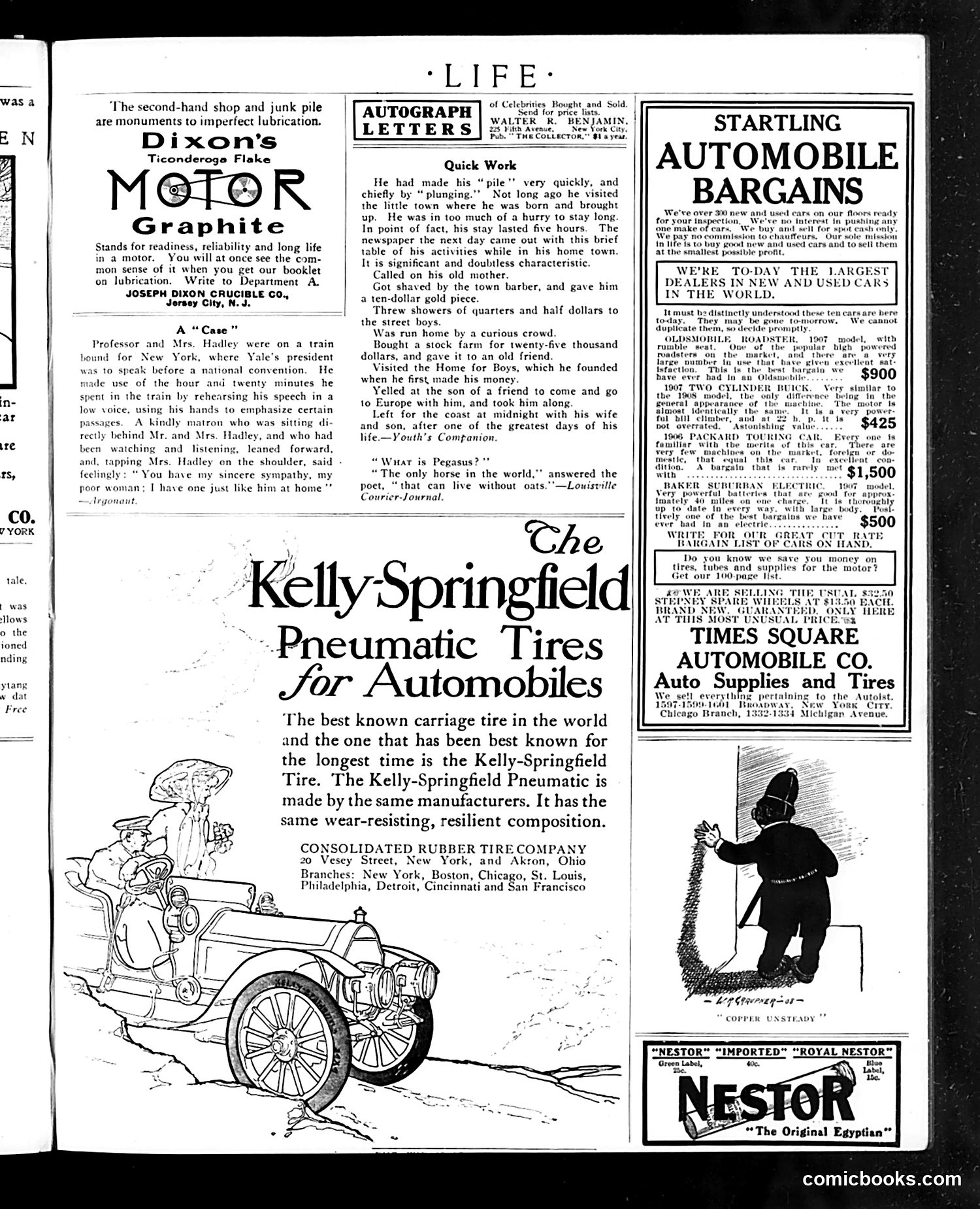
This page is primarily **advertising and humor content**, not political satire. **The Cartoons/Humor:** - A brief anecdote about Professor Hadley (likely Yale president James Hadley) rehearsing a speech on a train, with a sympathetic woman claiming she has "one just like him at home"—a joke about long-winded speakers. - A "Quick Work" piece humorously chronicling a wealthy businessman's five-hour visit to his hometown, showing his ostentatious generosity (throwing money to street boys, buying a stock farm as a gift). - A poetry joke about Pegasus needing no oats because it's mythical. **The Advertisements:** The bulk of the page features ads for automotive products (Dixon's Motor Graphite lubricant, Kelly-Springfield pneumatic tires, Times Square Automobile Company) and Nestor cigarettes—typical early 20th-century magazine advertising. **Modern Context:** These are gentle, observational humor pieces about contemporary upper-class life and conspicuous consumption, with no sharp political edge. The page reflects the magazine's mix of light satire and commercial content.
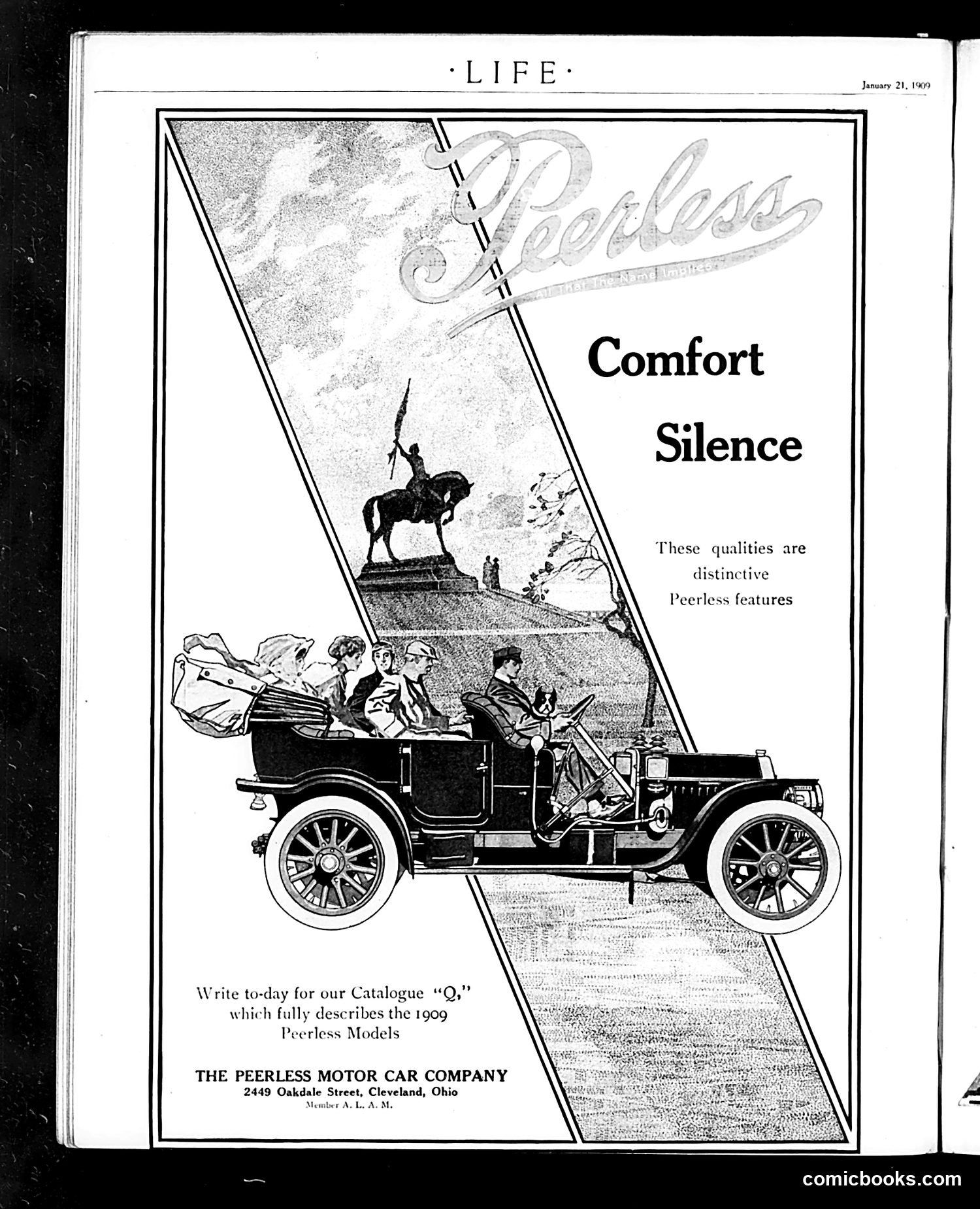
This is primarily an advertisement for the Peerless Motor Car Company (1909 models), not a political cartoon. The page features an early automobile with well-dressed passengers traveling through a landscape, with a mounted horseman visible in the background—a visual contrast emphasizing the modernity of motorized transport over traditional riding. The ad's messaging emphasizes "Comfort" and "Silence" as "distinctive Peerless features," appealing to early automotive consumers concerned with ride quality and noise reduction. The elegant illustration and affluent passengers suggest the car targets wealthy buyers. The dated text mentioning "1909 Peerless Models" and the January 21, 1909 publication date indicate this promotes that year's vehicle lineup. This is vintage commercial advertising within Life magazine's pages.