
Life, 1909-01-21 · page 17 of 28
Life — January 21, 1909 — page 17: what you’re looking at
What you’re looking at
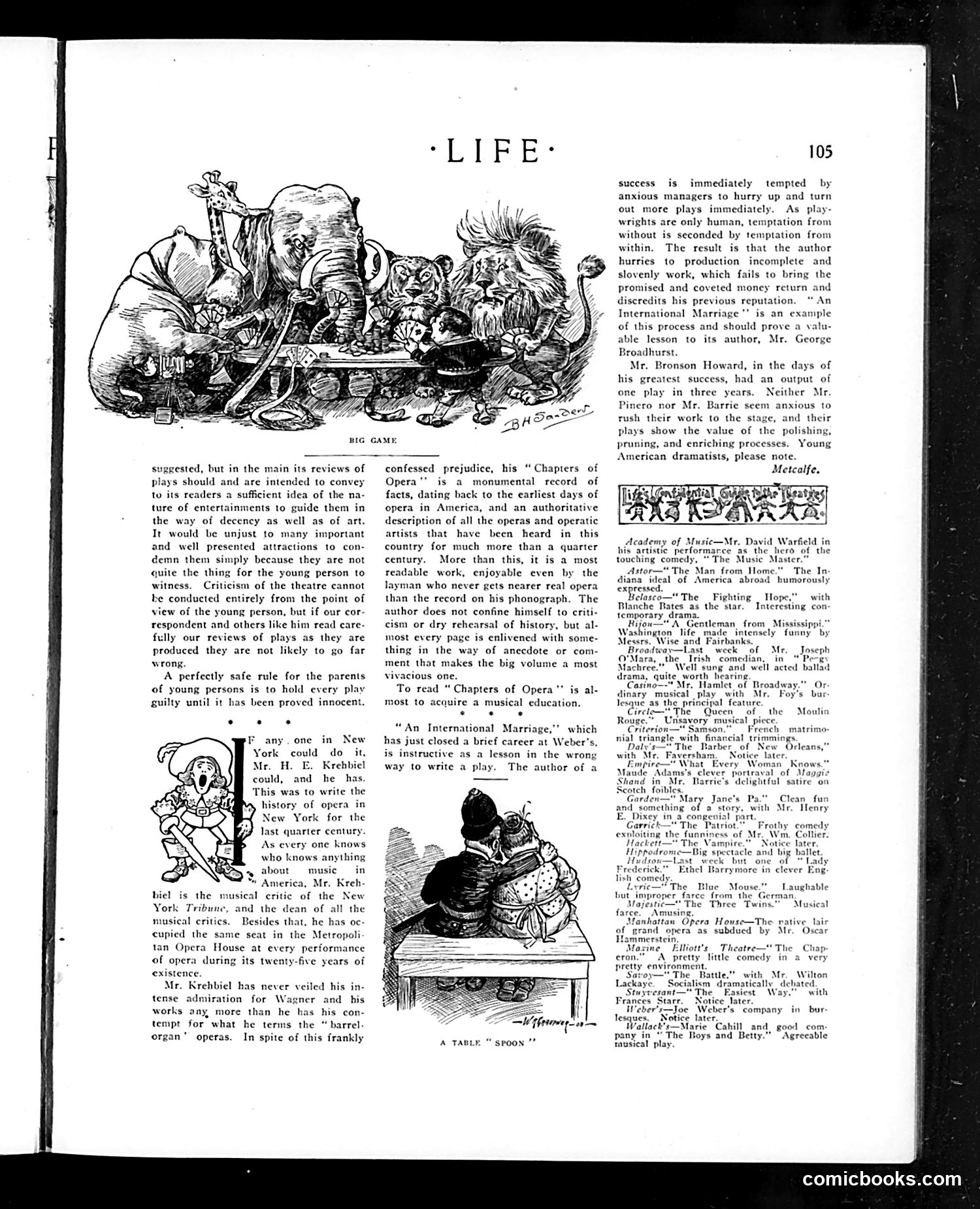
This page discusses American theatrical criticism and play production, featuring two cartoons satirizing the theater world. **"Big Game" (top cartoon):** Shows animals at a table laden with theatrical props and scripts, likely satirizing the competitive, predatory nature of theater management and producers fighting over plays and actors. **"A Table Spoon" (bottom cartoon):** Depicts a figure at a small table with a spoon, appearing to mock either underfunded productions or the meager offerings of certain theaters. **Main text content:** Critiques playwright George Broadhurst for rushing "An International Marriage" to production after early success, rather than following the deliberate approach of established playwrights like Pinero and Barrie. The piece warns young American dramatists against producer pressure to quickly capitalize on success, arguing that hasty work damages reputations and returns. The page also praises H.E. Krehbiel's opera history book as authoritative and readable, contrasting with his known Wagner admiration and contempt for popular "barrel-organ" operas.
📄 Transcribed text from this page (OCR, searchable)
Machine-transcribed from the original scan — historical spelling and the odd misread are preserved.
mG suggested, but in the main its reviews of plays should and are intended to convey to its readers a sufficient idea of the na- ture of entertainments to guide them in the way of decency as well as of art. It would be unjust to many important and well presented attractions to con- demn them simply because they are not quite the thing for the young person to witness, Criticism of the theatre cannot be conducted entirely from the point of view of the young person, but if our cor- respondent and others like him read care- fully our reviews of plays as they are produced they are not likely to go far wrong. A perfectly safe rule for the parents of young persons is to hold every play guilty until it has been proved innocent. F any. one in New York could do it, Mr. H. E. Krehbiel could, and he has. is was to write the history of opera in New York for the y) last quarter century As every one knows who knows anything sy about music in *» America, Mr. Kreh- musical critic of the New York Tribune, and the dean of all the musical critics. Besides that, he has oc- cupied the same seat in the Metropoli tan Opera House at every performance of opera during its twenty-five years of existence Mr. Krehbiel has never veiled his in- tense admiration for Wagner and his works any more than he has his con- tempt for what he terms the “barrel: organ’ operas. In spite of this frankly biel is the CAM: confessed prejudice, his “Chapters of Opera’ is a monumental record of facts, dating back to the earliest days of opera in America, and an authoritative description of all the operas and operatic artists that have been heard in this country for much more than a quarter century. More than this, it is a most readable work, enjoyable even by the layman who never gets nearer real opera than the record on his phonograph. The author does not confine himself to criti- cism or dry rehearsal of history, but al- most every page is enlivened with some- thing in the way of anecdote or com- ment that makes the big volume a most vivacious one. To read “Chapters of Opera’ is al- most to acquire a musical education. es 8 “An International Marriage,’ which has just closed a brief career at Weber's. is instructive as a lesson in the wrong way to write a play. The author of a A TABLE. “ SPOON 105 success is immediately tempted by anxious managers to hurry up and turn out more plays immediately. As play wrights are only human, temptation fror without is seconded by temptation from within, The result is that the author hurries to production incomplete and slovenly work, which fails to bring the promised and coveted money return and discredits his previous reputation. “An International Marriage’ is an example of this process and should prove a vali able lesson to its author, Mr. George Broadhurst. Mr. Bronson Howard, in the days of his greatest success, had an output of one play in three years. Neither Mr. Pinero nor Mr. Barrie seem anxious to rush their work to the stage, and their plays show the value of the polishing, pruning, and enriching processes. Young American dramatists, please note. Metcalfe. ui Academy of Music—Mr, David Warfield in his artistic performance as the hero of the touching comedy, “The Music Master.” Astor—" The Man from Home.” The In- diana ideal of America abroad humorously expressed. Belasco— The _ Fighting Blanche Rates as the star. Interesting ¢ temporary drama. Rijon—" A Gentleman, from Missi Washington life. made intensely funny. by Messrs. Wise and Fairbanks. roadway—Last week of Mr. O'Mara, the Irish comedian, ‘in Machree.” Well sung and weil acted b drama, quite worth hearing. Casino—-" Mr. Hamlet of Rroadwa dinary musical. play with Mr. Foy’s lesque as the principal feature. Circlo—" The Queen of the Unsavory musical. piece amson.” French matrimo nial triangle with financial trimmings. Daly's: Orleans,” with Mr, Empire— Hope,” joseph add ” Or bur Moulin Faversham What Knows.” Maude Adams's clever portraval of Maggie Shand in Mr. Barrie's delightful satire on Scotch foibles. Garden—" Mary Jane's Pa.” Clean fun and something of a story, with Mr. Henry E. Dixey ina congenial part “The Patriot.” funniness of Mr. The Vampire.” Frothy comedy Wm. Collier. Notice later. nd big ballet. of “Lady re in clever Eng exploiting th Hackett— Ethe The Blue but improper farce from Majestic—* The Thre farce. Amusing Manhattan Opera House—The rative lair of grand opera as subdued by Mr. Oscar Elliott's Theatre—* The ‘A pretty little comedy i pretty environment Savoy—" The Battle,” with Mr. Wilton Lackaye. Socialism dramatically dehated. s vesant. st Way,” with Frances mr. Natice ater. ie ‘eber's—Joe Weber's company in bur lesques. Notice later. Wallack’s—Marie Cahill pany in "The Boys and Betty.” rusical play Barryn sgha Twins. Chap- and. good com: Agreeable comicbooks.com