
Life, 1909-01-21 · page 18 of 28
Life — January 21, 1909 — page 18: what you’re looking at
What you’re looking at
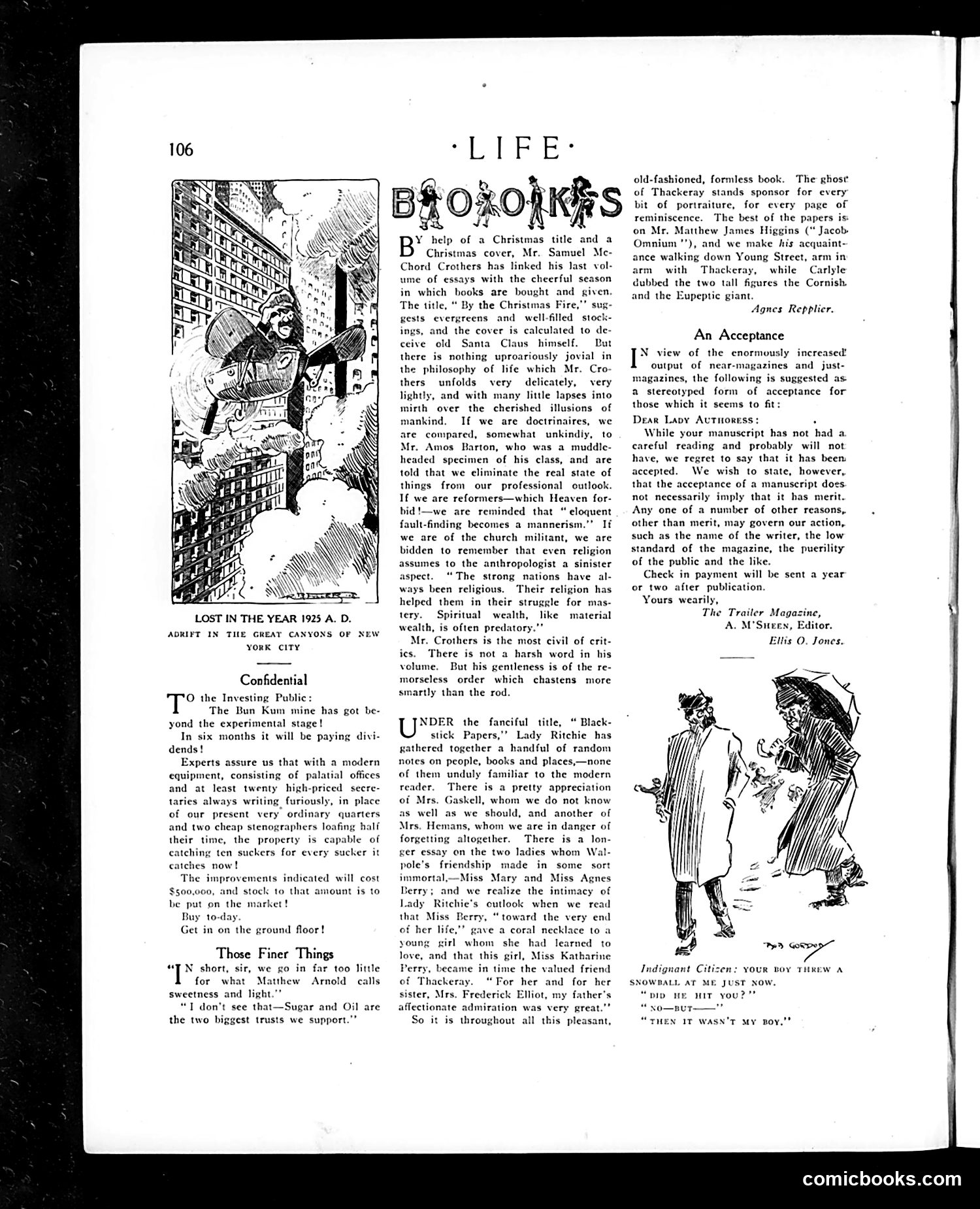
This page contains two distinct satirical pieces: **Left Column - Stock Scheme Satire ("Bun Kum Mine")**: A fictional "confidential" investment pitch mocking stock fraud. The scheme promises dividends after acquiring expensive offices and secretaries—essentially proposing to spend investment capital on overhead rather than actual operations. The joke: catching "ten suckers for every sucker it catches now" reveals the con explicitly. This satirizes the get-rich-quick schemes and investment fraud rampant in the 1920s pre-Crash era. **Right Column - Book Reviews**: Discusses Samuel McChord Crothers's essay collection and Lady Ritchie's "Blackstick Papers," noting their gentle but penetrating social criticism. The review praises their refined, non-harsh approach to examining human folly. **Cartoon (top right)**: Illustrates someone apparently lost among New York's tall buildings—likely commenting on urban disorientation or the chaos of modern city life in the Jazz Age. The page reflects 1920s concerns: financial chicanery, urbanization, and cultural criticism through literature.
📄 Transcribed text from this page (OCR, searchable)
Machine-transcribed from the original scan — historical spelling and the odd misread are preserved.
LOST IN THE YEAR 1925 A. D. ADRIFT IN THE GREAT CANYONS OF YORK CITY NEW Confidential O the Investing Public: The Bun Kum mine has got be- yond the experimental stage! In six months it will be paying divi- dends! Experts assure us that with a modern equipment, consisting of palatial offices and at least twenty high-priced secre- taries always writing, furiously, in place of our present very’ ordinary quarters and two cheap stenographers loafing half their time, the property is capable of catching ten suckers for every sucker it catches now! The improvements indicated will cost $500,000, and stock to that amount is to be on the market! Buy to-day Get in on the ground floor! Those Finer Things short, sir, we go in far too little for what Matthew Arnold calls sweetness and light.’’ “T don't see that—Sugar and Oil are the two biggest trusts we support. "LIPE* KoOLOLIGS Y help of a Christmas title and a Christmas cover, Mr. Samuel Mc- Chord Crothers has linked his last vol- ume of essays with the cheerful season in which books are bought and given. The title, “ By the Christmas Fire,”” sug- gests evergreens and well-filled stock- ings, and the cover is calculated to de- ceive old Santa Claus himself. But there is nothing uproariously jovial in the philosophy of life which Mr. Cro- thers unfolds very delicately, very lightly, and with many little lapses into mirth over the cherished illusions of mankind. If we are doctrinaires, we are compared, somewhat unkindiy, to Mr. Amos Barton, who was a muddle- headed specimen of his class, and are told that we eliminate the real state of things from our professional outlook. If we are reformers—which Heaven for- hid!—we are reminded that “ eloquent fault-finding becomes a mannerism.”” If we are of the church militant, we bidden to remember that even reli assumes to the anthropologist a sinister aspect. “The strong nations have al- ways been religious. Their religion has helped them in their struggle for mas- tery. Spiritual wealth, like material wealth, is often predatory.” Mr. Crothers is the most civil of erit- ics. There is not a harsh word in his volume. But his gentleness is of the re- morseless order which chastens more smartly than the rod. U NDER the fanciful title, “ Black- stick Papers,’ Lady Ritchie has gathered together a handful of random notes on people, books and places,—none of them unduly familiar to the modern reader, There is a pretty appreciation oi Mrs. Gaskell, whom we do not know as well as we should, and another of Mrs, Hemans, whom we are in danger of forgetting altogether. There is a lon- ger essay on the two ladies whom Wal- pole’s friendship made in some sort immortal,—Miss Mary and Miss Agnes Rerry; and we realize the intimacy of Lady Ritchie's outlook when we read that Miss Berry, “toward the very end her life,” gave a coral necklace to a young girl whom she had learned to love, and that this girl, Miss Katharine Perry, became in time the valued friend Thackeray. “For her and for her sister, Mrs. Frederick Elliot, my father's affectionate admiration was very great. So it is throughout all this pleasant, old-fashioned, formless book. The ghost of Thackeray stands sponsor for every bit of portraiture, for every page of reminiscence. The best of the papers is: on Mr. Matthew James Higgins (“* Jacob- Omnium"), and we make his acquaint- ance walking down Young Street, arm in arm with Thackeray, while Carlyle dubbed the two tall figures the Cornish. and the Eupeptic giant. Agnes Repplier. An Acceptance [tie of the snormouuly increasedt output of near-magazines and just- magazines, the following is suggested as a stereotyped form of acceptance for those which it seems to fit: Dear Lapy AvTioress : ‘ While your manuscript has not had a careful reading and probably will not have, we regret to say that it has been accepted. We wish to state, however, that the acceptance of a manuscript does not necessarily imply that it has merit. Any one of a number of other reasons, other than merit, may govern our action, such as the name of the writer, the low standard of the magazine, the puerility of the public and the like. Check in payment will be sent a year or two after publication. Yours wearily, The Trailer Magazine, A. M’Siteen, Editor. Ellis O. Jones. ™)> — Indignant Citizen; your voy THREW A SNOWDALL AT ME JUST NOW. MIT you?’? pip We No—nuT— THEN 1T WASN'T My Boy,"* comicbooks.com