
Life, 1909-01-21 · page 8 of 28
Life — January 21, 1909 — page 8: what you’re looking at
What you’re looking at
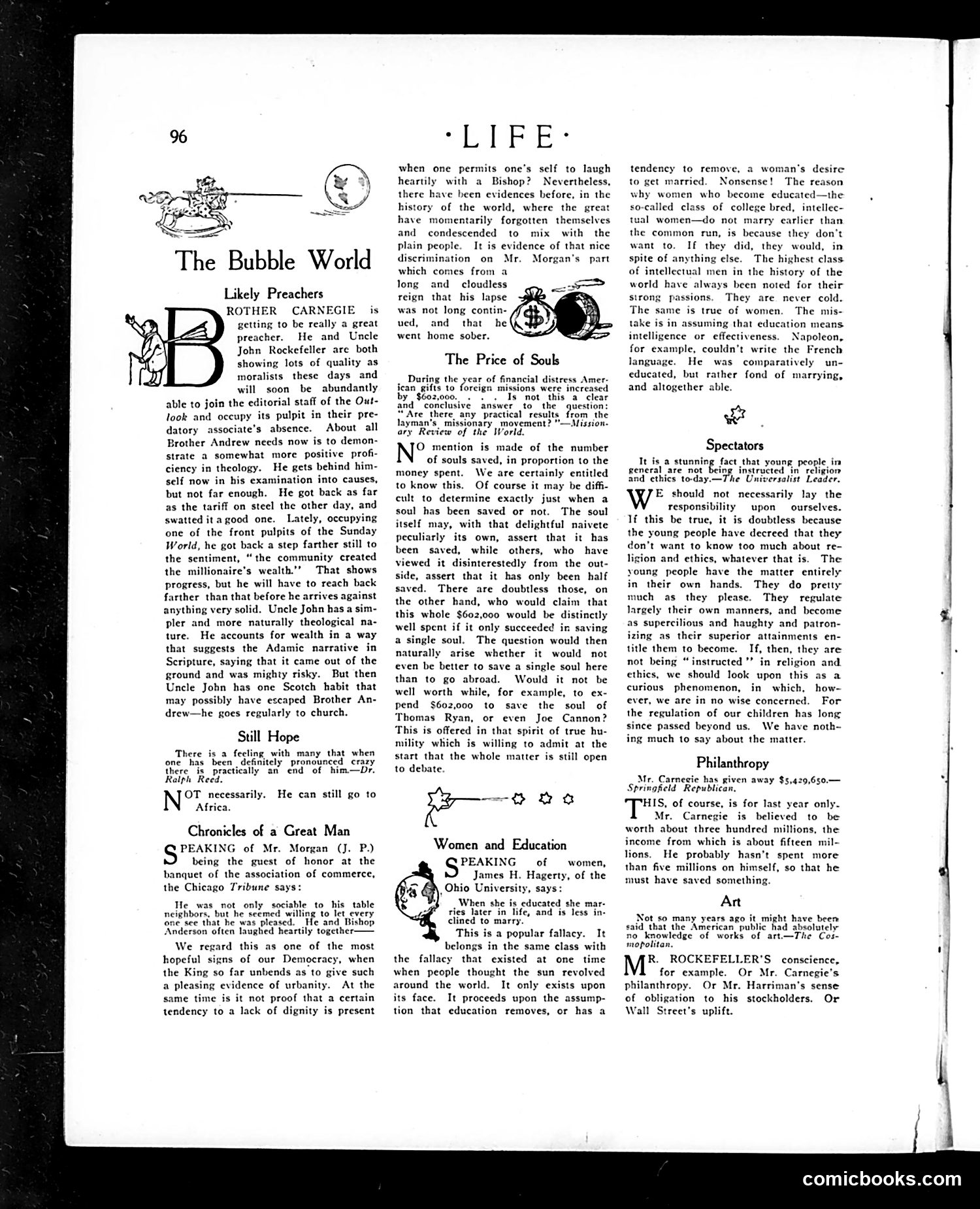
This page contains several satirical commentary sections rather than traditional political cartoons. The main pieces critique: **"Likely Preachers"**: Mocks Brother Andrew and others joining Life's editorial staff, suggesting they're abandoning theology for journalism—a commentary on religious figures entering secular media. **"Chronicles of a Great Man"**: Satirizes J.P. Morgan's wealth and social influence, noting his ability to host lavish banquets while claiming democratic values. The satire points out the contradiction between his aristocratic behavior and democratic pretensions. **"Women and Education"**: Challenges the fallacy that education removes class distinctions in women, arguing it doesn't eliminate inherent social hierarchies. The page employs sarcasm and irony to critique wealth inequality, religious hypocrisy, and social pretensions of the era.
📄 Transcribed text from this page (OCR, searchable)
Machine-transcribed from the original scan — historical spelling and the odd misread are preserved.
The Bubble World Likely Preachers ROTHER CARNEGIE is getting to be really a great preacher. He and Uncle John Rockefeller are both showing lots of quality as moralists these days and will soon be abundantly able to join the editorial staff of the Out- Took and occupy its pulpit in their pre- datory associate’s absence. About all Brother Andrew needs now is to demon- strate a somewhat more positive profi- ciency in theology. He gets behind him- self now in his examination into causes, but not far enough. He got back as far as the tariff on steel the other day, and swatted ita good one. Lately, occupying one of the front pulpits of the Sunday World, he got back a step farther still to the sentiment, “the community created the millionaire’s wealth.’’ That shows progress, but he will have to reach back farther than that before he arrives against anything very solid. Uncle John has a sim- pler and more naturally theological na- ture. He accounts for wealth in a way that suggests the Adamic narrative in Scripture, saying that it came out of the ground and was mighty risky. But then Uncle John has one Scotch habit that may possibly have escaped Brother An- drew—he goes regularly to church. Still Hope There is a fecling many that when fone has been definitely pronounced crazy there is practically an end of him—Dr. Ralph Reed. OT necessarily. He can still go to Africa. Chronicles of a Great Man PEAKING of Mr. Morgan (J. P.) being the guest of honor at the banquet of the association of commerce, the Chicago Tribune says: He was not only sociable to his table cighbors, but he seemed willing to let every one see that he was pleased. He and Bishop Anderson often laughed heartily together- We regard this as one of the most hopeful signs of our Democracy, when the King so far unbends as to give such a pleasing evidence of urbanity. At the same time is it not proof that a certain tendency to a lack of dignity is present “LI PE« when one permits one’s self to laugh heartily with a Bishop? Nevertheless, there have been evidences before, in the history of the world, where the grea have momentarily forgotten themselves and condescended to mix with the plain people. It is evidence of that nice discrimination on Mr. Morgan's part which comes from a long and cloudless reign that his lapse was not long contin- ued, and that he went home sober. The Price of Souls During the year of financial distress Amer- ican gifts to forcign missions were increased by | $602,00¢ + + « Is not this a clear ive answer to the question: re there any practical results from the layman’s. missionary. movement? "—Mission- ary Review of the World. O mention is made of the number of souls saved, in proportion to the money spent. We are certainly entitled to know this. Of course it may be diffi- cult to determine exactly just when a soul has been saved or not. The soul itself may, with that delightful naivete peculiarly its own, assert that it has been saved, while others, who have viewed it disinterestedly from the out- side, assert that it has only been half saved. There are doubtless those, on the other hand, who would claim that this whole $602,000 would be distinctly well spent if it only succeeded in saving a single soul. The question would then naturally arise whether it would not even be better to save a single soul here than to go abroad. Would it not be well worth while, for example, to ex- pend $602,000 to save the soul of Thomas Ryan, or even Joe Cannon? This is offered in that spirit of true hu- mility which is willing to admit at the start that the whole matter is still open to debate. ——<— & o Women and Education PEAKING of women, James H. Hagerty, of the G\, Ohio University, says: When she is educated she mar- ries later in life, and is less in- clined to marry. This is a popular fallacy. It belongs in the same class with the fallacy that existed at one time when people thought the sun revolved around the world. It only exists upon its face. It proceeds upon the assump- n that education removes, or has a tendency to remove, a woman's desire to get married. Nonsense! The reason why women who become educated—the so-called class of college bred, intellec- tual women—do not marry earlier ¢ the common run, is because they don’t want to. If they did, they would, in spite of anything else. The highest class of intellectual men in the history of the world have always been noted for their sirong passions. They are never cold. The same is true of women. The mis- take is in assuming that education means intelligence or effectiveness. Napoleon, for example, couldn't write the French language. He was comparatively un- educated, but rather fond of marrying, and altogether able. ve Spectators It is a stunning fact that Ne. general are not being instructed in religion and ethics to-day.—The Universalist Leader. WE should not necessarily lay the responsibility upon ourselves. lf this be true, it is doubtless because the young people have decreed that they don’t want to know too much about re- ligion and ethics, whatever that is. The young people have the matter entirely in their own hands. They do pretty much as they please. They regulate largely their own manners, and become supercilious and haughty and patron- izing as their superior attainments en- title them to become. If, then, they are not being “instructed” in religion and ethics, we should look upon this as a curious phenomenon, in which, how- ever, we are in no wise concerned. For the regulation of our children has long since passed beyond us. We have noth- ing much to say about the matter. Philanthropy Mr. Carnegie has given aw: 2 — SpritaRad Repubtichnc” "2 $8+429.650 HIS, of course, is for last year only. Mr. Carnegie is believed to be worth about three hundred millions, the income from which is about fifteen mil- lions, He probably hasn't spent more than five millions on himself, so that he must have saved something. Art Not so many years ago it might have been said that the American, public had absolutely no knowledge of works of art.—The Cos- mopolitan. R. ROCKEFELLER’S conscience, for example. Or Mr. Carnegie’s philanthropy. Or Mr. Harriman’s sense of obligation to his stockholders. Or Wall Street's uplift. young people in comicbooks.com