
Life, 1909-01-21 · page 6 of 28
Life — January 21, 1909 — page 6: what you’re looking at
What you’re looking at
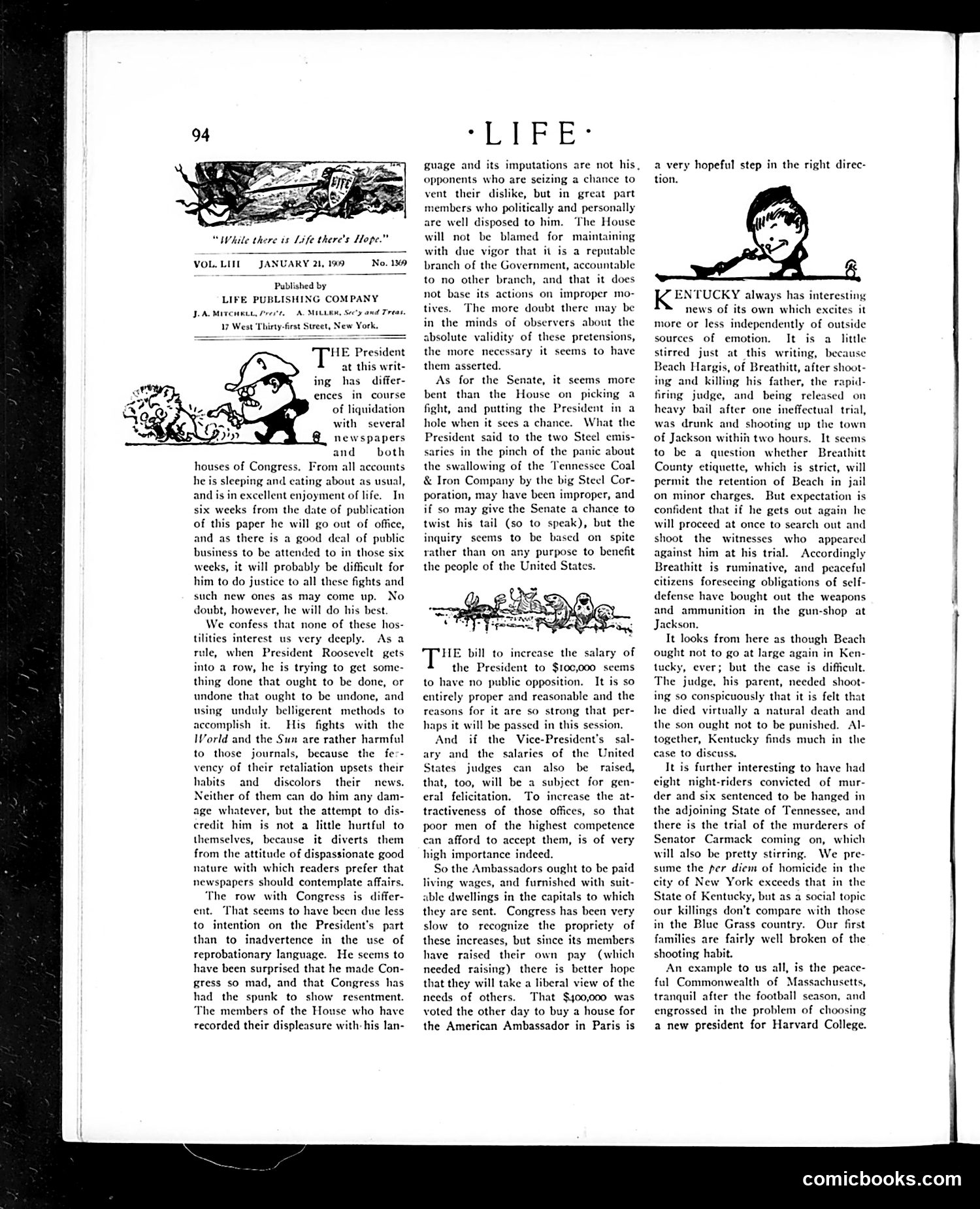
**The Main Cartoon:** The top illustration depicts President Theodore Roosevelt as a figure in a cowboy hat, drawn in caricature. The accompanying editorial discusses Roosevelt's various controversial actions and his relationship with Congress, particularly regarding House and Senate conflicts over matters like the Tennessee Coal & Iron Company acquisition and presidential salary increases. **The Satire's Point:** Life criticizes Roosevelt's methods as overly aggressive and his use of "unscrupulous" tactics to achieve his agenda. The cartoonist suggests Roosevelt operates somewhat independently of proper congressional oversight, comparing his approach unfavorably to standard governmental procedure. **Context:** This reflects Roosevelt's final year as president (before Taft took office) and public anxiety about executive overreach during his progressive reform era.
📄 Transcribed text from this page (OCR, searchable)
Machine-transcribed from the original scan — historical spelling and the odd misread are preserved.
No. 1309 VOL.LIM JAN JARY 21, 109 Published by LIFE PUBLISH JA. Mir 17 West Th COMPAD WRLL, Preste A MILLER, Secty aned Treas. ay-first Street, New York, HE President at this writ- ing has differ- ences in course of liquidation with several newspapers and both houses of Congress. From all accounts he is sleeping and cating about as usual, and is in excellent enjoyment of life. In six weeks from the date of publication of this paper he will go out of office, and as there is a good deal of public business to be attended to in those six weeks, it will probably be difficult for him to do justice to all these fights and such new ones as may come up. No doubt, however, he will do his best. We confess that none of these hos tilities interest us very deeply. As a rule, when President Roosevelt gets into a row, he is trying to get some- thing done that ought to be done, or undone that ought to be undone, and using unduly belligerent: methods to accomplish it. His fights with the IVorld and the Sun are rather harmful to those journals, because the fe>- vency of their retaliation upsets their habits and = discolors their news. Neither of them can do him any dam- age whatever, but the attempt to di. credit him is not a little hurtful to themselves, because it diverts them from the attitude of dispassionate good nature with which readers prefer that newspapers should contemplate affairs. The row with Congress is differ- ent. That seems to have been due less to intention on the President's part than to inadvertence in the use of reprobationary language. He scems to have been surprised that he made Con- gress so mad, and that Congress has had the spunk to show resentment. The members of the House who have recorded their displeasure with: his lan- ‘LIFE: guage and its imputations are not his, opponents who are seizing a chance to vent their dislike, but in great part members who politically and personally are well disposed to him. The House will not be blamed for maintaining with due vigor that it is a reputable branch of the Government, accountable to no other branch, and that it does not base its actions on improper mo- tives. The more doubt there may be in the minds of observers about the bsolute validity of these pretensions, the more necessary it seems to have them asserted. As for the Senate, it seems more bent than the House on picking a fight, and putting the President in a hole when it sces a chance. What the President said to the two Steel emis- saries in the pinch of the panic about the swallowing of the Tennessee Coal & Iron Company by the big Steel Cor- poration, may have been improper, and if so may give the Senate a chance to twist his tail (so to speak), but the inquiry scems to be based on spite rather than on any purpose to benefit the people of the United States. HE bill to increase the salary of the President to $100,000 seems. to have no public opposition. It is so entirely proper and reasonable and the reasons for it are so strong that per- haps it will be passed in this session. And if the Vice-President’s ry and the salaries of the United States judges can also be raised, that, too, will be a subject for gen- eral felicitation, To increase the at- tractiveness of those offices, so that poor men of the highest competence can afford to accept them, is of very high importance indeed. So the Ambassadors ought to be paid living wages, and furnished with suit- able dwellings in the capitals to which they are sent. Congress has been very slow to recognize the propriety of these increases, but since its members have raised their own pay (which needed raising) there is better hope that they will take a liberal view of the needs of others. That $400,000 was voted the other day to buy a house for the American Ambassador in Paris is a very hopeful step in the right direc- tion. TUCKY always has interesting news of its own which excites it more or less independently of outside sources of emotion. It is a_ little stirred just at this writing, because Beach Hargis, of Breathitt, after shoot- ing and killing his father, the rapid- firing judge, and being released on heavy bail after one ineffectual trial, was drunk and shooting up the town of Jackson within two hours. It seems to be a question whether Breathitt County ctiquette, which is strict, will permit the retention of Beach in jail on minor charges. But expectation is confident that if he gets out a; will proceed at once to search out and shoot the witnesses who appeared against him at his trial. ccordingly Breathitt is ruminative, and peaceful citizens foresecing obligations of self- defense have bought out the weapons and ammunition in the gun-shop at Jackson. It looks from here as though Beach ought not to go at large again in Ken- tucky, ever; but the case is difficult. The judge, his parent, needed shoot- ing so conspicuously that it is felt that he died virtually a natural death and the son ought not to be punished. Al- together, Kentucky finds much in the case to discuss, It is further interesting to have had eight night-riders convicted of mur- der and six sentenced to be hanged in the adjoining State of Tennessee, and there is the trial of the murderers of Senator Carmack coming on, which will also be pretty stirring. We pre- sume the per diem of homicide in the city of New York exceeds that in the State of Kentucky, but as a social topic our killings don’t compare with those in the Blue Grass country. Our first families are fairly well broken of the shooting habit. An example to us all, is the peace- ful Commonwealth of Massachusetts, tranquil after the football season, and engrossed in the problem of choosing a new president for Harvard College. comicbooks.com