
A complete issue · 24 pages · 1908
Life — December 10, 1908
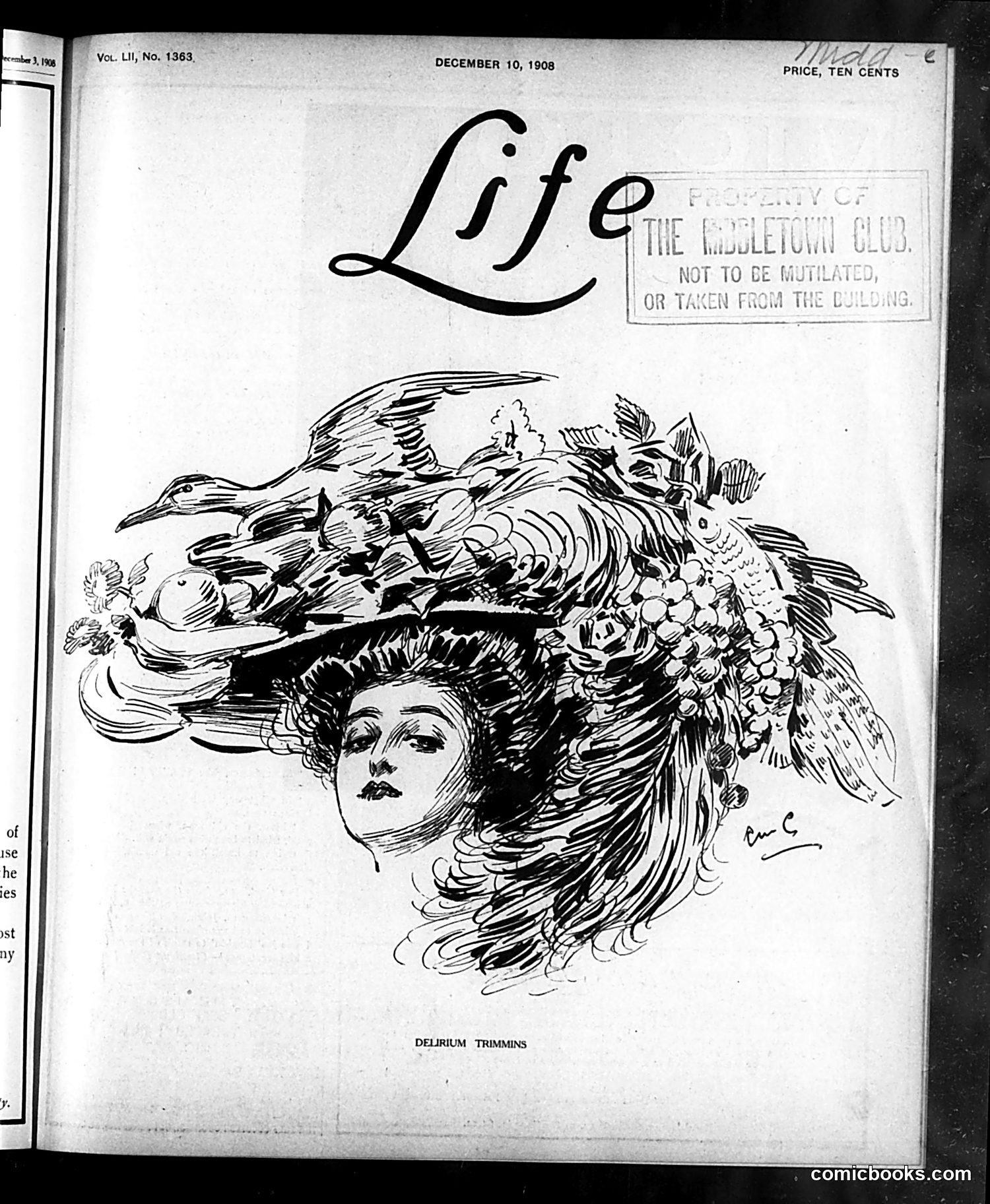
This illustration depicts an elaborately decorated woman's hat—a satirical commentary on the extravagant millinery fashions of the Edwardian era. The caption "Delirium Trimmins" is a pun on "delirium tremens" (alcohol withdrawal symptoms), suggesting that the trend toward increasingly ornate hat decorations was absurdly excessive, almost fever-dream-like in its delusion. The hat features fruits, vegetables, feathers, and a live bird—typical of actual 1908 women's hats, which notoriously incorporated dead wildlife and natural materials. The satire mocks both the impracticality and the animal cruelty involved in these fashions. This reflects Life magazine's role as social commentary, ridiculing upper-class women's fashion excess and the hat industry's wasteful practices.
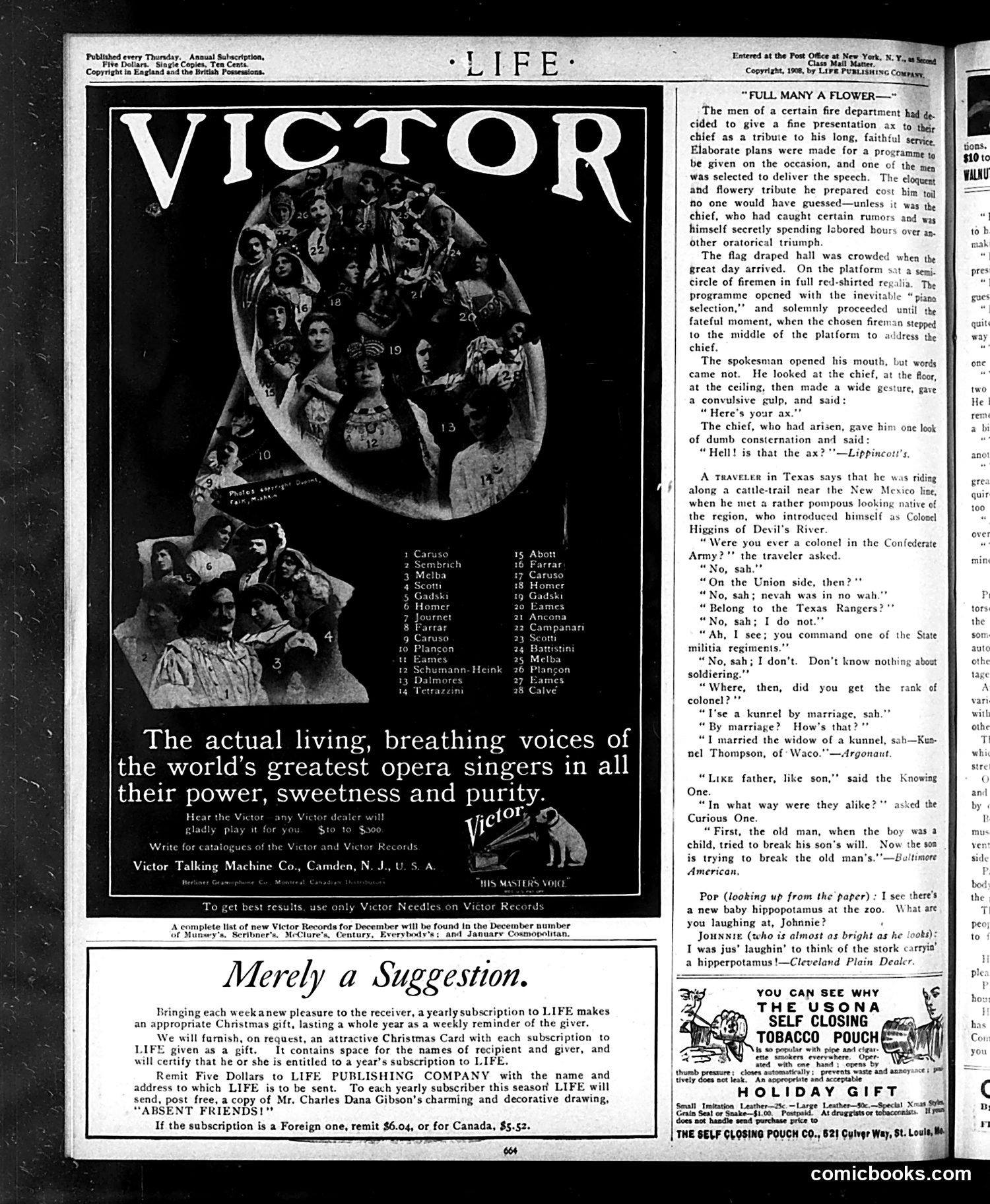
This page is **primarily advertising**, not political satire. The dominant feature is a Victor Talking Machine Company advertisement showcasing opera singers. The circular images display numbered portraits of famous opera performers (including names like Caruso, Sembrich, and Melba), promoting Victor Records and phonograph players. The small text snippets on the right appear to be humorous anecdotes rather than political commentary—including a story about a fire department chief and another about a Texas traveler meeting a Confederate Army veteran. Below is a subscription promotion for Life magazine itself ("Merely a Suggestion"), and a smaller advertisement for Usona Self-Closing Tobacco Pouch as a holiday gift. **No significant political or social satire is evident** on this particular page.
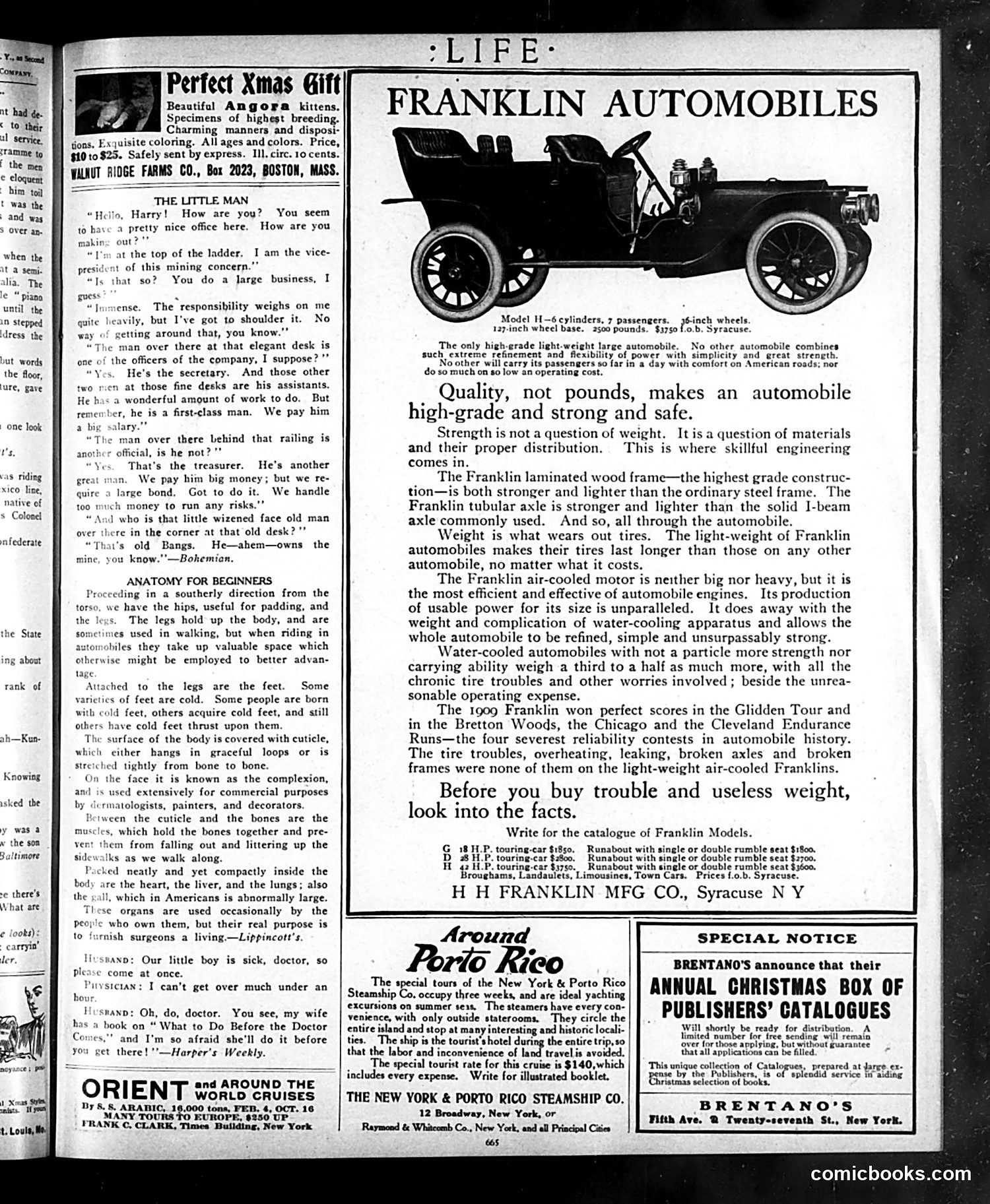
This page is primarily **advertising**, not political satire or comics. The dominant content is a large Franklin Automobiles advertisement emphasizing engineering quality over weight. The ad argues that "strength is not a question of weight" and promotes Franklin's laminated wood frame, tubular axle, and air-cooled engine as superior to heavier competitors. A small dialogue piece titled "THE LITTLE MAN" appears on the left—a humorous office conversation where an employee explains his company's organizational hierarchy to a visitor named Harry, joking about his own modest position despite the "elegant desk" of executives above him. The page also contains travel advertisements for Orient cruises and a New York & Porto Rico steamship line, plus publisher catalog and Christmas box notices at the bottom. No political commentary or identifiable caricatures are evident.
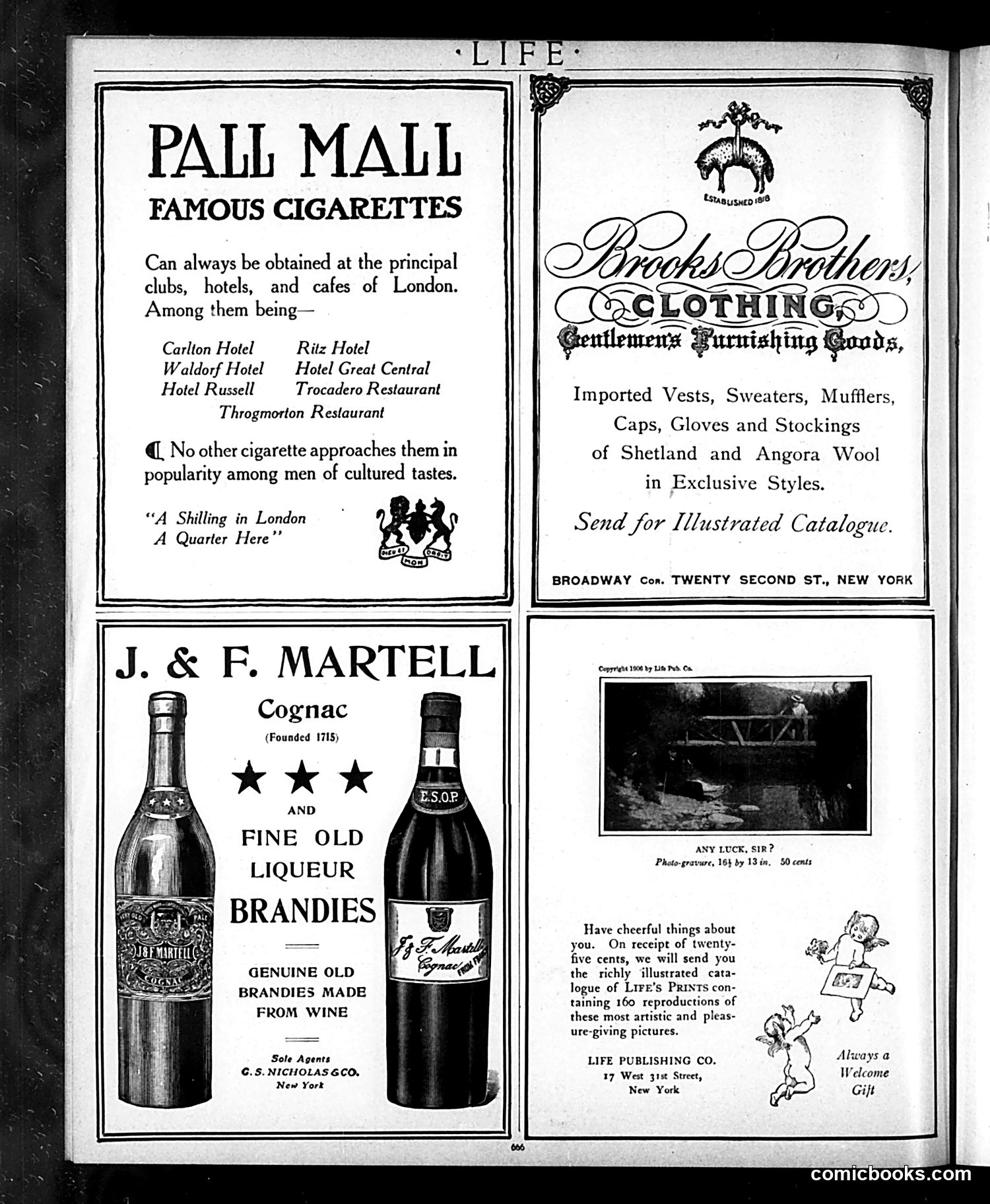
This page is **primarily advertising**, not satire or political commentary. It contains four advertisements from approximately 1906: 1. **Pall Mall Cigarettes** — promotes availability at London's elite establishments (Carlton Hotel, Ritz Hotel, etc.), positioning the product as sophisticated for "men of cultured tastes." 2. **Brooks Brothers** — advertises imported wool clothing (vests, sweaters, caps) available in New York. 3. **J. & F. Martell Cognac** — showcases brandy products, founded 1715, emphasizing quality and age. 4. **Life Publishing Company** — offers illustrated photo prints for 25 cents, featuring a photo of children and decorative illustrations. The page reflects turn-of-the-century consumer culture targeting wealthy audiences through appeals to taste, exclusivity, and sophistication. There is no discernible political cartoon or satire present.
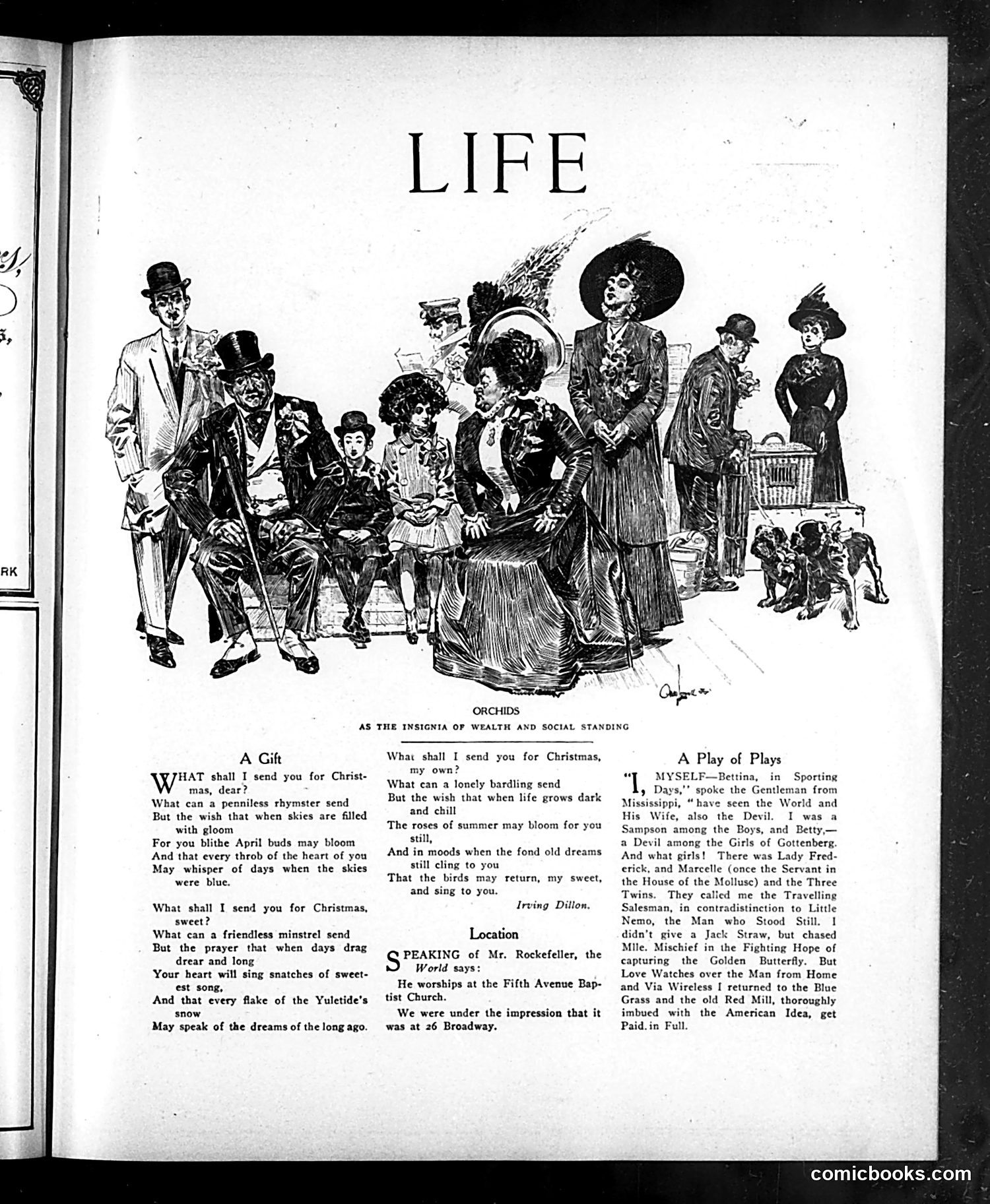
This page from *Life* magazine features satirical Christmas content alongside social commentary. The illustration titled "Orchids: As the Insignia of Wealth and Social Standing" depicts a gathering of fashionably dressed wealthy individuals, with orchids prominently displayed as symbols of their status. The text includes poetry and prose about Christmas gift-giving, touching on themes of generosity and sentiment versus material wealth. "A Play of Plays" references theatrical productions, mentioning various plays and theatrical figures from the era. The overall satire critiques the American upper class's obsession with displaying wealth through luxury goods (orchids) and their social pretensions, while juxtaposing this with more meaningful Christmas sentiments about genuine human connection and kindness.
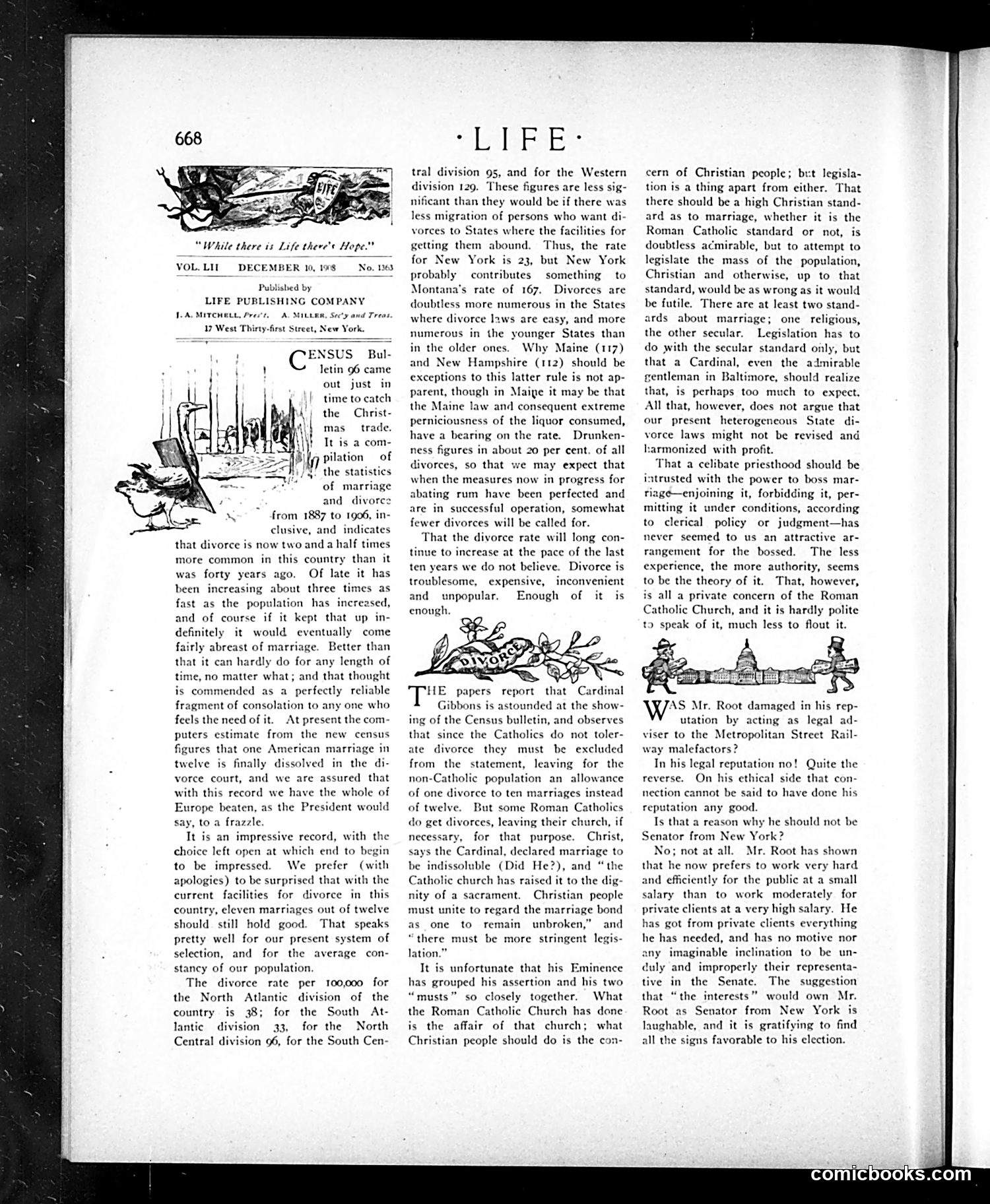
This page contains two editorial cartoons addressing early 20th-century social issues. The left cartoon illustrates divorce statistics, showing a cityscape with what appears to be a church or cathedral. The accompanying text discusses rising divorce rates across American states, noting that divorce is "now two and a half times more common" than forty years prior. The satirical point critiques how divorce, once scandalous, has become increasingly normalized—"a fairly direct of marriage." The right section discusses Cardinal Gibbons and Catholic doctrine on marriage and divorce. Below this appears a small cartoon depicting what seems to be a political figure (possibly Mr. Root, mentioned in text) in relation to railroad or infrastructure matters, though the specific reference remains unclear from the image alone. Both cartoons reflect Progressive Era tensions between traditional religious values and modernizing American society.
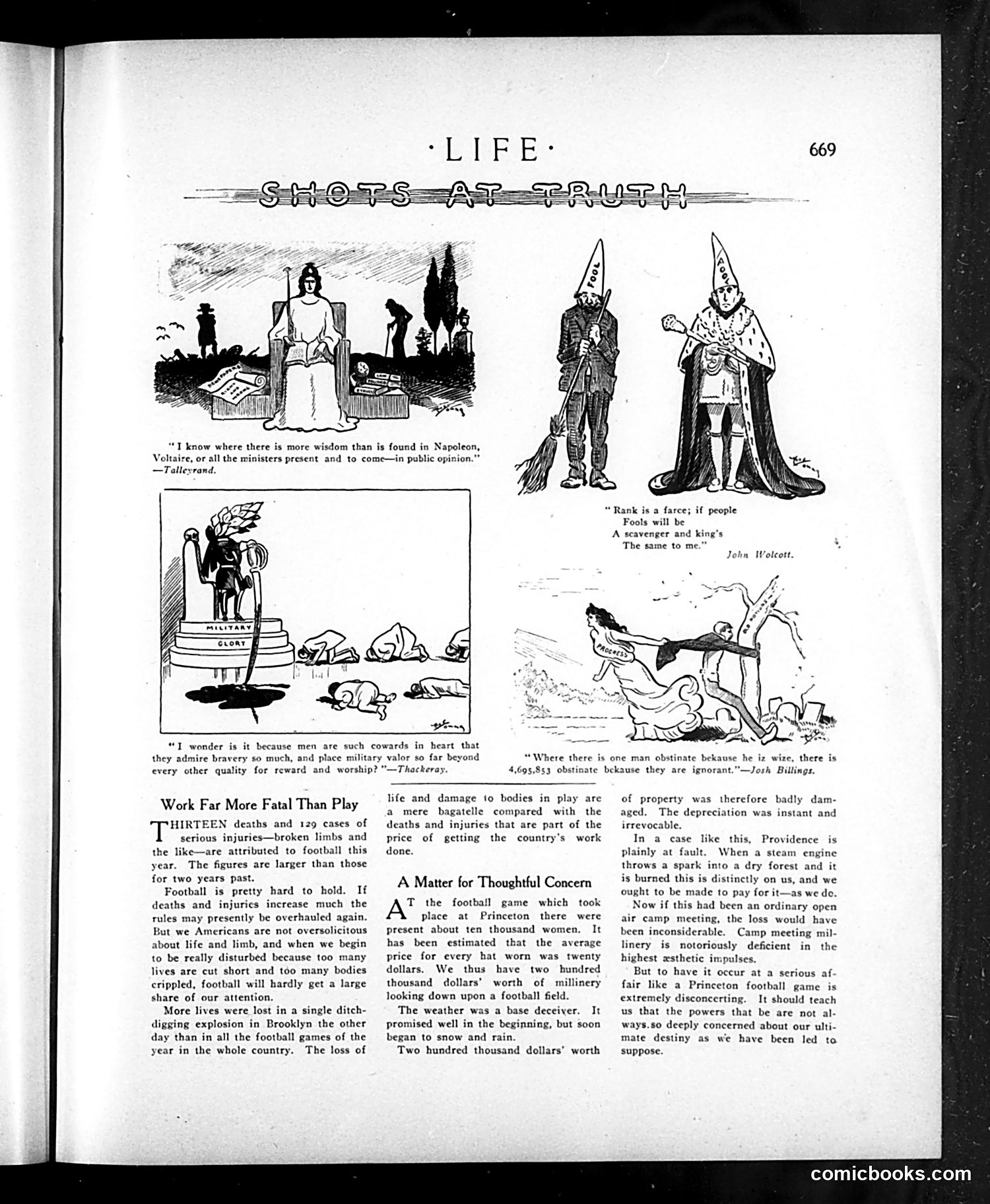
This satirical page critiques military glorification and the human cost of war. The top cartoon shows a seated figure labeled "Glory" surrounded by fallen soldiers, satirizing how society elevates military honor while ignoring battlefield deaths. The middle illustration depicts two robed figures (likely representing religious or political authority) in pointed hoods—imagery suggesting institutional hypocrisy regarding warfare. The lower section, titled "Work Far More Fatal Than Play," compares football injuries to military casualties, noting that thirteen deaths and 129 serious injuries from football occurred in two years. The satire suggests society is more concerned about football safety than war's far greater human cost. The quotes criticize society's misplaced values: admiring military bravery while ignoring its true consequences, and rank-based social hierarchies. The overall message challenges Americans' comfort with military sacrifice.
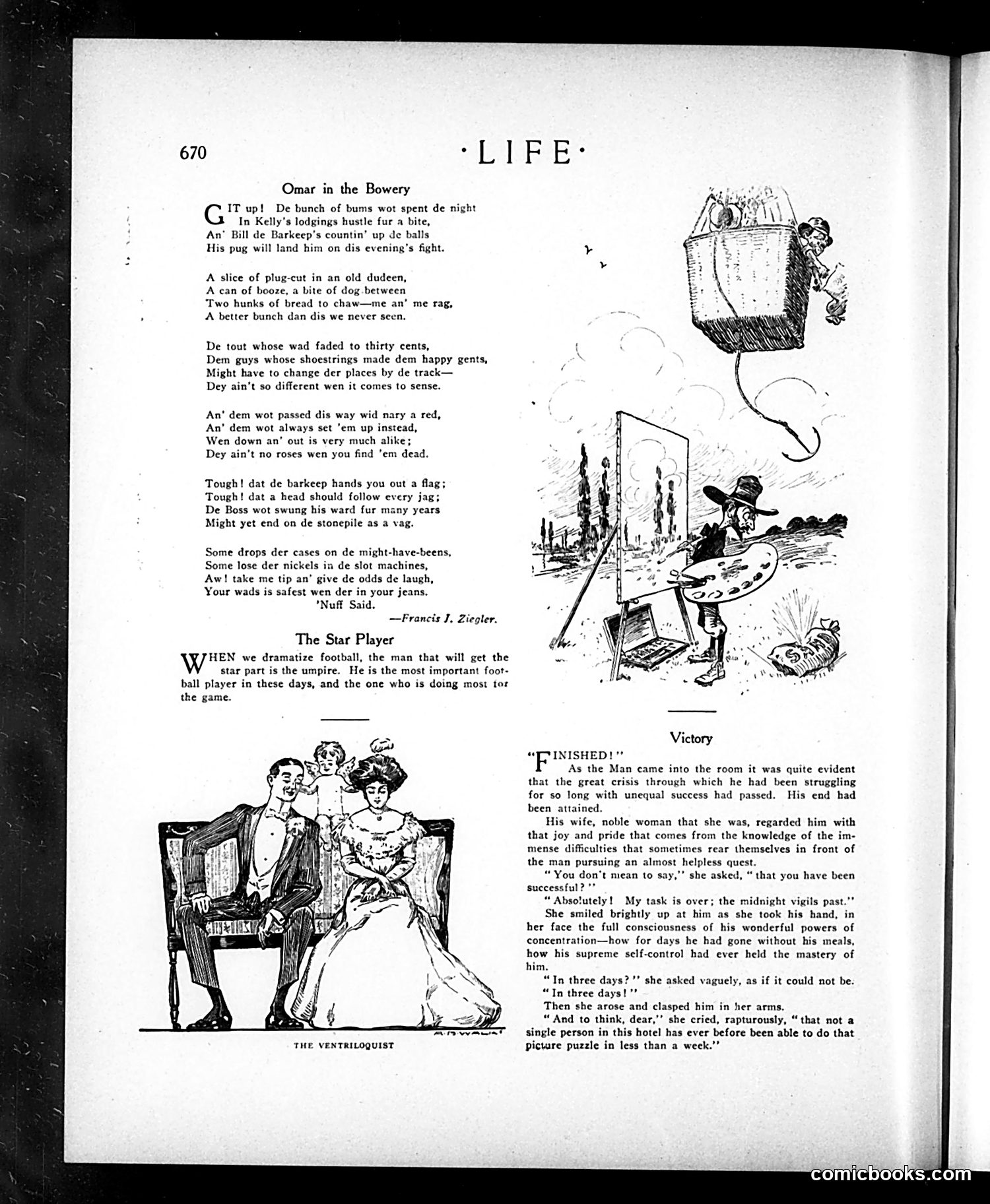
This page contains three distinct pieces: 1. **"Omar in the Bowery"** — A poem by Francis J. Ziegler depicting working-class life in New York's Bowery neighborhood, using dialect to describe poverty and hardship (cheap lodgings, minimal food, worn clothing). 2. **"The Star Player"** — An article discussing football and the umpire's critical role in the game. 3. **"Victory"** — A short story about a man who has completed some difficult task (appears to be intellectual or professional work), returning home triumphantly to his supportive wife. 4. **"The Ventriloquist"** — A cartoon illustration (bottom left) showing a well-dressed man with a dummy, likely making a social commentary about relationships or control, though the specific satire is unclear without additional context. The page represents typical early-20th-century Life magazine content: satirical poetry, sports commentary, domestic fiction, and visual humor.
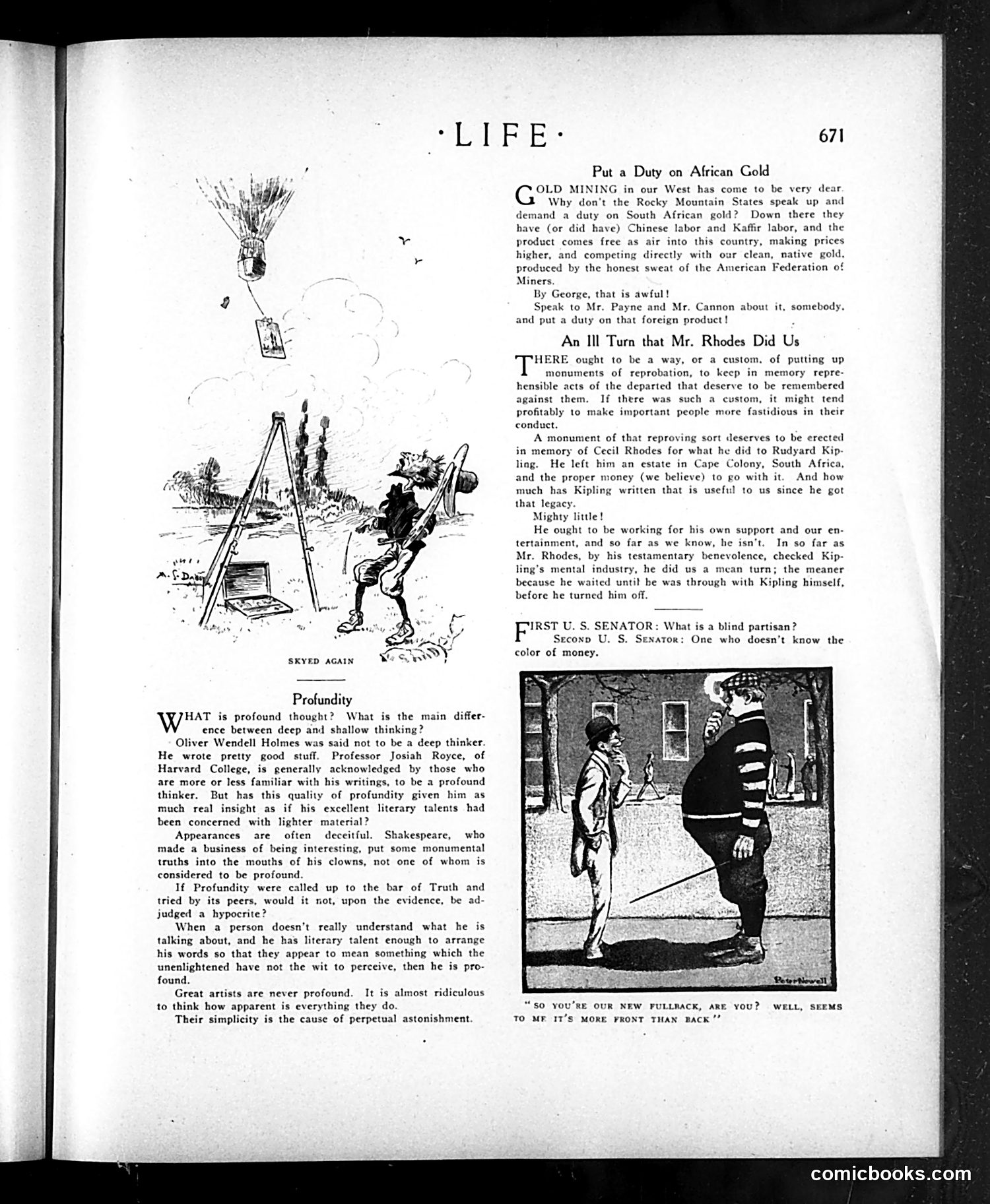
**"Put a Duty on African Gold"** discusses whether South African gold should face import tariffs to protect American mining interests, particularly against Chinese and Kaffir labor (offensive historical terminology). **"An Ill Turn that Mr. Rhodes Did Us"** critiques Cecil Rhodes' legacy in South Africa, specifically his bequest to Rudyard Kipling. The piece argues Rhodes' money has proven of limited value to Kipling's literary work. **"Profundity"** satirizes Oliver Wendell Holmes and literary pretentiousness, arguing that great artists achieve their impact through simplicity rather than obscure profundity—when people don't understand what's being discussed, they mistake confusion for depth. The cartoon shows two figures in conversation; the caption jokes about partisan blindness regarding money's influence in politics.
This page contains several opinion pieces rather than political cartoons. The main content includes: **"From Over the Pond"** by R. Walter R. Hadwen, a London Abolitionist, criticizing American electoral systems and political corruption. **"The Human Zoo"** section features short commentary pieces including: - "Non Olet" attacking Standard Oil executives - Discussion of mothers' welfare at a Children's Congress in Atlantic City (Dec. 15, 1914) - "Not a New York Product" — discussing financial practices - Commentary on William of Germany's statements about England The page is primarily *textual satire and opinion* rather than visual cartooning, typical of Life's format as an illustrated literary magazine. The pieces use sharp rhetoric to criticize wealthy industrialists, poor maternal conditions, and international politics of the 1914 era.
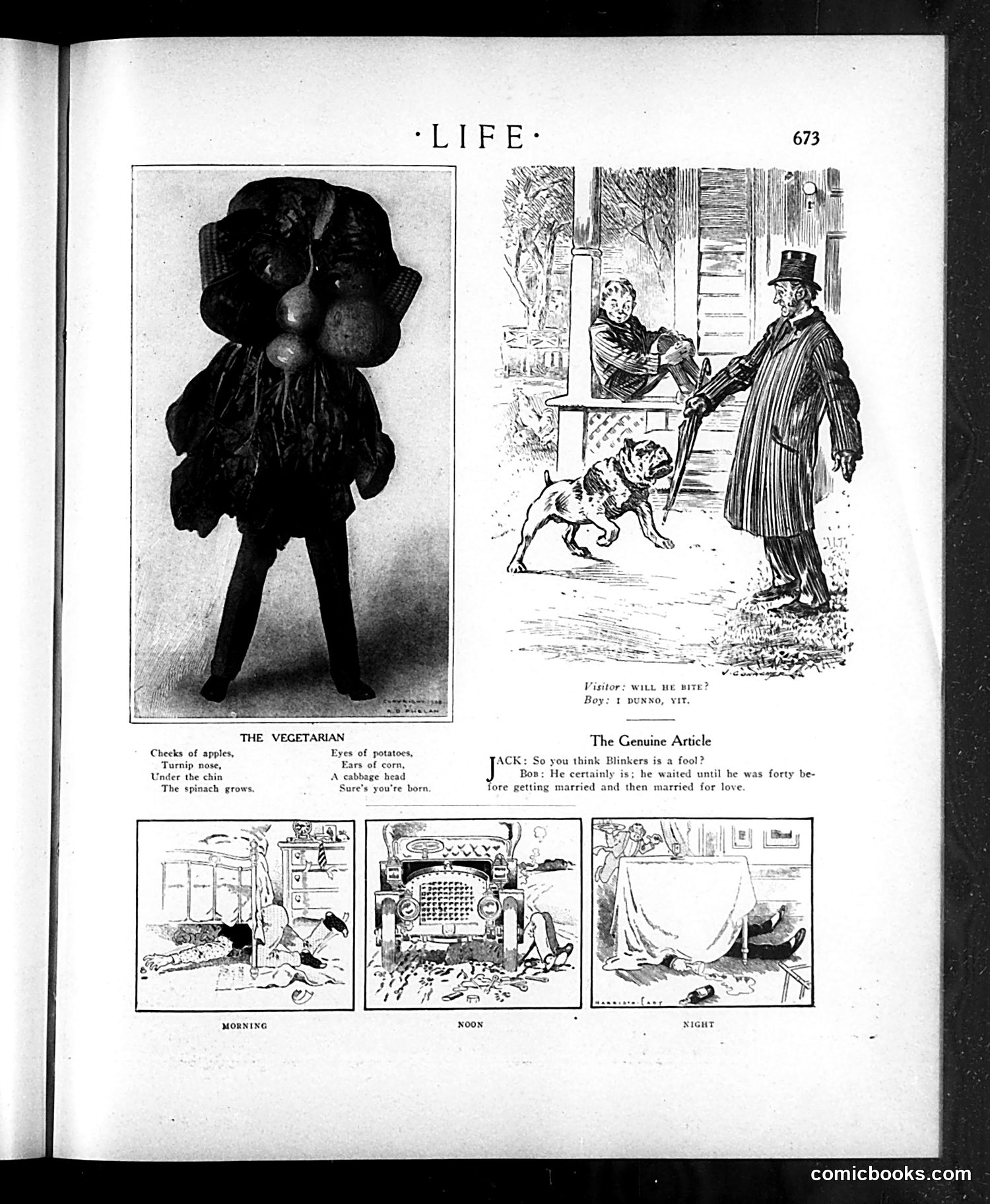
This page contains three distinct pieces: 1. **"The Vegetarian"** (left): A caricatured figure with exaggerated features holding vegetables, labeled with body parts replaced by produce ("Turnip nose," "Cabbage head," etc.). This mocks vegetarianism as unnatural and physically deforming. 2. **"The Genuine Article"** (right): A sketch showing a well-dressed gentleman with a dog greeting a boy, with dialogue about marriage and foolishness. The humor appears social rather than overtly political. 3. **Three sequential panels** (bottom) labeled "Morning," "Noon," and "Night" depicting what appears to be a car's progressive deterioration or comic mishaps throughout a day—likely satirizing early automobile reliability or ownership challenges. The page represents typical early-20th-century satirical humor targeting dietary choices, social manners, and new technology.
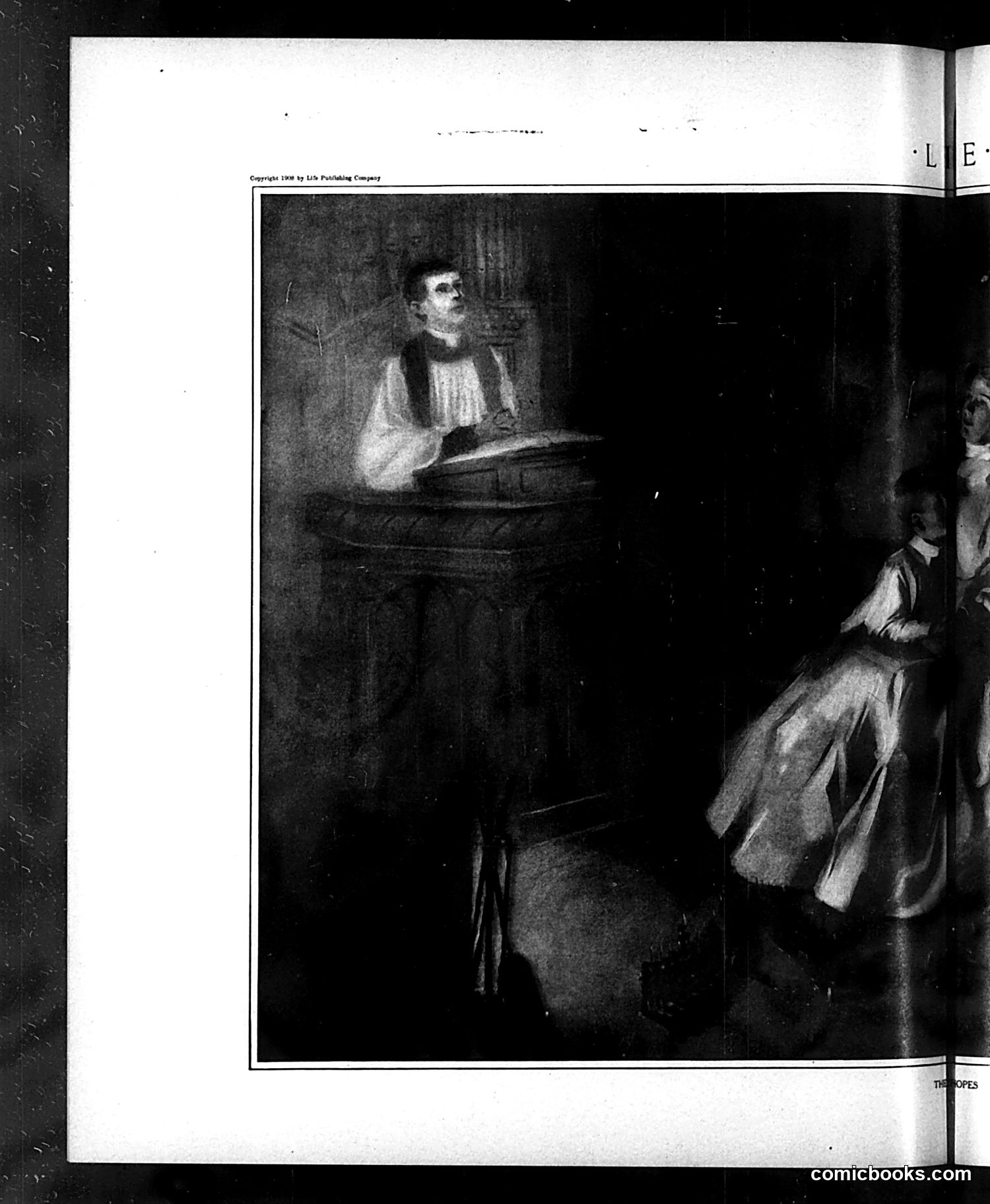
This page from *Life* magazine (copyright 1908 by Life Publishing Company) shows a black and white illustration of what appears to be a religious or formal scene. A man in clerical vestments stands at what looks like a pulpit or lectern, addressing seated figures on the right side of the image. Without visible caption text or clear OCR of explanatory text on this page, the specific satirical subject remains unclear. The formal religious setting suggests commentary on ecclesiastical matters—possibly clergy conduct, preaching, or church authority—which were common targets of *Life* magazine's satire during the early 20th century. However, the exact target, named individuals, or specific incident being mocked cannot be determined from the image alone.
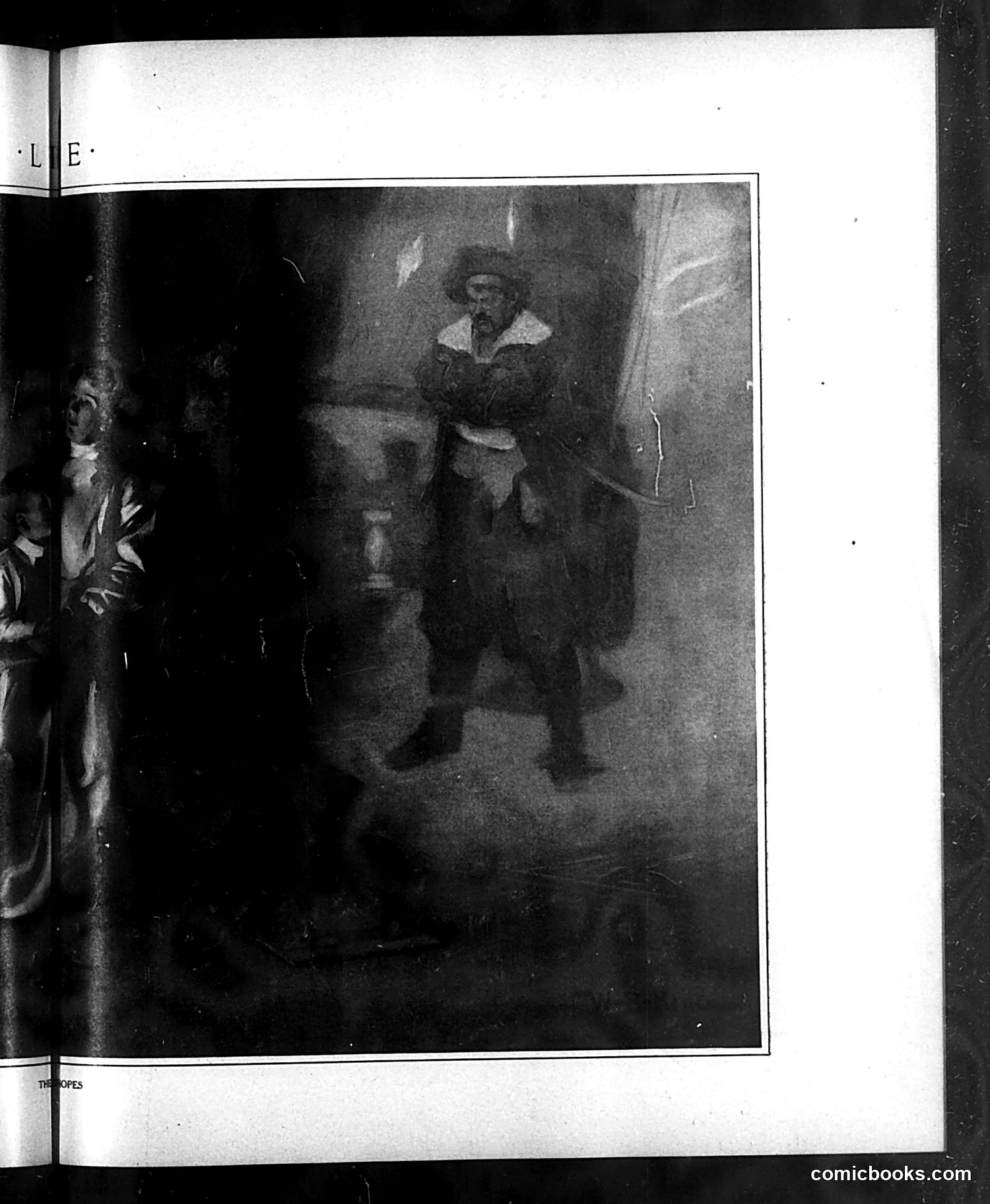
I can see this is a black and white photograph or artwork from Life magazine, but the OCR text provided is incomplete—it only shows "THE ROPES" at the bottom, which isn't sufficient to explain the image's meaning. The image appears to show figures in historical or period costume, with one figure prominently displayed and others around them, but without accompanying caption text or the full article, I cannot reliably identify who these figures represent or what political or social commentary this was meant to convey. To properly explain this satire to a modern reader, I would need the complete text that originally accompanied this image. I can only say it appears to be a theatrical or historical scene, likely making some pointed commentary, but the specific target and message remain unclear.
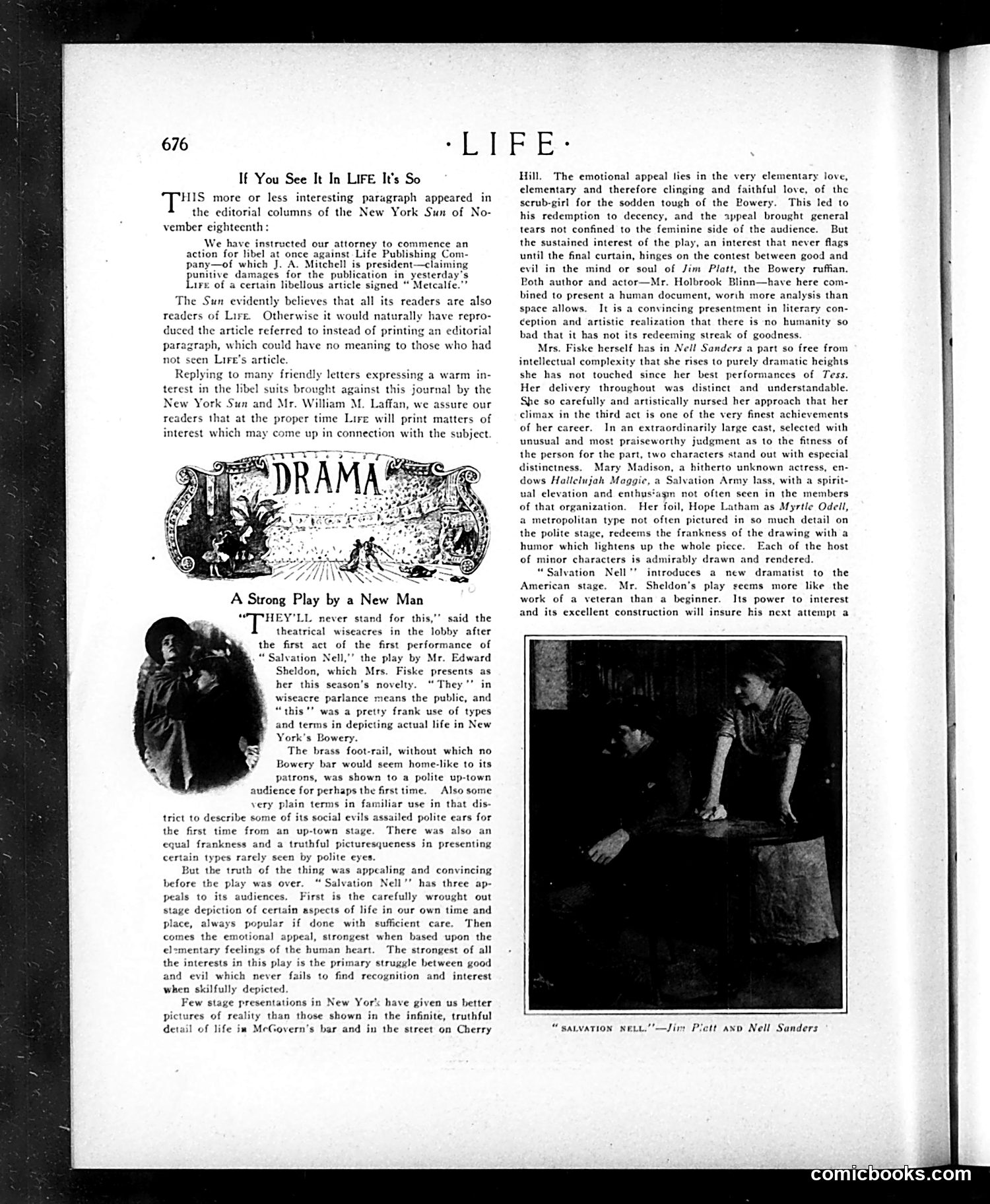
This page contains two distinct items: **Top Section - Editorial Satire:** Life mocks the New York Sun's lawsuit threat over a libel article. Life points out the absurdity: the Sun published an angry editorial condemning Life for printing an article by "Metcalfe," but didn't actually reprint the offending piece—making their complaint meaningless to readers who hadn't seen it. This is classic satirical gotcha journalism: Life exposes the Sun's logical inconsistency and self-defeating complaint. **Bottom Section - Theater Review:** A favorable review of Edward Sheldon's new play "Salvation Nell," starring Mrs. Fiske. The piece praises the production for realistically depicting New York's Bowery with authentic details (brass foot-rails, genuine vernacular) that shocked genteel audiences. The play's power comes from its raw truthfulness about urban poverty and redemption, appealing to audiences through realism, emotion, and the eternal good-versus-evil struggle.
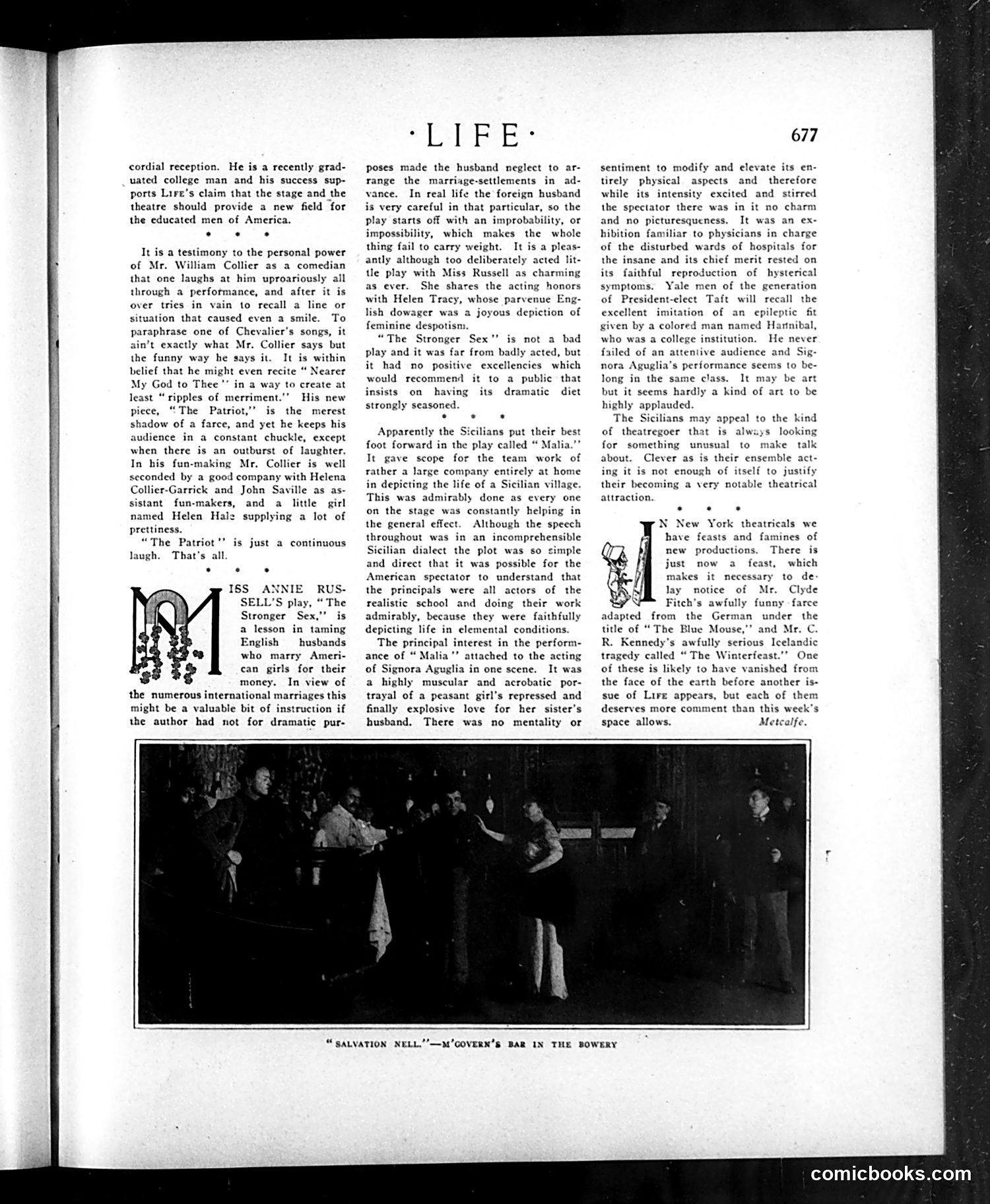
This page contains theater criticism rather than political cartoons. The reviews critique contemporary Broadway productions: **"The Patriot"** — A farce by William Collier, praised primarily for Collier's personal comedic charm rather than the script's merit. The critic notes audiences laugh throughout but can't recall specific funny lines afterward. **"The Stronger Sex"** — Annie Russell's play about American women marrying foreign husbands for money. The critic faults its dramatic setup (husbands wouldn't realistically neglect marriage settlements) despite Russell's charming performance. **"Malia"** — A Sicilian village drama notable for its ensemble acting and realistic staging. The review highlights actress Signora Aguglia's physically intense portrayal of passionate emotion, comparing it unfavorably to hysterical symptoms observed in psychiatric wards—a telling period critique using medical language to dismiss emotional female performance as pathological rather than artistic. The photograph shows a scene from "Salvation Nell."
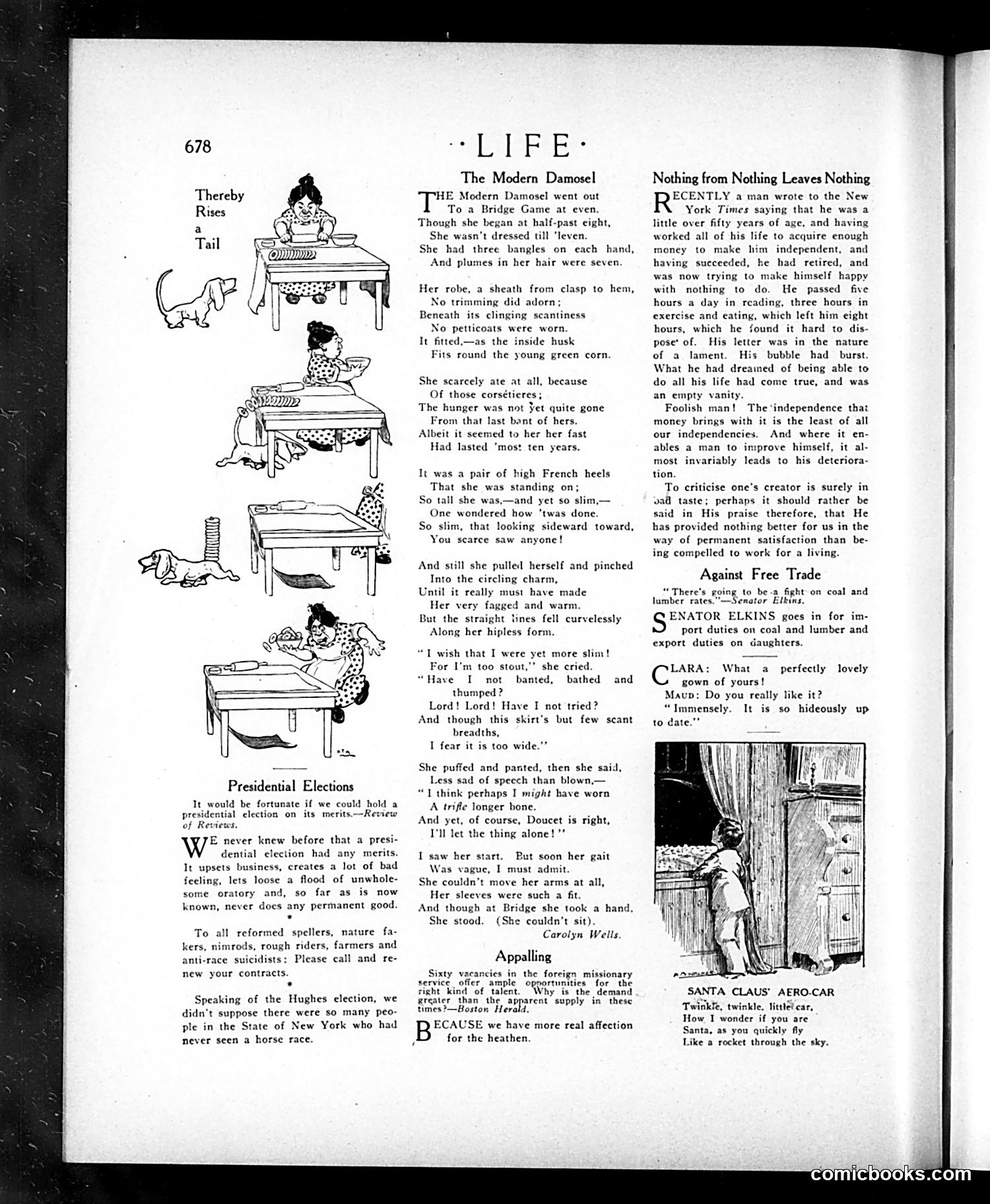
**Presidential Elections**: This section satirizes American presidential elections as inherently pointless. The writer mocks the notion that elections have "merits," claiming they upset business, generate bad feeling, and produce "unwholesome oratory" with no lasting benefit. The closing joke references the 1916 Hughes election, suggesting New York voters were so unsophisticated they'd "never seen a horse race"—implying they voted irrationally, like inexperienced gamblers. **"The Modern Damosel"**: This poem by Carolyn Wells satirizes the fashion-obsessed "modern woman" of the era. The caricature depicts an absurdly corseted, fashionably dressed woman attending a bridge game, so tightly bound in restrictive clothing (sheath dress, corset, tight sleeves) that she cannot eat, move her arms, or even sit down. The joke targets both women's vanity ("I wish I were yet more slim") and the impracticality of contemporary fashion that literally immobilizes the wearer.
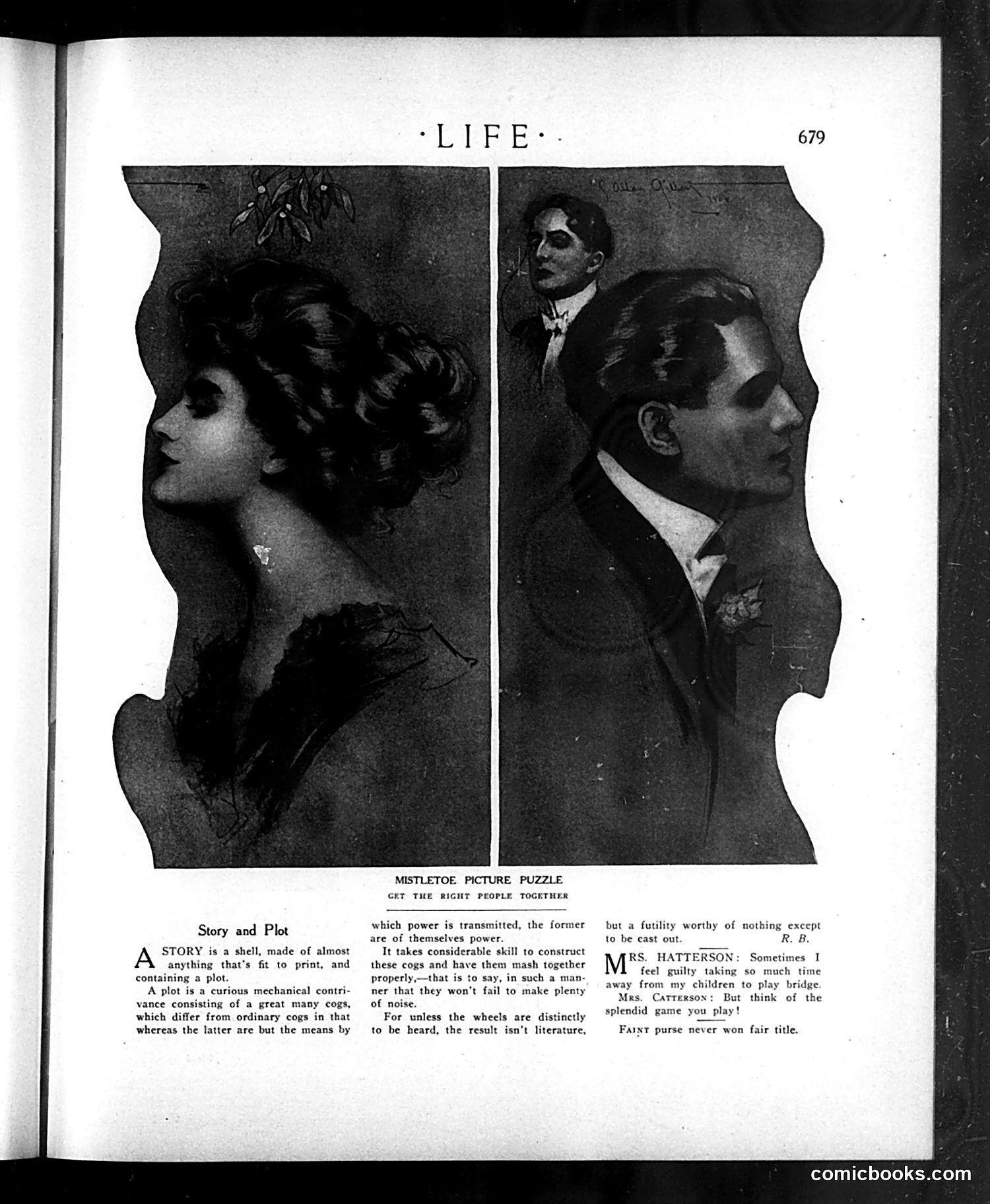
This page presents a "Mistletoe Picture Puzzle" — a visual matching game where readers must pair two profile portraits to find "the right people together," likely as romantic couples. The two silhouettes show a woman (left) and man (right) in formal dress, representing idealized potential matches. The accompanying text humorously defines "Story and Plot" as mechanical constructs requiring skilled assembly to function properly — a meta-commentary on literary construction. Below sits a brief comedic dialogue between Mrs. Hatterson and Mrs. Catterson about the guilt of leaving children to play bridge, with the punchline "Faint purse never won fair title" — a play suggesting financial security matters in marriage. The content reflects early 20th-century upper-class concerns: matchmaking, domestic leisure activities (bridge), and economic realities of courtship. The puzzle format was typical entertainment for Life's audience.
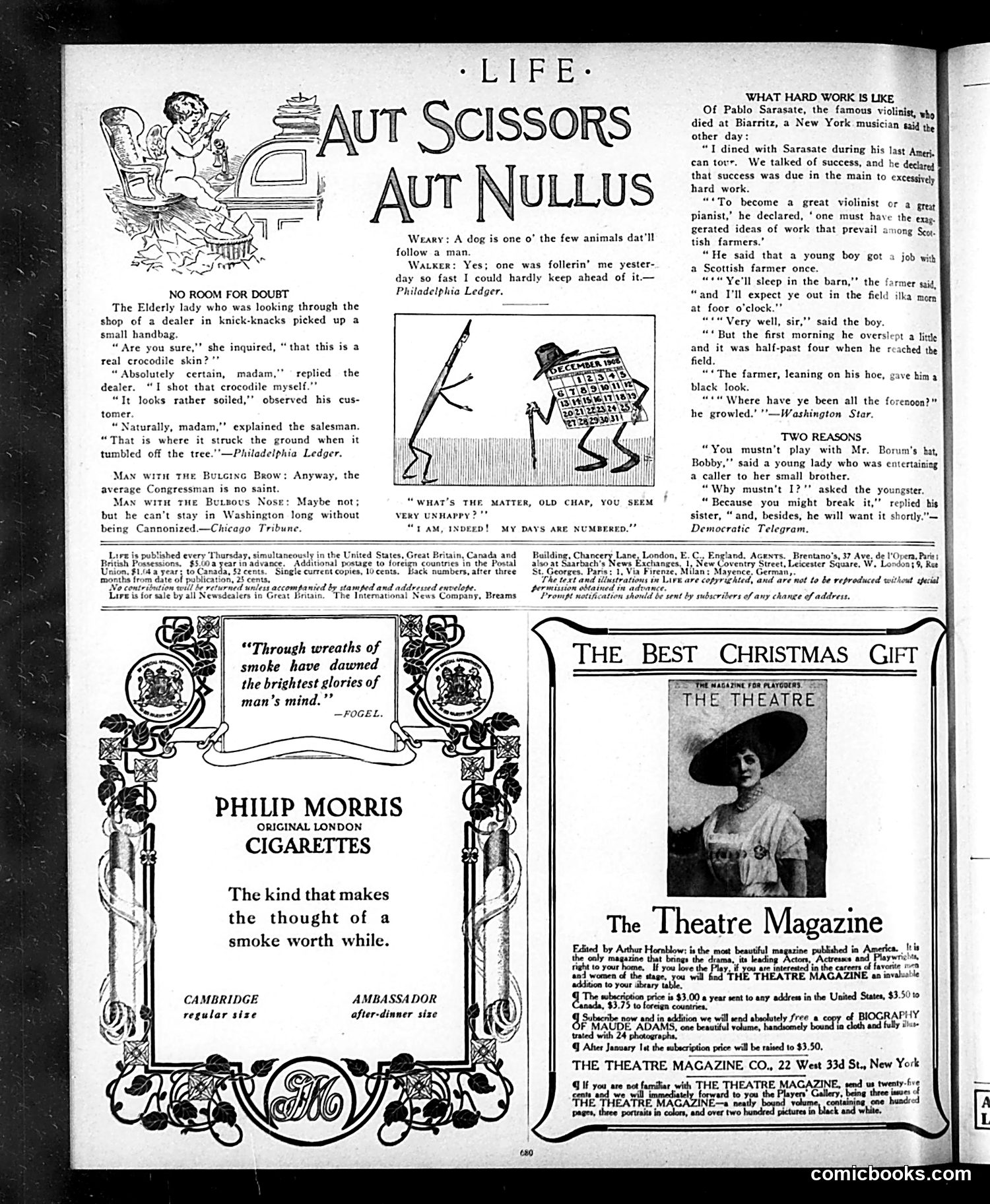
This page contains several brief humorous anecdotes and advertisements rather than political cartoons. The main jokes satirize everyday absurdities: **"No Room for Doubt"** mocks a shopkeeper's implausible excuse—claiming a crocodile skin is soiled because the animal "tumbled off the tree" after being shot. The humor lies in the obviously false explanation. **The other brief jokes** target conventional figures: a congressman's inevitable corruption ("Cannonized" in Washington), a dog's persistent pursuit, and a child's transparent excuse for breaking something. **References to Sarasate** (a real violinist) illustrate that success requires the obsessive work ethic of Scottish farmers. The page is primarily **advertising-focused**, featuring Philip Morris cigarettes and The Theatre Magazine prominently. The anecdotes are filler content typical of Life's satirical humor—poking fun at human nature, dishonesty, and social pretension rather than addressing specific political events or figures.
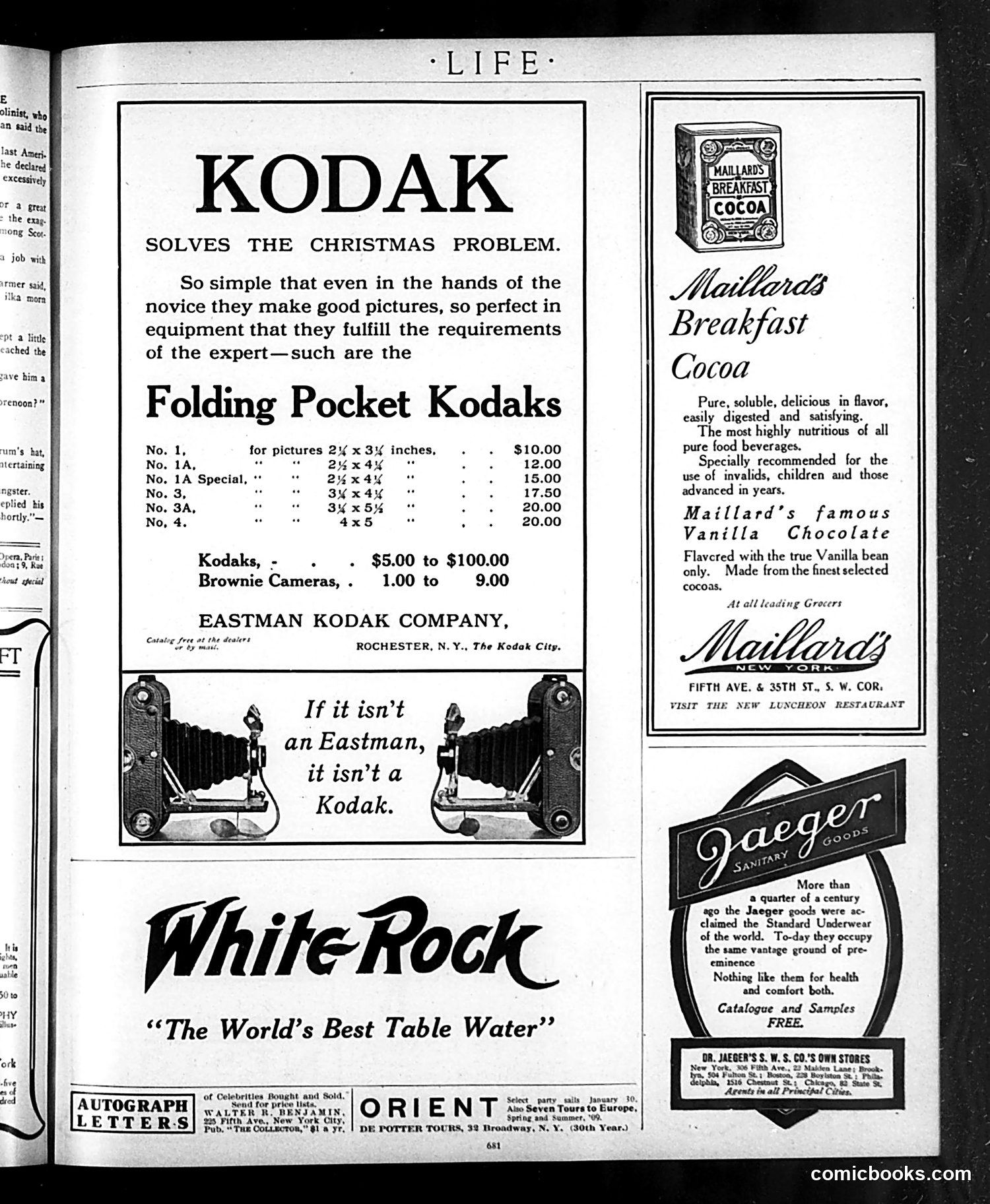
This page is primarily **advertising**, not satire or political commentary. It features multiple product advertisements typical of early 20th-century magazines: **Main Content:** - **Kodak cameras** dominate the left side, marketing "Folding Pocket Kodaks" as Christmas gifts ($10-$20). The tagline "If it isn't an Eastman, it isn't a Kodak" emphasizes brand authority. - **Maillard's Breakfast Cocoa** and **Maillard's Vanilla Chocolate** occupy the upper right, marketed as nutritious beverages for "invalids, children and those advanced in years." - **White Rock table water** advertises itself as "The World's Best Table Water." - **Jaeger sanitary goods** (underwear) claim century-old prestige. - **Orient de Potter Tours** offers European excursions. **No satirical content** is evident. This is straightforward consumer marketing using period conventions: luxury positioning, health claims, celebrity endorsements ("Autograph Letters"), and aspirational lifestyle messaging. The page reflects early 1900s consumer culture and advertising strategies.
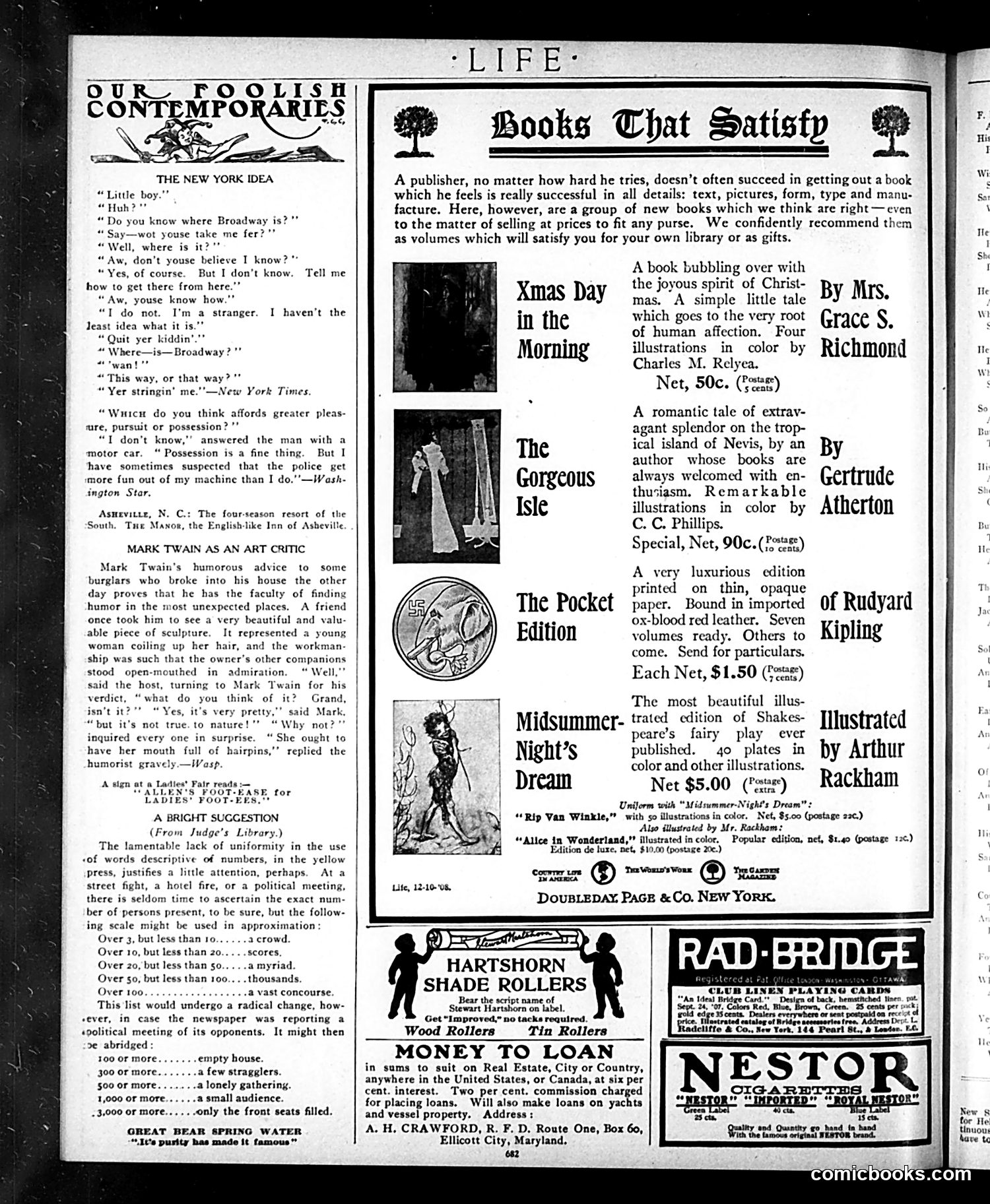
This page contains satirical humor pieces typical of Life magazine's social commentary, plus book advertisements. **"The New York Idea"** mocks working-class New York dialect and street culture—a tourist asking a streetwise boy for Broadway directions, with the boy feigning ignorance despite clearly knowing the city. The humor relies on ethnic/class-based dialect comedy popular in early 1900s America. **"Mark Twain as Art Critic"** presents Twain's practical irreverence toward high art—when shown an elaborate sculpture of a woman arranging her hair, he quips she should have hairpins in her mouth. It satirizes pretentious art appreciation. **"A Bright Suggestion"** from Judge's Library mocks yellow journalism's vague crowd estimates at events, proposing a satirical scale. It notably includes a dig at political opposition coverage—newspapers allegedly describe opponents' gatherings as "empty house" or "a few stragglers" while inflating their own side's numbers. This reflects early Progressive-era media criticism. The remainder is primarily book advertisements—typical period publishing fare.
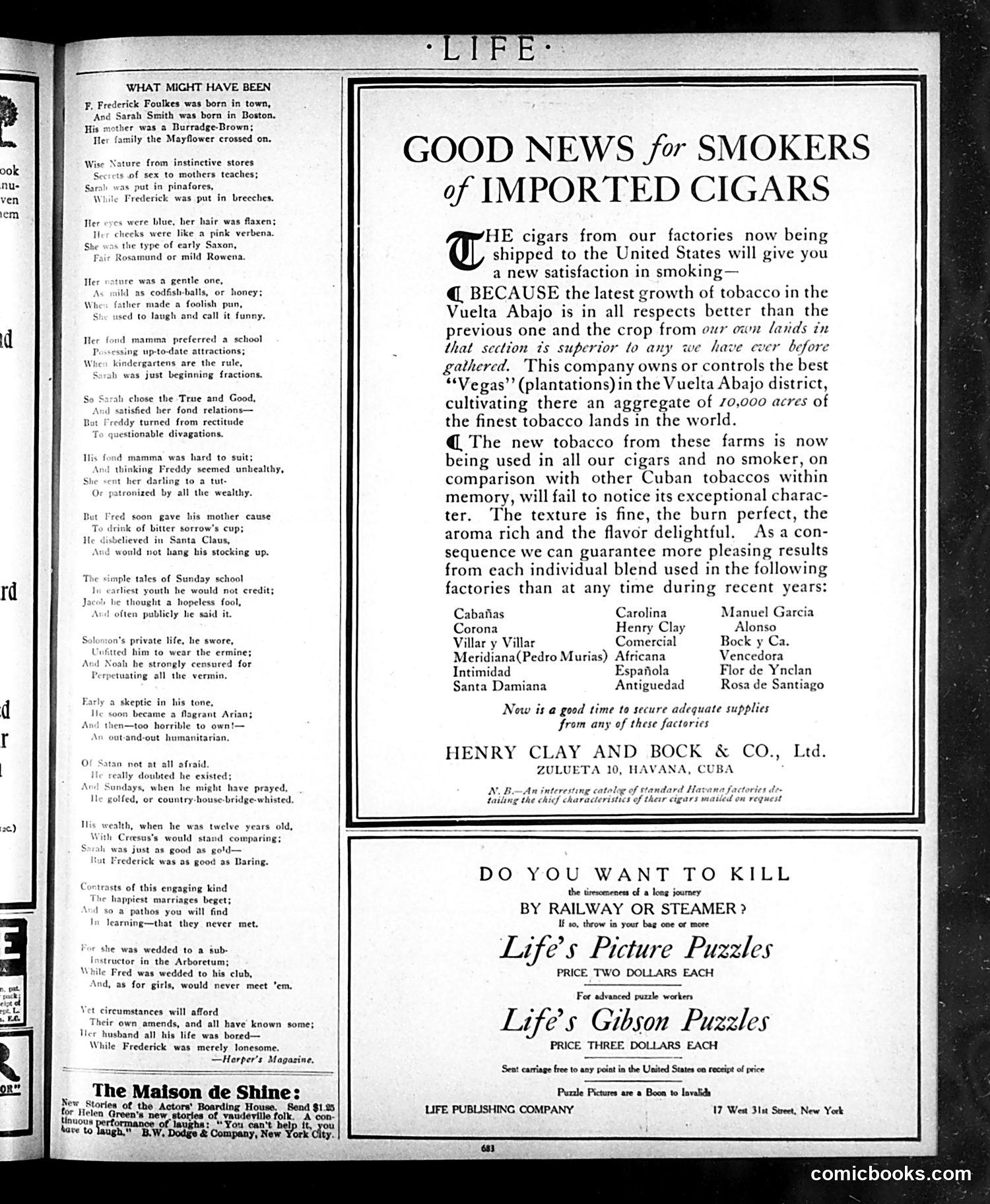
This Life magazine page contains two distinct sections: **Left side:** A satirical poem titled "What Might Have Been" by Harper's Magazine. It contrasts two children—Frederick Foulkes (born to privilege, upper-class lineage) and Sarah Smith (from Boston Brahmin stock)—who develop opposite personalities. Sarah becomes conventionally proper while Frederick becomes an irreverent skeptic who doubts religion, becomes a "flagrant Arian," and turns into a humanitarian. The satire mocks how their opposite developments prevent their marriage despite perfect social compatibility. The final irony: she marries a museum curator; he marries his club—both ending lonely. The piece satirizes rigid class expectations and predictable social outcomes. **Right side:** A full-page advertisement for Henry Clay and Bock & Co. cigars imported from Havana, Cuba, promoting superior Vuelta Abajo tobacco quality and listing various factory brands. The page is primarily advertising-driven rather than satirical commentary.
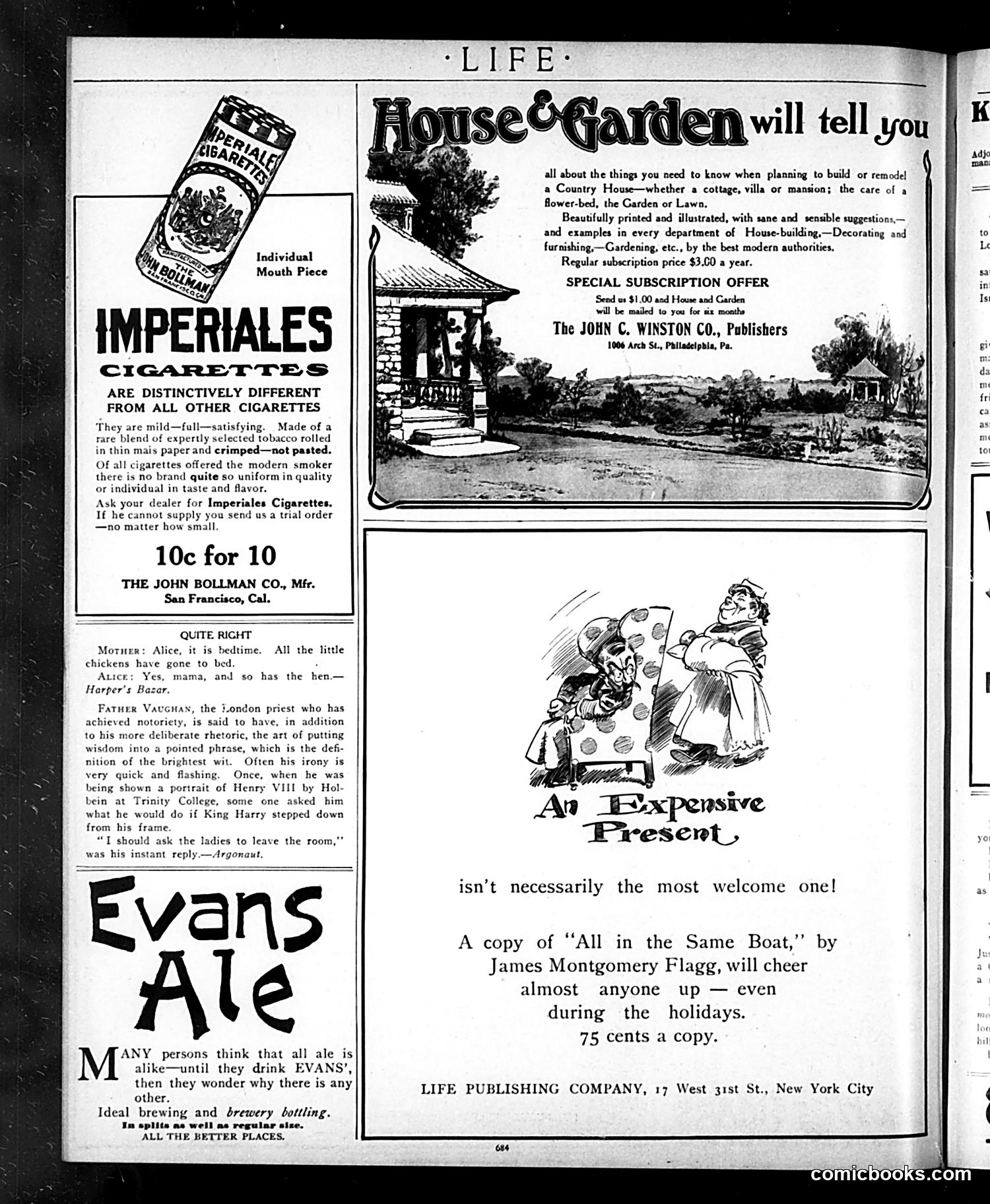
This is primarily an **advertising page** with minimal satirical content. The main items are: **"Quite Right" joke**: A brief humor piece playing on literal language—a child says the hen has gone to bed because the mother mentioned all the chickens had. It's a simple wordplay gag typical of early 20th-century family humor magazines. **Father Vaughan anecdote**: References an actual London priest known for witty remarks. The joke describes his quick wit—when shown a Henry VIII portrait, he quipped he'd ask ladies to leave if the king stepped down, implying Henry's notorious reputation regarding women. This relies on knowledge of Henry VIII's marital history. **Advertisements**: The bulk of the page advertises cigarettes (Imperiales), ale (Evans), and books/magazines (House & Garden, "All in the Same Boat"). These are straightforward product pitches with no apparent satire. The page reflects early 1900s advertising practices and social references (Henry VIII's wives) that modern readers would need historical context to fully appreciate, but contains no significant political or social satire worthy of detailed analysis.
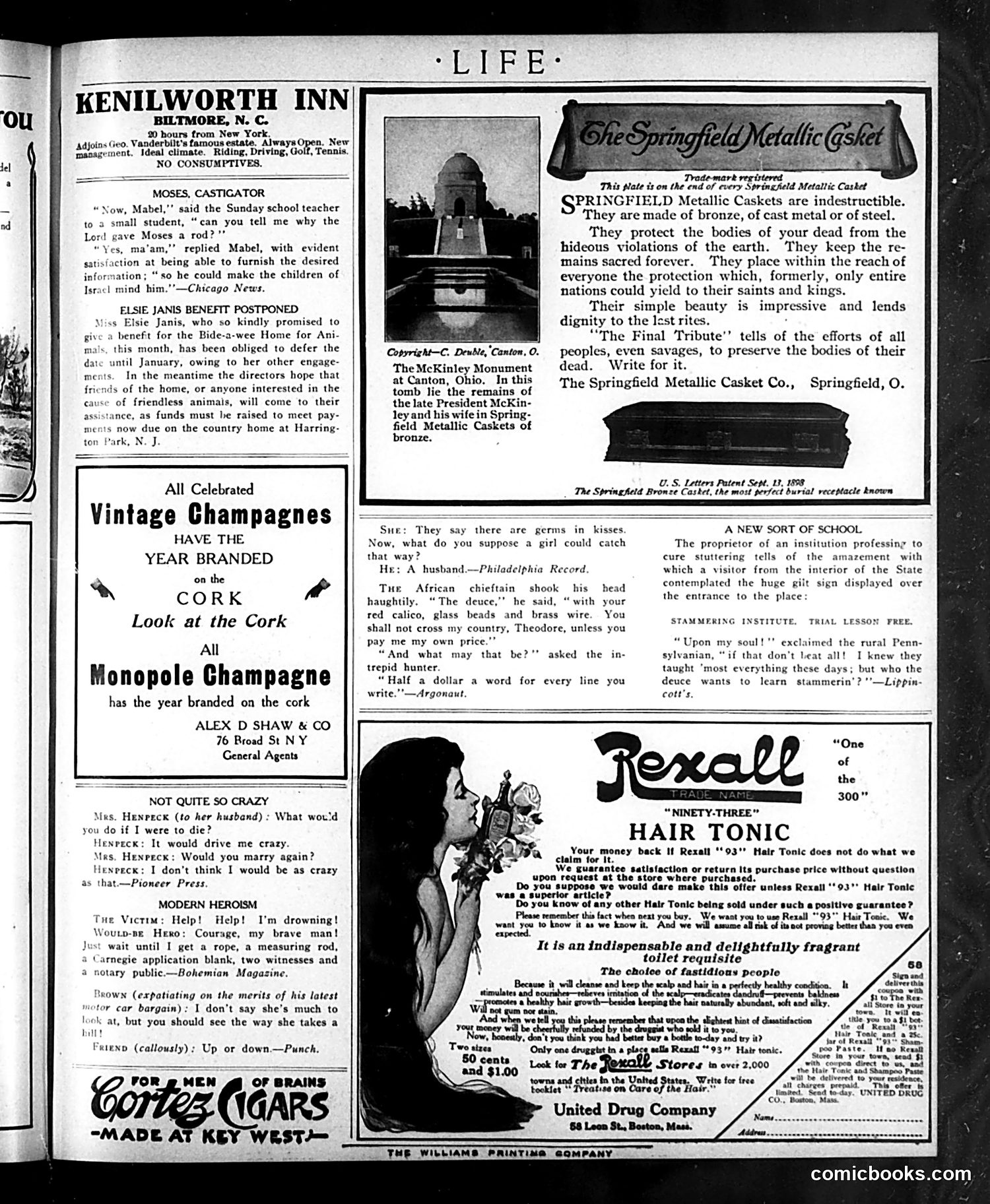
This is primarily an **advertising and humor page** from Life magazine, with several distinct elements: **The Cartoons/Humor:** The page contains brief joke snippets rather than political cartoons. Notable examples include "Moses, Castigator" (a Sunday school joke about Moses and his rod), and several short humorous exchanges about marriage, germs in kisses, and stuttering. These are gentle domestic humor typical of the era—no sharp political satire is evident. **Advertisements:** The page is dominated by product ads: Kenilworth Inn (a resort near Vanderbilt's estate), Springfield Metallic Caskets (promoting bronze burial caskets), Monopole Champagne (emphasizing year-branded corks), Cortez Cigars, and Rexall "93" Hair Tonic (offering money-back guarantees). **Social Context:** References to "consumptives" (tuberculosis patients) and the McKinley Monument suggest early 20th-century America. The ads reflect period concerns: wealthy tourism, funeral practices, and patent medicine marketing. This page lacks significant political commentary—it's primarily commercial content interspersed with mild domestic humor.
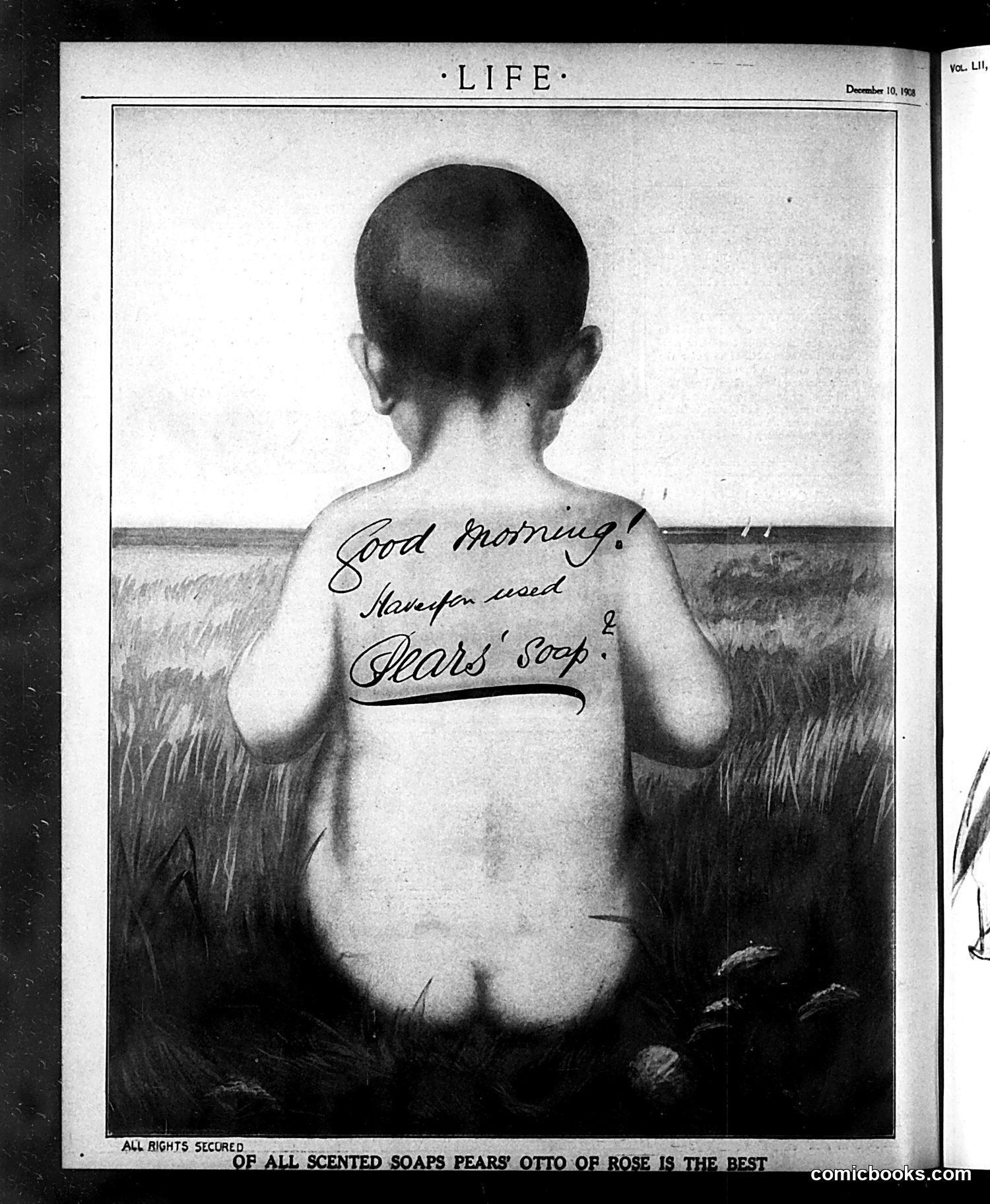
This is a **Life magazine advertisement** from December 10, 1908, not a political cartoon. The image shows a bare-bottomed infant viewed from behind, sitting in a field of grain or wheat. The handwritten text reads: "Good morning! Never you used Pears' Soap?" The caption states: "Of all scented soaps Pears' Otto of Rose is the best." This is a **soap advertisement** using innocent humor and a cherubic child to promote Pears' brand soap, specifically their "Otto of Rose" scented variety. The joke relies on the child's pristine appearance suggesting effective cleansing. This type of wholesome, child-centered advertising was common in early 20th-century magazines. There is no political or social satire intended—it's straightforward product marketing.