
Life, 1908-12-10 · page 6 of 24
Life — December 10, 1908 — page 6: what you’re looking at
What you’re looking at
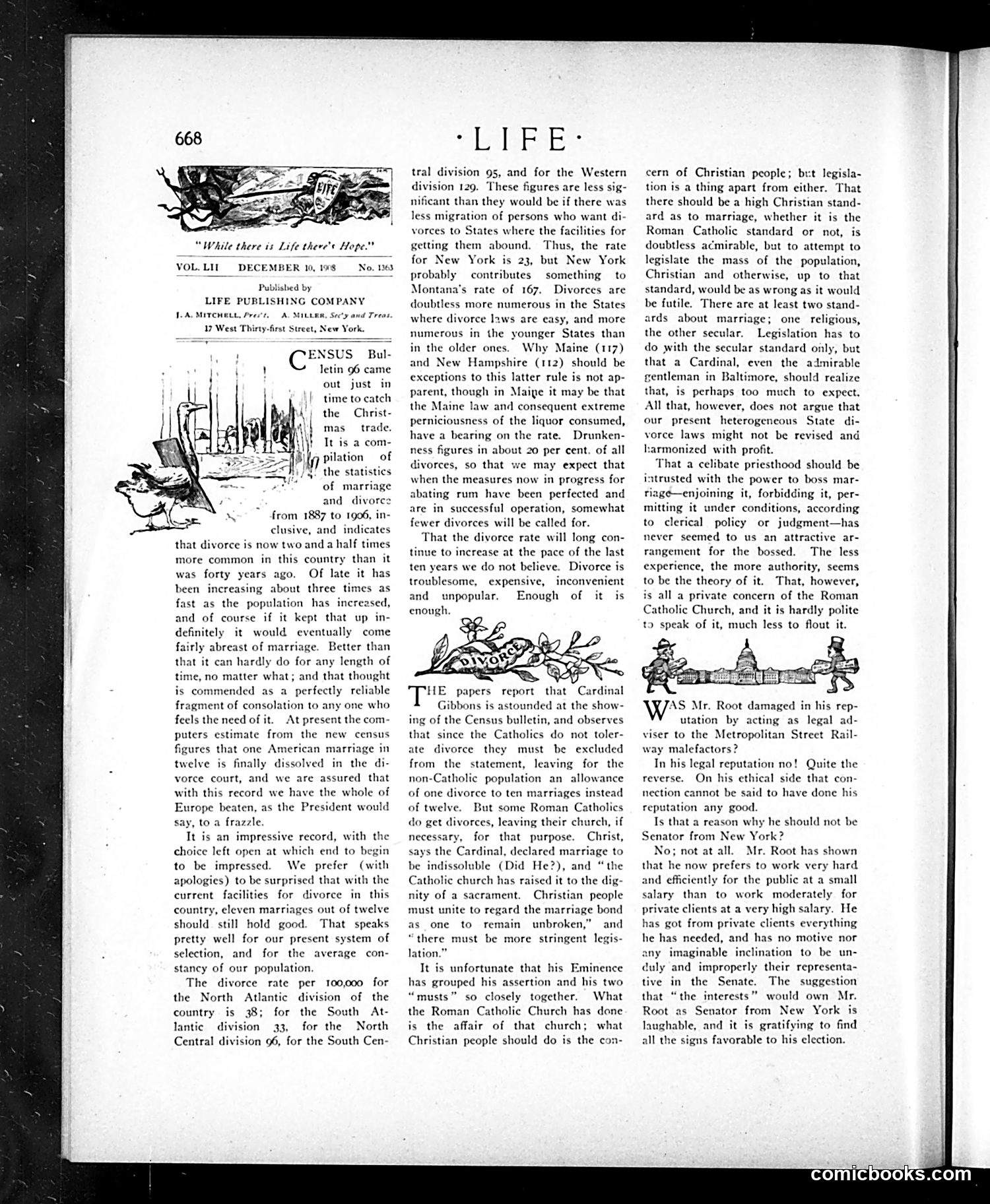
This page contains two editorial cartoons addressing early 20th-century social issues. The left cartoon illustrates divorce statistics, showing a cityscape with what appears to be a church or cathedral. The accompanying text discusses rising divorce rates across American states, noting that divorce is "now two and a half times more common" than forty years prior. The satirical point critiques how divorce, once scandalous, has become increasingly normalized—"a fairly direct of marriage." The right section discusses Cardinal Gibbons and Catholic doctrine on marriage and divorce. Below this appears a small cartoon depicting what seems to be a political figure (possibly Mr. Root, mentioned in text) in relation to railroad or infrastructure matters, though the specific reference remains unclear from the image alone. Both cartoons reflect Progressive Era tensions between traditional religious values and modernizing American society.
📄 Transcribed text from this page (OCR, searchable)
Machine-transcribed from the original scan — historical spelling and the odd misread are preserved.
“While there is Life there's Hope.” VOL. LIL DECEMBER 10, 198 No. Published by LIFE PUBLISHING COMPANY LA MiTOMELL, Pret, 17 West Thirty-first Street, New York. A. MILLER, Sec'y and Treat. ENSUES Bul- letin 96 came out just in time to catch the Christ- mas trade. } It is a com- pilation of 1/3! the statistics of marriage and divorces from 1887 to 1906, in- clusive, and indicates that divorce is now two and a half times more common in this country than it was forty years ago. Of late it has been increasing about three times as fast as the population has increased, and of course if it kept that up in- definitely it would eventually come fairly abreast of marriage. Better than that it can hardly do for any length of time, no matter what; and that thought is commended as a perfectly reliable fragment of consolation to any one who feels the need of it. At present the com- puters estimate from the new census figures that one American marriage in twelve is finally dissolved in the di- vorce court, and we are assured that with this record we have the whole of Europe beaten, as the President would say, to a frazzle. It is an impressive record, with the choice left open at which end to begin to be impressed. We prefer (with apologies) to be surprised that with the current facilities for divorce in this country, eleven marriages out of twelve should still hold good. That speaks pretty well for our present system of selection, and for the average con- stancy of our population. The divorce rate per 100,000 fe the North Atlantic division of the country is 38; for the South At- lantic division 33, for the North Central division 96, for the South Cen- “LlGRSEs tral division 95, and for the Western division 129. These figures are less si; nificant than they would be if there wa less migration of persons who want di- vorces to States where the facilities for getting them abound, Thus, the rate for New York is 23, but New York probably contributes something to Montana’s rate of 167, Divorces are doubtless more numerous in the States where divorce laws are easy, and more numerous in the younger States than in the older ones. Why Maine (117) and New Hampshire (112) should be exceptions to this latter rule is not ap- parent, though in Maige it may be that the Maine law and consequent extreme perniciousness of the liquor consumed, have a bearing on the rate. Drunken- ness figures in about 20 per cent. of all divorces, so that we may expect that when the measures now in progress for abating rum have been perfected and are in successful operation, somewhat fewer divorces will be called for. That the divorce rate will long con- tinue to increase at the pace of the last ten years we do not believe. Divorce is troublesome, expensive, inconvenient and unpopular. Enough of it is enough, HE papers report that Cardinal Gibbons is astounded at the show- ing of the Census bulletin, and observes that since the Catholics do not toler- ate divorce they must be excluded from the statement, leaving for the non-Catholic population an_ allowance of one divorce to ten marriages instead of twelve. But some Roman Catholics do get divorces, leaving their church, if necessary, for that purpose. Christ, says the Cardinal, declared marriage to be indissoluble (Did He?), and “the Catholic church has raised it to the dig- nity of a sacrament. Christian people must unite to regard the marriage bond as one to remain unbroken,” and “there must be more stringent legis- lation.” It is unfortunate that his Eminence has grouped his assertion and his two “musts” so closely together. What the Roman Catholic Church has done is the affair of that church; what Christian people should do is the con- cern of Christian people; bit legisla- tion is a thing apart from either. That there should be a high Christian stand- ard as to marriage, whether it is the Roman Catholic standard or not, is doubtle: ‘mirable, but to attempt to legislate the mass of the population, Christian and otherwise, up to that standard, would be as wrong as it would be futile. There are at least two stand- ards about marriage; one religious, the other secular. Legislation has to do with the secular standard only, but. that a Cardinal, even the admirable gentleman in Baltimore, should realize that, is perhaps too much to expect. All that, however, does not argue that our present heterogeneous State di- vorce laws might not be revised and larmonized with profit. That a celibate priesthood should be intrusted with the power to boss mar- riage—enjoining it, forbidding it, per- mitting it under conditions, according to clerical policy or judgment—has never seemed to us an attractive ar- rangement for the bossed. The less experience, the more authority, seems to be the theory of it. That, however, is all a private concern of the Roman Catholic Church, and it is hardly polite to speak of it, much less to flout it. AS Mr. Root damaged in his rep- utation by acting as legal ad- viser to the Metropolitan Street Rail- way malefactors? In his legal reputation no! Quite the reverse. On his ethical side that con- nection cannot be said to have done his reputation any good. Is that a reason why he should not be Senator from New York? No; not at all. Mr. Root has shown that he now prefers to work very hard nd efficiently for the public at a small salary than to work moderately for private clients at a very high salary. He has got from private clients everything he has needed, and has no motive nor ny imaginable inclination to be un- duly and improperly their representa~ tive in the Senate. The suggestion that “the interests” would own Mr. Root as Senator from New York is laughable, and it is gratifying to find all the signs favorable to his election. comicbooks.com