
Life, 1908-12-10 · page 10 of 24
Life — December 10, 1908 — page 10: what you’re looking at
What you’re looking at
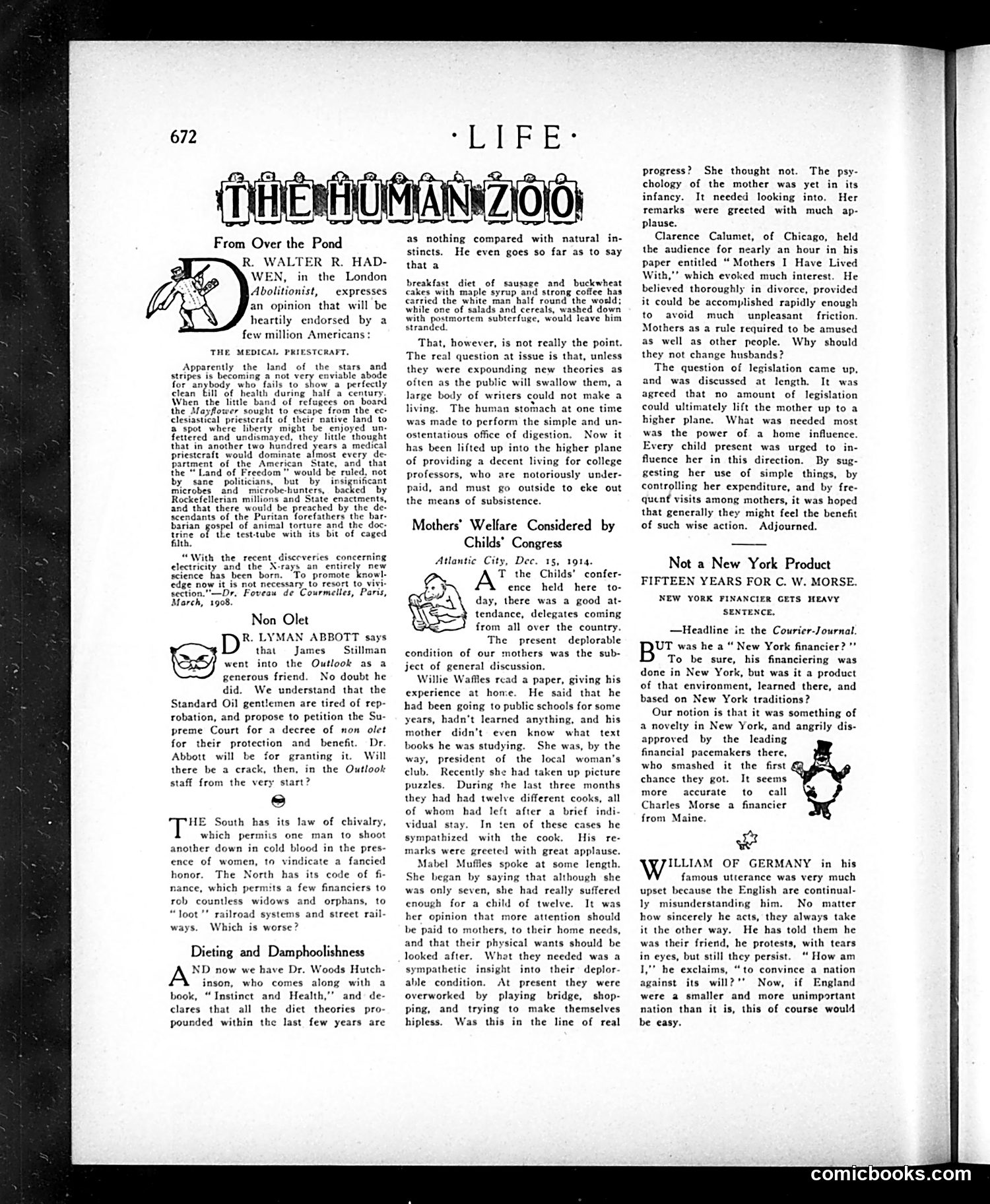
This page contains several opinion pieces rather than political cartoons. The main content includes: **"From Over the Pond"** by R. Walter R. Hadwen, a London Abolitionist, criticizing American electoral systems and political corruption. **"The Human Zoo"** section features short commentary pieces including: - "Non Olet" attacking Standard Oil executives - Discussion of mothers' welfare at a Children's Congress in Atlantic City (Dec. 15, 1914) - "Not a New York Product" — discussing financial practices - Commentary on William of Germany's statements about England The page is primarily *textual satire and opinion* rather than visual cartooning, typical of Life's format as an illustrated literary magazine. The pieces use sharp rhetoric to criticize wealthy industrialists, poor maternal conditions, and international politics of the 1914 era.
📄 Transcribed text from this page (OCR, searchable)
Machine-transcribed from the original scan — historical spelling and the odd misread are preserved.
From Over the Pond R. WALTER R. HAD- WEN, in the London Abolitionist, expresses an opinion that will be heartily endorsed by a few million Americans : THE MEDICAL PRIESTCRAPT. Apparently the land of the stars and stripes is becoming a not very enviable abode for anybody who fails to show a perfectly clean Eill of health during half a century When the little band of refugees on board the Mayflower sought to escape from the ec- clesiastical priestcraft of their native land to & spot where liberty might be enjoyed un- fettered and undismayed, they little thought that in another two hundred years a medical priestcraft would dominate almost every de- partment of the American State, and that the “Land of Freedom" would be ruled, not by sane politicians, but by insignificant microbes. and microbe-hunters, backed by Rockefellerian millions and State enactments, and that there would be preached by the de: scendants of the Puritan forefathers the bar- barian gospel of animal torture and the doc- trine ‘of the test-tube with its bit of caged th. “With the recent discoveries concerning electricity and the X-rays an entirely new science has been born. To promote knowl- edge now it is not necessary_to resort tov section."—Dr, Foveau de Courmelles, Par March, 1908. Non Olet R. LYMAN ABBOTT says that James — Stillman went into the Outlook as a generous friend. No doubt he did. We understand that the Standard Oil gentlemen are tired of rep- robation, and propose to petition the Su- preme Court for a decree of non olet for their protection and benefit. Dr. Abbott will be for granting it. Will there be a crack, then, in the Outlook staff from the very start? e HE South has its law of chivalry, which permits one man to shoot another down in cold blood in the pres- ence of women, to vindicate a fancied honor. The North has its code of fi- nance, which permits a few financiers to rob countless widows and orphans, to “loot ' railroad systems and street rail- s. Which is worse? Dieting and Damphoolishness ND now we have Dr. Woods Hutch- inson, who comes along with a book, “Instinct and Health,’’ and de- clares that all the diet theories pro- pounded within the last few years are as nothing compared with natural in- He even goes so far as to say stincts. that a breakfast diet of sausage and buckwheat cakes with maple syrup and strong coffee has carried the white man half round the world; while one of salads and cereals, washed down with postmortem subterfuge, would leave him strande That, however, is not really the point. The real question at issue is that, unless they were expounding new theories as often as the public will swallow them, a large body of writers could not make a living. The human stomach at one time was made to perform the simple and un- ostentatious office of digestion. Now it has been lifted up into the higher plane of providing a decent living for college professors, who are notoriously under- paid, and must go outside to eke out the means of subsistence. Mothers’ Welfare Considered by Childs’ Congress Atlantic City, Dec. 15, 1914. a A’ the Childs’ confer- ¥ ence held here to- Ya\ day, there was dat. ay, there was a goo tendance, delegates coming from all over the country. The present deplorable condition of our mothers was the sub- ject of general discussion. Willie Waffles read a paper, giving his experience at home. He said that he had been going to public schools for some years, hadn't learned anything, and his mother didn't even know what text books he was studying. She was, by the way, president of the local woman's club. Recently she had taken up picture puzzles. During the last three months they had had twelve different cooks, all of whom had left after a brief indi- vidual stay. In ten of these cases he sympathized with the cook. His re- marks were greeted with great applause. Mabel Muffles spoke at some length. She began by saying that although she was only seven, she had really suffered enough for a child of twelve. It was her opinion that more attention should be paid to mothers, to their home needs, and that their physical wants should be looked after. Whot they needed was a sympathetic insight into their deplor able condition. At present they were overworked by playing bridge, shop- ping, and trying to make themselves hipless. Was this in the line of real progress? She thought not. The psy- chology of the mother was yet in its infancy. It needed looking into. Her remarks were greeted with much ap- plause. Clarence Calumet, of Chicago, held the audience for nearly an hour in his paper entitled “ Mothers I Have Lived With,”’ which evoked much interest. He believed thoroughly in divorce, provided it could be accomplished rapidly enough to avoid much unpleasant friction: Mothers as a rule required to be amused as well as other people. Why should they not change husbands? The question of legislation came up. and was discussed at length. It was agreed that no amount of legislation could ultimately lift the mother up to a higher plane. What was needed most was the power of a home influence. Every child present was urged to in- fluence her in this direction. By sug- gesting her use of simple things, by controlling her expenditure, and by fre- quenf visits among mothers, it was hoped that generally they might feel the benefit of such wise action. Adjourned. Not a New York Product FIFTEEN YEARS FOR C. W. MORSE. NEW YORK FINANCIER GETS HEAVY SENTENCE, —Headline in the Courier-Journal. UT was he a “ New York financier?” To be sure, his financiering was done in New York, but was it a product of that environment, learned there, and based on New York traditions? Our notion is that it was something of a novelty in New York, and angrily dis- approved by the leading financial pacemakers there, who smashed it the first chance they got. It seems more accurate to call Charles Morse a financier from Maine. ILLIAM OF GERMANY in his famous utterance was very much upset because the English are continual- ly misunderstanding him. No matter how sincerely he acts, they always take it the other way. He has told them he was their friend, he protests, with tears in eyes, but still they persist.“ How am 1,"" he exclaims, “to convince a nation against its will?'’ Now, if England were a smaller and more unimportant nation than it is, this of course would be easy. comicbooks.com