
Life, 1908-12-10 · page 14 of 24
Life — December 10, 1908 — page 14: what you’re looking at
What you’re looking at
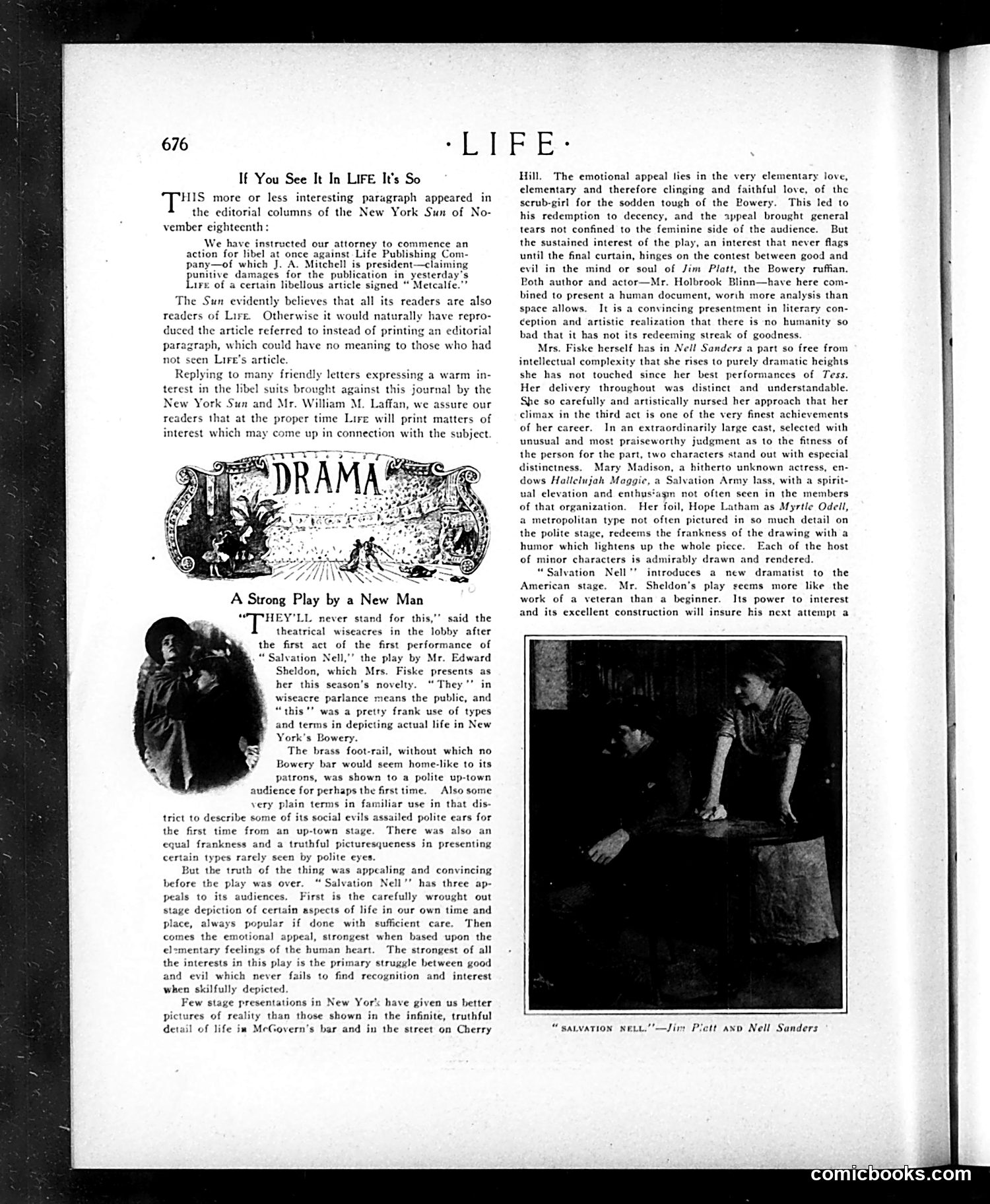
This page contains two distinct items: **Top Section - Editorial Satire:** Life mocks the New York Sun's lawsuit threat over a libel article. Life points out the absurdity: the Sun published an angry editorial condemning Life for printing an article by "Metcalfe," but didn't actually reprint the offending piece—making their complaint meaningless to readers who hadn't seen it. This is classic satirical gotcha journalism: Life exposes the Sun's logical inconsistency and self-defeating complaint. **Bottom Section - Theater Review:** A favorable review of Edward Sheldon's new play "Salvation Nell," starring Mrs. Fiske. The piece praises the production for realistically depicting New York's Bowery with authentic details (brass foot-rails, genuine vernacular) that shocked genteel audiences. The play's power comes from its raw truthfulness about urban poverty and redemption, appealing to audiences through realism, emotion, and the eternal good-versus-evil struggle.
📄 Transcribed text from this page (OCR, searchable)
Machine-transcribed from the original scan — historical spelling and the odd misread are preserved.
676 ‘LIFE: If You See It In LIFE It’s So HIS more or less interesting paragraph appeared in the editorial columns of the New York Sun of No- vember eighteenth : We have instructed our attorney to commence an action for libel at once against Life Publishing Com- pany—of which J. A. Mitchell is president—claiming punitive damages for the publication in yesterday's Lire, of a certain libellous article signed “ Metcalfe.”’ The Sun evidently believes that all its readers are also readers of Lire. Otherwise it would naturally have repro- duced the article referred to instead of printing an edito paragraph, which could have no meaning to those who had not seen Lire’s article. Replying to many friendly letters expressing a warm in- terest in the libel suits brought against this journal by the New York Sun and Mr. William M. Laffan, we assure our readers that at the proper time Lire will print matters of interest which may come up in connection n the subject A Strong Play by a New Man “THEY'LL never stand for this,” said the theatrical wiseacres in the lobby after the first act of the first performance of “ Salvation Nell,’’ the play by Mr. Edward Sheldon, which Mrs. Fiske presents as her this season's novelty. “ They"? in wiseacre parlance means the public, and “this” was a pretty frank use of types and terms in depicting actual life in New York's Bowery. The brass foot-rail, without which no 7 Bowery bar would seem home-like to its patrons, was shown to a polite up-town audience for perhaps the first time. Also some very plain terms in familiar use in that dis- trict to describe some of its social evils assailed polite ears for the first time from an up-town stage. There was also an equal frankness and a truthful picturesqueness in presenting certain types rarely seen by polite eyes. But the truth of the thing was appcaling and convincing before the play was over. “Salvation Nell’ has three ap- peals to its audiences. First is the carefully wrought out stage depiction of certain aspects of life in our own time and place, always popular if done with sufficient care. Then comes the emotional appeal, strongest when based upon the elementary feelings of the human heart. The strongest of all the interests in this play is the primary struggle between good and evil which never fails to find recognition and interest when skilfully depicted. Few stage presentations in New Yor'c have given us better pictures of reality than those shown in the infinite, truthful detail of life in MeGovern's bar and in the street on Cherry Hill. The emotional appeal lies in the very elementary love, elementary and therefore clinging and faithful love, of the scrub-girl for the sodden tough of the Bowery. This led to his redemption to decency, and the appeal brought general tears not confined to the feminine side of the audience. But the sustained interest of the play, an interest that never flags until the final curtain, hinges on the contest between good and evil in the mind or soul of Jim Platt, the Bowery ruffian. Poth author and actor—Mr. Holbrook Blinn—have here com- bined to present a human document, worth more analysis than space allows. It is a convincing presentment in literary con- ception and artistic realization that there is no humanity so bad that it has not its redeeming streak of goodness. Mrs, Fiske herself has in Neil Sanders a part so free from intellectual complexity that she rises to purely dramatic heights she has not touched since her best performances of Tess. Her delivery throughout was distinct and understandable. ¢ so carefully and artistically nursed her approach that her climax in the third act is one of the very finest achievements of her career. In an extraordinarily large cast, selected with unusual and most praiseworthy judgment as to the fitness of the person for the part, two characters stand out with especial distinctness. Mary Madison, a hitherto unknown actress, en- dows Hallelujah Maggie, a Salvation Army lass, with a spirit- ual elevation and enthus‘agn not often seen in the members of that organization. Her foil, Hope Latham as Myrtle Odell, a metropolitan type not often pictured in so much detail on the polite stage, redeems the frankness of the drawing with a humor which lightens up the whole picce. Each of the host of minor characters is admirably drawn and rendered. “Salvation Nell’ introduces a new dramatist to the American stage. Mr. Sheldon’s play seems more like the work of a veteran than a beginner. Its power to interest and its excellent construction will insure his next attempt a SALVATION NELL t ann Nell Sanders Ccomicbooks.com