
Life, 1908-12-10 · page 15 of 24
Life — December 10, 1908 — page 15: what you’re looking at
What you’re looking at
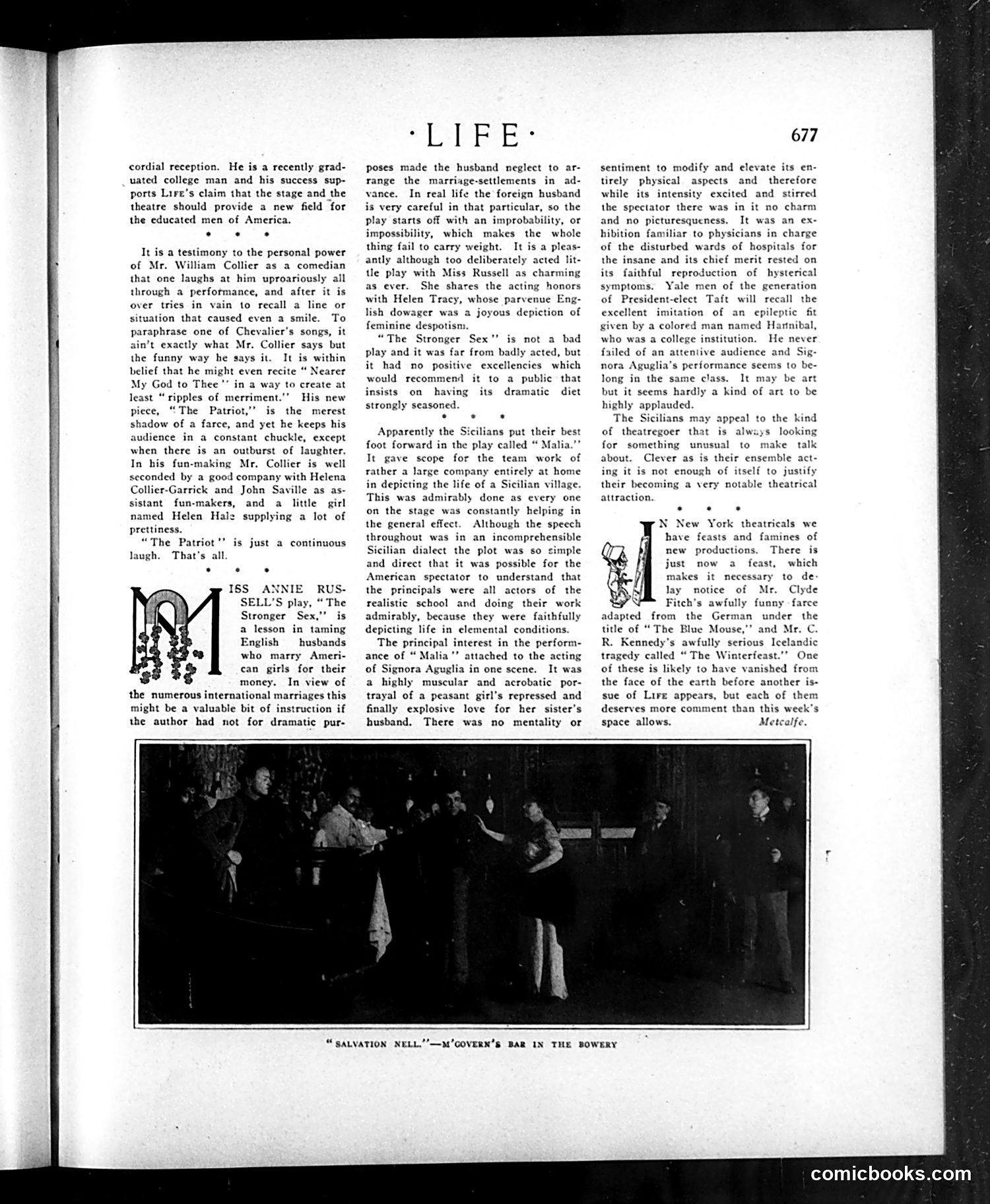
This page contains theater criticism rather than political cartoons. The reviews critique contemporary Broadway productions: **"The Patriot"** — A farce by William Collier, praised primarily for Collier's personal comedic charm rather than the script's merit. The critic notes audiences laugh throughout but can't recall specific funny lines afterward. **"The Stronger Sex"** — Annie Russell's play about American women marrying foreign husbands for money. The critic faults its dramatic setup (husbands wouldn't realistically neglect marriage settlements) despite Russell's charming performance. **"Malia"** — A Sicilian village drama notable for its ensemble acting and realistic staging. The review highlights actress Signora Aguglia's physically intense portrayal of passionate emotion, comparing it unfavorably to hysterical symptoms observed in psychiatric wards—a telling period critique using medical language to dismiss emotional female performance as pathological rather than artistic. The photograph shows a scene from "Salvation Nell."
📄 Transcribed text from this page (OCR, searchable)
Machine-transcribed from the original scan — historical spelling and the odd misread are preserved.
cordial reception. He is a recently grad- uated college man and his success sup- ports Lire’s claim that the stage and the theatre should provide a new field for the educated men of America. It is a testimony to the personal power of Mr. William Collier as a comedian that one laughs at him uproariously all through a performance, and after it is over tries in vain to recall a line or situation that caused even a smile. To paraphrase one of Chevalier's songs, it ain’t exactly what Mr. Collier says but the funny way he says it. It is within belief that he might even recite “ Nearer My God to Thee "’ in a way to create at least “ripples of merriment.'" His new piece, “The Patriot," is the merest shadow of a farce, and yet he keeps his audience in a constant chuckle, except when there is an outburst of laughter. In his fun-making Mr. Collier is well seconded by a good company with Helena Collier-Garrick and John Saville as as- sistant fun-makers, and a little girl named Helen Halz supplying a lot of prettiness. The Patriot’? is just a continuous laugh. That's all. 18S ANNIE RU SELL’S play, “The Stronger Sex,’’ is a lesson in taming English husbands who marry Ameri- can girls for their money. In view of the numerous international marriages this might be a valuable bit of instruction if the author had not for dramatic pur- “TEES poses made the husband neglect to ar- range the marriage-settlements in ad- vance. In real life the foreign husband is very careful in that particular, so the play starts off with an improbability, or impossibility, which makes the whole thing fail to carry weight. It is a pleas- antly although too deliberately acted I tle play with Miss Russell as charming as ever. She shares the acting honors with Helen Tracy, whose parvenue Eng- lish dowager was a joyous depiction of feminine despotism. “The Stronger Sex’? is not a bad play and it was far from badly acted, but it had no positive excellencies which would recommend it to a public that insists on having its dramatic diet strongly seasoned. Apparently the Sicilians put their best foot forward in the play called “ Malia.”’ It gave scope for the team work of rather a large company entirely at home in depicting the life of a Sicilian village. This was admirably done as every one on the stage was constantly helping in the general effect. Although the speech throughout was in an incomprehensible Sicilian dialect the plot was so cimple and direct that it was possible for the American spectator to understand that the principals were all actors of the realistic school and doing their work admirably, because they were faithfully depicting life in elemental conditions. The principal interest in the perform- ance of “ Malia’ attached to the acting of Signora Aguglia in one scene. It was a highly muscular and acrobatic por- trayal of a peasant girl's repressed and finally explosive love for her sister's husband. There was no mentality or 677 sentiment to modify and elevate its en- tirely physical aspects and therefore while its intensity excited and stirred the spectator there was in it no charm and no picturesqueness. It was an ex- hibition familiar to physicians in charge of the disturbed wards of hospitals for the insane and its chief merit rested on its faithful reproduction of hysterical symptoms. Yale men of the generation of President-elect Taft will recall the excellent imitation of an epileptic fit given by a colored man named Hartnibal, who was a college institution. He never failed of an attentive audience and Si nora Aguglia’s performance seems to be- long in the same class. It may be art but it seems hardly a kind of art to be highly applauded. The Sicilians may appeal to the kind of theatregoer that is always looking for something unusual to make talk about. Clever as is their ensemble act- ing it is not enough of itself to justif; their becoming a very notable theatrical attraction. N New York theatricals we have feasts and famines of new productions. There is just now a feast, which makes it necessary to de lay notice of Mr. Clyde Fitch’s awfully funny farce adapted from the German under the title of “The Blue Mouse,’’ and Mr. C. R. Kennedy's awfully serious Icelandic tragedy called “The Winterfeast.’”” One of these is likely to have vanished from the face of the earth before another is- sue of Lire appears, but each of them deserves more comment than this week's space allows. Metcalfe. “SALVATION NELL.’’—M’COVERN’S BAR IN THE BOWERY comicbooks.com