
Life, 1908-12-10 · page 16 of 24
Life — December 10, 1908 — page 16: what you’re looking at
What you’re looking at
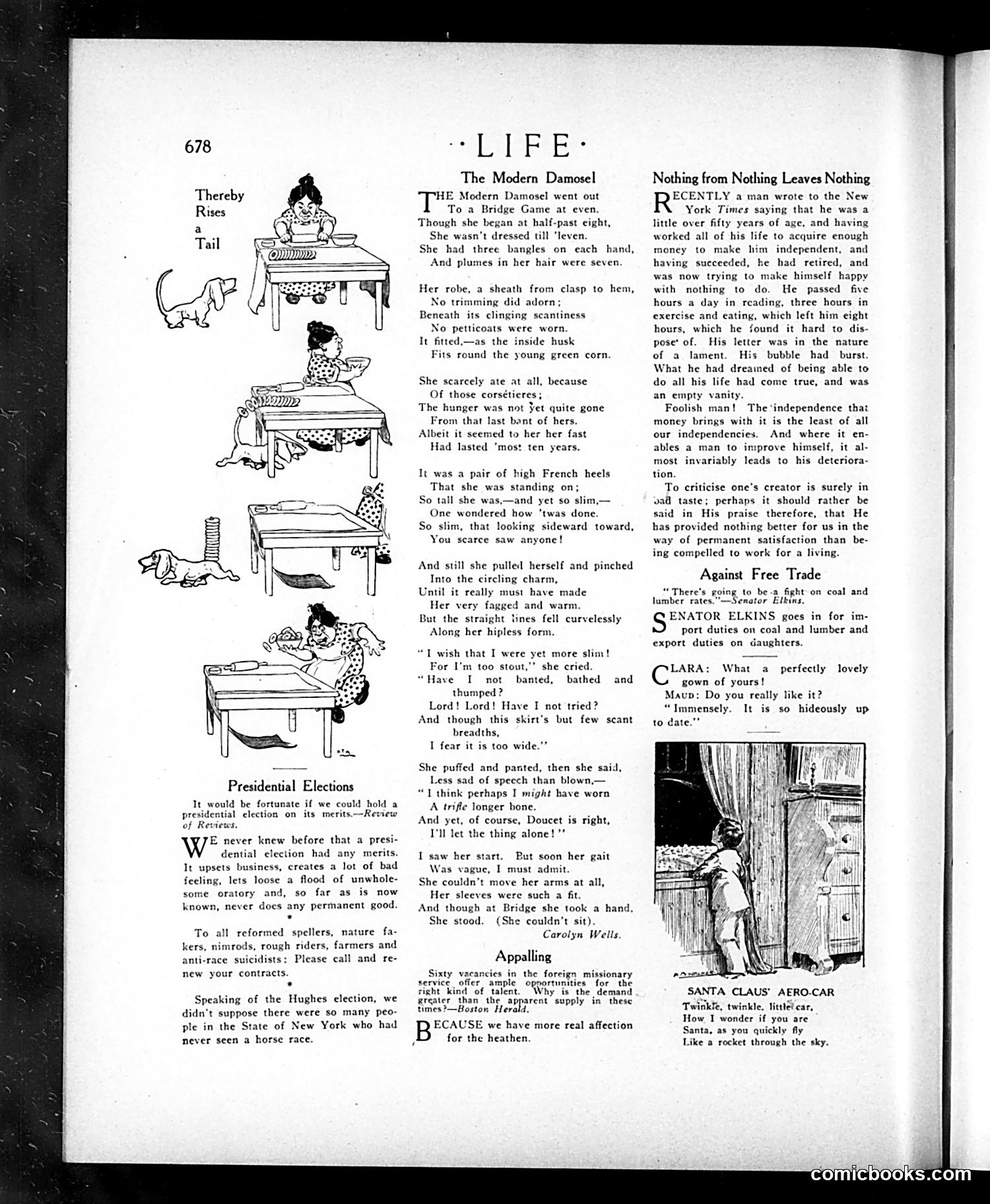
**Presidential Elections**: This section satirizes American presidential elections as inherently pointless. The writer mocks the notion that elections have "merits," claiming they upset business, generate bad feeling, and produce "unwholesome oratory" with no lasting benefit. The closing joke references the 1916 Hughes election, suggesting New York voters were so unsophisticated they'd "never seen a horse race"—implying they voted irrationally, like inexperienced gamblers. **"The Modern Damosel"**: This poem by Carolyn Wells satirizes the fashion-obsessed "modern woman" of the era. The caricature depicts an absurdly corseted, fashionably dressed woman attending a bridge game, so tightly bound in restrictive clothing (sheath dress, corset, tight sleeves) that she cannot eat, move her arms, or even sit down. The joke targets both women's vanity ("I wish I were yet more slim") and the impracticality of contemporary fashion that literally immobilizes the wearer.
📄 Transcribed text from this page (OCR, searchable)
Machine-transcribed from the original scan — historical spelling and the odd misread are preserved.
Presidential Elections It would be fortunate if we could hold a presidential election on its merits.—R. rw of Reviews. E never knew before that a presi- dential election had any merits. It upsets business, creates a lot of bad feeling, lets loose a flood of unwhole- some oratory and, so far as is now known, never does any permanent good. To all reformed spellers, nature fa- kers, nimrods, rough riders, farmers and anti-race suicidists: Please call and re- new your contracts. . Speaking of the Hughes election, we didn't suppose there were so many peo- ple in the State of New York who had never seen a horse race. aE BEAEe The Modern Damosel ‘HE Modern Damosel went out To a Bridge Game at even. Though she began at half-past eight, She wasn’t dressed till ‘leven. She had three bangles on each hand, And plumes in her hair were seven. Her robe, a sheath from clasp to hem, No trimming did adorn; Beneath its clinging scantiness No petticoats were worn. It fitted,—as the inside husk Fits round the young green corn. She scarcely ate at all, because Of those corsétieres; The hunger was not Fet quite gone From that last bant of hers. Albeit it seemed to her her fast Had lasted ‘most ten years. It was a pair of high French heels That she was standing on; So tall she was,—and yet so sl One wondered how ‘twas done. So slim, that looking sideward toward, You scarce saw anyone! And still she pulled herself and pinched Into the circling charm, Until it really must have made id warm. nes fell curvelessly Along her hipless form. “L wish that I were yet more slim! For I’m too stout,”’ she cried. “Have I not banted, bathed and thumped ? Lord! Lord! Have I not tried? And though this skirt's but few scant breadths, I fear it is too wide.”” She puffed and panted, then she said, Less sad of specch than blown,— “TL think perhaps I might have worn A trifle longer bone. And yet, of course, Doucet is right, I'll let the thing alone!" I saw her start. But soon her gait Was vague, I must admit. She couldn’t move her arms at all, Her sleeves were such a fit. And though at Bridge she took a hand, She stood. (She couldn’t sit) Carolyn Wells. Appalling y vacancies in the for ign missionary ample opportunities for the right kind of talent. Why is the demand greater than the apparent supply in these times?—Boston Herald, service offer ECAUSE we have more real affection for the heathen, Nothing from Nothing Leaves Nothing ECENTLY a man wrote to the New ‘ork Times saying that he was a little over fifty years of age, and having worked all of his life to acquire enough money to make independent, and having succeeded, he had retired, and was now trying to make himself happy with nothing to do. He passed five hours a day in reading, three hours in exercise and eating, which left him eight hours, which he found it hard to dis- pose’ of. His letter was in the nature of a lament. His bubble had burst. What he had dreamed of being able to do all his life had come true, and was an empty vanity. Foolish man! The‘independence that money brings with it is the least of all our independencies. And where it en- ables a man to improve himself, it al- most invariably leads to his deteriora- tion. To criticise one’s creator is surely in vad taste; perhaps it should rather be said in His praise therefore, that He has provided nothing better for us in the way of permanent satisfaction than be- ing compelled to work for a living. Against Free Trade “There's going to bea fight on coal and lumber rates.""—Senator Elkins, S ENATOR ELKINS goes in for im- port duties on coal and lumber and export duties on daughters. LARA: What a gown of yours! Mavp: Do you really like it? Immensely. It is so hideously up perfectly lovely SANTA CLAUS’ AERO-CAR Twinkle, twinkle, littlet car, How I wonder ou are Santa, as you quickly fly Like a rocket through the sky.