
Life, 1908-12-10 · page 9 of 24
Life — December 10, 1908 — page 9: what you’re looking at
What you’re looking at
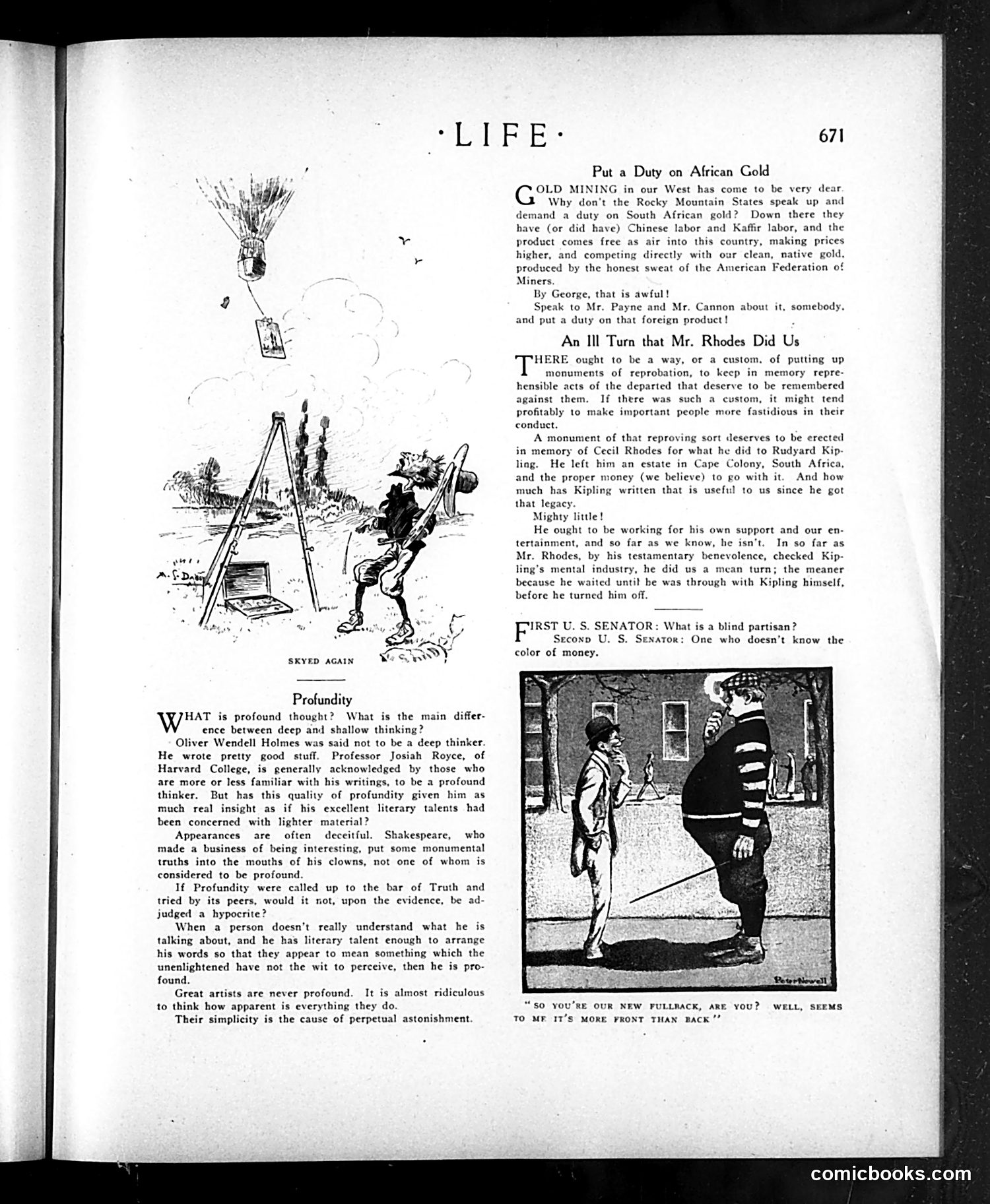
**"Put a Duty on African Gold"** discusses whether South African gold should face import tariffs to protect American mining interests, particularly against Chinese and Kaffir labor (offensive historical terminology). **"An Ill Turn that Mr. Rhodes Did Us"** critiques Cecil Rhodes' legacy in South Africa, specifically his bequest to Rudyard Kipling. The piece argues Rhodes' money has proven of limited value to Kipling's literary work. **"Profundity"** satirizes Oliver Wendell Holmes and literary pretentiousness, arguing that great artists achieve their impact through simplicity rather than obscure profundity—when people don't understand what's being discussed, they mistake confusion for depth. The cartoon shows two figures in conversation; the caption jokes about partisan blindness regarding money's influence in politics.
📄 Transcribed text from this page (OCR, searchable)
Machine-transcribed from the original scan — historical spelling and the odd misread are preserved.
SESE sEe: 671 Put a Duty on African Gold OLD MINING in our West has come to be very dear Why don't the Rocky Mountain States speak up and demand a duty on South African gold? Down there they have (or did have) Chinese labor and Kaffir labor, and the product comes free as air into this country, making prices higher, and competing directly with our clean, native gold, produced by the honest sweat of the American Federation of Miners. By George, that is awful! Speak to Mr. Payne and Mr. Cannon about it, somebody, and put a duty on that foreign product! An Ill Turn that Mr. Rhodes Did Us HERE ought to be a way, or a custom, of putting up monuments of reprobation, to keep in memory repre- hensible acts of the departed that deserve to be remembered against them. If there was such a custom, it might tend profitably to make important people more fastidious in their conduct. A monument of that reproving sort deserves to be erected in memory of Cecil Rhodes for what he did to Rudyard Kip- ling. He left him an estate in Cape Colony, South Africa, and the proper money (we believe) to go with it. And how much has Kipling written that is useful to us since he got that legacy. Mighty little! He ought to be working for his own support and our en- tertainment, and so far as we know, he isn’t. In so far as Mr. Rhodes, by his testamentary benevolence, checked Kip- ling’s mental industry, he did us a mean turn; the meaner because he waited untit he was through with Kipling himself, before he turned him off. IRST U. S. SENATOR: What is a blind partisan? Seconn U. S. Senator: One who doesn’t know the color of money. Profundity HAT is profound thought? What is the main differ- ence between deep and shallow thinking? Oliver Wendell Holmes was said not to be a deep thinker. He wrote pretty good stuff. Professor Josiah Royce, of Harvard College, is generally acknowledged by those who are more or less familiar with his writings, to be a profound thinker. But has this quality of profundity given him as much real insight as if his excellent literary talents had been concerned with lighter material? Appearances are often deceitful. Shakespeare, who made a business of being interesting, put some monumental truths into the mouths of his clowns, not one of whom is considered to be profound. If Profundity were called up to the bar of Truth and tried by its peers, would it not, upon the evidence, be ad- judged a hypocrite? When a person doesn’t really understand what he is talking about, and he has literary talent enough to arrange his words so that they appear to mean something which the unenlightened have not the wit to perceive, then he is pro- found. Great artists are never profound. It is almost ridiculous to think how apparent is everything they do. “(30 YOU'RE OUR NEW PULLRACK, ARE YOU? WELL, SEEMS Their simplicity is the cause of perpetual astonishment. TO MF IT’S MORE FRONT THAN BACK ’” comicbooks.com