
A complete issue · 28 pages · 1908
Life — November 19, 1908
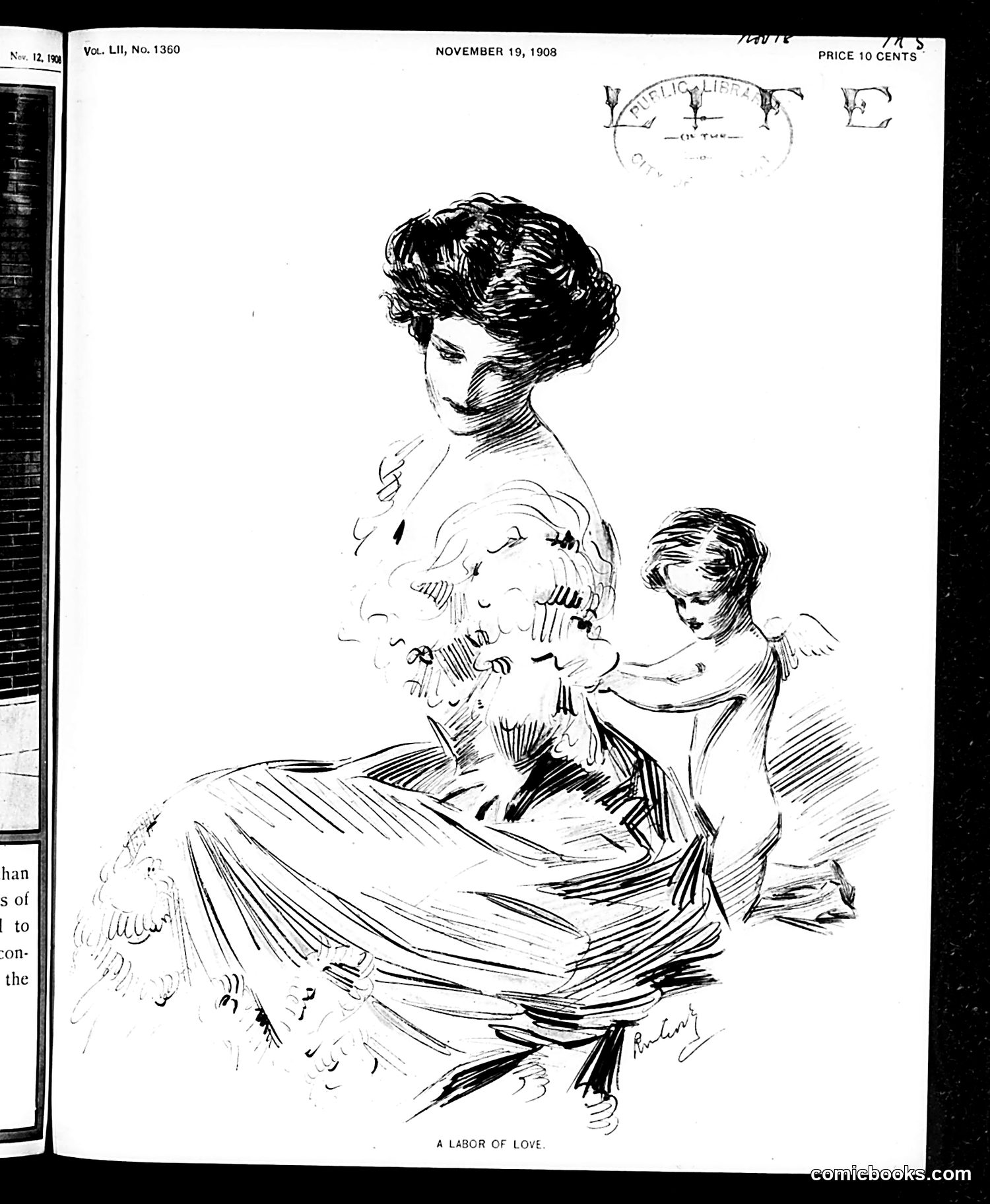
This 1908 Life magazine illustration depicts a woman seated with a young child, titled "A Labor of Love." The sketch employs sentimental, idealized artistic style typical of early 20th-century sentimental illustration. Without additional context text on this page, the specific satirical or political intent remains unclear. The title could reference motherhood as noble "labor," or—given Life's satirical nature—possibly mock sentimentalized views of domestic work, or critique something about contemporary attitudes toward women and children. The artistic quality and subject matter suggest this either accompanied an article or served as standalone commentary on domestic/social themes relevant to 1908 audiences. The full satirical point would require viewing accompanying text or article context not visible here.
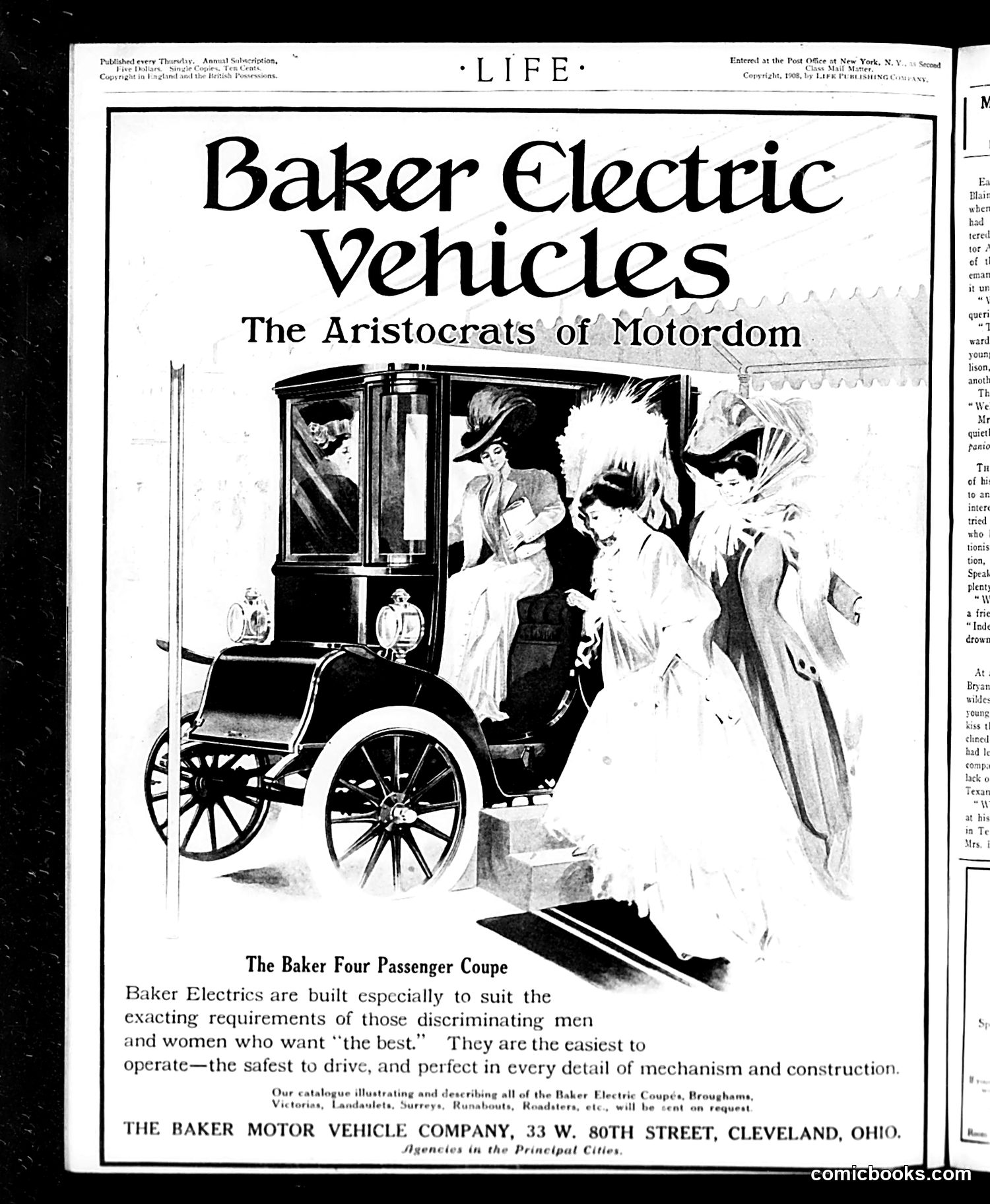
This is **not a cartoon or satire**, but rather a straightforward advertisement for Baker Electric Vehicles, a real automobile manufacturer based in Cleveland, Ohio. The ad promotes the "Baker Four Passenger Coupe" as luxury transportation for wealthy, discriminating consumers ("the best"). The illustration depicts elegantly dressed women in elaborate Edwardian fashion (large feathered hats, formal gowns) admiring or boarding the electric vehicle, positioning it as a status symbol appropriate for high society. The text emphasizes the car's ease of operation, safety, and mechanical perfection—practical selling points for early electric automobiles, which were quieter and cleaner than gasoline vehicles and appealed particularly to affluent female drivers during the early 1900s.
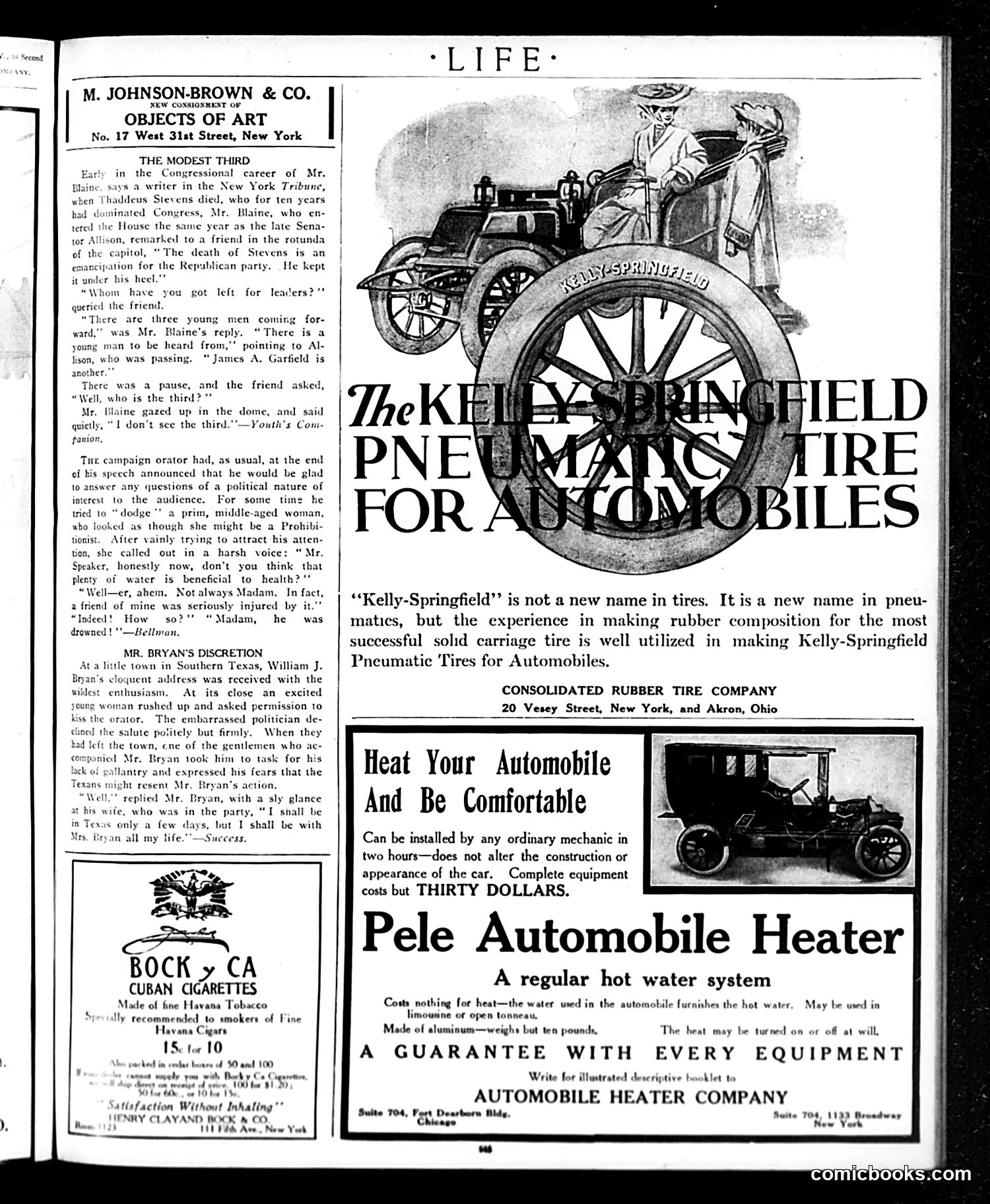
This page is primarily **advertising**, with minimal editorial content. The main cartoon depicts an automobile with two well-dressed men, advertising Kelly-Springfield pneumatic tires for automobiles—emphasizing the company's experience in rubber composition. The left column contains brief anecdotes labeled "The Modest Third" and "Mr. Bryan's Discretion," appearing to be political humor. The first references congressional succession following Thaddeus Stevens's death; the second mentions William J. Bryan, suggesting Democratic Party mockery. The advertisements below—for Bock y Ca Cuban cigarettes and the Pele Automobile Heater—are period-typical commercial content. The page's satire, if any, is minimal; it primarily served as a revenue vehicle for advertisers in an early-20th-century satirical publication.
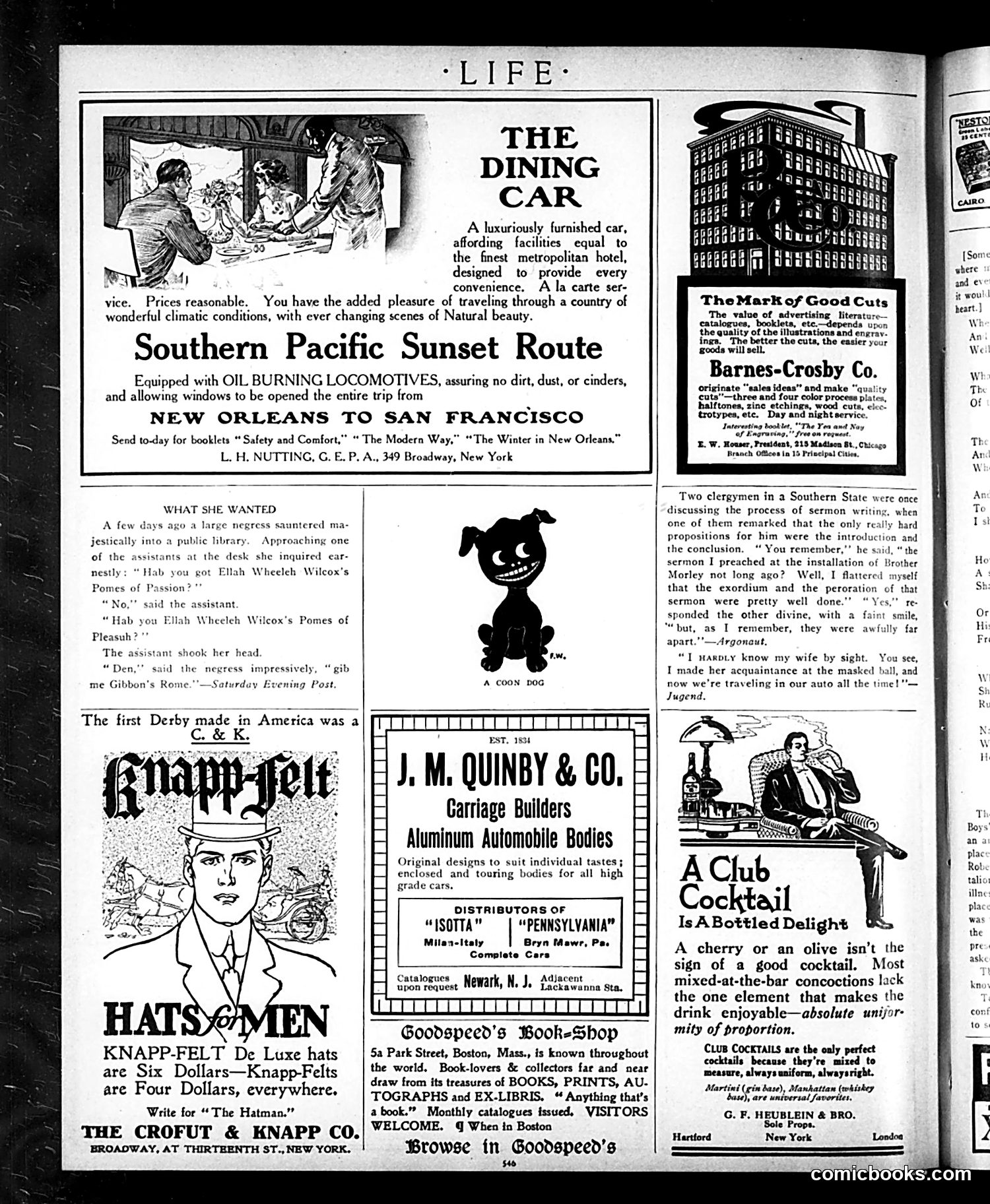
This page is primarily **advertising with minimal editorial content**. The main items include: - **Southern Pacific railroad ad** promoting luxury dining cars and scenic routes from New Orleans to San Francisco - **Knapp-Felt hat advertisement** - **J.M. Quinby & Co.** carriage builders ad - **A small cartoon titled "A Coon Dog"** — a simple, crude black silhouette illustration with minimal satirical content The one editorial piece, "What She Wanted," appears to be a brief humorous anecdote about a library patron asking for book titles, with a punchline about "Gibbon's Rome." There is **no significant political satire or social commentary** on this page. The "Coon Dog" illustration, while problematic by modern standards, lacks context suggesting deeper meaning beyond the simple animal drawing. The page functions primarily as a commercial vehicle for period advertising.
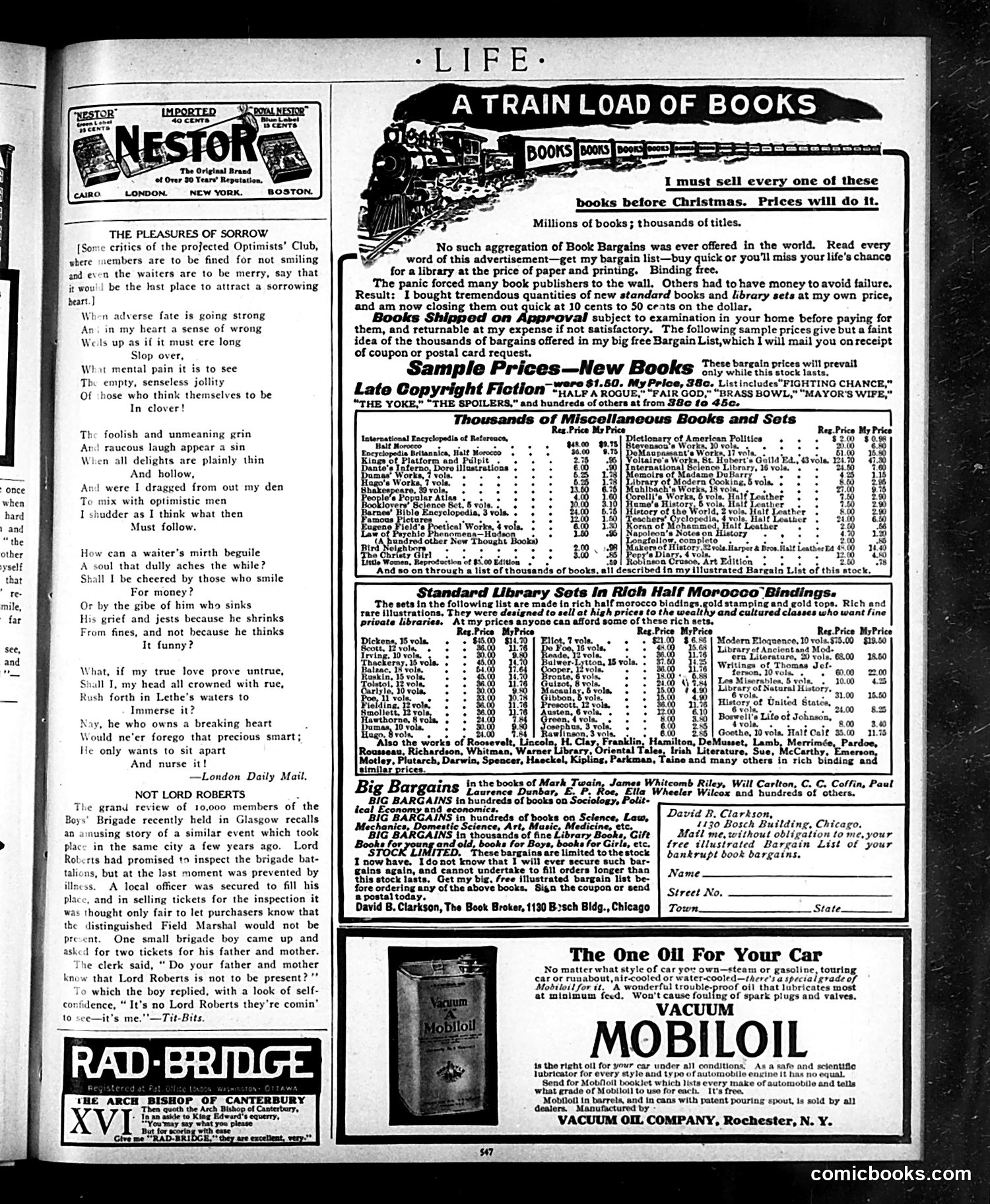
This page is primarily **advertising and literary content** rather than political satire. The dominant feature is "A Train Load of Books"—a large advertisement for a book seller offering bargain-priced volumes before Christmas. The ad emphasizes thousands of titles at reduced prices, appealing to budget-conscious readers. The left column contains poetry titled "The Pleasures of Sorrow" and another poem "Not Lord Roberts" (likely referencing the British military figure), exploring romantic melancholy and a anecdote about a boy brigade. Below are advertisements for **Rad-Bridge** (a film) and **Mobiloil** motor oil. This appears to be a typical 1920s Life magazine page mixing humor, literature, and commercial messages rather than focused political commentary.
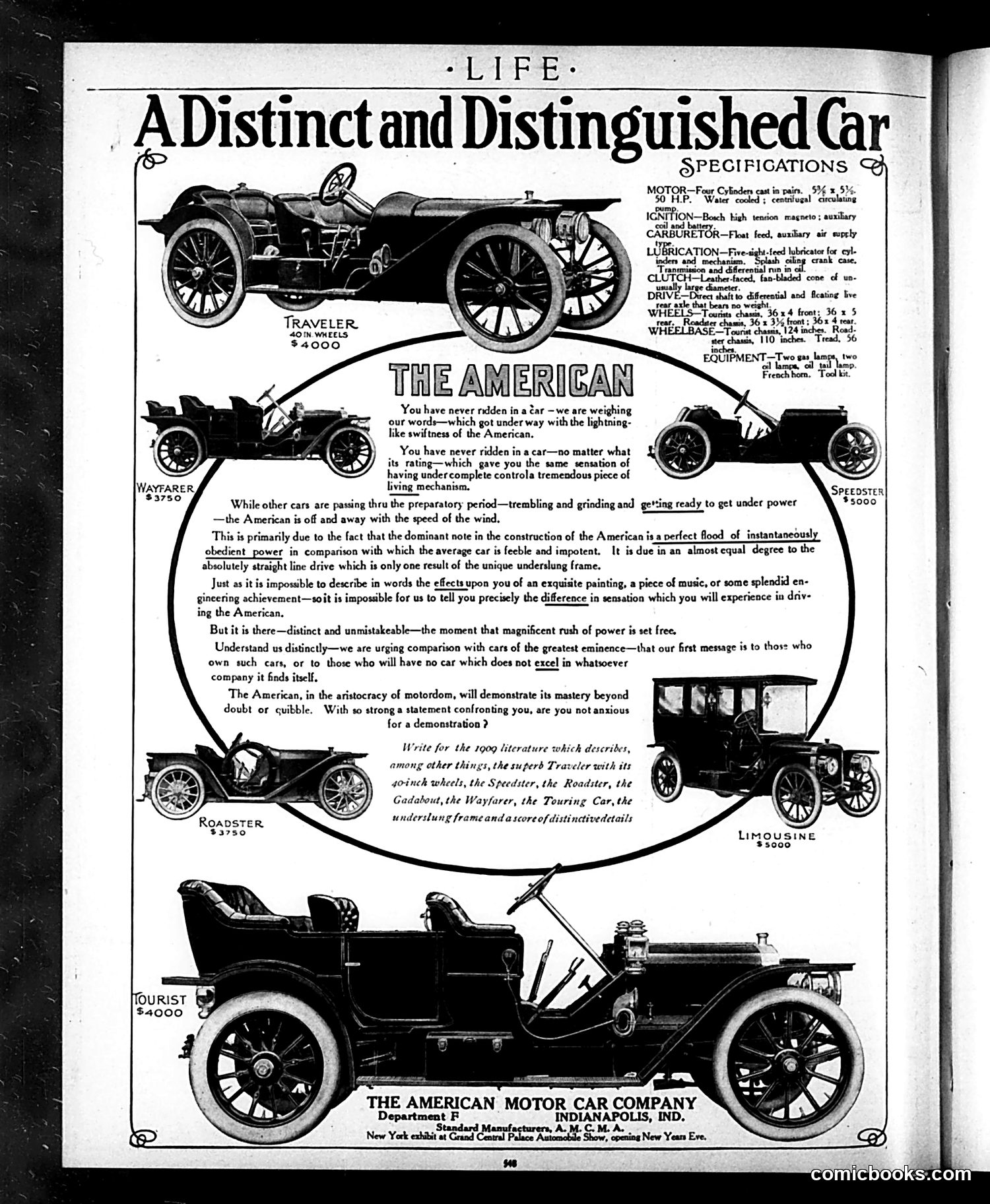
This is **not a political cartoon or satire** — it's a straightforward **automobile advertisement** for the American Motor Car Company of Indianapolis. The page showcases six vehicle models (Traveler, Wayfarer, Speedster, Roadster, Limousine, and Tourist) with prices ranging from $2,750 to $5,000. The text uses marketing language emphasizing the American car's superior engineering, particularly its "perfect flood of instantaneously electrical power" and distinctive undersung frame design. The central message compares driving an American car favorably to other vehicles, claiming unmatched power and control. This is period automotive advertising, not social or political commentary. The decorative border and multiple vehicle illustrations were typical design conventions of early 1900s trade publications.
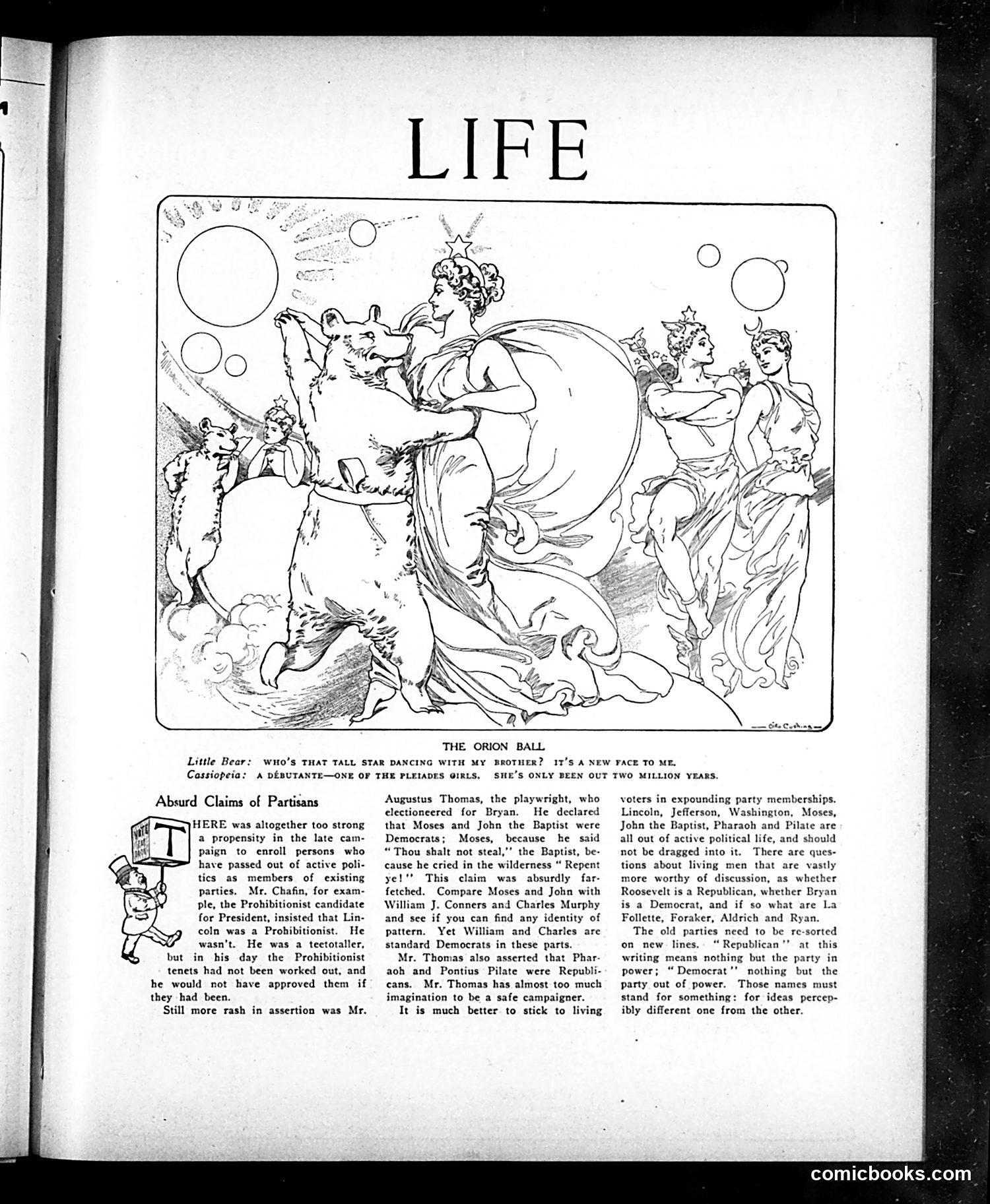
This Life magazine page satirizes absurd partisan political claims. The illustration shows mythological and allegorical figures (including bears, cherubs, and classical figures) at a celestial ball. The accompanying text mocks Augustus Thomas, a playwright supporting Bryan's presidential campaign, for making ridiculous historical claims. Thomas allegedly asserted that biblical figures Moses and John the Baptist were Democrats, and that Republican figures like William Conners and Charles Murphy matched ancient patterns—comparisons the author finds laughably far-fetched. The satire targets both Thomas's over-imaginative campaign rhetoric and the broader tendency of both parties to retroactively claim famous historical figures for political credibility. The joke is that such partisan name-claiming is equally absurd regardless of which party does it.
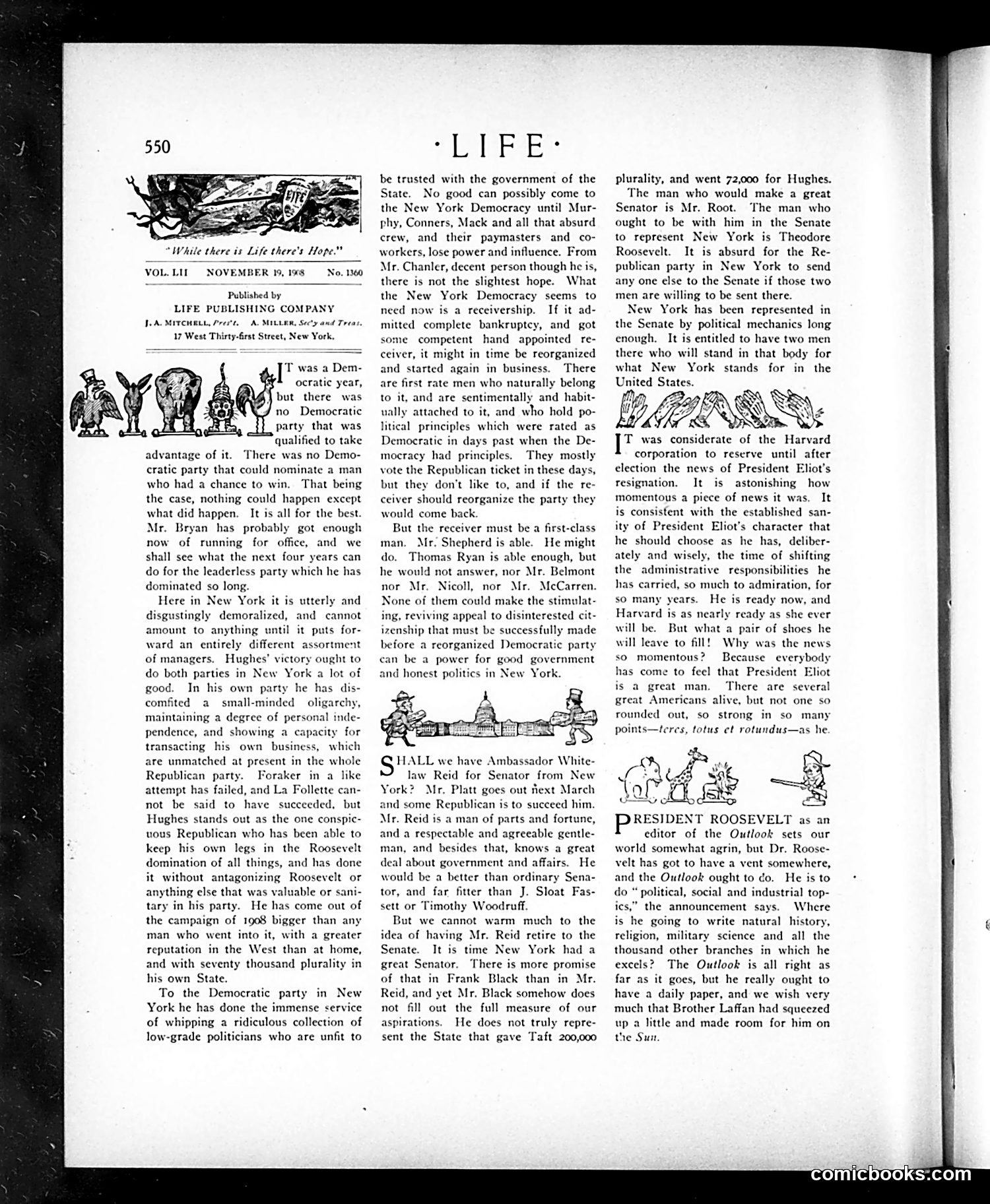
This page critiques New York's Democratic Party leadership during a period of internal chaos. The text argues the party is "utterly and disgustingly demoralized" and cannot attract competent leadership. The satire discusses potential Senate candidates: Ambassador Whitclaw Reid and potential successors to departing Senator Platt are mentioned as options. The author suggests the Democratic Party lacks capable figures—that "there is not the slightest hope" without a complete reorganization under competent leadership. The commentary also praises President Roosevelt, suggesting his administrative competence contrasts sharply with Democratic disarray. The overall tone is scathing toward Democratic Party dysfunction in New York politics during this period.
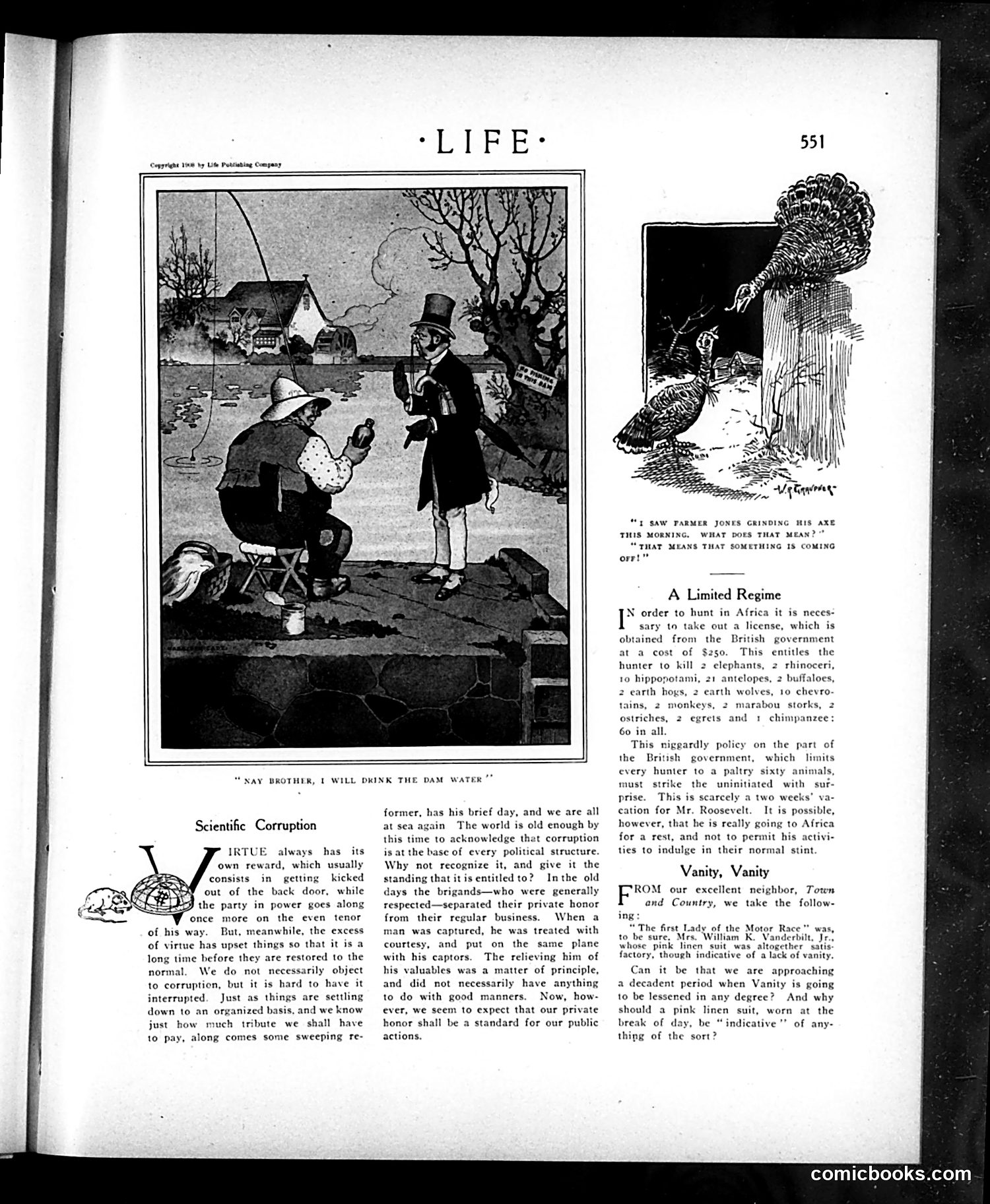
**"Scientific Corruption"** (left cartoon): A man in a top hat fishes while another man approaches. The text criticizes how political corruption works like fishing—those "in power" benefit while excess virtue temporarily disappears before normalcy resumes. It argues that organized institutions enable corruption that honest individuals cannot stop alone. **"A Limited Regime"** (right, with turkeys): References British hunting licenses costing £250, allowing hunters to kill specific numbers of elephants, rhinoceroses, and other animals. The satire appears critical of this "niggardly policy" as inadequate for Roosevelt, mocking the arbitrariness of colonial wildlife restrictions. **"Vanity, Vanity"** (bottom): Gossip column commentary on fashion trends, unrelated to political content.
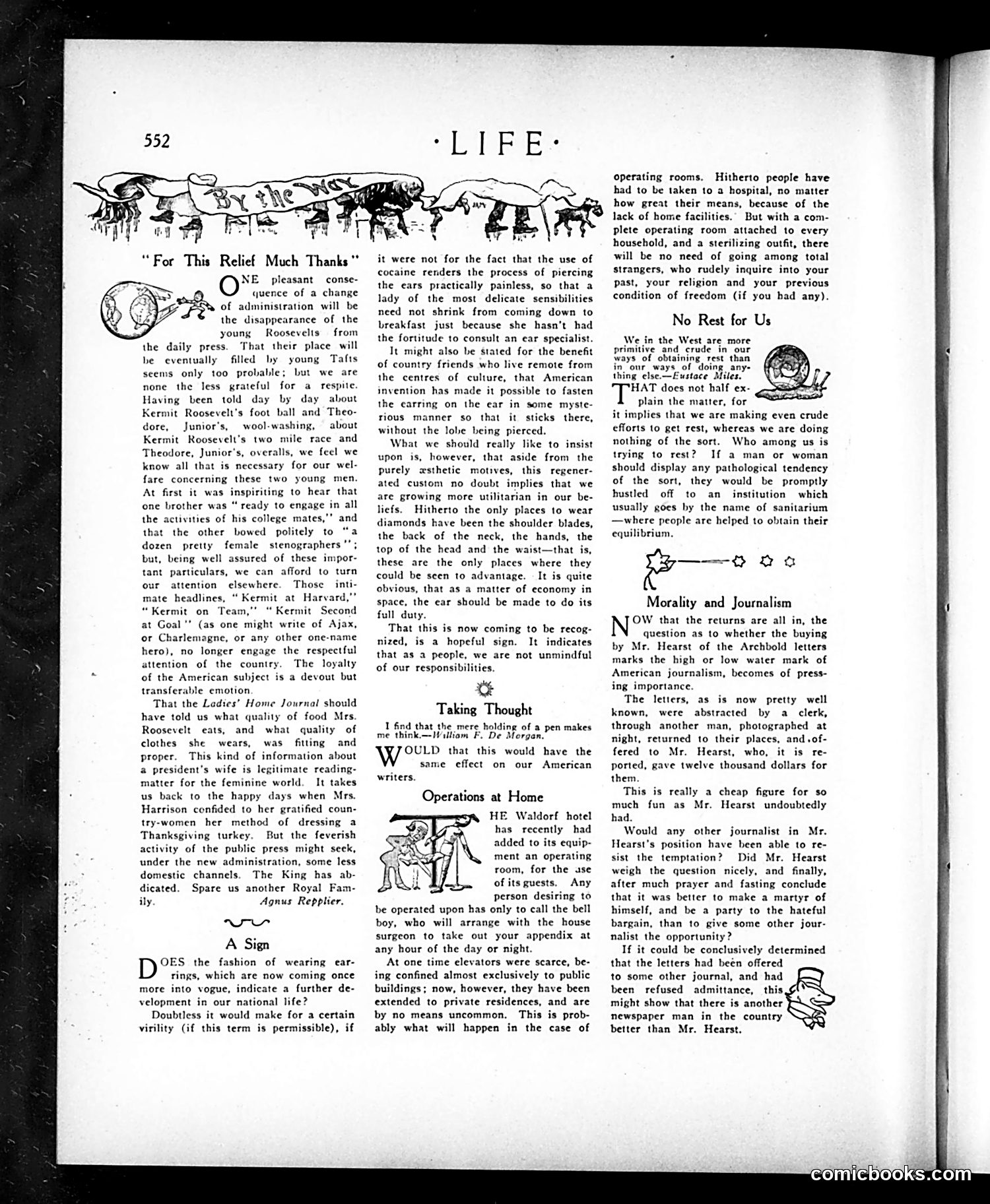
This page contains several short satirical essays rather than political cartoons. The pieces critique early 20th-century American life: **"For This Relief Much Thanks"** mocks the Roosevelt administration's expansion of government bureaucracy, specifically praising the addition of operating rooms to hospitals—sarcastically suggesting this represents significant "progress." **"Taking Thought"** discusses a quote attributed to William F. De Morgan about effects on American writers. **"Operations at Home"** criticizes the Waldorf hotel's recent addition of an operating room for guest appendectomies, satirizing the absurdity of privatizing medical procedures previously handled in hospitals. **"Morality and Journalism"** addresses Mr. Hearst's purchase of Archibold letters, debating whether journalism ethics permit such transactions. The overall tone mocks institutional pretension and contemporary social trends through gentle mockery.
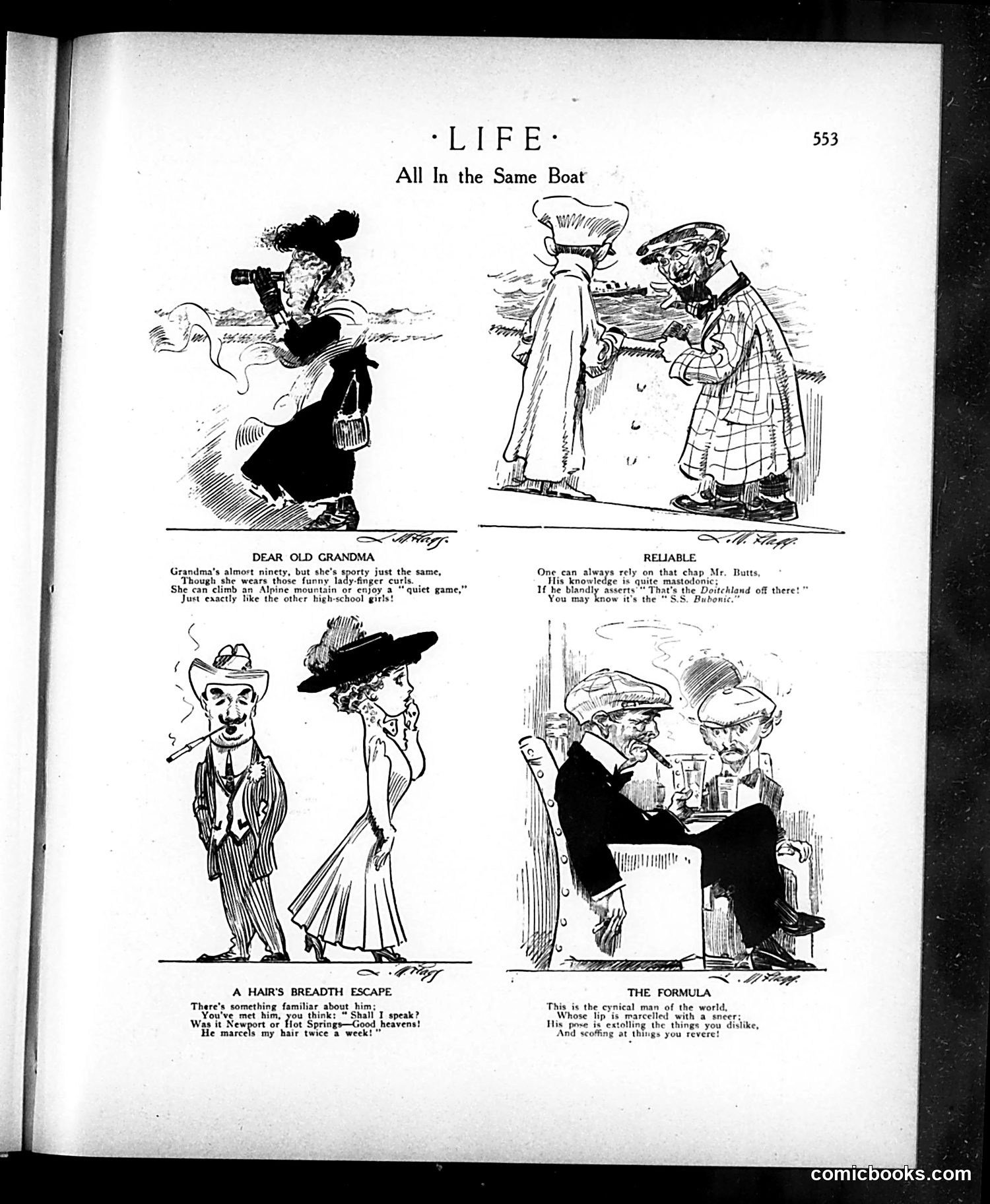
This page contains four satirical cartoons mocking various social types and behaviors: 1. **"Dear Old Grandma"**: Jokes about an elderly woman who claims athletic prowess despite her age—she can climb mountains and play "quiet games," matching her granddaughter's abilities. 2. **"Reliable"**: Satirizes a man named Mr. Butts who is "quite masochistic"—he confidently asserts false information about Germany while remaining willfully ignorant. 3. **"A Hair's Breadth Escape"**: Mocks a married couple; the husband complains about her frequent salon visits ("twice a week!"), suggesting marital tension over beauty expenses. 4. **"The Formula"**: Depicts two men; one has a "sneer" and "exalts things you dislike," while the other scorns what the first reveres—satirizing petty contrarianism in relationships or society.
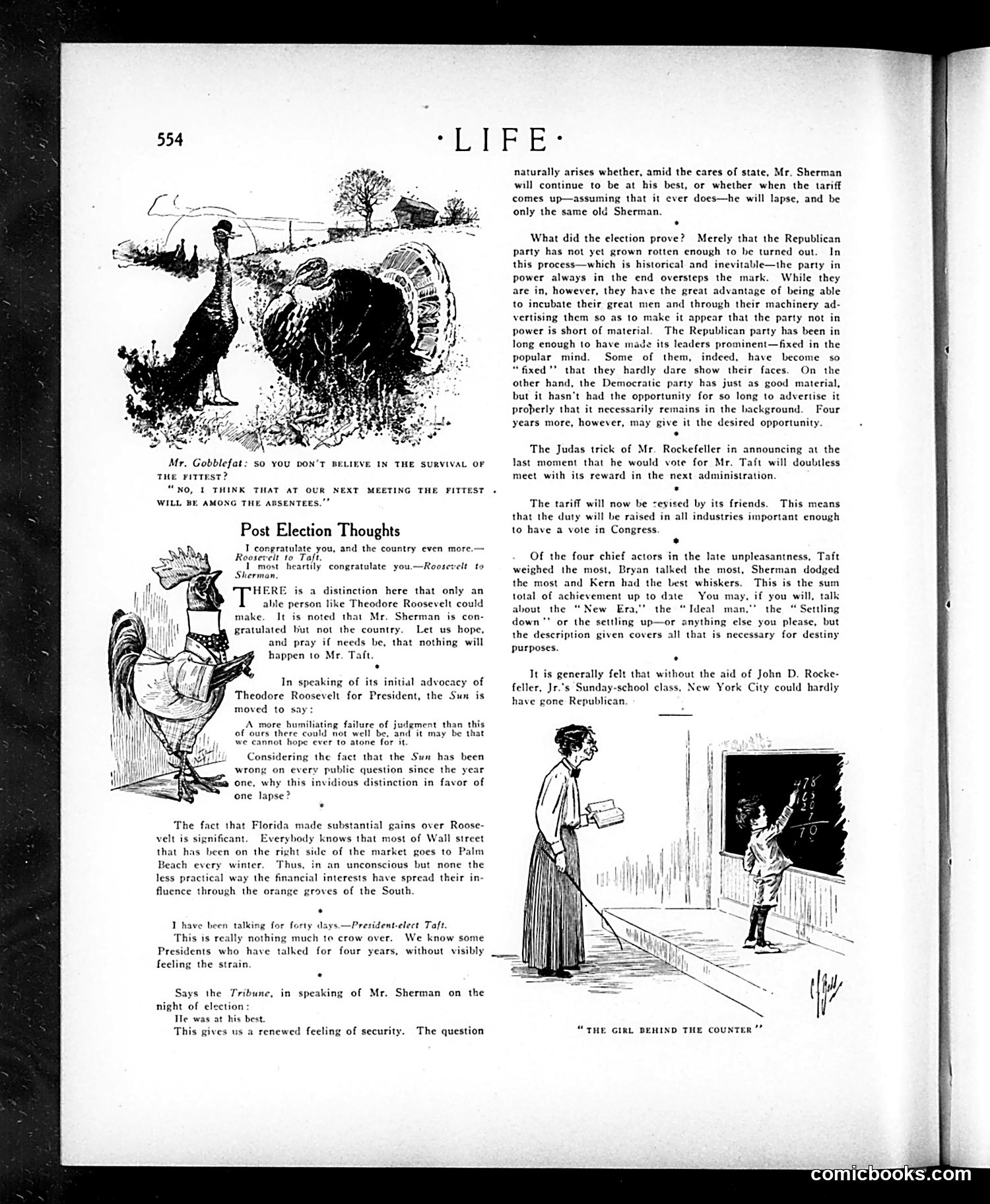
The top cartoon depicts a turkey labeled "Mr. Gobbler" rejecting survival of the fittest, with the caption stating he believes the fittest will be absent from their next meeting. This appears to be satirizing political complacency—likely about Republican Party confidence following an election. The page's main article, "Post Election Thoughts," discusses Theodore Roosevelt's endorsement of a presidential candidate and analyzes election results, particularly regarding tariff policy and Wall Street influence in Florida's gains. The bottom illustration, "The Girl Behind the Counter," shows a young woman at what appears to be a shop counter, though its specific satirical meaning remains unclear without additional context.
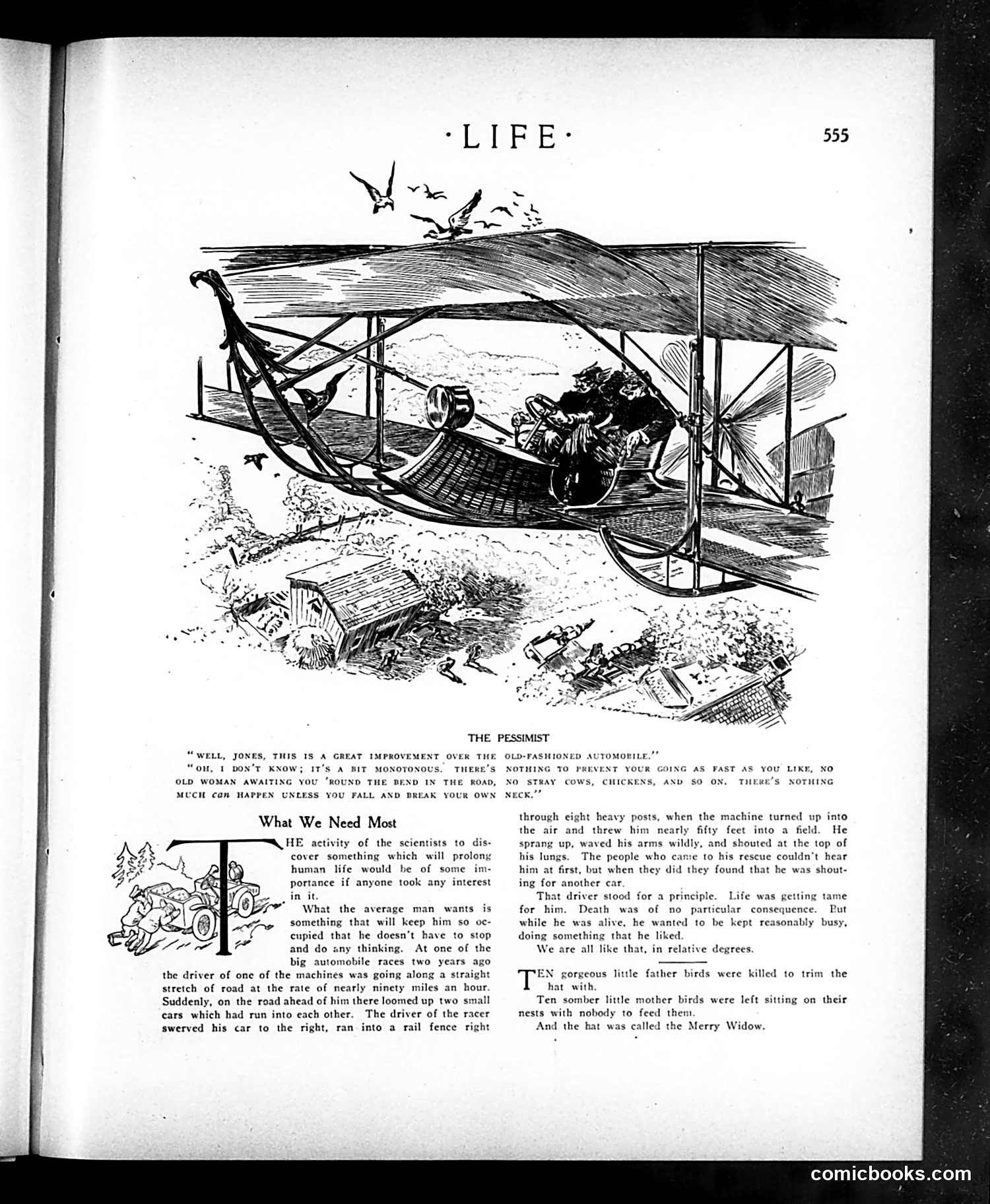
This page contains two distinct pieces satirizing automobile safety and driver behavior in the early automotive era. **"The Pessimist"** depicts a woman warning a male driver about the dangers of automobiles—she references previous accidents and urges caution. The cartoon mocks pessimistic attitudes toward the then-new technology. **"What We Need Most"** criticizes reckless driving. It describes a racer driving at "nearly ninety miles an hour" who swerves into oncoming traffic, causing a collision with two small cars. The narrative suggests that what society needs is not more automotive innovation, but rather driver responsibility and safety-consciousness. Both pieces reflect early-1900s anxieties about automobile dangers and the cultural clash between technological enthusiasm and genuine safety concerns.
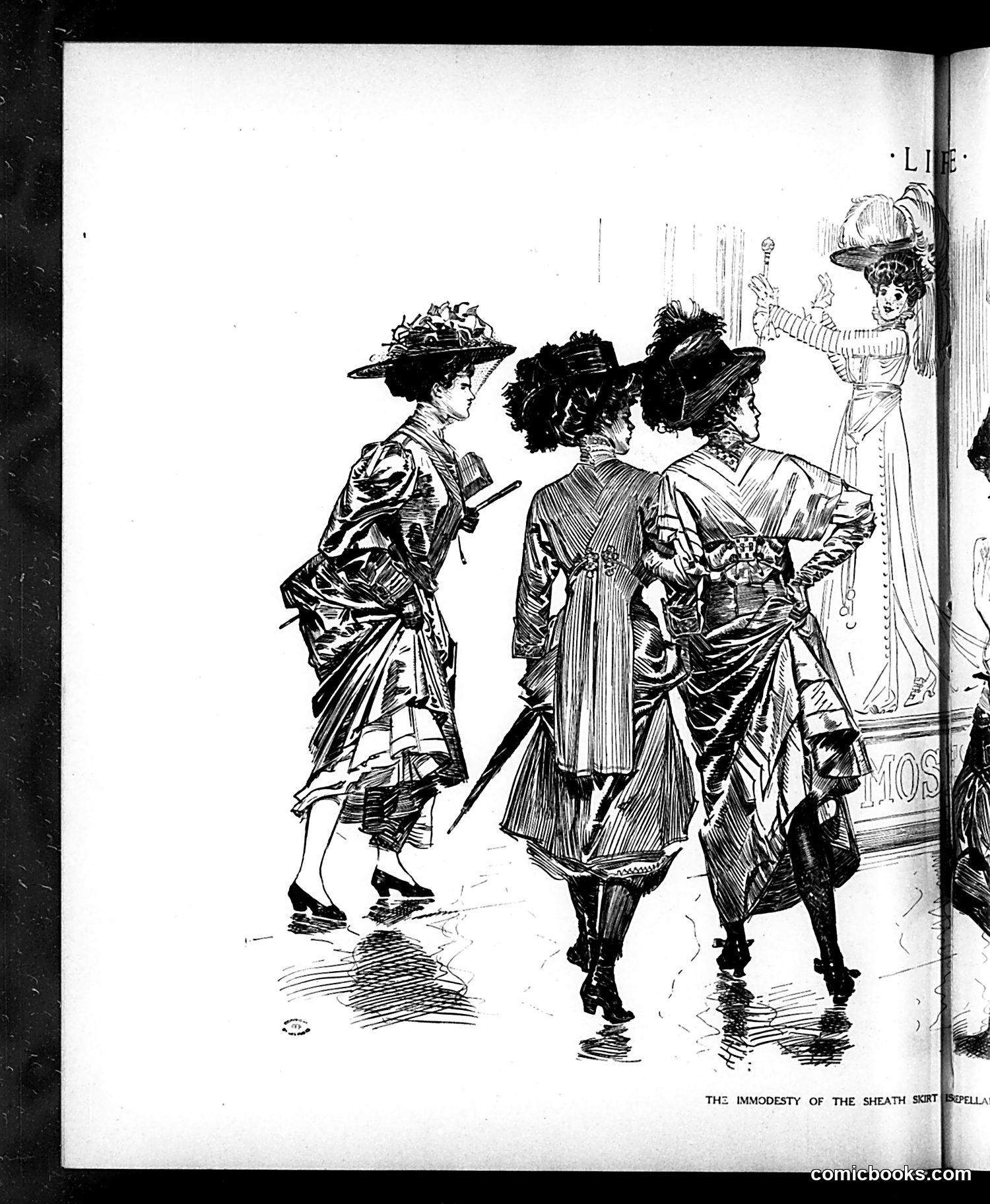
This satirical illustration mocks the "sheath skirt"—a fashionable women's garment of the early 1900s that fit tightly around the hips and legs. Three well-dressed women in elaborate hats are depicted, with one appearing scandalized or commenting on the trend. The joke centers on Victorian-era body modesty standards. The sheath skirt was controversial because its form-fitting silhouette emphasized women's figures more than previous loose designs, making it seem "immodest" to conservative critics. Life magazine, being satirical, uses the woman observing from above (possibly representing propriety or scandal) to amplify this moral panic. The cartoon mocks both the garment as socially transgressive and, implicitly, the prudishness of those who found it shocking. This reflects early 20th-century debates over women's fashion and changing social attitudes.
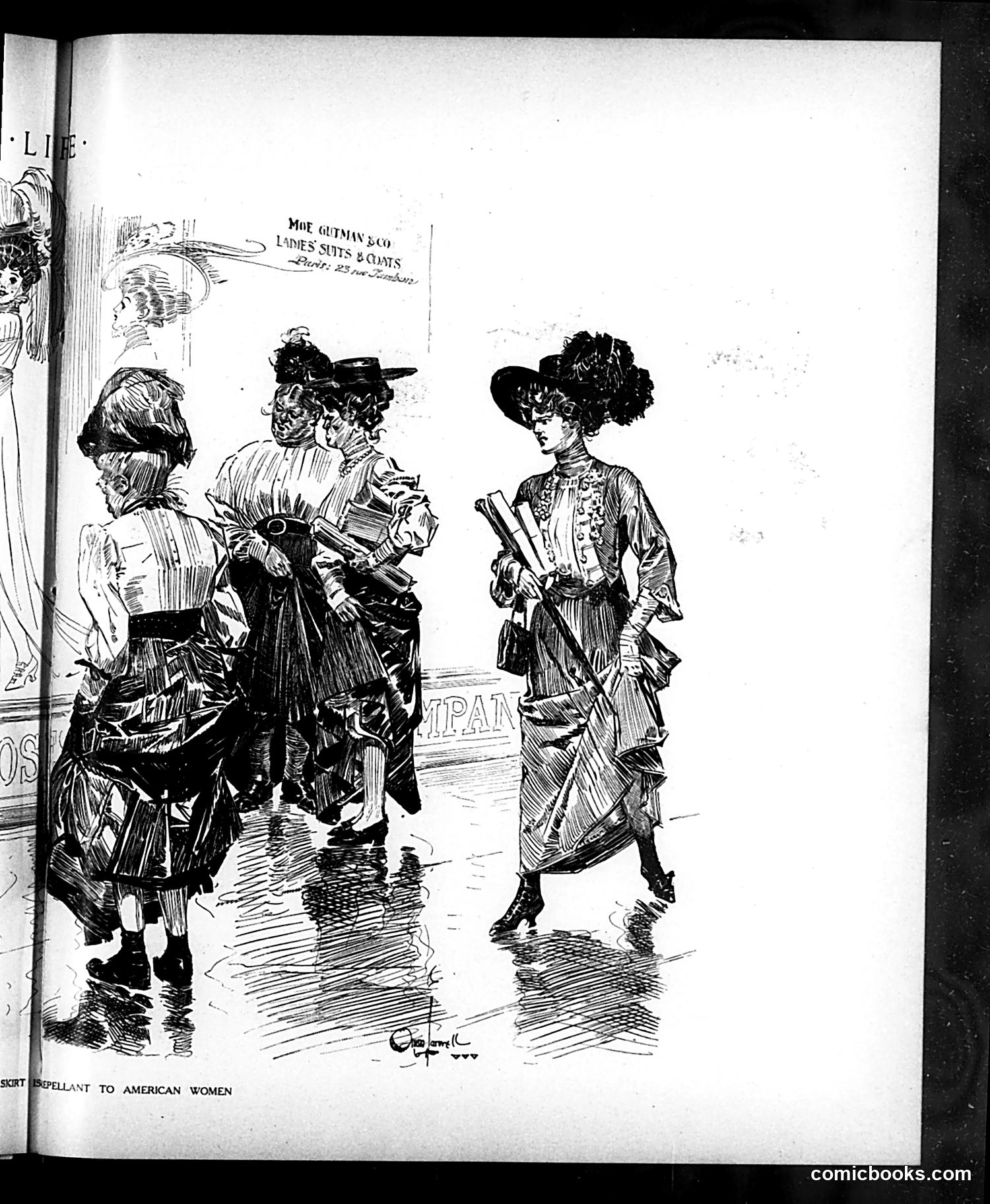
This cartoon satirizes women's fashion, specifically skirt designs from Mme. Gutman & Co. (visible in the shop sign). The drawing shows fashionably dressed women on a street, with the caption "Skirt Repellant to American Women." The satire likely mocks either an overly ornate, impractical, or foreign skirt style being marketed as fashionable. The women's elaborate hats, cinched waists, and detailed clothing suggest early 20th-century fashion commentary. By calling it "repellant," *Life* magazine—known for satirizing contemporary trends—suggests American women would reject this particular design despite its marketing, either because it was too extreme, too French/continental, or otherwise unsuitable for practical American tastes.
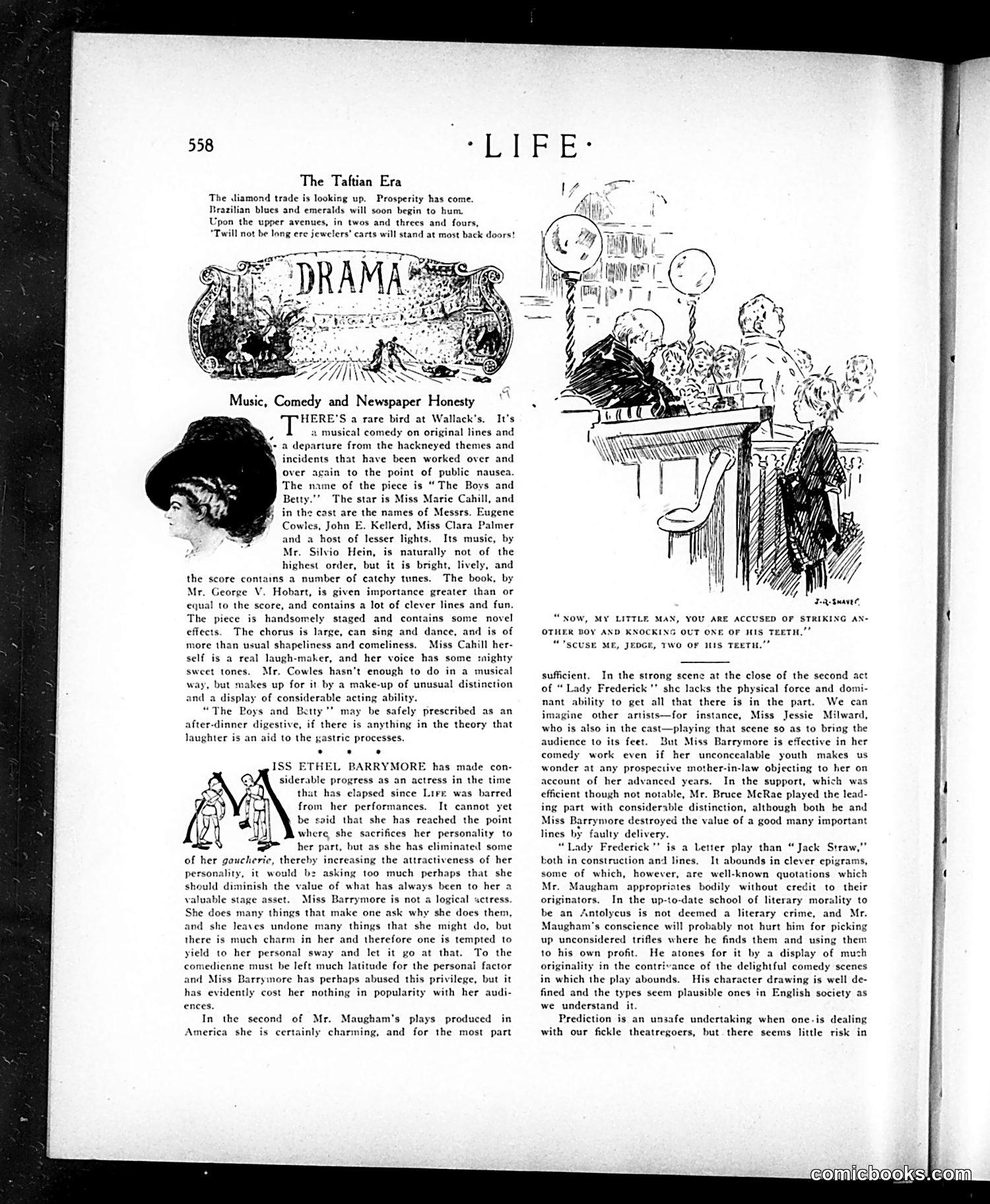
This page from *Life* magazine reviews theatrical productions and includes a satirical cartoon about judicial leniency. **The "Taftian Era" poem** at top appears to reference President Taft's administration, sardonically predicting that prosperity will soon bring luxury goods (diamonds, jewelry) back to the wealthy. **The drama reviews** discuss contemporary Broadway productions: "The Boys and Betty" (a musical comedy starring Marie Cahill) and plays featuring actress Ethel Barrymore. The critiques are generally favorable, praising the humor and staging while noting Barrymore's charm despite her tendency to prioritize personality over character. **The cartoon** depicts a judge hearing a case where a boy is accused of striking another boy and knocking out a tooth. The defendant corrects the judge: "Scuse me, jedge, two of his teeth"—a humorous admission that the boy actually caused more damage than charged. The joke satirizes either judicial incompetence or the boy's casual honesty about his misdeed.
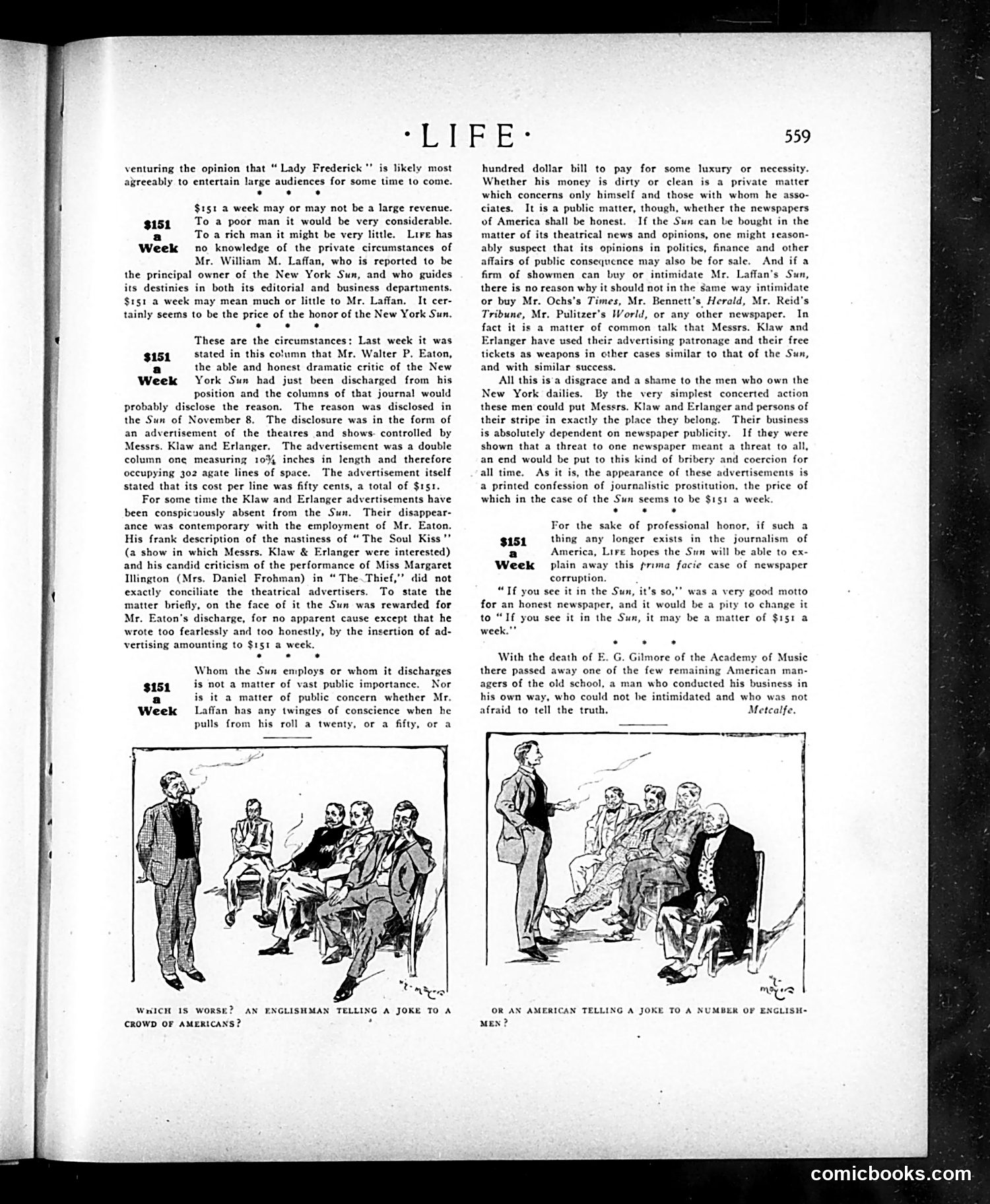
This page satirizes **newspaper corruption**, specifically criticizing the *New York Sun* for firing drama critic **Walter P. Eaton** after he negatively reviewed shows by theatrical producers **Klaw and Erlanger**. The irony: the *Sun* then published a $151 advertisement from those same producers—precisely one week's salary for Eaton. Life argues this demonstrates bought journalism. The editor warns that if major theatrical interests can intimidate the *Sun*, they can similarly corrupt the *Times*, *Herald*, *Tribune*, and *World*—threatening all American press integrity. The two cartoons illustrate comparative cultural dignity: one shows an Englishman joking to Americans; the other shows an American joking to Englishmen. This underscores the editorial's concern: American newspapers are sacrificing their honor and credibility, damaging national reputation. The satire's force depends on understanding Klaw-Erlanger's dominance in theater production and newspapers' dependence on theatrical advertising revenue—a system enabling editorial blackmail.
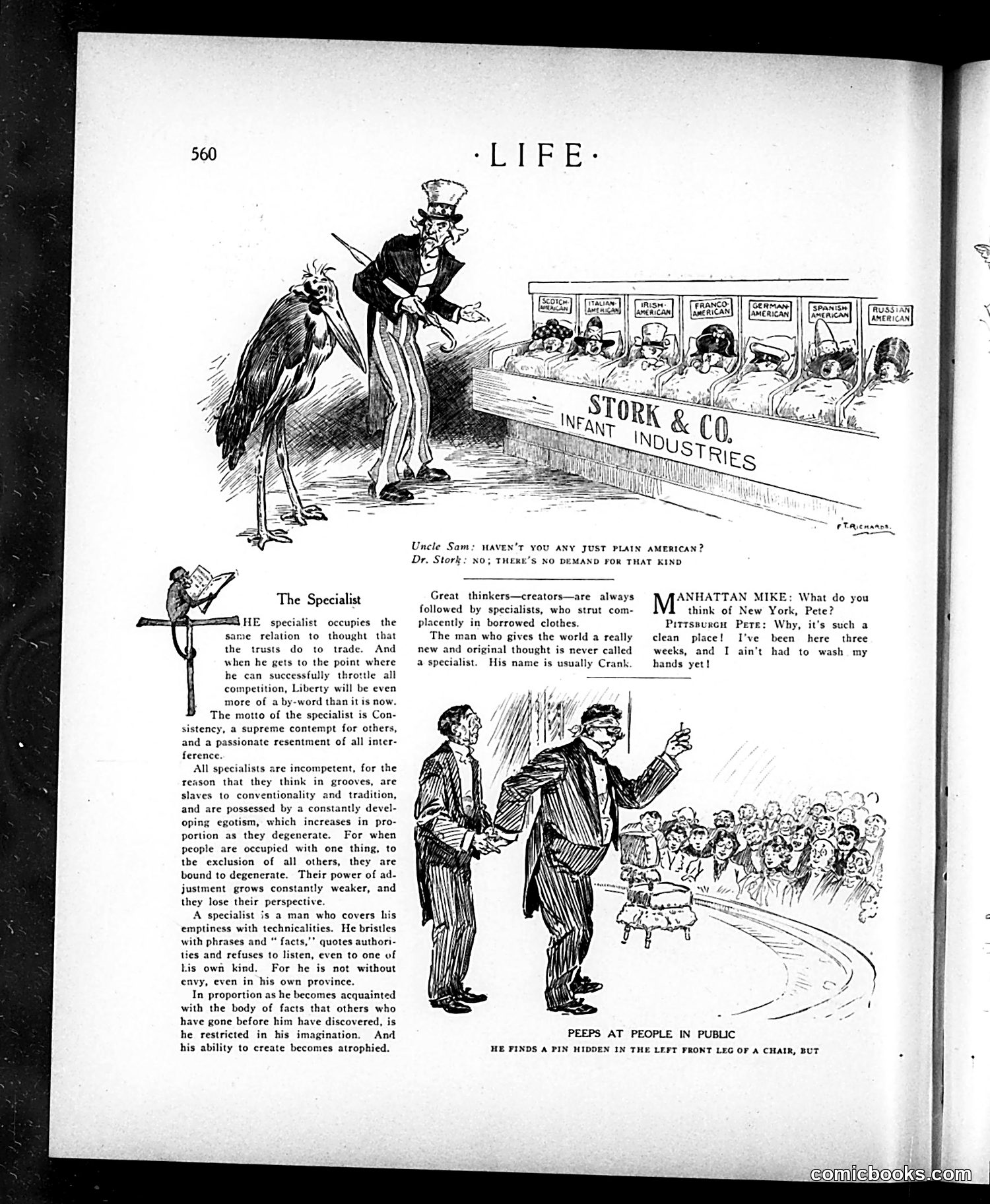
**"The Specialist" Essay & Cartoons:** This page critiques excessive specialization in American thought and industry. The top cartoon shows Uncle Sam and Dr. Stork at a factory labeled "Stork & Co. Infant Industries," where babies are being mass-produced with ethnic/national labels (Spanish-American, Italian-American, etc.). Uncle Sam asks if there are "just plain Americans"—satirizing how immigrants were being categorized rather than assimilated. The accompanying essay argues specialists are narrow-minded, arrogant, and creatively stunted, hiding "emptiness with technicalities." True innovators, it claims, are called "cranks," not specialists. **Lower cartoon:** A man finds a hidden pin in a public chair—depicting petty urban annoyances. **"Manhattan Mike" dialogue:** Contrasts Pittsburgh Pete's amazement at New York's cleanliness with his own poor hygiene—likely ethnic humor about regional/immigrant stereotypes common to early 20th-century Life magazine. The satire targets both industrial conformity and intellectual rigidity.
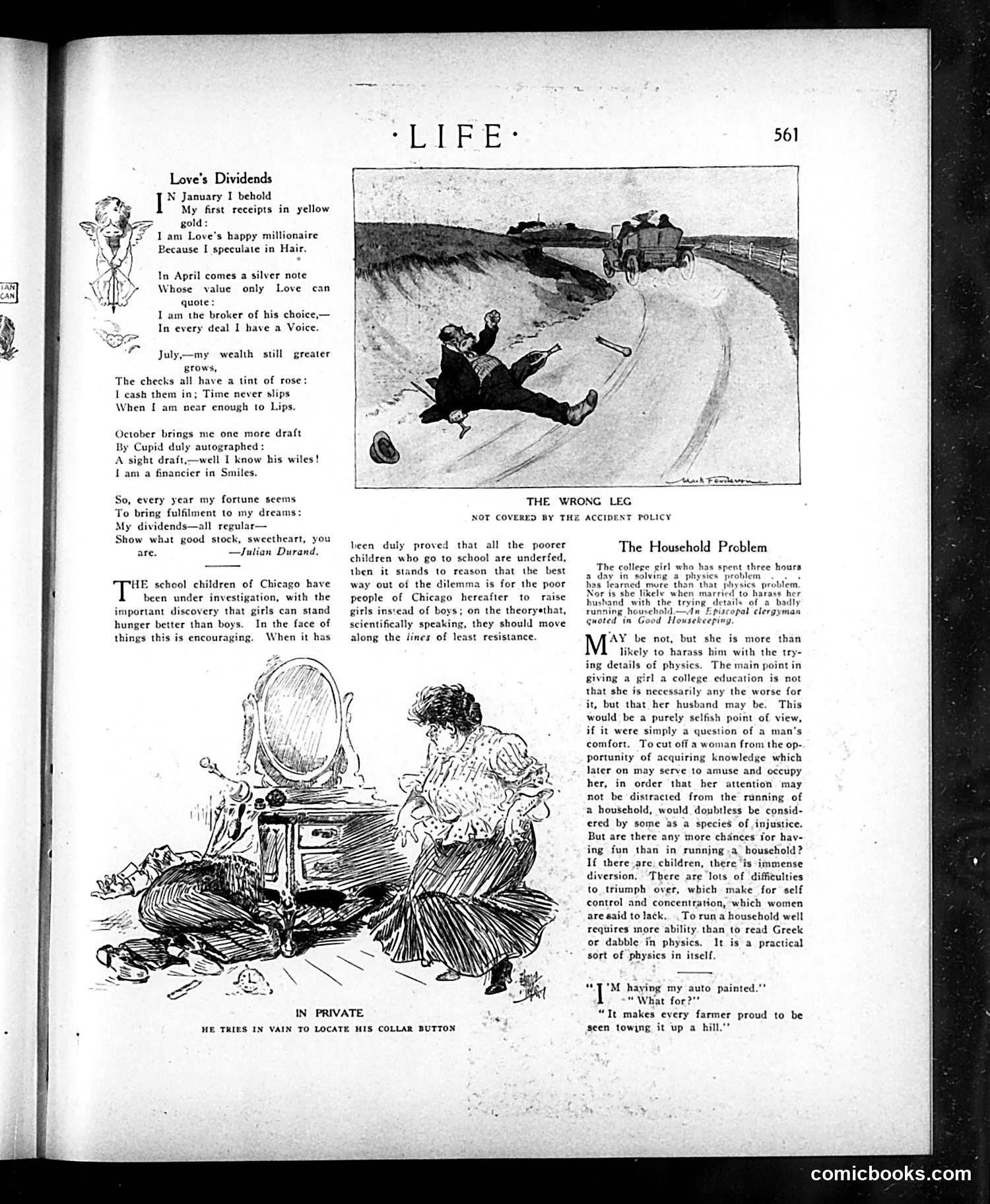
This page contains three satirical pieces reflecting early 20th-century gender anxieties: **"Love's Dividends"** is a romantic poem personifying romantic affection as financial investment, with monthly "payments" in hair, voice, and smiles—typical sentimental verse of the era. **"The Wrong Leg"** cartoon shows a man injured in a fall, captioned as "not covered by the accident policy"—a dark joke about insurance limitations. **"The Household Problem"** article satirizes college education for women. It mocks the tension between female intellectual development and domestic duties: while acknowledging women shouldn't be denied knowledge, it sarcastically suggests educated wives will annoy husbands with physics talk rather than focus on housework. The piece ironically argues household management actually requires more ability than academic study—a backhanded defense of women's education that ultimately reinforces traditional gender roles by implying educated women might become tiresome spouses. The tone reflects period anxiety about "New Women" gaining access to higher education.
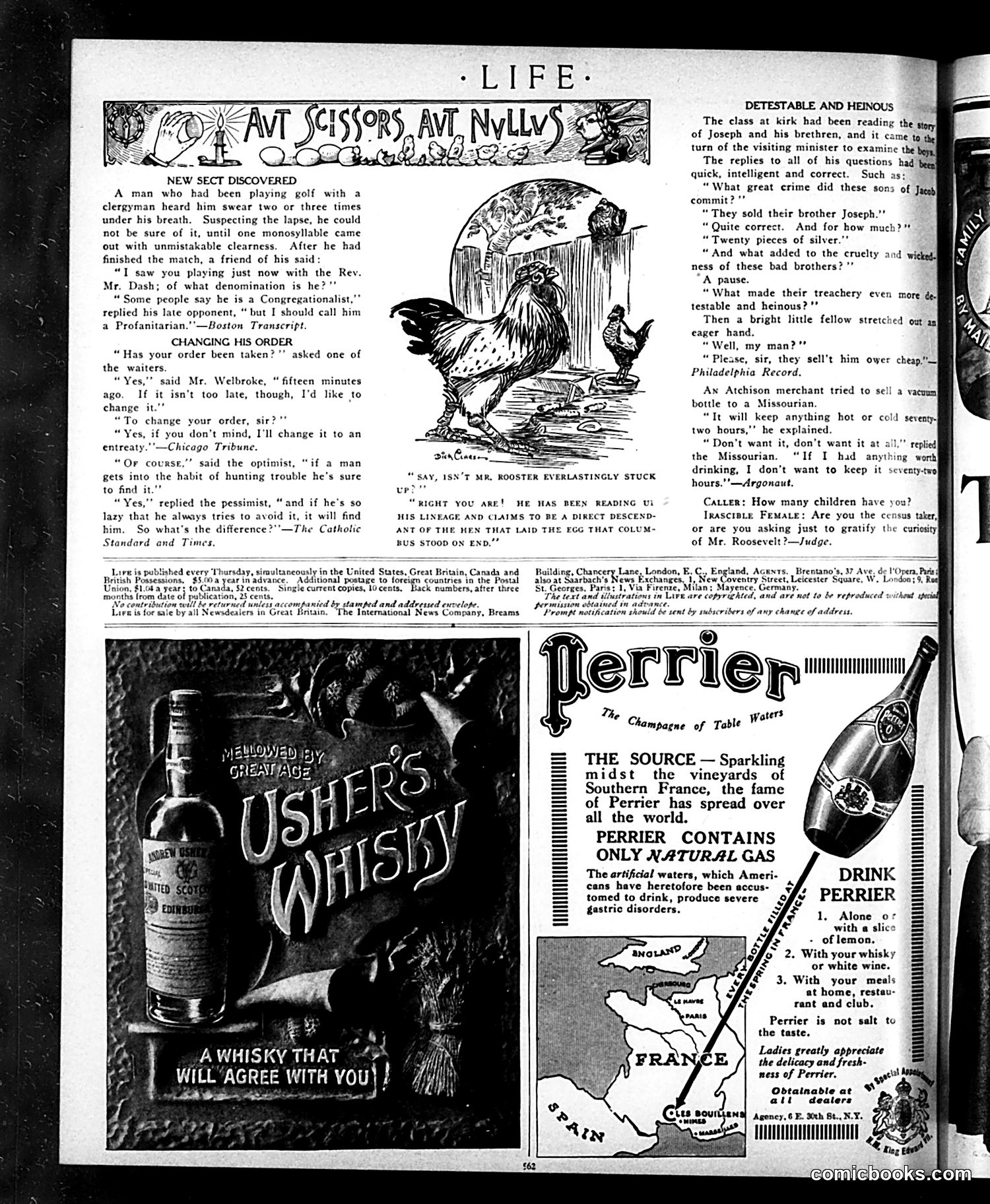
This page contains multiple short humorous anecdotes and advertisements typical of early 20th-century Life magazine. The main cartoon features two roosters discussing one rooster's pretentiousness. The stuck-up rooster claims descent from the bird whose egg Columbus famously stood on end (a classic trick). The joke satirizes social snobbery and genealogical pretension—the rooster is absurdly boasting about an ancestor's dubious claim to fame. The text anecdotes mock various social types: a clergyman who swears while golfing (the "Profanitarian"), a diner changing his order to an "entreaty," and a pessimist-optimist debate. The "Detestable and Heinous" piece humorously shows a Scottish child observing that Joseph's brothers got too low a price selling him (20 pieces of silver). The advertisements promote Usher's Whisky and Perrier sparkling water, with Perrier emphasizing its natural mineral content versus inferior "artificial waters." Overall, the page reflects genteel, middle-class humor of the period—gentle mockery of pretension, religious hypocrisy, and social pretense.
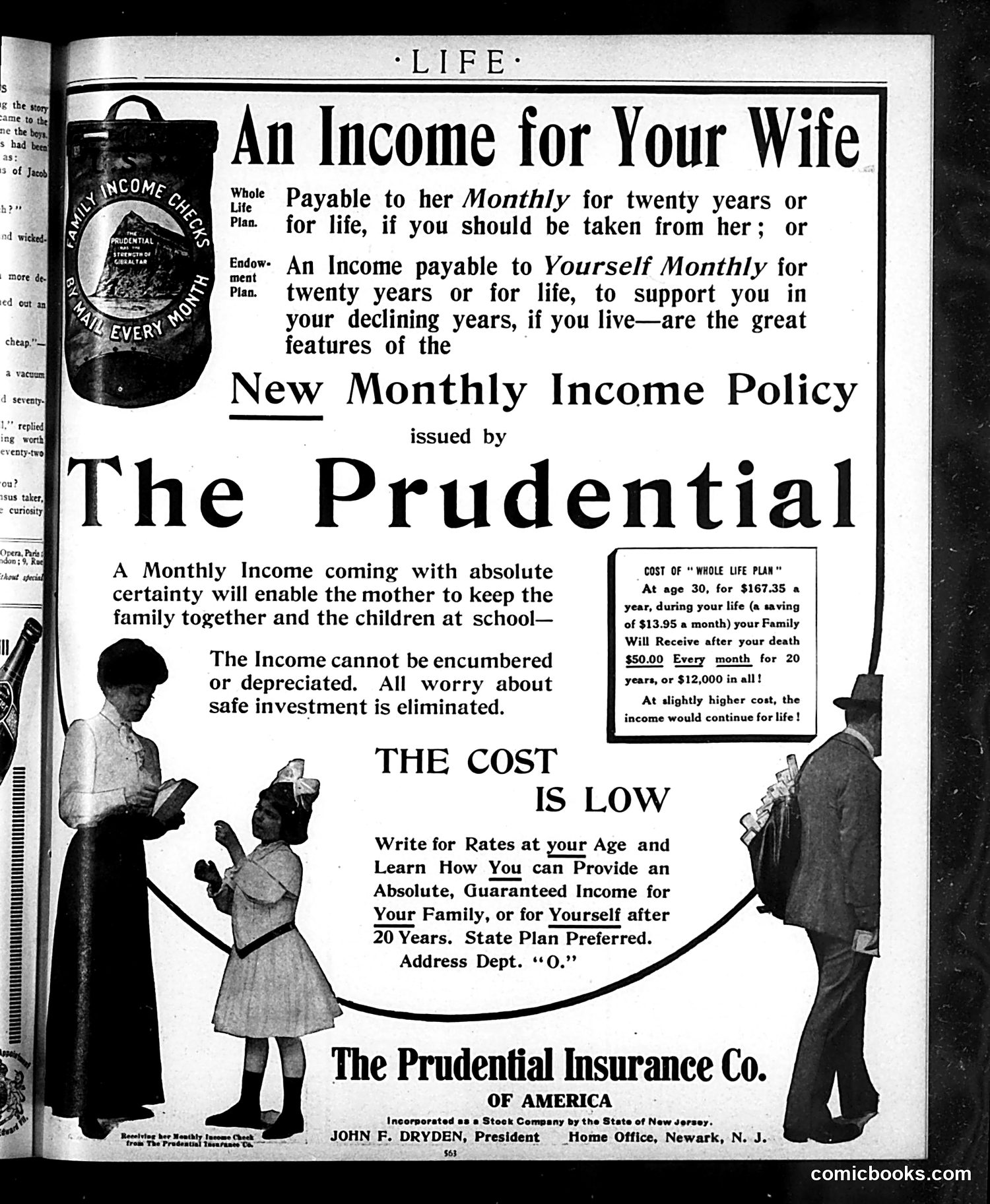
This is **not satire or a cartoon**—it's a straightforward insurance advertisement from Life magazine's advertising section. The Prudential Insurance Company is promoting its "New Monthly Income Policy," a life insurance product designed to provide financial security for families. The ad targets husbands/fathers, emphasizing two key features: monthly income payments to a wife if the policyholder dies, or payments to himself in old age. The imagery shows a mother with a child and a man in a suit, visualizing the family protection the policy offers. The inset box provides a concrete example: for $167.35 yearly ($13.95/month), a 30-year-old receives $50 monthly death benefits to his family for 20 years. The appeal is emotional and practical—keeping families together and eliminating financial worry—while stressing affordability ("THE COST IS LOW"). This reflects early 20th-century concerns about breadwinner security and dependent protection before modern social safety nets existed. This is genuine advertising, not editorial commentary.
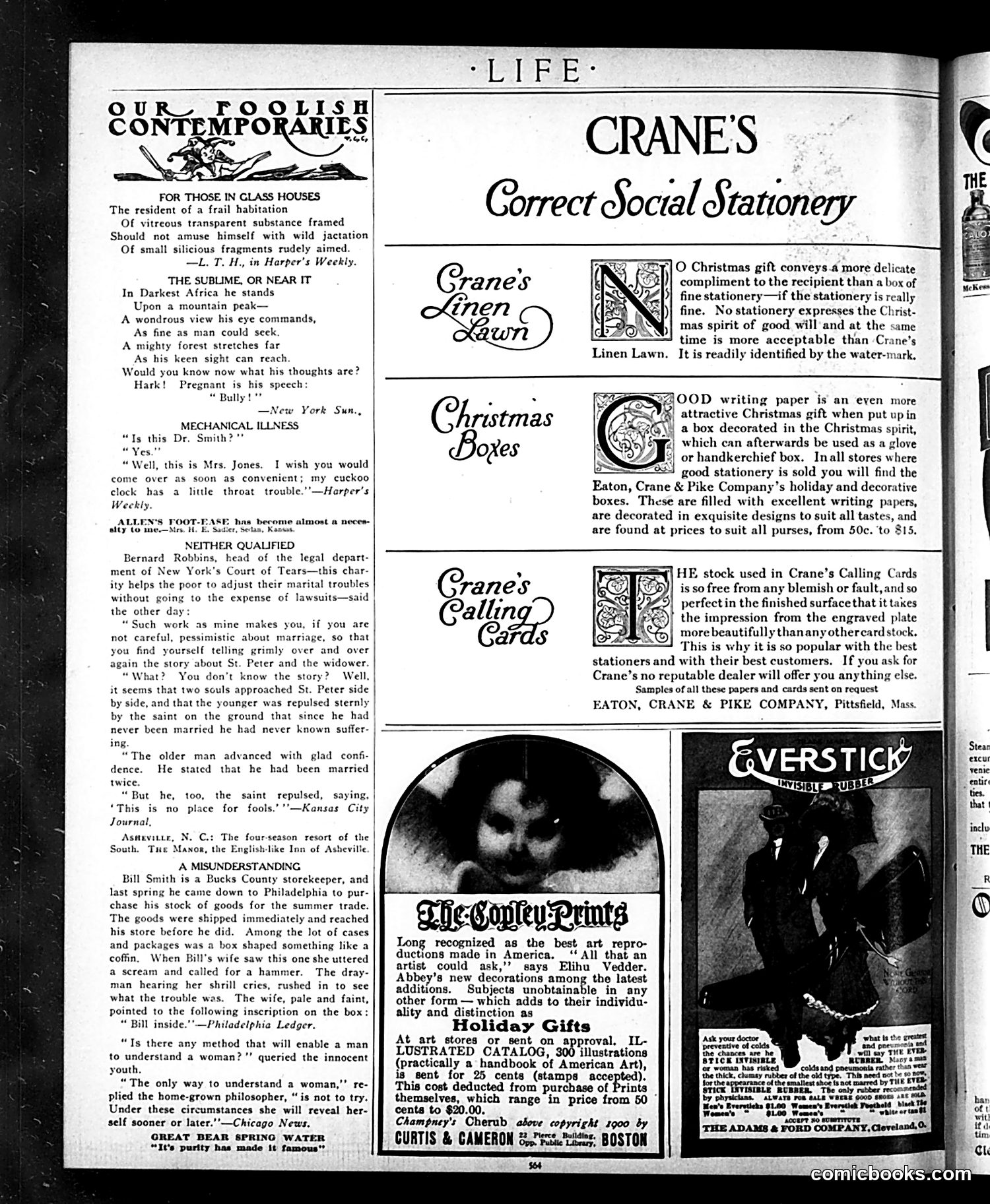
This page primarily consists of **short humorous anecdotes** rather than political cartoons. The pieces satirize everyday absurdities of early 20th-century American life: **"FOR THOSE IN GLASS HOUSES"** mocks people who live in fragile situations yet criticize others—a moral lesson in verse form. **"THE SUBLIME, OR NEAR IT"** satirizes Theodore Roosevelt's famous "Bully!" catchphrase, suggesting that even when confronted with sublime natural beauty in Africa, he can only muster his characteristic exclamation. **"MECHANICAL ILLNESS"** is a simple pun: a woman calls her doctor about her cuckoo clock's "throat trouble." **"NEITHER QUALIFIED"** presents a folk tale suggesting that only those who've suffered marriage qualify for heaven—a cynical joke about matrimony. The remaining anecdotes involve misunderstandings and confusion. The right side consists entirely of **advertisements** for Crane's stationery and other products—the page is largely commercial rather than satirical.
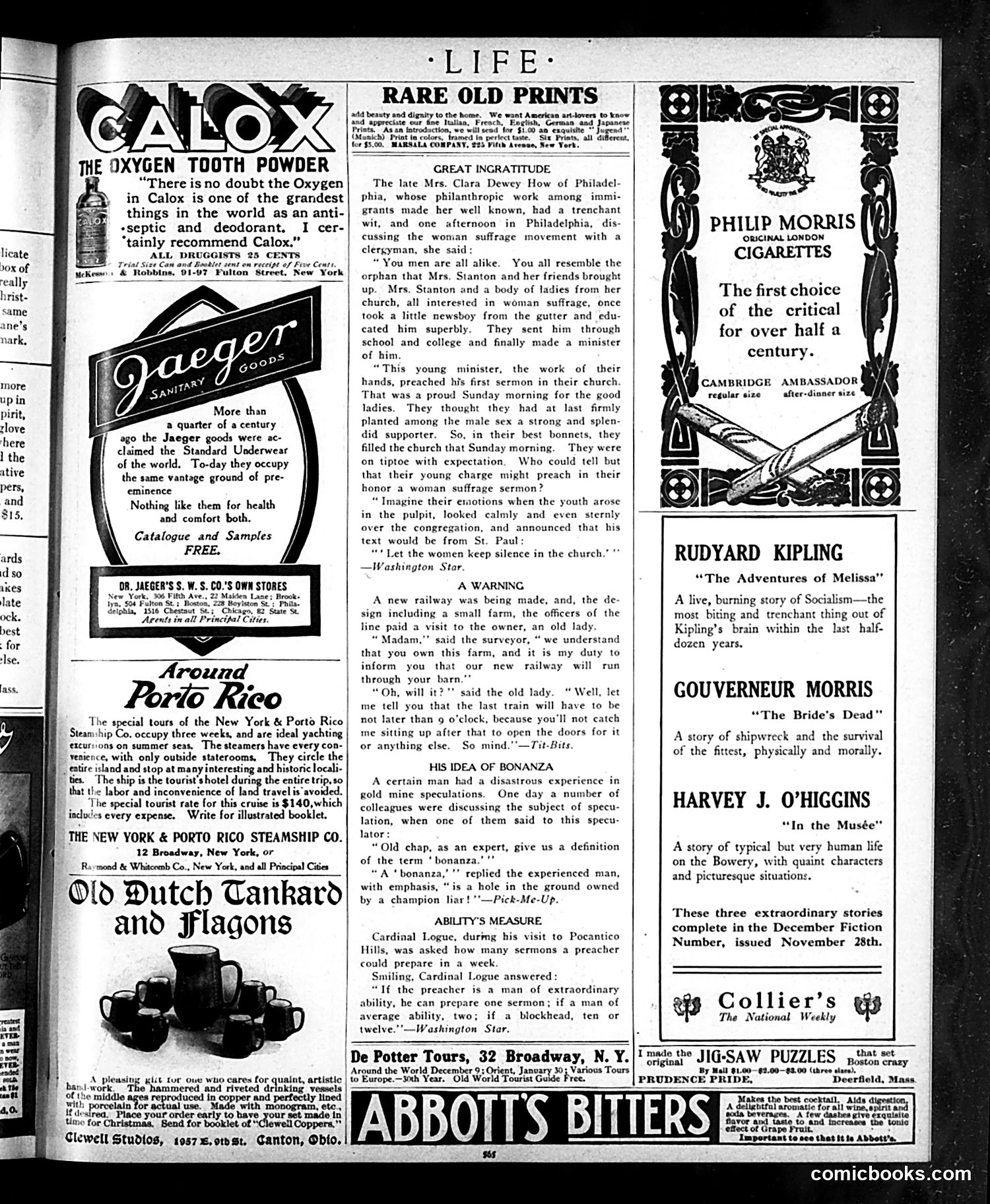
This is primarily an **advertising page** with three brief humorous anecdotes interspersed. The cartoons are minimal; the page features ads for Calox tooth powder, Jaeger underwear, Porto Rico steamship tours, and Old Dutch tankards. The three short satirical pieces are: 1. **"Great Ingratitude"**: A woman recounts how suffragettes educated an orphan into ministry, only for him to preach that women should "keep silence in the church" (quoting St. Paul). The joke mocks male hypocrisy and ingratitude toward women's suffrage efforts—this references the active women's suffrage movement of the era. 2. **"A Warning"**: An old farmer's deadpan response to a railway surveyor threatens to stop opening her barn doors after 9 PM, treating the train as her personal servant. Humor derives from rural stubbornness meeting industrial "progress." 3. **"His Idea of Bonanza"**: Text is cut off, but appears to discuss financial speculation or luck. The page reflects early 20th-century concerns: women's rights, rural-versus-modern tensions, and economic anxieties.
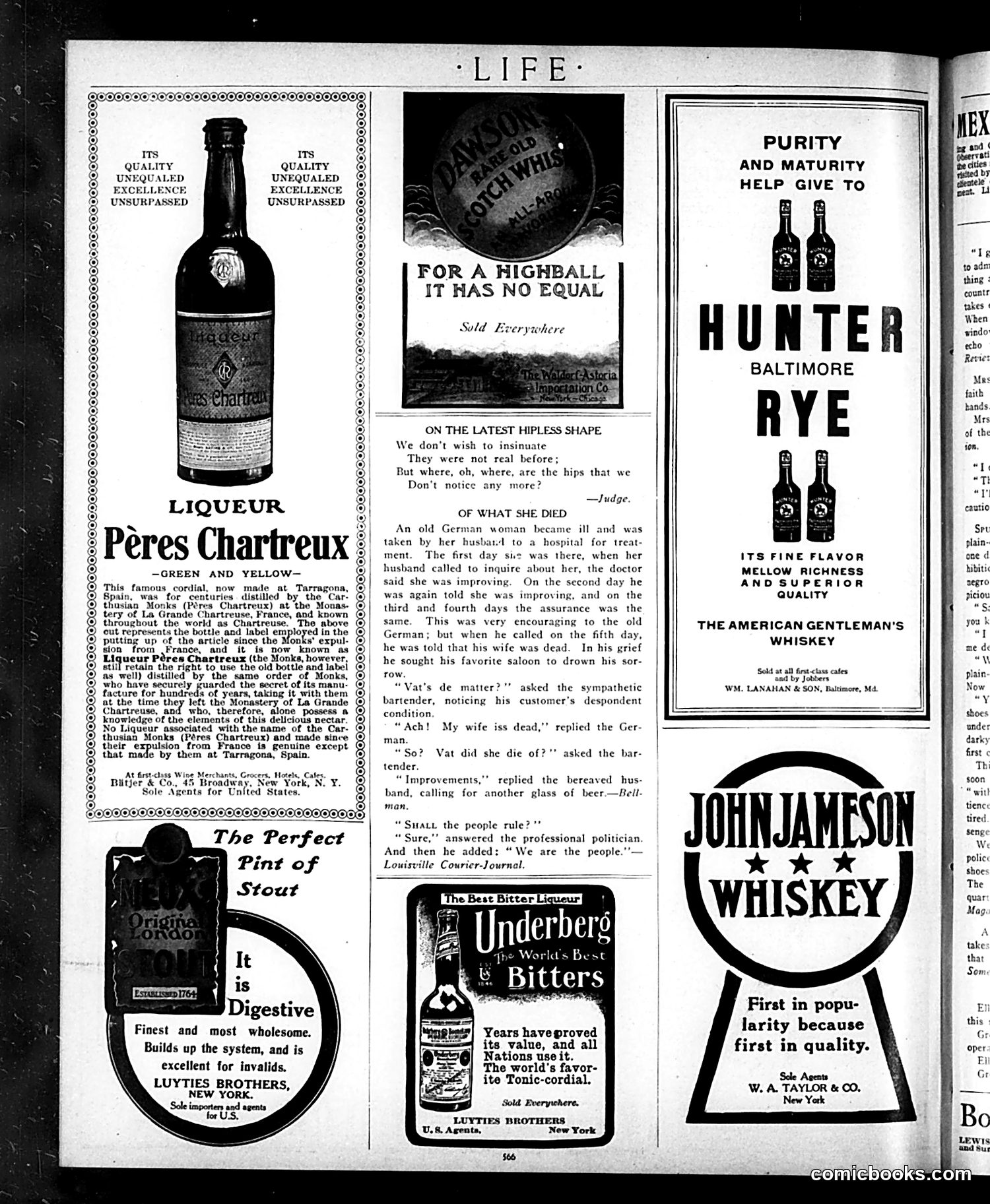
This page is primarily **advertising**, not political satire. It features alcohol ads (liqueurs, whiskeys, bitters) typical of early 20th-century Life magazine. The only satirical content appears as **two brief joke excerpts**: 1. **"OF WHAT SHE DIED"**: A ethnic humor joke (German accent dialect) about an old German man whose wife dies in a hospital. The dark comedy: doctors kept saying she was "improving" each day, yet she died—so the husband concludes she died of "improvements." This mocks medical optimism and incompetence. 2. **"SHALL THE PEOPLE RULE?"**: A political joke about democratic ideals. A politician claims "the people" rule, then reveals the contradiction: "We are the people"—suggesting politicians monopolize power despite democratic rhetoric. Both jokes reflect early 20th-century satirical magazine humor: ethnic caricature, cynicism about institutions (medicine, politics), and wordplay. The page otherwise consists of liquor advertisements claiming superiority and medicinal benefits—commonplace before modern advertising regulations.
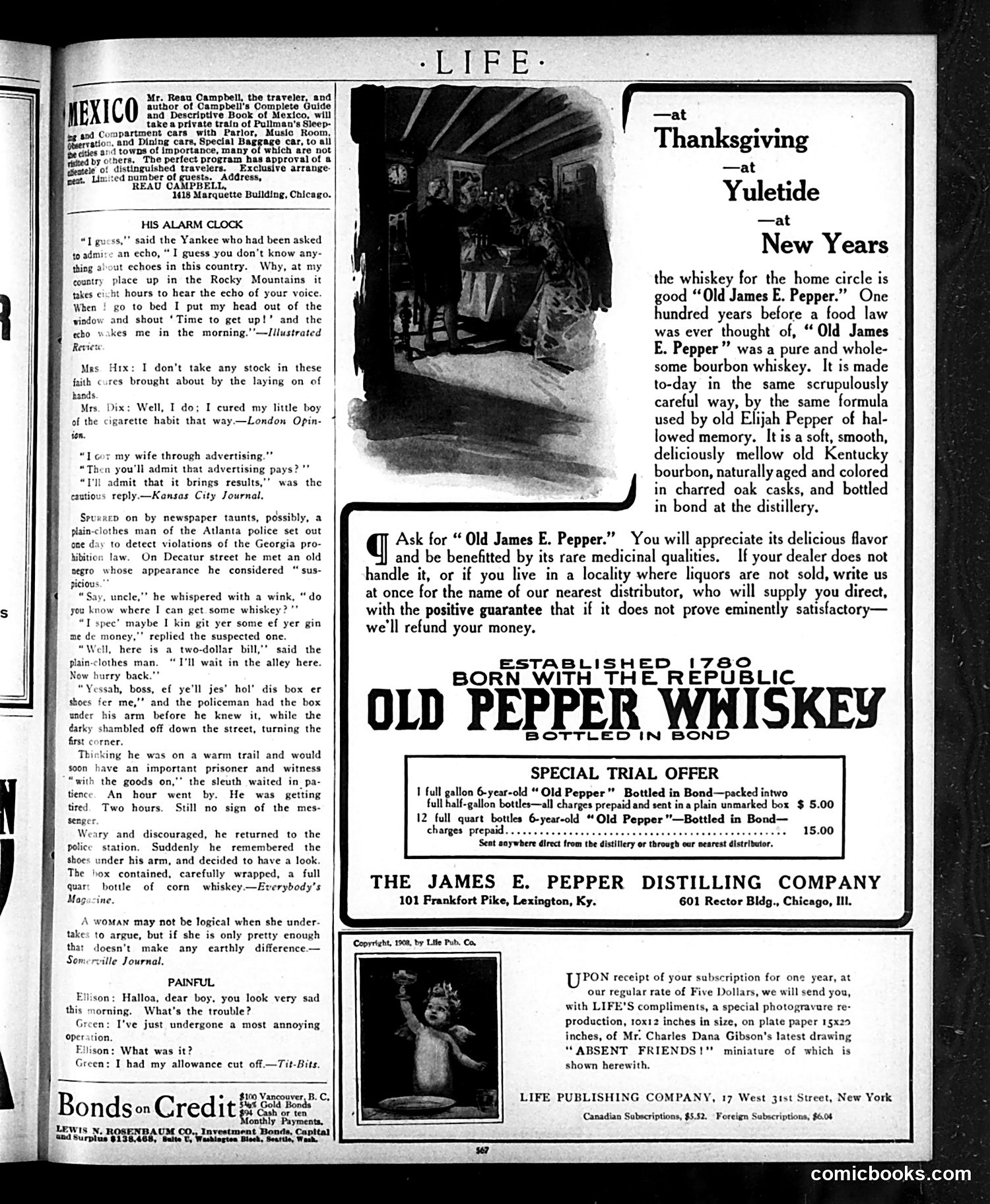
This page consists primarily of **advertisements and brief humorous anecdotes** rather than political cartoons. The main content includes: **Advertising:** The dominant feature is a full-page ad for "Old James E. Pepper" bourbon whiskey, emphasizing its pre-Prohibition heritage (established 1780) and medicinal qualities—typical of early 20th-century liquor marketing before federal regulation. **Humor Pieces:** Several short jokes and anecdotes satirize American attitudes: - A Yankee's exaggerated claim about Rocky Mountain echoes (playing on frontier tall tales) - A "plain-clothes" Atlanta police officer attempting to catch bootleggers during Prohibition, only to be outwitted by a Black man who disappears with his money—the joke mocking law enforcement incompetence - Standard workplace/relationship humor (allowance cuts, advertising's power) **Context:** This appears from the Prohibition era, when whiskey ads still ran in magazines despite legal restrictions. The humor reflects contemporary attitudes toward Prohibition enforcement and racial stereotypes common in period publications.
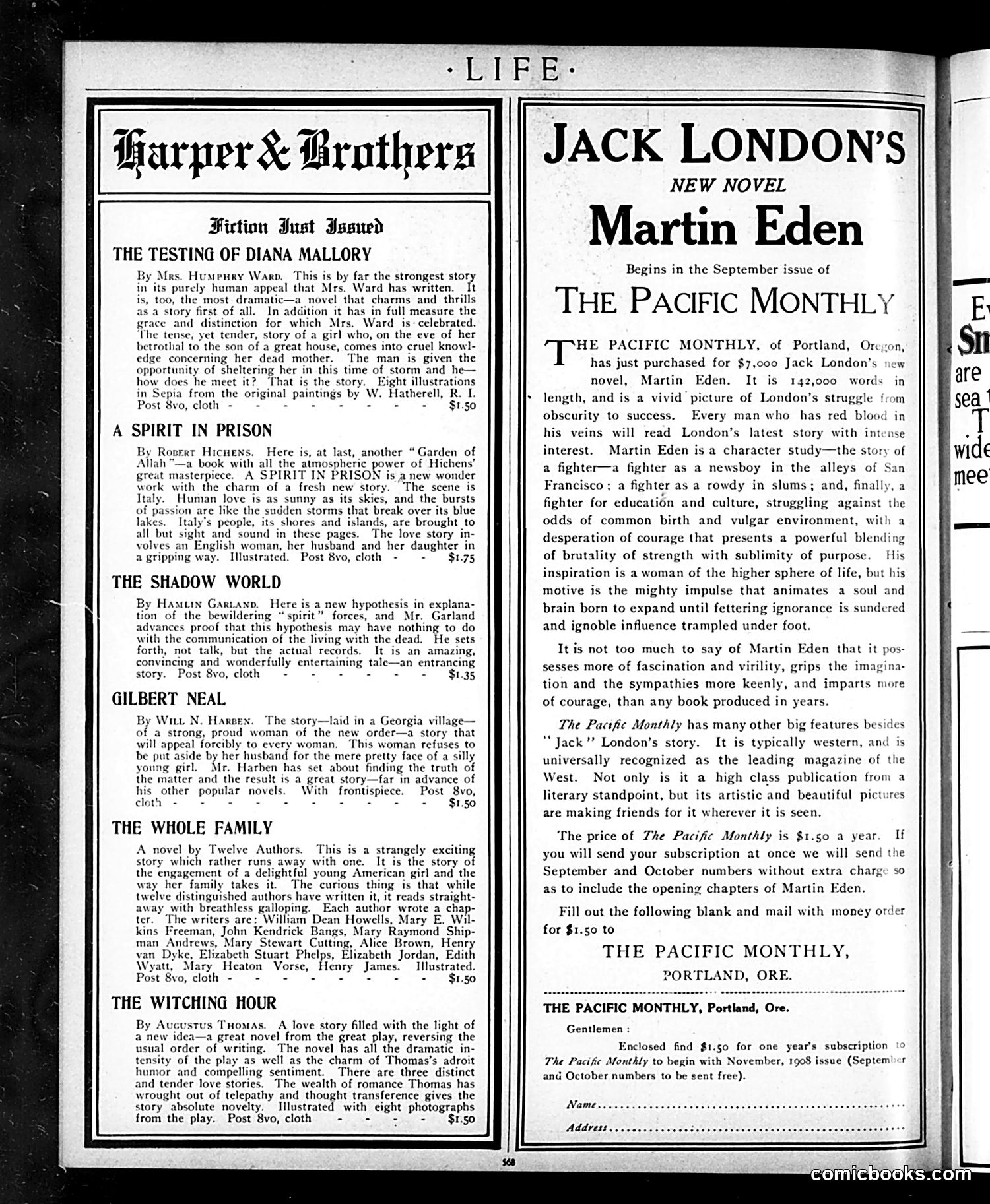
This is not a political cartoon page, but rather a **book advertisement and literary promotion section** from *Life* magazine. The left column features Harper & Brothers publisher announcements for newly issued fiction titles (works by Mrs. Humphry Ward, Robert Hichens, Hamilton Garland, and others), with brief descriptions and prices ranging from $1.35 to $1.75. The right side promotes **Jack London's novel *Martin Eden*** serializing in *The Pacific Monthly* magazine. The text describes it as a character study of a fighter struggling against poverty and ignorance in San Francisco—London's "latest story with intense interest." **For modern readers:** This page documents early 1900s literary culture, showing which authors were considered significant (Henry James, William Dean Howells appear in "The Whole Family" collaborative novel), typical book prices, and how magazines serialized popular fiction to drive subscriptions. There is no satire or political commentary present—it's straightforward publishing industry content.
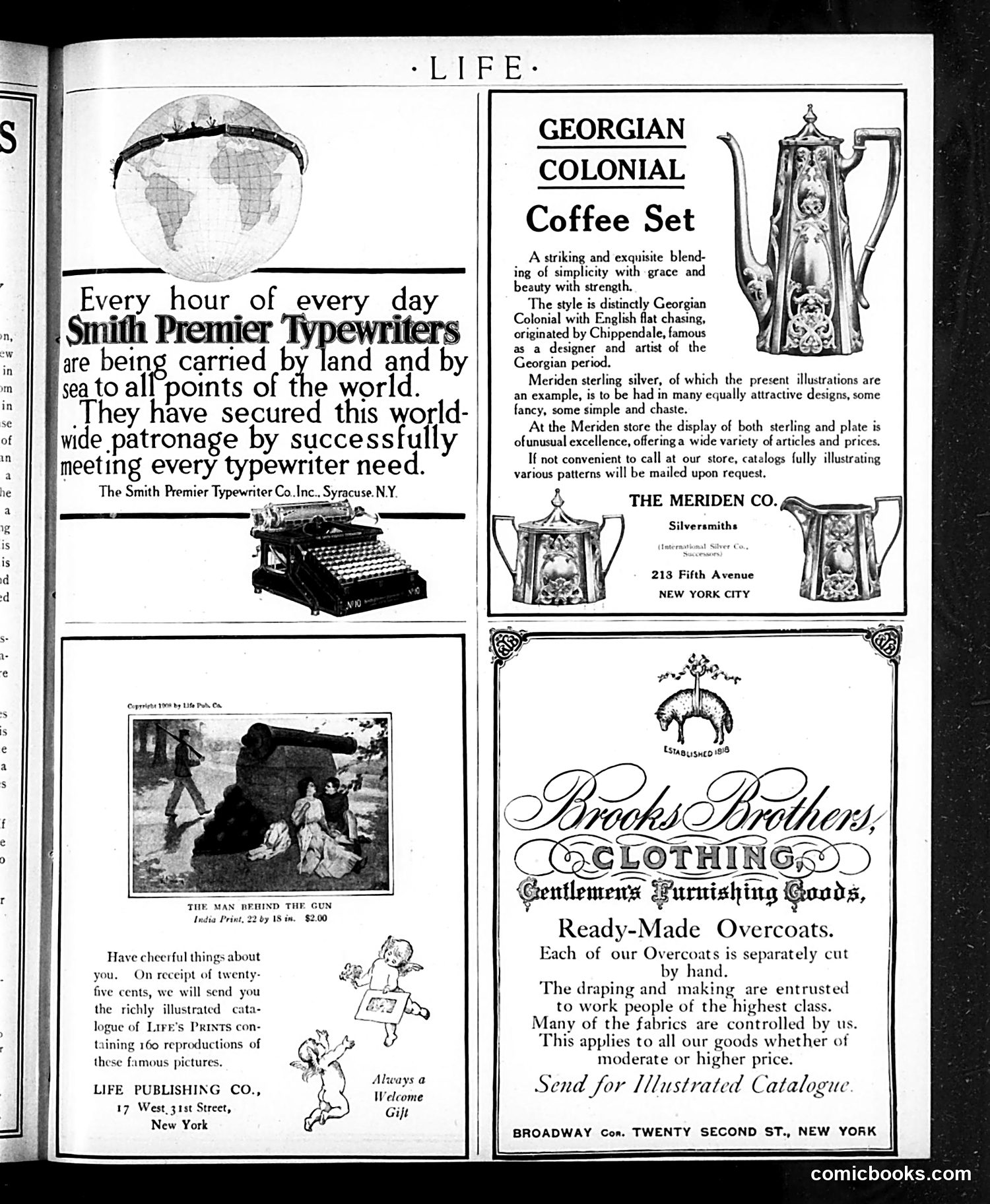
This page is primarily **advertising**, not political satire. It contains four commercial advertisements from circa 1908: 1. **Smith Premier Typewriters**: Claims global distribution and reliability for business use. 2. **The Meriden Co. silverware**: Promotes Georgian Colonial-style coffee sets in sterling silver, emphasizing classical design aesthetics. 3. **Life Publishing**: Sells reproductions of prints, including "The Man Behind the Gun" (an India print), offering a 160-image catalog for 25 cents. This appears to be general artistic merchandise rather than political commentary. 4. **Brooks Brothers**: Advertisement for ready-made overcoats, emphasizing hand-cutting and quality craftsmanship by skilled workers. There are no identifiable political cartoons or satirical commentary visible on this page. The content reflects early 20th-century consumer culture and product marketing typical of *Life* magazine's advertising sections.
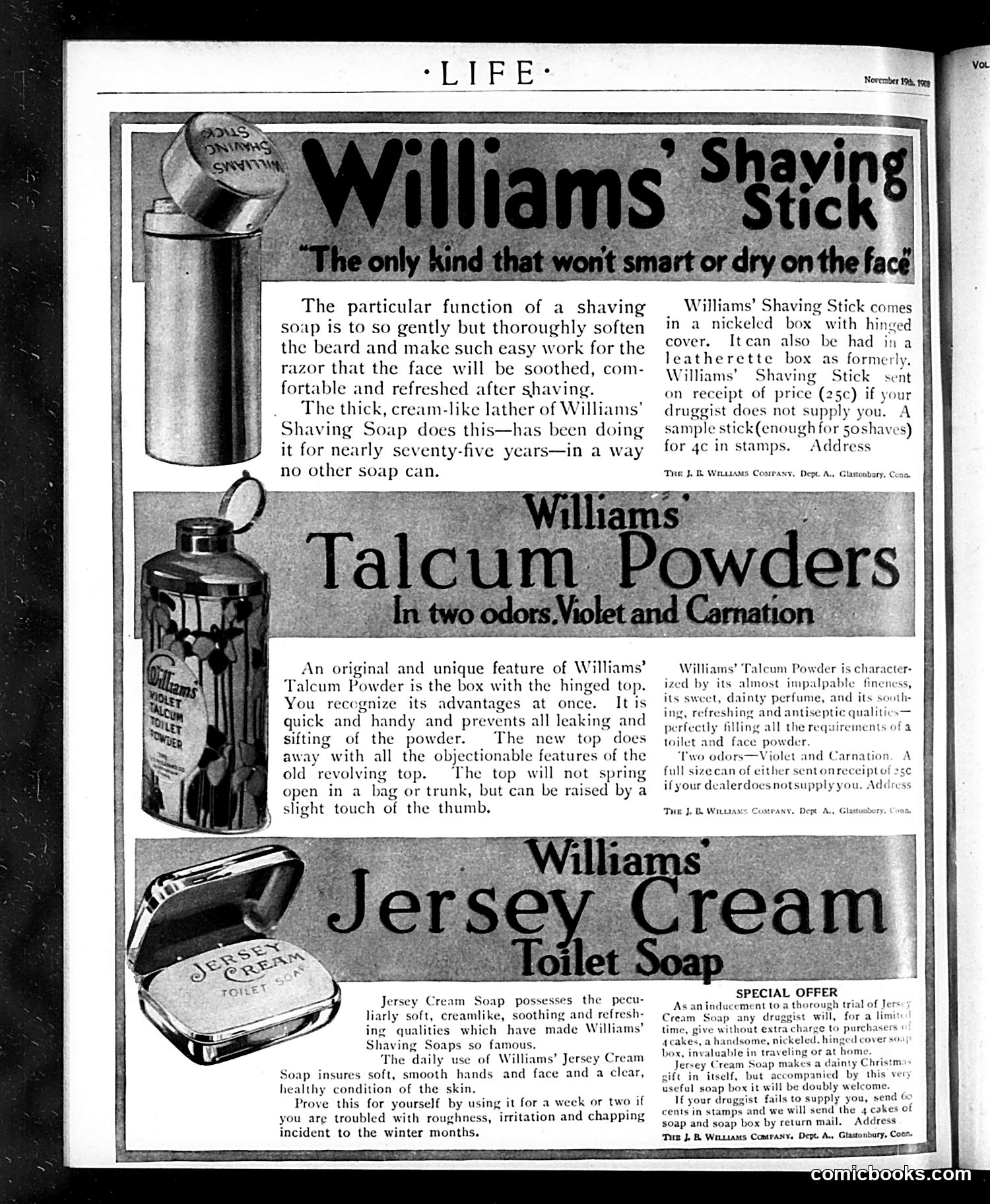
This is **not a cartoon or satirical content**—it's a straightforward advertising page from *Life* magazine (dated November 1903, based on visible header). The page contains three product advertisements for the J.B. Williams Company of Glastonbury, Connecticut: 1. **Williams' Shaving Stick** — marketed as superior for not drying on the face 2. **Williams' Talcum Powders** — emphasizing an innovative hinged-top box design in two scents (Violet and Carnation) 3. **Williams' Jersey Cream Toilet Soap** — promoted for softening hands and treating winter skin irritation The appeals are typical of early 1900s advertising: emphasis on product innovation (the hinged powder box), health benefits, and mail-order purchasing options. There is no satire, political commentary, or caricature—merely commercial promotion using period-appropriate marketing language about cleanliness, comfort, and convenience.