
Life, 1908-11-19 · page 17 of 28
Life — November 19, 1908 — page 17: what you’re looking at
What you’re looking at
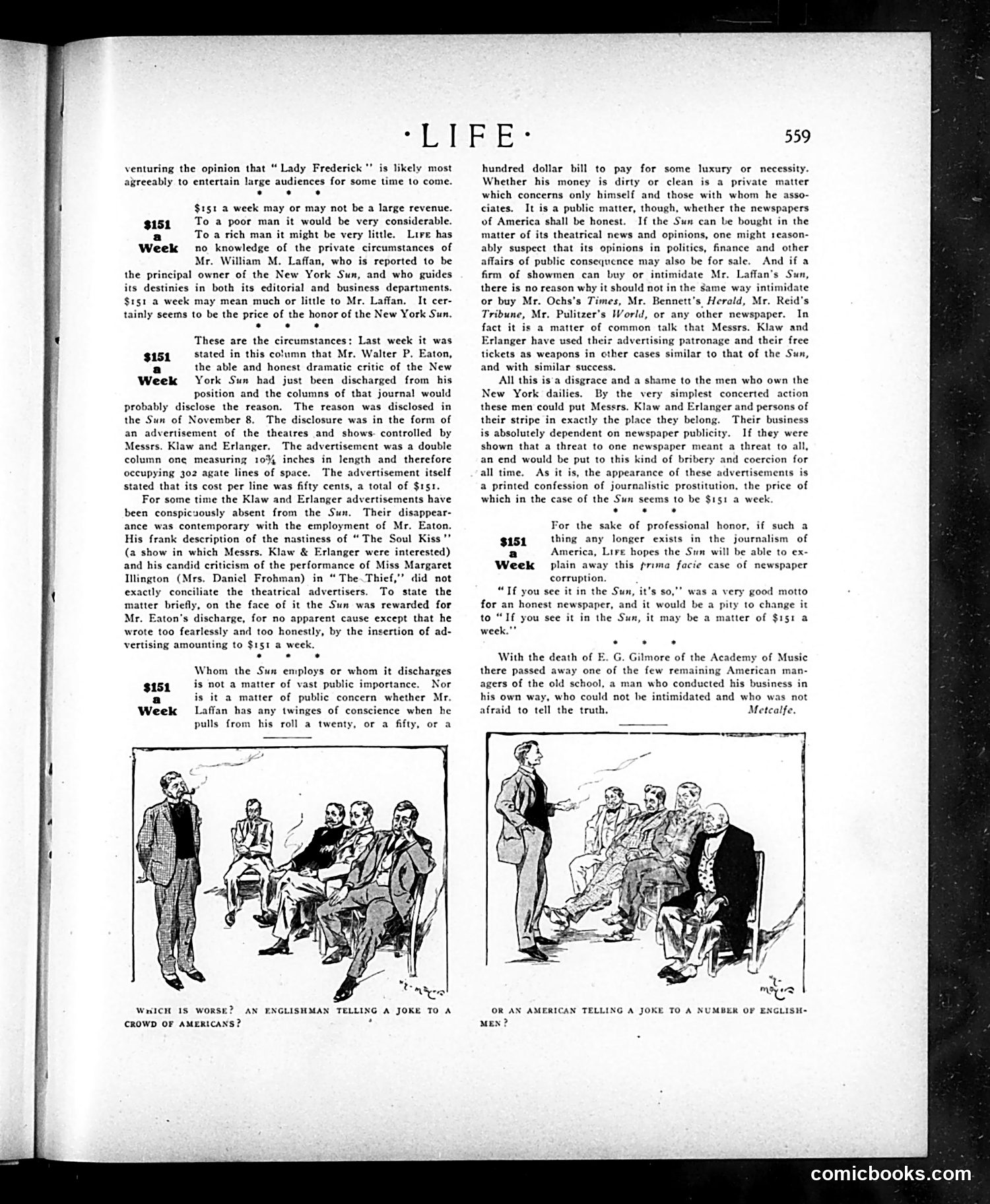
This page satirizes **newspaper corruption**, specifically criticizing the *New York Sun* for firing drama critic **Walter P. Eaton** after he negatively reviewed shows by theatrical producers **Klaw and Erlanger**. The irony: the *Sun* then published a $151 advertisement from those same producers—precisely one week's salary for Eaton. Life argues this demonstrates bought journalism. The editor warns that if major theatrical interests can intimidate the *Sun*, they can similarly corrupt the *Times*, *Herald*, *Tribune*, and *World*—threatening all American press integrity. The two cartoons illustrate comparative cultural dignity: one shows an Englishman joking to Americans; the other shows an American joking to Englishmen. This underscores the editorial's concern: American newspapers are sacrificing their honor and credibility, damaging national reputation. The satire's force depends on understanding Klaw-Erlanger's dominance in theater production and newspapers' dependence on theatrical advertising revenue—a system enabling editorial blackmail.
📄 Transcribed text from this page (OCR, searchable)
Machine-transcribed from the original scan — historical spelling and the odd misread are preserved.
A ERIE venturing the opinion that “Lady Frederick "’ is likely most agreeably to entertain large audiences for some time to come. ee teUrce $151 a week may or may not be a large revenue. To a poor man it would be very considerable. To a rich man it might be very little. Lire has no knowledge of the private circumstances of Mr. William M. Laffan, who is reported to be the principal owner of the New York Sun, and who guides its destinies in both its editorial and business departments. $151 a week may mean much or little to Mr. Laffan, It cer- tainly seems to be the price of the honor of the New York Sun. es 8 $151 a Week These are the circumstances: Last week it was stated in this column that Mr. Walter P. Eaton, the able and honest dramatic critic of the New York Sun had just been discharged from his position and the columns of that journal would probably disclose the reason. The reason was disclosed in the Sun of November 8, The disclosure was in the form of an advertisement of the theatres and shows. controlled by Messrs. Klaw and Erlanger. The advertisement was a double column one measuring 10% inches in length and therefore occupying 302 agate lines of space. The advertisement itself stated that its cost per line was fifty cents, a total of $151. For some time the Klaw and Erlanger advertisements have been conspicuously absent from the Sun, Their disappear- ance was contemporary with the employment of Mr. Eaton. His frank description of the nastiness of “The Soul Kiss’ (a show in which Messrs, Klaw & Erlanger were interested) and his candid criticism of the performance of Miss Margaret Illington (Mrs. Daniel Frohman) in “The.Thief,” did not exactly conciliate the theatrical advertisers. To state the matter briefly, on the face of it the Sun was rewarded for Mr. Eaton's discharge, for no apparent cause except that he wrote too fearlessly and too honestly, by the insertion of ad- vertising amounting to $151 a week. $151 a Week Whom the Sun employs or whom it discharges is not a matter of vast public importance. Nor is it a matter of public concern whether Mr. Laffan has any twinges of conscience when he pulls from his roll a twenty, or a fifty, or a $151 a Week WriICH 1S worse? CROWD OF AMERICANS? AN ENGLISHMAN TELLING A JOKE TO A 559 hundred dollar bill to pay for some luxury or necessity. Whether his money is dirty or clean is a private matter which concerns only himself and those with whom he asso- ciates. It is a public matter, though, whether the newspapers of America shall be honest. If the Sun can be bought in the matter of its theatrical news and opinions, one might reason- ably suspect that its opinions in politics, finance and other affairs of public consequence may also be for sale. And if a firm of showmen can buy or intimidate Mr. Laffan’s Sun, there is no reason why it should not in the game way intimidate or buy Mr. Ochs’s Times, Mr. Bennett's, Herald, Mr. Reid's Tribune, Mr. Pulitzer’s World, or any other newspaper. In fact it is a matter of common talk that Messrs. Klaw and Erlanger have used their advertising patronage and their free tickets as weapons in other cases similar to that of the Sun, and with similar success. All this is'a disgrace and a shame to the men who own the New York dailies. By the very simplest concerted action these men could put Messrs. Klaw and Erlanger and persons of their stripe in exactly the place they belong. Their business is absolutely dependent on newspaper publicity. If they were shown that a threat to one newspaper meant a threat to all, an end would be put to this kind of bribery and coercion for all time. As it is, the appearance of these advertisements is a printed confession of journalistic prostitution, the price of which in the case of the Sun seems to be $151 a week. SY Beale For the sake of professional honor, if such a thing any longer exists in the journalism of America, Lire hopes the Sun will be able to ex- plain away this prima facie case of newspaper corruption. “If you see it in the Sun, it's so,” for an honest newspaper, and it would be a pity to change it to “If you see it in the Sun, it may be a matter of $151 a week."* $151 a Week was a very good motto With the death of E. G. Gilmore of the Academy of Music there passed away one of the few remaining American man- agers of the old school, a man who conducted his business in who could not be intimidated and who was not raid to tell the truth, Metcalfe, OR AN AMERICAN TELLING A JOKE TO A NUMBER OF ENGLISH- MEN? comicbooks.com