
Life, 1908-11-19 · page 16 of 28
Life — November 19, 1908 — page 16: what you’re looking at
What you’re looking at
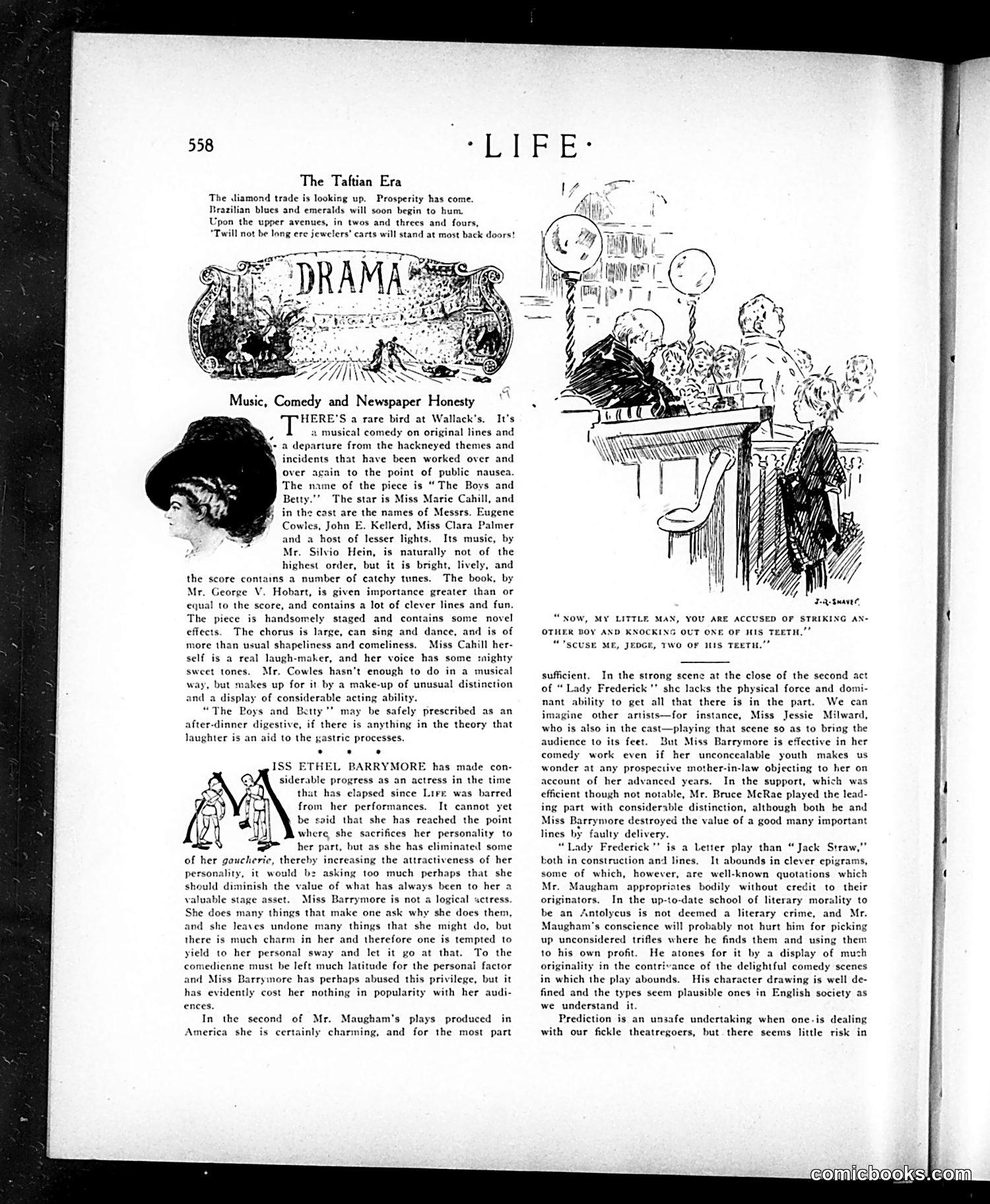
This page from *Life* magazine reviews theatrical productions and includes a satirical cartoon about judicial leniency. **The "Taftian Era" poem** at top appears to reference President Taft's administration, sardonically predicting that prosperity will soon bring luxury goods (diamonds, jewelry) back to the wealthy. **The drama reviews** discuss contemporary Broadway productions: "The Boys and Betty" (a musical comedy starring Marie Cahill) and plays featuring actress Ethel Barrymore. The critiques are generally favorable, praising the humor and staging while noting Barrymore's charm despite her tendency to prioritize personality over character. **The cartoon** depicts a judge hearing a case where a boy is accused of striking another boy and knocking out a tooth. The defendant corrects the judge: "Scuse me, jedge, two of his teeth"—a humorous admission that the boy actually caused more damage than charged. The joke satirizes either judicial incompetence or the boy's casual honesty about his misdeed.
📄 Transcribed text from this page (OCR, searchable)
Machine-transcribed from the original scan — historical spelling and the odd misread are preserved.
The Taftian Era iamond trade is looking up. Prosperity has come. Brazilian blues and emeralds will soon begin to hum. Upon the upper avenues, in twos and threes and fours, ‘Twill not be long ere jewelers’ carts will stand at most back doors! Music, Comedy and Newspaper Honesty HERE'S a rare bird at Wallack’s. It's a musical comedy on original lines and a departure from the hackneyed themes and mM incidents that have been worked over and over again to the point of public nausea. The name of the piece is “The Boys and Betty.’ The star is } Marie Cahill, and f in the cast are the names of Messrs. Eugene Cowles, John E. Kellerd, Miss Clara Palmer and a host of lesser lights. Its music, by Mr. Silvio Hein, is naturally not of the highest order, but it is bright, lively, and the score contains a number of catchy tunes, The book, by Mr. George V. Hobart, is given importance greater than or equal to the score, and contains a lot of clever lines and fun. The piece is handsomely staged and contains some novel effects. The chorus is large, can sing and dance, and is of more than usual shapeliness and comeliness. Miss Cahill her- self is a real laugh-maker, and her voice has some :ighty sweet tone: Mr. Cowles hasn't enough to do in a musical , but makes up for it. by a make-up of unusual distinction and a display of considerable acting ability. “The Boys and Betty" may be safely firescribed as an after-dinner digestive, if there is anything in the theory that laughter is an aid to the gastric processes. se) HEL BARRYMORE has made con- siderable progress as an actress in the time that has elapsed since Lire was barred from her performances. It cannot yet be said that she has reached the point where, she sacrifices her personality to her part, but as she has eliminated some of her gaucheric, thereby increasing the attractiveness of her personality, it would bz asking too much perhaps that she should diminish the value of what has always been to her a valuable stage asset. Miss Barrymore is not a logical actress. She does many things that make one ask why she does them, and she Jeaves undone many things that she might do, but there is much charm in her and therefore one is tempted to yield to her personal sway and let it go at that. To the comedienne must be left much latitude for the personal factor and Miss Barrymore has perhaps abused this privilege, but it has evidently cost her nothing in popularity with her audi- ences. In the second of Mr. Maugham’s plays produced in America she is certainly charming, and for the most part CSS SN \ SS FR Suavel, “NOW, MY LITTLE MAN, YOU ARE ACCUSED OF STRIKING AN- BOY AND KNOCKING OUT ONE OF HIS TEETH,” "SCUSE ME, JEDGE, TWO OF 11s TEETH,” In the strong scene at the close of the second act Frederick" she lacks the physical force and domi- bility to get all that there is in the part. We can ne other artists—for instance, Miss Jessie Milward, who is also in the cast—playing that scene so as to bring the sufficient audience to its feet. But Miss Barrymore is effective in her comedy work even if her unconcealable youth makes us wonder at any prospective mother-in-law objecting to her on account of her advanced years. In the support, which was efficient though not notable, Mr. Bruce McRae played the lead- ing part with considerable distinction, although both he and Miss Barrymore destroyed the value of a good many important faulty delivery. y Frederick” is a Letter play than “Jack Stra both in construction and lines. It abounds in clever epigrams, some of which, however, are well-known quotations which Mr. Maugham appropriates bodily without credit to their originators. In the up-to-date school of literary morality to be an Antolycus is not deemed a literary crime, and Mr. Maugham’s conscience will probably not hurt him for picking up unconsidered trifles where he finds them and using them to his own profit. He atones for it by a display of much originality in the contrivance of the delightful comedy scenes in which the play abounds. His character drawing is well de- fined and the types seem plausible ones in English society as we understand it Prediction is an unsafe undertaking when one-is dealing with our fickle theatregoers, but there seems little risk in