
Life, 1908-11-19 · page 8 of 28
Life — November 19, 1908 — page 8: what you’re looking at
What you’re looking at
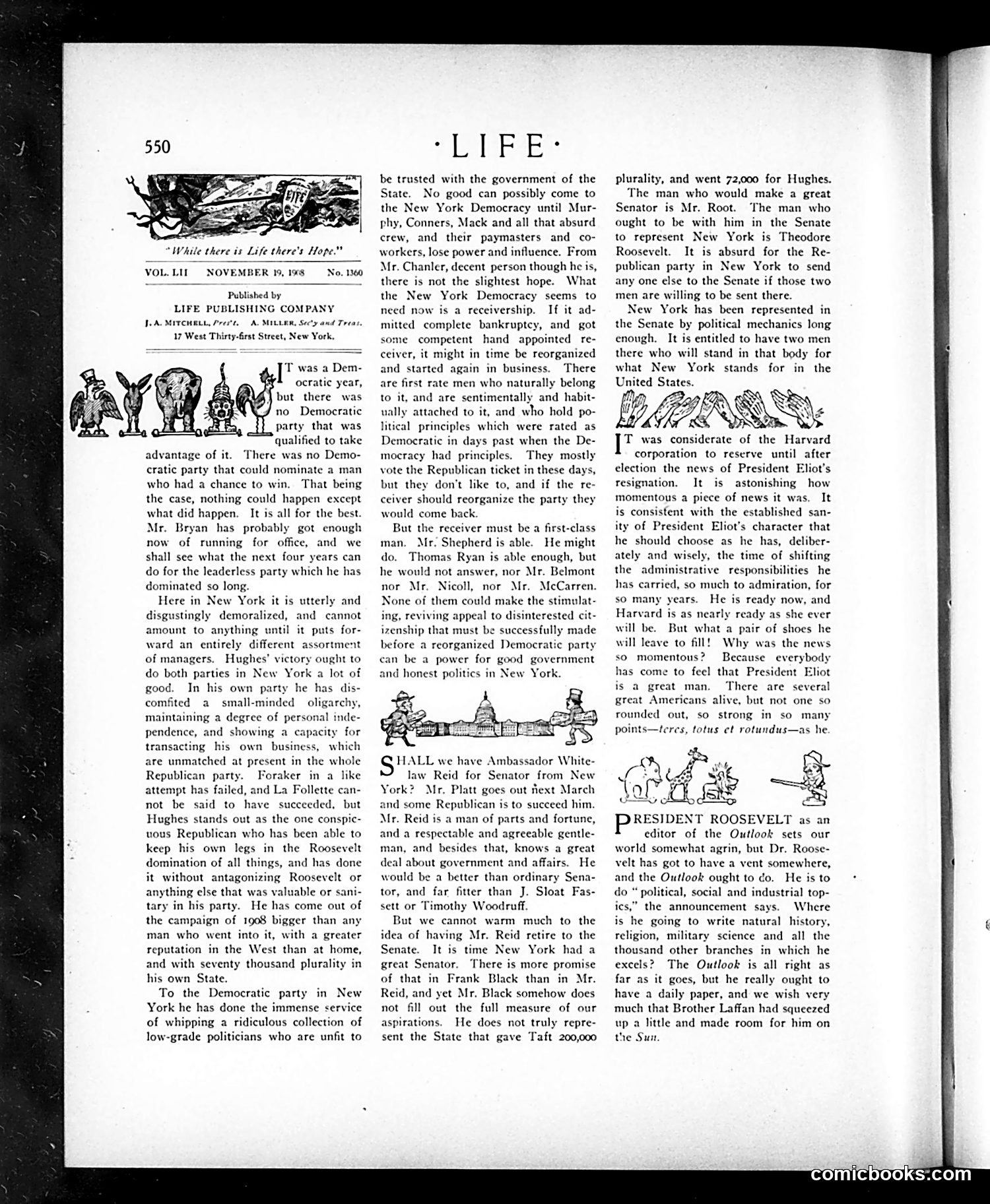
This page critiques New York's Democratic Party leadership during a period of internal chaos. The text argues the party is "utterly and disgustingly demoralized" and cannot attract competent leadership. The satire discusses potential Senate candidates: Ambassador Whitclaw Reid and potential successors to departing Senator Platt are mentioned as options. The author suggests the Democratic Party lacks capable figures—that "there is not the slightest hope" without a complete reorganization under competent leadership. The commentary also praises President Roosevelt, suggesting his administrative competence contrasts sharply with Democratic disarray. The overall tone is scathing toward Democratic Party dysfunction in New York politics during this period.
📄 Transcribed text from this page (OCR, searchable)
Machine-transcribed from the original scan — historical spelling and the odd misread are preserved.
“While there is Life there's Hope.” VOL.LIT NOV! Published by LIFE PUBLISHING COMPANY JA MITCHELL, Prestt, A. MILLER, Secty anf Treat, 17 West Thiety Et Street, New York. T was a Dem- ocratic year, but there was no Democratic party that was qualified to take advantage of it. There was no Demo- cratic party that could nominate a man who had a chance to win. That being the case, nothing could happen except what did happen. It is all for the best. Mr. Bryan has probably got enough now of running for office, and we MBER 19, shall see what the next four years can do for the leaderless party which he has dominated so long. Here in New York it is utterly and disgustingly demoralized, and cannot amount to anything until it puts for- ward an entirely different assortment of managers. Hughes’ victory ought to do both parties in New York a lot of good. In his own party he has dis- comfited a small-minded oligarchy, maintaining a degree of personal inde- pendence, and showing a capacity for transacting his which are unmatched at present in the whole Republican party. Foraker in a like attempt has failed, and La Follette can- not be said to have succeeded, but Hughes stands out as the one conspic- uous Republican who has been able to keep his own legs in the Roosevelt domination of all things, and has done it without antagonizing Roosevelt or anything else that was valuable or sani- tary in his party. He has come out of the campaign of 1908 bigger than any man who went into it, with a greater reputation in the West than at home, and with seventy thousand plurality in his own State. To the Democratic party in New York he has done the immense service of whipping a ridiculous collection of low-grade politicians who are unfit to own business, Pre be trusted with the government of the State. No good can possibly come to the New York Democracy until Mur- phy, Conners, Mack and all that absurd crew, and their paymasters and co- workers, lose power and influence. From Mr. Chanler, decent person though he is, there is not the slightest hope. What the New York Democracy seems to need now is a receivership. If it ad- mitted complete bankruptcy, and got me competent hand appointed re- ceiver, it might in time be reorganized and started again in business. There are first rate men who naturally belong to it, and are sentimentally and habit- ually attached to it, and who hold po- litical principles which were rated as Democratic in days past when the De- mocracy had principles. They mostly vote the Republican ticket in these days, but they don’t like to, and if the re- ceiver should reorganize the party they would come back. But the receiver must be a first-class man. Mr. Shepherd is able. He might do. Thomas Ryan is able enough, but he would not answer, nor Mr. Belmont nor Mr. Nicoll, nor Mr. McCarren. None of them could make the stimulat- ing, reviving appeal to disinterested cit- izenship that must be successfully made before a reorganized Democratic party can be a power for good government and honest politics in New York. HALL we have Ambassador White- law Reid for Senator from New York? Mr, Platt goes out fext March and some Republican is to succeed him. Mr. Reid is a man of parts and fortune, and a respectable and agreeable gentle- man, and besides that, knows a great deal about government and affairs. He would be a better than ordinary Sena- tor, and far fitter than J. Sloat Fas- sett or Timothy Woodruff. But we cannot warm much to the idea of having Mr. Reid retire to the Senate. It is time New York had a great Senator. There is more promise of that in Frank Black than in Mr. Reid, and yet Mr. Black somehow does not fill out the full measure of our aspirations. He does not truly repre- sent the State that gave Taft 200,000 plurality, and went 72,000 for Hughes. The man who would make a great Senator is Mr. Root. The man who ought to be with him in the Senate to represent New York is Theodore Roosevelt. It is absurd for the Re- publican party in New York to send any one else to the Senate if those two. men are willing to be sent there. New York has been represented in the Senate by political mechanics long enough. It is entitled to have two men there who will stand in that body for what New York stands for in the United States. T was considerate of the Harvard corporation to reserve until after election the news of President Eliot's resignation. It is astonishing how momentous a piece of news it was. It is consistent with the established san- ity of President Eliot's character that he should choose as he has, deliber- ately and wisely, the time of shifting the administrative responsibilities he has carried, so much to admiration, for so many years. He is ready now, and Harvard is as nearly ready as she ever will be. But what a pair of shoes he will leave to fill! Why was the news so momentous? Because everybody has come to feel that President Eliot is a great man. There are several great Americans alive, but not one so rounded out, so strong in so many points—teres, totus et rotundus—as he. RESIDENT ROOSEVELT as an editor of the Outlook sets our world somewhat agrin, but Dr. Roose- velt has got to have a vent somewhere, and the Outlook ought to do. He is to do “ political, social and industrial top- ics,” the announcement says. Where is he going to write natural history, religion, military science and all the thousand other branches in which he excels? The Outlook is all right as far as it goes, but he really ought to have a daily paper, and we wish very much that Brother Laffan had squeezed up a little and made room for him on