
Life, 1908-11-19 · page 10 of 28
Life — November 19, 1908 — page 10: what you’re looking at
What you’re looking at
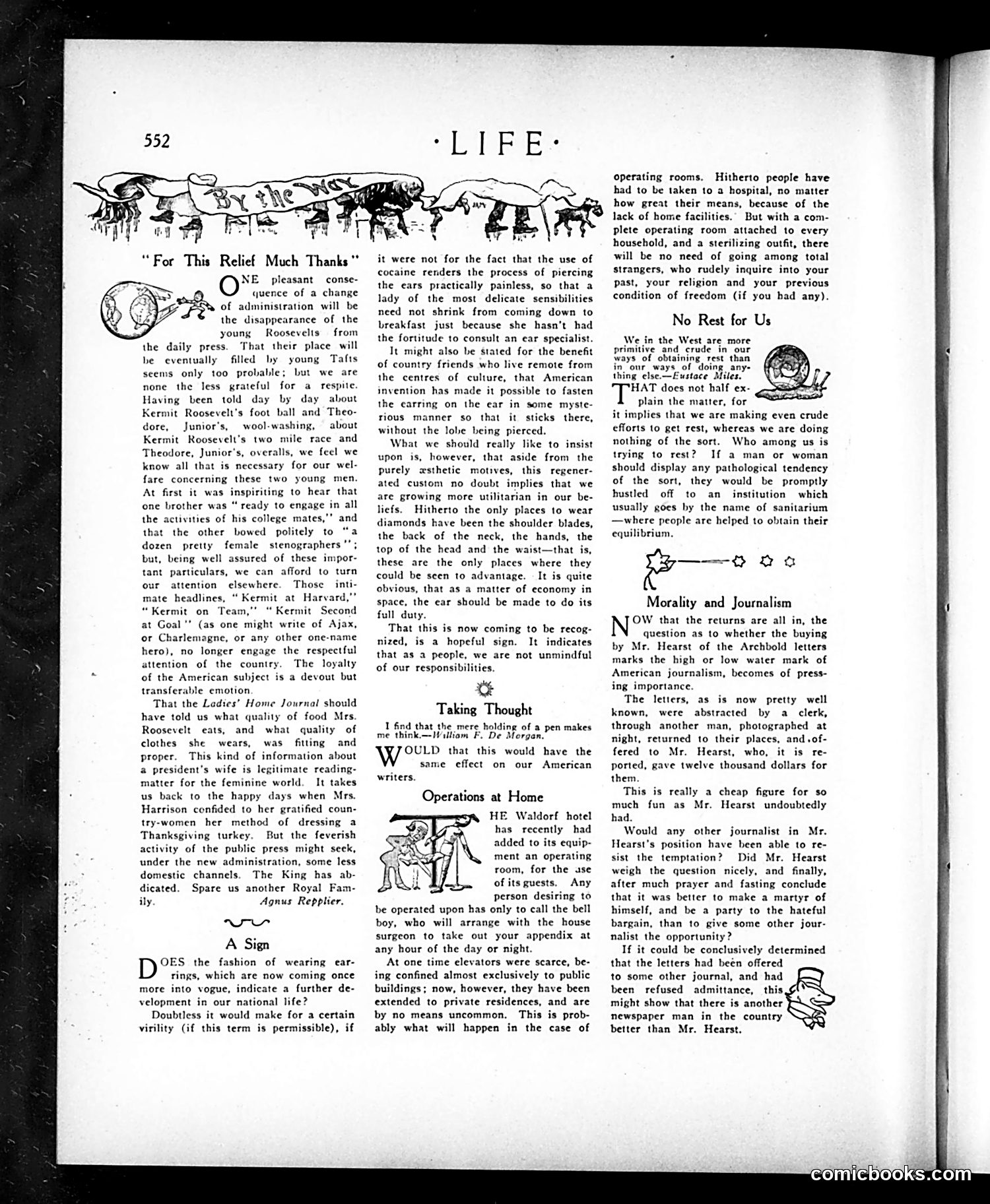
This page contains several short satirical essays rather than political cartoons. The pieces critique early 20th-century American life: **"For This Relief Much Thanks"** mocks the Roosevelt administration's expansion of government bureaucracy, specifically praising the addition of operating rooms to hospitals—sarcastically suggesting this represents significant "progress." **"Taking Thought"** discusses a quote attributed to William F. De Morgan about effects on American writers. **"Operations at Home"** criticizes the Waldorf hotel's recent addition of an operating room for guest appendectomies, satirizing the absurdity of privatizing medical procedures previously handled in hospitals. **"Morality and Journalism"** addresses Mr. Hearst's purchase of Archibold letters, debating whether journalism ethics permit such transactions. The overall tone mocks institutional pretension and contemporary social trends through gentle mockery.
📄 Transcribed text from this page (OCR, searchable)
Machine-transcribed from the original scan — historical spelling and the odd misread are preserved.
“For This Relief Much Thanks“ NE pleasant conse- quence of a change of administration will be the disappearance of the young Roosevelts from the daily press. That their place will be eventually filled by young Tafts seems only too probable; bi none the less grateful for a respite Having been told day by day about Kermit Roosevelt's foot ball and Theo- dore, Junior's, wool-washing, about Kermit Roosevelt's two mile race and Theodore, Junior's, overalls, we feel we know all that is necessary for our wel- fare concerning these two young men. At first it was inspiriting to hear that one brother was “ ready to engage in all the activities of his college mates,"” and that the other bowed politely to “a dozen pretty female stenographers ""; but, being well assured of these impor- tant particulars, we can afford to turn our attention elsewhere. Those inti mate headlines, “Kermit at Harvard, “Kermit on Team," “Kermit Second at Goal? (as one might write of Ajax, or Charlemagne, or any other one-name hero), no longer engage the respectful attention of the country, The loyalty of the American subject is a devout but transferable emotion. That the Ladies’ Home Journal should have told us what quality of food Mrs Roosevelt eats, and what quality of clothes she wears, was fitting and proper. This kind of information about a president's wife is legitimate reading- matter for the feminine world. It takes us back to the happy days when Mrs. Harrison confided to her gratified coun- try-women her method of dressing a Thanksgiving turkey. But the feverish activity of the public press might seek, under the new administration, some less domestic channels. The King has ab- dicated. Spare us another Royal Fam- ily Agnus Repplier. we A Sign OES the fashion of wearing ear- rings, which are now coming once more into vogue, indicate a further de- velopment in our national life? Doubtless it would make for a certain virility (if this term is permissible), if it were not for the fact that the use of cocaine renders the process of piercing the ears practically painless, so that a lady of the most delicate sensibilities need not shrink from coming down to breakfast just because she hasn't had the fortitude to consult an ear specialist. It might also be stated for the benefit of country friends who live remote from the centres of culture, that American invention has made it possible to fasten the earring on the ear in some myste- rious manner so that it sticks there, without the lobe being pierced. What we should really like to insist upon is, however, that aside from the purely asthetic motives, this regener- ated custom no doubt implies that we are growing more utilitarian in our be- liefs. Hitherto the only places to wear diamonds have been the shoulder blades, the back of the neck, the hands, the top of the head and the waist—that is, these are the only places where they could be seen to advantage. It is quite obvious, that as a matter of economy in space, the ear should be made to do its full duty. That this is now coming to be recog- nized, is a hopeful sign. It indicates that as a people, we are not unmindful of our responsibilities. 1o Taking Thought I find that the mere holding of a pen makes me think.—Walliom F, De Morgan. OULD that this would have the same effect on our American writers. Operations at Home HE Waldorf hotel has recently had added to its equip- ment an operating room, for the ase of its guests, Any person desiring to be operated upon has only to call the bell boy, who will arrange with the house surgeon to take out your appendix at any hour of the day or night. At one time elevators were scarce, be- ing confined almost exclusively to public buildings; now, however, they have been extended to private residences, and are by no means uncommon. This is prob- ably what will happen in the case of operating rooms. Hitherto people have had to be taken to a hospital, no matter how great their means, because of the lack of home facilities. But with a com- plete operating room attached to every household, and a sterilizing outfit, there will be no need of going among total strangers, who rudely inquire into your past, your religion and your previous condition of freedom (if you had any). No Rest for Us We in the West are more primitive and crude in our ways of obtaining rest than in onr ways of doing any- thing else-—Eustace Miles. HAT does not half ex- plain the matter, for it implies that we are making even crude efforts to get rest, whereas we are doing nothing of the sort. Who among us is trying to rest? If a man or woman should display any pathological tendency of the sort, they would be promptly hustled off to an institution which usually goes by the name of sanitarium —where people are helped to obtain their equilibrium, ai ao Morality and Journalism OW that the returns are all in, the question as to whether the buying by Mr. Hearst of the Archbold letters marks the high or low water mark of American journalism, becomes of press- ing importance. The letters, as is now pretty well known, were abstracted by a clerk, through another man, photographed at night, returned to their places, and.of- fered to Mr. Hearst, who, it is re- ported, gave twelve thousand dollars for them. This is really a cheap figure for so much fun as Mr. Hearst undoubtedly had. Would any other journalist in Mr. Hearst's position have been able to re- sist the temptation? Did Mr. Hearst weigh the question nicely, and finally, after much prayer and fasting conclude that it was better to make a martyr of himself, and be a party to the hateful bargain, than to give some other jour- nalist the opportunity? If it could be conclusively determined that the letters had beén offered to some other journal, and had been refused admittance, this might show that there is another newspaper man in the country better than Mr. Hearst.