
A complete issue · 24 pages · 1908
Life — September 17, 1908
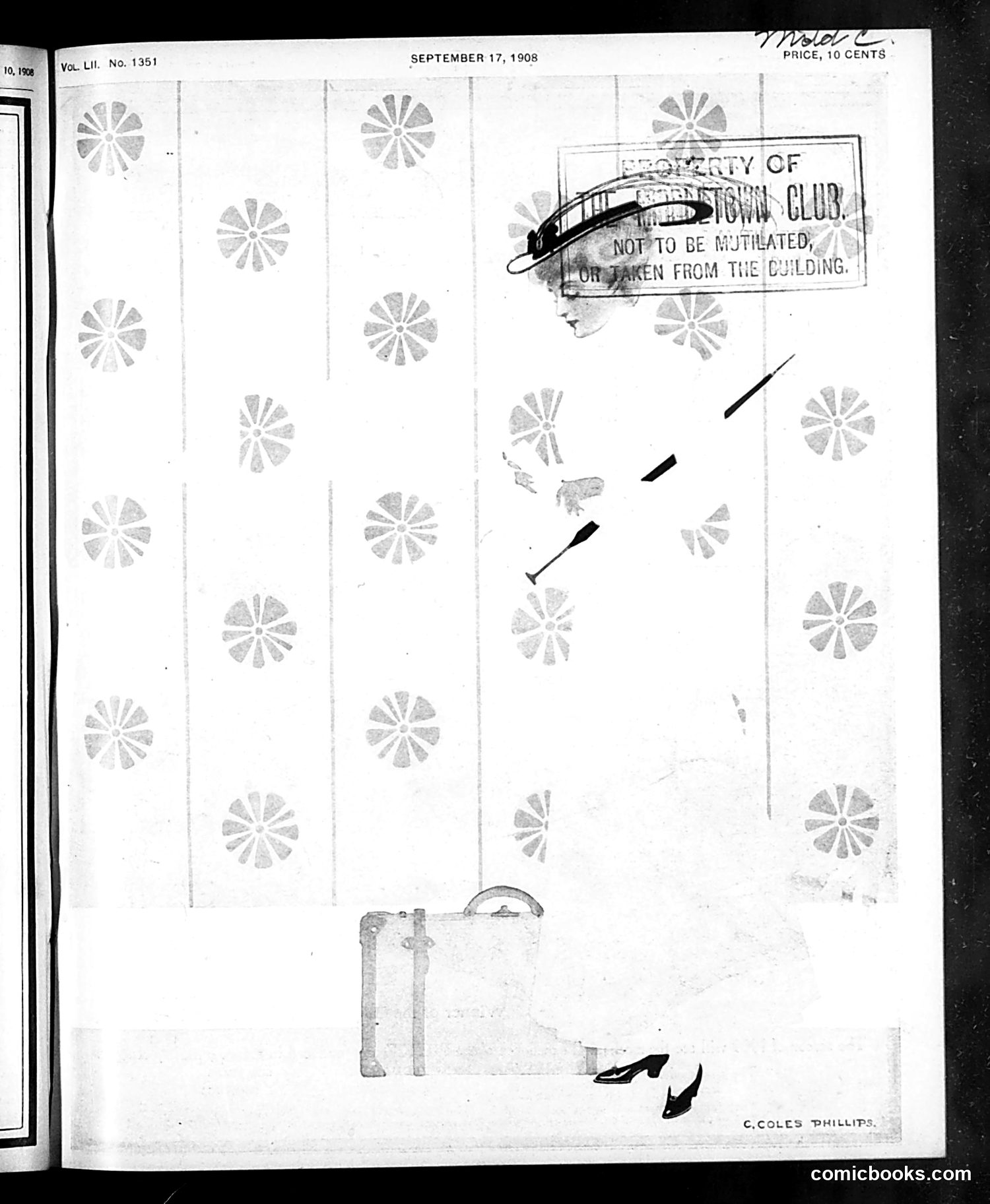
This page appears to be primarily **decorative wallpaper or pattern design** rather than political satire or comics. The repeating circular floral motifs dominate the composition. The only substantive content is a library stamp marked "PROPERTY OF [GEORGETOWN CLUB]" with text stating "NOT TO BE MUTILATED, NOR TAKEN FROM THE BUILDING." At the bottom, there are illustrated objects—a suitcase and shoes—signed by C. Coles Phillips, a known illustrator of the era. These items might reference travel or fashion, but without accompanying text or context, their satirical meaning is unclear. The page functions primarily as institutional archive material rather than satirical commentary.
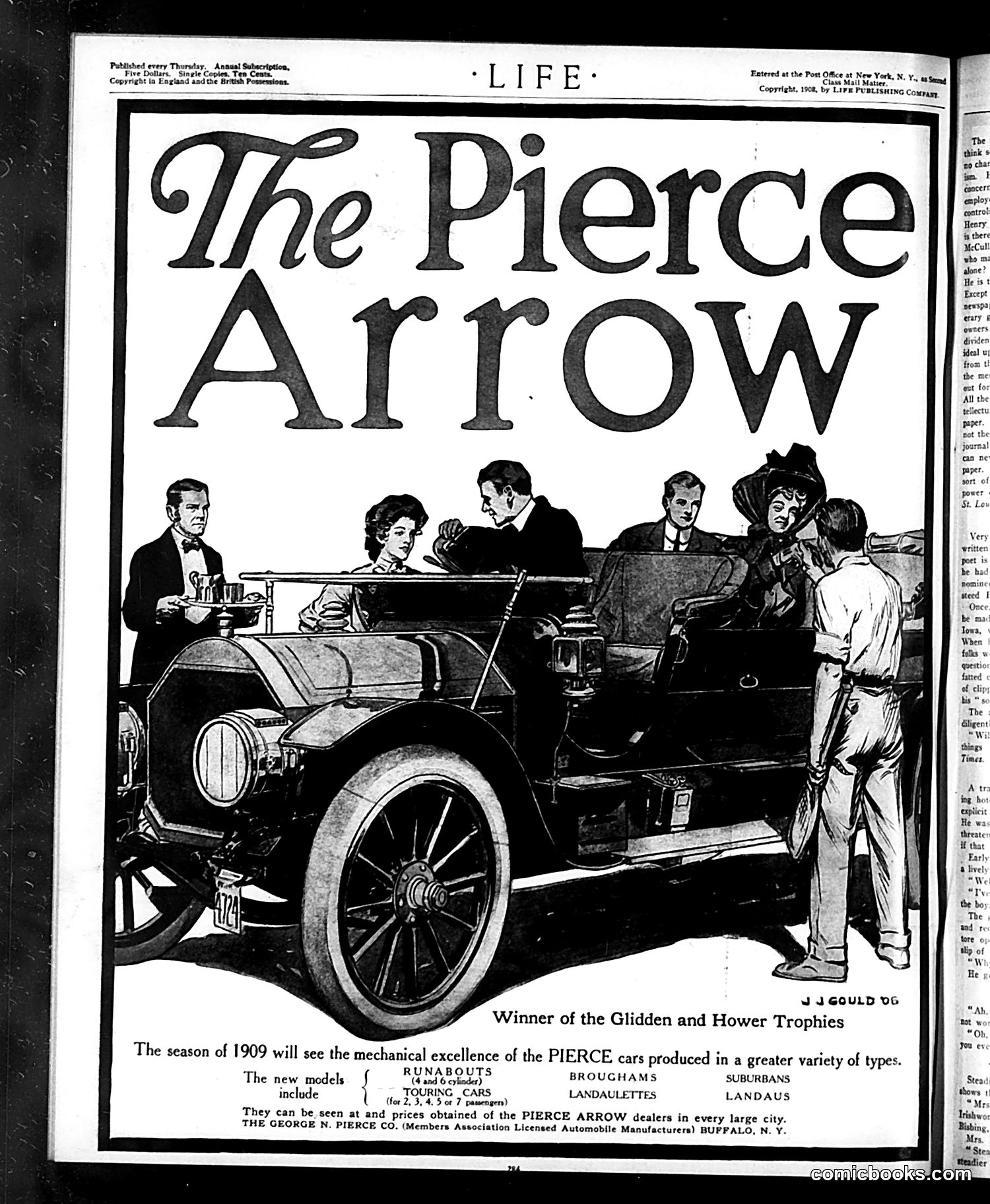
This is primarily a **commercial advertisement**, not political satire. It depicts the Pierce-Arrow automobile, a luxury vehicle manufactured by the George N. Pierce Company of Buffalo, New York. The image shows well-dressed passengers in an early 1900s touring car, illustrating the vehicle's elegant design and spacious interior. The text indicates this advertisement appeared in Life magazine's 1909 season and highlights that Pierce-Arrow won the "Glidden and Hower Trophies"—prestigious automotive competitions of the era. The accompanying text lists various Pierce-Arrow models available: Runabouts, Broughams, Landaulettes, Suburbans, and Landaus, indicating diverse body styles for affluent buyers. Rather than satire, this represents period advertising targeting Life's educated, wealthy readership.
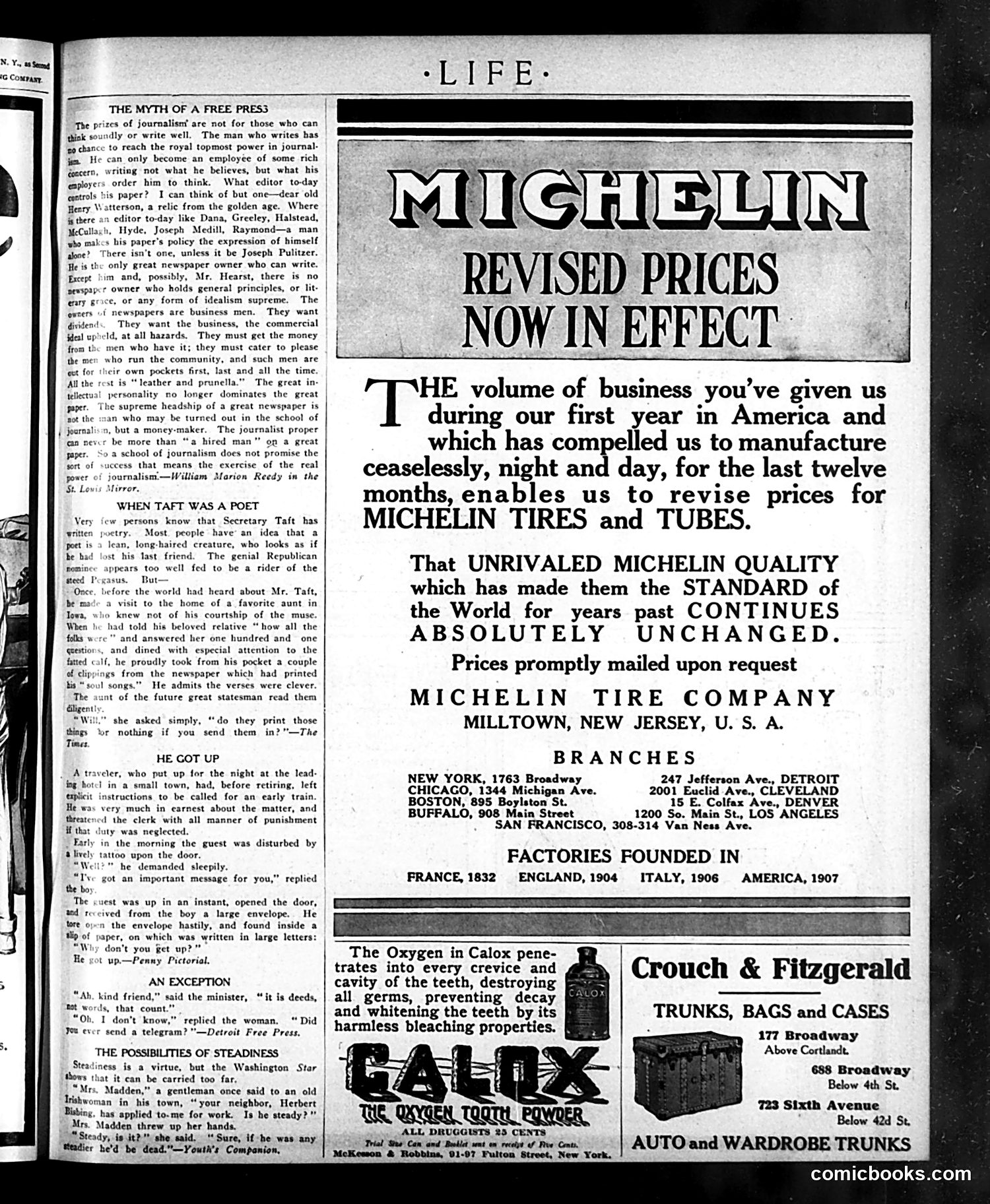
This page is **primarily advertising**, not political satire. The dominant content is a full-page Michelin Tire Company advertisement announcing revised (lower) prices effective after their first year operating in America. The ad emphasizes their "unrivalled quality" and lists branches across major U.S. cities and factories founded in France (1832), England (1904), Italy (1906), and America (1907). The left column contains unrelated short humor pieces ("The Myth of a Free Press," "When Taft Was a Poet," etc.)—typical Life magazine filler—and advertisements for Calox tooth powder and Crouch & Fitzgerald luggage below. **No political cartoons appear on this page.** It's a commercial issue showcasing early 20th-century advertising and light editorial humor.
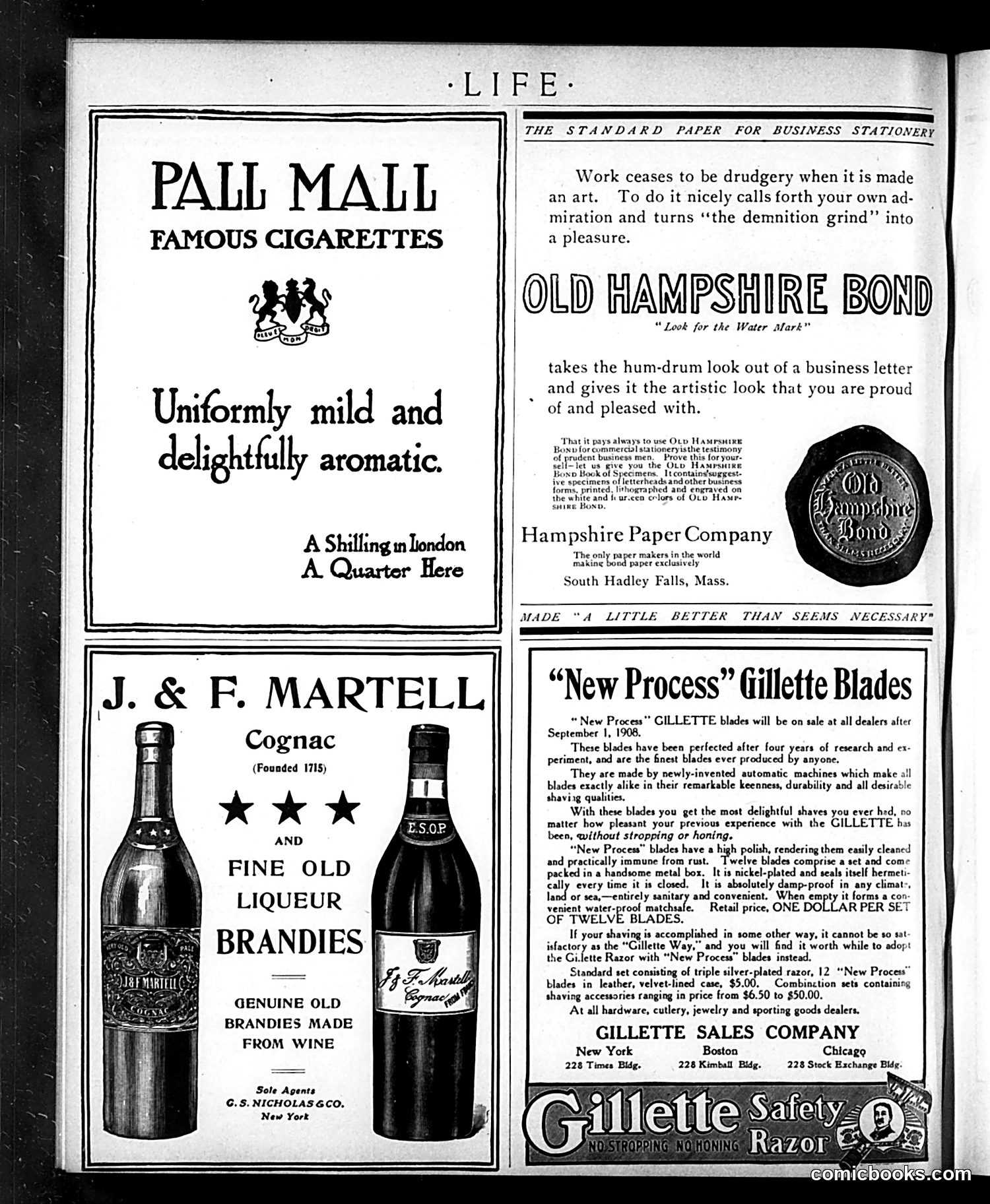
This page contains **no political cartoons or satirical content**. Instead, it is entirely devoted to **period advertisements** from approximately 1908: - **Pall Mall cigarettes**: promotes mild, aromatic tobacco - **Old Hampshire Bond paper**: business stationery emphasizing quality - **J. & F. Martell Cognac**: fine French brandy and liqueurs - **Gillette Safety Razor blades**: advertises a "New Process" blade with detailed product benefits The page represents typical early 20th-century magazine advertising, targeting affluent male consumers through luxury goods (spirits, tobacco, grooming products). There is no satirical commentary, political messaging, or cartoon humor present—merely commercial promotion aligned with the era's consumer culture.
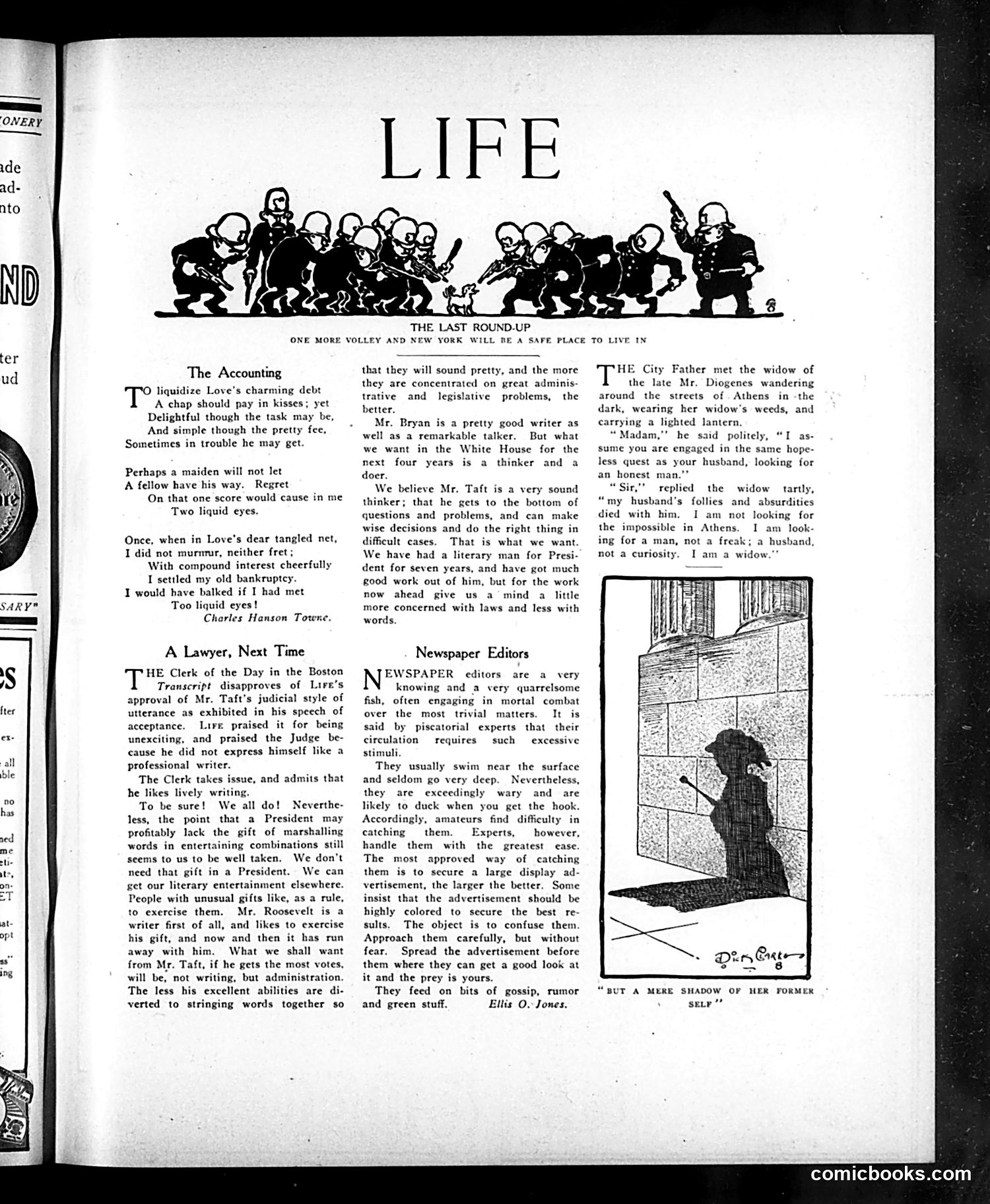
This page satirizes potential presidential cabinet choices, likely from the early 1900s. The top cartoon shows skeletal figures labeled "THE LAST ROUND-UP," captioning "ONE MORE VOLLEY AND NEW YORK WILL BE A SAFE PLACE TO LIVE IN"—suggesting violent political conflict. The main articles discuss ideal candidates for President: Mr. Bryan (a writer/talker), Mr. Taft (sound on legal matters), and commentary on a "literary man for President." The illustration at bottom right, captioned "BUT A MERE SHADOW OF HER FORMER SELF," depicts a widow in mourning—accompanying text about a City Father meeting a widow wandering Athens streets, discussing her search for a "looking for a man, not a freak; a husband, not a curtain." The satire critiques both political leadership qualities and social pretensions.
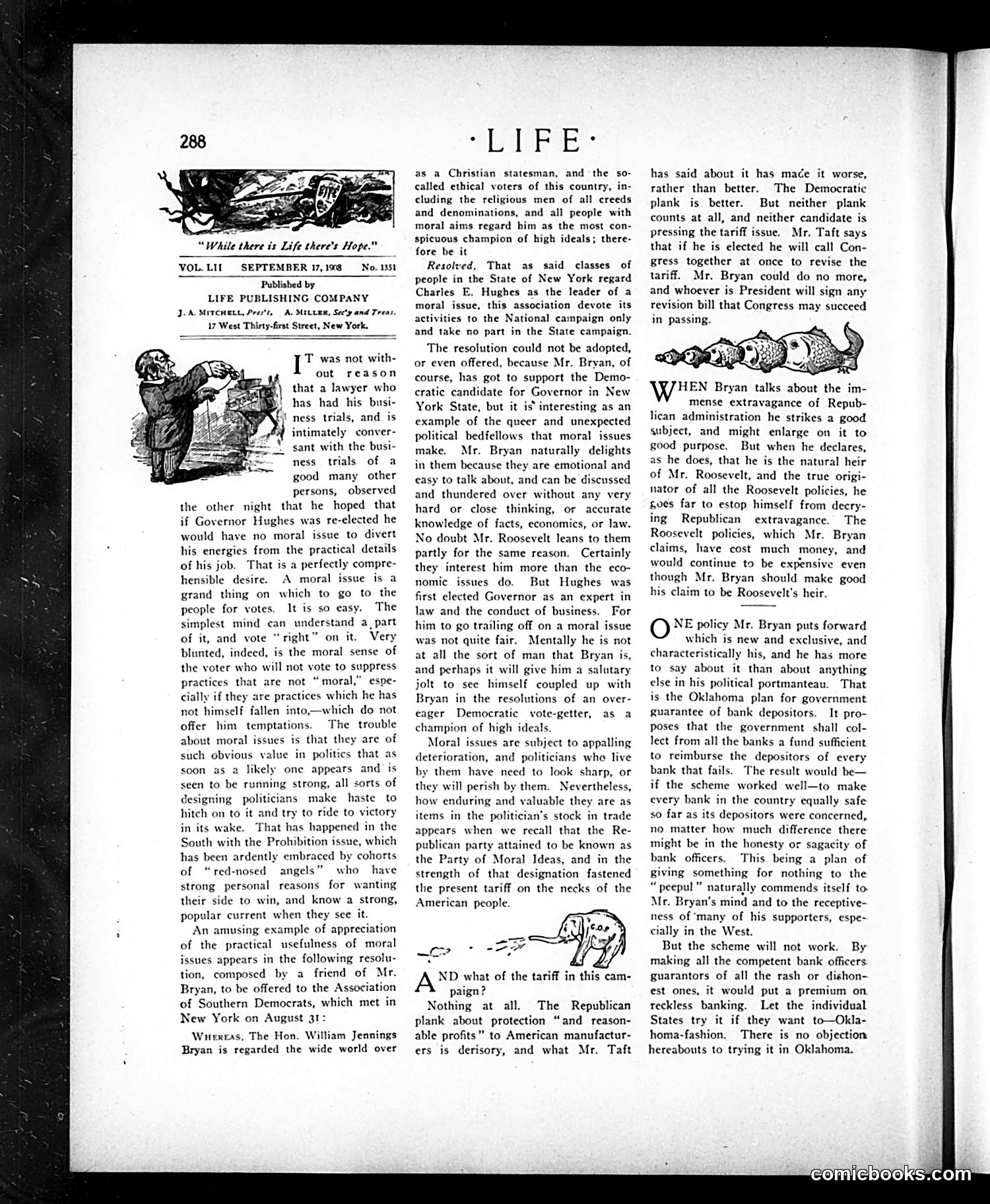
This editorial page critiques William Jennings Bryan's 1908 presidential campaign and his moral positioning as a Democrat. The text argues that Bryan, while claiming to champion "high ideals," is actually a problematic political figure who avoids serious economic analysis in favor of emotional rhetoric about morality. The small cartoon (upper left) appears to show a figure in distress, illustrating the editorial's point about impractical idealism. The larger cartoon (lower right) depicts what appears to be a donkey—the Democratic Party symbol—suggesting Bryan's policies are flawed. The satire contends that Bryan's proposed Oklahoma banking guarantee scheme is unrealistic and won't solve actual economic problems, dismissing his moral crusading as evasion of substantive policy debate.
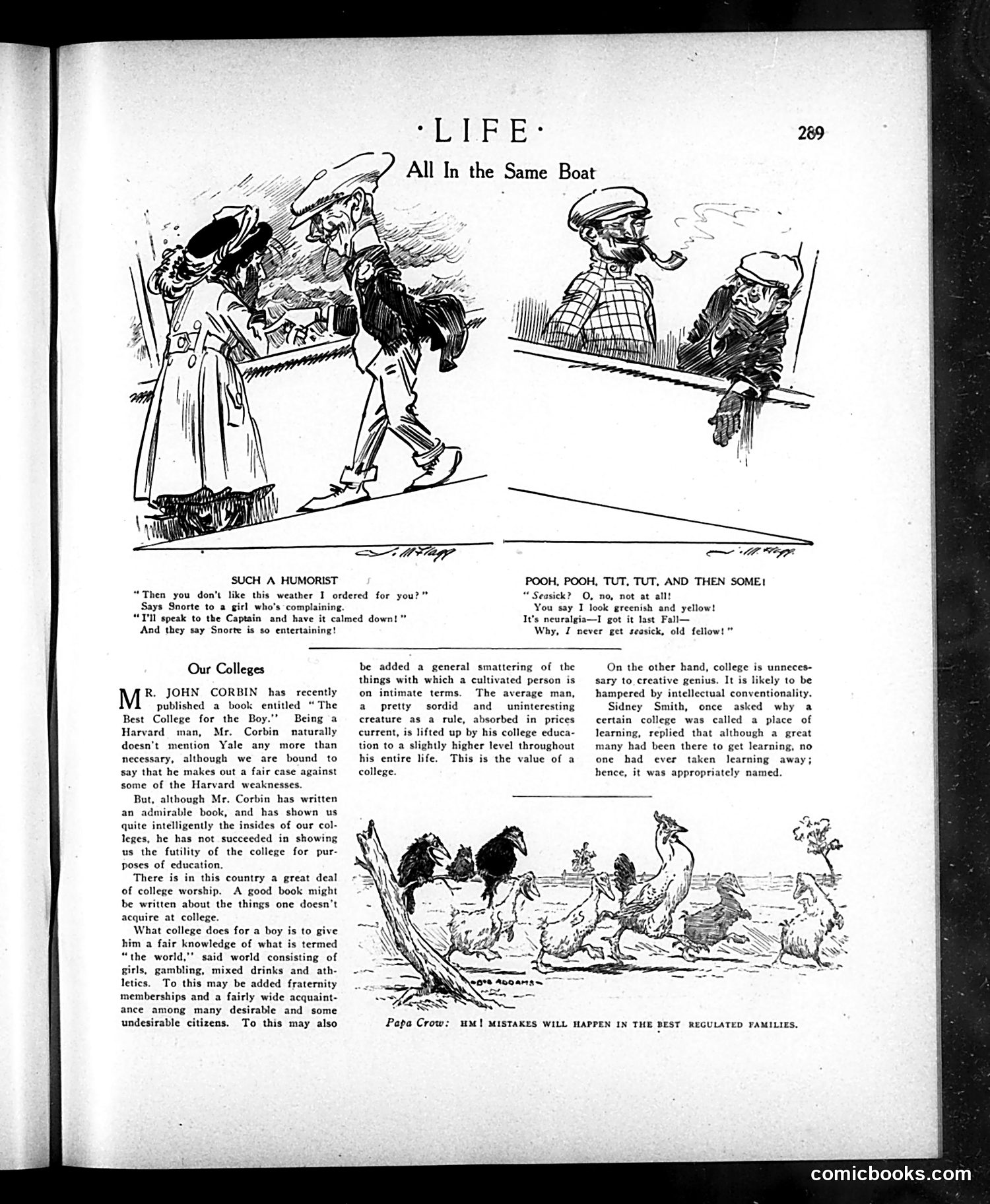
This page contains two cartoon sections satirizing social hypocrisy and college education. The top cartoon "All In the Same Boat" shows three vignettes depicting weather-related complaints: a woman blaming a captain for bad weather, a man similarly complaining, and another person claiming seasickness. The joke critiques people from different social classes all suffering equally—they're "in the same boat" despite their pretensions. Below, an article by Mr. John Corbin reviews "The Best College for the Boy," critiquing Harvard's value. The text argues colleges don't adequately prepare men for "the world" (defined as "girls, gambling, mixed drinks and athletics"). The bottom illustration shows various animals in chaotic interaction, captioned "HM! MISTAKES WILL HAPPEN IN THE BEST REGULATED FAMILIES"—suggesting that disorder is inevitable even in supposedly well-ordered institutions.
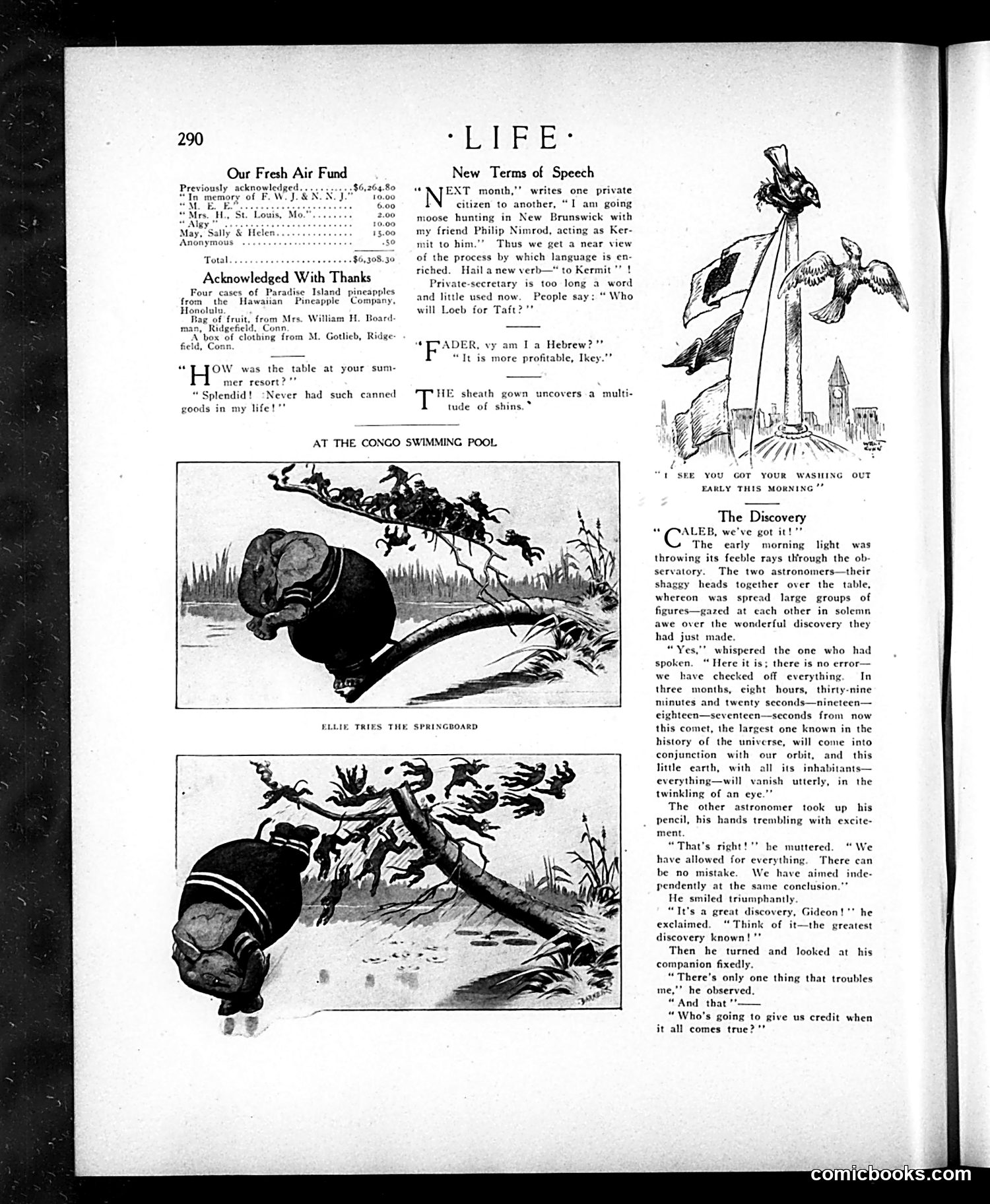
This page contains two cartoon panels depicting an elephant (labeled "Ellie") attempting to use a springboard at what appears to be a swimming pool. The humor derives from the obvious physical absurdity: an elephant is far too heavy and large to safely use such equipment, yet the cartoons show it trying anyway—presumably with comedic results. The satire likely mocks contemporary behavior or pretensions, possibly referencing the "Congo" setting to invoke colonial-era attitudes. However, without additional historical context about Life magazine's specific political commentary from this period, the exact social critique remains unclear. The humor appears primarily physical/slapstick rather than overtly political.
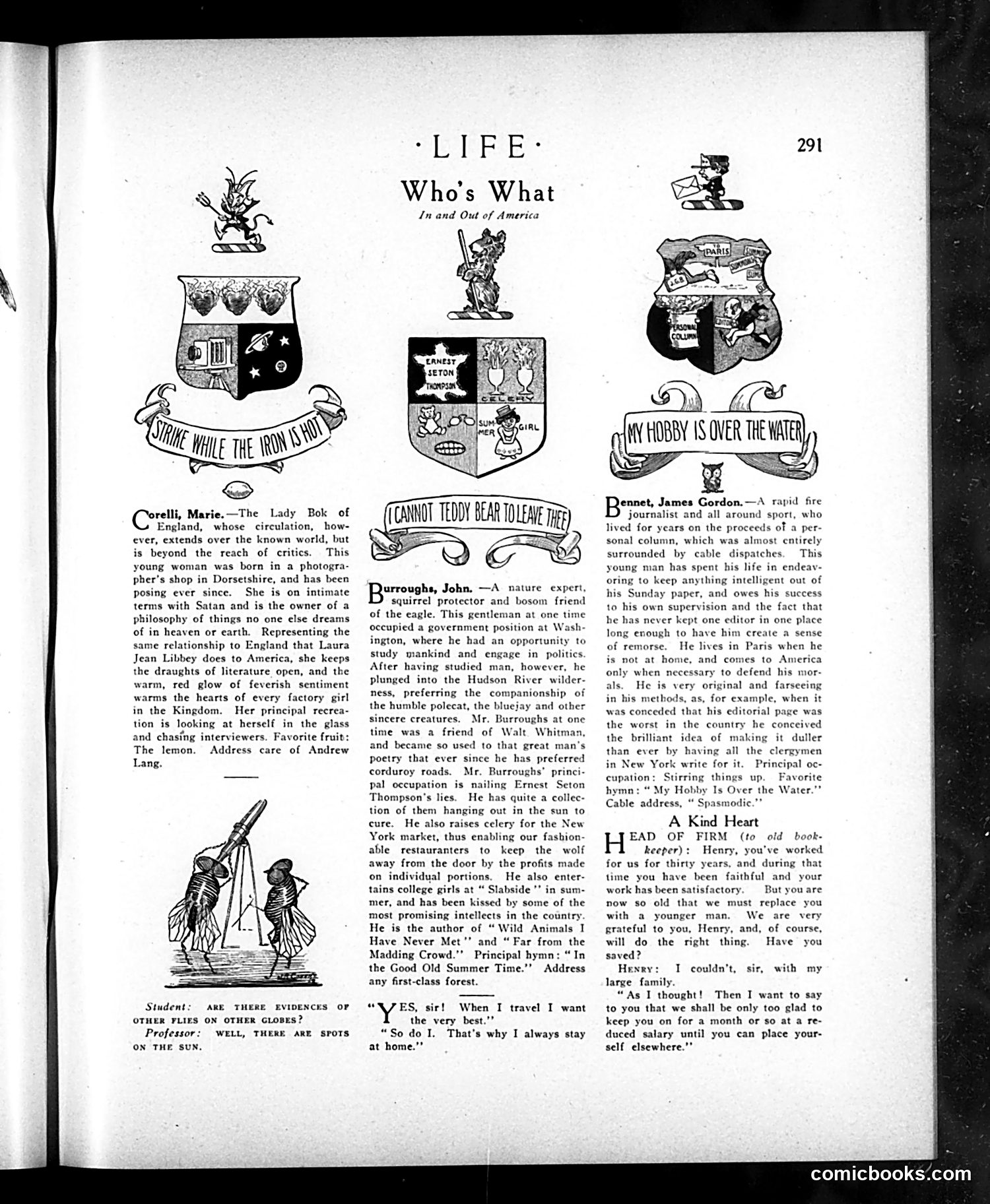
This page features biographical sketches under the heading "Who's What: In and Out of America." The content includes entries for three people: **Corelli, Marie** — described as "The Lady Bob of England," a fiction writer with global influence. **Burroughs, John** — a naturalist and friend of Walt Whitman, characterized as a nature expert who prefers wilderness and animal companions to urban life. **A Kind Heart** — appears to be a workplace dialogue where an older employee (Henry) is being replaced by a younger worker, with Henry graciously accepting his replacement. The page includes decorative crests/emblems and a small illustration of what appears to be fishing or outdoor activity. Rather than political satire, this reads as human-interest profiles typical of Life's "Who's What" column, presenting notable figures and social observations to readers.
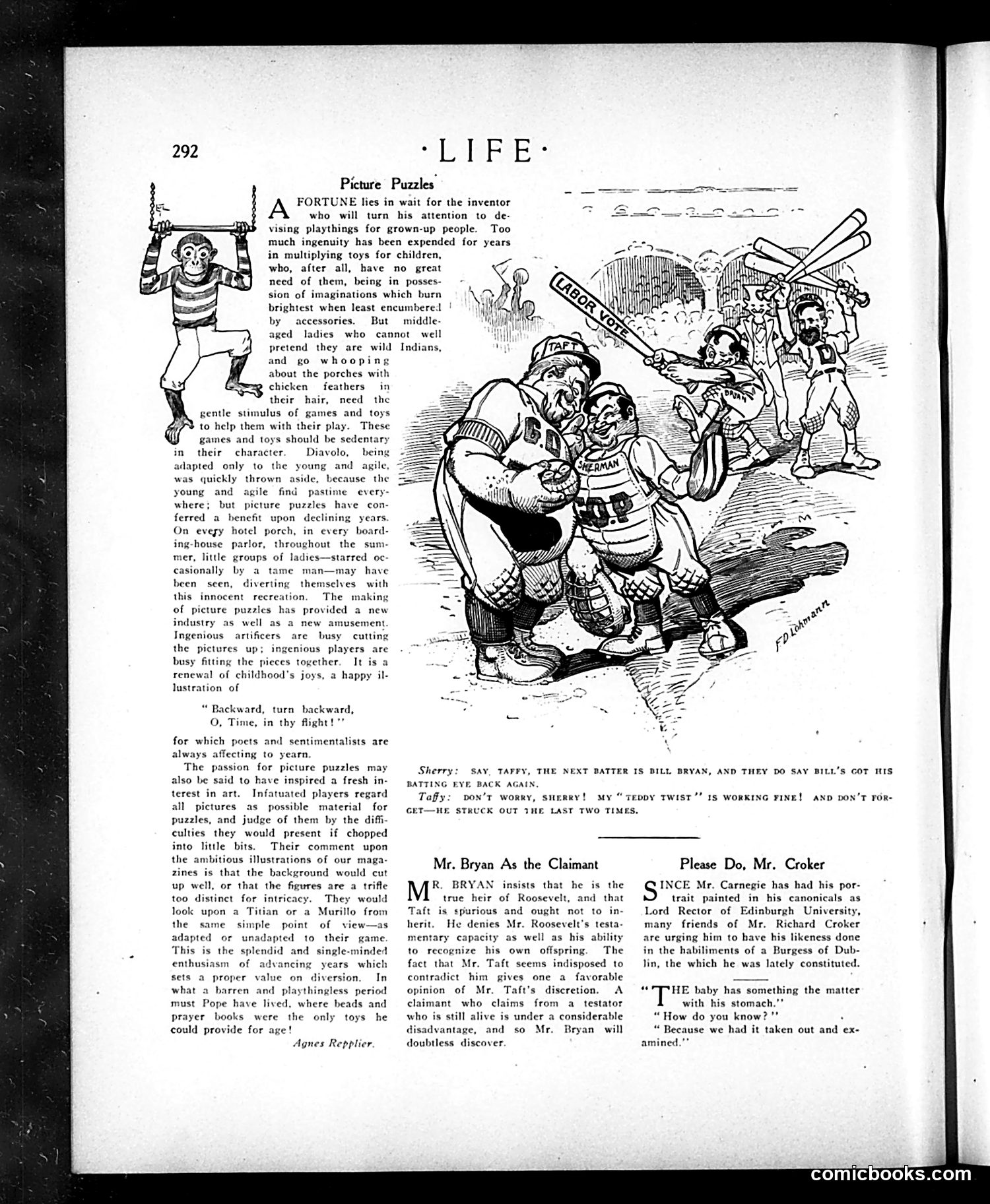
The main illustration depicts a baseball scene with caricatured figures labeled "Sherry," "Taffy," and "Bill Bryan." The dialogue references Bill Bryan's "batting eye" and a character called "Teddy Twist" who is "working fine." The cartoon appears to satirize early 1900s baseball culture, likely mixing sports commentary with political figures. "Bill Bryan" references William Jennings Bryan, the three-time presidential candidate. The exact political point is unclear without publication date context. Below are two brief prose items: "Mr. Bryan As the Claimant" and "Please Do, Mr. Croker," which appear to satirize political claims and disputes involving these figures, though specific references remain ambiguous without additional historical context. The overall page combines sports humor with political satire typical of Life magazine's format.
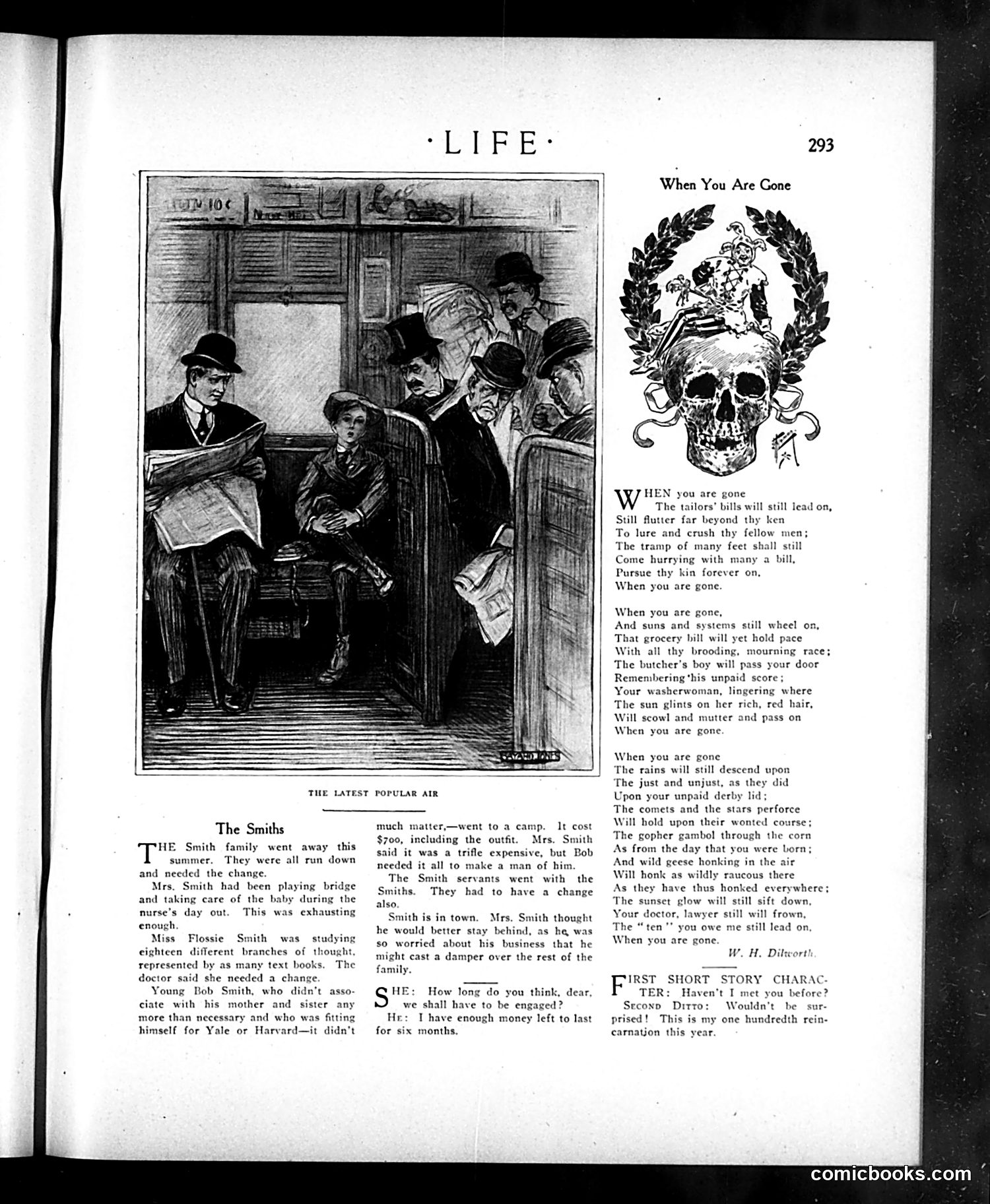
This page contains two distinct pieces: **Left side:** An illustration titled "The Latest Popular Air" depicting men reading newspapers on public transit (likely a subway or train car). The accompanying text "The Smiths" describes a family's summer vacation to camp—a satirical commentary on middle-class leisure aspirations and the financial strain of maintaining appearances. **Right side:** A poem titled "When You Are Gone" by W. H. Dinsworh, featuring a memento mori (skull with laurel wreath) illustration. The melancholic verse reflects on mortality and life's indifference to individual death—a traditional Romantic theme about human insignificance. The page juxtaposes mundane domestic comedy with existential meditation, typical of Life's satirical approach to American society and culture.
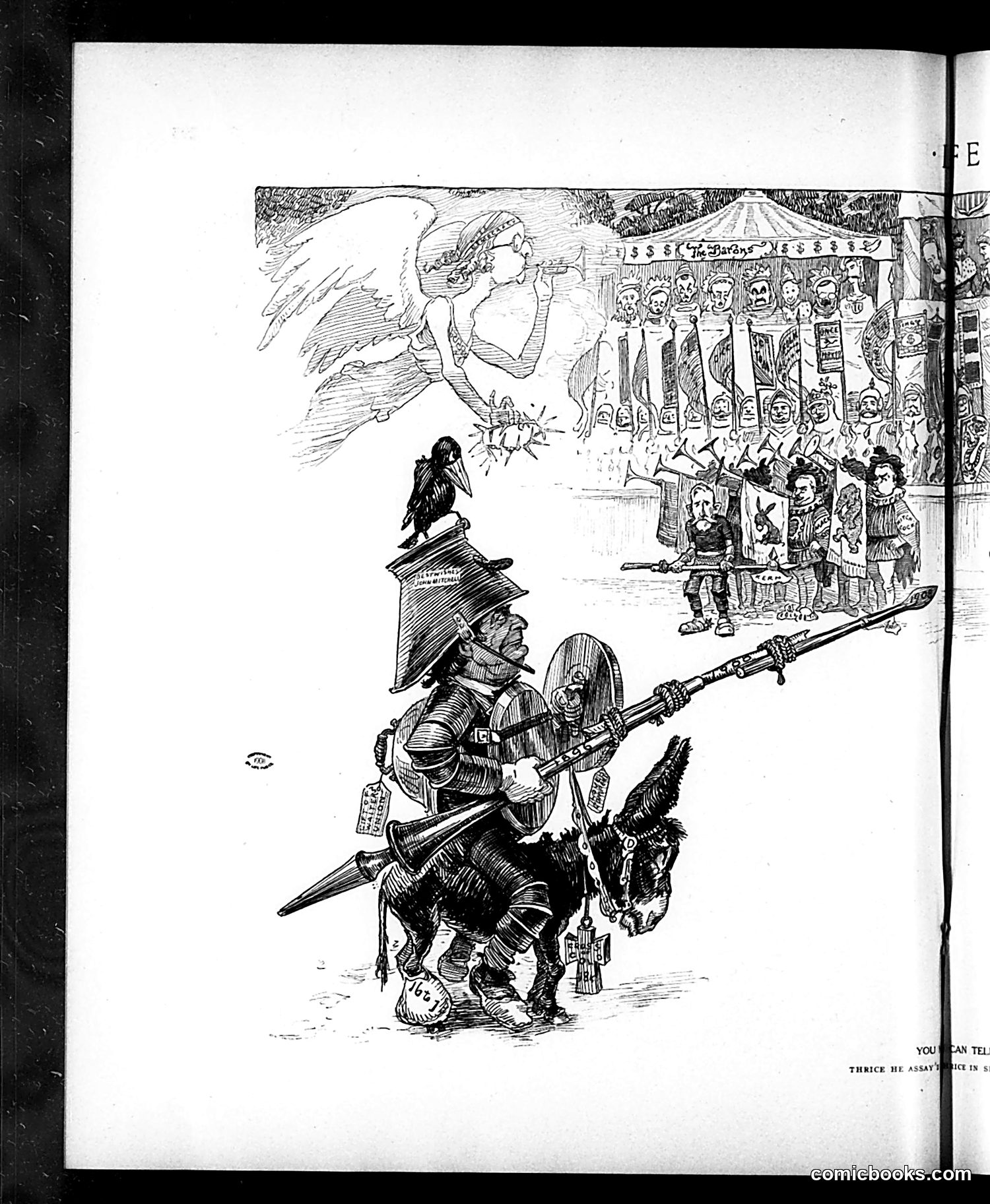
This is a satirical political cartoon from Life magazine depicting a militaristic figure on horseback wielding an enormous bayoneted rifle, with a raven perched on his tall military hat. The figure appears to embody German militarism or Prussian aggression—suggested by the distinctive spiked helmet and martial imagery. In the background, an angel hovers above while crowds of figures (possibly representing nations or peoples) observe from fortified structures. The composition suggests critique of aggressive military expansion and warmongering. The raven—traditionally associated with death and ill-omen—reinforces the negative characterization. The exaggerated scale of the weapon emphasizes the threat posed by this militaristic power. Without visible publication date or clearer textual context, the specific historical moment remains uncertain, though the style suggests early 20th-century conflict commentary.
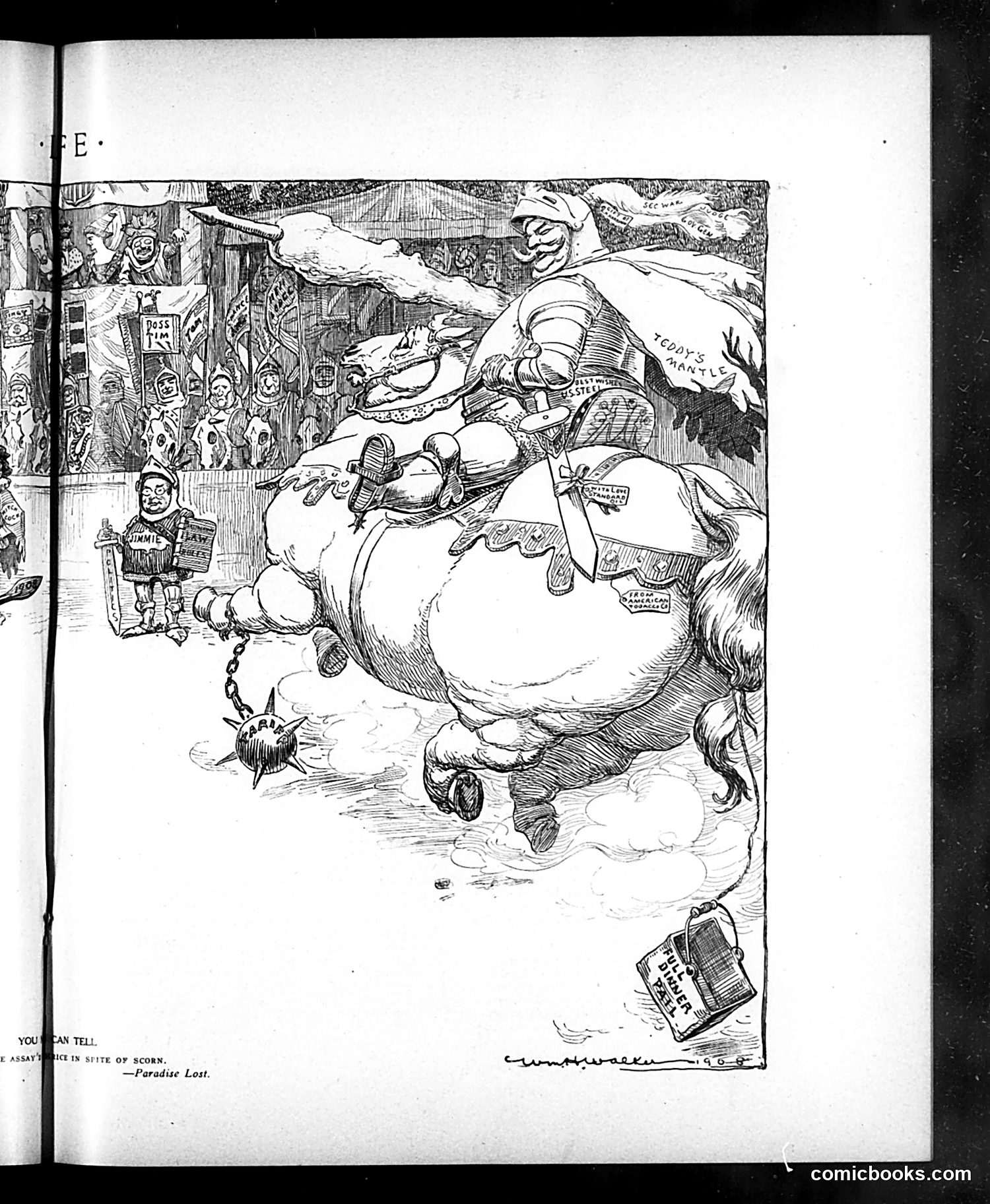
This appears to be an early 20th-century satirical cartoon from *Life* magazine. The main illustration depicts an enormous, grotesquely obese figure labeled "Teddy's Mantle" riding on what appears to be a spiked ball or sphere. A smaller uniformed figure stands to the left, appearing diminished by comparison. The cartoon likely satirizes **Theodore Roosevelt's political legacy and influence**, with "Teddy's Mantle" representing the weight of his presidency or policies that someone (possibly a successor or political heir) must bear. The exaggerated corpulence emphasizes how burdensome or overshadowing Roosevelt's influence remained in American politics. The text fragment mentions "Paradise Lost," suggesting a commentary on lost political innocence or failed ideals. Without clearer dating or labels, the exact political moment remains uncertain.
This page reviews two Broadway plays through satirical drama criticism. **"The Molluse"** concerns a parasitic woman who manipulates others through calculated passivity and laziness, relying on her charm to exploit family members. The reviewer praises the playwright H.H. Davies for anatomizing this character type as social commentary, though notes it's a "character sketch" rather than a traditional play. The term "molluscry" — describing selfish dependency — is presented as likely to enter common usage. **"Diana of Dobson's"** by Cicely Hamilton exposes the exploitation of underpaid British shop-girls, but the reviewer dismisses it as heavy-handed socialist tract-writing lacking Bernard Shaw's wit. The critic mocks British shop-girls as supercilious and materialistic (obsessing over the word "cash"), suggesting American audiences won't sympathize with their plight. The satire targets both theatrical naturalism and social problem plays that preach without cleverness or practical solutions.
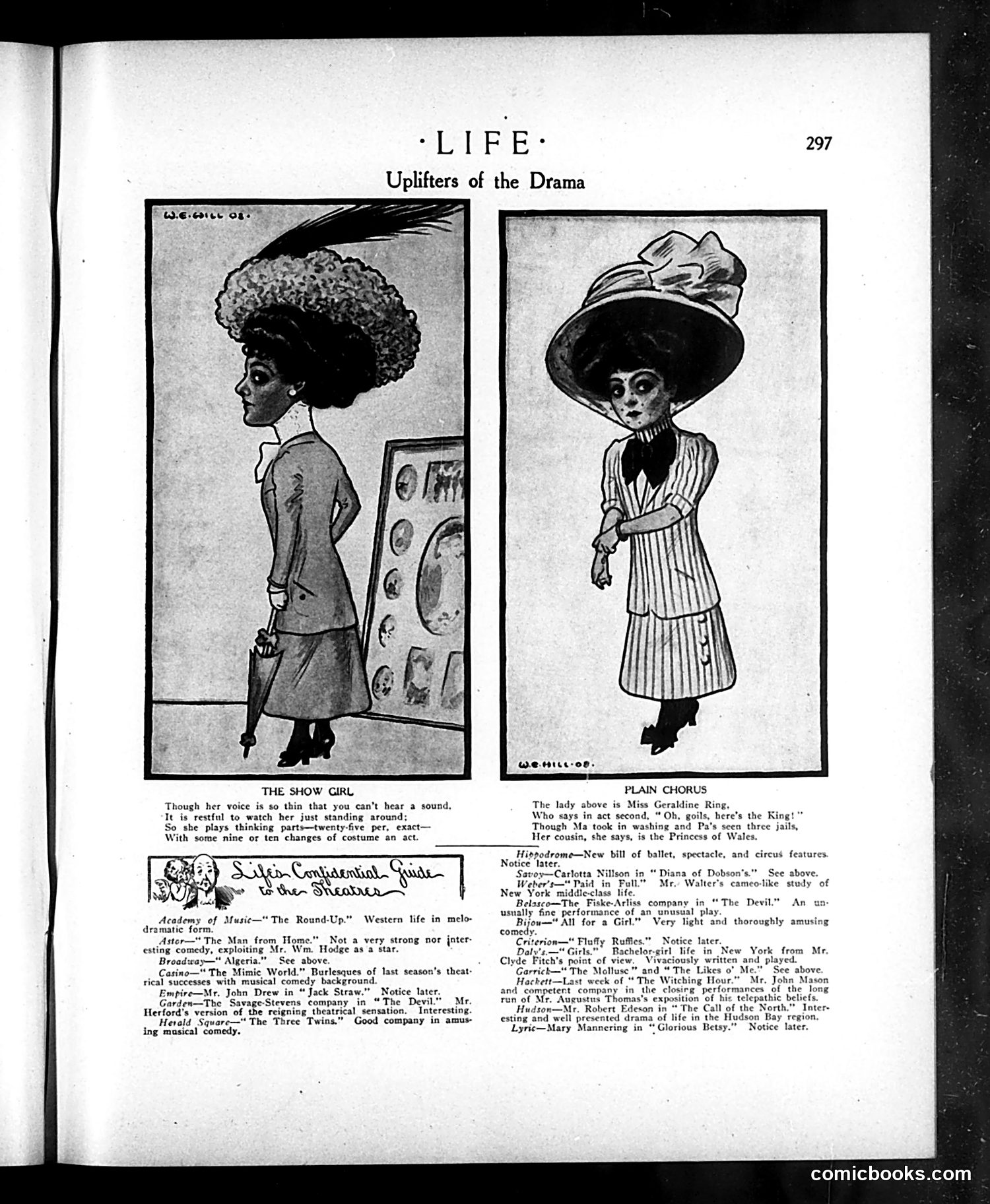
This page satirizes early 1900s Broadway performers and productions through two caricatured figures representing theatrical stereotypes. **"The Show Girl"** mocks chorus performers hired purely for appearance despite having weak voices and minimal talent. She's depicted as intellectually vacant, playing "thinking parts" while relying on costume changes to distract audiences from her lack of actual ability. **"Plain Chorus"** features Miss Geraldine Ring, who represents the social-climbing ambitions of working-class performers. She brags about aristocratic connections (claiming her cousin is the Princess of Wales) while her background reveals poverty—her mother took in laundry and her father served prison time. The satire targets both the shallow theatrical industry that prioritizes looks over talent, and the pretensions of chorus girls seeking upward mobility through theatrical fame. The page also provides contemporary theater reviews, suggesting *Life* positioned itself as cultural arbiter critiquing New York's entertainment scene for its readers.
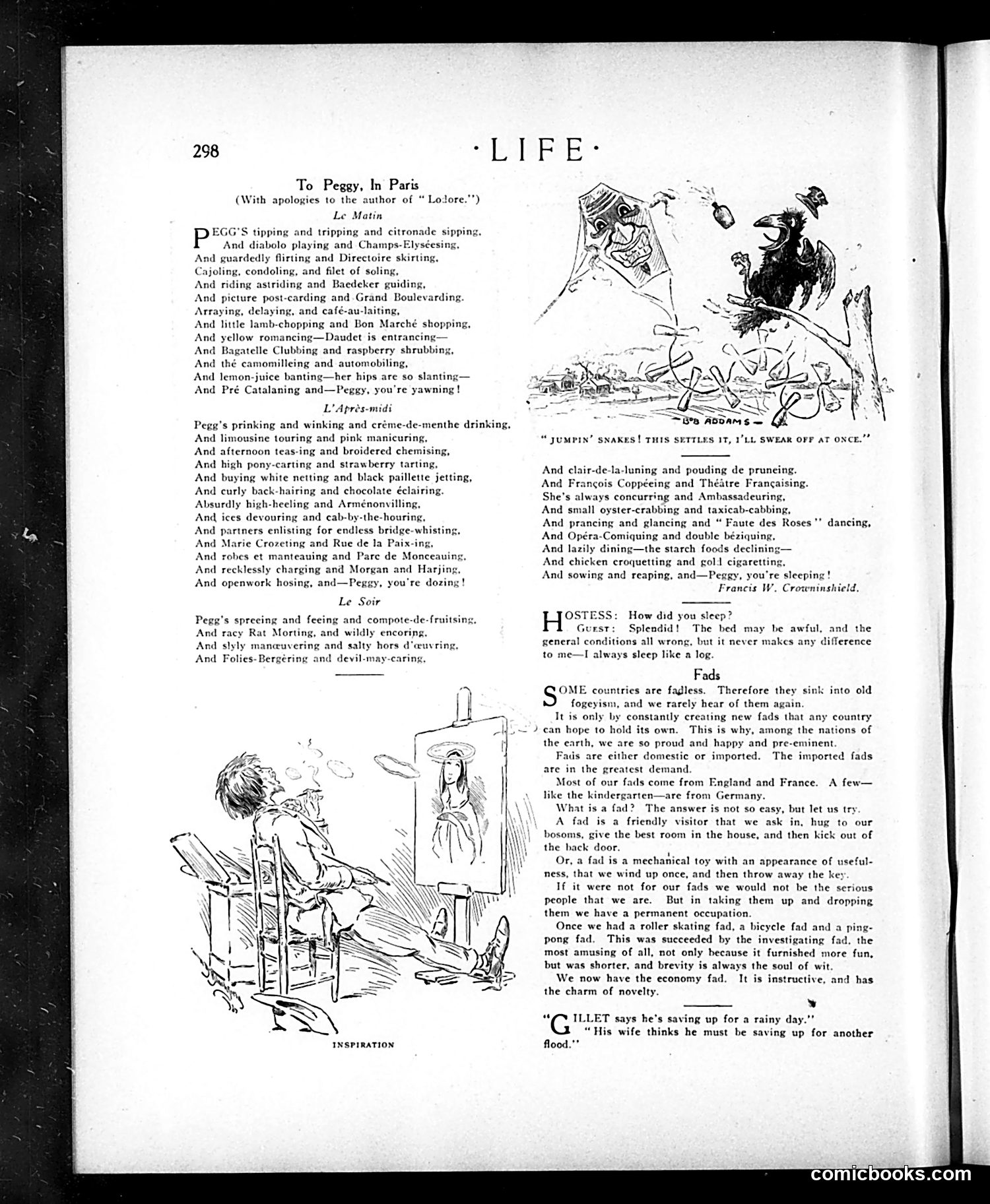
This page satirizes American tourists in Paris through two pieces: **"To Peggy, In Paris"** is a mock-heroic poem listing clichéd Parisian activities—flirting, shopping at Bon Marché, café culture, automobiling, opera-going—that expatriate Americans supposedly pursue. The repetitive structure parodies romantic French poetry while suggesting tourists engage in shallow, exhausting consumerism rather than genuine cultural experience. The illustrations show a woman frantically busy, ultimately falling asleep, mocking the frantic tourist lifestyle. **"Fads"** explains that nations maintain prestige by constantly creating new fashions. It defines a fad as a "friendly visitor" you discard after brief use—a mechanical toy wound up and abandoned. The piece notes America proudly imports fads from Europe (especially England and France) and cycles through them (roller skating, bicycles, ping-pong, "investigating," now "economy"). The humor lies in recognizing Americans' earnest adoption of passing trends as evidence of national vitality rather than superficiality. Both pieces mock American aspirational consumption and trend-chasing.
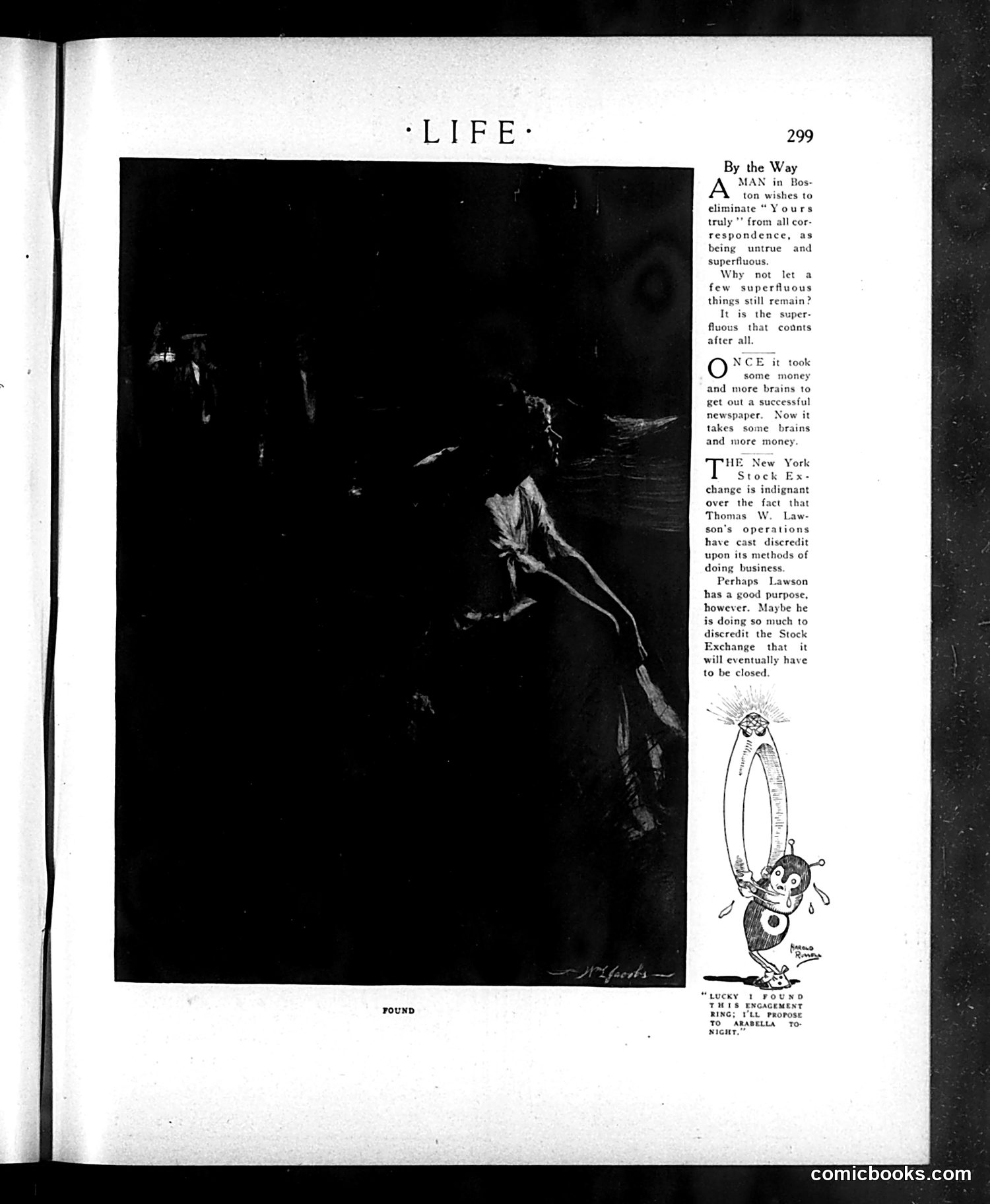
This page contains two satirical pieces: **"By the Way" column** (top right): Brief social commentary criticizing a Boston man's desire to eliminate "Yours truly" from correspondence. The writer argues some superfluities are harmless and worth keeping. **Main commentary**: Discusses Thomas W. Lawson's public criticism of the New York Stock Exchange's business practices. Lawson, apparently a financial figure, has attracted controversy. The writer sarcastically suggests that Lawson's attacks on the Exchange—intended to reform it—might be so damaging they'll force its closure entirely. **Bottom cartoon**: A small illustration of a beetle or insect holding an engagement ring, captioned about proposing to "Arabella." This appears to be a humorous non-sequitur or advertisement. The page's core satire concerns financial reform: whether Lawson's crusade against Stock Exchange corruption serves legitimate purposes or merely discredits the institution itself.
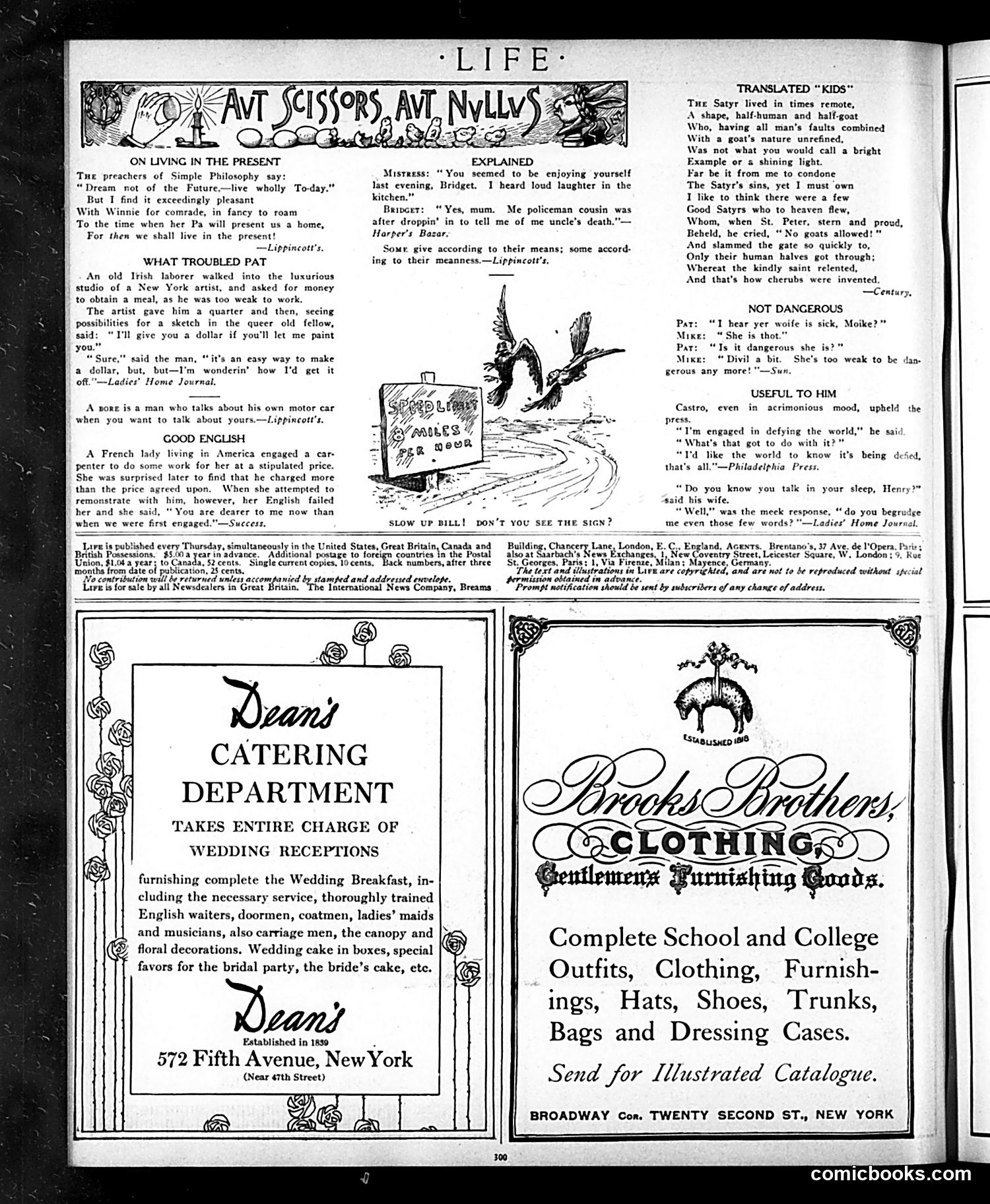
This page consists primarily of **short humorous anecdotes and jokes** rather than political cartoons. The content reflects early 20th-century American humor: **Key Items:** 1. **"On Living in the Present"** — A joke about a young man fantasizing about his future home with his girlfriend "Winnie," mocking philosophical advice to "live for today." 2. **"What Troubled Pat"** — An Irish stereotype joke where an old laborer worries about removing paint from his body after being paid to sit for a portrait. 3. **"Good English"** — Humor from a French woman's mistranslation calling a carpenter "dearer" (more expensive) rather than "more costly." 4. **"Slow Up Bill"** — A cartoon showing someone ignoring a speed limit sign. 5. **"Translated Kids"** — A longer poem explaining mythological satyrs, reframed as a children's story about cherubs. The remaining items are brief witticisms on bores, marriage, and workplace dynamics. The page is supplemented by period advertisements for catering and clothing services.
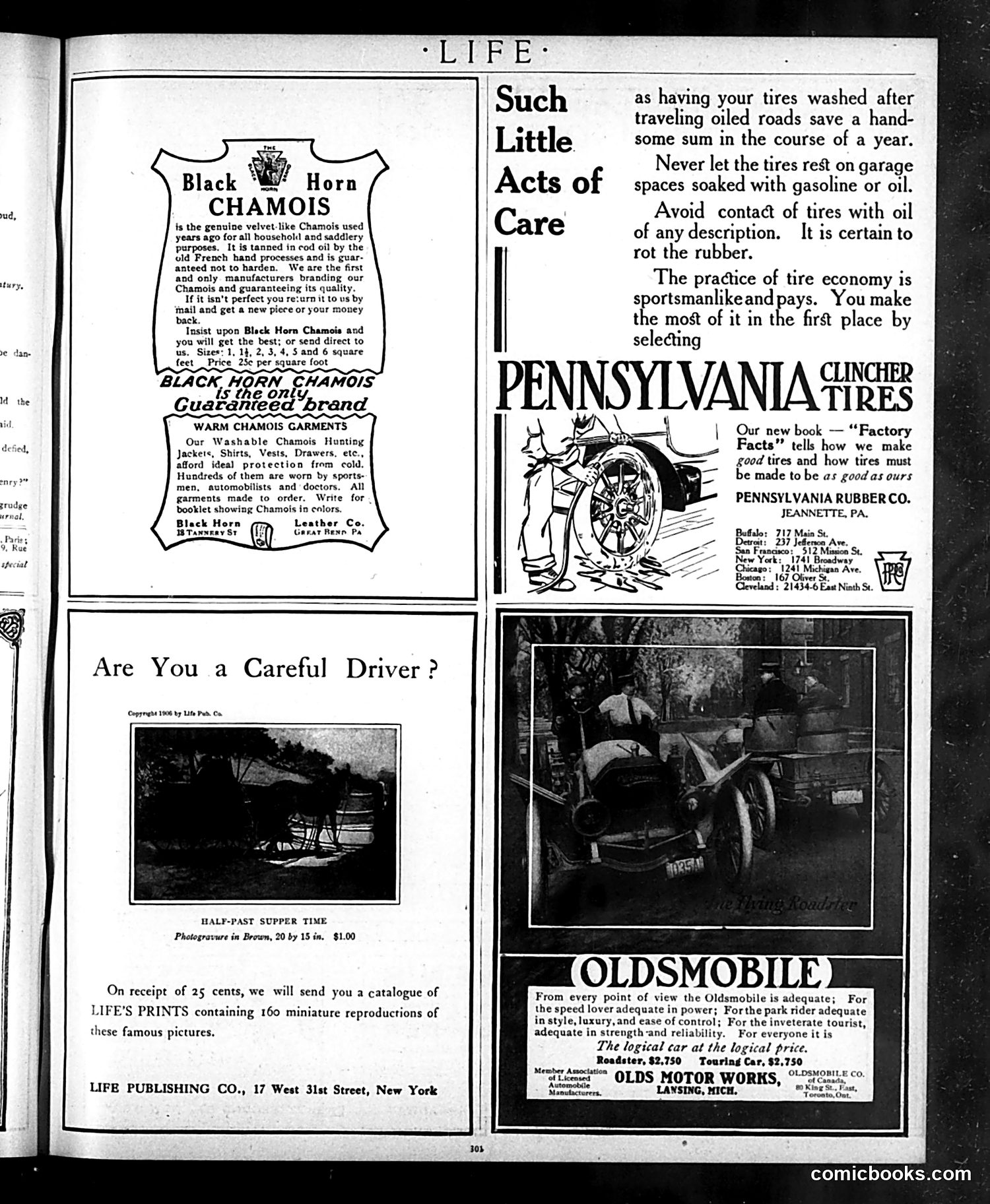
This page is primarily **advertising**, not satire or political content. It contains four distinct advertisements: 1. **Black Horn Chamois** - promotes genuine French chamois leather for cleaning and protective garments, emphasizing quality and money-back guarantees. 2. **Pennsylvania Clincher Tires** - advertises automobile tires with tire-care advice (avoid oil contact, wash after dusty roads), promoting tire economy as "sportsmanlike." 3. **Life's Prints** - sells photogravure reproductions, including one titled "Half-Past Supper Time" (a domestic scene), for catalog purposes. 4. **Oldsmobile** - emphasizes the car's versatility for different drivers (speed enthusiasts, luxury seekers, tourists), positioning it as the logical choice at a logical price. The page reflects early 1900s automotive culture and consumer goods marketing. No political cartoons or satire are present—it's a straightforward commercial section of the magazine.
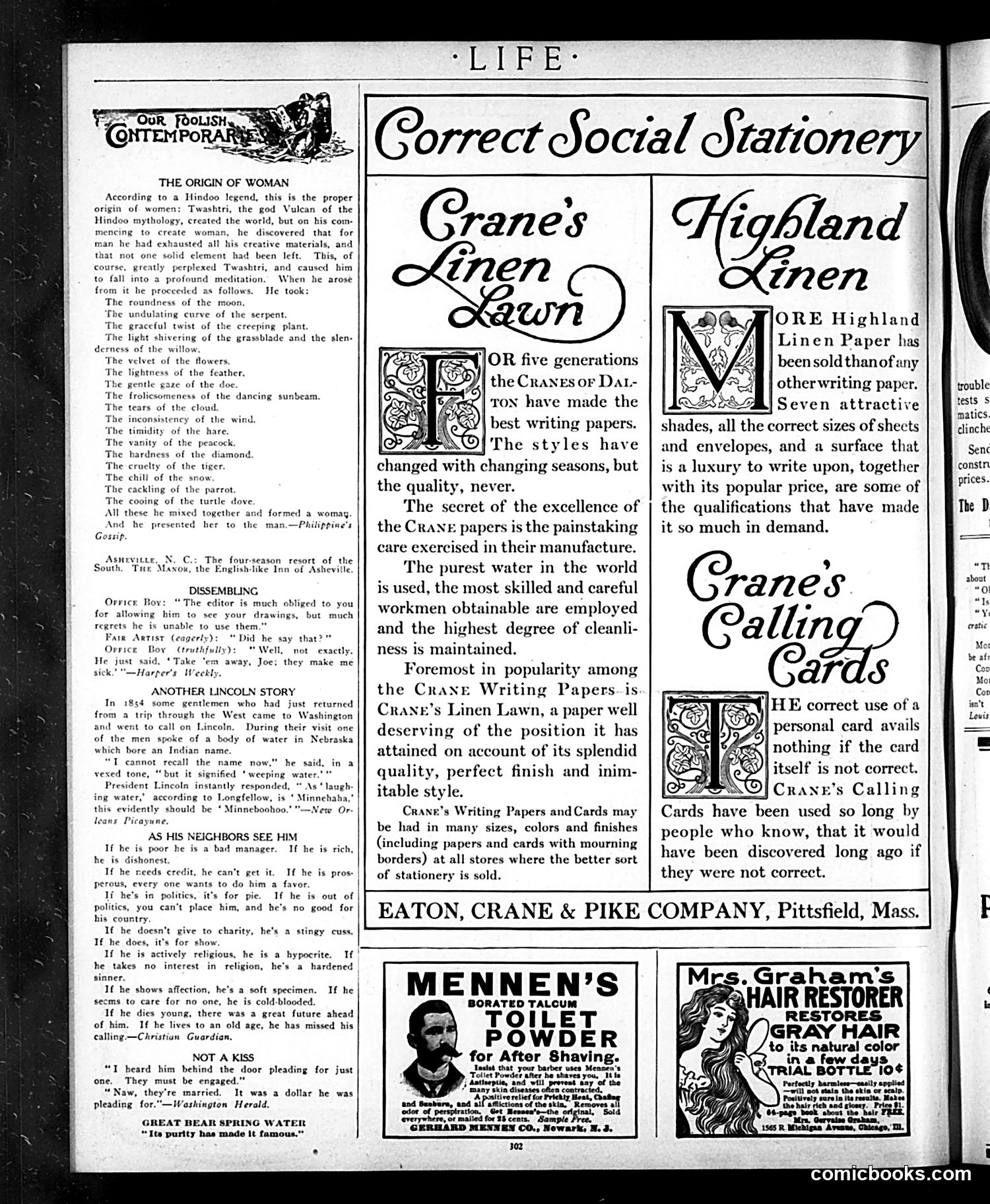
This page contains satirical humor typical of early 20th-century Life magazine alongside period advertisements. **"The Origin of Woman"** presents a Hindu creation myth presented as pseudo-intellectual satire—mocking how women were romantically idealized yet reduced to stereotypical traits (fickleness, weakness, beauty). The joke assumes readers will find this "explanation" amusingly absurd. **"Dissembling"** satirizes workplace hypocrisy: an editor tells his assistant to dismiss an artist's work as "making him sick," but the assistant honestly reports the criticism as a polite rejection. The humor lies in contrasting brutal honesty with social politeness. **"As His Neighbors See Him"** offers cynical observations about how people judge their peers—whatever one does, critics find fault. It's social commentary on human nature's negativity bias. The remaining anecdotes follow similar patterns of ironic, brief humor centered on dishonesty, misunderstandings, or human contradictions. The advertisements (Crane's stationery, hair restorer, toilet powder) represent period product endorsements using decorative typography.
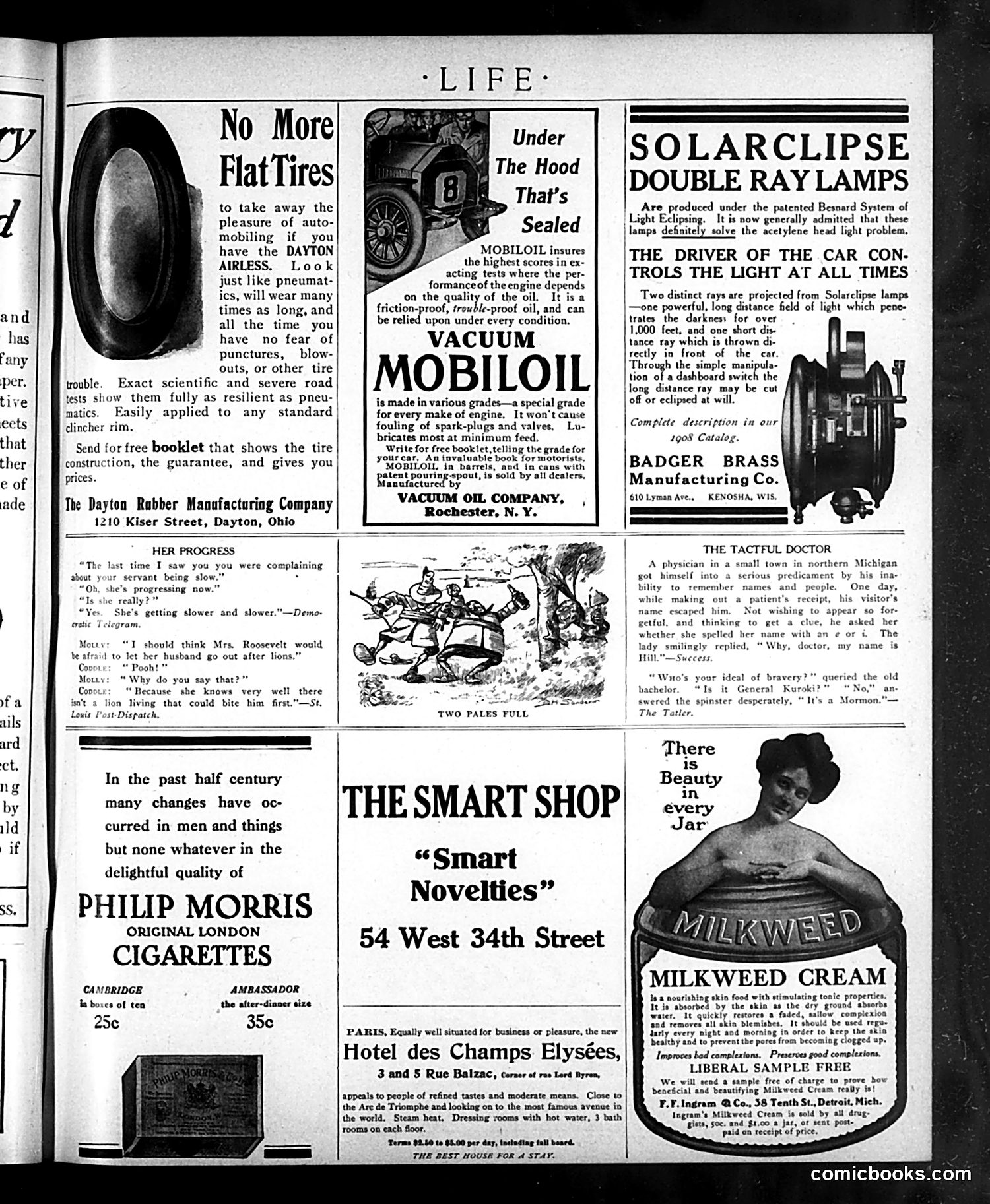
This page is primarily **advertising**, typical of early 1900s Life magazine. The cartoons are minor filler pieces alongside product promotions. The two small cartoon jokes are: 1. **"Her Progress"**: A domestic humor piece where a wife complains her husband is "progressing" (improving), then contradicts herself saying he's "getting slower and slower"—the joke being marital incompatibility or her inability to articulate what she actually means. 2. **"The Tactful Doctor"**: A physician, unable to remember a patient's name, awkwardly asks if she spells it with "one or i." She replies her name is "Hill"—making his question absurd. The punchline references "General Kuroki" (a Japanese general from the Russo-Japanese War) and "Mormon," playing on the absurdity of his desperate guessing. The bulk of the page advertises automobiles (Dayton tires, Mobiloil, Solarclipse lamps), cigarettes, hotel accommodations, and beauty cream—reflecting early 20th-century consumer culture and luxury goods marketing.
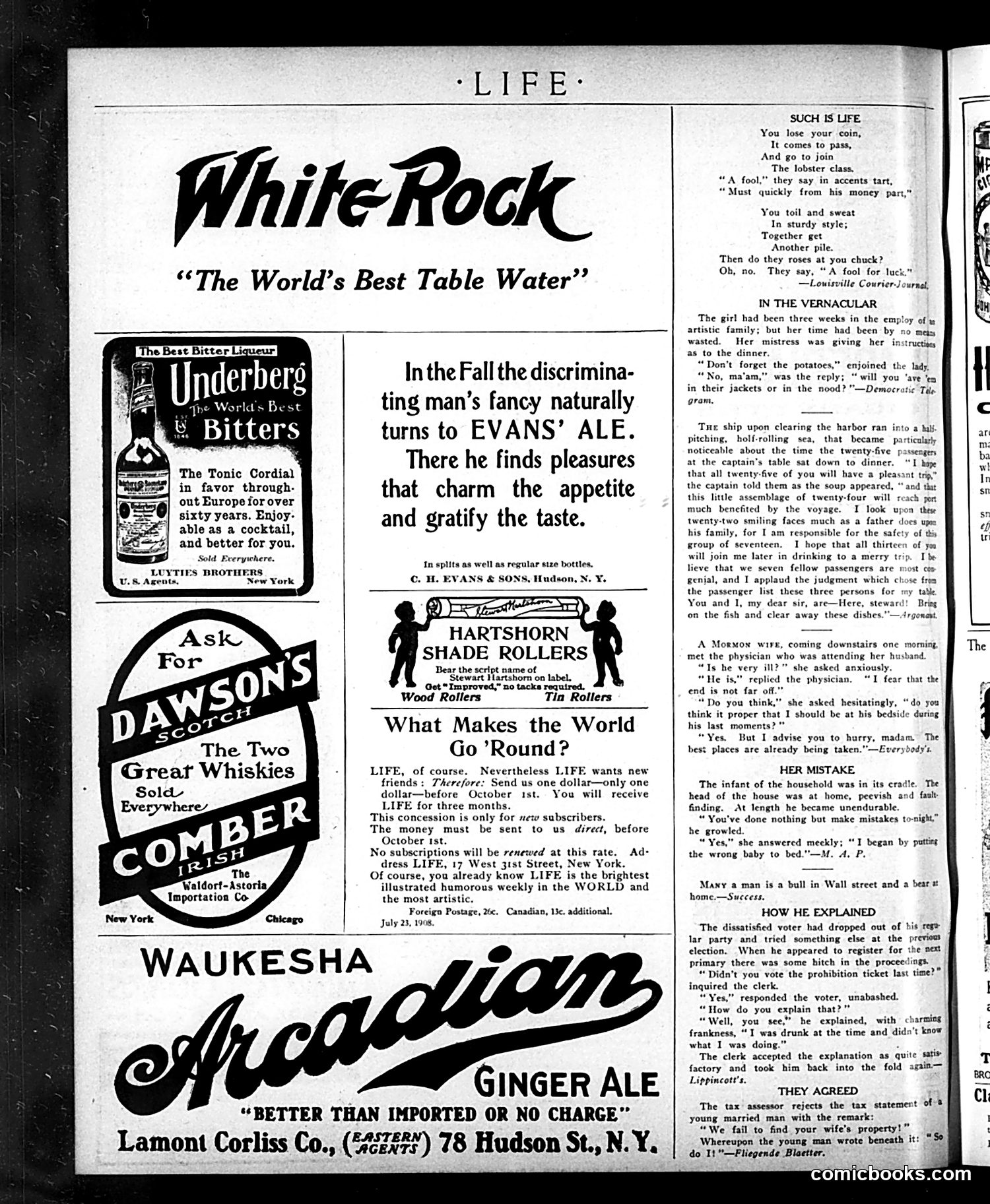
This page is primarily **advertisements and humorous short anecdotes**—not political cartoons. The ads (White Rock water, Evans' Ale, Underberg Bitters, Dawson's Comber whiskey, Hartshorn Shade Rollers, Waukesha Ginger Ale) reflect early 1900s consumer products and patent medicines. The humor pieces are satirical observations on everyday life: - "Such Is Life" (poem): mocks how people lose money yet still face ridicule from others - "In the Vernacular": working-class domestic humor (servant's innocent double entendre about serving potatoes) - Ship captain's speech: absurdist joke where he keeps revising headcount downward as passengers get seasick - Mormon wife anecdote: dark humor about plural marriage and deathbed etiquette - Final jokes: gentle domestic satire about marital discord and Wall Street behavior The page demonstrates *Life* magazine's satirical approach: poking fun at social pretension, class distinctions, and human folly through brief, witty observations rather than visual cartoons.
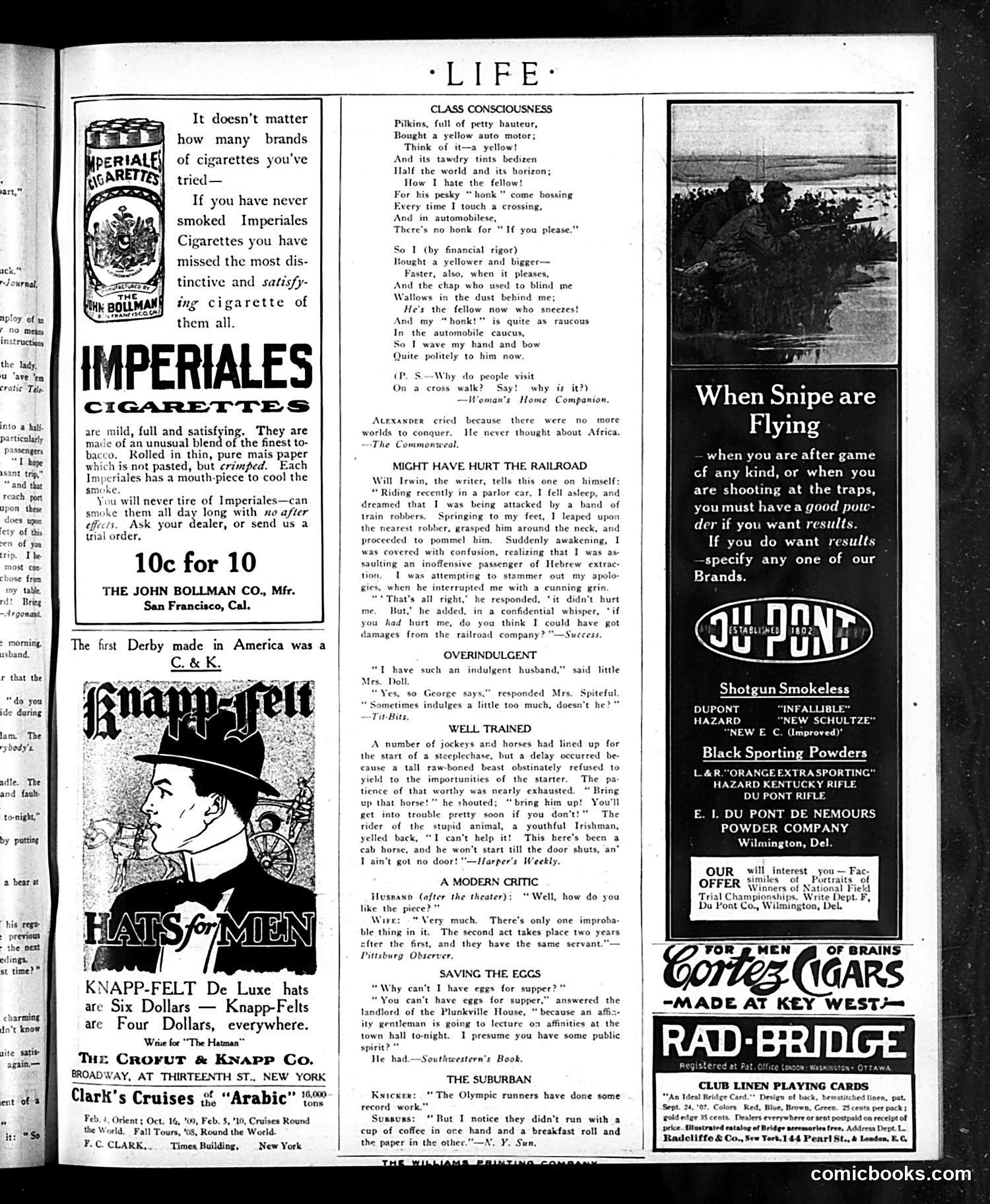
This page is primarily **advertising with interspersed short humorous pieces** typical of early 20th-century Life magazine. The main visual element is a **Knapp-Felt hat advertisement** featuring a man in formal dress and top hat—a standard fashion ad of the era. The text pieces are brief satirical sketches: - **"Class Consciousness"**: A poem mocking social pretension. A man (Pilkins) buys a yellow automobile to show off, but a neighbor buys an even larger, faster yellow car, leaving Pilkins humiliated in the dust. The satire targets nouveau-riche car ownership and competitive status-seeking among the emerging automobile-owning class. - **"Might Have Hurt the Railroad"**: A humorous anecdote by writer Will Irwin about accidentally attacking a sleeping passenger, mistaking him for a train robber. - Other brief joke pieces about marital indulgence and horse training round out the page. The ads promote cigarettes, hats, cruises, and ammunition—reflecting early 1900s consumer culture. The satire is gentle, targeting middle-class social anxieties rather than political issues.
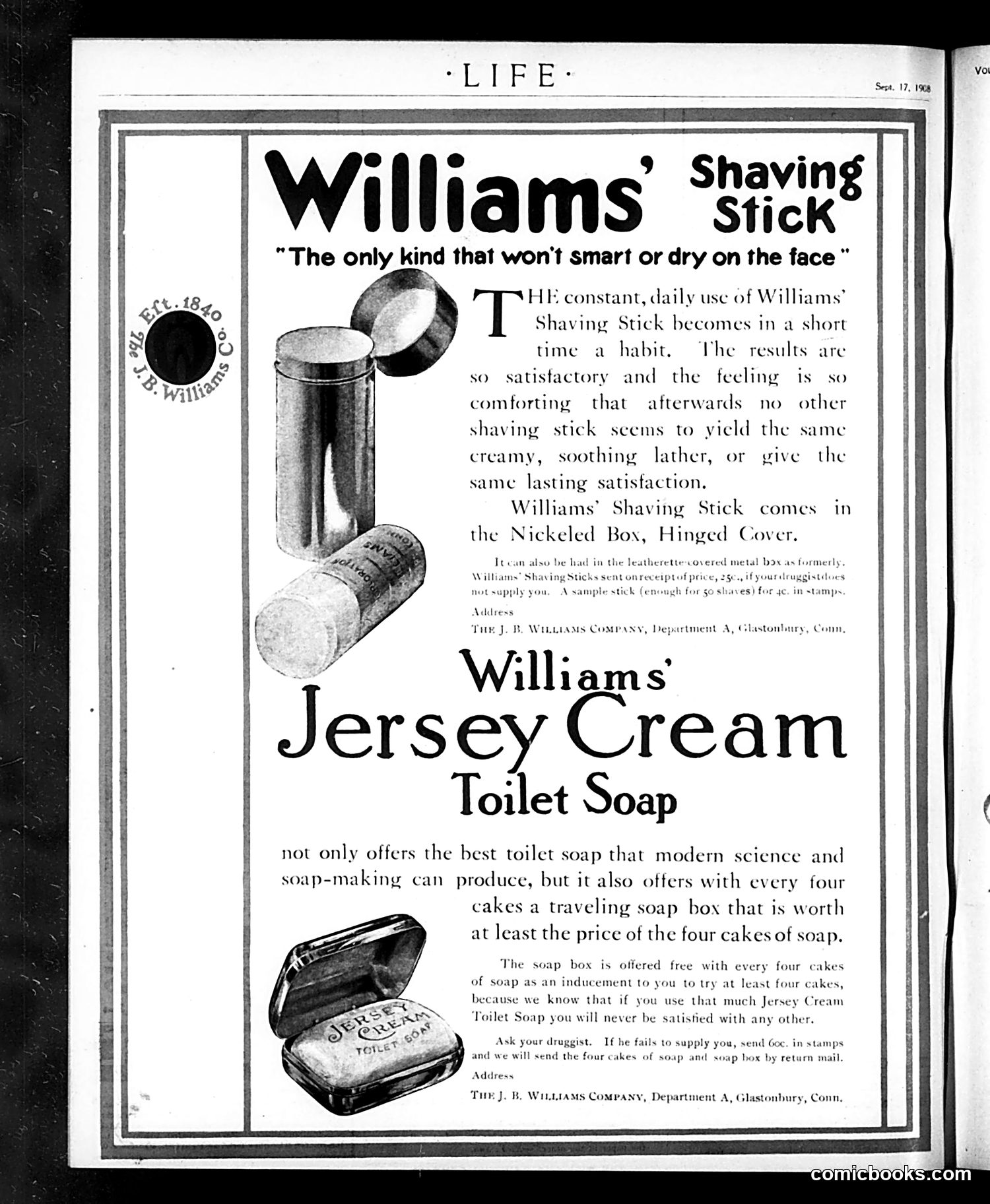
This page contains **no political cartoon or satire**—it is purely commercial advertising from Life magazine (September 17, 1908). The page promotes two grooming products by J.B. Williams Company: a shaving stick and toilet soap. The advertisements use common early-1900s marketing tactics: - **Shaving Stick**: Claims superiority ("the only kind that won't smart or dry") and promises habit-forming satisfaction - **Jersey Cream Toilet Soap**: Offers a "free" traveling soap box with every four-cake purchase as an inducement to try the product The language emphasizes modern scientific achievement and emotional comfort—typical of Edwardian consumer advertising. The soap box premium is a classic early marketing strategy: give away something of perceived value to encourage trial purchases. This appears to be a standard advertising section from Life rather than satirical content. Life did publish satire, but this page is straightforward product promotion.