
Life, 1908-09-17 · page 6 of 24
Life — September 17, 1908 — page 6: what you’re looking at
What you’re looking at
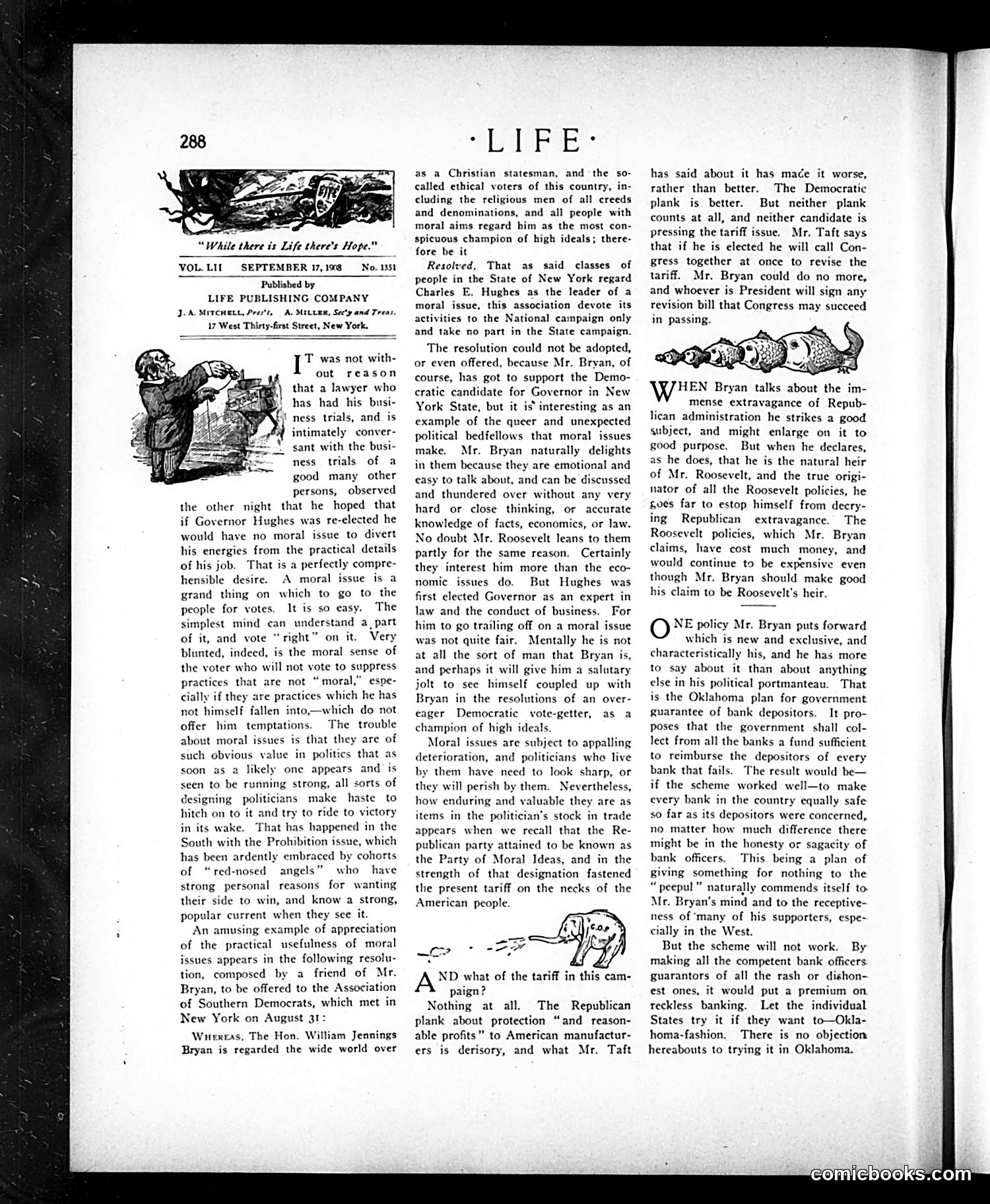
This editorial page critiques William Jennings Bryan's 1908 presidential campaign and his moral positioning as a Democrat. The text argues that Bryan, while claiming to champion "high ideals," is actually a problematic political figure who avoids serious economic analysis in favor of emotional rhetoric about morality. The small cartoon (upper left) appears to show a figure in distress, illustrating the editorial's point about impractical idealism. The larger cartoon (lower right) depicts what appears to be a donkey—the Democratic Party symbol—suggesting Bryan's policies are flawed. The satire contends that Bryan's proposed Oklahoma banking guarantee scheme is unrealistic and won't solve actual economic problems, dismissing his moral crusading as evasion of substantive policy debate.
📄 Transcribed text from this page (OCR, searchable)
Machine-transcribed from the original scan — historical spelling and the odd misread are preserved.
es “While there is Life there's Hope.” VOL.LII SEPTEMBER 17, 108 Published by LIFE PUBLISHING COMPANY J.-A Mrvenett, Prete, A. MILLER, Secty and Treas, No. 1351 T was not with- out reason that a lawyer who has had his busi- ness trials, and is intimately conver- sant with the busi- ness trials of a good many other persons, observed the other night that he hoped that if Governor Hughes was re-elected he would have no moral issue to divert his energies from the practical details of his job. That is a perfectly compre- hensible desire. A moral issue is a grand thing on which to go to the people for votes. It is so easy. The simplest mind can understand a, part of it, and vote “right” on it. Very blunted, indeed, is the moral se of the voter who will not vote to suppress practices that are not “moral,” espe- cially if they are practices which he has not himself fallen into,—which do not offer him temptations. The trouble about moral issues is that they are of such obvious value in politics that as soon as a likely one appears and is seen to be running strong, all sorts of designing politicians make haste to hitch on to it and try to ride to victory in its wake. That has happened in the South with the Prohibition issue, which has been ardently embraced by cohorts of “red-nosed angels” have strong personal reasons for wanting their side to win, and know a strong, popular current when they see it. An amusing example of appreciation of the practical usefulness of moral issues appears in the following resolu- tion, composed by a friend of Mr. Bryan, to be offered to the Association of Southern Democrats, which met in New York on August 31: Whereas, The Hon. William Jennings Bryan is regarded the wide world over who BIE jie eye as a Christian statesman, and the so- called ethical voters of this country, in- cluding the religious men of all creeds and denominations, and all people with moral aims regard him as the most con- spicuous champion of high ideals; there- fore be it Resolved, That as said classes of people in the State of New York regard Charles E. Hughes as the leader of a moral issue, this association devote its activities to the National campaign only and take no part in the State campaign. The resolution could not be adopted, or even offered, because Mr. Bryan, of course, has got to support the Demo- cratic candidate for Governor in New York State, but it is interesting as an example of the queer and unexpected political bedfellows that moral issues make. Mr. Bryan naturally delights in them because they are emotional and easy to talk about, and can be discussed and thundered over without any very hard or close thinking, or accurate knowledge of facts, economics, or law. No doubt Mr. Roosevelt leans to them partly for the same reason. Certainly they interest him more than the eco- nomic issues do. But Hughes was first elected Governor as an expert in law and the conduct of business. For him to go trailing off on a moral issue was not quite fair. Mentally he is not at all the sort of man that Bryan is, and perhaps it will give him a salutary jolt to see himself coupled up with Bryan in the resolutions of an over- eager Democratic vote-getter, as a champion of high ideals. Moral issues are subject to appalling deterioration, and politicians who live by them have need to look sharp, or they will perish by them. Nevertheless, how enduring and valuable they are as items in the politician's stock in trade appears when we recall that the Re- publican party attained to be known as the Party of Moral Ideas, and in the strength of that designation fastened the present tariff on the necks of the American people. ome AX? what of the tariff in this cam- paign? Nothing at all. plank about protection “and reason- able profits” to American manufactur- ers is derisory, and what Mr. Taft The Republican has said about it has mace it worse, rather than better. The Democratic plank is better. But neither plank counts at all, and neither candidate is pressing the tariff issue. Mr. Taft says that if he is elected he will call Con- gress together at once to revise the tariff. Mr. Bryan could do no more, and whoever is President will sign any revision bill that Congress may succeed in passing. HEN Bryan talks about the im- mense extravagance of Repub- lican administration he strikes a good subject, and might enlarge on it to good purpose. But when he declares, as he does, that he is the natural heir of Mr. Roosevelt, and the true origi- nator of all the Roosevelt policies, he g0es far to estop himself from decry- ing Republican extravagance. The Roosevelt policies, which Mr. Bryan claims, have cost much money, and would continue to be expensive even though Mr. Bryan should make good his claim to be Roosevelt's heir. O NE policy Mr. Bryan puts forward which is new and exclusive, and characteristically his, and he has more to say about it than about anything else in his political portmanteau. That is the Oklahoma plan for government guarantee of bank depositors. It pro- poses that the government shall col- lect from all the banks a fund sufficient to reimburse the depositors of every bank that fails. The result would be— if the scheme worked well—to make every bank in the country equally safe so far as its depositors were concerned, no matter how much difference there might be in the honesty or sagacity of bank officers. This being a plan of giving something for nothing to the “peepul” naturally commends itself to Mr. Bryan's mind and to the receptive- ness of ‘many of his supporters, espe- cially in the West. But the scheme will not work. By making all the competent bank officers: guarantors of all the rash or dishon- est ones, it would put a premium on reckless banking. Let the individual States try it if they want to—Okla- homa-fashion. There is no objection hereabouts to trying it in Oklahoma.