
Life, 1908-09-17 · page 14 of 24
Life — September 17, 1908 — page 14: what you’re looking at
What you’re looking at
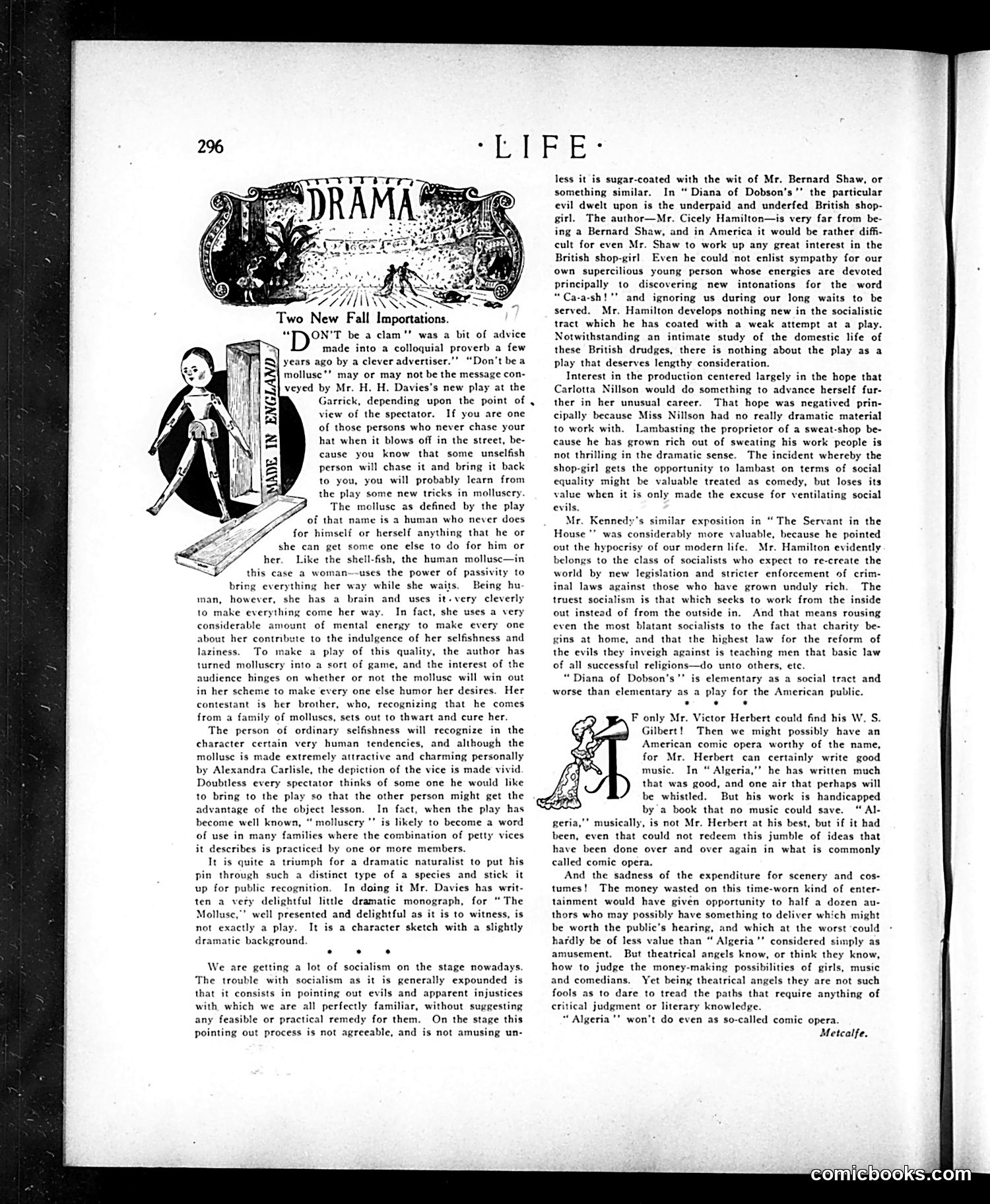
This page reviews two Broadway plays through satirical drama criticism. **"The Molluse"** concerns a parasitic woman who manipulates others through calculated passivity and laziness, relying on her charm to exploit family members. The reviewer praises the playwright H.H. Davies for anatomizing this character type as social commentary, though notes it's a "character sketch" rather than a traditional play. The term "molluscry" — describing selfish dependency — is presented as likely to enter common usage. **"Diana of Dobson's"** by Cicely Hamilton exposes the exploitation of underpaid British shop-girls, but the reviewer dismisses it as heavy-handed socialist tract-writing lacking Bernard Shaw's wit. The critic mocks British shop-girls as supercilious and materialistic (obsessing over the word "cash"), suggesting American audiences won't sympathize with their plight. The satire targets both theatrical naturalism and social problem plays that preach without cleverness or practical solutions.
📄 Transcribed text from this page (OCR, searchable)
Machine-transcribed from the original scan — historical spelling and the odd misread are preserved.
“LIFE: 2A 7THINWNY NS Two New Fall Importations. Ip y be a clam’’ was a bit of advice made into a colloquial proverb a few rs ago by a clever advertiser."’ “Don't bea mollusc’? may or may not be the message con- w3L veyed by Mr. H. H. Davies’s new play at the Garrick, depending upon the point of view of the spectator. If you are one of those persons who never chase your hat when it blows off in the street, be- cause you know that some unselfish person will chase it and bring it back to you, you will probably learn from the play some new tricks in molluscry. The molluse as defined by the play of that name is a human who never does for himself or herself anything that he or she can get some one else to do for him or her. Like the shell-fish, the human mollusc—in this case a woman—uses the power of passivity to bring everything her way while she waits. Being hu. man, however, she has a brain and uses it-very cleverly to make everything come her way. In fact, she uses a very considerable amount of mental energy to make every one about her contribute to the indulgence of her selfishness and laziness. To make a play of this quality, the author has turned mollusery into a sort of game, and the interest of the audience hinges on whether or not the mollusc will win out in her scheme to make every one else humor her desires. Her contestant is her brother, who, recognizing that he comes from a family of molluscs, sets out to thwart and cure her. The person of ordinary selfishness will recognize in the character certain very human tendencies, and although the molluse is made extremely attractive and charming personally by Alexandra Carlisle, the depiction of the vice is made vivid. Doubtless every spectator thinks of some one he would like to bring to the play so that the other person might get the advantage of the object lesson. In fact, when the play has become well known, “ molluscry "’ is likely to become a word of use in many families where the combination of petty vices it describes is practiced by one or more members. It is quite a triumph for a dramatic naturalist to put his pin through such a distinct type of a species and stick it up for public recognition. In doing it Mr. Davics has writ- ten a very delightful little dramatic monograph, for “ The Molluse,"’ well presented and delightful as it is to witness, is not exactly a play. It is a character sketch with a slightly dramatic background. o 8 6 We are getting a lot of socialism on the stage nowadays. The trouble with socialism as it is generally expounded is that it consists in pointing out evils and apparent injustices with which we are all perfectly familiar, without suggesting any feasible or practical remedy for them. On the stage this pointing out process is not agreeable, and is not amusing un- less it is sugar-coated with the wit of Mr. Bernard Shaw, or something similar. In “Diana of Dobson's’’ the particular evil dwelt upon is the underpaid and underfed British shop- girl. The author—Mr. Cicely Hamilton—is very far from be- ing a Bernard Shaw, and in America it would be rather diffi- cult for even Mr. Shaw to work up any great interest in the British shop-girl Even he could not enlist sympathy for our own supercilious young person whose energies are devoted principally to discovering new intonations for the word “Ca-a-sh!'’ and ignoring us during our long waits to be served. Mr, Hamilton develops nothing new in the socialistic tract which he has coated with a weak attempt at a play. Notwithstanding an intimate study of the domestic life of these British drudges, there is nothing about the play as a play that deserves lengthy consideration. Interest in the production centered largely in the hope that Carlotta Nillson would do something to advance herself fur- ther in her unusual career. That hope was negatived prin- cipally because Miss Nillson had no really dramatic material to work with. Lambasting the proprietor of a sweat-shop be- cause he has grown rich out of sweating his work people is not thrilling in the dramatic sense. The incident whereby the shop-girl gets the opportunity to lambast on terms of social equality might be valuable treated as comedy, but loses its value when it is only made the excuse for ventilating social evils. Mr. Kennedy's similar exposition in “The Servant in the House "’ was considerably more valuable, because he pointed out the hypocrisy of our modern life. Mr. Hamilton evidently belongs to the class of socialists who expect to re-create the world by new legislation and stricter enforcement of crim- inal laws against those who have grown unduly rich. The truest socialism is that which secks to work from the inside out instead of from the outside in. And that means rousing even the most blatant socialists to the fact that charity be- gins at home, and that the highest law for the reform of the evils they inveigh against is teaching men that basic law of all successful religions—do unto others, etc. “Diana of Dobson's’? is elementary as a social tract and worse than clementary as a play for the American public. 8 8 F only Mr. Victor Herbert could find his W. S. Gilbert! Then we might possibly have an American comic opera worthy of the name, for Mr. Herbert can certainly write good music. In “ Algeria,” he has written much that was good, and one air that perhaps will be whistled. But his work is handicapped bya book that no music could save. “ Al- geria,’” musically, is not Mr. Herbert at his best, but if it had been, even that could not redeem this jumble of ideas that have been done over and over again in what is commonly called comic opera. And the sadness of the expenditure for scenery and cos- tumes! The money wasted on this time-worn kind of enter- tainment would have givén opportunity to half a dozen au- thors who may possibly have something to deliver which might be worth the public’s hearing, and which at the worst ‘could hardly be of less value than “ Algeria’? considered simply as amusement. But theatrical angels know, or think they know, how to judge the money-making possibilities of girls, music and comedians, Yet being theatrical angels they are not such fools as to dare to tread the paths that require anything of critical judgment or literary knowledge. “ Algeria’ won't do even as so-called comic opera. Metcalfe.