
A complete issue · 22 pages · 1908
Life — September 10, 1908
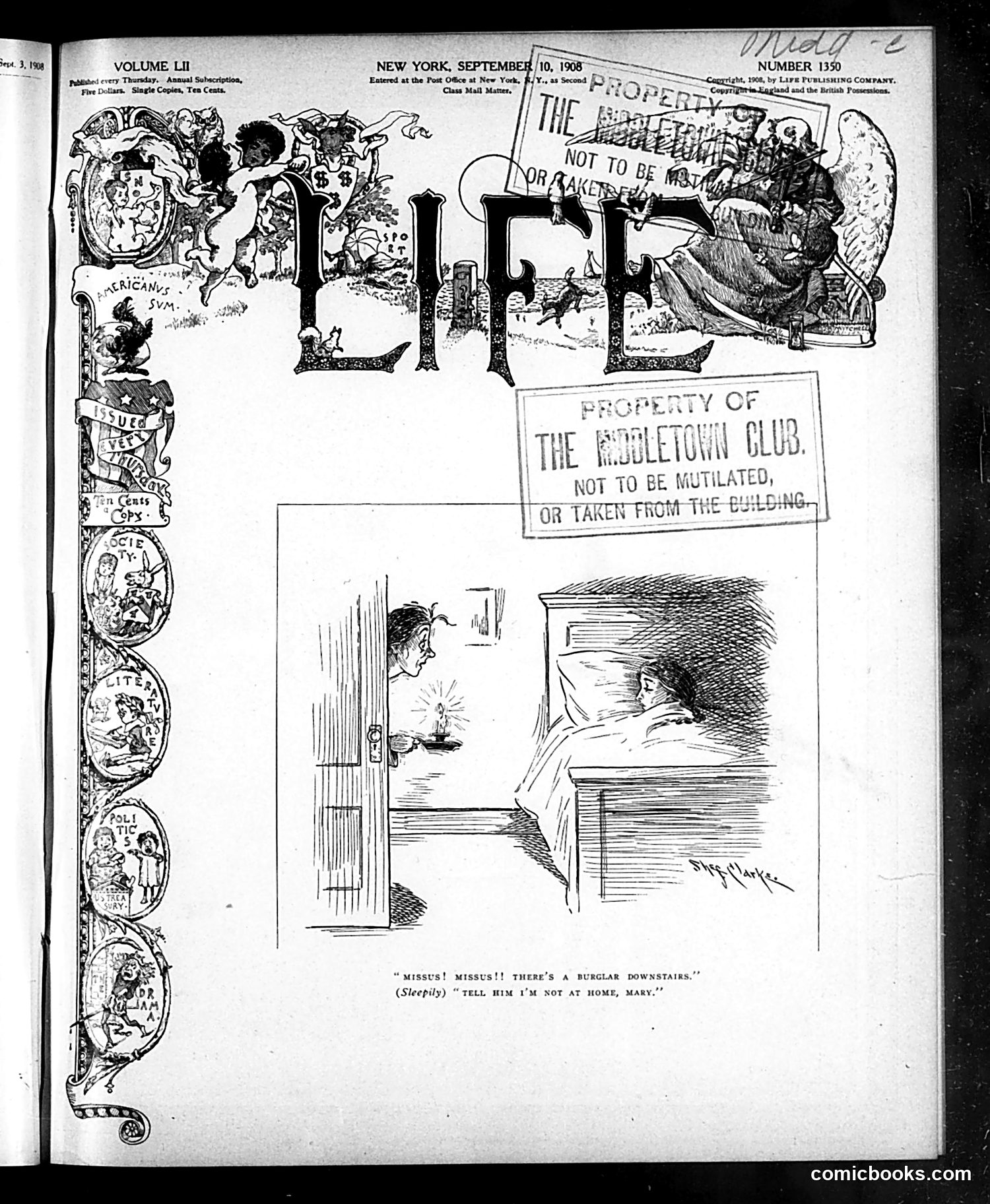
This page contains a single-panel cartoon depicting a domestic scene. A woman lies in bed while a man stands at the bedroom door holding a candle, apparently having just discovered a burglar downstairs. The caption reads: "MISSUS! MISSUS!! THERE'S A BURGLAR DOWNSTAIRS" with the sleeping woman's response: "(Sleepily) 'TELL HIM I'M NOT AT HOME, MARY.'" The humor relies on absurdist logic: the woman, already in bed, claims unavailability to someone actually in her home. This likely satirizes either marital dynamics (a wife avoiding her husband) or the era's conventions about receiving callers. The joke's point appears to be about social pretense—maintaining the fiction of unavailability even when circumstances make it ridiculous.
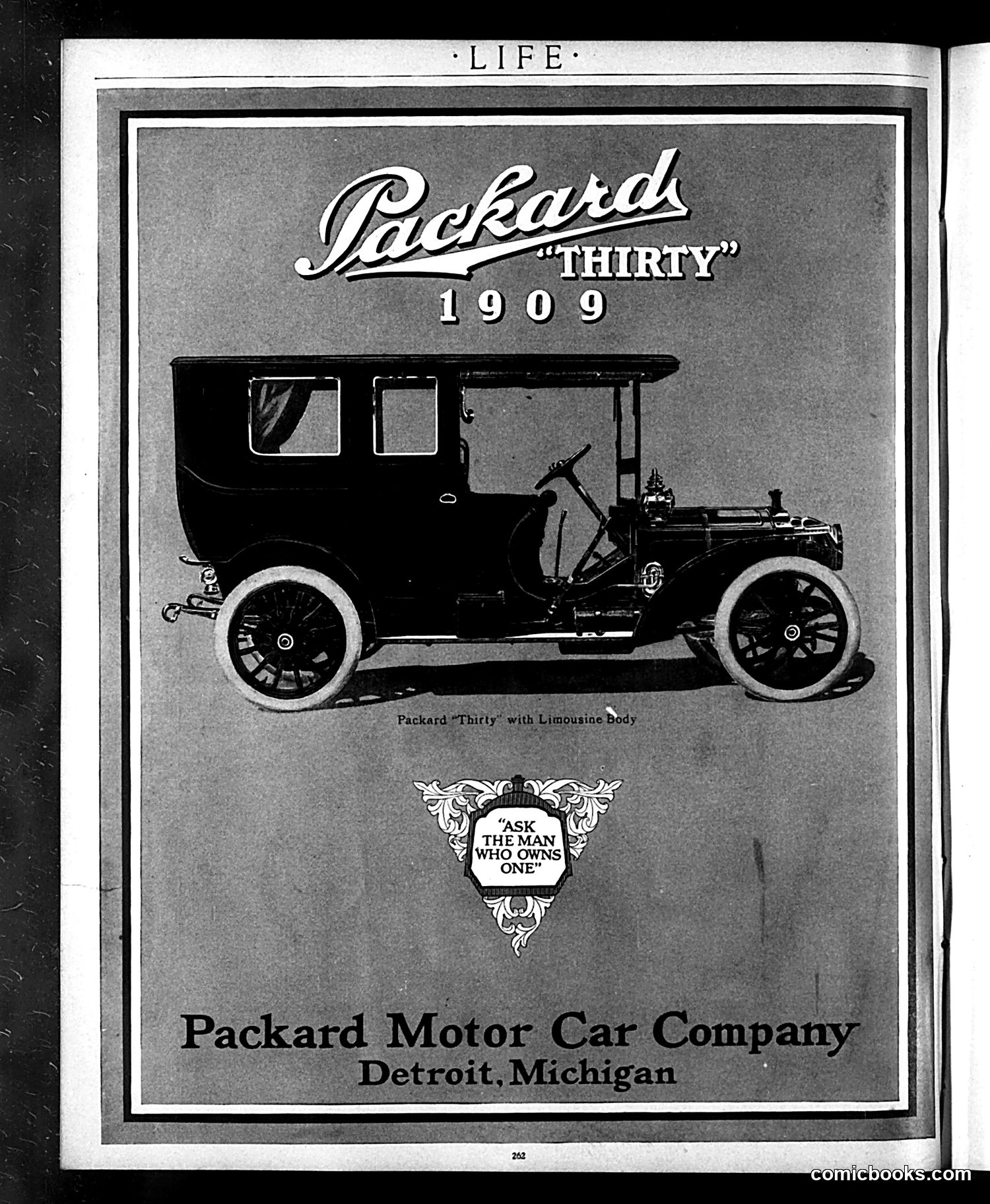
This is **advertising, not satire or political commentary**. The page promotes the Packard "Thirty" automobile from 1909, manufactured by the Packard Motor Car Company in Detroit, Michigan. The image shows a side profile of the luxury vehicle with a limousine body—a closed cabin for passengers, representing premium comfort. The tagline "Ask the Man Who Owns One" was Packard's actual marketing slogan, suggesting satisfied customers would attest to quality. This reflects early 1900s advertising strategy: appealing to wealthy buyers through testimonial-based claims rather than specifications. The formal presentation in *Life* magazine targets its affluent readership. There is no political satire or social commentary present—merely commercial promotion of a luxury product.
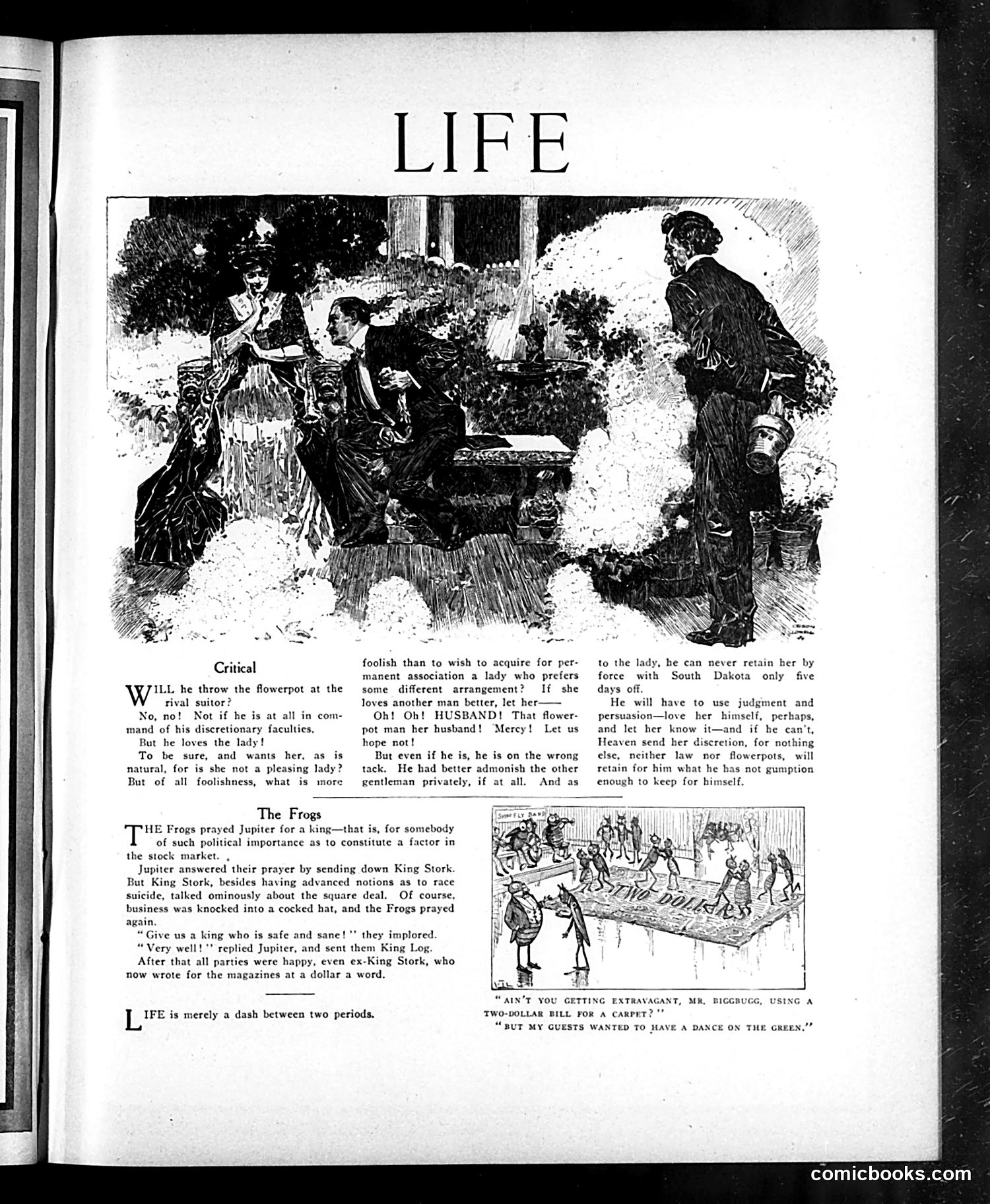
**"Critical" section:** This satirizes a domestic dispute, likely addressing whether a man should force his wife to stay in an unhappy marriage. The text argues against coercion, suggesting that if a wife loves another man, the husband cannot retain her "by force with South Dakota only five days off"—a reference to South Dakota's notably quick divorce laws, which were notorious in this era as a destination for people seeking easy divorces. **"The Frogs":** This appears to be a political fable mocking stock market speculation and political decision-making. It references "King Stork" sending down "advanced notions" to make frogs wealthy through risky ventures. The satire criticizes how politicians and businessmen treat financial markets recklessly, comparing them to foolish creatures pursuing unsound schemes. The bottom cartoon jokes about excessive spending at social events.
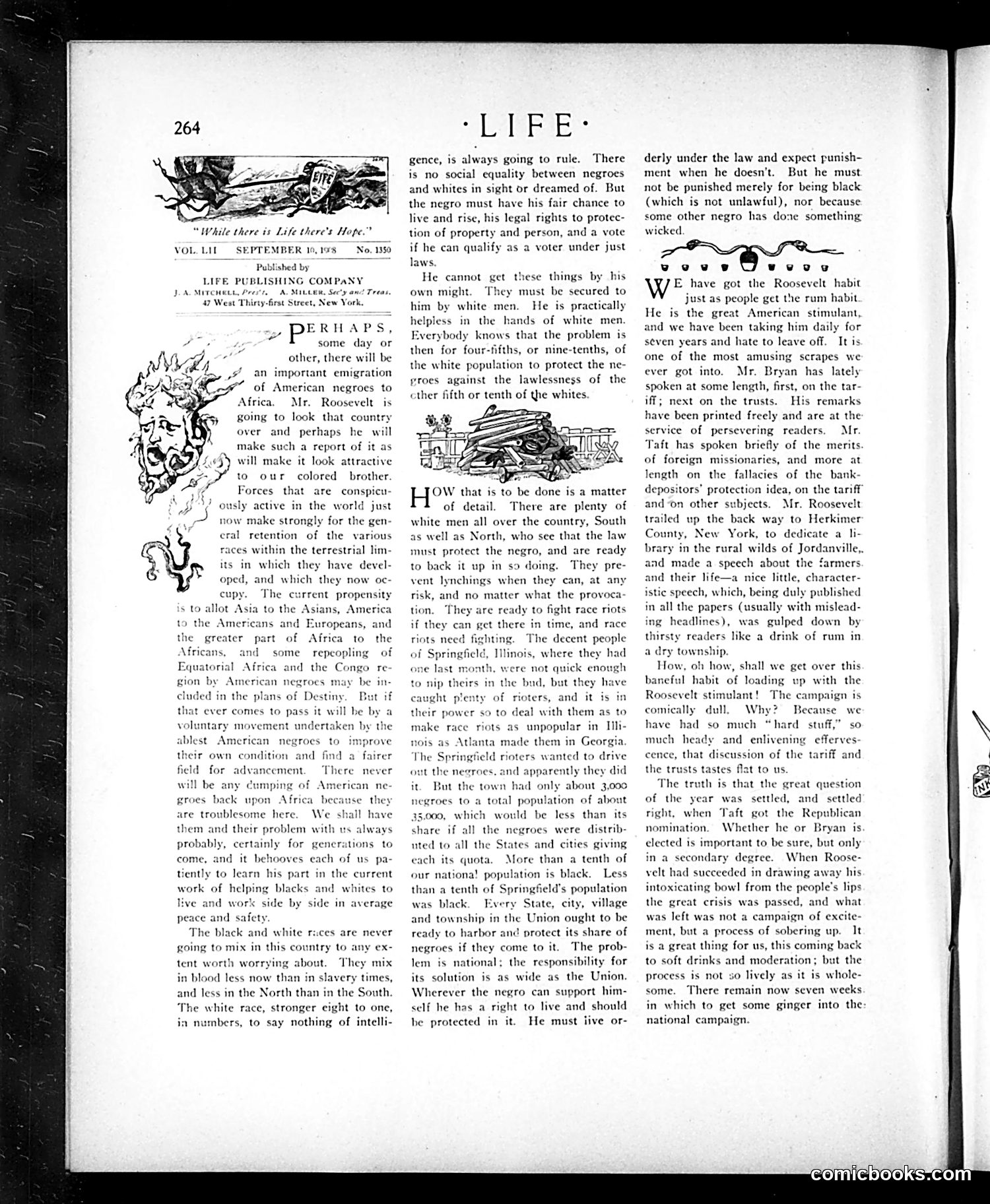
The main cartoon depicts a grotesque caricatured head labeled "PERHAPS," illustrating the article's discussion of race relations and Theodore Roosevelt's policies. The image appears designed to mock anxieties about American race dynamics. The accompanying article critiques Roosevelt's consideration of appointing African Americans to federal positions and addresses broader racial tensions. It argues that while black and white populations mix "less now than in slavery times," the "stronger eight to one, in numbers" white race need not fear racial equality. The piece advocates for legal protections of Black citizens' property and voting rights while opposing social equality—a position reflecting early 20th-century segregationist ideology disguised as "reasonable" compromise. The overall tone is paternalistic toward African Americans while defending white supremacy as natural demographic fact.
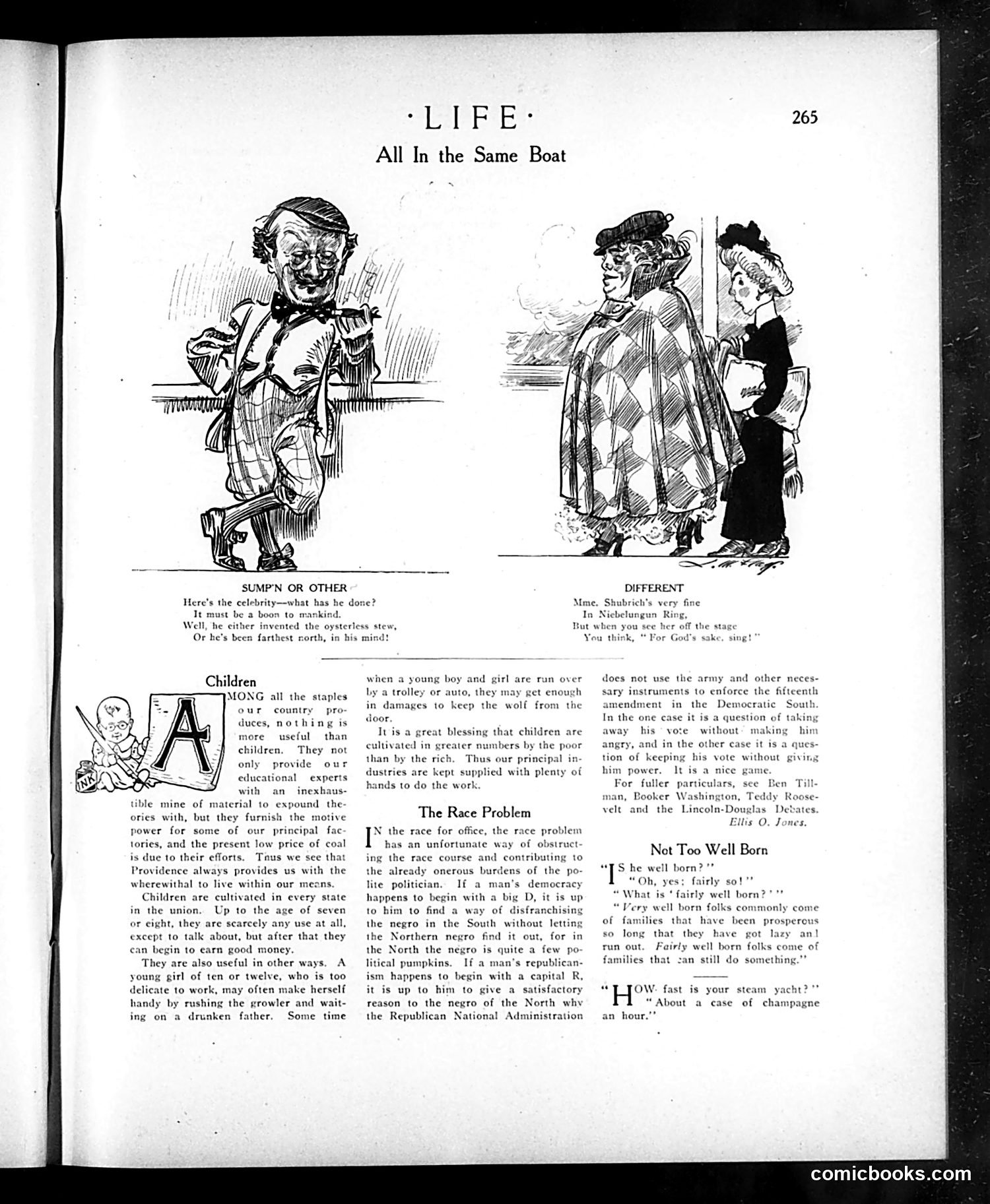
This page contains three satirical pieces critiquing American social and political issues: **"Sump'n or Other"** (left cartoon): Mocks a pompous celebrity or politician who claims credit for inventions or achievements while being "farthest north in his mind"—suggesting he's either delusional or intellectually challenged. **"Different"** (right cartoon): Appears to satirize theatrical or entertainment circles, with a woman remarking that performers seem different offstage than onstage. **Text sections** address: children's labor in industry (praising their usefulness), racial politics in elections (critiquing how both parties use race strategically), and class disparities in education and opportunity. The overall theme suggests systemic hypocrisies affecting vulnerable populations—hence "all in the same boat."
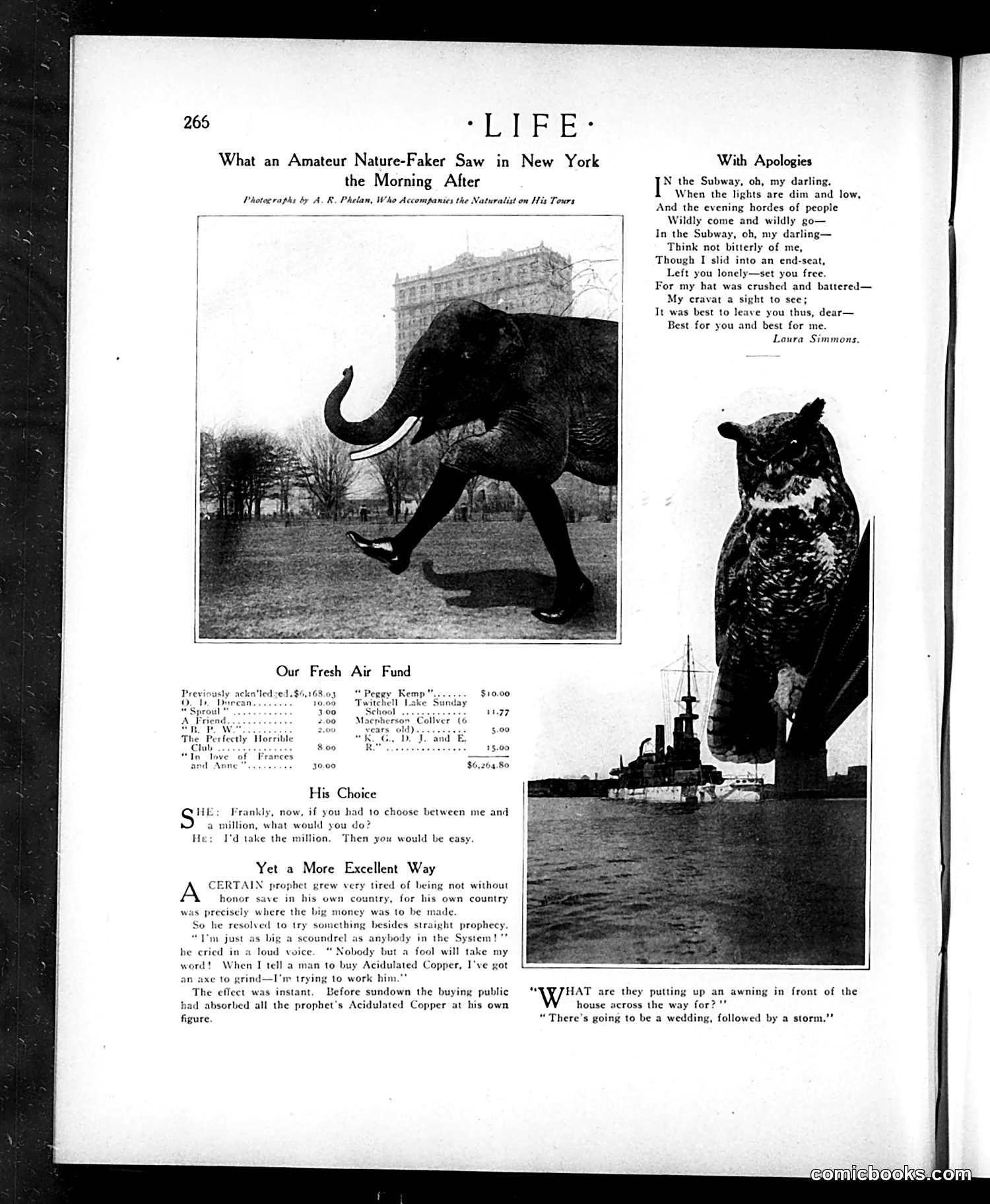
The main image is a humorous fake photograph showing an elephant in New York City, captioned "What an Amateur Nature-Faker Saw in New York the Morning After." This appears to satirize sensationalist reporting or exaggerated claims about urban wildlife sightings—the "nature-faker" being someone who fabricates or grossly embellishes nature stories. The accompanying sections ("His Choice," "Yet a More Excellent Way") contain unrelated satirical dialogues about money and prophets, while the right page features poetry and images of an owl and a warship. This is primarily a humor/satire magazine mixing visual jokes, short comedy pieces, and advertisements. The overall tone mocks gullibility and exaggeration in contemporary news and society.
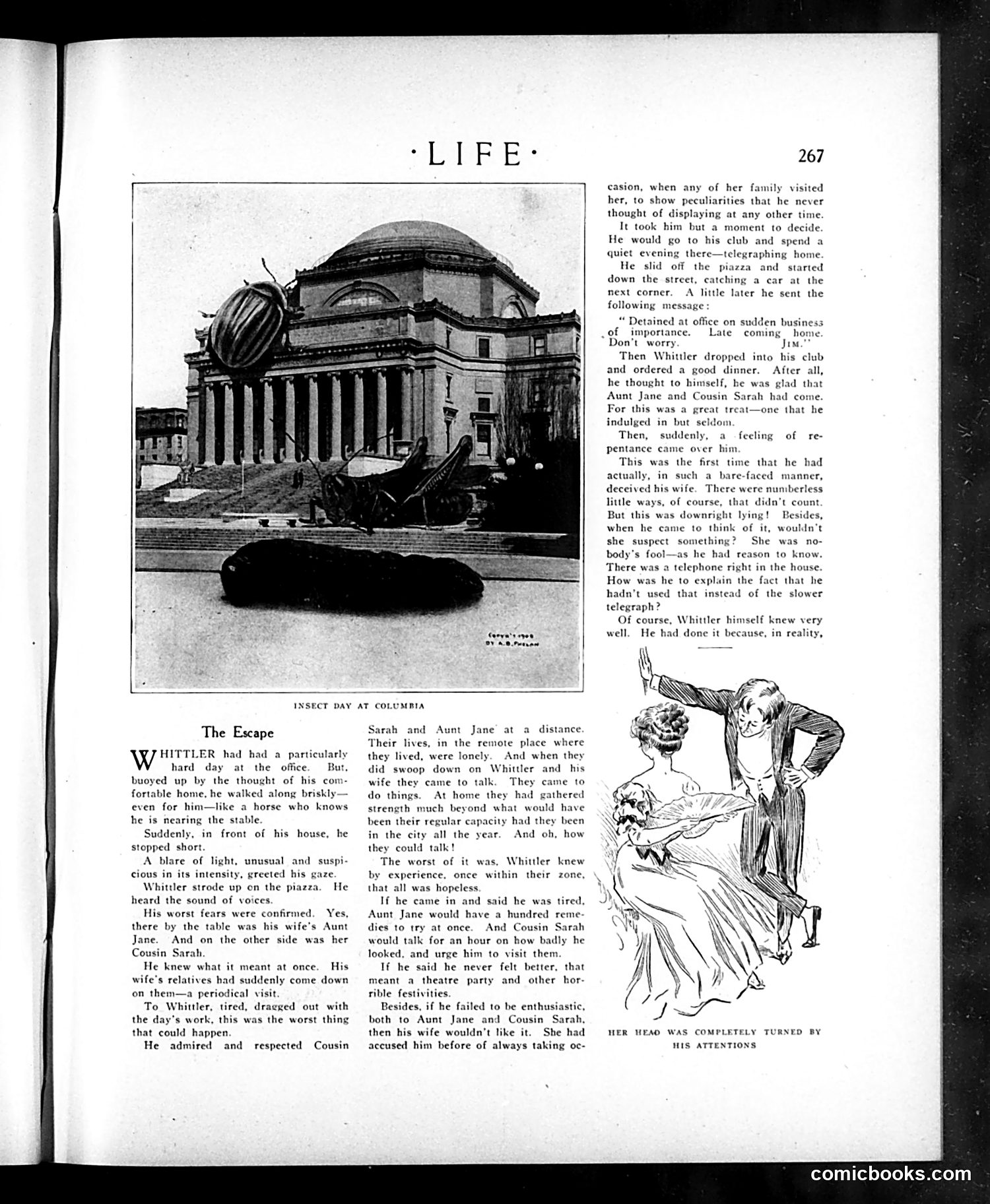
This page contains a short story titled "The Escape" rather than political satire. The narrative follows Whitler, a married man who deceives his wife by claiming to work late at the office, when he's actually visiting relatives (Aunt Jane and Cousin Sarah) in the countryside. The accompanying illustration shows a classical building labeled "Insect Day at Columbia," though its connection to the story is unclear. A second illustration depicts a woman touching a man's head, captioned "Her Head Was Completely Turned By His Attentions." The content satirizes domestic infidelity and deception within marriage—a common theme in early 20th-century American humor—rather than addressing specific political figures or events.
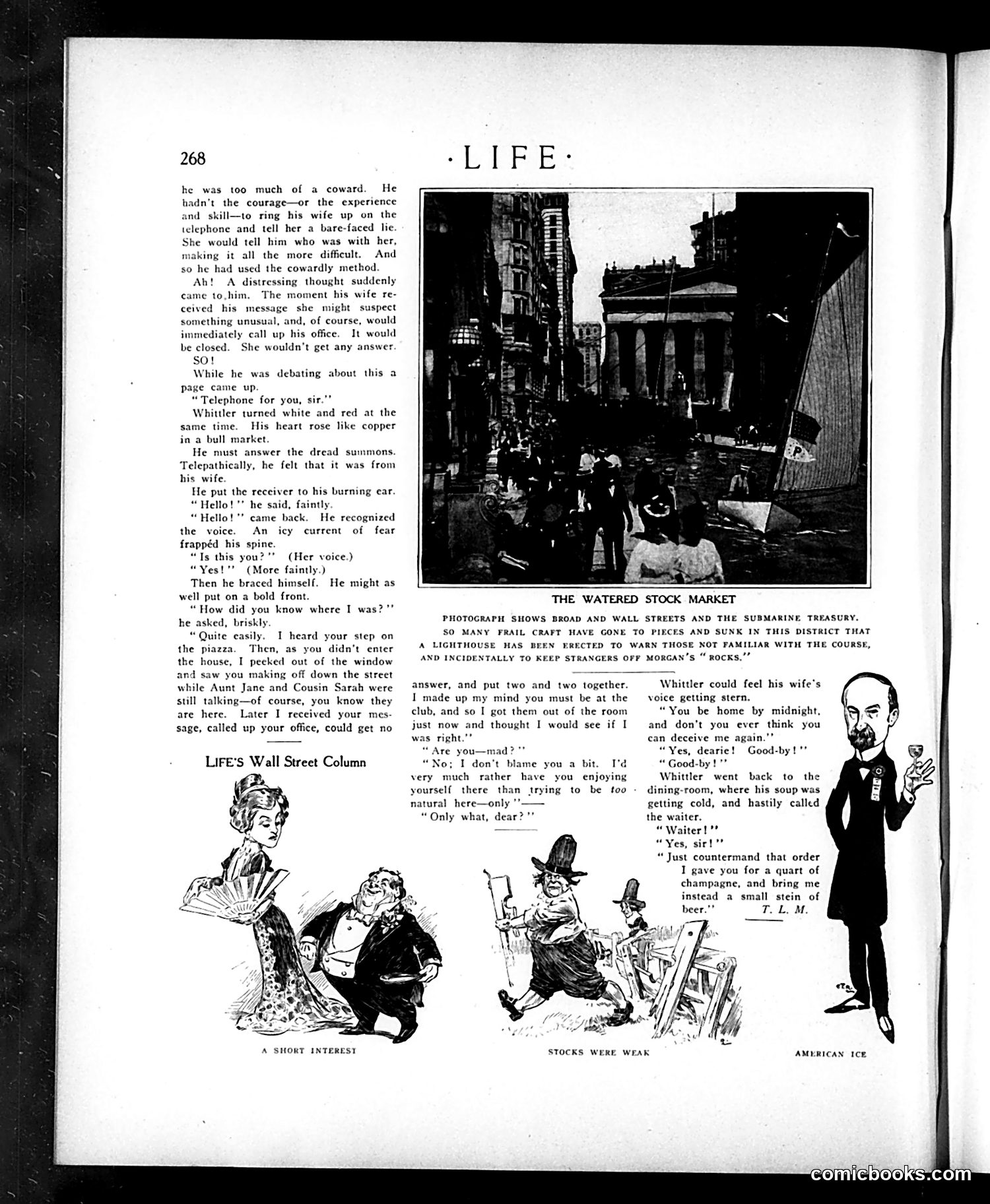
This page contains "Life's Wall Street Column," satirizing financial market behavior during what appears to be a period of stock market volatility. The three cartoons mock different investor types: 1. **"A Short Interest"** depicts a fashionable woman with a fan—likely representing speculative investors taking "short" positions (betting prices will fall). 2. **"Stocks Were Weak"** shows a disheveled figure amid collapsed stock certificates, illustrating market decline and investor losses. 3. **"American Ice"** portrays a waiter or servant, possibly referencing specific stocks or commodities affected by market weakness. The accompanying narrative describes a man anxiously waiting for his wife's telephone call, unable to directly contact her due to market concerns—satirizing how financial stress infiltrated domestic life. The satire targets both investor anxiety and the social pretense required to maintain appearances during financial turmoil.
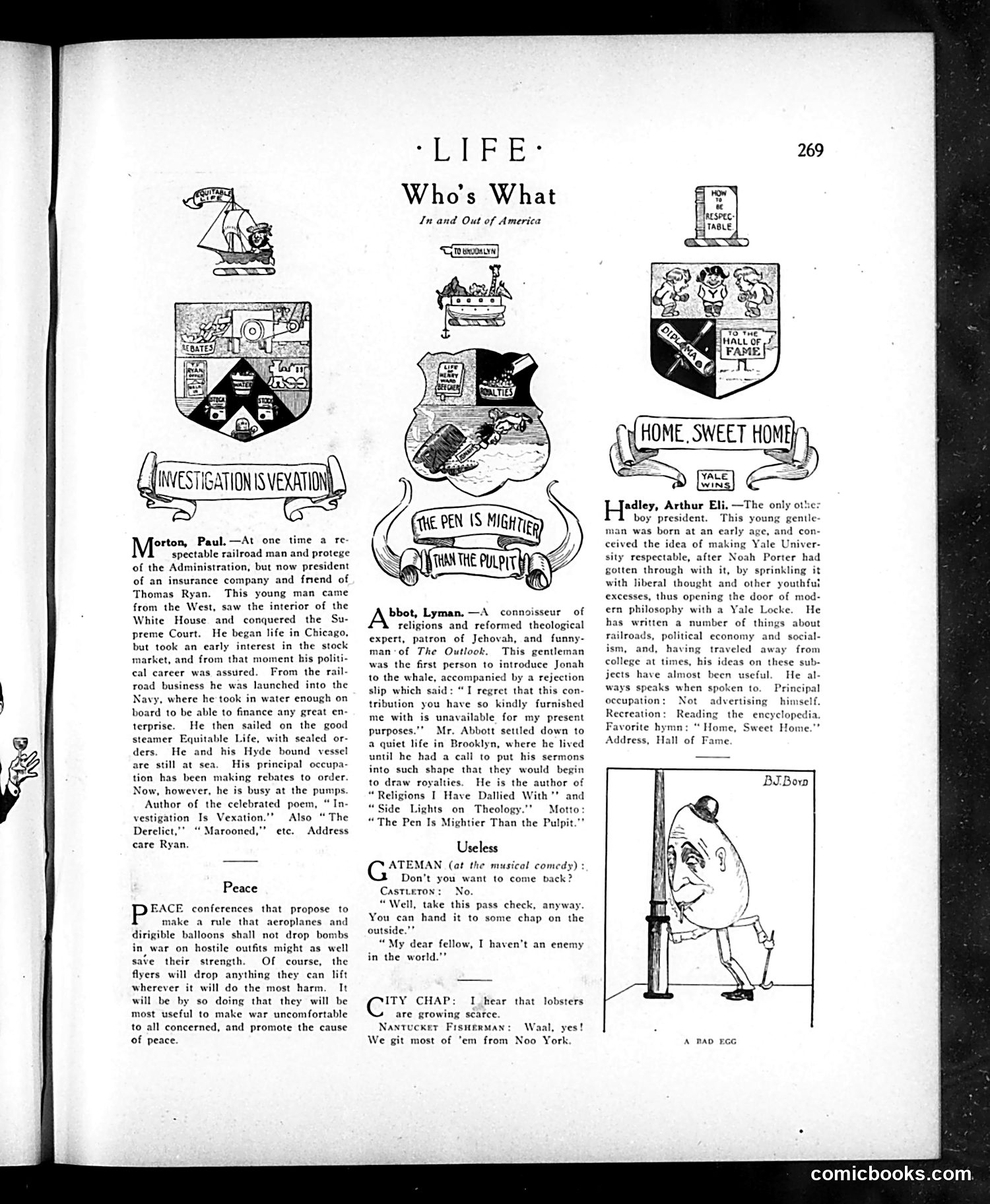
This page mixes biographical sketches with satirical commentary. The main content includes: **"Who's What" section**: Brief profiles of notable figures like Paul Morton (railroad/administration official) and Abbot Lyman (religious reformer and Outlook magazine contributor). These appear to be straightforward biographical entries. **Satirical pieces**: - "Peace" mocks peace conferences proposing "dirigible balloons" to drop bombs, satirizing the naive optimism of pacifists - "Useless" presents a humorous dialogue about a medical "pass check" - "A Bad Egg" cartoon (right) depicts a figure at a lamp post, likely social satire The page exemplifies Life's dual purpose: serious journalism alongside cutting social commentary. The specific targets and references suggest early 20th-century American politics and reform movements, though exact dating and some references remain unclear from this excerpt alone.
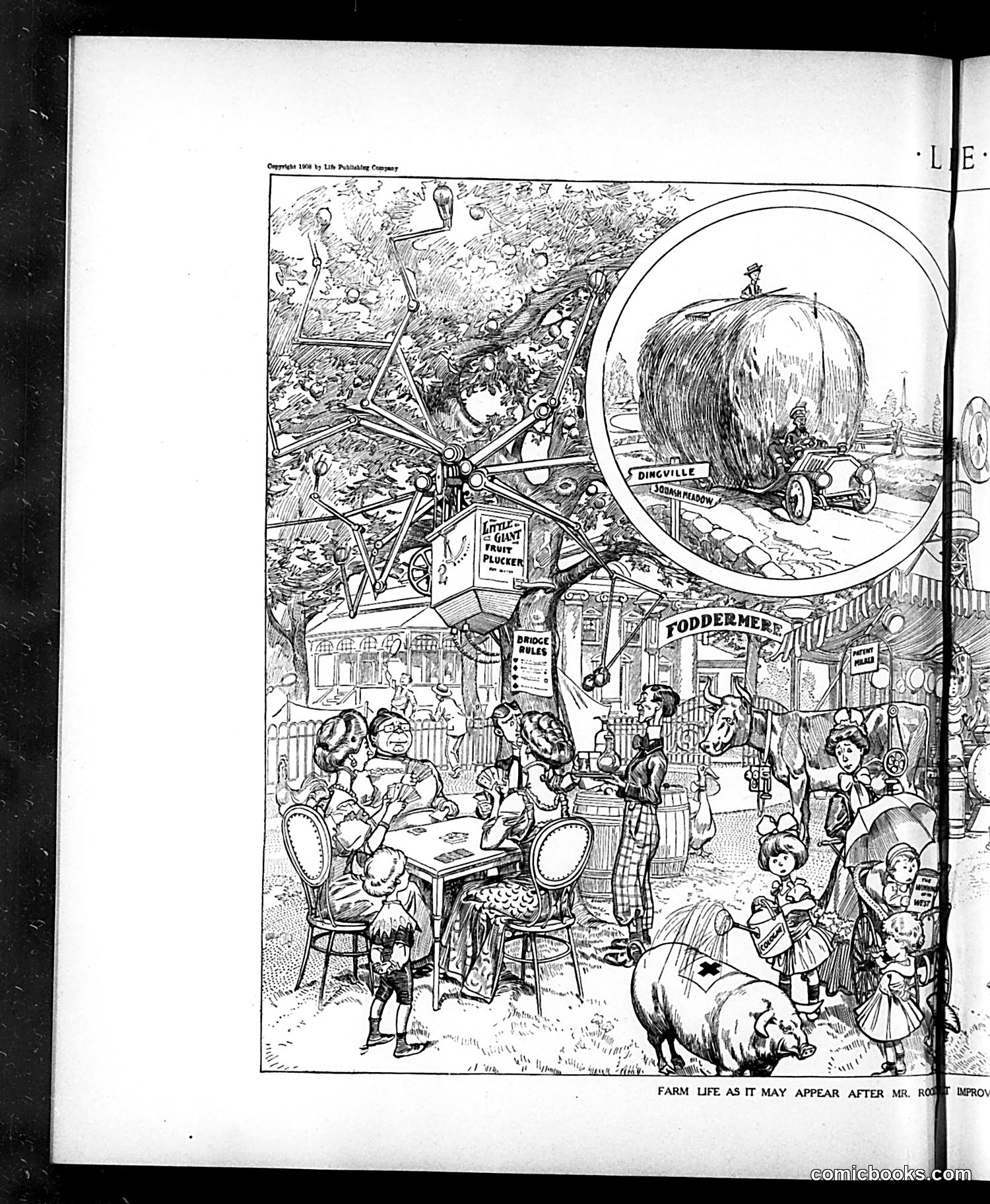
This is a satirical illustration titled "Farm Life as It May Appear After Mr. Roosevelt's Improvements" (text partially visible at bottom). The cartoon depicts an idealized, fantastical farm scene with impossibly large vegetables and fruits—notably a giant pumpkin and enormous produce—being transported and displayed. The satire targets President Roosevelt's agricultural policies, likely his farm improvement initiatives. The exaggerated scale of the crops represents skepticism about promises of agricultural prosperity and improved farming conditions under his administration. The bustling, almost circus-like atmosphere with crowds suggests either optimistic propaganda or mockery of unrealistic expectations. The "Toddermere" sign visible suggests a specific farm location referenced in the satire. Overall, it's political commentary questioning whether Roosevelt's farm reforms would actually deliver the promised abundance.
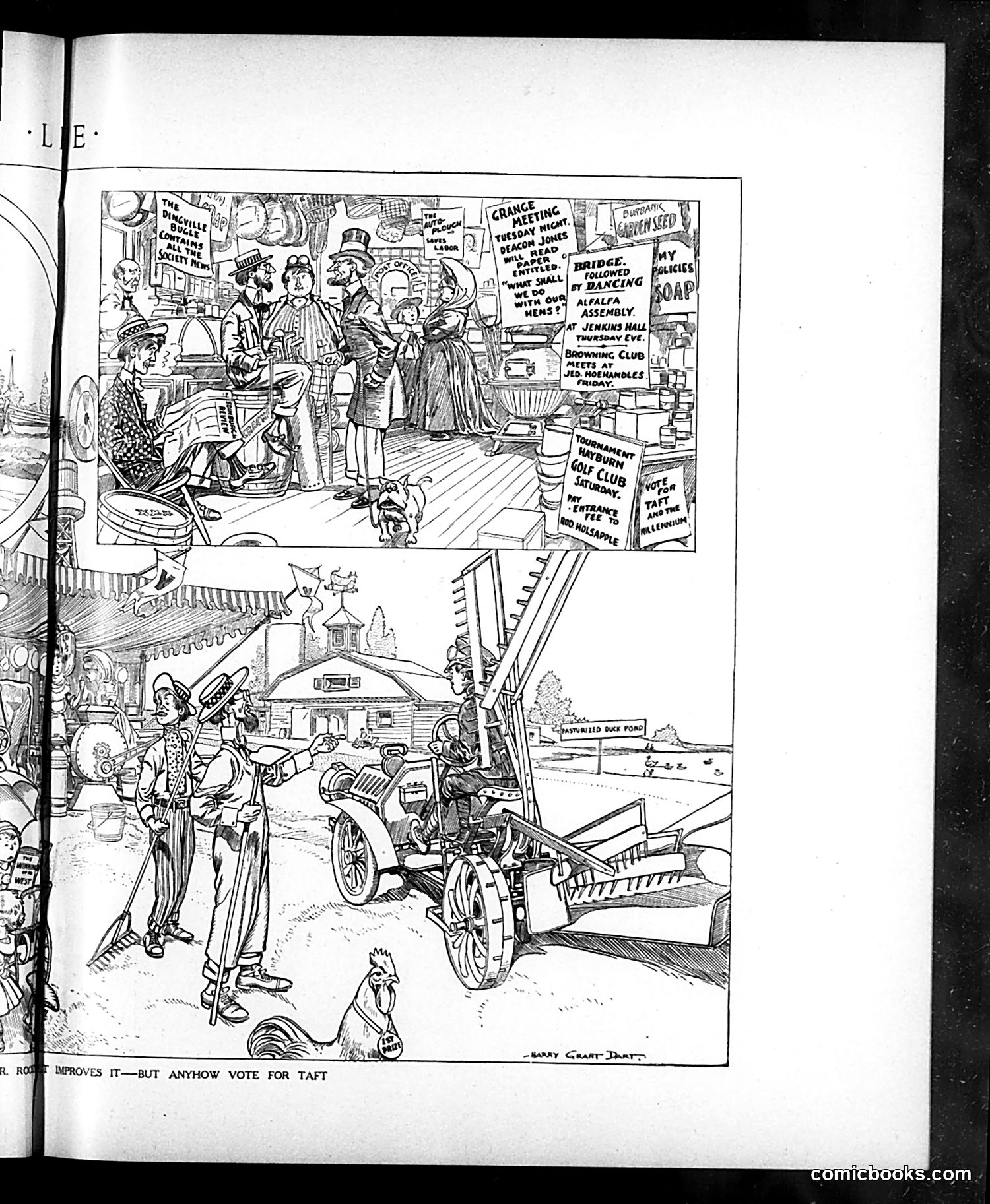
This is a two-panel satirical cartoon by Harry Grant Dart titled "Harry Root Improves It—But Anyhow Vote for Taft." The **top panel** shows a crowded indoor scene with various campaign signs and notices advertising local events and products—a busy commercial/social hub. The **bottom panel** depicts a rural farm scene with agricultural machinery and workers, contrasting sharply with the urban setting above. The cartoon's message appears to criticize a candidate (likely Harry Root) or his improvements/policies, suggesting they don't matter because voters should "anyhow vote for Taft"—implying William Howard Taft's election was predetermined or inevitable regardless of local efforts or improvements. The satire suggests cynicism about electoral choice and the futility of local political engagement.
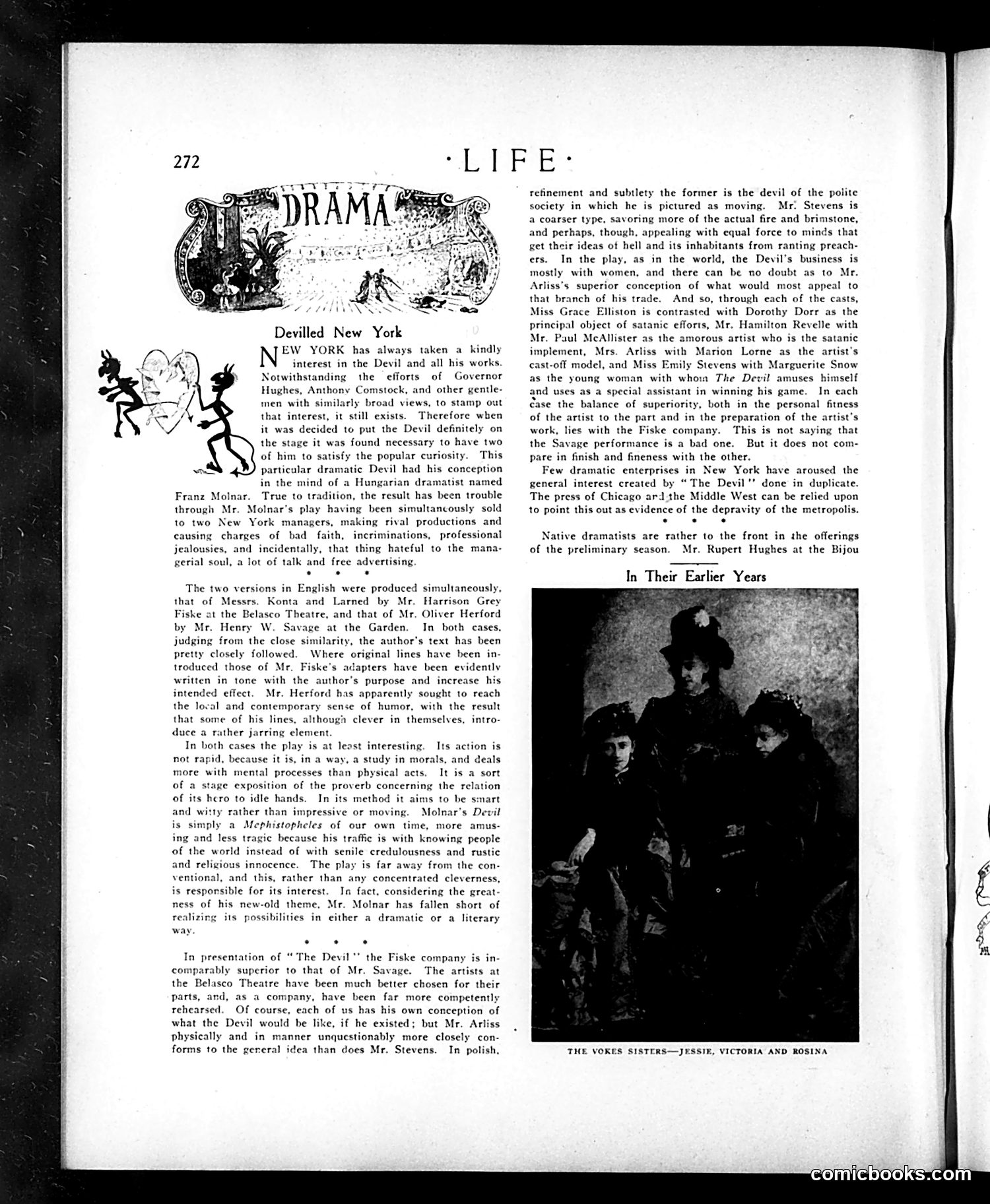
This page discusses theatrical productions of "The Devil," comparing versions by different companies. The small cartoon at top left depicts demonic figures and appears to relate to the play's subject matter. The main photograph shows "The Vokes Sisters—Jessie, Victoria and Rosina," likely performers in one of the theatrical productions discussed. The text critiques various dramatic adaptations, noting that Franz Molnar's original play spawned simultaneous English productions by competing New York theater companies. The article compares performances by different casts, discussing how each adapted the material. The satire appears directed at theatrical commercialism—how competing producers rushed similar versions to market, suggesting more interest in profit than artistic merit or originality.
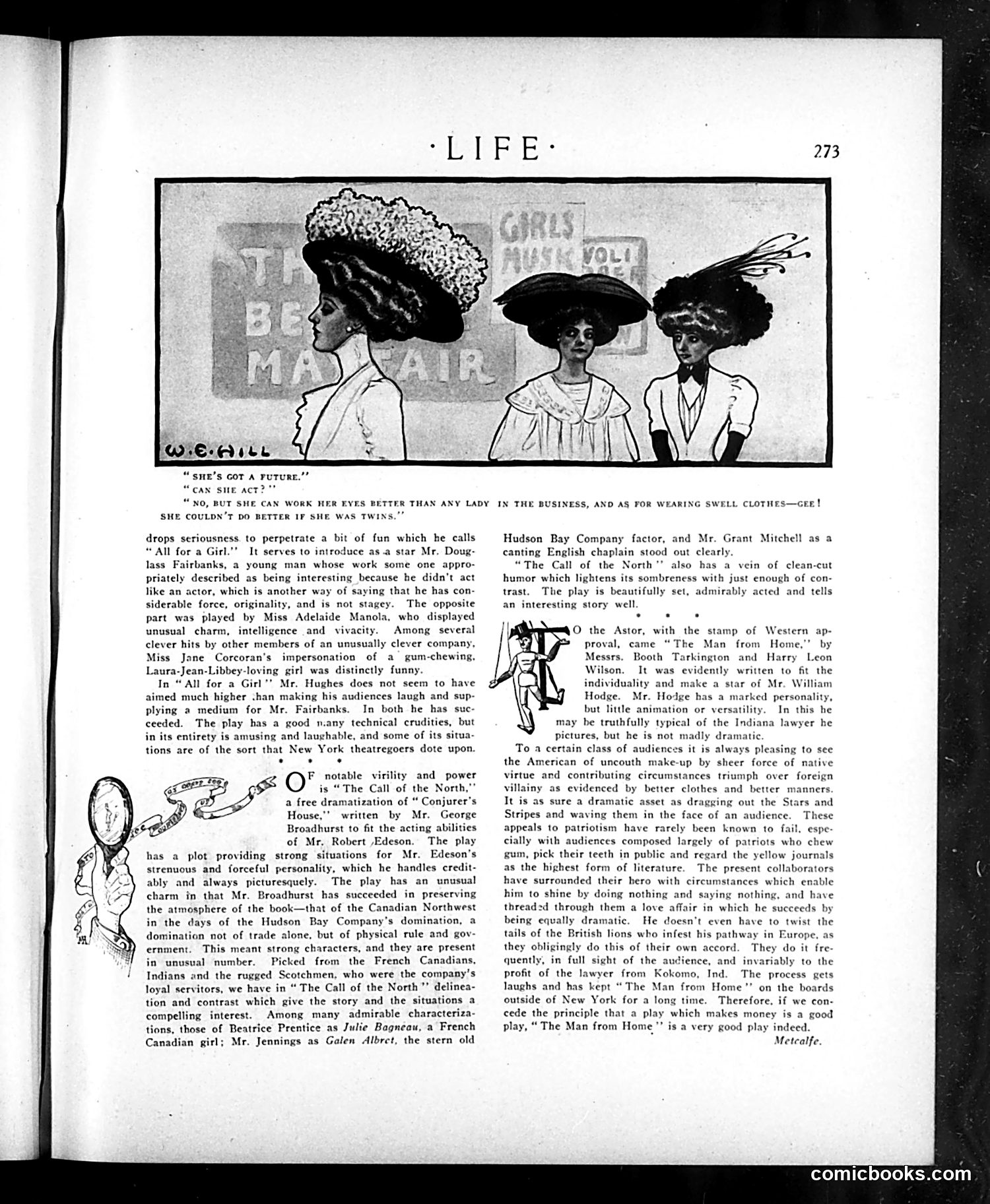
The illustration at top shows three women in elaborate Edwardian-era fashion, prominently featuring large, decorative hats. The caption reads: "She's got a future. Can she act? No. But she can work her eyes better than any lady in the business, and as for wearing swell clothes—gee! She could go miles in a picture show." This is satirizing early cinema's focus on **female appearance over talent**. The joke mocks the film industry's casting priorities—that actresses needed physical attractiveness and fashionable dress rather than acting ability to succeed. The exaggerated hats emphasize how costumes were central to female performers' marketability during the silent film era, when visual presentation was paramount. The accompanying article reviews stage plays, including discussion of "The Call of the North" and "The Man from Home."
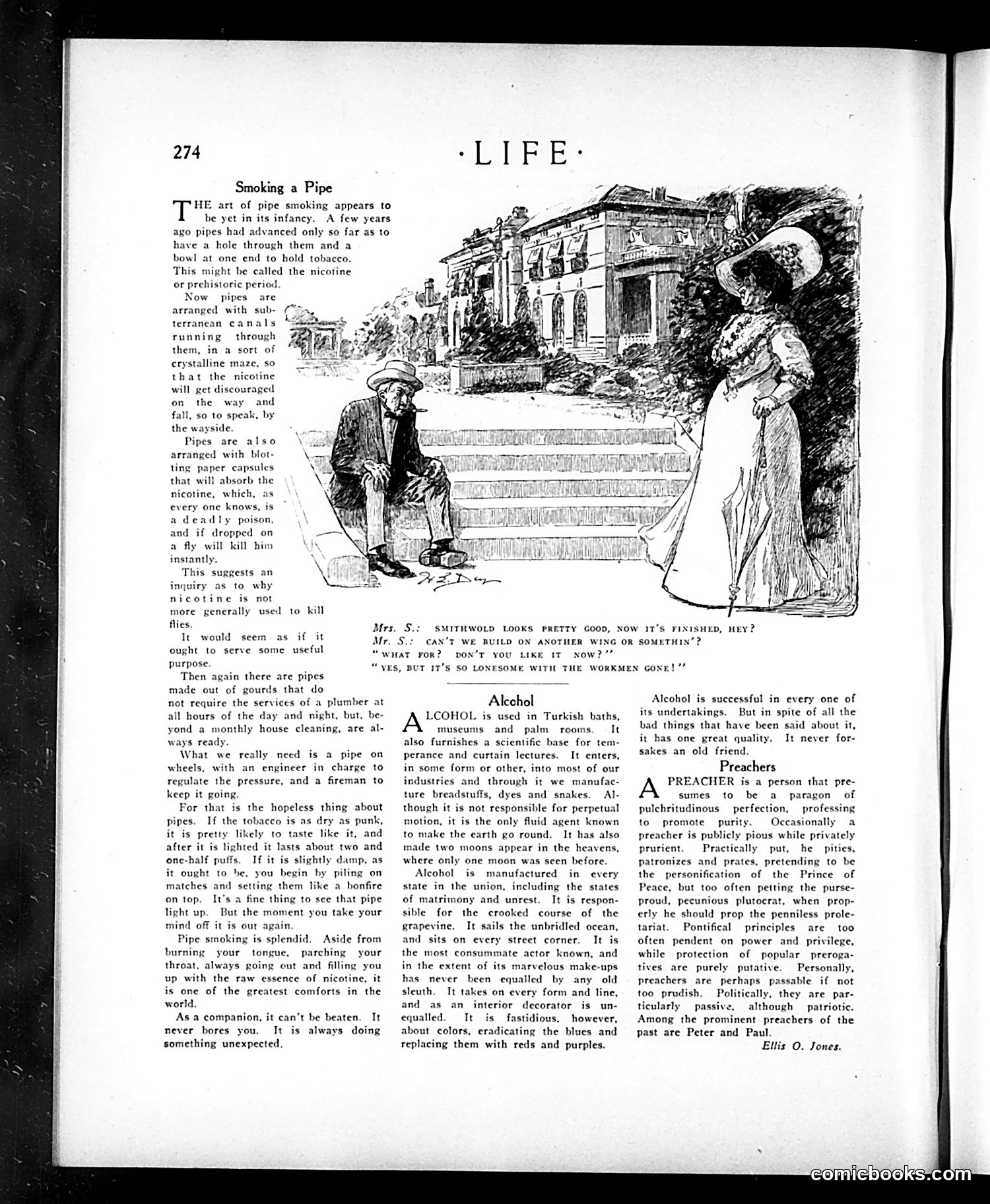
This page contains three satirical pieces typical of Life magazine's humor: **"Smoking a Pipe"** mocks the absurd complexity of modern pipe designs. The text humorously catalogs elaborate pipe features (underground canals, blotting paper capsules) meant to filter nicotine—then questions why, if nicotine kills flies, it isn't used as pesticide. The irony: despite all these "improvements," pipes remain unreliable, constantly going out and requiring constant relighting. **The cartoon** shows a couple at their new mansion. Mrs. S. complains the finished house is "lonesome" without the workmen, suggesting she wants to immediately expand it—satirizing wealthy Americans' endless consumption and dissatisfaction. **"Alcohol" and "Preachers"** are brief satirical definitions using exaggeration and wordplay. The alcohol piece ironically praises alcohol while listing its social harms (causing drunkenness, affecting industries). The preachers piece criticizes religious hypocrisy—preachers publicly promote purity while privately behaving immorally and greedily pursuing money. All three pieces employ Life's characteristic approach: absurdist humor masking social critique of contemporary American behavior and values.
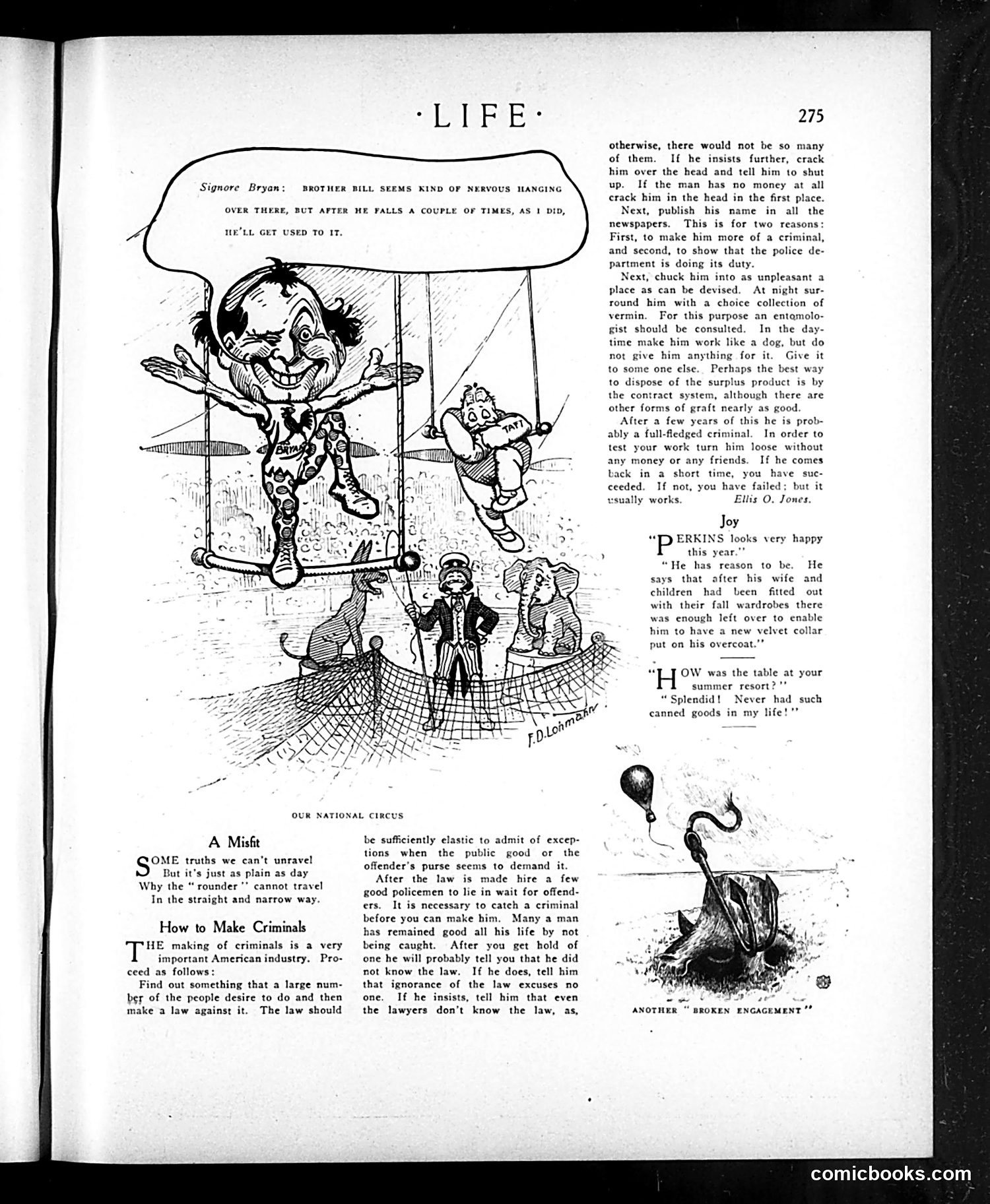
This page from *Life* magazine contains three satirical pieces: **Top Cartoon ("Our National Circus"):** Depicts "Signore Bryan" (William Jennings Bryan, the politician) as a nervous figure on a swing. The caption suggests he'll get used to the swinging motion—likely mocking his political vacillation or controversial positions. **"How to Make Criminals":** A biting satirical essay (attributed to Ellis O. Jones) that exposes systemic injustice in law enforcement and incarceration. It darkly prescribes how to criminalize people by: criminalizing popular behaviors, using selective enforcement based on wealth, publicizing arrests to stigmatize offenders, and deliberately creating harsh prison conditions that ensure recidivism. The satire critiques police corruption, class-based justice, and how the system manufactures repeat criminals. **"Joy" and "Another Broken Engagement":** Brief humorous social commentary on middle-class life—one about small wardrobe upgrades, another about broken engagements (illustrated with lovers in water). The page reflects Progressive-Era skepticism toward law enforcement and class inequality.
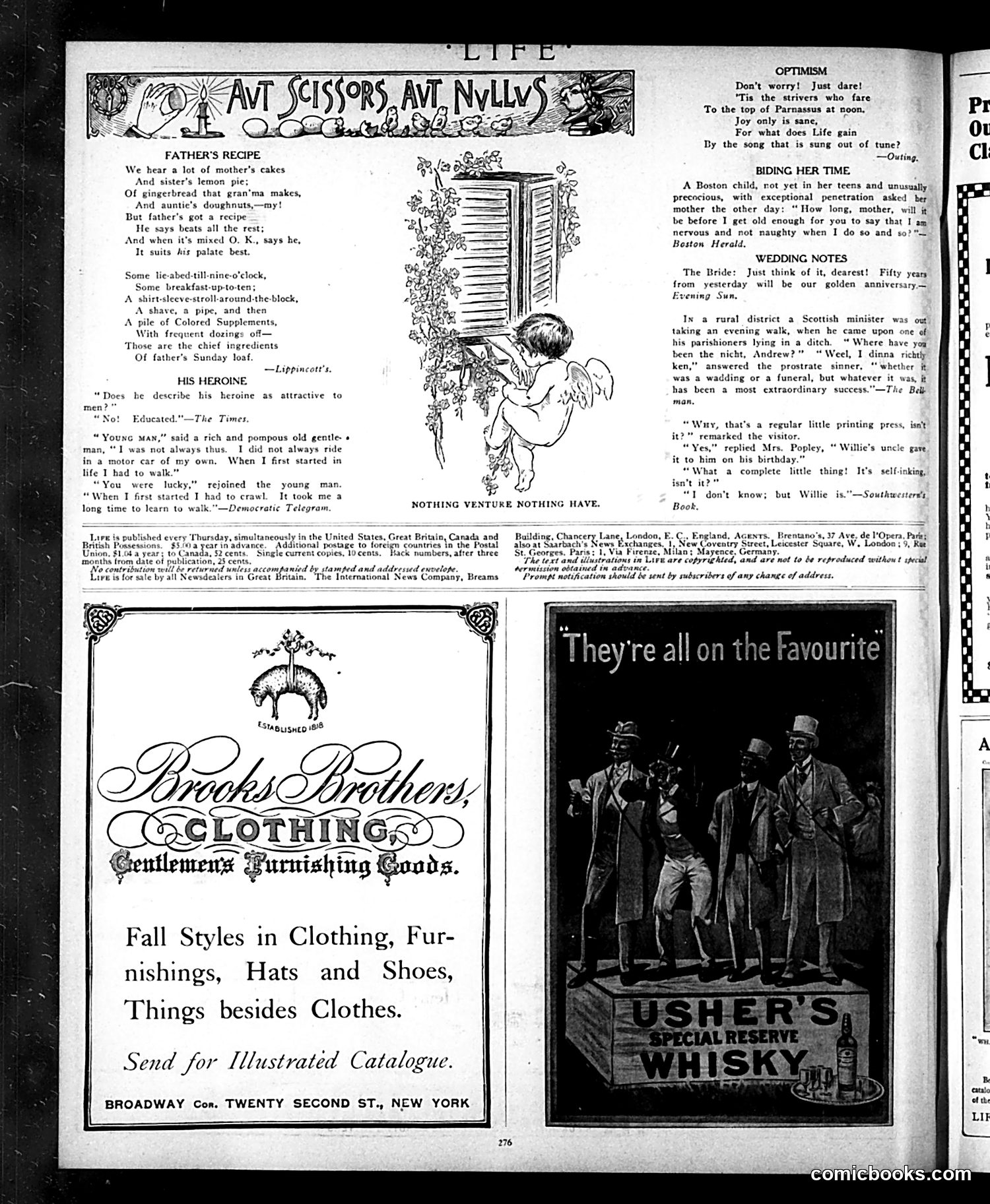
This page contains several short humorous pieces typical of early 20th-century American satirical journalism: **"Father's Recipe"** satirizes the leisurely Sunday routine of middle-class fathers—sleeping late, avoiding exercise, reading the comic supplements (the colorful newspaper inserts), and napping. It gently mocks paternal idleness as a cherished indulgence. **"His Heroine"** plays on class anxiety: a wealthy gentleman boasts he once walked for transportation, treating poverty as a quaint accomplishment. The young man retorts that he had to *crawl*—inverting the "self-made man" narrative by suggesting the gentleman's past hardship is trivial compared to true struggle. **"Biding Her Time"** and **"Wedding Notes"** are brief anecdotes about children's precocity and marital milestones—mild social humor without sharp satire. The bottom half contains advertisements for Brooks Brothers clothing and Usher's whisky. The page is primarily content-driven rather than political, reflecting Life's focus on domestic social observation and consumer culture circa 1900s-1910s.
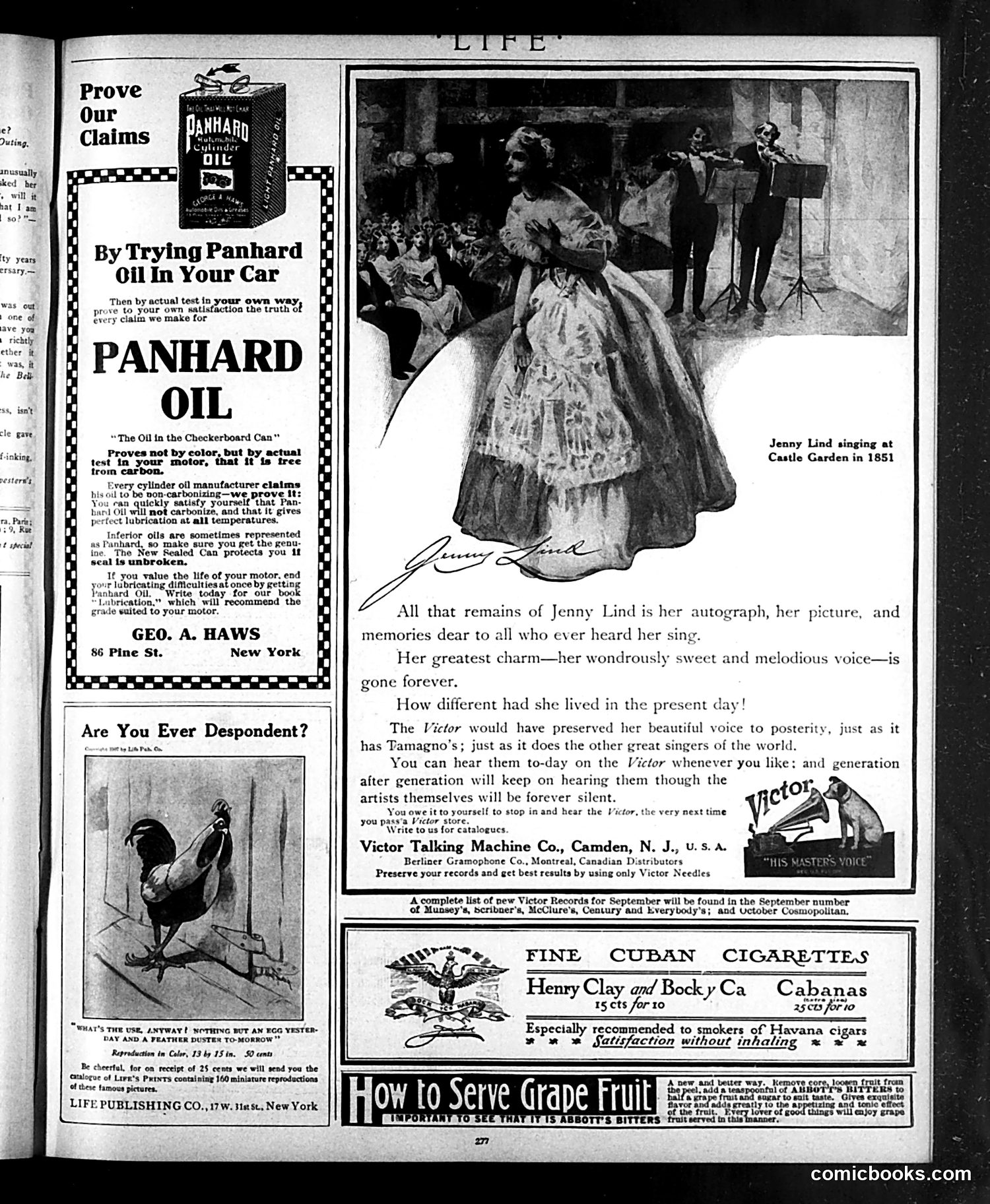
This page consists primarily of **advertisements** rather than editorial cartoons or satire. The main content is a **tribute to Jenny Lind**, the famous 19th-century Swedish opera singer, paired with a **Victor Talking Machine advertisement**. The ad's argument is straightforward: had Lind lived in the modern era (when this was published), the Victor phonograph would have preserved her voice for posterity, unlike in 1851 when her artistry could only be remembered through "autograph, her picture, and memories." The smaller cartoon depicts a despondent rooster with the caption "What's the use, anyway? Nothing but an egg yesterday and a feather duster to-morrow"—a humorous representation of Depression-era pessimism that Life Publishing used to sell reproductions of cheerful paintings. The remaining items are **product advertisements**: Panhard Oil for automobiles, Henry Clay cigars, and Abbott's Bitters grape-fruit serving instructions. This reflects Life's mixed content model of editorial material interspersed with paid advertising.
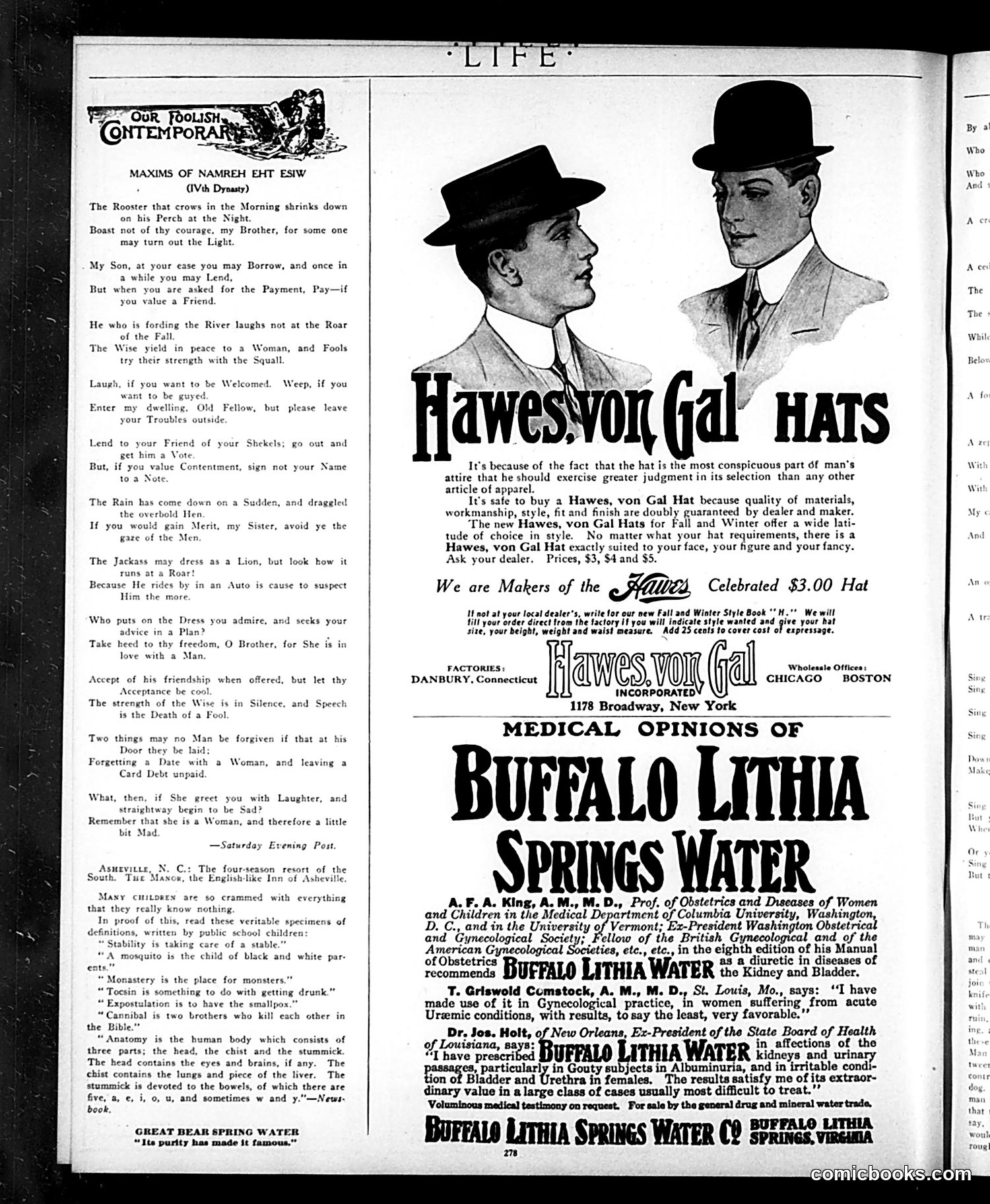
This Life magazine page mixes two main elements: **Left column: Satirical pseudo-ancient wisdom.** "Maxims of Namreh Eht Esiw" (reading backwards: "Wise the Henram of Maxims") parodies ancient Egyptian wisdom literature by offering cynical 19th-century American proverbs. Topics include avoiding lending money, not trusting women's judgment, and maintaining social silence—essentially satirizing conventional (especially misogynistic) American wisdom as timeless "ancient" truth. **Center/bottom: Period advertising.** Two full-page ads for Hawes Von Gal hats and Buffalo Lithia Springs Water appear below. These represent typical Life magazine revenue sources—the hat ad emphasizes quality and style choice; the mineral water ad quotes medical authorities endorsing its therapeutic properties, reflecting the era's patent medicine culture. The page's humor derives from juxtaposing mock-serious pseudo-historical moralizing against mundane consumer capitalism.
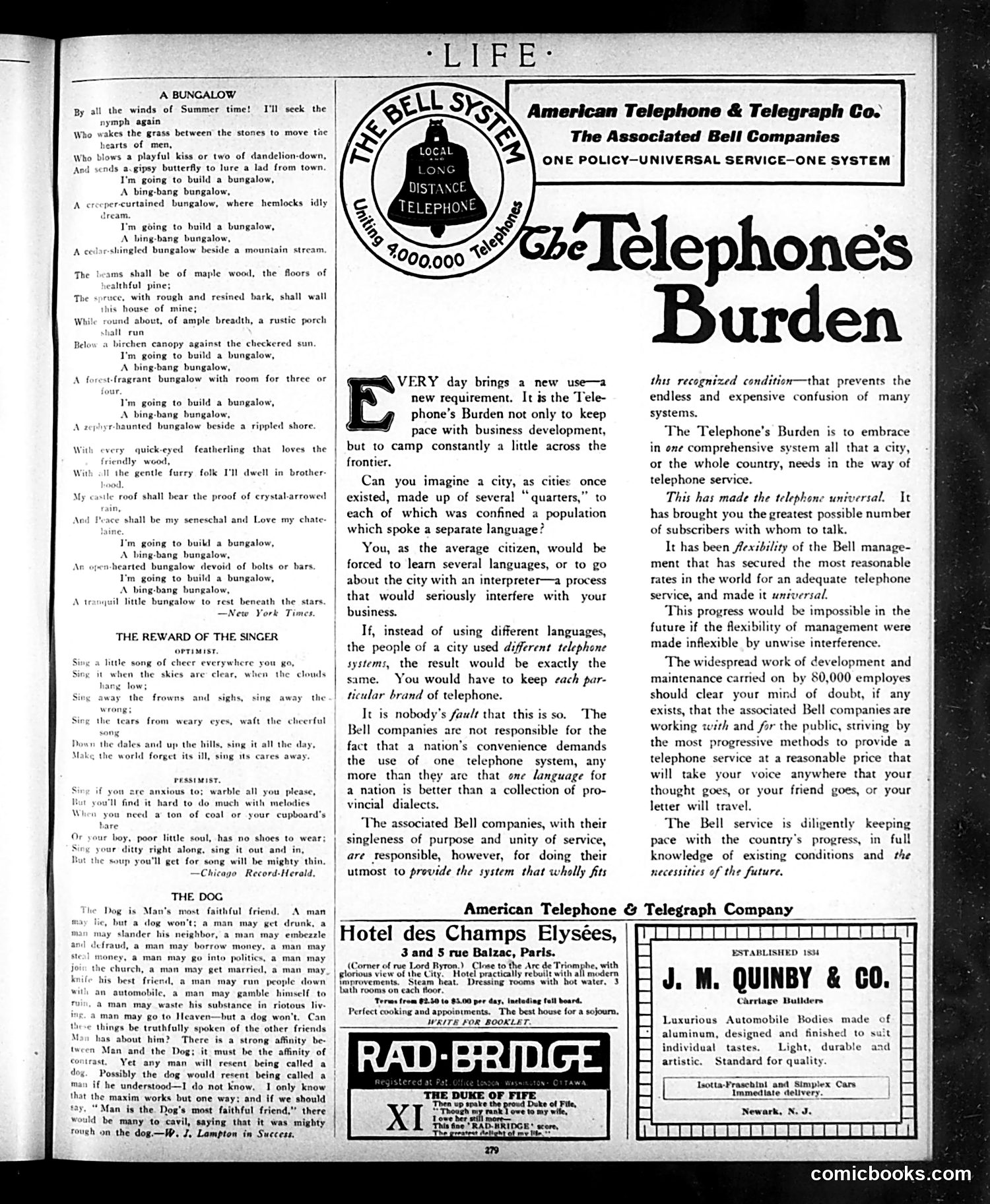
This page is dominated by a full-page advertisement for American Telephone & Telegraph Co. defending the Bell System's monopoly structure. The ad argues that just as a city with multiple languages would be chaotic and inefficient, a city with multiple competing telephone systems would similarly hamper business and commerce. The implicit message: unified control under one company (Bell) serves the public interest better than competition. This reflects the early 20th-century "natural monopoly" argument—that telephone service requires integrated infrastructure making competition wasteful. The ad frames Bell's dominance not as corporate greed but as necessary efficiency, claiming the company employs 50,000 people to keep telephone service universal and affordable. The surrounding poems and short humorous pieces are typical Life magazine filler content unrelated to the advertising strategy.
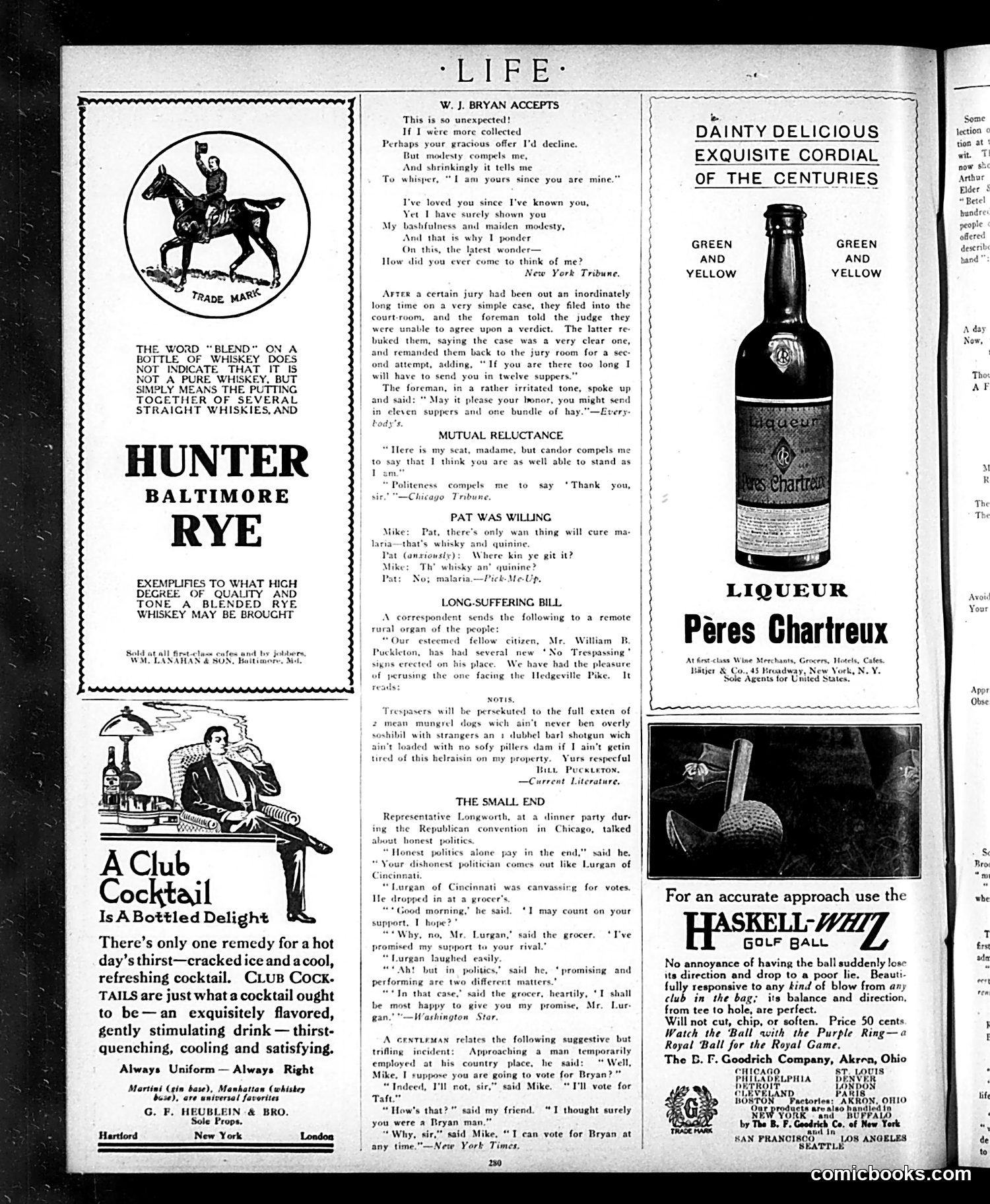
This page is primarily **advertising with satirical humor pieces interspersed**. The main content includes: **Left side:** Whiskey and cocktail advertisements (Hunter Baltimore Rye, Club Cocktails) with instructional copy about blended whiskey. **Center:** Four brief comic anecdotes mocking political and social pretension: - "W.J. Bryan Accepts" — appears to parody William Jennings Bryan's coy acceptance of something (unclear what specifically) - Jury room humor about sending "supper" and "hay" - A dialogue about politeness and seat-taking - Irish dialect jokes about whiskey and quinine **"The Small End"** — the most pointed piece — satirizes hypocritical politicians. It depicts Representative Longworth claiming "honest politics pay," then tells a story where a dishonest politician (Lurgan) openly admits "promising and performing are two different matters" — mocking the gap between political rhetoric and actual behavior. **Right side:** Liqueur and golf ball advertisements. The page reflects early 20th-century American satirical journalism mixing social commentary with consumer culture.
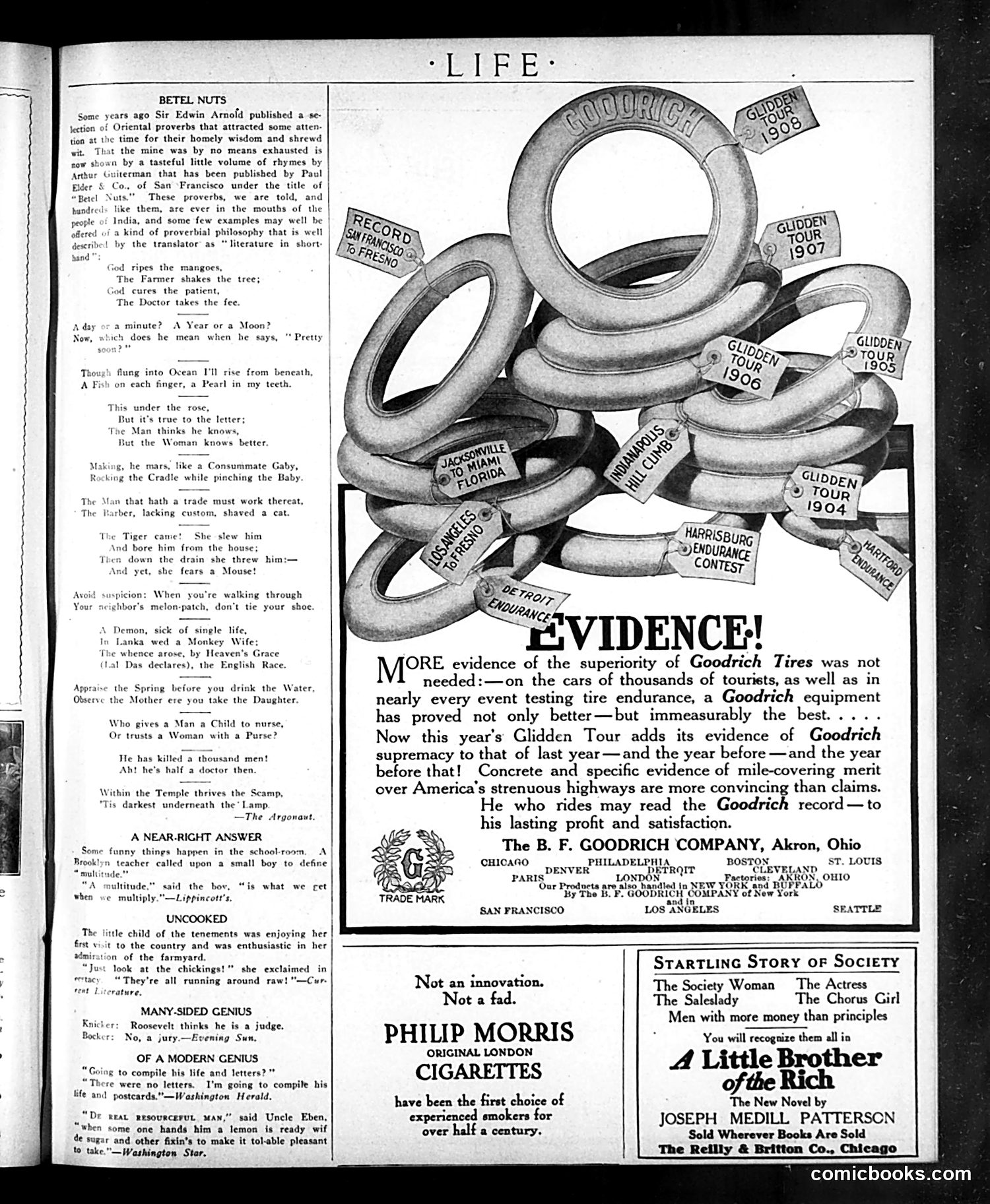
This page showcases **Life magazine's typical format**: literary content alongside advertisements. The left column features "Betel Nuts"—a book review of Arthur Guiterman's collection of Oriental proverbs, presented with whimsical examples emphasizing paradoxes (women know better than men, demons' offspring allegedly explains the English race, etc.). These gentle philosophical jokes reflect early-20th-century fascination with "exotic" Eastern wisdom. The dominant right-side advertisement features the **Glidden Tour**—a famous automobile endurance race. The illustration shows tire hoops labeled with consecutive years (1904-1908), visually demonstrating Goodrich Tires' competitive victories across multiple racing seasons. This advertising strategy uses concrete "evidence" of product superiority rather than mere claims. Below appear smaller ads for **Philip Morris Cigarettes** and a novel titled "A Laughter of the Rich." The page primarily serves as advertising vehicle (literally), with the literary content filling supporting space—typical of Life's commercial-editorial balance.
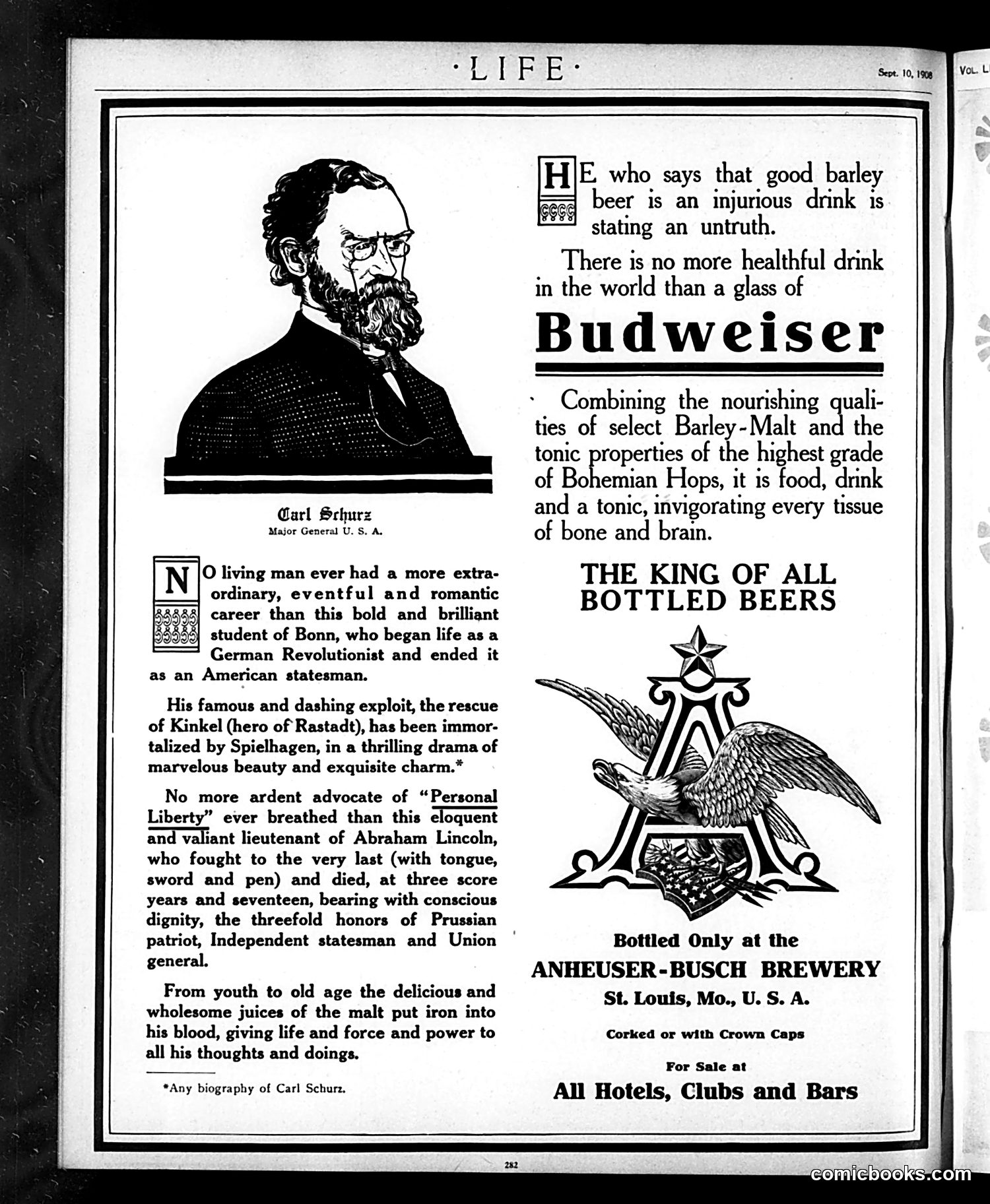
This is primarily a **Budweiser beer advertisement** masquerading as editorial content in *Life* magazine (circa 1908). The page exploits **Carl Schurz**, a real historical figure—a German-born Union general who fought for Lincoln and later became a prominent American statesman. The ad credits Schurz's vigor and accomplishments to lifelong beer consumption, claiming malt liquor provides "iron into his blood" and invigorates "every tissue of bone and brain." This was **satirical advertising**: the magazine juxtaposes Schurz's serious political legacy ("Personal Liberty" advocate, Union general) with the absurd claim that beer made him great. By linking a respected immigrant politician to German beer culture, Budweiser appeals to German-American readers while implicitly endorsing beer as essential to masculine achievement and vigor. The humor relies on readers recognizing the historical Schurz and finding the reductive attribution of his success to beer consumption ridiculous—yet the ad presents it as earnest biography.