
Life, 1908-09-10 · page 13 of 22
Life — September 10, 1908 — page 13: what you’re looking at
What you’re looking at
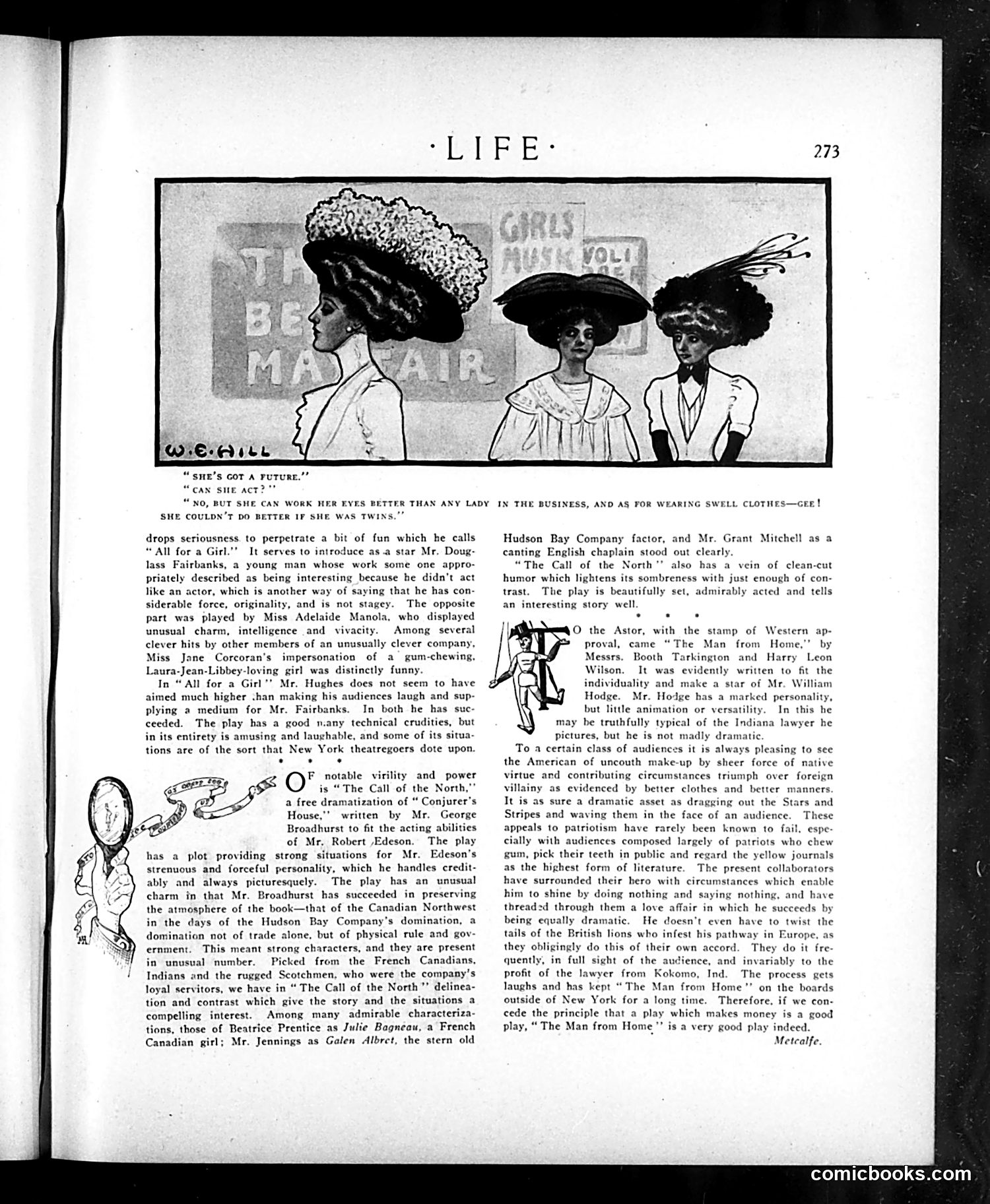
The illustration at top shows three women in elaborate Edwardian-era fashion, prominently featuring large, decorative hats. The caption reads: "She's got a future. Can she act? No. But she can work her eyes better than any lady in the business, and as for wearing swell clothes—gee! She could go miles in a picture show." This is satirizing early cinema's focus on **female appearance over talent**. The joke mocks the film industry's casting priorities—that actresses needed physical attractiveness and fashionable dress rather than acting ability to succeed. The exaggerated hats emphasize how costumes were central to female performers' marketability during the silent film era, when visual presentation was paramount. The accompanying article reviews stage plays, including discussion of "The Call of the North" and "The Man from Home."
📄 Transcribed text from this page (OCR, searchable)
Machine-transcribed from the original scan — historical spelling and the odd misread are preserved.
“sne’s Got A ruTuRr.”” “CAN site act?” SHE COULDN’T DO BETTER IF SHE WAS TWINS.” drops seriousness. to perpetrate a bit of fun which he calls “All for a Girl.’ It serves to introduce asa star Mr. Doug- lass Fairbanks, a young man whose work some one appro- priately described as being interesting because he didn’t act like an actor, which is another way of saying that he has con- siderable force, originality, and is not stagey. The opposite part was played by Miss Adelaide Manola, who displayed unusual charm, intelligence and vivacity. Among several clever hits by other members of an unusually clever company, Miss Jane Corcoran'’s impersonation of a gum-chewing, Laura-Jean-Libbey-loving girl was distinctly funny. In “All for a Girl’? Mr. Hughes does not seem to have aimed much higher .han making his audiences laugh and sup- plying a medium for Mr. Fairbanks. In both he has suc- ceeded. The play has a good n.any technical crudities, but in its entirety is amusing and laughable, and some of its situa- tions are of the sort that New York theatregoers dote upon. F notable virility and power os is “The Call of the North, a free dramatization of “ Conjurer’s House,” written by Mr. George Broadhurst to fit the acting abilities of Mr. Robert Edeson. The play Edeson’s ie has a plot providing strong situations for Mr. strenuous and forceful personality, which he handles credit- ably and always picturesquely. The play has an unusual charm in that Mr. Broadhurst has succeeded in preserving the atmosphere of the book—that of the Canadian Northwest in the days of the Hudson Bay Company's domination, a domination not of trade alone, but of physical rule and gov- ernment. This meant strong characters, and they are present in unusual number. Picked from the French Canadians, Indians and the rugged Scotchmen, who were the company’s loyal servitors, we have in “ The Call of the North ’’ delinea- tion and contrast which give the story and the situations compelling interest. Among many admirable characteriza tions, those of Beatrice Prentice as Julie Bagneau, a French Canadian girl; Mr. Jennings as Galen Albret, the stern old NO, BUT SNE CAN WORK HER EVES BETTER THAN ANY LADY IN THE BUSINESS, AND AS FOR WEARING SWELL CLoTHES—ceE! Hudson Bay Company factor, and Mr. Grant Mitchell as a canting English chaplain stood out clearly. “The Call of the North” also has a vein of clean-cut humor which lightens its sombreness with just enough of con- trast. The play is beautifully set, admirably acted and tells an interesting story well. O the Astor, with the stamp of Western ap- proval, came “The Man from Home," by Messrs. Booth Tarkington and Harry Leon Wilson. It was evidently written to fit the individuality and make a star of Mr. William Hodge. Mr. Hodge has a marked personality, but little animation or versatility. In this he may be truthfully typical of the Indiana lawyer he pictures, but he is not madly dramatic: To a certain class of audiences it is always pleasing to see the American of uncouth make-up by sheer force of native virtue and contributing circumstances triumph over foreign villainy as evidenced by better clothes and better manners. It is as sure a dramatic asset as dragging out the Stars and Stripes and waving them in the face of an audience. appeals to patriotism have rarely These been known to fail. espe- cially with audiences composed largely of patriots who chew gum, pick their teeth in public and regard the yellow journals as the highest form of literature. The present collaborators have surrounded their hero with circumstances which enable him to shine by doing nothing and saying nothing, and have threadzd through them a love affair in which he succeeds by being equally dramatic. He doesn’t even have to twist the tails of the British lions who infest his pathway in Europe. as they obligingly do this of their own accord. They do it fre quently, in full sight of the audience, and invariably to the profit of the lawyer from Kokomo, Ind. The process gets laughs and has kept “The Man from Home" on the boards outside of New York for a long time. Therefore, if we con- cede the principle that a play which makes money is a good play, “The Man from Home" is a very good play indeed. Metcalfe. comicbooks.com