
Life, 1908-09-10 · page 4 of 22
Life — September 10, 1908 — page 4: what you’re looking at
What you’re looking at
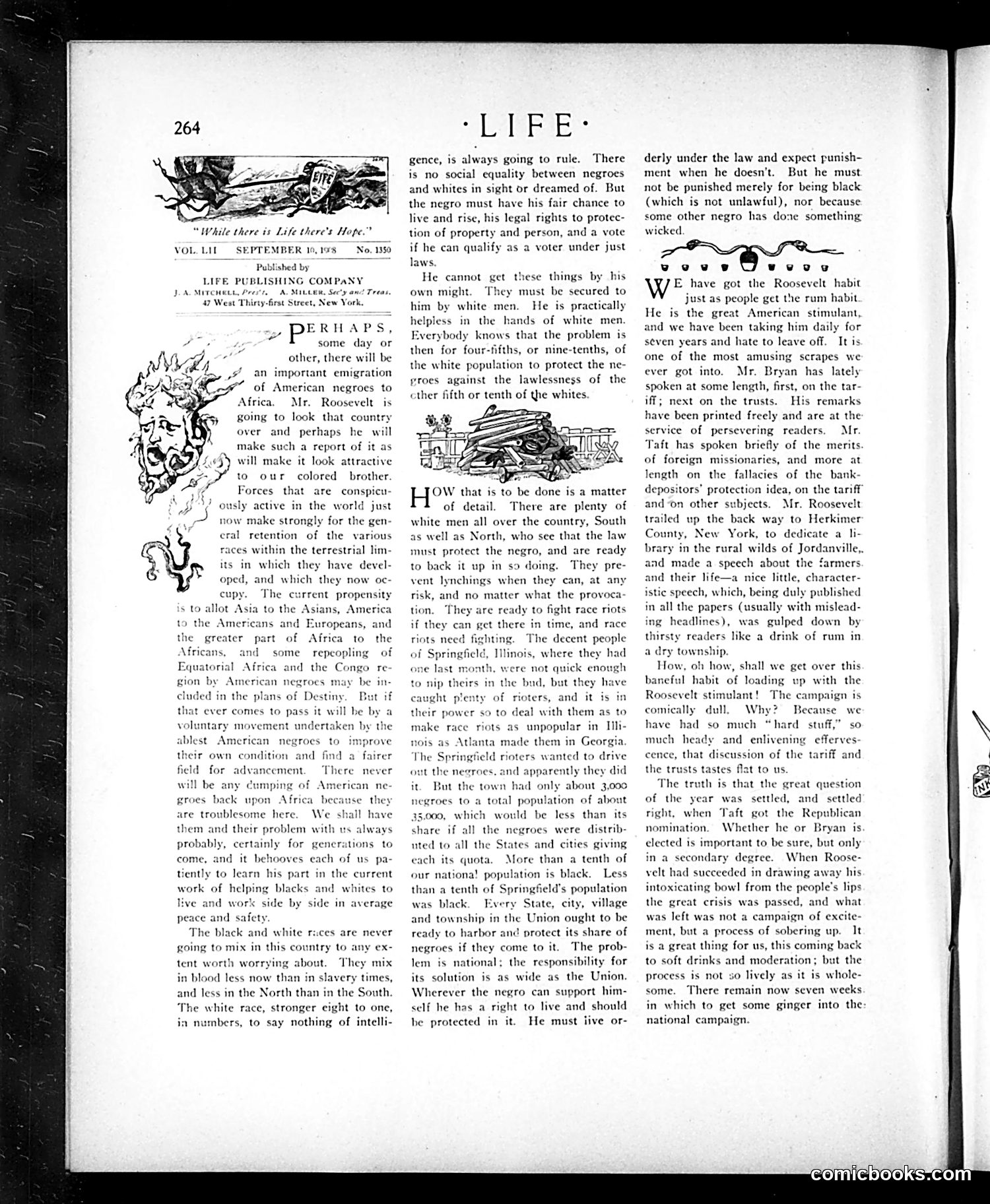
The main cartoon depicts a grotesque caricatured head labeled "PERHAPS," illustrating the article's discussion of race relations and Theodore Roosevelt's policies. The image appears designed to mock anxieties about American race dynamics. The accompanying article critiques Roosevelt's consideration of appointing African Americans to federal positions and addresses broader racial tensions. It argues that while black and white populations mix "less now than in slavery times," the "stronger eight to one, in numbers" white race need not fear racial equality. The piece advocates for legal protections of Black citizens' property and voting rights while opposing social equality—a position reflecting early 20th-century segregationist ideology disguised as "reasonable" compromise. The overall tone is paternalistic toward African Americans while defending white supremacy as natural demographic fact.
📄 Transcribed text from this page (OCR, searchable)
Machine-transcribed from the original scan — historical spelling and the odd misread are preserved.
“While there is Life there's Hope.” VOL.LIL SEPTEMBER 10, No. 1350 Published by LIFE PUBLISHING COMPANY JA MITCHELL, Pret A MILEER, Sec’y an y-first Street, New York. RHAPS, some day or other, there will be an important emigration of American negroes to Africa, Mr. Roosevelt is going to look that country over and perhaps he make such a report of it as will make it look attractive to our colored Forces that ssly active in the world just will brother: are conspicu- now make strongly for the gen- cral retention of the races within the terrestrial lim- its in which they have devel- oped, and which the cupy. various now oc- The current propensity s to allot Asia to the Asians, America to the Americans and Europeans, and the greater part of Africa to. the Afri and repeopling of Equatorial Africa and the Congo re gion by American ne cluded in the plans of Destiny. But if some oes may be in- that ever comes to pass it will be by « voluntary movement u by the ablest their own condition lertaker American negroes to. improve and find a fairer field for adv There will be cement. never ny cumpi erican ne- are troublesome here. We shall have them and their problem with us always probably certainly for generations to come, and it behooves each of us pa- tiently to learn his part in th work of helping blacks and current whites to live and work side by side in average peace and safety The black and white races are never going to mix in this country to any ex- tent worth worrying about. They mix in blood less now than in slavery times, and less in the North than in the South. The white race, stronger eight to one, in numbers, to say nothing of intelli- ‘LIFE: gence, is always going to rule. There is no social equality between negroes and whites in sight or dreamed of. But the negro must have his fair chance to live and rise, his legal rights to protec- tion of property and person, and a vote if he can qualify as a voter under just laws. He cannot get these things by his own might. They must be secured to him by white men. He is practically helpless in the hands of white men. Everybody knows that the problem is then for four-fifths, or nine-tenths, of the white population to protect the ne- proes against the lawlessness of the cther fifth or tenth of the whites. OW that is to be done is a matter of detail. There are plenty of white men all over the country, South as well as North, who see that the law must protect the negro, and are ready to back it up in so doing. They pr vent lynchings when they can, at an: risk, and no matter what the provoca tion. They are ready to fight race riots if they can get there in time, and ra riots need fighting. The decent people i Springfield, Illinois, where they had © last month, were not quick enough to nip theirs in the bud, but they ha caught plent f rioters, and it is in their power so to deal with them as to make race riots as unpopular in Illi- s Atlanta made them in Georgi: pringfield rioters wanted to drive out the negroes, and apparently they did it. But the town had only about 3,000 negroes to a total population of about 33.000, which would be less than its share if all the negroes were distrib- uted to all the States and cities giving each its quota. More than a tenth of our nationa! population is black. Less than a tenth of Springfield's population was black. Every State, city, village and township in the Union ought to be ready to harbor and protect its share of negroes if they come to it. The prob- Jem is national; the responsibility for its solution is as wide as the Union. Wherever the negro can support him- self he has a right to live and should be protected in it. He must iive or- derly under the law and expect punish- ment when he doesn’t. But he must not be punished merely for being black (which is not unlawful), nor because some other negro has doae something wicked E have got the Roosevelt habit just as people get the rum habit He is the great American stimulant, and we have been taking him daily for s¢ven years and hate to leave off. It is. one of the most amusing scrapes we ever got into. Mr. Bryan has lately spoken at some length, first, on the tar- iff; next on the trusts. His remarks have been printed freely and are at the service of persevering readers. Mr Taft has spoken briefly of the merits. of foreign missionaries, and more at length on the fallacies of the bank- depositors’ protection idea, on the tariff and on other subjects. Mr. Roosevelt trailed up the back way to Herkimer County, New York, to dedicate a li- brary in the rural wilds of Jordanville and made a speech about the farmers. and their life—a nice little, character- istic speech, which, being duly published in all the papers (usually with mislead- ing headlines), was gulped down by thirsty readers like a drink of rum in a dry township. How, oh how, shall we get over this baneful habit of loading up with the Roosevelt stimulant ! The campaign is comically dull, Why? Because we have had so “hard much heady and enlivening efferves cence, that discussion of the tariff and the trusts tastes flat to us. The truth is that the great question of the year was settled, and settled right, when Taft got the Republican nomination. Whether he or Bryan is clected is important to be sure, but only When Roo: velt had succeeded in drawing away his intoxicating bowl from the people's lips the great crisis was passed, and what was left was not a campaign of excite- ment, but a process of sobering up. It is a great thing for us, this coming back to soft drinks and moderation; but the process is not so lively as it is whole- some. There remain now seven weeks in which to get some ginger into the national campaign. much stuff,” so na secon degree.