
Life, 1908-09-10 · page 12 of 22
Life — September 10, 1908 — page 12: what you’re looking at
What you’re looking at
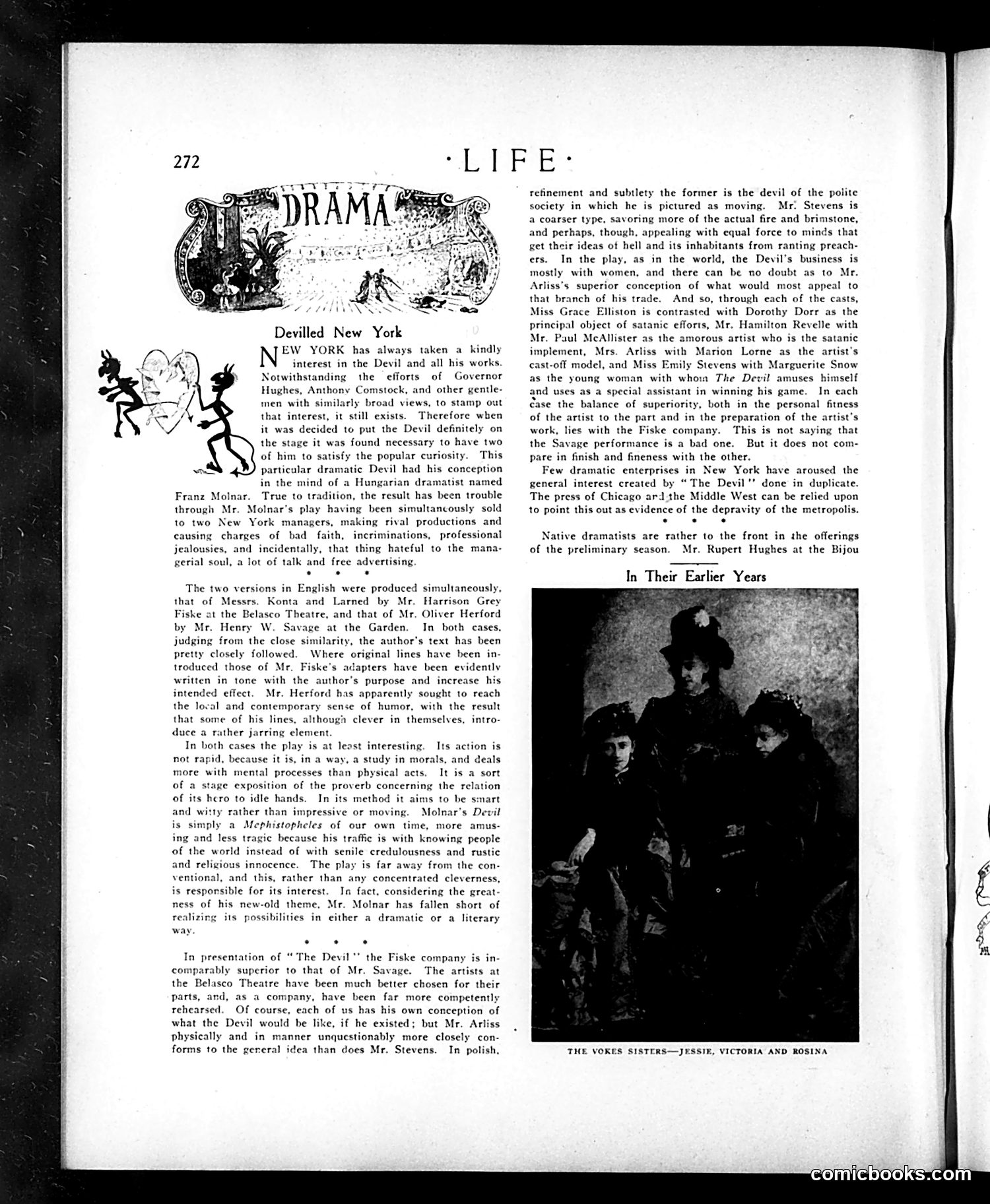
This page discusses theatrical productions of "The Devil," comparing versions by different companies. The small cartoon at top left depicts demonic figures and appears to relate to the play's subject matter. The main photograph shows "The Vokes Sisters—Jessie, Victoria and Rosina," likely performers in one of the theatrical productions discussed. The text critiques various dramatic adaptations, noting that Franz Molnar's original play spawned simultaneous English productions by competing New York theater companies. The article compares performances by different casts, discussing how each adapted the material. The satire appears directed at theatrical commercialism—how competing producers rushed similar versions to market, suggesting more interest in profit than artistic merit or originality.
📄 Transcribed text from this page (OCR, searchable)
Machine-transcribed from the original scan — historical spelling and the odd misread are preserved.
“ds PE Devilled New York EW YORK has always taken a kindly interest in the Devil and all his works. Notwithstanding the efforts of Governor Hughes, Anthony Comstock, and other gentle- men with similarly broad views, to stamp out that interest, it still exists. Therefore when it was decided to put the Devil definitely on the stage it was found necessary to have two of him to satisfy the popular curiosity. This particular dramatic Devil had his conception in the mind of a Hungarian dramatist named Franz Molnar. True to tradition, the result has been trouble through Mr. Molnar’s play having been simultancously sold to two New York managers, making rival productions and causing charges of bad faith, incriminations, professional jealousies, and incidentally, that thing hateful to the mana- gerial soul, a lot of talk and free advertising. The two versions in English were produced simultaneously, that of Messrs. Konta and Larned by Mr. Harrison Grey Fiske at the Belasco Theatre, and that of Mr. Oliver Herford by Mr. Henry W. Savage at the Garden. In both cases, judging from the close similarity, the author's text has been pretty closely followed. Where original lines have been in- troduced those of Mr. Fiske’s adapters have been evidently written in tone with the author's purpose and increase his intended effect. Mr. Herford has apparently sought to reach the local and contemporary sense of humor, with the result that some of his lines, although clever in themselves, intro- duce a rather jarring element In both cases the play is at least interesting. Its action is not rapid, because it is, in a way, a study in morals, and deals It is a sort of a stage exposition of the proverb concerning the relation of its hero to idle hands. In its method it aims to be smart d witty rather than impressive or moving. Molnar’s Devil is simply a Mephistopheles of our own time, more amus- ing and less tragic because his traffic is with knowing people of the world instead of with senile credulousness and rustic Theiplay ta faraway from the con. 1, and this, rather than any concentrated cleverness, is responsible for its interest. In fact, considering the great- ness of his new-old theme, Mr. Molnar has fallen short of realizing its possibilities in either a dramatic or a literary way more with mental processes than physical acts, and religious innocence ventior In presentation of “The Devil’ the Fiske company is in- comparably superior to that of Mr. Savage. The the Belasco Theatre have been much better chosen for their parts, and, as a company, have been far more competently rehearsed. Of course, each of us has his own conception of what the Devil would be like, if he existed; but Mr. Arliss physically and in manner unquestionably more closely con- forms to the general idea than does Mr. Stevens. In polish, tists at refinement and subtlety the former is the devil of the polite society in which he is pictured as moving. Mr: Stevens is a coarser type, savoring more of the actual fire and brimstone, and perhaps, though, appealing with equal force to minds that get their ideas of hell and its inhabitants from ranting preach- ers. In the play, as in the world, the Devil's business is mostly with women, and there can be no doubt as to Mr. Arliss’s superior conception of what would most appeal to that branch of his trade. And so, through each of the casts, Miss Grace Elliston is contrasted with Dorothy Dorr as the principal object of satanic efforts, Mr. Hamilton Revelle with Mr. Paul McAllister as the amorous artist who is the satanic implement, Mrs. Arliss with Marion Lorne as the artist's cast-off model, and Miss Emily Stevens with Marguerite Snow as the young woman with whoia The Devil amuses himself and uses as a special assistant in winning his game. In each Case the balance of superiority, both in the personal fitness of the artist to the part and in the preparation of the artist's work, lies with the Fiske company. This is not saying that the Savage performance is a bad one. But it does not com- pare in finish and fineness with the other. Few dramatic enterprises in New York have aroused the general interest created by “The Devil’? done in duplicate. The press of Chicago ard the Middle West can be relied upon to point this out as evidence of the depravity of the metropolis. Native dramatists are rather to the front in the offerings of the preliminary season. Mr. Rupert Hughes at the Bijou In Their Earlier Years THE VOKES SISTERS R, VICTORIA AND ROSINA