
A complete issue · 36 pages · 1908
Life — September 3, 1908
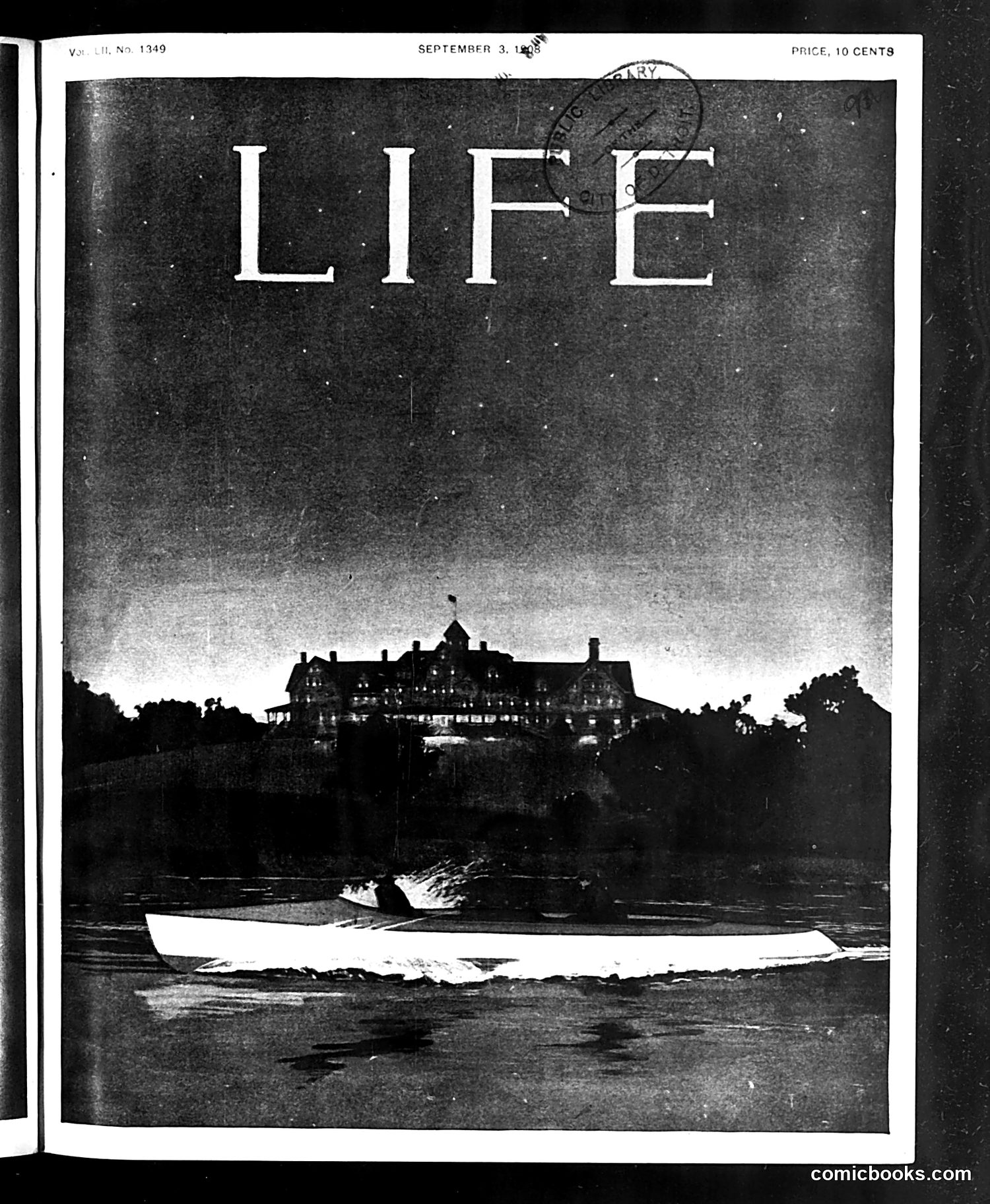
This appears to be the cover of *Life* magazine from September 3, 1928 (price 10 cents). The image shows a scenic riverside landscape featuring a large mansion or hotel silhouetted against the sky, with a canoe in the foreground on the water. Without additional OCR text from the interior or a visible caption identifying the specific location or satirical subject, I cannot definitively explain what social or political commentary this cover intends. The composition suggests it may be promoting leisure travel or commenting on American wealth and architecture of the era, but the exact satirical point or reference remains unclear from the image alone. More context would be needed for accurate interpretation.
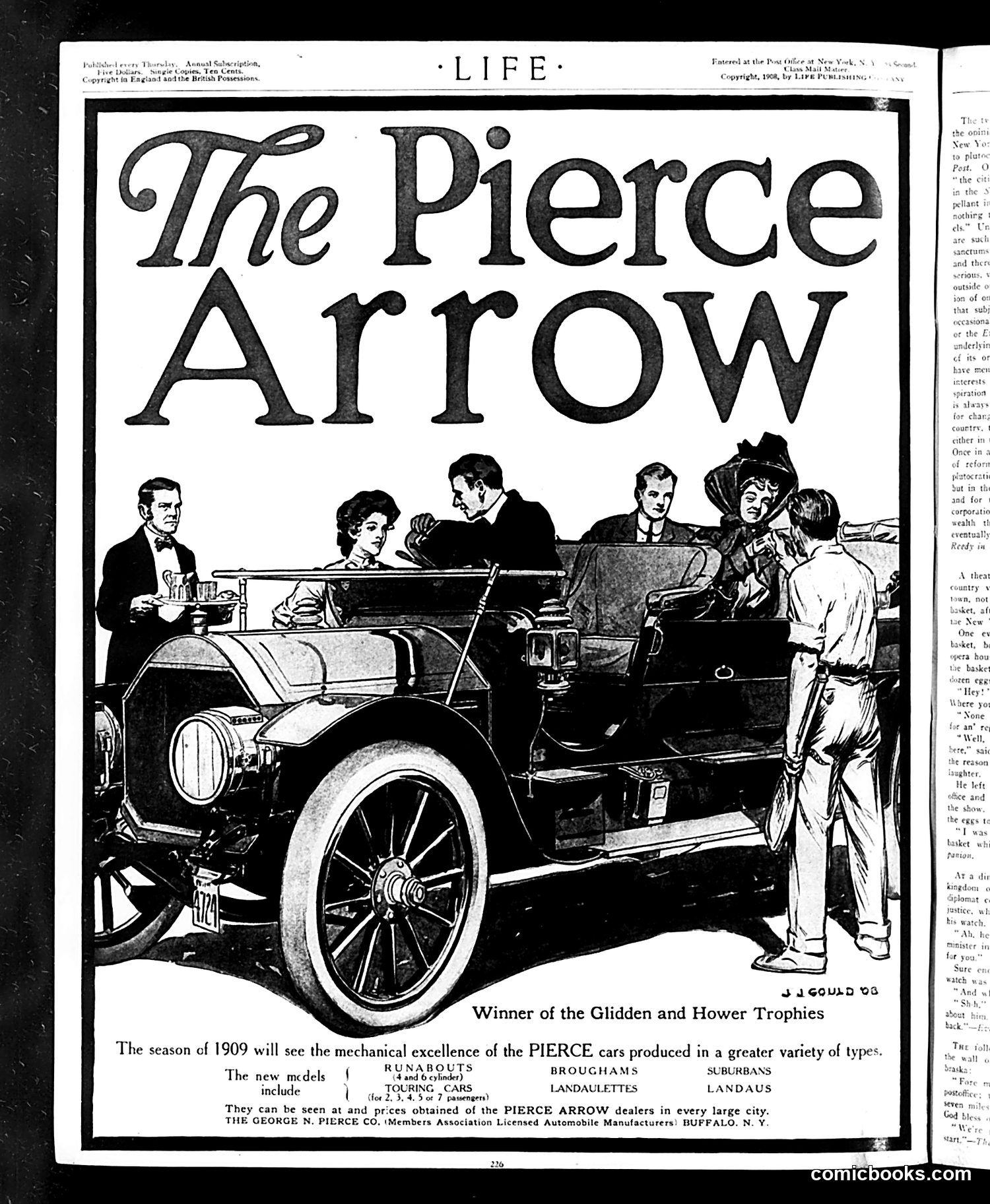
This is a **car advertisement**, not political satire. The image promotes Pierce-Arrow automobiles, manufactured by The George N. Pierce Co. in Buffalo, New York. The illustration depicts a well-dressed group of people around an early 1900s automobile, establishing the car as a luxury product for the affluent. The subtitle notes it was a "Winner of the Glidden and Hower Trophies"—automotive competitions that conveyed reliability and prestige. The text emphasizes mechanical excellence and variety of models (Runabouts, Broughams, Landaulets, Suburbans). This 1909-era advertisement targets wealthy consumers by associating the vehicle with social status, technological achievement, and automotive reliability—standard marketing appeals for high-end automobiles of the period.
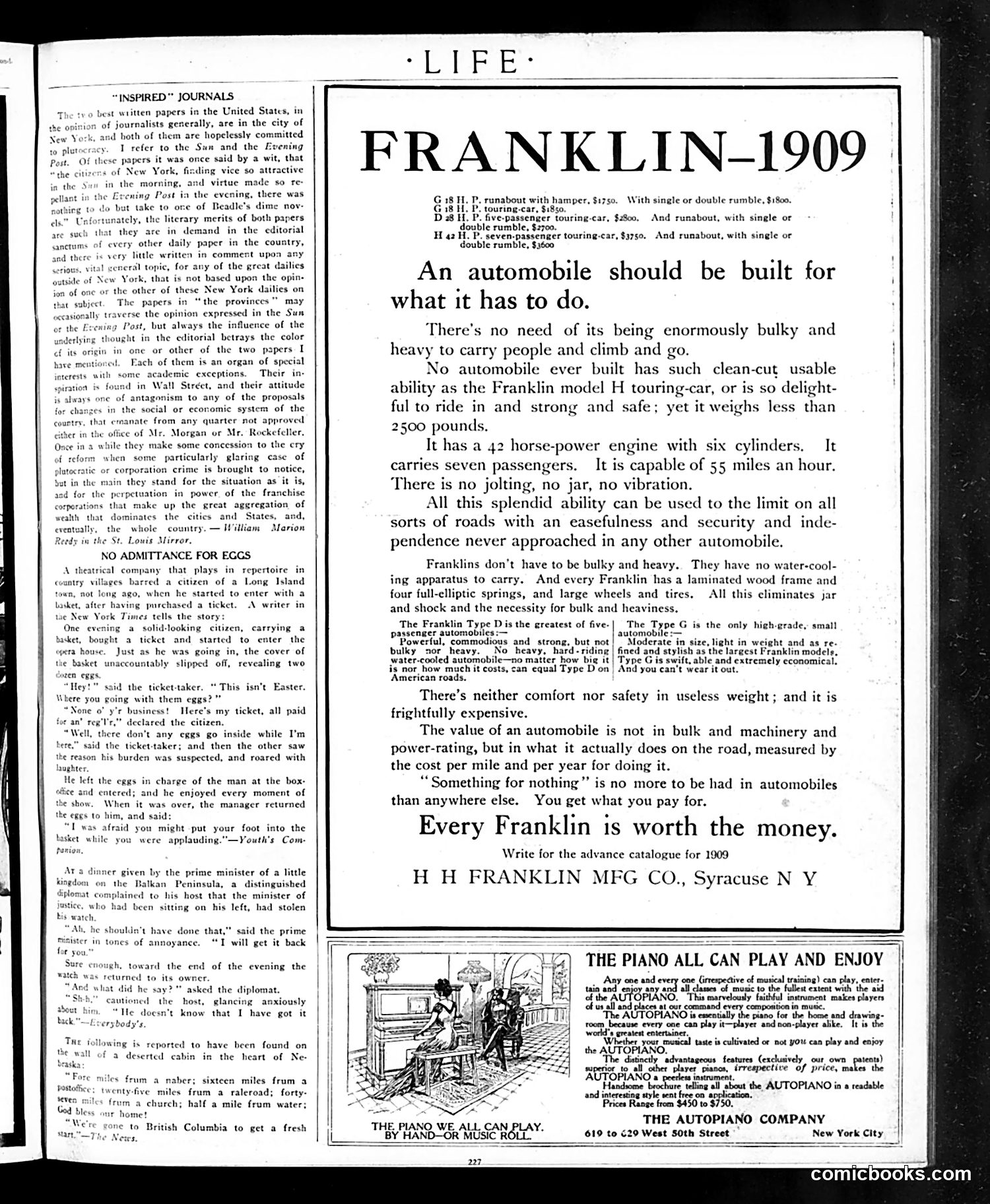
This page is **primarily advertising**, not satire or political commentary. The dominant content is a large Franklin automobile advertisement (Model H touring car, priced $2,750) emphasizing the vehicle's lightweight design, efficiency, and reliability—key selling points for early automobiles. Below is an advertisement for the Autopiano, a player piano that plays music rolls "by hand or music roll," marketed as entertainment for the home. On the left is a small column titled "Inspired Journals" discussing New York newspapers' editorial practices—a genuine commentary on journalism standards rather than satire. There are no political cartoons or caricatures visible. This represents typical early-20th-century magazine content: advertising mixed with light editorial commentary.
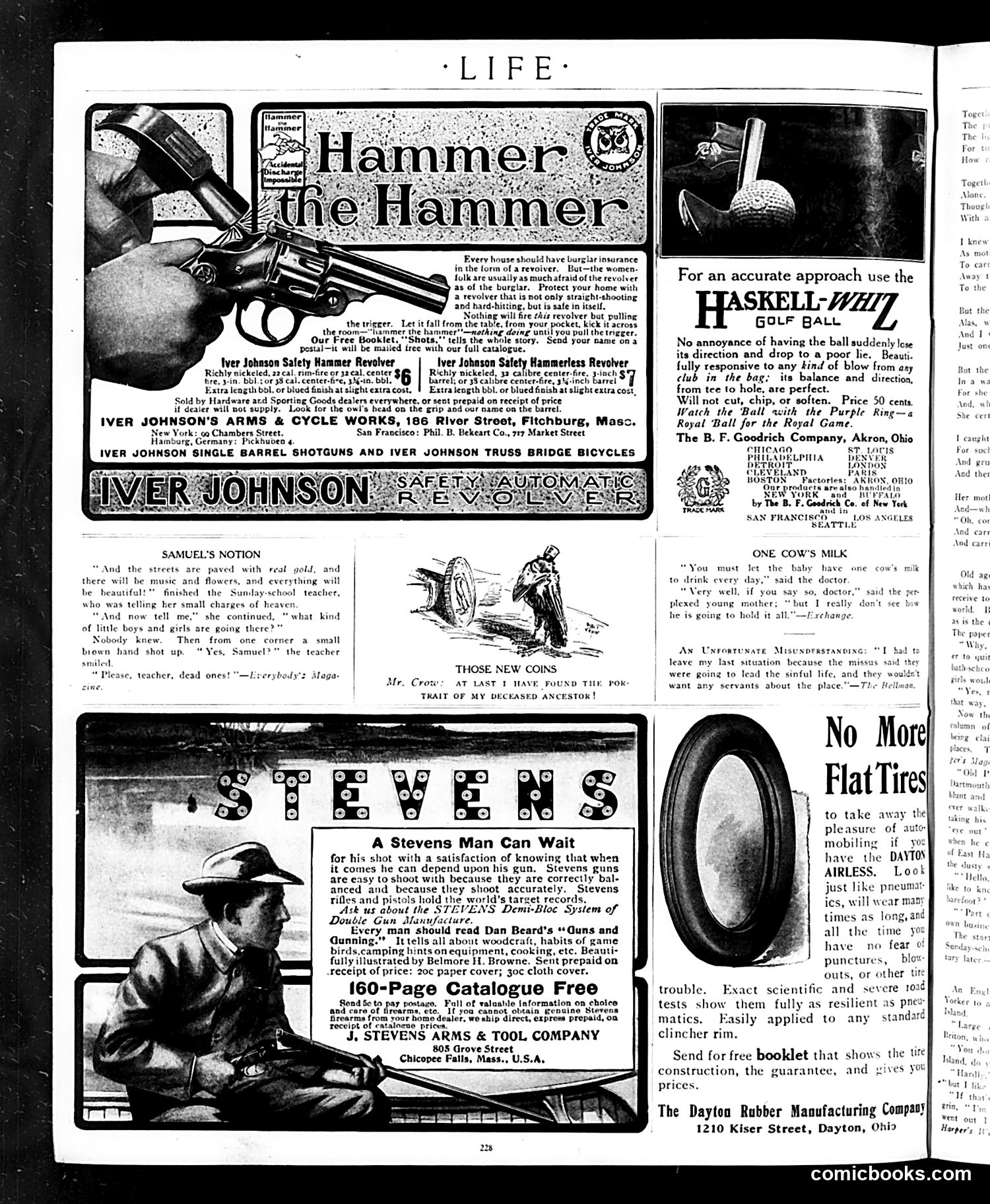
This page is primarily **advertising**, not political satire. The dominant content includes: 1. **Hammer & revolver ads** (Iver Johnson Arms) - promoting home security and firearms 2. **Haskell golf ball advertisement** - sporting goods 3. **Stevens firearms catalog ad** - featuring "A Stevens Man Can Wait," emphasizing accuracy in hunting/shooting 4. **Dayton airless tires ad** - automotive safety innovation The brief humorous sections ("Samuel's Notion," "One Cow's Milk," "Those New Corns") are light satirical jokes about domestic life—a teacher's classroom exchange about "dead ones," a doctor's milk prescription, and a man discovering a cow in his house. **No major political figures or events** are referenced. This represents Life magazine's typical early 20th-century content: commercial advertising mixed with gentle domestic humor, reflecting contemporary concerns about home security, hunting, and automobiles.
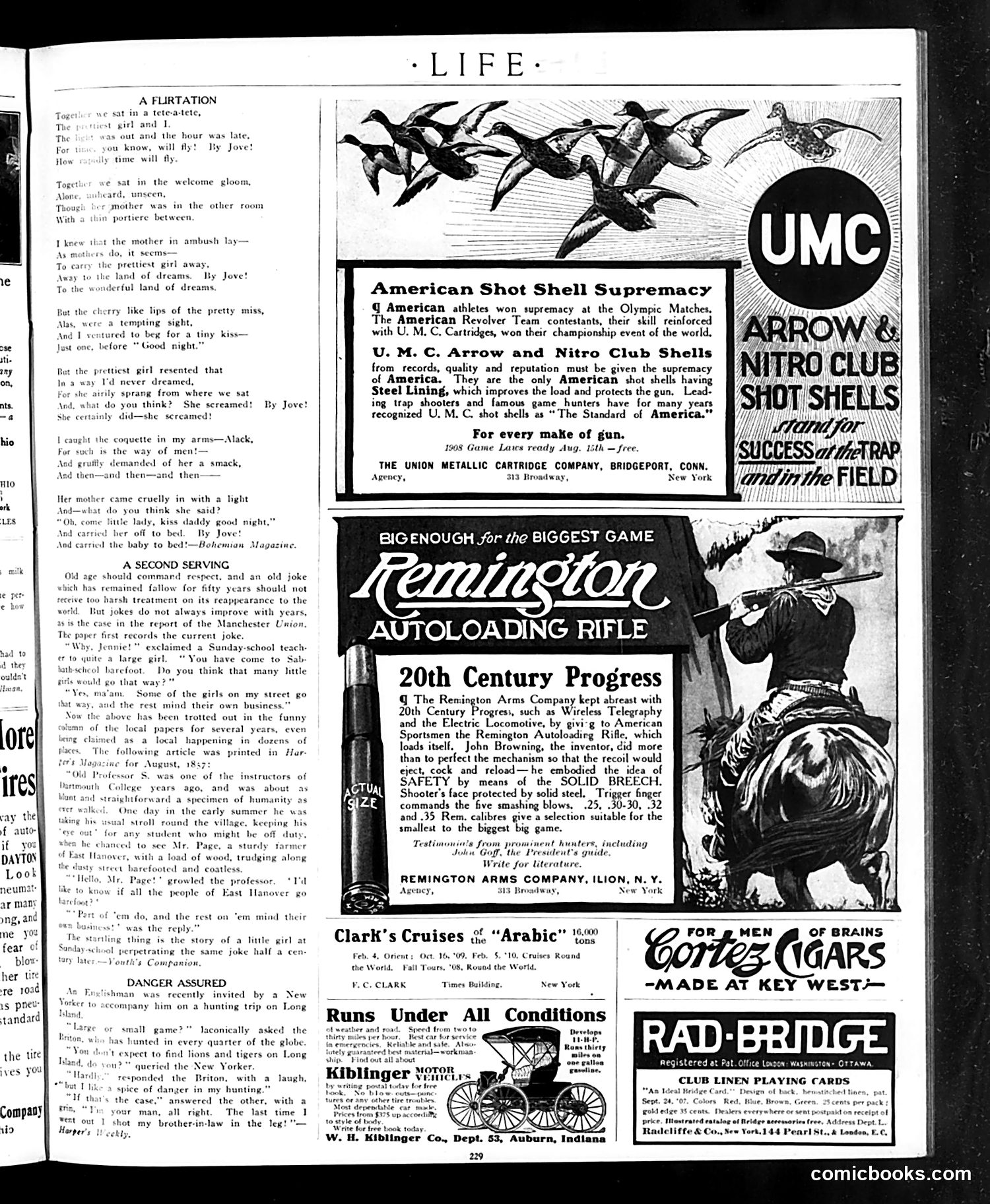
This page is primarily **advertising**, not satirical content. The left column contains poems ("A Flirtation," "A Second Serving," "Danger Assured"), but the page is dominated by period product advertisements. The ads include: - **UMC Arrow & Nitro Club Shot Shells** — ammunition marketed on "American Shot Shell Supremacy" claims, referencing Olympic competition - **Remington Autoloading Rifle** — emphasizing technological progress ("20th Century Progress") - **Clark's Cruises**, **Cortez Cigars**, **Rad-Bridge playing cards**, and **Kiblinger Motors** These represent typical early 20th-century American consumer marketing. The ammunition ads notably appeal to nationalist pride and sporting prowess. This appears to be a standard Life magazine issue mixing light verse with commercial content — the satirical magazine format included substantial advertising revenue.
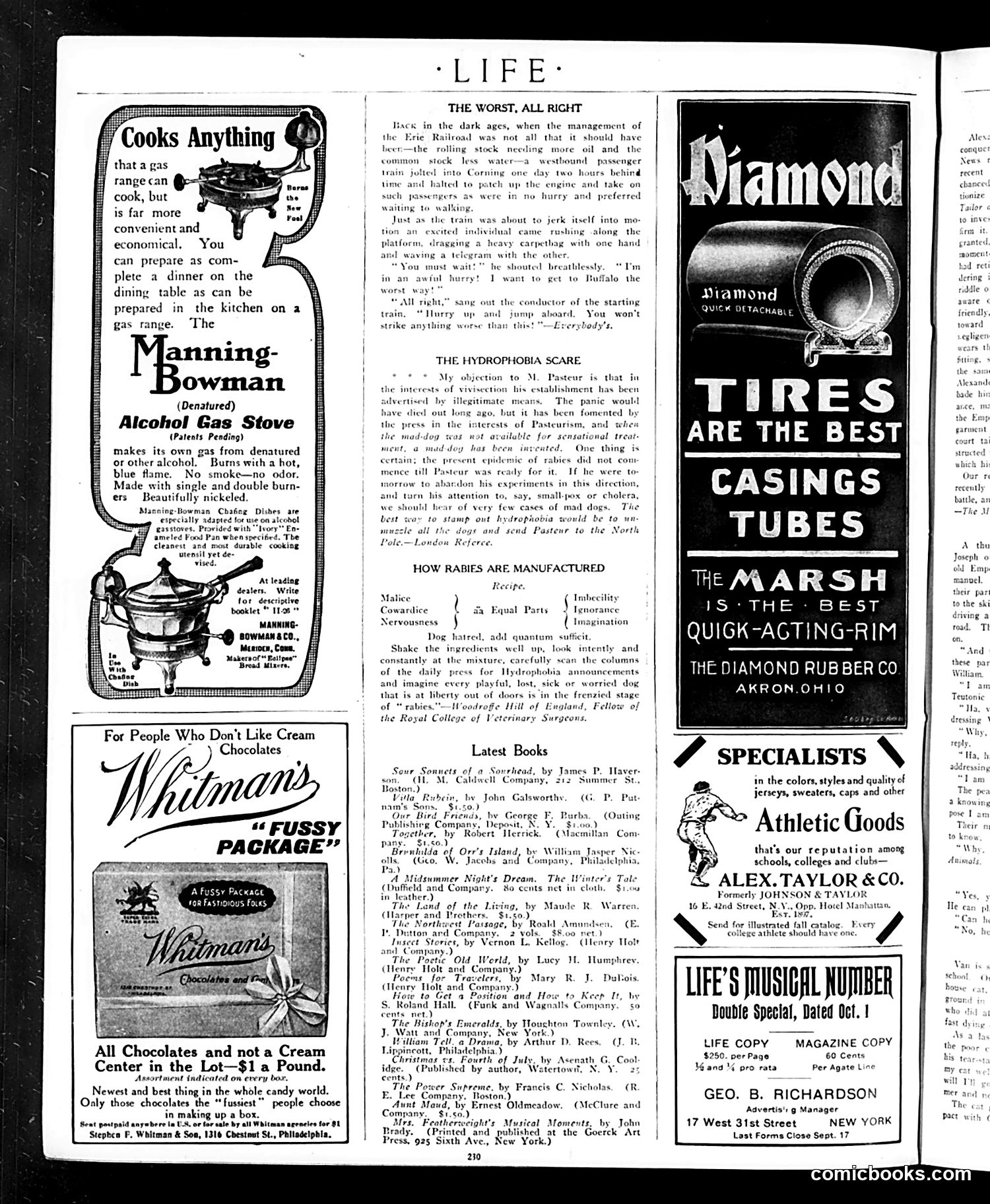
This page is primarily **advertisements** rather than satirical content. The main items are: 1. **Manning-Bowman Gas Stove** (left): Promotes a denatured alcohol gas stove for home cooking, emphasizing convenience and economy compared to traditional ranges. 2. **Whitman's Chocolates** (lower left): Advertises their "Fussy Package," marketing chocolates without cream centers. 3. **Diamond Tires** and **Marsh Rim** (right): Competing tire advertisements emphasizing quality casings and tubes. 4. **Alex. Taylor & Co.** (right): Athletic goods specialist. 5. **Life's Musical Number** (bottom right): Promotes a special edition. The page reflects early 20th-century consumer culture, with no apparent political satire. The "How Rabies Are Manufactured" section appears to be genuine educational content about dog behavior rather than satirical commentary.
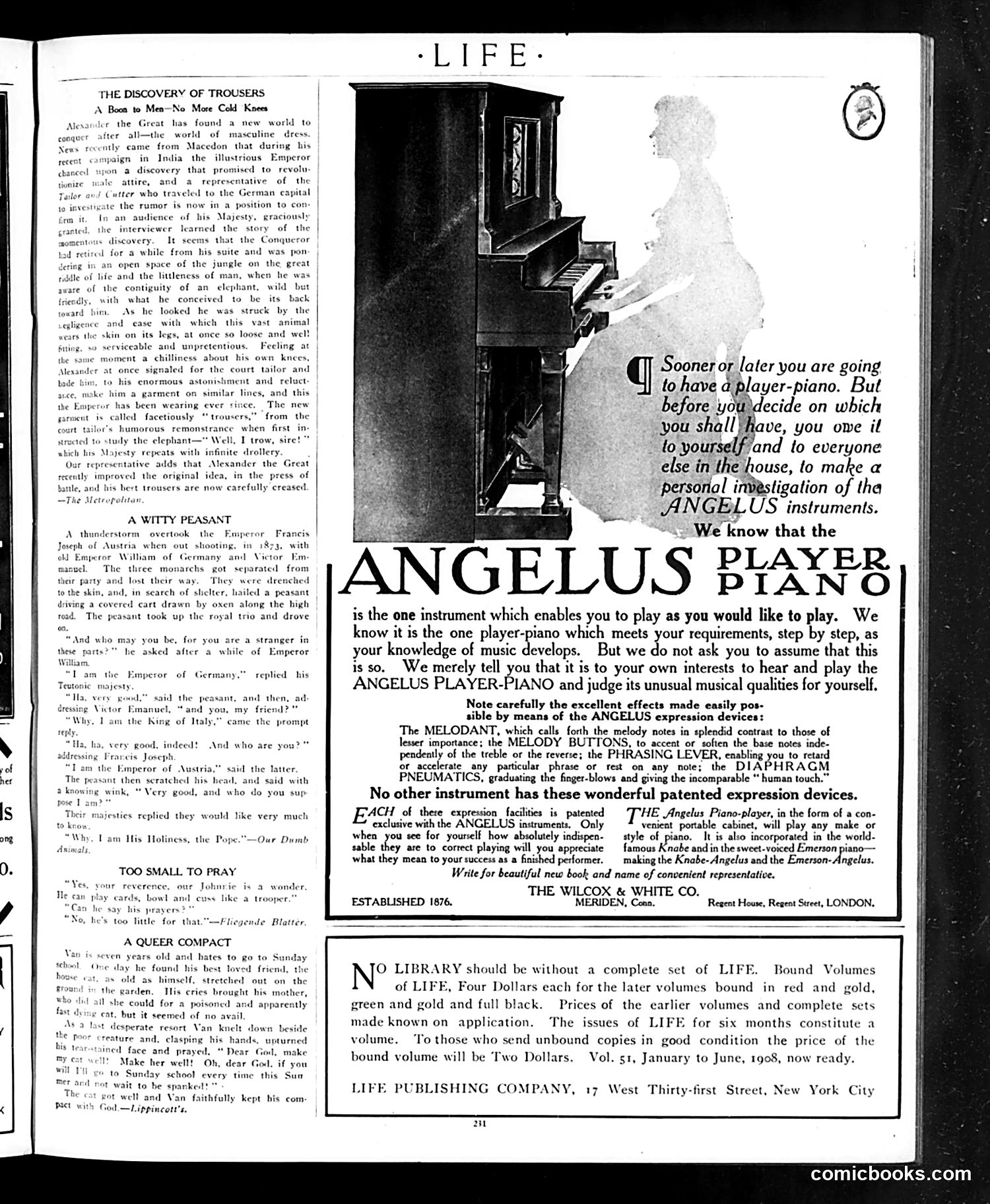
This page is primarily **advertising and satirical articles** rather than political cartoons. The main content includes: 1. **"The Discovery of Trousers"** — A satirical piece about Alexander the Great discovering trousers during an Indian campaign, used as humor about "masculine dress." 2. **"A Witty Pleasant"** — A brief anecdote about Emperor Francis Joseph of Austria encountering monarchs during a thunderstorm, playing on European imperial pretension. 3. **"Too Small to Pray"** and **"A Queer Compact"** — Short humorous stories. The **dominant feature** is a large advertisement for the **Angelus Player Piano** (center-right), promoting its musical capabilities. Below that is an advertisement for **Life magazine volumes** themselves. The page reflects early 1900s magazine format: mixing light satirical social commentary with commercial advertising, targeting educated, affluent readers.
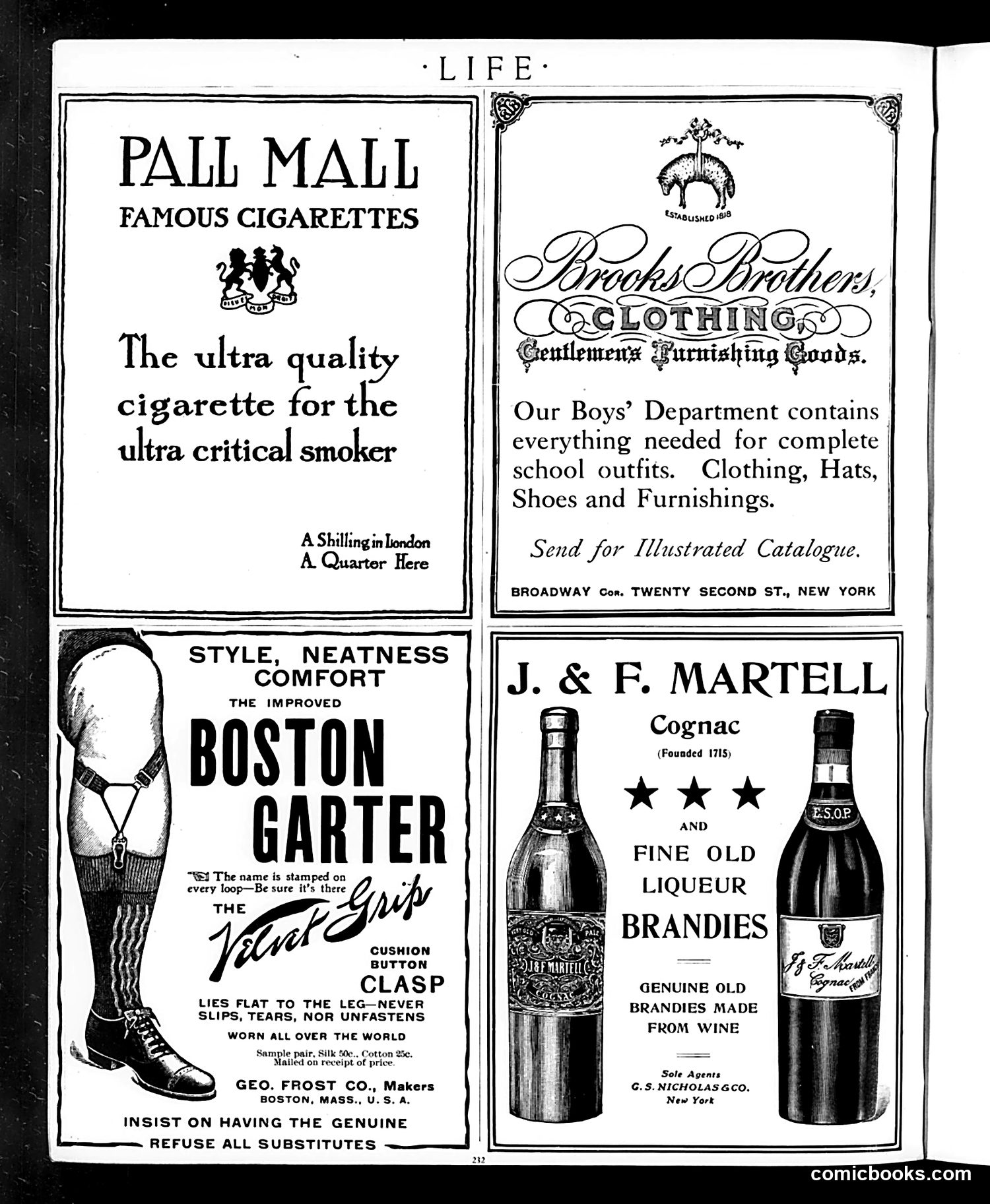
This page is **primarily advertising**, not satirical content. It contains four period advertisements: 1. **Pall Mall Cigarettes** — promotes "ultra quality" cigarettes at premium London pricing 2. **Brooks Brothers** — advertises boys' clothing and furnishings from their Broadway location 3. **Boston Garter** — showcases an improved garter with "velvet grip" and cushion button, emphasizing durability ("worn all over the world") 4. **J. & F. Martell** — advertises French cognac and brandies, founded 1715 These ads reflect early 20th-century consumer goods targeting affluent men. There is no political satire or cartoon present—this appears to be a standard advertising section from *Life* magazine's commercial pages, showcasing luxury products typical of the era.
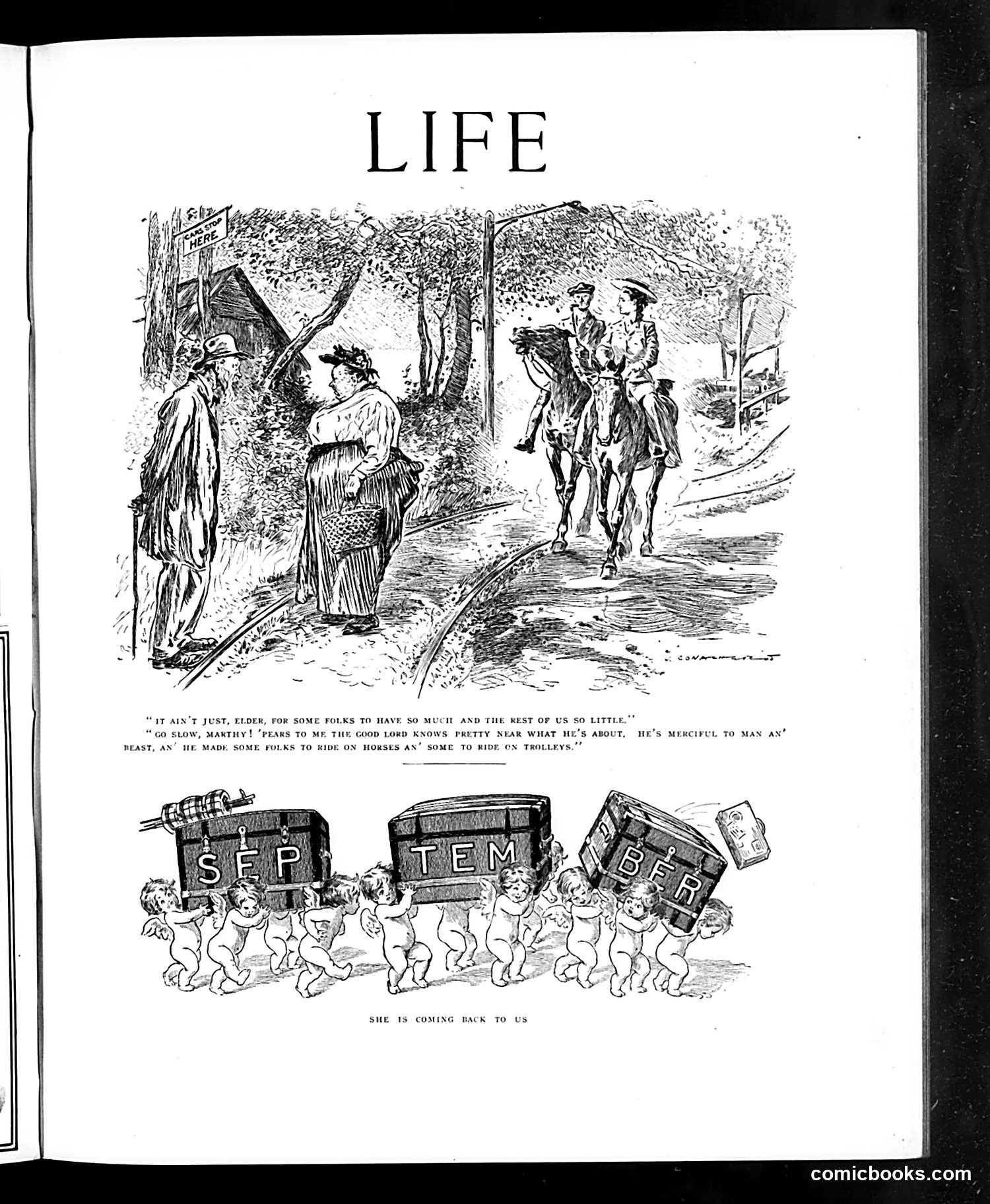
This page contains two distinct satirical cartoons from Life magazine: **Top cartoon:** Shows wealthy individuals on horseback encountering poorer people on foot. The dialogue expresses resentment about wealth inequality—one character complains that some folks have "so much and the rest of us so little," and references someone being "merciful to man as beast" by letting people ride on trolleys. **Bottom cartoon:** Depicts cherubs/babies carrying barrels labeled "SEP," "TEM," and "BER" (September, September, September), captioned "SHE IS COMING BACK TO US." This appears to reference the seasonal return of autumn/fall, personified as female. Both cartoons use humor to comment on social and economic disparities, and the cyclical nature of seasons or social conditions, typical of Life's satirical approach to American society.
This editorial page discusses the 1908 presidential election and William Jennings Bryan's candidacy. The masthead cartoon shows a figure labeled "Life" declaring "While there is Life there's Hope," likely referring to the magazine's continuing advocacy. The text criticizes Democrats for lacking enthusiasm for Bryan, noting that many old-time Democrats won't vote for him. The piece also discusses Methodist ministers' support for Bryan despite his Unitarian faith, suggesting this creates awkward tensions within religious communities. The final section praises two citizens—Mr. Harriman and Mr. Charles Morse—as exemplars of American virtue worthy of emulation by families. The overall tone is satirical commentary on the fractious 1908 campaign and internal party divisions.
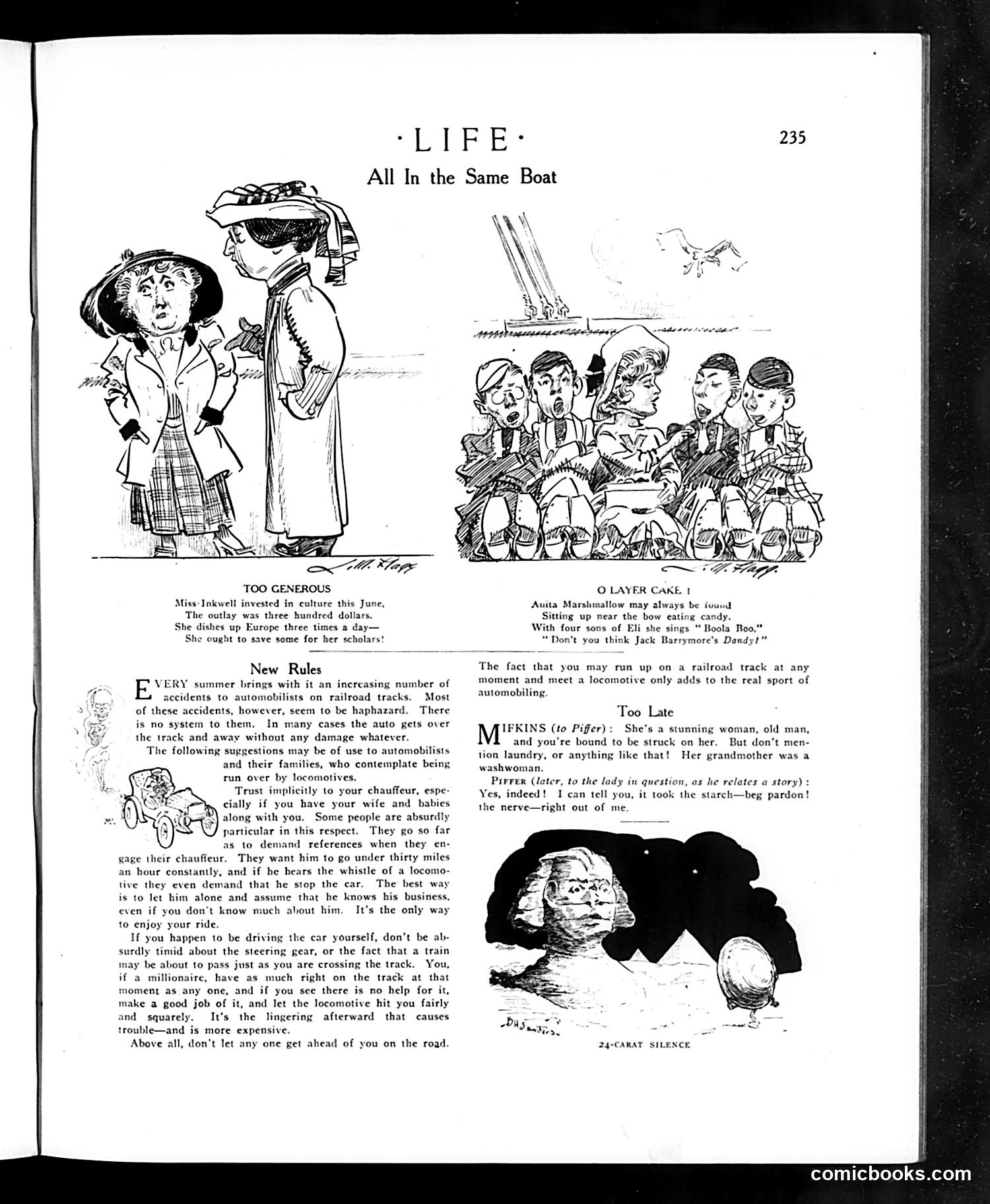
This page contains three satirical cartoons about early automobile culture: **"Too Generous"** mocks Miss Inkwell's extravagant spending on a new car—she invests heavily but tries to economize elsewhere, even limiting scholars' grants. **"All in the Same Boat"** depicts children crowded dangerously near a ship, captioned about layer cake and candy—satirizing parents' reckless behavior transporting children by car near railroad tracks. **"New Rules"** is a substantial essay advising automobile owners on safety etiquette: trust your chauffeur, don't demand excessive speed, avoid confrontations with trains, and crucially, "let no one get ahead of you on the road"—the last point delivered with ironic humor. **"Too Late"** shows a woman struck by a train, referenced through Kipling's story about a washerwoman's grandmother. The cartoons address early 1900s automobile safety anxieties and driving culture.
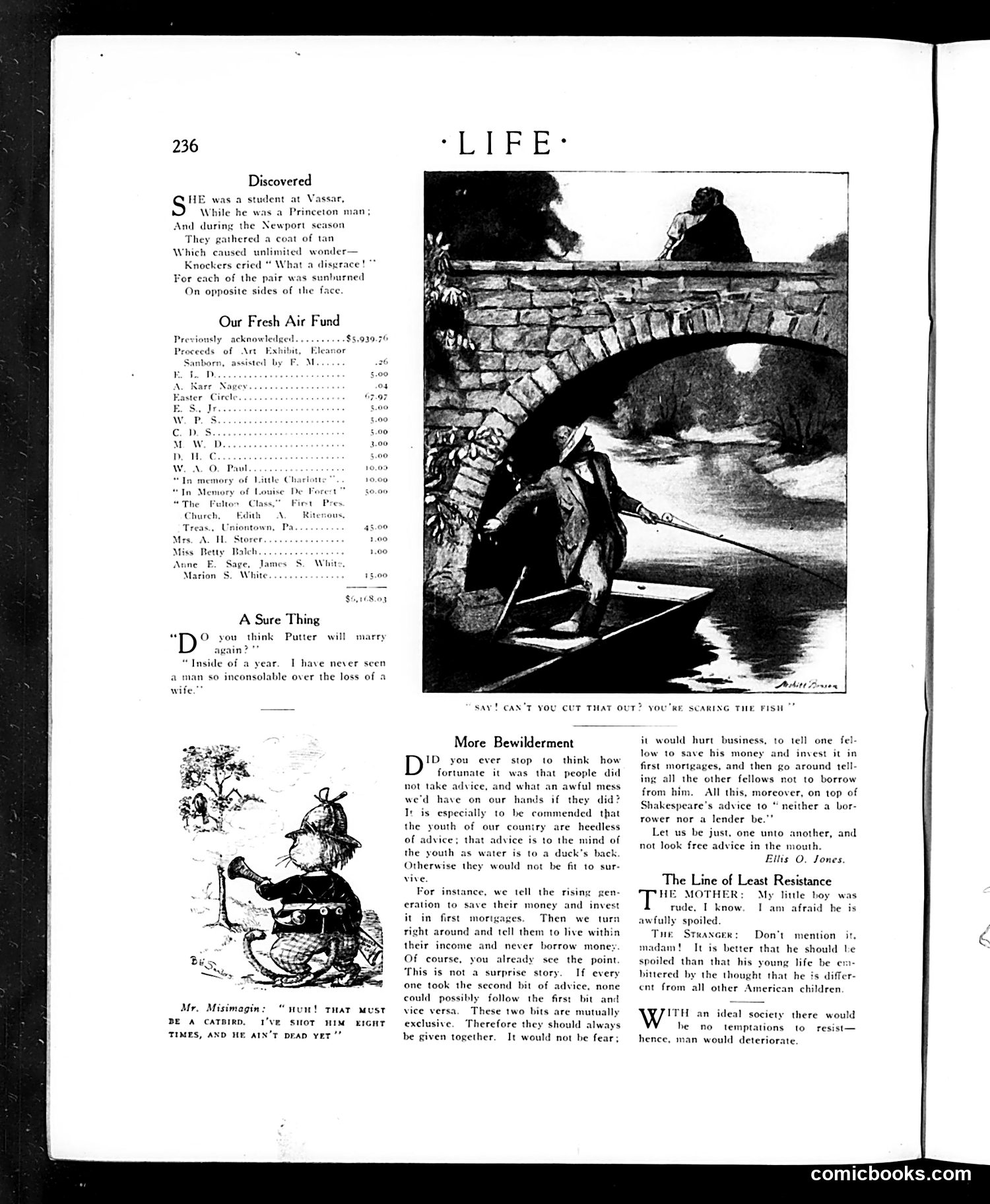
This page contains several satirical pieces rather than a single unified cartoon. The main illustration shows a fisherman under a stone bridge with the caption "SAY! CAN'T YOU CUT THAT OUT? YOU'RE SCARING THE FISH" — a straightforward joke about someone's behavior disrupting fishing. Below is a cartoon of a man labeled "Mr. Mistemagic" with the caption "HUH! THAT MUST BE A CATBIRD. I'VE SHOT HIM EIGHT TIMES, AND HE AIN'T DEAD YET" — likely satirizing either poor marksmanship or the difficulty of eliminating persistent problems. The text sections ("A Sure Thing," "More Bewilderment," "The Line of Least Resistance") appear to be humorous advice columns offering satirical commentary on marriage, finances, and child-rearing — typical of Life magazine's social satire from this era. The "Fresh Air Fund" listing shows charitable donations.
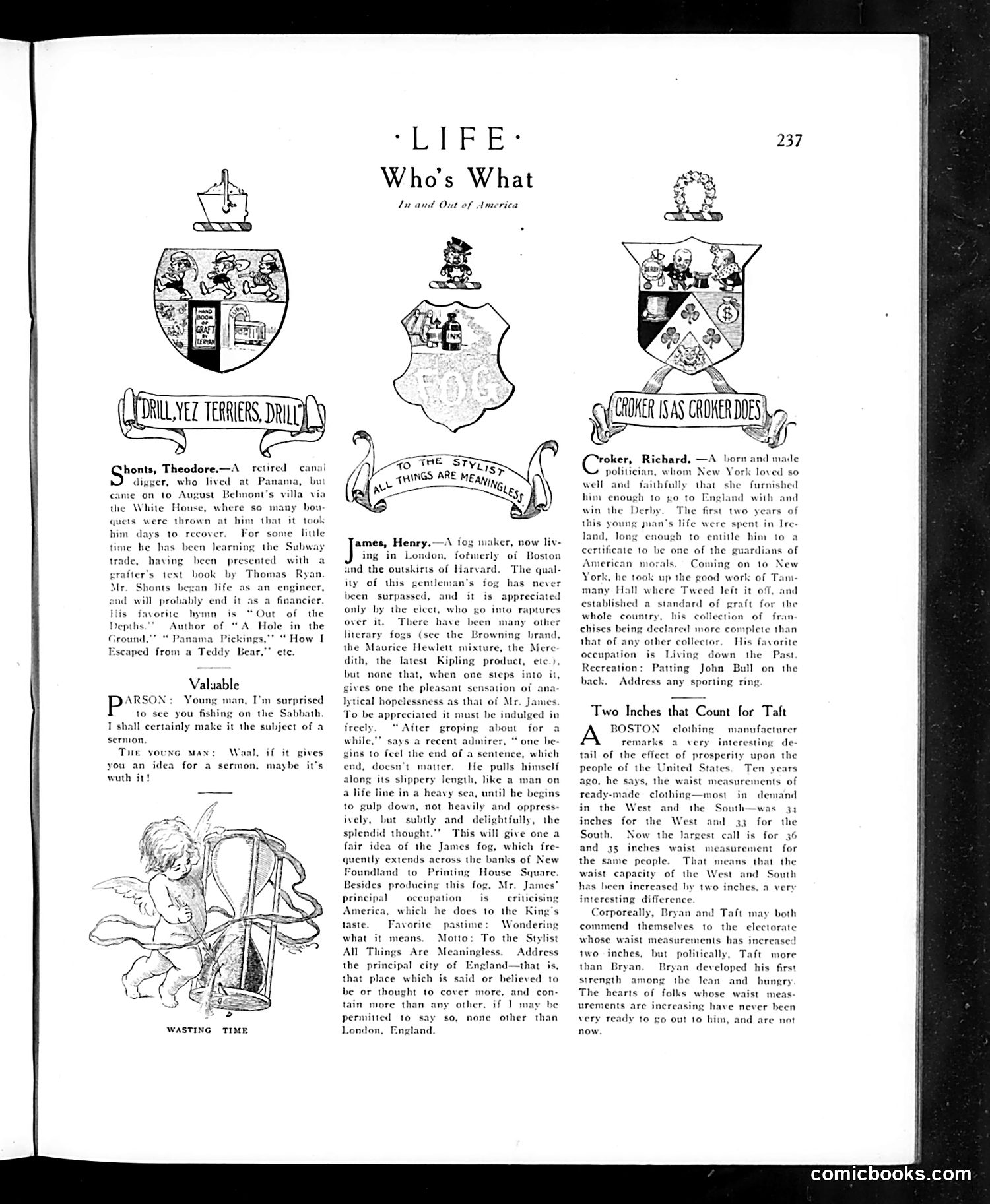
This is a satirical biographical page featuring prominent Americans. The visible entries include: - **Shodts, Theodore**: A retired canal digger from Panama who came to the White House, where many bouquets were thrown at him; the article humorously notes he needed days to recover. - **James, Henry**: A log-booker from Boston, described as creating a famous literary "fog" (likely referencing his notoriously dense writing style). The satire mocks his obscure prose. - **Croker, Richard**: A New York politician described as furnishing his Ireland home with Hall furniture and establishing a sporting record. The page's humor derives from mixing genuinely notable figures with exaggerated or absurd biographical details, poking fun at their public personas and reputations.
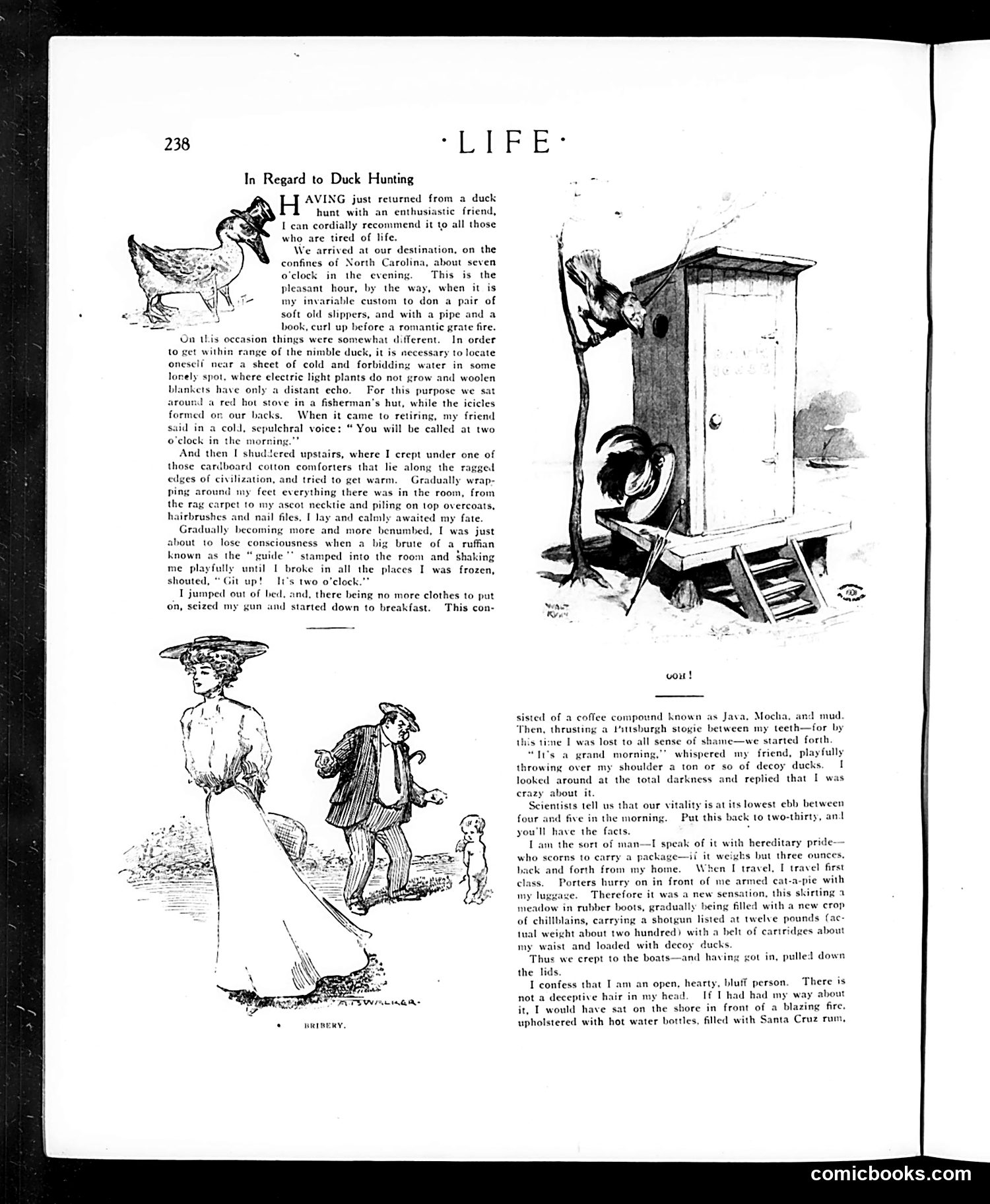
This humorous essay mocks the absurdity of duck hunting as a leisure activity. The narrator, a comfort-loving gentleman accustomed to slippers, pipes, and firesides, is dragged into an ordeal of pre-dawn cold, inadequate accommodations, and physical misery in North Carolina's swamps. The satire targets masculine pride and the social pressure to participate in "manly" pursuits. The narrator repeatedly emphasizes his aversion to discomfort—he refuses to carry luggage, prefers first-class travel, yet finds himself carrying a twelve-pound shotgun while wearing rubber boots in freezing darkness. The illustrations show genteel Victorian figures (labeled "Archery" and "Archery") contrasting with the hunting scene, suggesting the gap between refined leisure and brutal outdoor realities. The essay's repeated refrain that duck hunting is recommended "to all those who are tired of life" frames the activity as essentially suicidal misery disguised as sport.
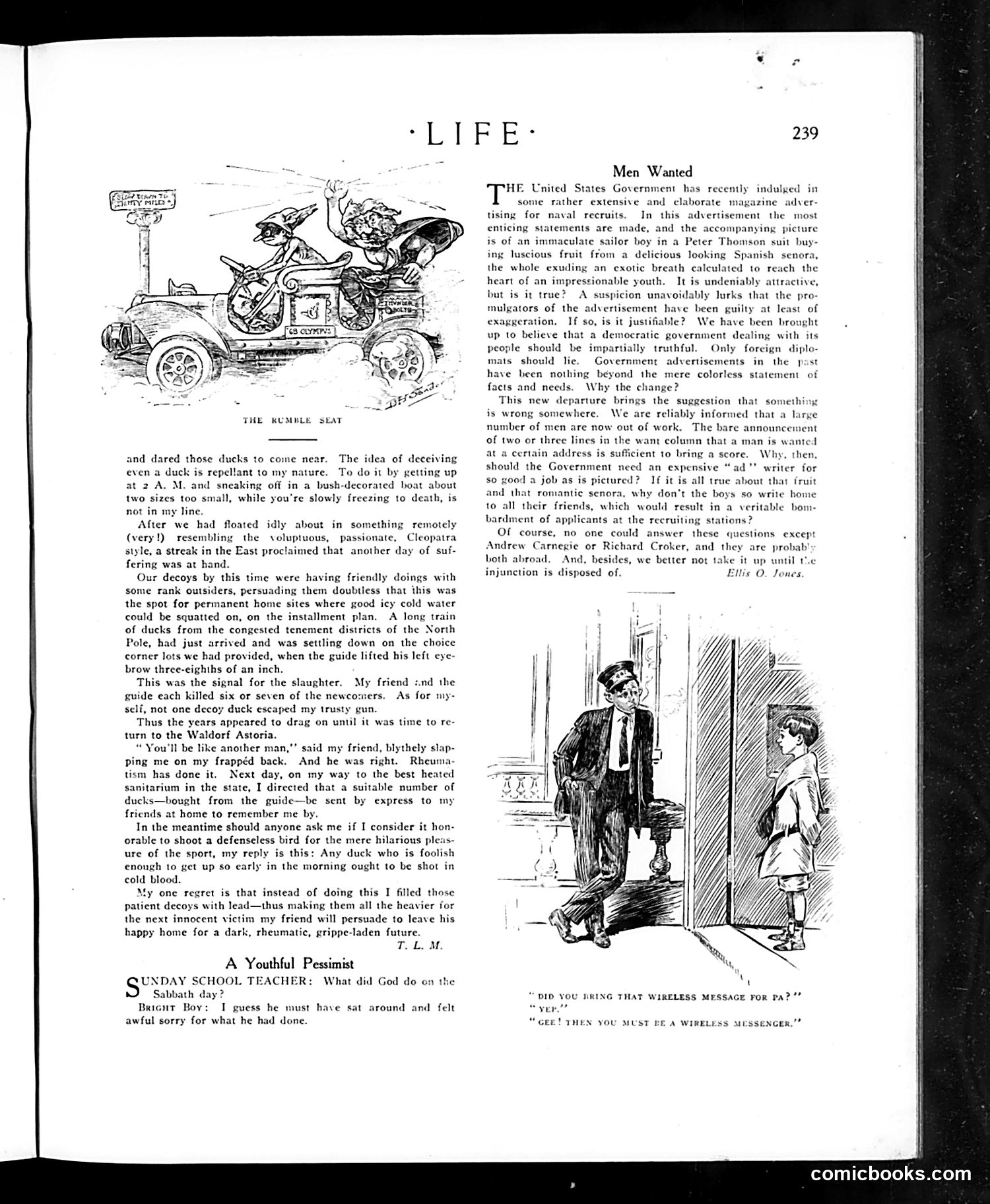
This page contains three satirical pieces from *Life* magazine: **"The Rumble Seat"** (left): A humorous hunting narrative mocking the writer's failed duck-hunting expedition. The joke centers on his self-righteous refusal to deceive ducks, yet he kills them anyway—then justifies shooting defenseless birds because they're "foolish enough to get up so early." **"Men Wanted"** (right): Social commentary criticizing U.S. Navy recruitment advertising. The article argues the government's elaborate, romanticized ads (showing sailors buying fruit from Spanish women) are unnecessarily expensive propaganda. The satire's point: if jobs are truly scarce (implied by unemployment), the Navy shouldn't need fancy advertising—simple want-ads would bring applicants. The government's shift from factual recruitment to elaborate "ads" suggests either dishonesty or unnecessary spending. **"A Youthful Pessimist"** (bottom): A one-liner joke where a Sunday school boy suggests God regretted creation itself—dark humor about the human condition.
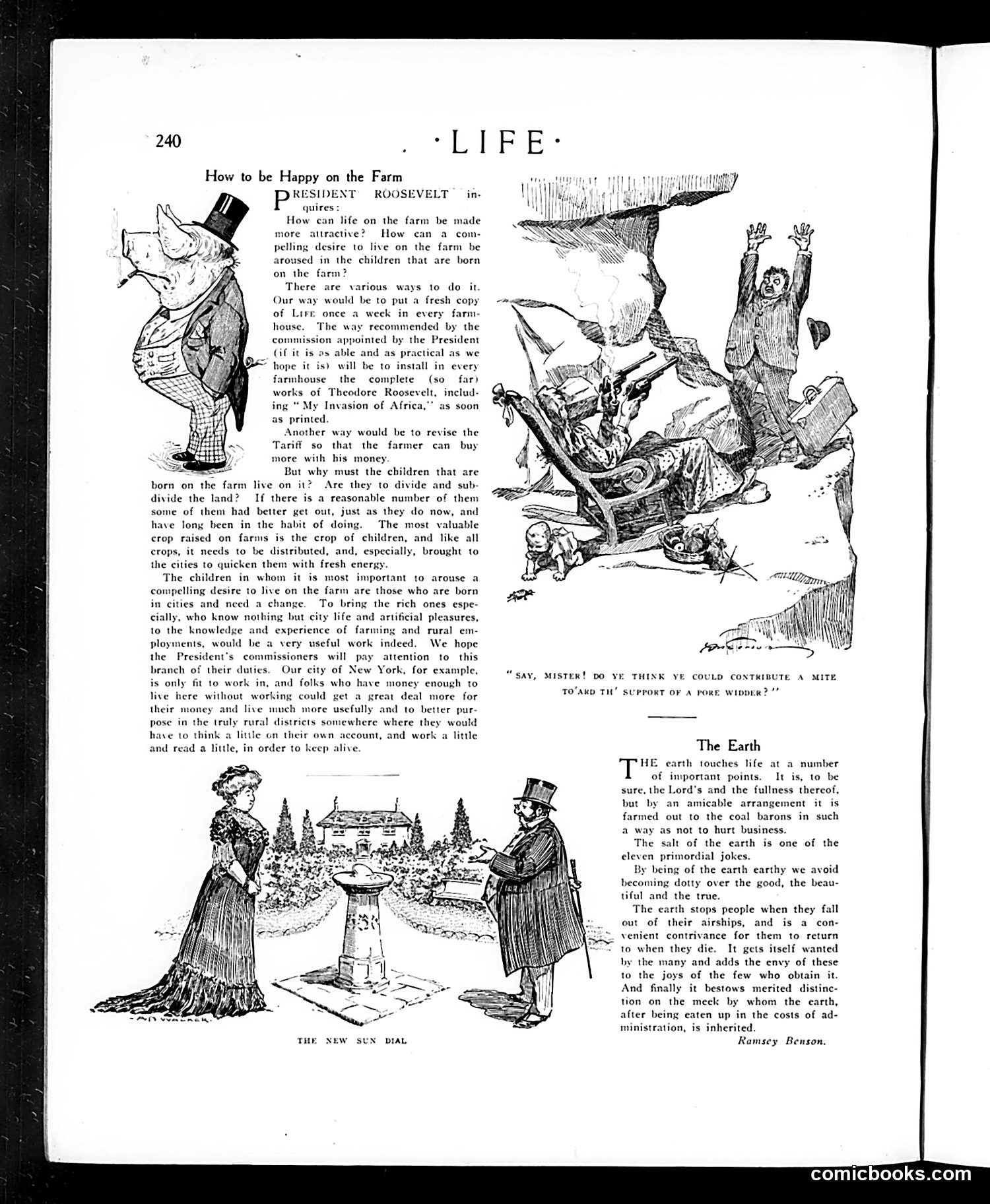
This page mocks President Roosevelt's commission on farm life. The top article sarcastically proposes installing Roosevelt's complete works (including "My Invasion of Africa") in farmhouses to make rural life attractive—a jab at Roosevelt's self-promotion and prolific writing. The satire's actual point: Life argues that children *should* leave farms for cities (the "most valuable crop" needs distribution), contradicting Roosevelt's goal. The magazine suggests instead bringing wealthy city children to farms for character-building work—inverting the administration's actual concern. "The Earth" section below offers cynical aphorisms about land ownership, mocking how coal barons control earth while claiming divine right, and how the wealthy monopolize property while the poor merely inherit dust. The tone throughout is skeptical of both Rooseveltian progressivism and capitalist exploitation.
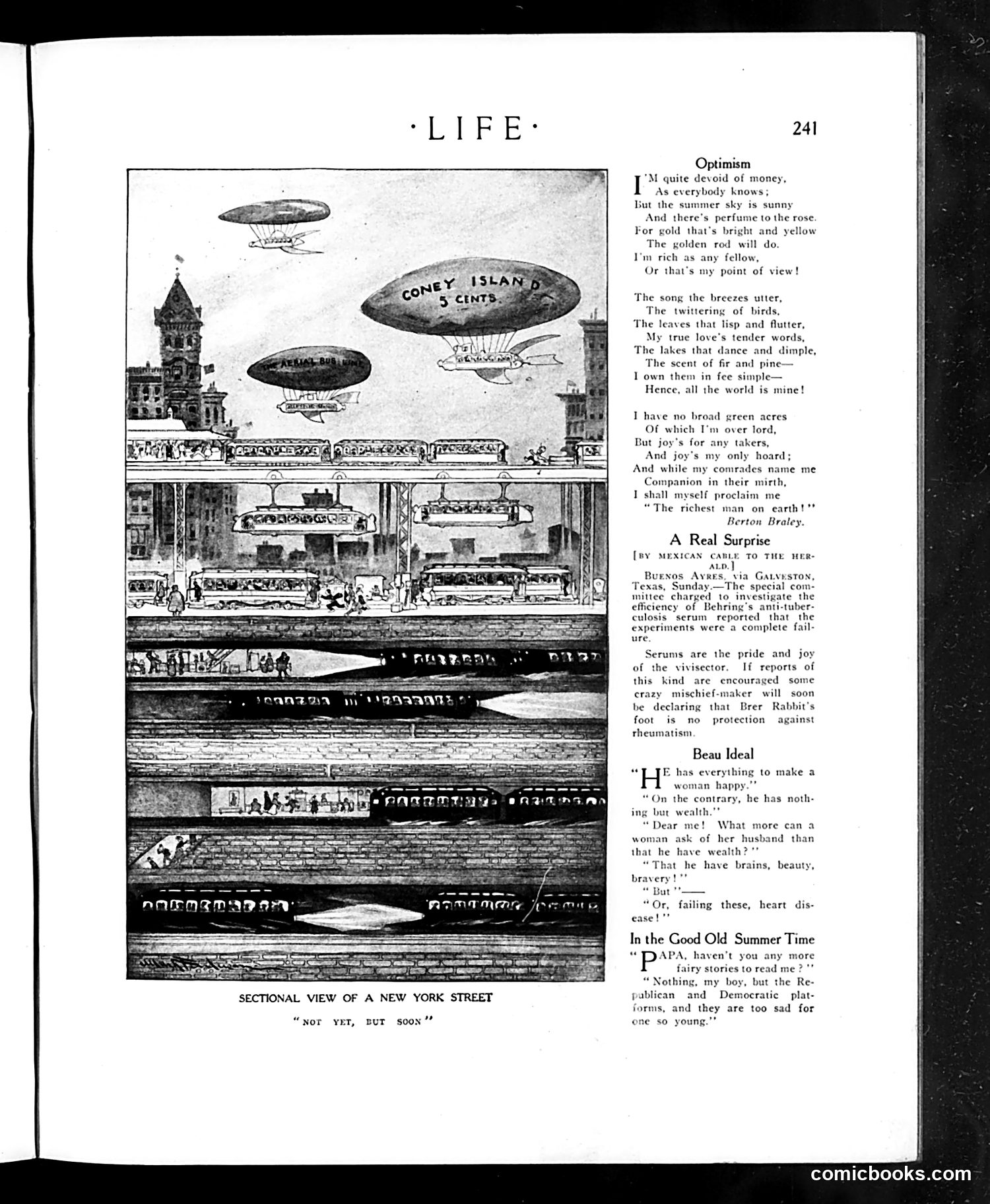
This page contains three satirical pieces reflecting early 20th-century concerns: **Main Image:** A futuristic cross-section of a New York street shows multiple transportation layers—aerial vehicles (appearing to be early airships), elevated trains, and ground-level transit. Caption reads "Not Yet, But Soon," satirizing predictions of urban congestion and technological overcrowding. **"Optimism" poem (by Berton Braley):** A romantic verse celebrating non-material wealth—nature, love, and joy—as superior to money. It's satirizing both wealthy materialism and sentimental idealism about contentment without riches. **"A Real Surprise":** Mocks anti-tuberculosis serum research, suggesting such medical advances frequently fail despite the vivisectionists' (animal researchers') pride in them. **"Beau Ideal" and "In the Good Old Summer Time":** Brief domestic humor dialogues critiquing marriage expectations and political platforms as unsuitable entertainment for youth. The page reflects turn-of-the-century anxieties: rapid urbanization, scientific limitations, and cultural disillusionment.
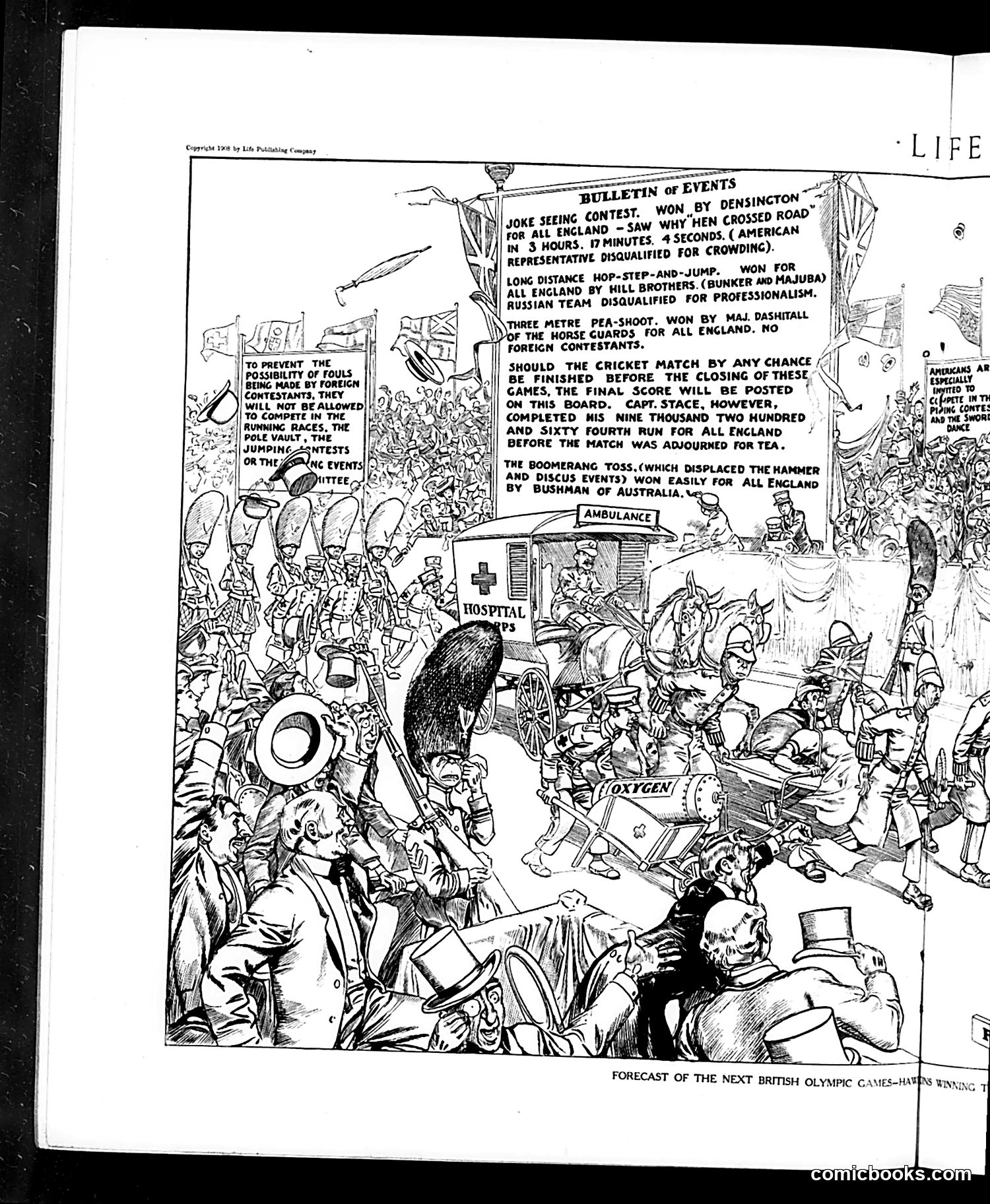
This 1908 Life cartoon satirizes the upcoming British Olympic Games through absurdist humor about international athletic competition. The elaborate "Bulletin of Events" describes deliberately ridiculous contest outcomes: - An American representative is disqualified for "crowding" in a race - Russian athletes are disqualified for "professionalism" - British competitors dominate through increasingly absurd events (a "three metre pea-shoot," "boomerang toss") - A cricket match threatens to run indefinitely, with scores posted on a board The satire mocks British athletic superiority claims and Olympic nationalism, suggesting Britain will rig competitions or create absurd rules favoring their athletes. The chaotic crowd scene depicts the spectacle's disorder. This reflects contemporary tensions over amateur versus professional athletics and national pride in international competition—themes central to early Olympic Games politics.
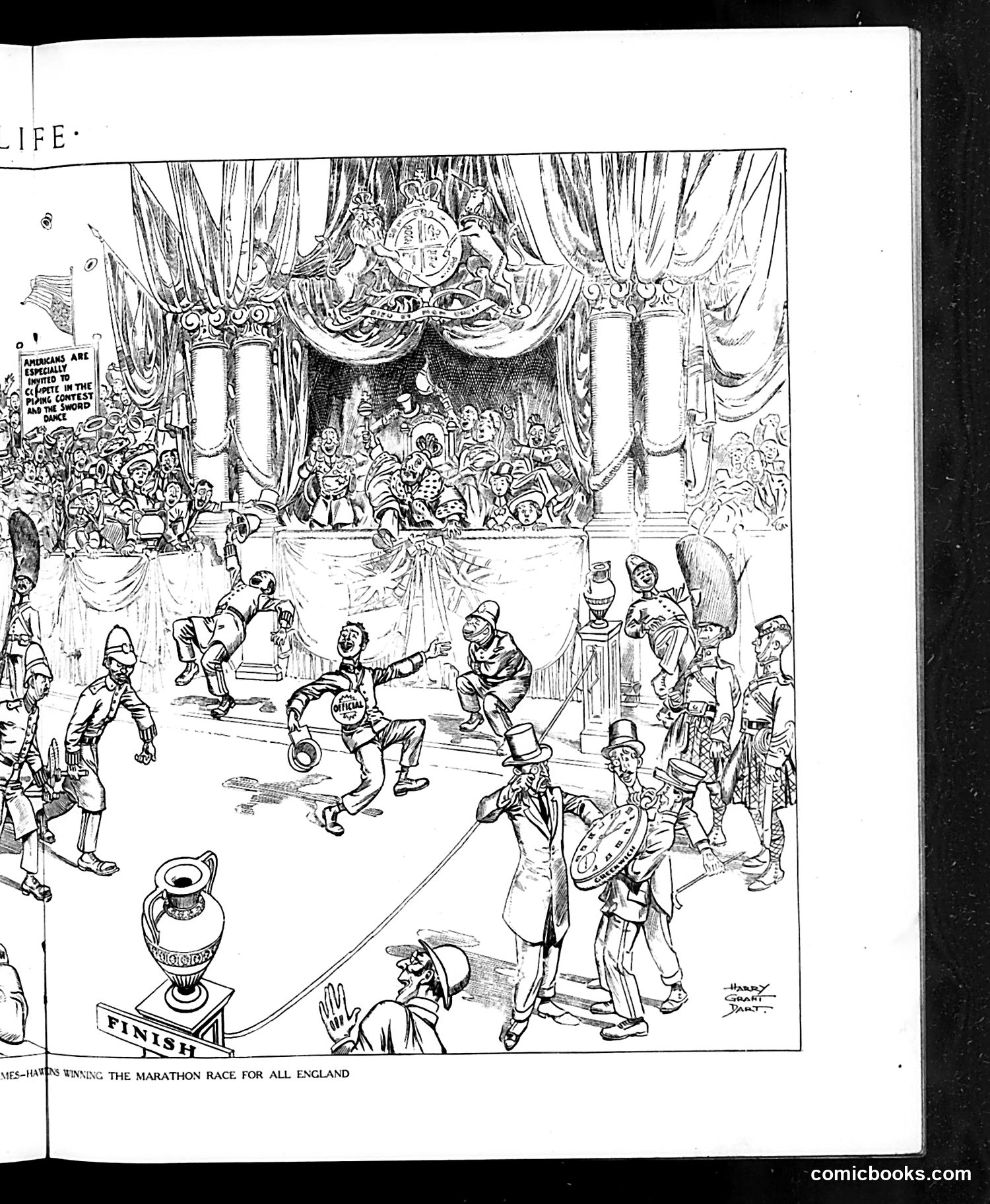
This satirical cartoon depicts a marathon race at what appears to be an official British venue, complete with grandstands, dignitaries, and a "FINISH" line marked by a classical urn. The caption references "Americans winning the marathon race for all England." The satire likely comments on American cultural or economic dominance over Britain—a common theme in early 20th-century Life magazine. The elaborate British ceremonial setting contrasts with the apparent American victory, suggesting anxiety about American ascendance replacing British preeminence. The text box on the left mentions Americans are "especially invited to compete in the games," possibly indicating a sporting event or metaphorical competition for cultural/political influence. Without the specific date or additional context, the exact historical reference remains unclear, though this reflects broader Anglo-American rivalry anxieties of that era.
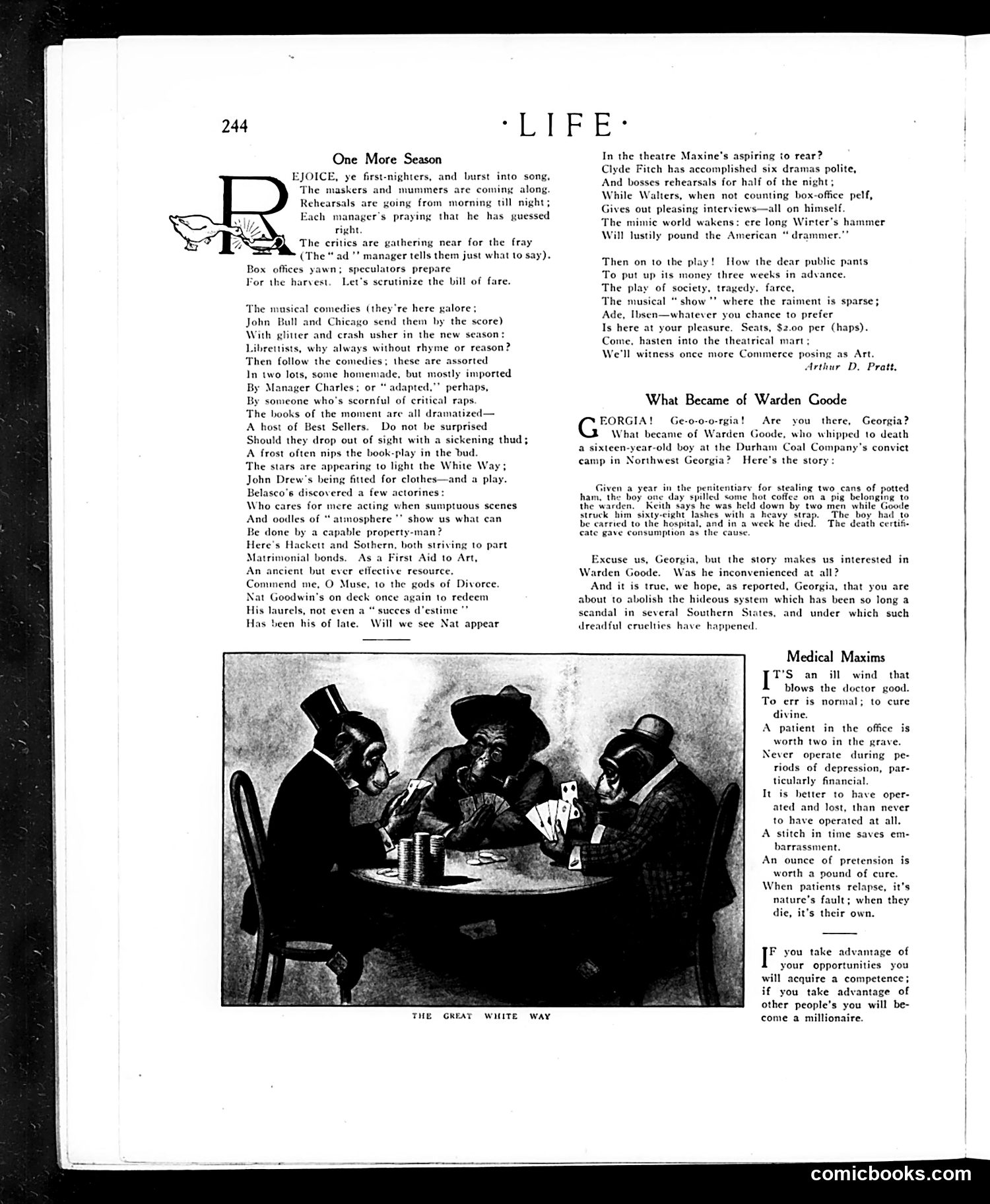
This page from Life contains three distinct pieces of satirical content: **"One More Season"** (poem by Arthur D. Pratt): A theatrical season preview mocking Broadway's commercialism. It satirizes imported musicals, dramatized bestsellers that flop, and stars like John Drew and Nat Goodwin. The recurring jab is that "Commerce" poses as "Art"—producers prioritize spectacle and profit over genuine artistry. **The cartoon "The Great White Way"**: Depicts three men in top hats gambling at cards, representing the theatrical industry's gambling mentality toward productions. **"What Became of Warden Goode"**: Exposes a brutal true crime case where a Georgia prison warden fatally whipped a sixteen-year-old boy for spilling coffee. Life pointedly questions whether the warden faced any real consequences, calling for reform of Southern convict labor systems. **"Medical Maxims"**: Humorous aphorisms mocking doctors' profit motives and ethical shortcuts—"A patient in the office is worth two in the grave" and "An ounce of pretension is worth a pound of cure."
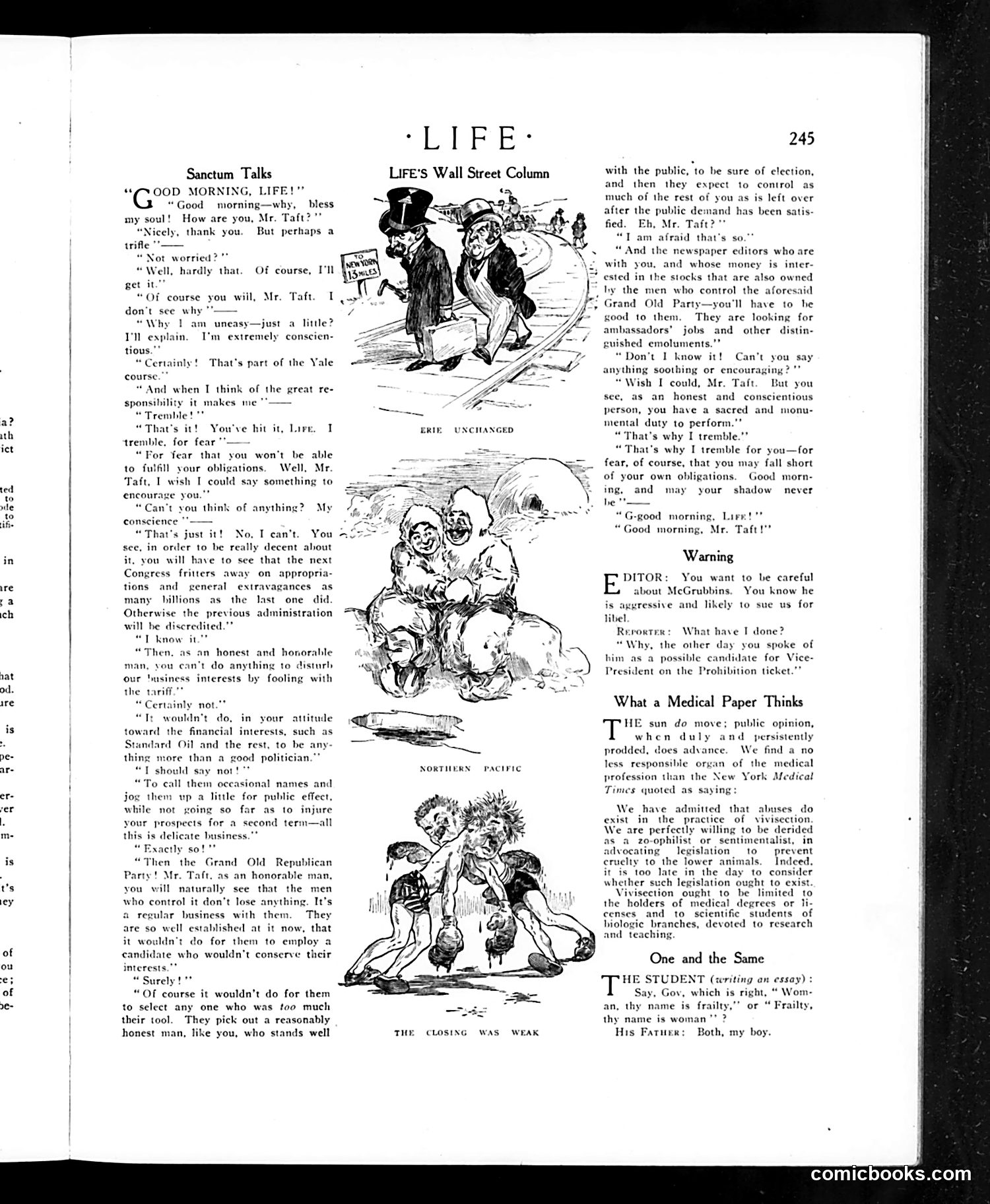
This page satirizes President William Howard Taft's political compromises and moral conflicts. The "Sanctum Talks" dialogue features a cynical editor explaining to an anxious Taft that, despite being "an honest and honorable man," he must compromise his conscience by: - Allowing Congress wasteful spending to discredit his predecessor - Protecting Standard Oil and financial interests rather than truly reforming them - Controlling Republican Party machine interests - Favoring newspaper editors with ambassadorships The cartoons (Erie Unchanged, Northern Pacific, The Closing Was Weak) appear to be financial satire about railroad stocks—industries Taft was supposed to regulate but allegedly wouldn't challenge. The "Warning" section mocks potential libel suits from aggressive figures like McGrubbins, while "What a Medical Paper Thinks" discusses vivisection ethics. The overall point: Taft, despite personal integrity, was trapped by political realities requiring him to serve wealthy interests over reform—a critique of his perceived weakness compared to Theodore Roosevelt.
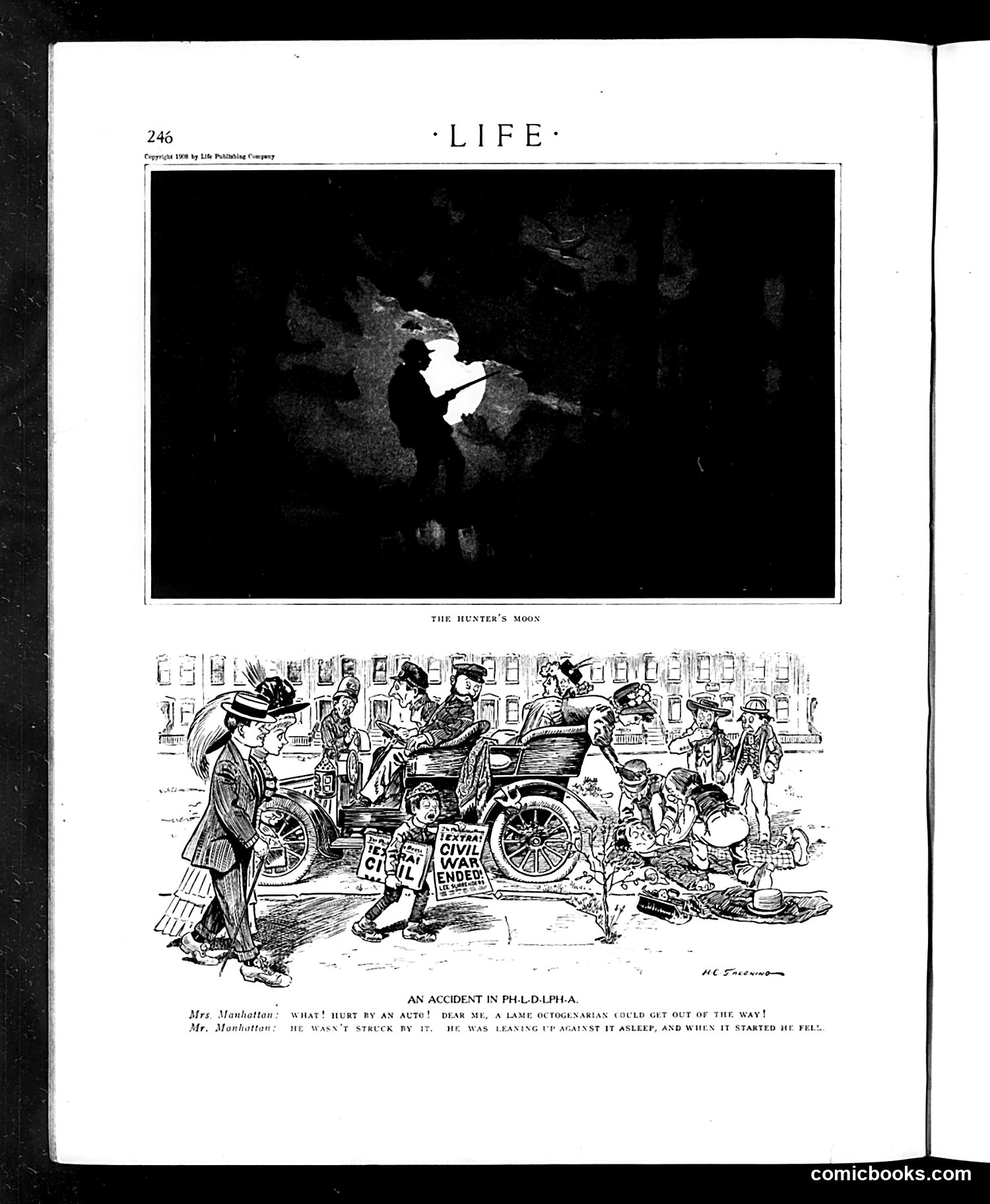
This page contains two satirical pieces from Life magazine (circa 1908, based on the copyright date). **"The Hunter's Moon"** (top): A silhouetted photograph showing a figure reading by moonlight, likely commenting on leisure or intellectual pursuits. **"An Accident in Ph-L-D-LPH-A"** (bottom): A cartoon mocking Philadelphia's chaotic streets and reckless automobile culture. The joke: A man wasn't *hit* by a car—he was merely *leaning asleep against* a parked automobile when it started moving, causing him to fall. Mrs. Manhattan's quip about "a lame octogenarian" getting out of the way sarcastically highlights how dangerous early automobiles were in crowded city areas. The cartoon ridicules both the proliferation of cars and pedestrians' casual disregard for traffic hazards during the early automotive era.
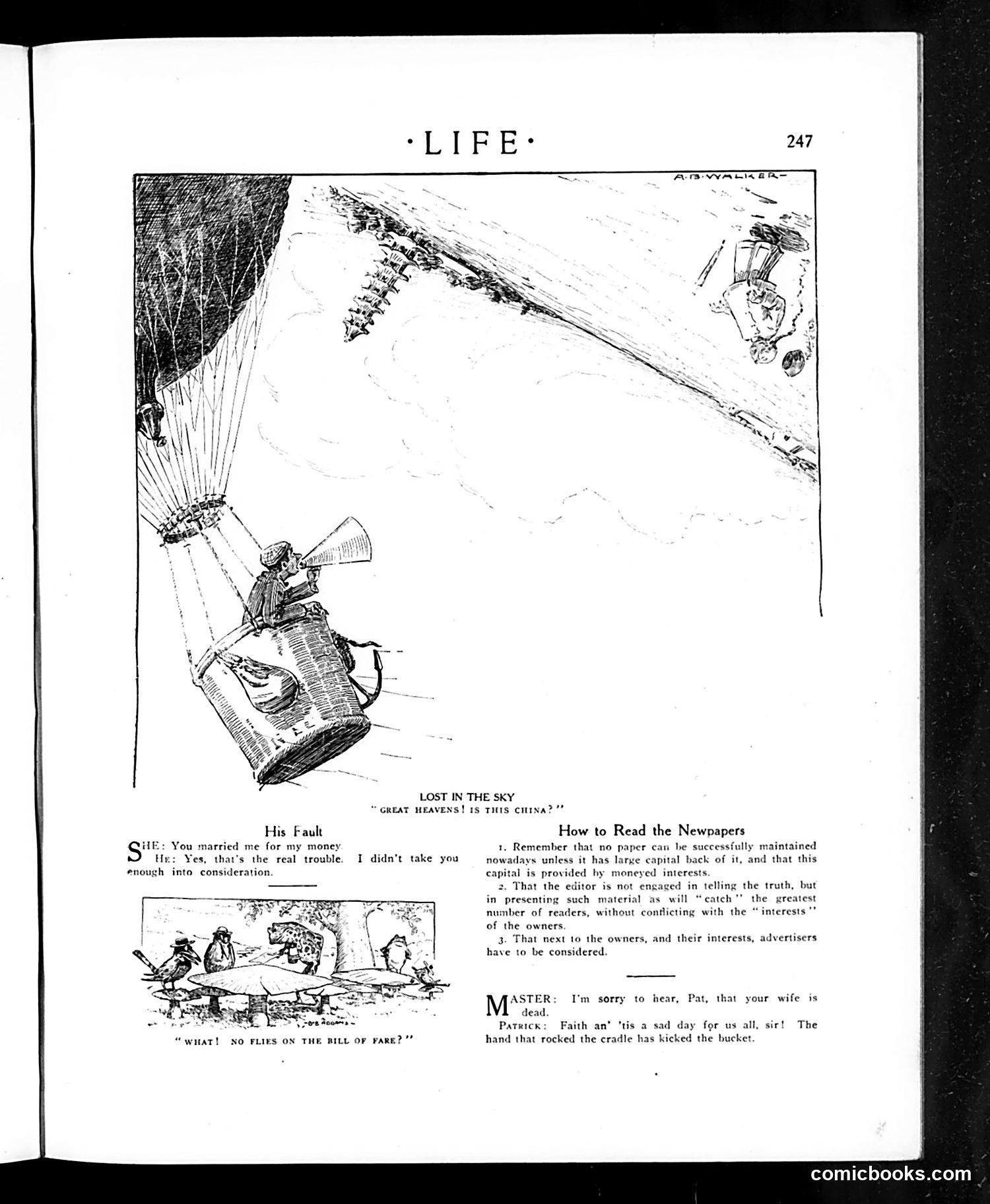
**Top Cartoon ("Lost in the Sky"):** An airship passenger asks "Great Heavens! Is this China?" while lost in clouds. This appears to reference early aviation mishaps or the novelty/confusion of air travel, likely mocking either incompetent pilots or the bewilderment of early flying experiences. **Middle Comics:** Two brief domestic humor strips—one about a wife marrying for money, another Irish-dialect joke about a man's wife's death ("hand that rocked the cradle has kicked the bucket"). **"How to Read the Newspapers" Section:** This is satirical instruction explaining newspaper economics cynically: papers are funded by moneyed interests, editors prioritize reader-grabbing content over truth, and advertisers' interests matter more than public information. This reflects Progressive Era skepticism about newspaper reliability and corporate influence—a pointed critique that newspapers aren't objective sources but profit-driven enterprises beholden to wealthy owners and advertisers.
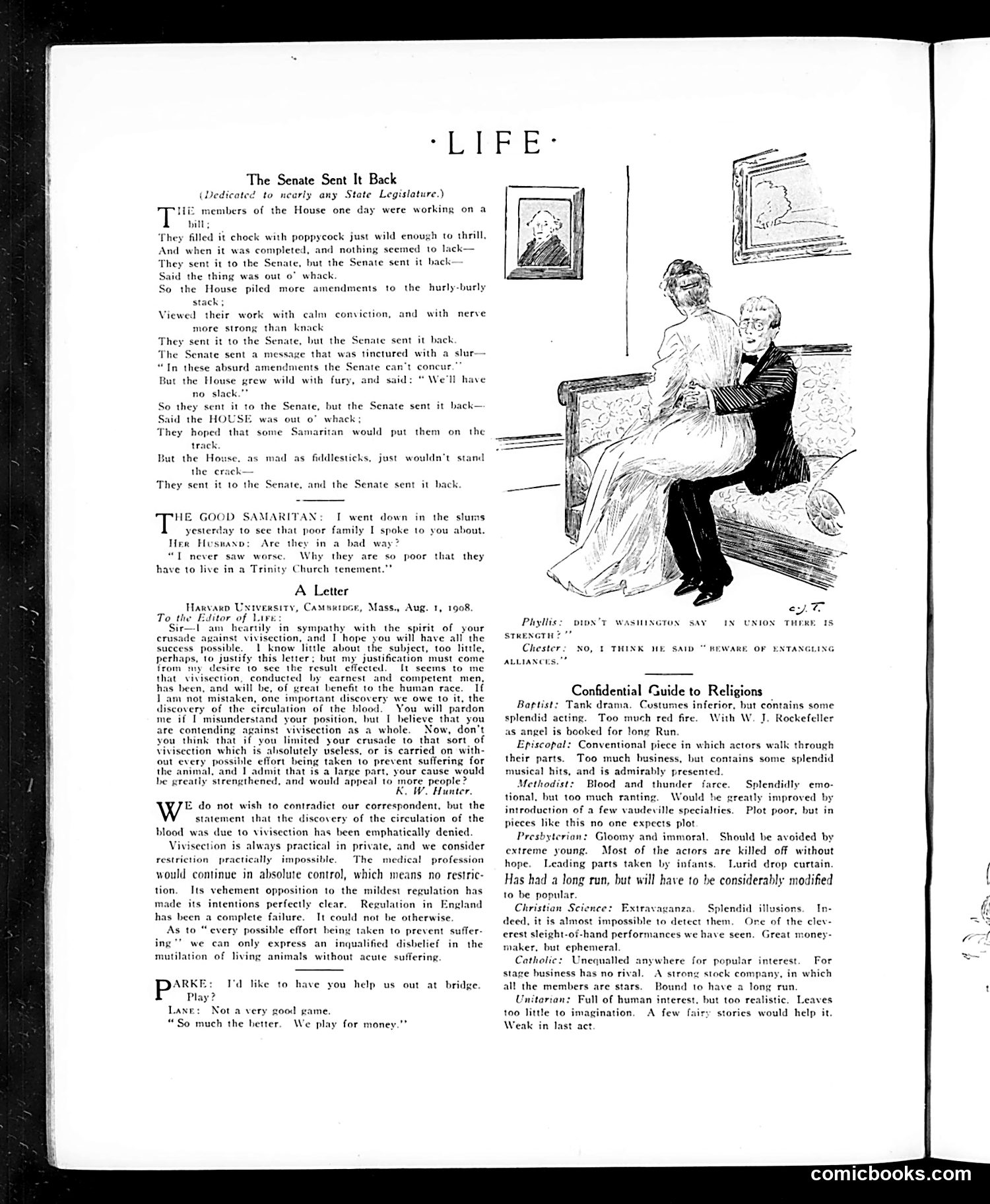
**"The Senate Sent It Back"** is a humorous poem mocking legislative gridlock. It depicts the House passing a poorly-drafted bill ("poppycock") which the Senate repeatedly rejects. Each chamber blames the other, with neither willing to compromise—a timeless critique of bureaucratic dysfunction applicable to "nearly any State Legislature." **The Illustration** shows two figures in what appears to be a domestic scene, captioned with dialogue about Washington and "entangling alliances"—likely referencing isolationist foreign policy debates of the era (the page is dated 1908). **"Confidential Guide to Religions"** is satirical theater criticism describing different denominations as if they were Broadway productions—Baptist has "splendid acting," Episcopal is conventional, Methodist involves "blood and thunder." This mocks both religious practices and theater culture, treating faith denominations as entertainment spectacles with varying production values. The letter about vivisection (animal testing) represents genuine contemporary debate over medical ethics versus scientific progress.
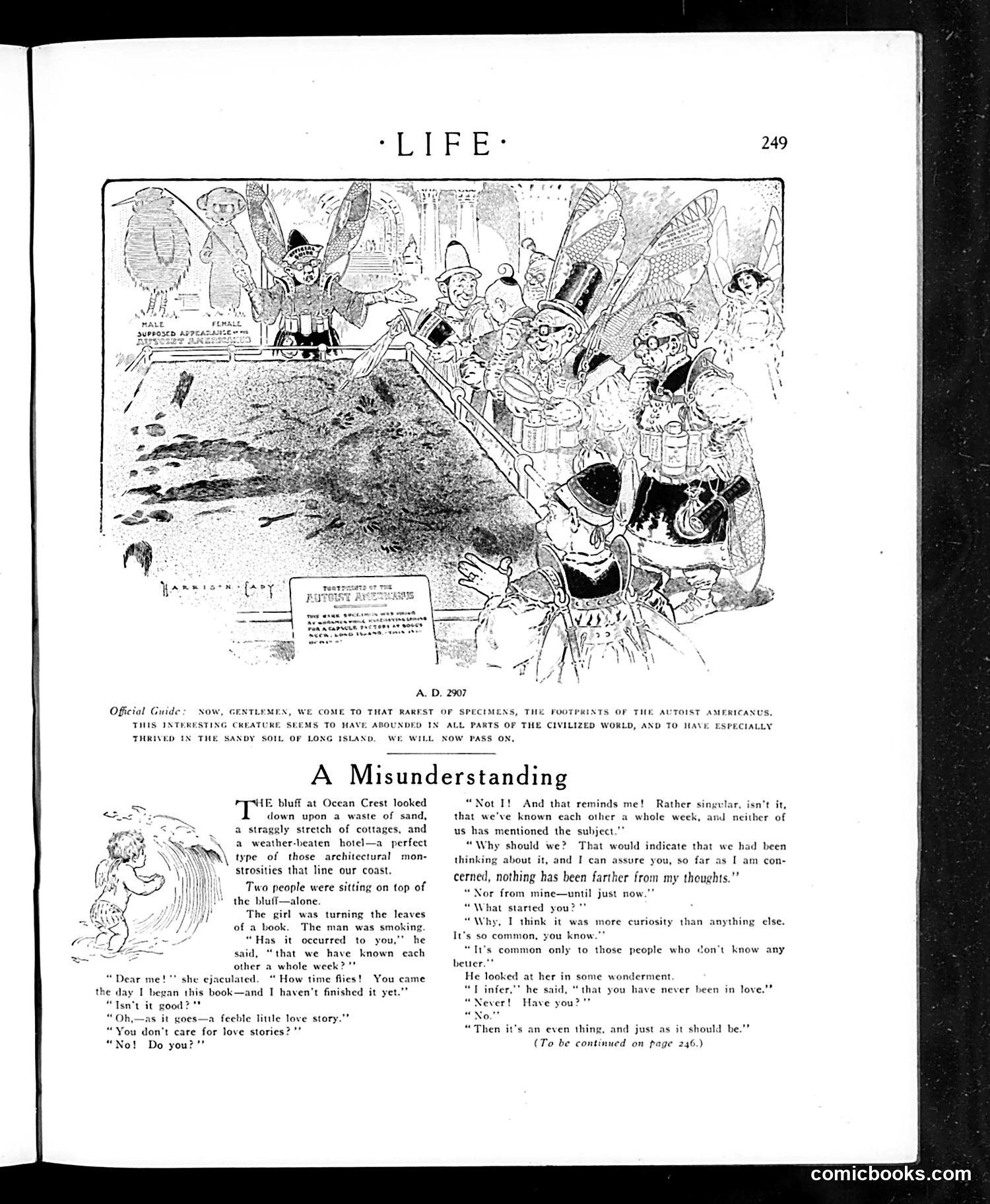
**Top Cartoon:** A satirical "museum exhibit" mocking early American automobile culture. The guide presents fossilized "footprints of the autoist americanus" as if displaying ancient artifacts—a jab at the novelty and rapid proliferation of cars, particularly among wealthy Long Island residents who left visible tracks in sandy soil. The exaggerated museum-exhibit framing suggests automobiles were already reshaping American society in noticeable, almost archaeological ways. **Story: "A Misunderstanding":** A romantic vignette about two young people at a seaside resort who've spent a week together without discussing love—each claiming indifference to the topic. When the man finally mentions it, they playfully deny having thought about it, with the woman dismissing love as "common" to ignorant people. The irony is obvious: their very defensiveness reveals they've *both* been thinking about love all along. It's gentle comedy about youthful romantic pretense and denial.
This page contains serialized fiction—a romantic dialogue between a man and woman debating whether to pursue a relationship. There are **no political cartoons visible** on this page. The text presents an early 20th-century social commentary through their conversation: both characters rationalize avoiding marriage using "modern" logic—career ambitions, financial independence, and urban bachelor/bachelorette lifestyles. The man argues that contemporary conditions make marriage unsuccessful; the woman agrees, citing settlement work and social good as fulfilling alternatives. The subtle satire targets the era's emerging "New Woman" ideology and modern attitudes toward romance. Their carefully logical arguments about love are undermined by their growing anxiety about accidentally falling for each other—suggesting that despite rational self-interest, human emotion remains unpredictable and threatening to their independence. This reflects Progressive Era tensions between traditional romance and modern, individualistic values.
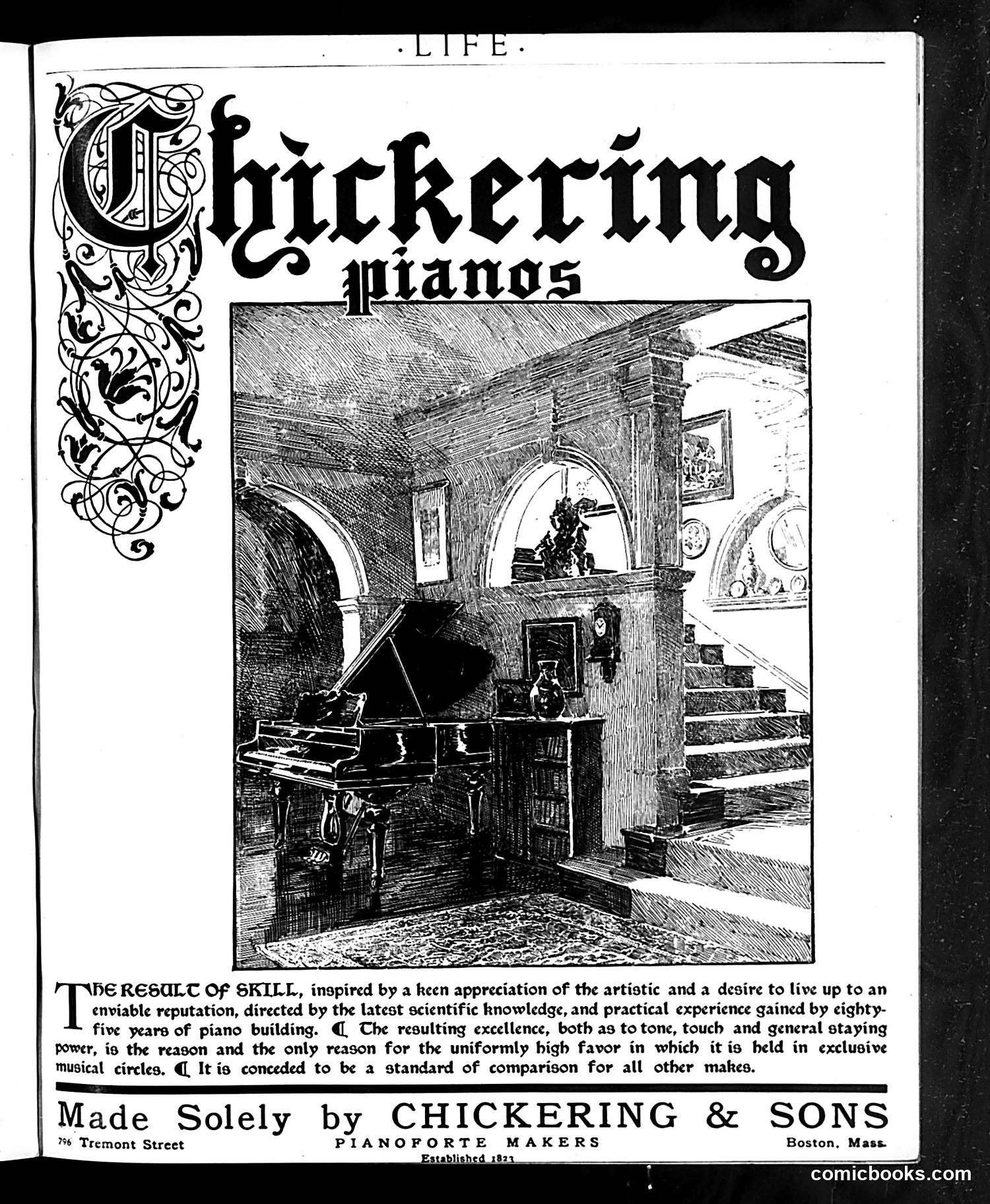
This is **not a cartoon or satire**, but rather a **full-page advertisement** for Chickering & Sons pianos, a Boston-based manufacturer established in 1823. The image shows an elegant interior with a grand piano, emphasizing the instrument's place in refined, "exclusive musical circles." The advertisement's text makes claims typical of late 19th/early 20th-century product marketing: the piano represents "skill," "scientific knowledge," and "eighty-five years of piano building," making it a standard by which competitors are judged. There is no political commentary or satirical content here—this is straightforward advertising aimed at affluent consumers seeking a prestigious instrument for their homes. The ornate typography and architectural setting reinforce the product's association with wealth and cultural refinement.
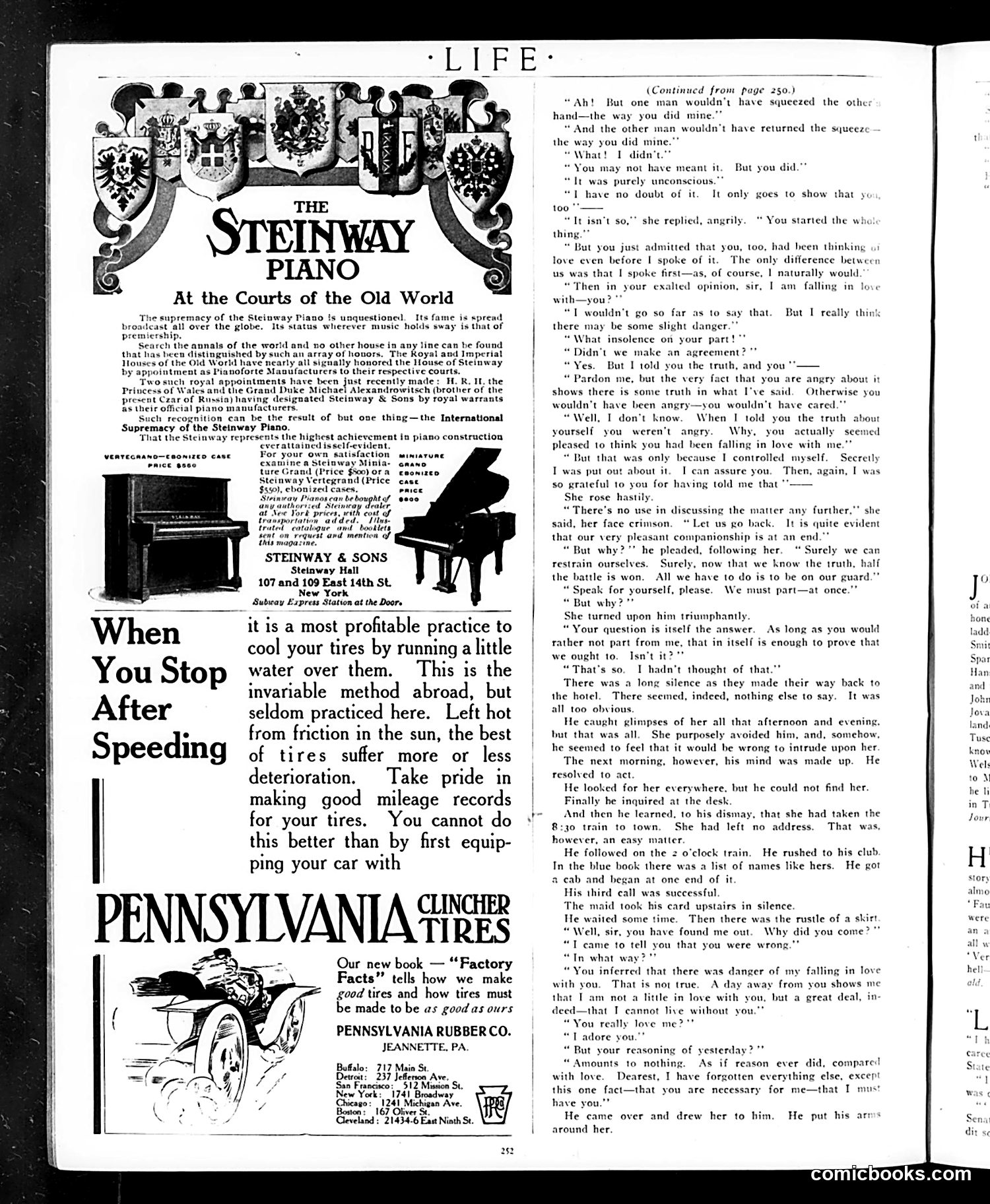
This page combines two distinct elements: **advertisements** and **serialized romantic fiction**. The **ads** promote the Steinway Piano (emphasizing royal court endorsements from European nobility) and Pennsylvania Clincher Tires (advising readers to cool tires with water after speeding to prevent deterioration). The **fiction** (continued from page 250) depicts a romantic couple's tense conversation. A man and woman, having acknowledged mutual attraction, debate whether they should part ways. She argues their "pleasant companionship" must end to avoid impropriety; he pleads they can "restrain ourselves." She prevails by pointing out his reluctance to part proves they *should* separate—a logically triumphant but emotionally hollow victory. This represents typical early-20th-century serialized romance: genteel characters navigating propriety and restrained emotion. The couple's formal language and moral scrupulosity reflect period social expectations about unmarried relationships.
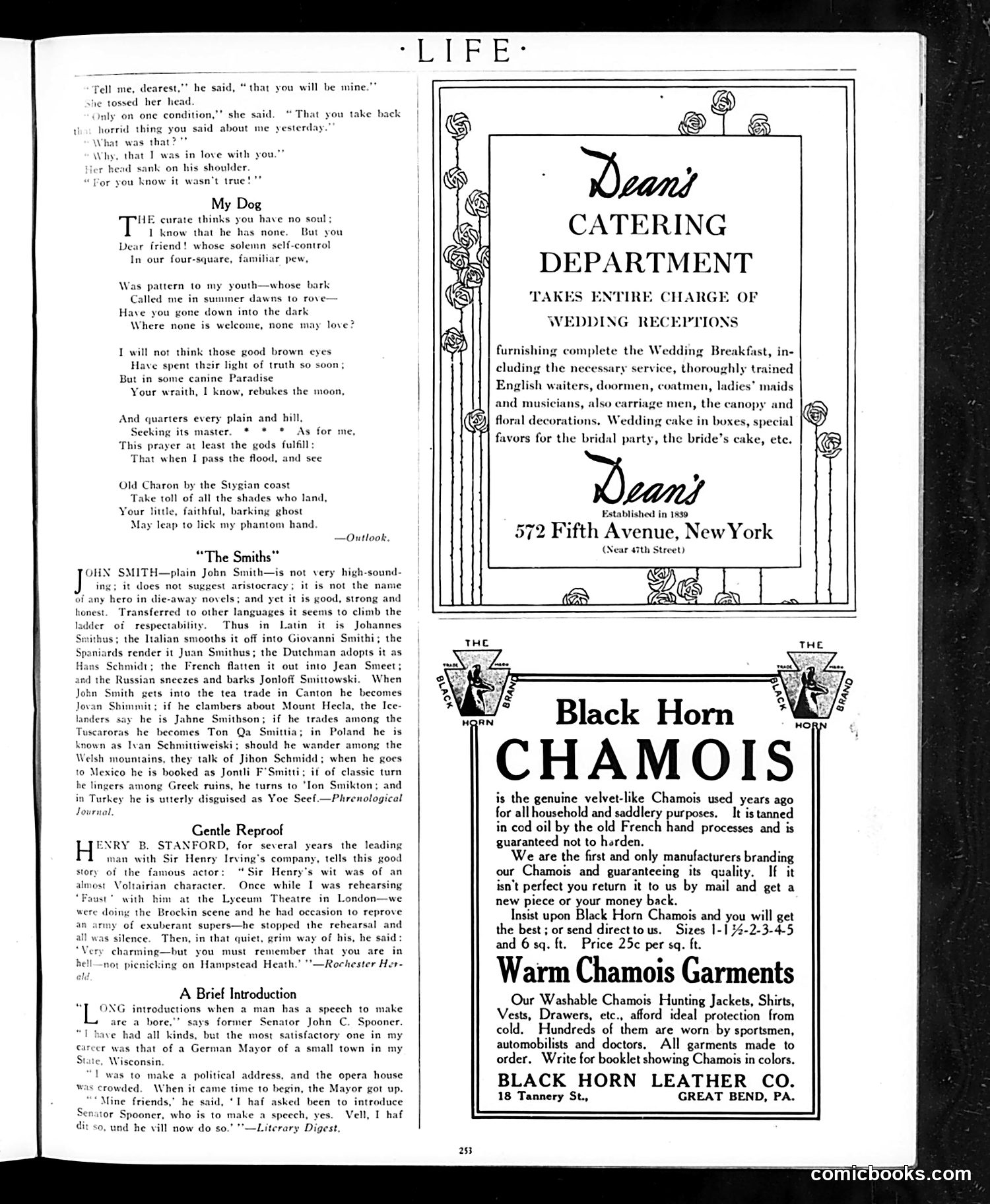
This page from *Life* magazine contains mostly **literary and humorous prose pieces** rather than political cartoons. The content includes: - **"My Dog"**: A sentimental poem about a dog's loyalty and the speaker's hope to reunite with it in the afterlife - **"The Smiths"**: A humorous essay noting how the plain English name "John Smith" sounds more respectable when Latinized or adapted to other languages (Johannes, Giovanni, Juan, etc.) - **"Gentle Reproof"**: An anecdote about actor Henry Irving's wit, where he rebukes theatrical extras for over-acting during a Hell scene - **"A Brief Introduction"**: A joke about a German-American mayor's hilariously brief introduction of Senator John C. Spooner The page also contains **advertisements** for Dean's Catering Department and Black Horn Chamois leather goods. There is **no political satire or cartooning here**—instead, the humor derives from wordplay, gentle mockery of human nature, and ethnic/linguistic comedy typical of early 20th-century American magazines.
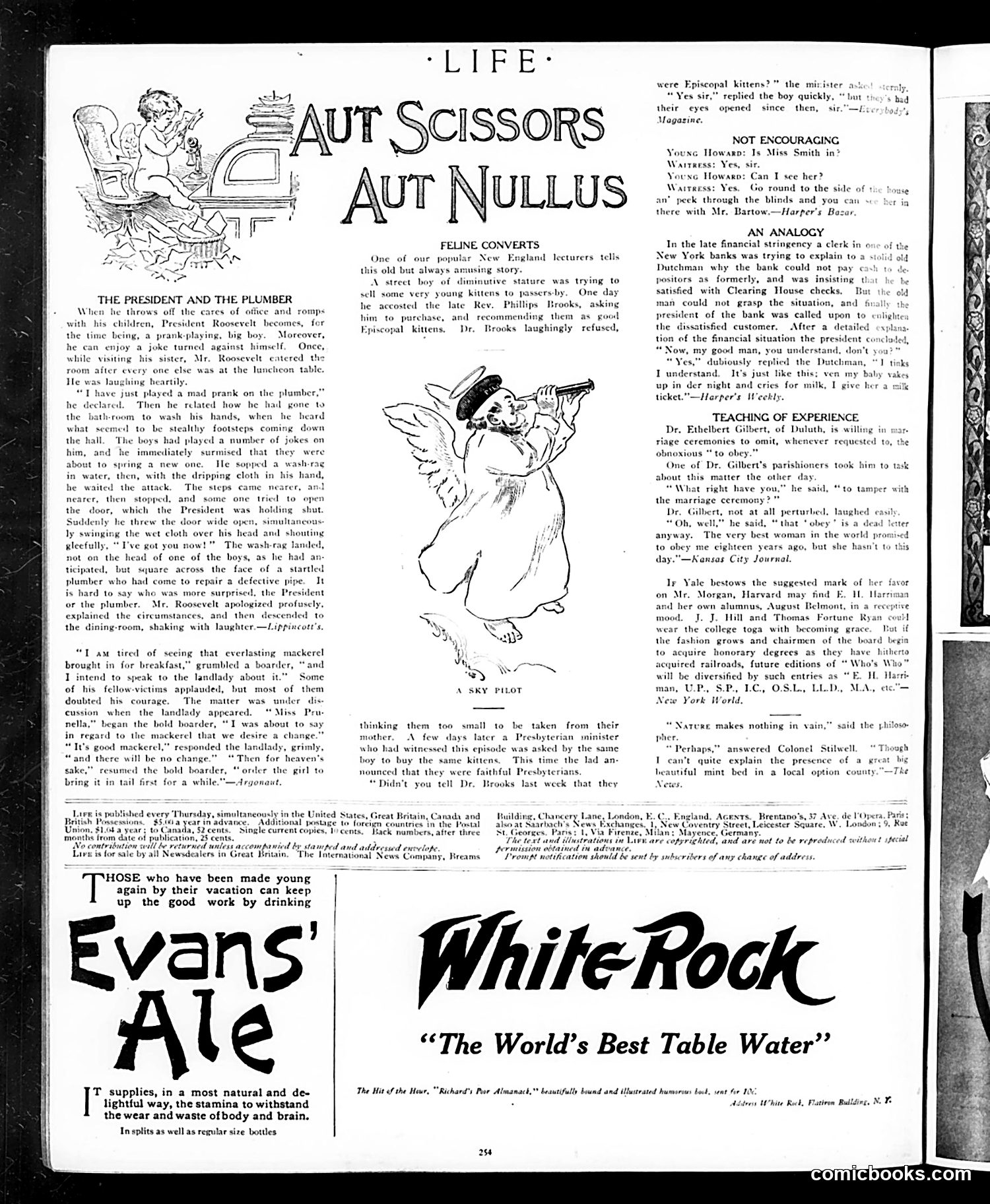
This page from *Life* magazine contains several brief humorous anecdotes and satirical pieces typical of early 20th-century American humor. **"The President and the Plumber"** describes President Theodore Roosevelt playing a practical joke. While visiting his sister, Roosevelt overhears footsteps and, remembering pranks the boys had played on staff, grabs a wet cloth to surprise them. He inadvertently hits an actual plumber making repairs instead, then apologizes. The humor lies in Roosevelt's eagerness to participate in pranks and his good-natured response to the mishap. **"Feline Converts"** recounts Reverend Phillips Brooks refusing to buy kittens from a street boy, who pitches them as "Episcopal kittens." The joke plays on religious terminology applied to cats. **Other brief anecdotes** mock various social situations—a bank president explaining financial difficulties, a clergyman removing "to obey" from marriage vows based on practical experience, and Yale/Harvard competition for wealthy donors' charitable donations. The page also contains advertisements for Evans' Ale and White Rock water, typical of period *Life* publications.
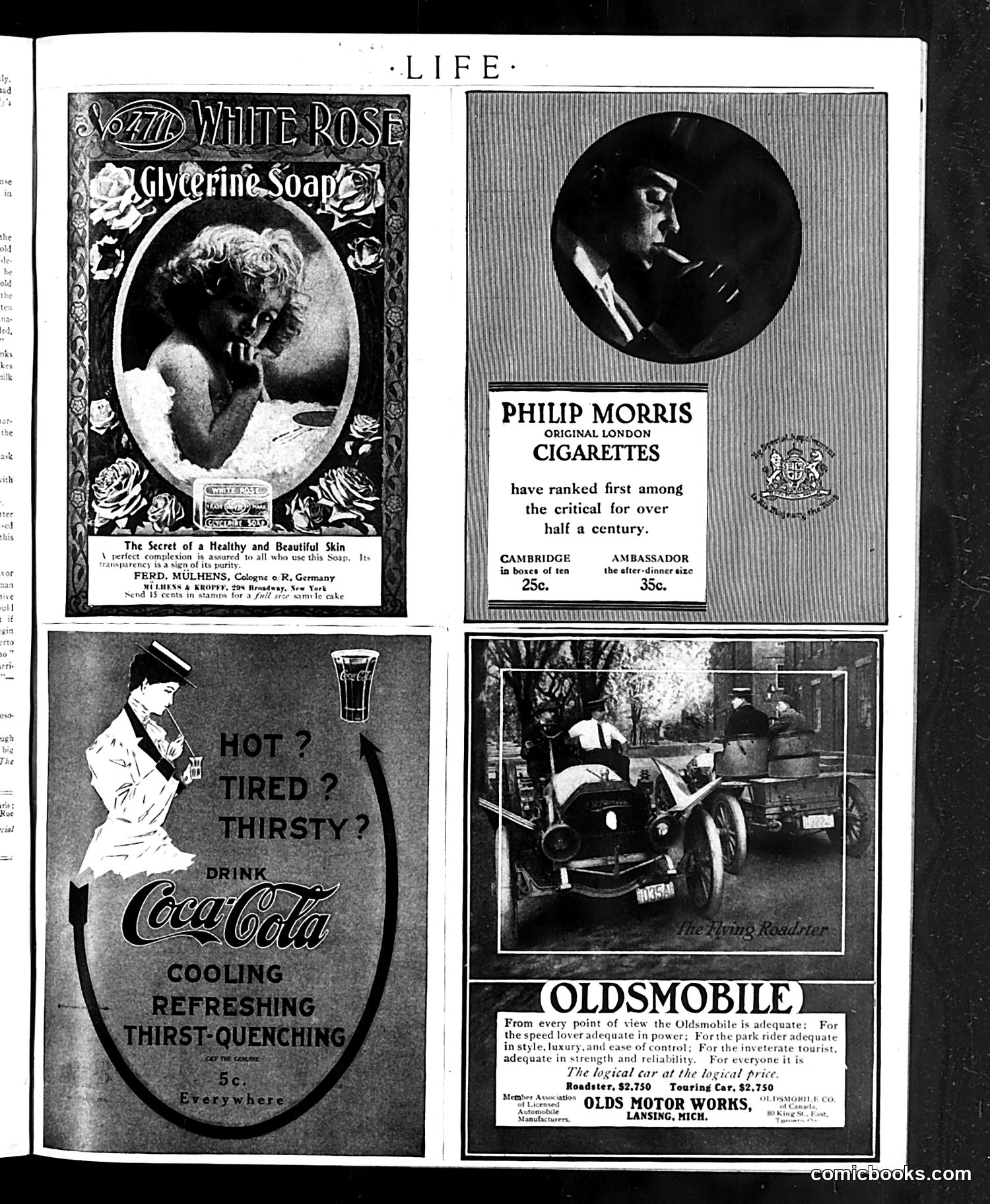
This is an **advertising page**, not satirical content. It contains four vintage advertisements: 1. **White Rose Glycerine Soap** — claims to provide "healthy and beautiful skin" 2. **Philip Morris Cigarettes** — emphasizes their century-long reputation among "the critical" (discerning consumers) 3. **Coca-Cola** — addresses common discomforts ("Hot? Tired? Thirsty?") with their refreshing beverage at 5¢ 4. **Oldsmobile** — promotes their roadster automobile as stylish, luxurious, and reasonably priced The ads reflect early 20th-century consumer culture and marketing strategies. Notable is the casual cigarette advertisement alongside health products—reflecting the era before tobacco health risks were widely acknowledged. The Coca-Cola and automobile ads emphasize affordability and modern convenience for the growing middle class.
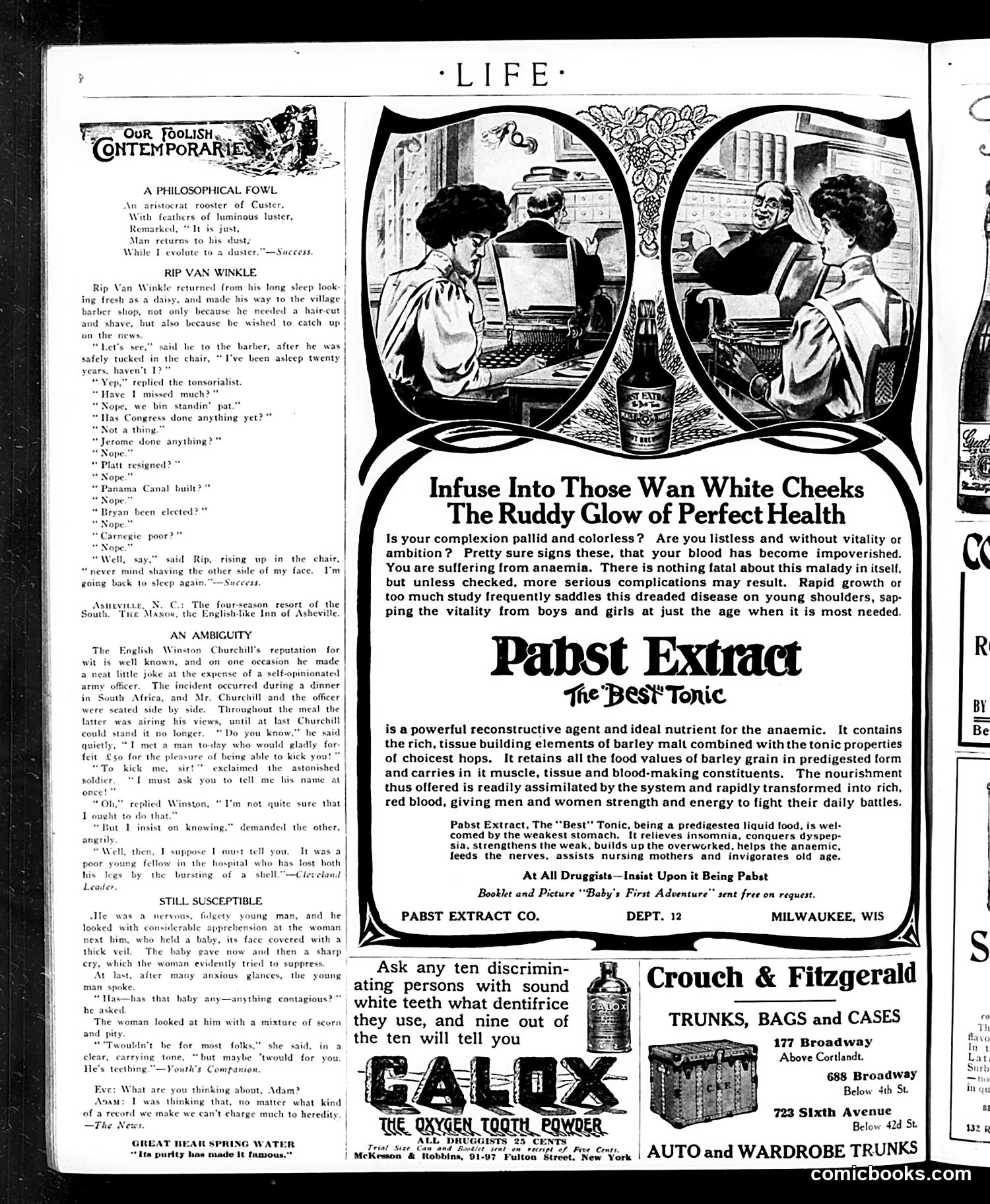
This page contains satirical humor pieces and period advertisements from early 20th-century Life magazine. **Satirical Content:** The cartoons mock contemporary figures and issues. "Rip Van Winkle" jokes that nothing has changed in Congress—no legislation passes, no reforms occur. This appears to critique legislative stagnation. "An Ambiguity" recounts a Winston Churchill anecdote about wit at an army officer's expense. Other brief pieces satirize human nature and hypocrisy. **Advertisements:** The dominant feature is a Pabst Extract beer advertisement claiming to cure anemia in pallid young people—a dubious health claim typical of early-1900s patent medicine marketing. Below are ads for Crouch & Fitzgerald trunks and Calix tooth powder. **Historical Context:** These satirical sketches reflect concerns about Congressional ineffectiveness and showcase period humor. The medical advertisements reveal how unregulated product claims were, marketing alcohol as health tonic for young people—practices now considered fraudulent.
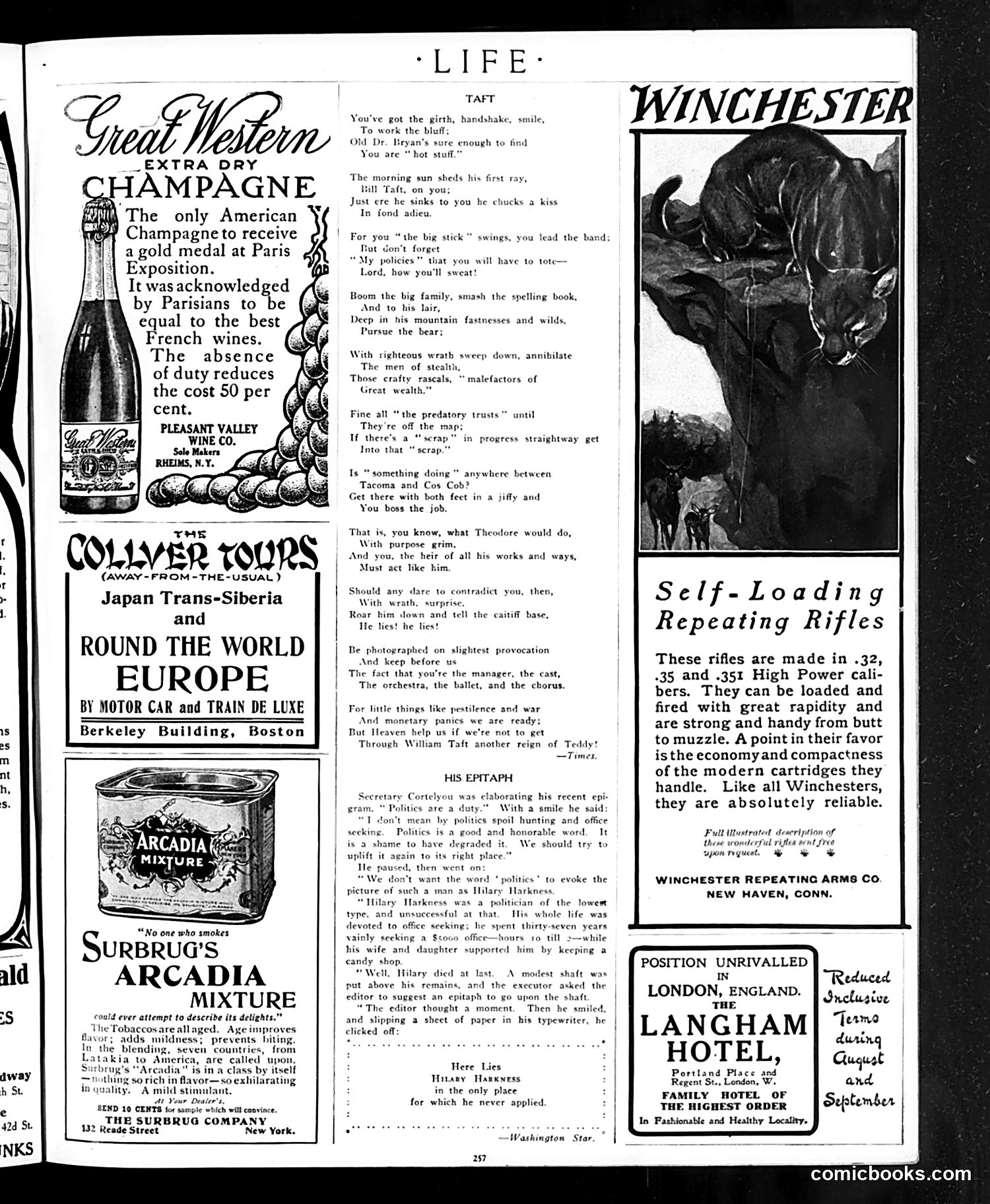
This page is primarily advertisements with one substantial satirical poem about President William Howard Taft (who succeeded Theodore Roosevelt). **The Satire:** The poem mocks Taft as merely imitating Roosevelt's aggressive "Big Stick" presidency without Roosevelt's genuine conviction. It catalogs Taft's expected actions—prosecuting trusts, pursuing bears, suppressing corruption—but frames them as theatrical performance ("the manager, the cast, / The orchestra, the ballet, and the chorus"). **The Point:** The satire suggests Taft is playing a role, following Roosevelt's script rather than leading authentically. The closing joke—comparing his presidency to "another reign of Teddy"—underscores that Americans fear they're getting Roosevelt's shadow, not Taft's own leadership. **Context:** This reflects early-1900s frustration with Taft's perceived weakness compared to his popular predecessor, a tension that would culminate in Roosevelt's 1912 split with Taft.
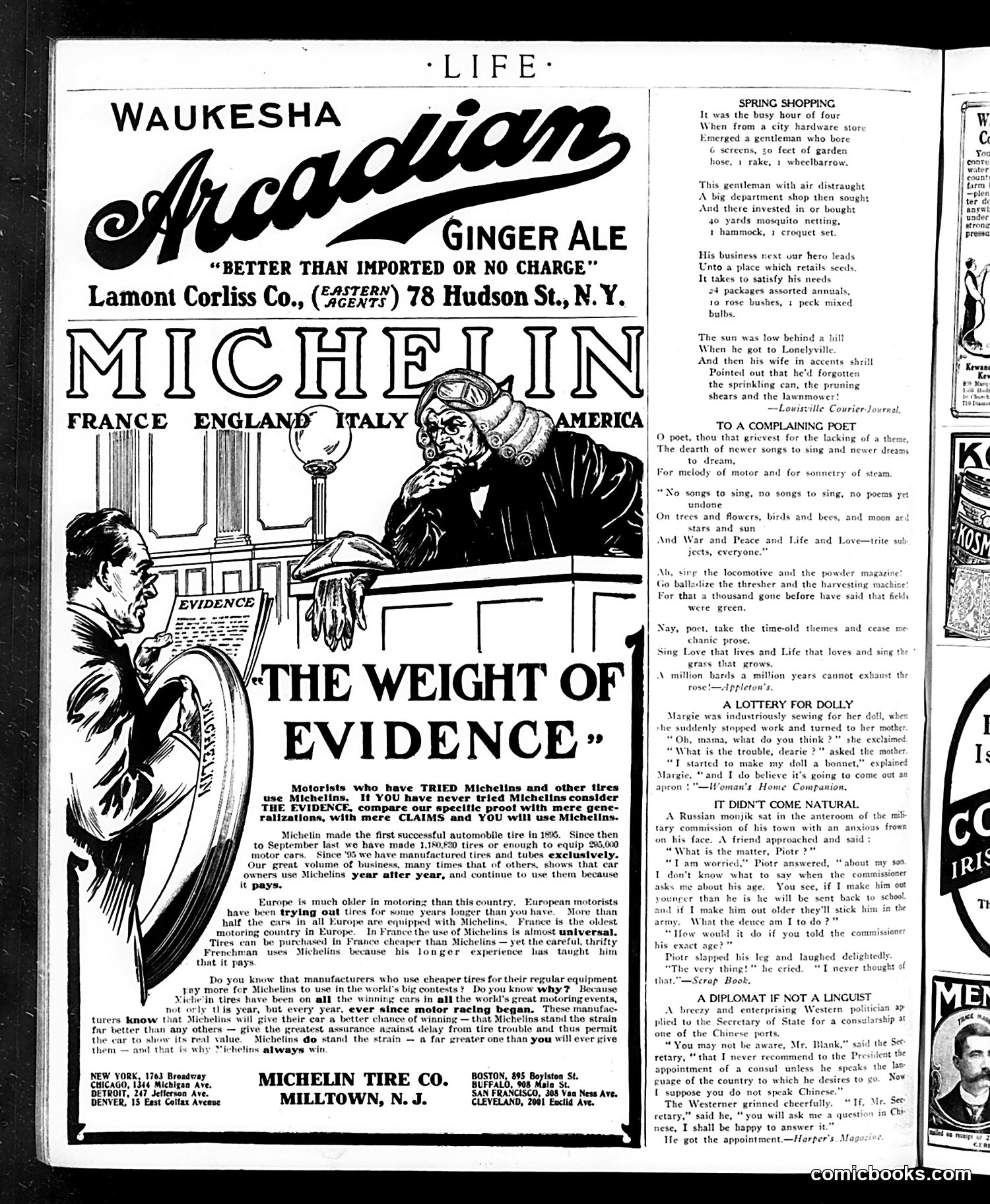
This page contains primarily **advertisements** (Waukesha Ginger Ale, Michelin Tires) rather than political satire. The editorial content includes: **"Spring Shopping"** — a humorous poem about a distracted gentleman who purchases garden supplies, then realizes he's forgotten essential items like a sprinkler can. **"To a Complaining Poet"** — satirizes poets who claim there are no new subjects worth writing about. The poem mocks those lamenting the exhaustion of poetic themes, sarcastically suggesting they write about modern industrial subjects (locomotives, threshers) before insisting they return to timeless themes of love and nature. **"A Lottery for Dolly"** — a brief, incomplete domestic humor piece about a child sewing a bonnet for her doll. None of these constitute political cartoons or sharp satire. The page reflects early 20th-century *Life* magazine's mix of light social humor, advertising, and verse—targeting middle-class readers with gentle, family-friendly content rather than biting political commentary.
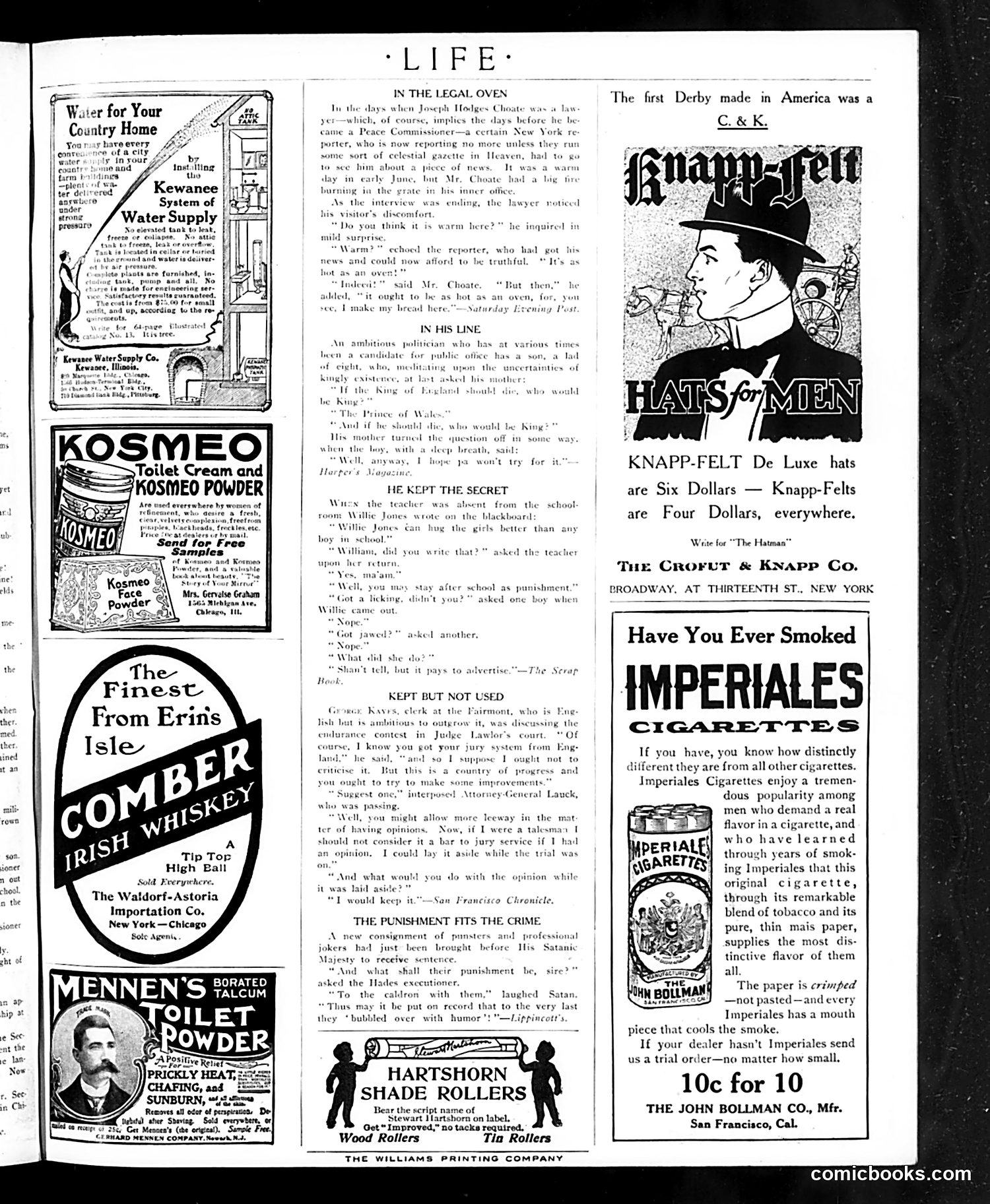
This page is primarily **advertisements and humor anecdotes** rather than political cartoons. The short comic pieces titled "In the Legal Oven," "In His Line," "He Kept the Secret," and others are brief satirical stories poking fun at everyday situations and human nature. The notable content includes: **"The Punishment Fits the Crime"** — a dark joke about professional jokers brought before royalty, punished by being forced into a caldron where they "bubbled over with humor." This is absurdist satire on justice and irony. **"He Kept the Secret"** — mocks a student who refuses to reveal why he stayed after school, quipping "it pays to advertise," suggesting even children exploit commercial logic. The page is dominated by period **product advertising** (Knapp-Felt hats, Imperiales cigarettes, Kosmeo powder, etc.), which was standard Life magazine content. The satirical anecdotes seem designed to entertain while promoting the magazine's urbane, witty sensibility to middle-class readers.
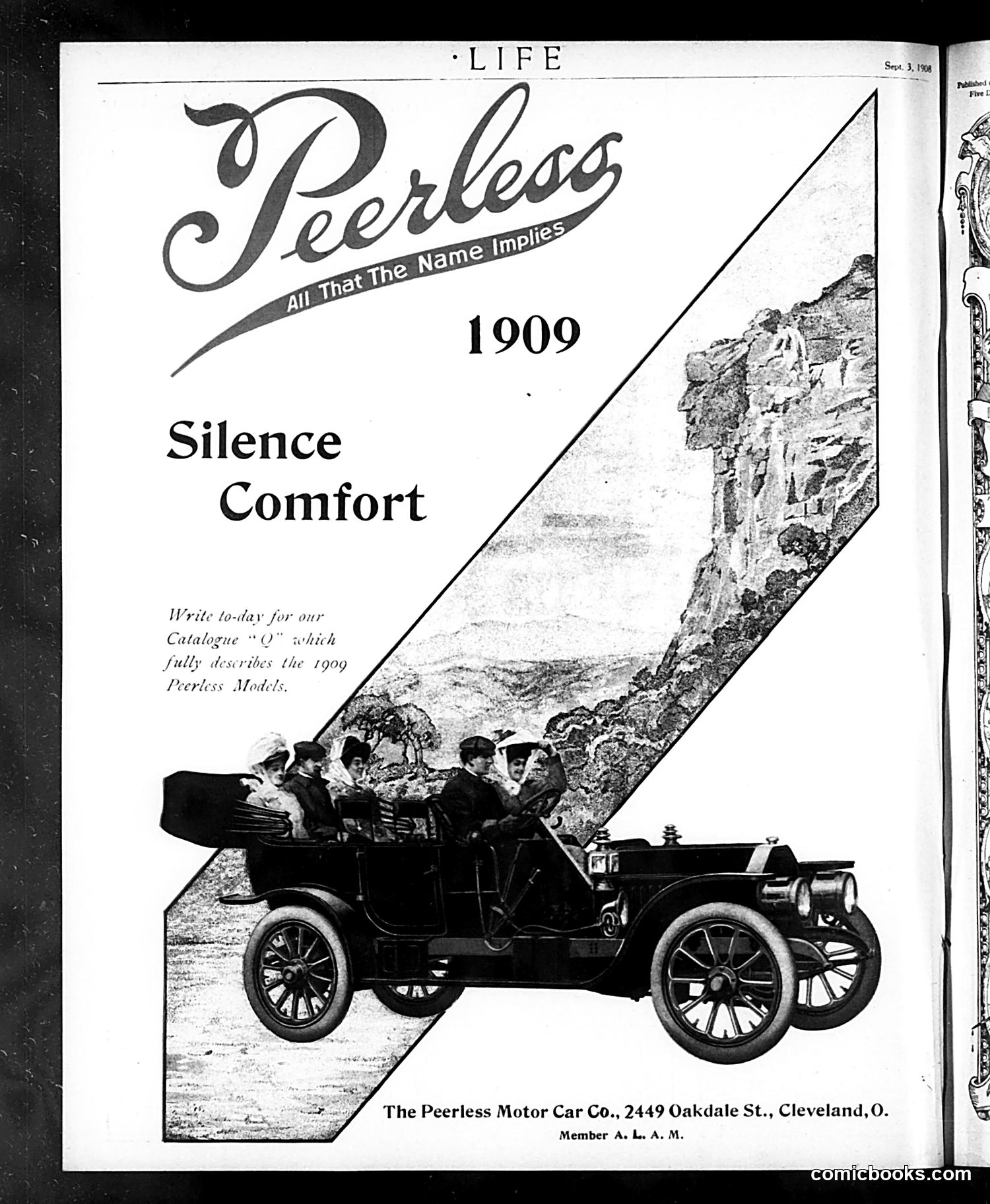
This is primarily a **product advertisement**, not political satire. The page advertises the 1909 Peerless automobile, manufactured in Cleveland, Ohio. The ad's tagline "All That The Name Implies" and heading "Silence Comfort" emphasize the car's quality and smooth, quiet operation—selling points for early automobiles. The illustrated scene shows well-dressed passengers enjoying a scenic mountain drive, suggesting luxury and leisure. The phrase "Write to-day for our Catalogue" was standard advertising copy of the era. "Member A.L.A.M." indicates membership in the Association of Licensed Automobile Manufacturers, a trade organization lending credibility. This reflects early 1900s automotive marketing, targeting affluent consumers. No satire or political commentary appears present—it's a straightforward commercial pitch in *Life* magazine's advertising section.