
Life, 1908-09-03 · page 11 of 36
Life — September 3, 1908 — page 11: what you’re looking at
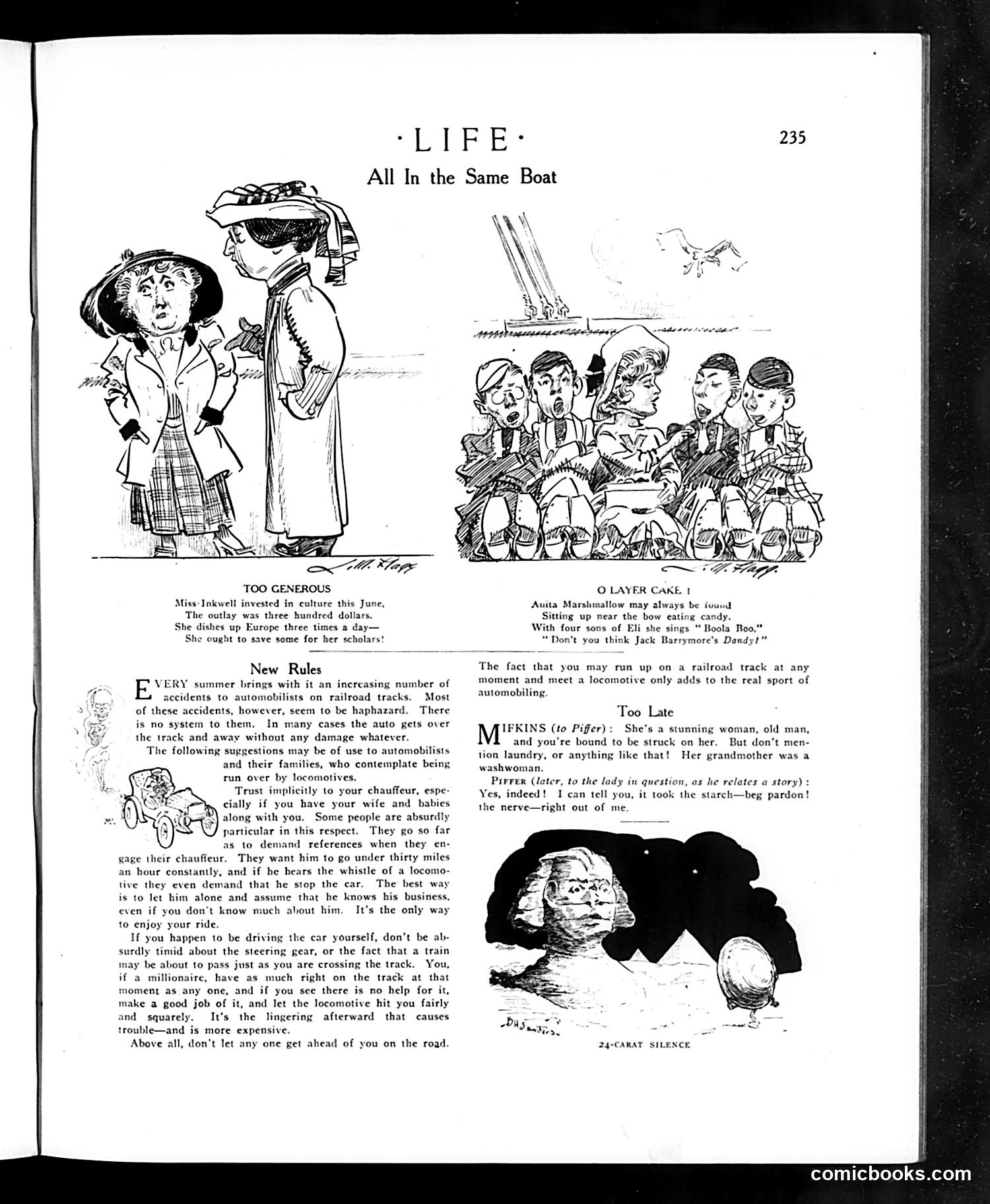
What you’re looking at
This page contains three satirical cartoons about early automobile culture: **"Too Generous"** mocks Miss Inkwell's extravagant spending on a new car—she invests heavily but tries to economize elsewhere, even limiting scholars' grants. **"All in the Same Boat"** depicts children crowded dangerously near a ship, captioned about layer cake and candy—satirizing parents' reckless behavior transporting children by car near railroad tracks. **"New Rules"** is a substantial essay advising automobile owners on safety etiquette: trust your chauffeur, don't demand excessive speed, avoid confrontations with trains, and crucially, "let no one get ahead of you on the road"—the last point delivered with ironic humor. **"Too Late"** shows a woman struck by a train, referenced through Kipling's story about a washerwoman's grandmother. The cartoons address early 1900s automobile safety anxieties and driving culture.
📄 Transcribed text from this page (OCR, searchable)
Machine-transcribed from the original scan — historical spelling and the odd misread are preserved.
"LIFE: All In the Same Boat OO age TOO GENEROUS Miss: Inkwell invested in culture this June, The outlay was three hundred dollars. She dishes up Europe three times a day— ought to save some for her scholars! O LAYER CAKE 1 Auita Marshmallow may always be fou: Sitting up near the bow eating candy. With four sons of Eli she sings “ Boola Roo,” “Don't you think Jack Barrymore's Dandy!” New Rules VERY summer brings with it an increasing number of cidents to automobilists on railroad tracks. Most of these accidents, however, seem to be haphazard. There is no system to them. In many cases the auto gets over the track and away without any damage whatever. The following suggestions may be of use to automobilists and their families, who contemplate being run over by locomotives. Trust implicitly to your chauffeur, espe- cially if you have your wife and babies long with you. Some people are absurdly particular in this respect. They go so far as to demand references when they en- gage their chauffeur. They want him to go under thirty miles an hour constantly, and if he hears the whistle of a locomo- tive they even demand that he stop the car. The best way is to let him alone and assume that he knows his business, even if you don’t know much about him. It’s the only way to enjoy your ride. If you happen to be driving the car yourself, don’t be ab- surdly timid about the steering gear, or the fact that a train may be about to pass just as you are crossing the track. You, if a millionaire, have as much right on the track at that moment as any one, and if you see there is no help for it, ¢ a good job of it, and let the locomotive hit you fairly and squarely. It’s the lingering afterward that causes trouble—and is more expensive. Above all, don’t let any one get ahead of you on the road. The fact that you may run up on a railroad track at any moment and meet a locomotive only adds to the real sport of automobiling Too Late IFKINS (to Piffer): She's a stunning woman, old man, and you're bound to be struck on her. But don’t men- tion laundry, or anything like that! Her grandmother was a washwoman. Pirrer (later, to the lady in question, as he relates a story): Yes, indeed! I can tell you, it took the starch—beg pardon! the nerve—right out of me. CARAT SILENCE, comicbooks.com