
Life, 1908-09-03 · page 10 of 36
Life — September 3, 1908 — page 10: what you’re looking at
What you’re looking at
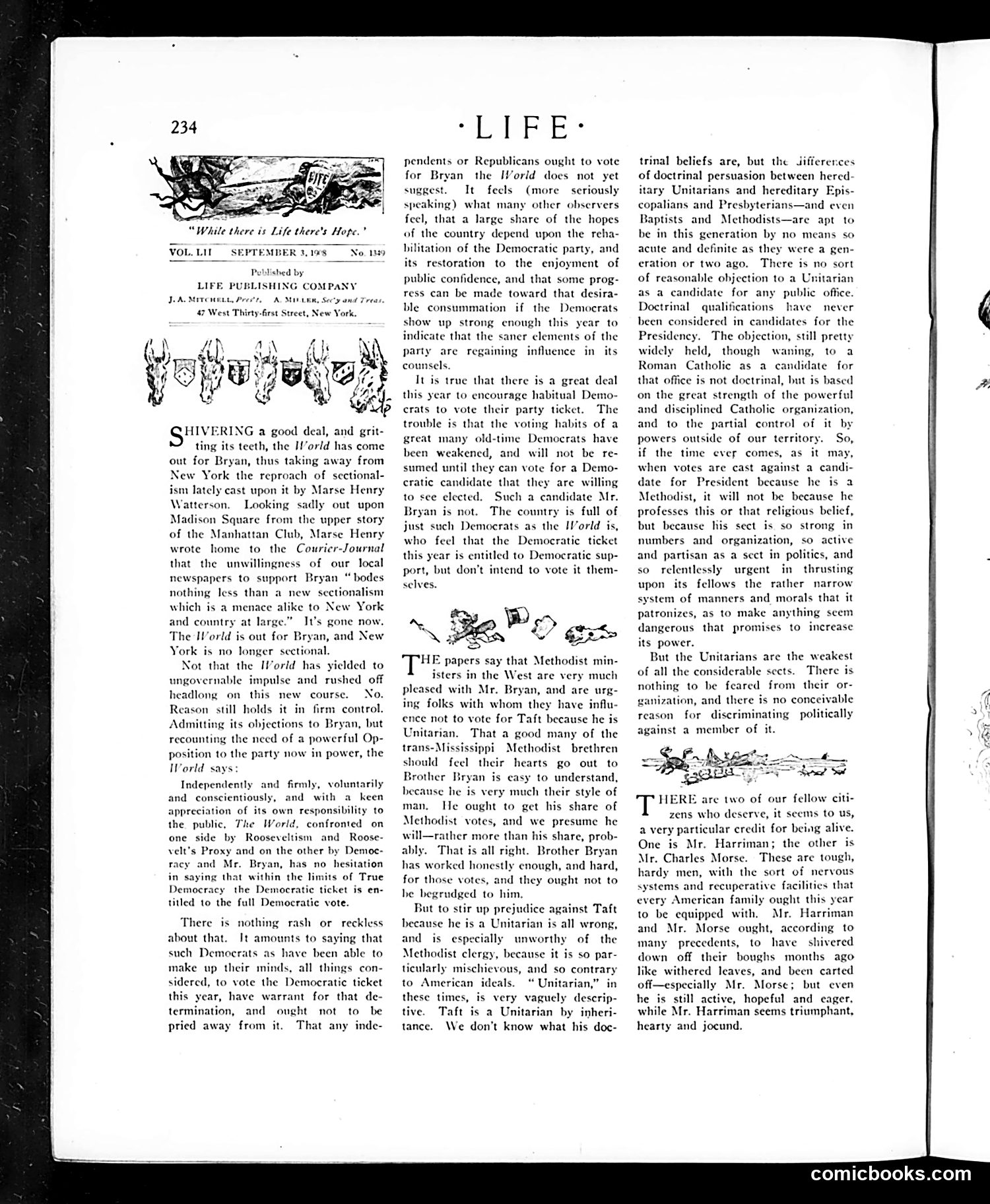
This editorial page discusses the 1908 presidential election and William Jennings Bryan's candidacy. The masthead cartoon shows a figure labeled "Life" declaring "While there is Life there's Hope," likely referring to the magazine's continuing advocacy. The text criticizes Democrats for lacking enthusiasm for Bryan, noting that many old-time Democrats won't vote for him. The piece also discusses Methodist ministers' support for Bryan despite his Unitarian faith, suggesting this creates awkward tensions within religious communities. The final section praises two citizens—Mr. Harriman and Mr. Charles Morse—as exemplars of American virtue worthy of emulation by families. The overall tone is satirical commentary on the fractious 1908 campaign and internal party divisions.
📄 Transcribed text from this page (OCR, searchable)
Machine-transcribed from the original scan — historical spelling and the odd misread are preserved.
Polished by LIFE PUBLISHING COMPANY J.A. Merc 47 West Thirty-first Street, New York. Pret, RMULKR, Seep and Treas s ; 4 ¢ HIVERING a good deal, and grit- ting its teeth, the World has come out for Bryan, thus taking away from New York the reproach of sectional- ism lately cast upon it by Marse Henry Watterson. Looking sadly out upon Madison Square from the upper story of the Manhattan Club, Marse Henry wrote home to the Courier-Journal that the unwillingness of our local newspapers to support Bryan “ bodes nothing less than a new sectionalism which is a menace alike to New York and country at large.” It’s gone now. The World is out for Bryan, and New York is no longer sectional, Not that the MWorld has yielded to ungovernable impulse and rushed off headlong on this new course. No. Reason still holds it in firm control. Admitting its objections to Bryan, but recounting the need of a powerful Op- position to the party now in power, the World says: Independently and firmly, voluntarily and conscientiously, and with a keen appreciation of its own responsibility to the public, The HWorld, confronted on ‘one side by Rooseveltism and Roose- velt's Proxy and on the other by Demoe- racy and Mr. Bryan, has no hesitation in saying that within the limits of True Democracy the Democratic ticket is en- titled to the full Democratic vote. There is nothing rash or reckless about that. It amounts to saying that such Democrats as have been able to make up their minds, all things con- sidered, to vote the Democratic ticket this year, have warrant for that de- termination, and ought not to be pried aw from it. That any inde- “PE * pendents or Republicans ought to vote for Bryan the MWorld does not yet suggest. It feels (more seriously speaking) what many other observers fecl, that a large share of the hopes f the country depend upon the reha- hilitation of the Democratic party, and its restoration to the enjoyment of public confidence, and that some proj ress can be made toward that desira- ble consummation if the Democrats show up strong enough this year to indicate that the saner elements of the party are regaining influence in its counsels, It is true that there is a great deal this year to encourage habitual Demo- crats to vote their party ticket. The trouble is that the voting habits of a great many old-time Democrats have been weakened, and will not be re- sumed until they can vote for a Demo- cratic candidate that they are willing to see elected. Such a candidate Mr. Bryan is not. The country is full of just such Democrats as the MWorld is, who feel that the Democratic ticket this year is entitled to Democratic sup- port, but don’t intend to vote it them- selves. ~ Beh op Sx TH papers say that Methodist min- isters in the West are very much pleased with Mr. Bryan, and are urg- ing folks with whom they have influ- ence not to vote for Taft because he is Unitarian. That a good many of the trans-Mississippi Methodist brethren should feel their hearts go out to Brother Bryan is easy to understand, because he is very much their style of man. He ought to get his share of Methodist votes, and we presume he will—rather more than his share, prob- ably. That is all right. Brother Bryan has worked honestly enough, and hard, for those votes, and they ought not to be begrudged to him, But to stir up prejudice against Taft because he is a Unitarian is all wrong, and is especially unworthy of the Methodist clergy, because it is so par- ticularly mischievous, and so contrary to American ideals. “ Unitarian,” in these times, is very vaguely descrip- tive. Taft is a Unitarian by inheri- tance. We don’t know what his doc- trinal beliefs are, but the Jifferences of doctrinal persuasion between hered- itary Unitarians and hereditary Epis- copalians and Presbyterians—and even Baptists and Methodists—are apt to be in this generation by no means so acute and definite as they were a gen- eration or two ago. There is no sort of reasonable objection to a Unitarian as a candidate for any public office. Doctrinal qualifications have never been considered in candidates for the Presidency. The objection, still pretty widely held, though waning, to a Roman Catholic as a candidate for that office is not doctrinal, but is based on the great strength of the powerful and disciplined Catholic organization, and to the partial control of it by powers outside of our territory. So, if the time ever comes, as it may when votes are cast against a candi- date for President because he is 2 Methodist, it will not be because he professes this or that religious belief, but because his sect is so strong in numbers and organization, so active and partisan as a sect in politics, and so relentlessly urgent in’ thrusting upon its fellows the rather narrow system of manners and morals that it patronizes, as to make anything seem dangerous that promises to increase its power. But the Unitarians are the weakest of all the considerable sects. There is nothing to be feared from their or- ganization, and there is no conceivable reason for discriminating politically against a member of it. ¢ two of our fellow citi- zens who deserve, it seems to us, avery particular credit for being ali One is Mr. Harriman; the other Mr. Charles Morse. These are tough, hardy men, with the sort of nervous systems and recuperative facilitics that every American family ought this year to be equipped with, Mr. Harriman and Mr. Morse ought, according to many precedents, to have shivered down off their boughs months ago like withered leaves, and been carted off—especially Mr. Morse; but even he is still active, hopeful and eager. while Mr. Harriman seems triumphant, hearty and jocund. comicbooks.com