
Life, 1908-09-03 · page 16 of 36
Life — September 3, 1908 — page 16: what you’re looking at
What you’re looking at
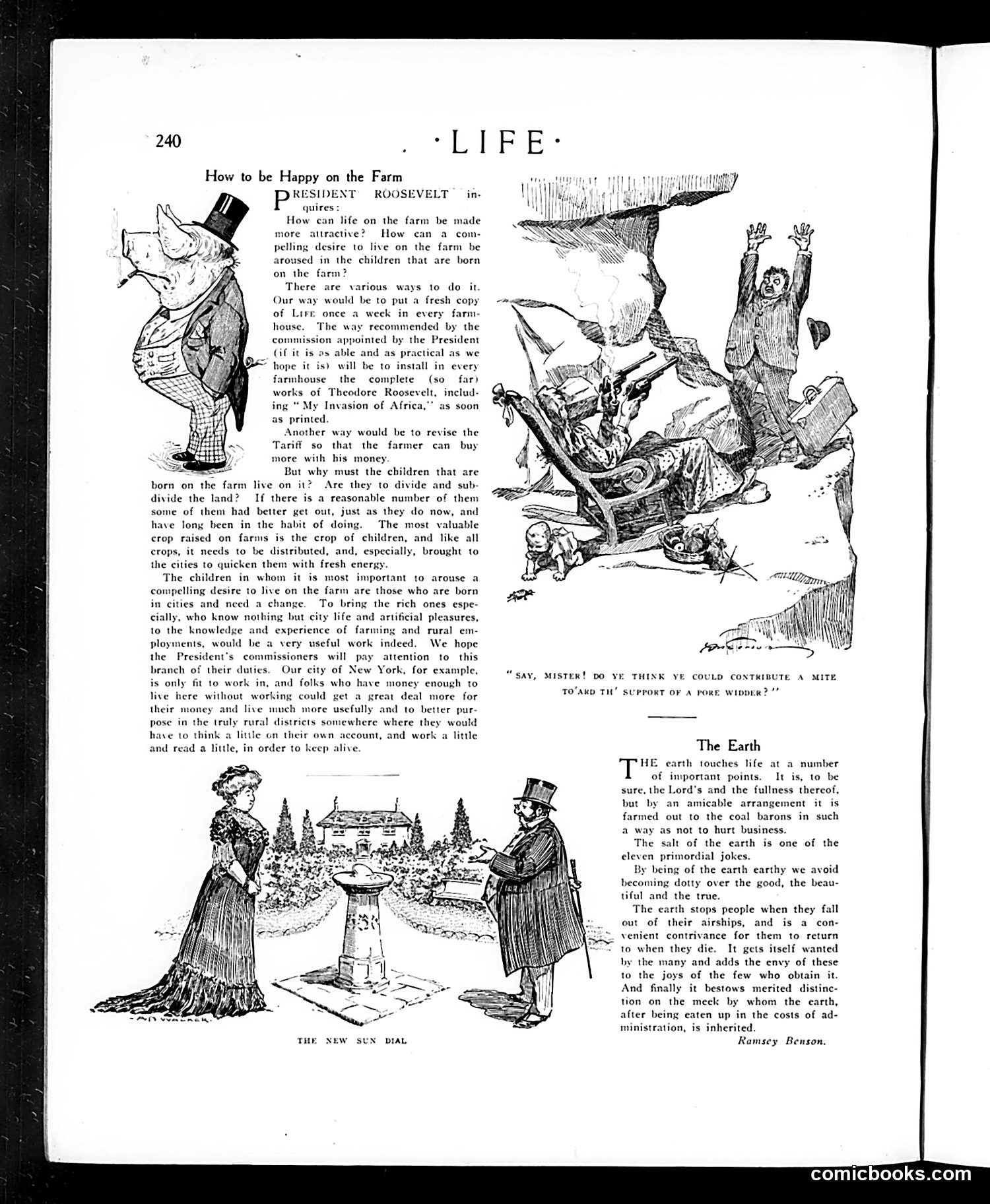
This page mocks President Roosevelt's commission on farm life. The top article sarcastically proposes installing Roosevelt's complete works (including "My Invasion of Africa") in farmhouses to make rural life attractive—a jab at Roosevelt's self-promotion and prolific writing. The satire's actual point: Life argues that children *should* leave farms for cities (the "most valuable crop" needs distribution), contradicting Roosevelt's goal. The magazine suggests instead bringing wealthy city children to farms for character-building work—inverting the administration's actual concern. "The Earth" section below offers cynical aphorisms about land ownership, mocking how coal barons control earth while claiming divine right, and how the wealthy monopolize property while the poor merely inherit dust. The tone throughout is skeptical of both Rooseveltian progressivism and capitalist exploitation.
📄 Transcribed text from this page (OCR, searchable)
Machine-transcribed from the original scan — historical spelling and the odd misread are preserved.
How to be Happy on the Farm RESIDENT) ROOSEVELT in- quires How can life on the farm be made more attractive? How can a com- pelling desire to live on the farm be aroused in the children that are born on the farm? There are various to do it. Our way would be to put a fresh copy of Lire once a week in every farm- house. The way recommended by the commission appointed by the President Gif it is ay able and as practical as we hope it is) will be to install in every farmhouse the complete (so far) works of Theodore Roosevelt, includ- ing “ My Invasion of Africa,”’ as soon as printed. Another way would be to revise the Tariff so that the farmer can buy more with his money : But why must the children that are born on the farm live on it? Are they to divide and sub- divide the land? If there is a reasonable number of them some of them had better get out, just as they do now, and have long been in the habit of doing. The most valuable crop raised on farms is the crop of children, and like all crops, it needs to be distributed, and, especially, brought to the cities to quicken them with fresh energy. The children in whom it is most important to arouse a compelling desire to live on the farm are those who are born in cities and need a cha To bring the rich ones espe- cially, who know nothing but city life and artificial pleasures, to the knowledge and experience of farming and rural em- ployments, would be a very useful work indeed. We hope the President's commissioners will pay attention to this branch of their duties. Our city of New York, for example, is only fit to work in, and folks who have money enough to live here without working could get a great deal more for their money and live much more usefully and to better pur- pose in the truly rural districts somewhere where they would have to think a little on their own account, and work a little and read a little, in order to keep alive. “Say, MISTER! DO YE THINK YE COULD CONTRIBUTE A MITE TO'AKD TH’ SUPPORT OF A PORE WIDDER? ’? The Earth HE earth touches life at a number of important points. It is, to be sure, the Lord’s and the fullness thereof, but by an amicable arrangement it is farmed out to the coal barons in such a way as not to hurt business. The salt of the earth is one of the eleven primordial jokes. By being of the earth earthy we avoid becoming dotty over the good, the beau- tiful and the true. The earth stops people when they fall out of their airships, and is a con- venient contrivance for them to return to when they die. It gets itself wanted by the many and adds the envy of these to the joys of the few who obtain it And finally it bestows merited distine- tion on the meek by whom the earth, after being eaten up in the costs of ad- ministration, is inherited. Ramsey Benson. comicbooks.com