
Life, 1908-09-03 · page 13 of 36
Life — September 3, 1908 — page 13: what you’re looking at
What you’re looking at
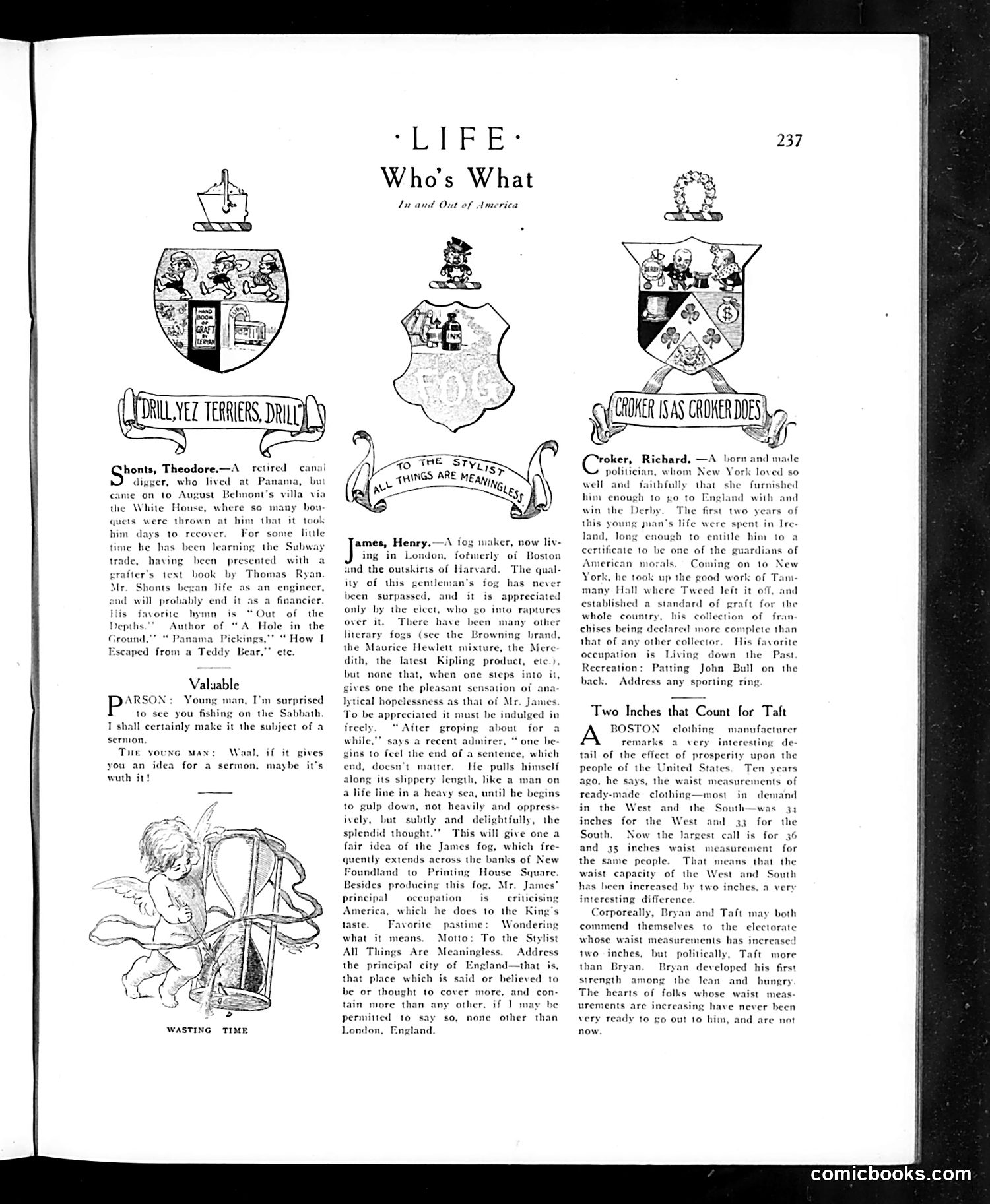
This is a satirical biographical page featuring prominent Americans. The visible entries include: - **Shodts, Theodore**: A retired canal digger from Panama who came to the White House, where many bouquets were thrown at him; the article humorously notes he needed days to recover. - **James, Henry**: A log-booker from Boston, described as creating a famous literary "fog" (likely referencing his notoriously dense writing style). The satire mocks his obscure prose. - **Croker, Richard**: A New York politician described as furnishing his Ireland home with Hall furniture and establishing a sporting record. The page's humor derives from mixing genuinely notable figures with exaggerated or absurd biographical details, poking fun at their public personas and reputations.
📄 Transcribed text from this page (OCR, searchable)
Machine-transcribed from the original scan — historical spelling and the odd misread are preserved.
honts, Theodore.—A digger, who lived at Panama, bu: came on to August Belmont's villa the White House, where so many bi quets were thrown at him that it took him days to recover. For some little time he has been learning the Subway trade, having presented with a grafter’s text hook by Thomas Ryan. Mr. Shonts began life as an e and will probably end it as a financier. His favorite hymn is “Out of the Author of “A Hole in the 27 Panama Pickin “How I Escaped from a Teddy Bear,” ete. heen inecr, Valuable ARSON: Young man, I’m surprised to sce you fishing on the I shall certainly make it the subject of a sermon. Tue you an idea wuth it! youxe Max: Waal, if it gives for a sermon, maybe it’s WASTING TIME “LIFE: Who's What In and Out of America ames, Henry.—A fog maker, now liv- ing in London, fotmerly of and the outskirts of Harvard. The qual- ity of this gentleman's fog has never been sur is appreciated only by the elect, who go into raptures There have been mai other literary fogs (see the Browning the Maurice Hewlett mixture, the Mere dith, the latest Kipling product, etc.), but none that, when one steps into gives one the pleasant scnsation of ana- lytical hopelessness as that of Mr. James ‘To be appreciated it must be indulged i ireely. “After groping about for a while,” says a recent admirer, “one be- gins to feel the end of a sentence, which He pulls himself Boston assed, and it over it. brand, end, doesn’t matter. along its slippery length, like a man on a life line in a heavy sea, until he begins to gulp down, not heavily and oppress- ively, but subtly and delightfully, the splendid thought." This will give one a fair idea of the James fog, which fre- quently extends across the banks of New Foundland to Printing House Square. Besides producing this fog, Mr. Jame: principal occupation is criticising America, which he does to the King’s taste. Favorite pastime: Wondering what it means. Motto: To the Stylist All Things Are Meaningless. Address the principal city of England—that is, that place which is said or believed to be or thought to cover more, and con tain more than any other. if I may be permitted to say so, none other than London, England. « Croker, Richard. —A born and made politician, whom New York loved so well and faithfully that she furnished him enough to yo to England with and win the Derby. The first two years of this young pan’s life were spent in Ire land, long enough to entitle certificate to be one of the guardians of ng on to New York, he took up the good work of him to a American morals. Cot many Hall where Tweed leit it off, and established a standard of graft for the whole country, of fran chises being declared more complete than that of any other collector. His favorite occupation is Living down the Past Recreation: Patting John Bull on the back. Address any sporting ring his collection Two Inches that Count for Taft BOSTON remarks a tail of the effect of prosperity upon the clothing manufacturer very. intere de- people of the United States. Ten years ago, he says, the waist measurements of ready-made clothing—most in demand in the West and the South—was 34 inches for the West and 33 for the South. Now the largest call is for 36 and 35 inches waist measurement for the same people. That waist of the means that th capacity West and South has heen increased hy two inches, a very interesting difference Corporeally, Bryan and Taft may both commend themselves to the whose waist measurements has increase:! politically, Taft more than Bryan developed his first strength among the lean and hungry The hearts of folks whose waist urements are increasing h very ready 10 go out 10 h now. electorate two inches, but Bryan comicbooks.com