
A complete issue · 20 pages · 1908
Life — July 9, 1908
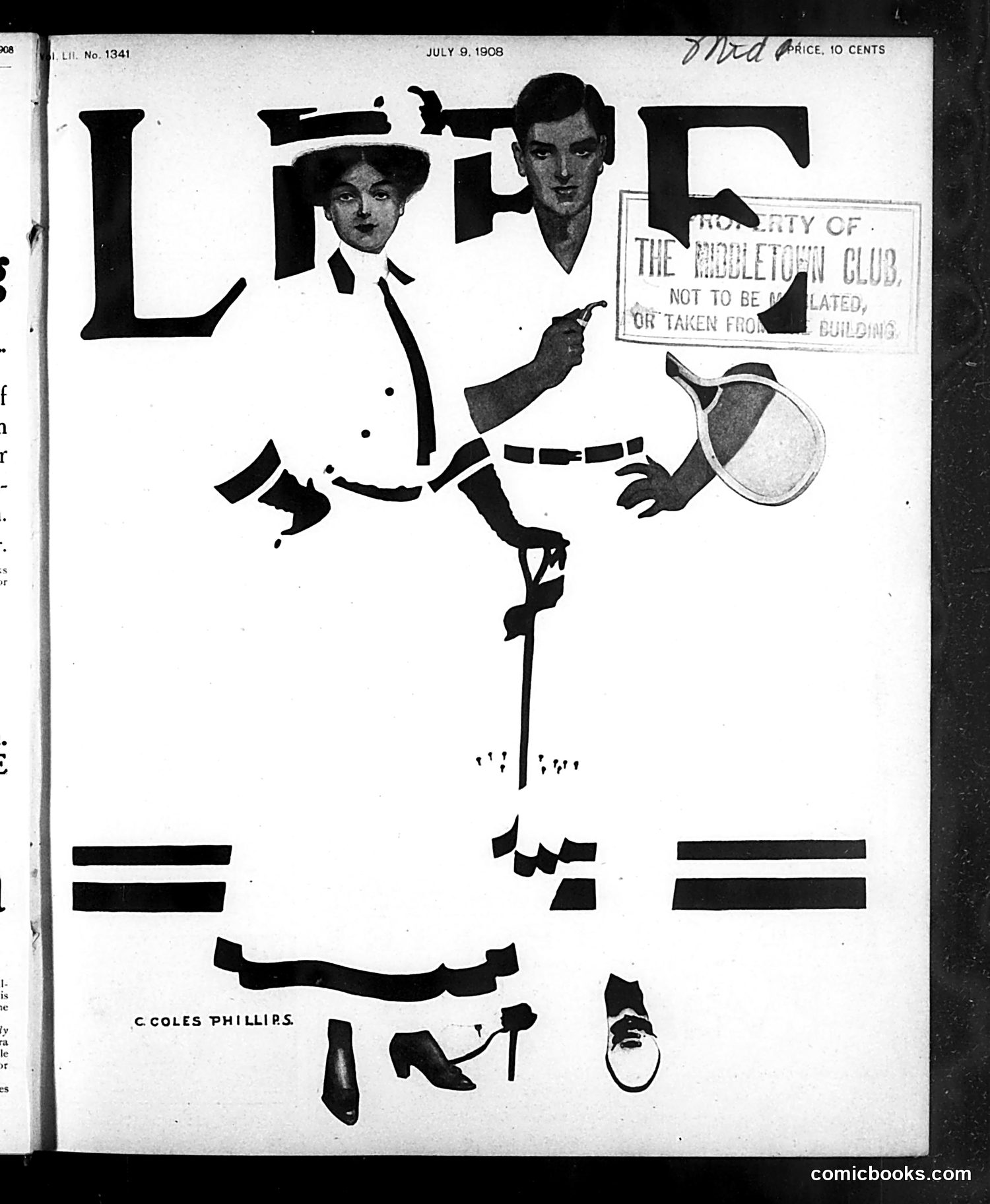
This appears to be a fashion/lifestyle cover from Life magazine advertising C. Coles Phillips footwear and accessories. The central illustration shows two men in suits - one wearing a hat on the left, one bareheaded on the right - depicted in an exaggerated, comedic pose suggesting they're demonstrating shoes, hats, and other items below them. The layout displays various shoes, hats, and accessories as product illustrations. There's a library stamp visible ("Property of the Bridgeham Club"), indicating this particular copy belonged to a private club. This is primarily **commercial/advertising content** rather than political satire - a typical early-20th-century magazine cover mixing editorial illustration with product promotion in humorous fashion.
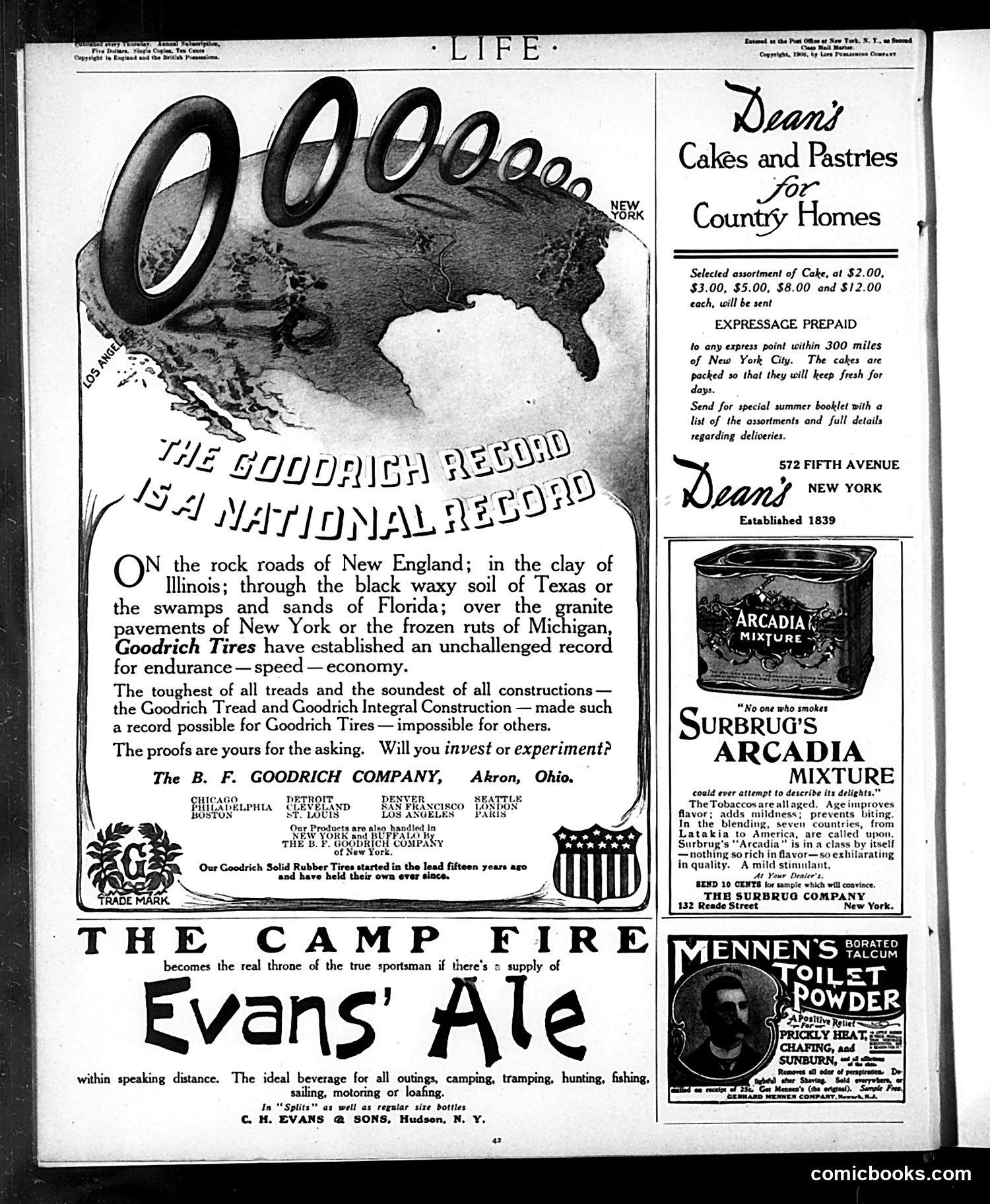
This page is primarily **advertising**, not satire or political commentary. The dominant image shows a large tire wrapped around a U.S. map, promoting **Goodrich Tires**. The advertisement emphasizes the tire's durability across diverse American terrain—from New England rocks to Texas clay to Michigan's frozen ground. The text claims Goodrich Tires have an "unchallenged record for endurance—speed—economy" and boasts their construction makes their record "impossible for others." The page also contains unrelated advertisements for **Dean's Cakes and Pastries**, **Surbrug's Arcadia** (tobacco mixture), **Mennen's Talc Powder**, and **Evans' Ale**. There is no political cartoon or satire present—this is straightforward early-20th-century product marketing.
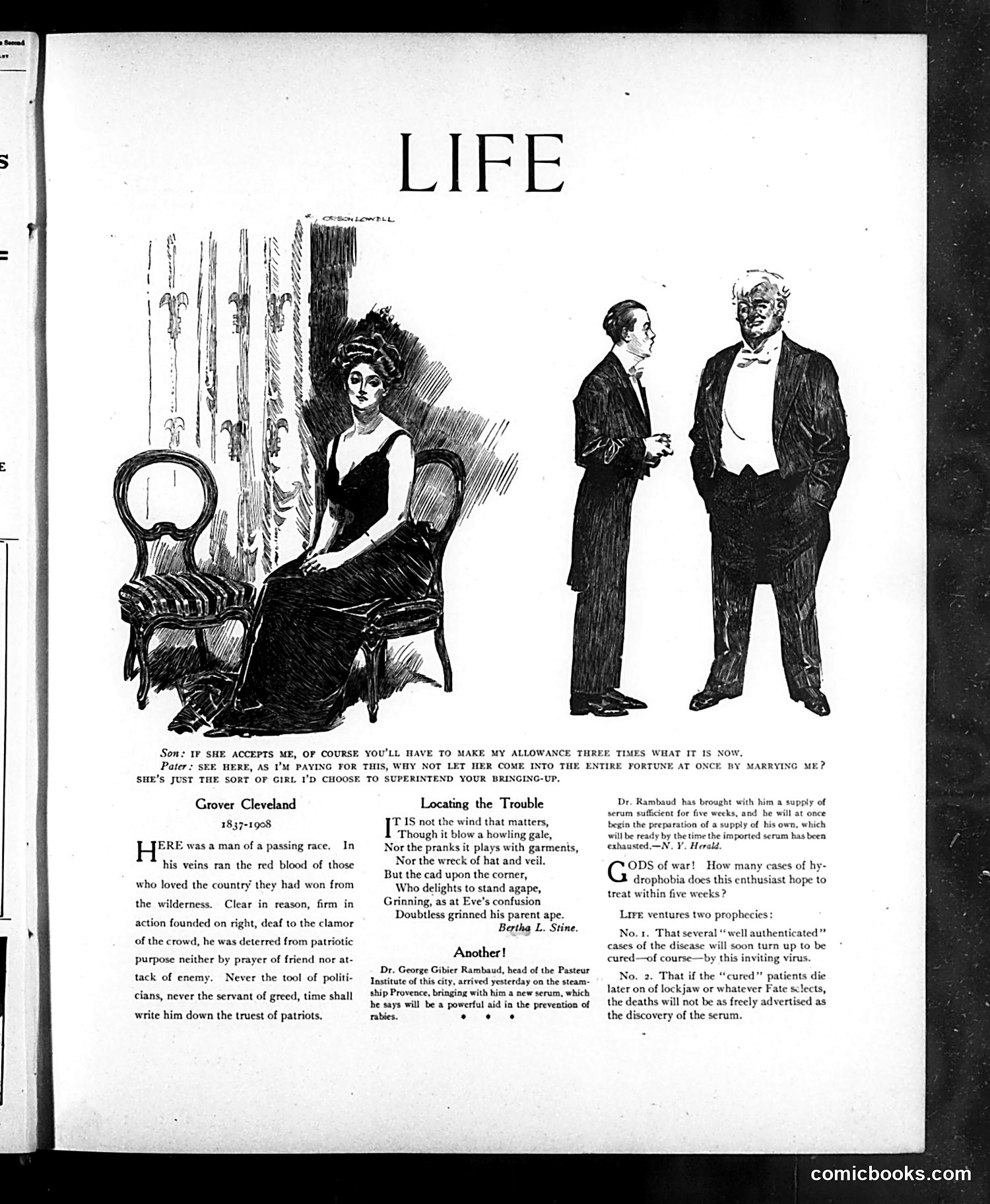
This page features a satirical cartoon labeled "Locating the Trouble" depicting a conversation between two men in formal dress. The left illustration shows a woman seated, with text indicating a domestic financial dispute—a husband complaining about his wife's allowance demands. The right cartoon presents what appears to be two gentlemen discussing a medical matter. The accompanying text references Dr. George Giber Rambaud and the Pasteur Institute, discussing a new serum treatment for hygiene-related diseases. The satire appears to contrast marital/financial troubles with contemporary medical advances. The specific social reference—likely about venereal disease treatment—reflects early 20th-century anxieties about both family finances and the era's emerging medical treatments, presented through coded, euphemistic language typical of Life's satirical approach.
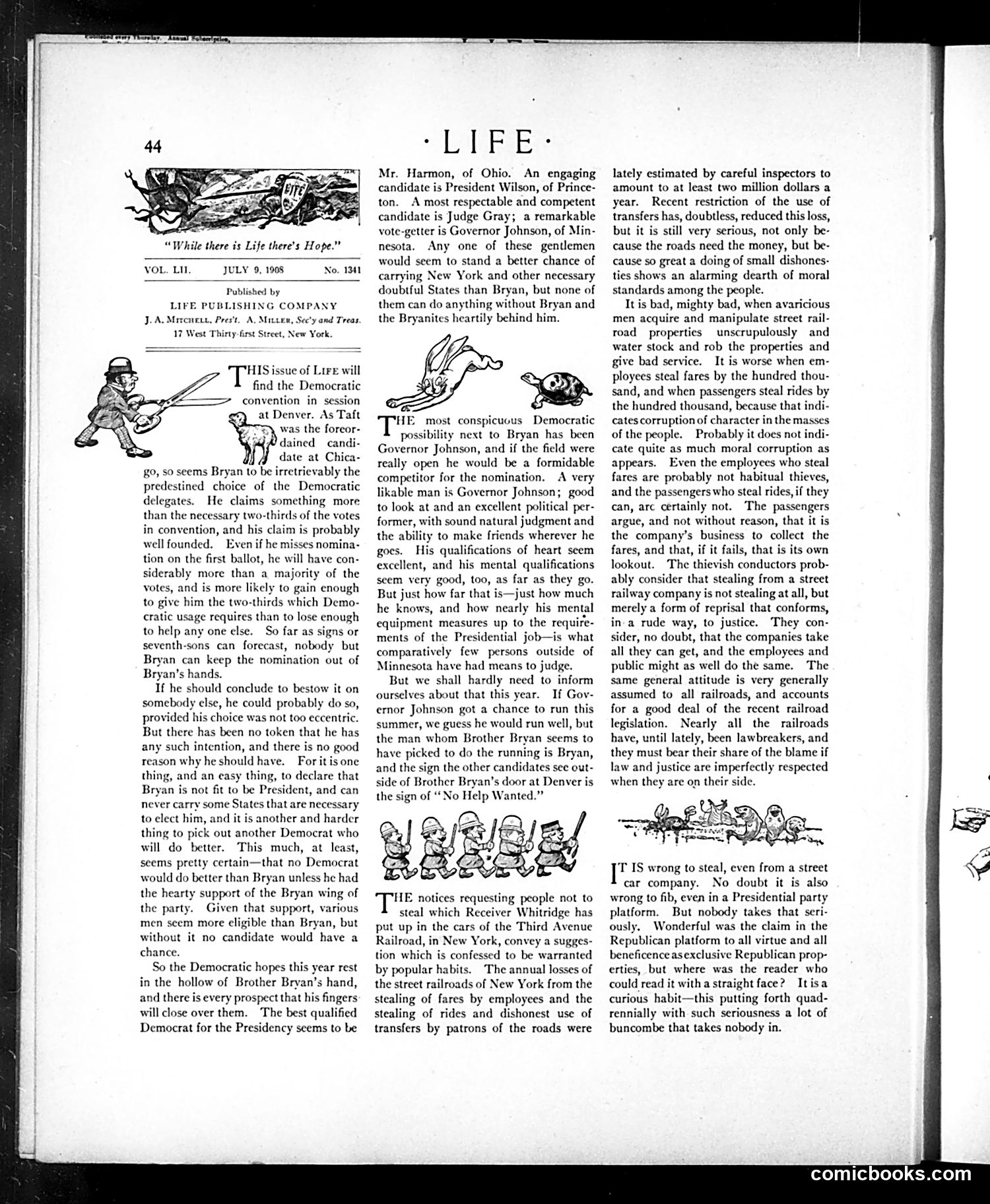
This page discusses the 1908 Democratic National Convention, examining potential presidential candidates as William Jennings Bryan's political influence wanes. The text considers Governors Johnson (Minnesota) and Gray as alternatives to Bryan, debating whether Bryan retains enough party support to influence the nomination. The cartoon at top shows five caricatured heads in a row—likely representing competing Democratic candidates or factional leaders at the convention. The satire centers on whether Bryan can maintain control of the Democratic Party despite his previous electoral losses, and whether Democrats should nominate someone fresh or continue backing Bryan's preferred candidate. The page ultimately questions whether Democratic prospects depend on Bryan's continued dominance.
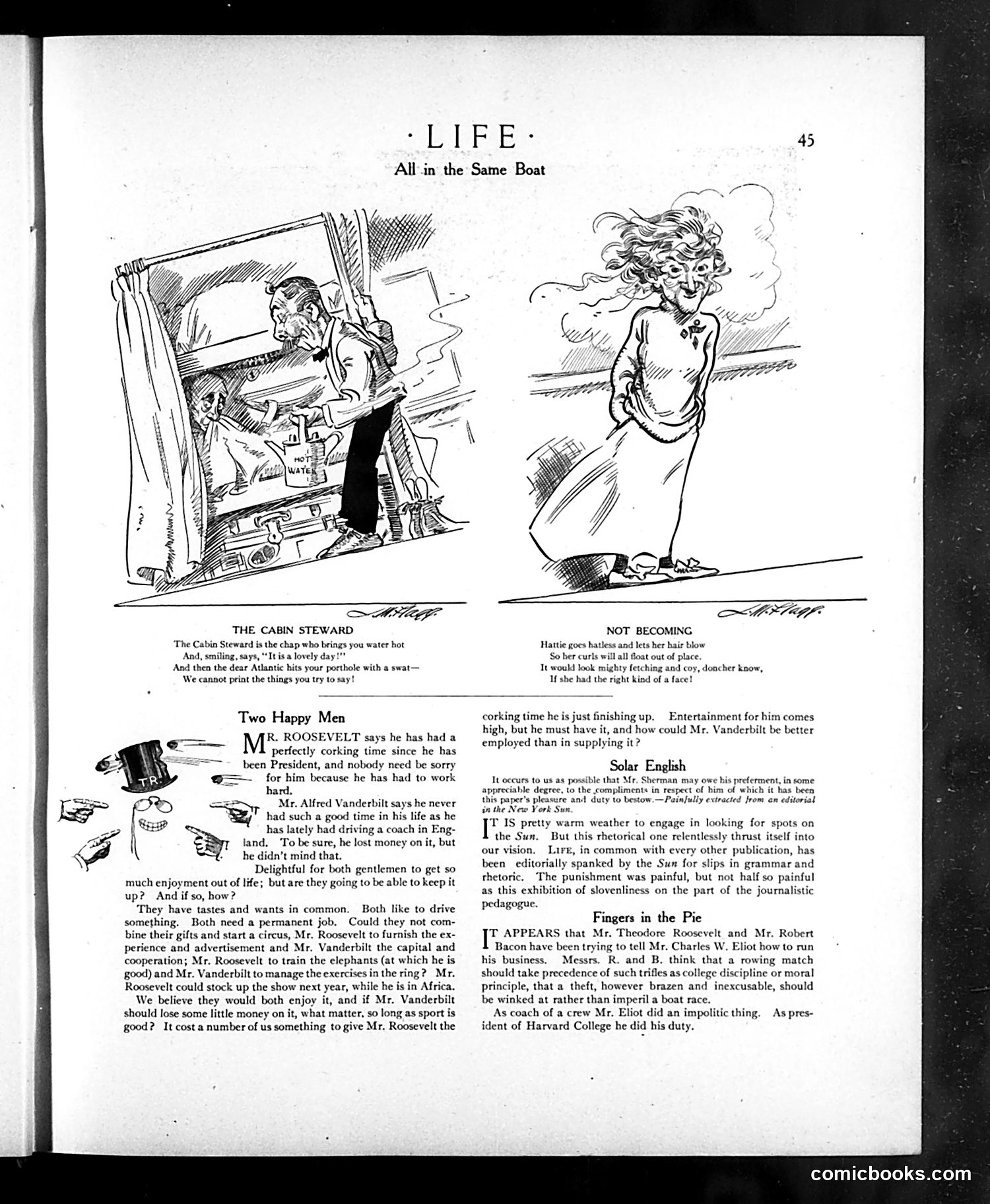
This page contains satirical commentary on wealthy American figures from the early 20th century. **"Two Happy Men"** celebrates President Roosevelt and Alfred Vanderbilt, contrasting their leisure activities. Roosevelt apparently enjoys simple pleasures, while Vanderbilt—described as someone who "never had such a good time" despite his wealth—prefers elaborate entertainment. The satire suggests that despite vastly different circumstances, both men find contentment, though the text humorously questions whether Vanderbilt's expensive pursuits actually bring him joy equal to Roosevelt's simpler enjoyments. **"Fingers in the Pie"** discusses Theodore Roosevelt and Robert Bacon allegedly involving themselves in Charles W. Eliot's Harvard College coaching decisions, satirizing their interference in institutional matters unrelated to their positions. The cartoons mock wealthy industrialists' excessive leisure and their tendency toward meddling in affairs beyond their proper scope.
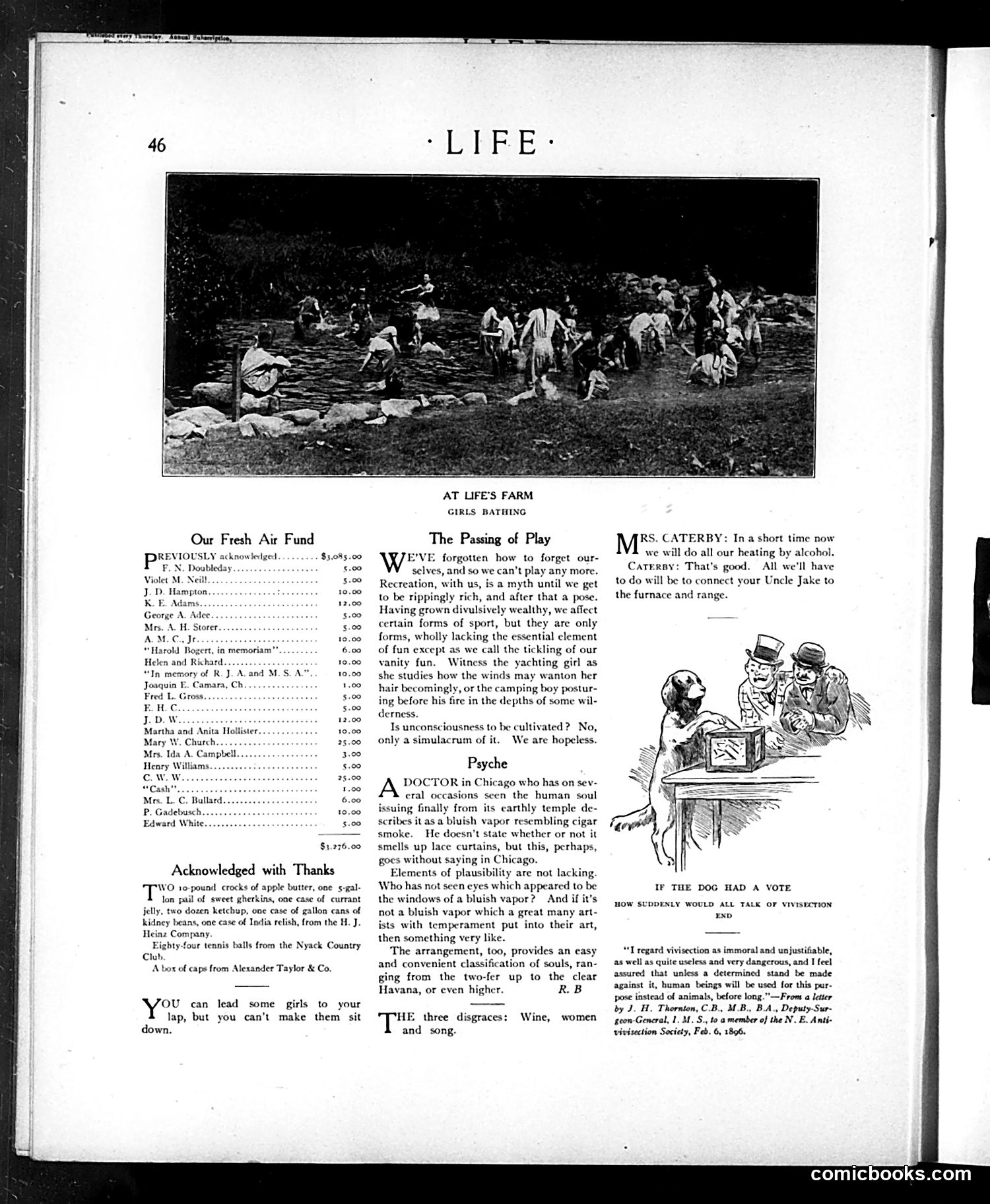
**Main Content:** The page features a photograph titled "At Life's Farm: Girls Bathing" showing multiple people in a body of water, likely documenting a recreational activity at a facility. **Cartoons:** A small illustration captioned "If the Dog Had a Vote: How Suddenly Would All Talk of Vivisetion End" depicts animals discussing human treatment of creatures. The satire mocks human hypocrisy—suggesting people would immediately oppose animal testing if dogs could vote and express opinions, yet ignore animal suffering when convenient. **Accompanying Text:** Multiple short pieces including donor acknowledgments for a "Fresh Air Fund" and philosophical essays on topics like "The Passing of Play" and "Psyche." These reflect Life's typical mix of humor, social commentary, and literary content aimed at educated readers.
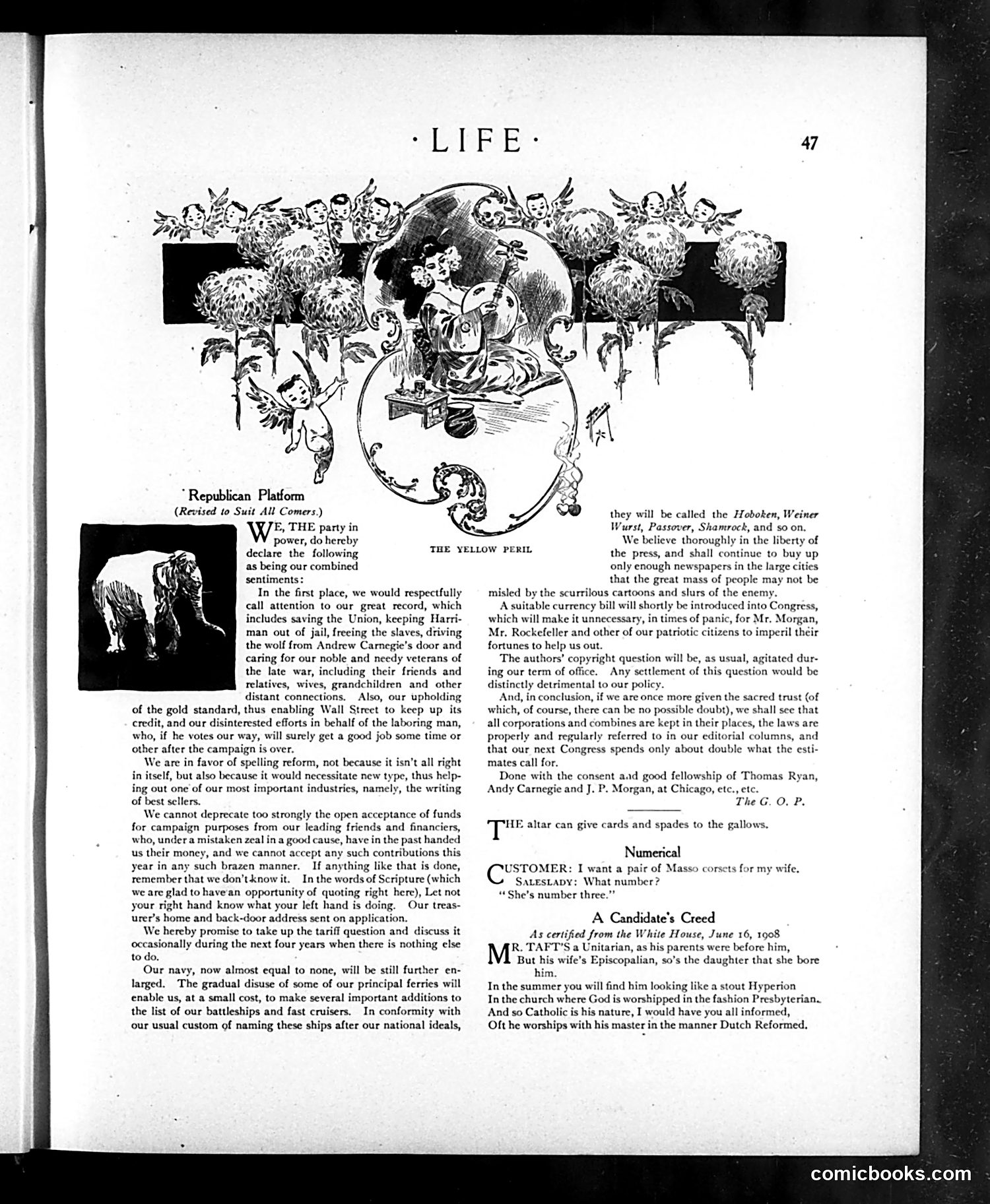
This 1908 Life magazine page features a racist political cartoon titled "The Yellow Peril"—a common xenophobic trope of the era depicting Asian immigration as a threat to America. The central image shows a menacing face emerging from a globe, surrounded by blooming flowers (likely poppies, evoking opium stereotypes). Cherubs or putti hang from vines, suggesting corrupted innocence. The accompanying "Republican Platform" text discusses currency reform, tariffs, and navy expansion—suggesting the cartoon connects immigration fears to broader anxieties about American economic and military power during the early 20th century. The page reflects the intense anti-Asian sentiment prevalent in American politics and popular media of this period, particularly regarding Chinese and Japanese immigration.
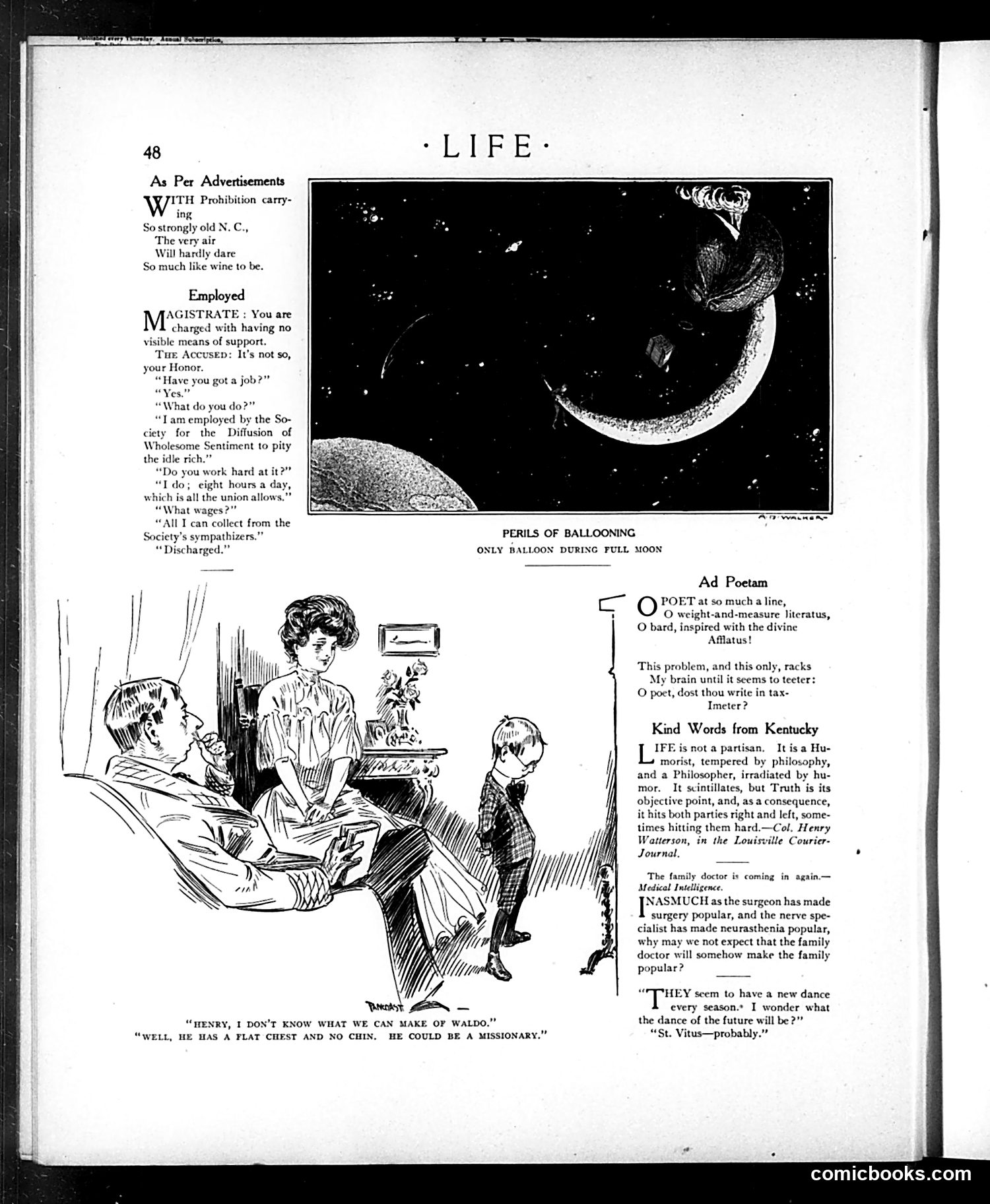
This page contains satirical commentary on contemporary social issues circa early 20th century. **Top cartoon ("Perils of Ballooning")**: A dark illustration showing a figure clinging to a crescent moon during a balloon flight, suggesting the dangers of early aviation technology—a topical concern when ballooning was a novel, hazardous activity. **Main cartoon**: Depicts a domestic scene where a woman shows a man a small boy, with the caption suggesting they're considering him as a missionary due to his physical characteristics ("flat chest and no chin"). This satirizes both missionary work and eugenic attitudes of the era—the joke mocks the idea of selecting people for vocations based on physical traits. **Text sections**: Include satirical commentary on prohibition, employment, and social philosophy, typical of Life's editorial approach to contemporary controversies.
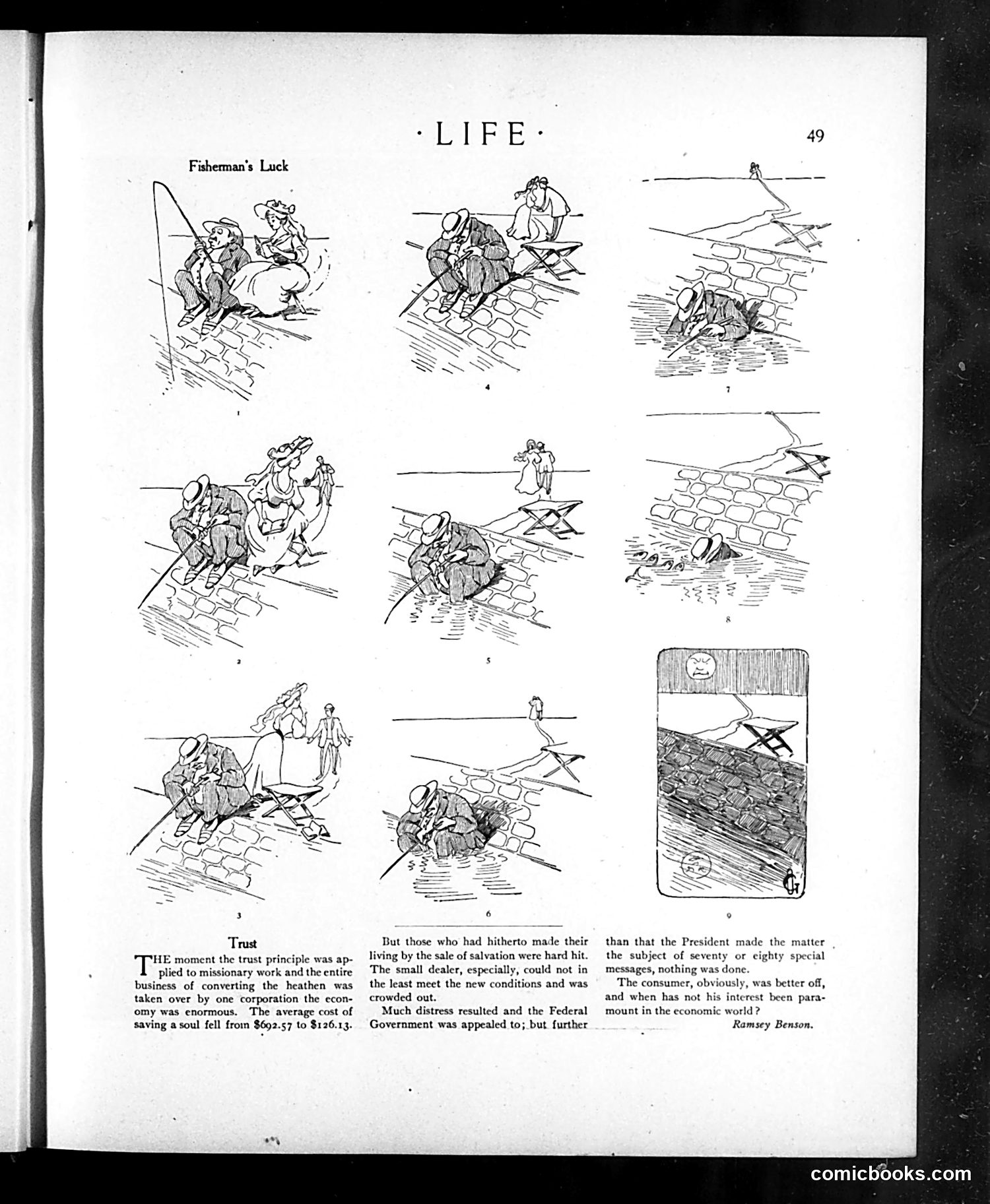
This page contains two satirical comics critiquing early 20th-century American economics. **"Fisherman's Luck"** (top) depicts a fisherman repeatedly casting his line with minimal success—a visual metaphor for futile effort, likely referencing failed business ventures or economic schemes. **"Trust"** (bottom) addresses corporate monopolies. The text explains that converting heathens through religious salvation was expensive ($602-$1263 per person), and when a corporation took over this "business," economies of scale created enormous cost savings. The satire criticizes how corporations prioritize profit over humanitarian or religious principles, and how consumers suffer when monopolies control markets. The attribution to "Ramsey Benson" suggests this reflects contemporary debates over trust-busting and corporate power in America.
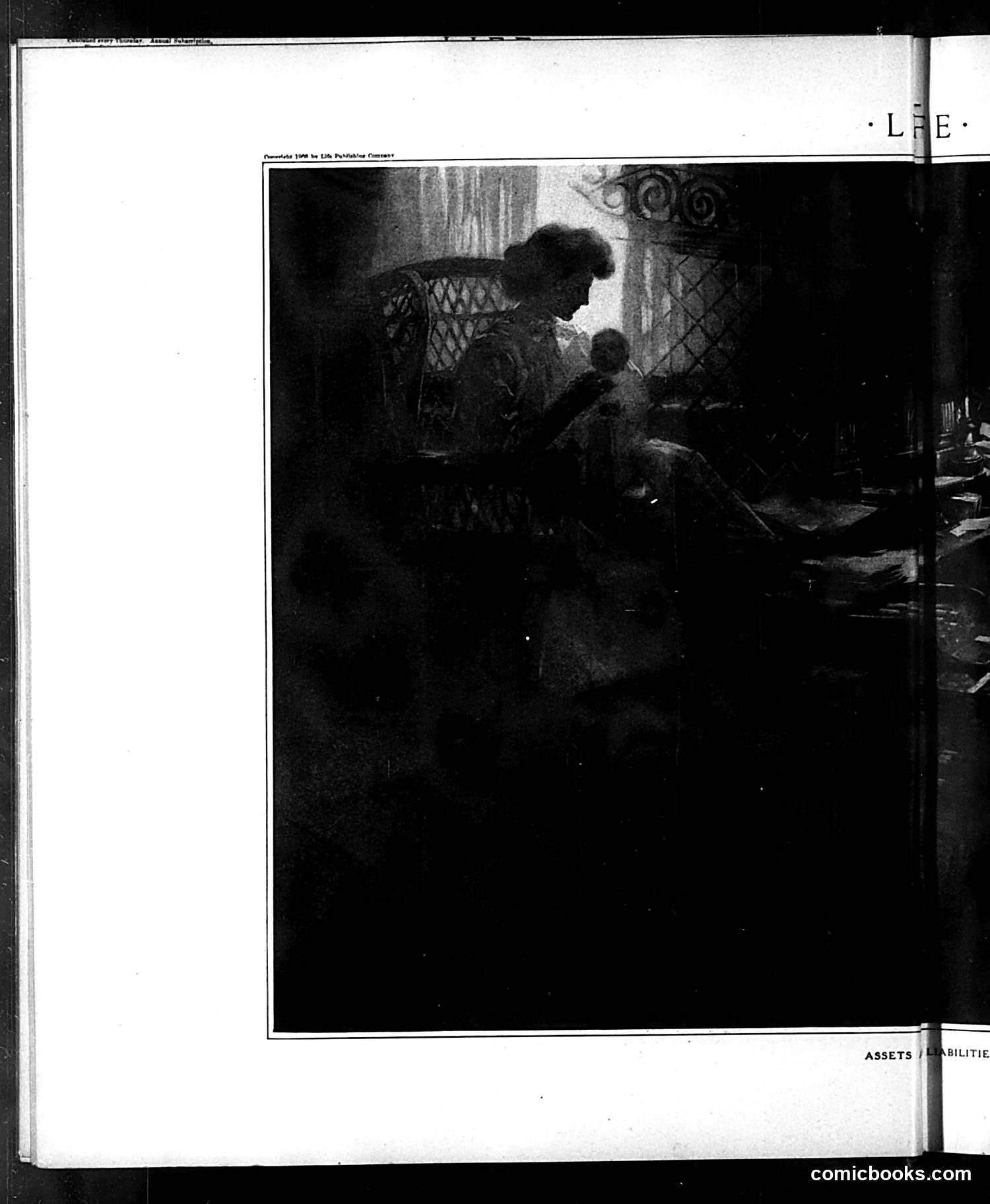
This appears to be a page from *Life* magazine featuring a dramatic black and white photograph rather than a traditional cartoon. The image shows two figures in what seems to be an interior domestic scene, with one person seated and another standing nearby. The lighting and composition suggest theatrical or staged photography. However, the image quality is quite poor, making specific identification of the figures difficult. The caption area is largely obscured or illegible in this reproduction. Without clearer text or identifying details visible in the photograph itself, I cannot confidently identify who these figures represent or what political or social commentary this page was intended to convey to contemporary readers. To properly explain this page's satirical meaning, a higher-resolution image or legible caption text would be necessary.
I can see this is a page from Life magazine with a large black-and-white photograph occupying most of the space. The image appears to show an interior scene with dramatic lighting, but the details are too dark and unclear for me to identify specific figures or activities with confidence. The visible text fragment at the bottom reads "TS / LIABILITIES" which suggests this may be part of a larger article or feature, but without clearer text or additional context, I cannot reliably explain what cartoon or content this page contains, what it references, or what point it makes. To provide accurate historical analysis as requested, I would need either a clearer image or more legible OCR text.
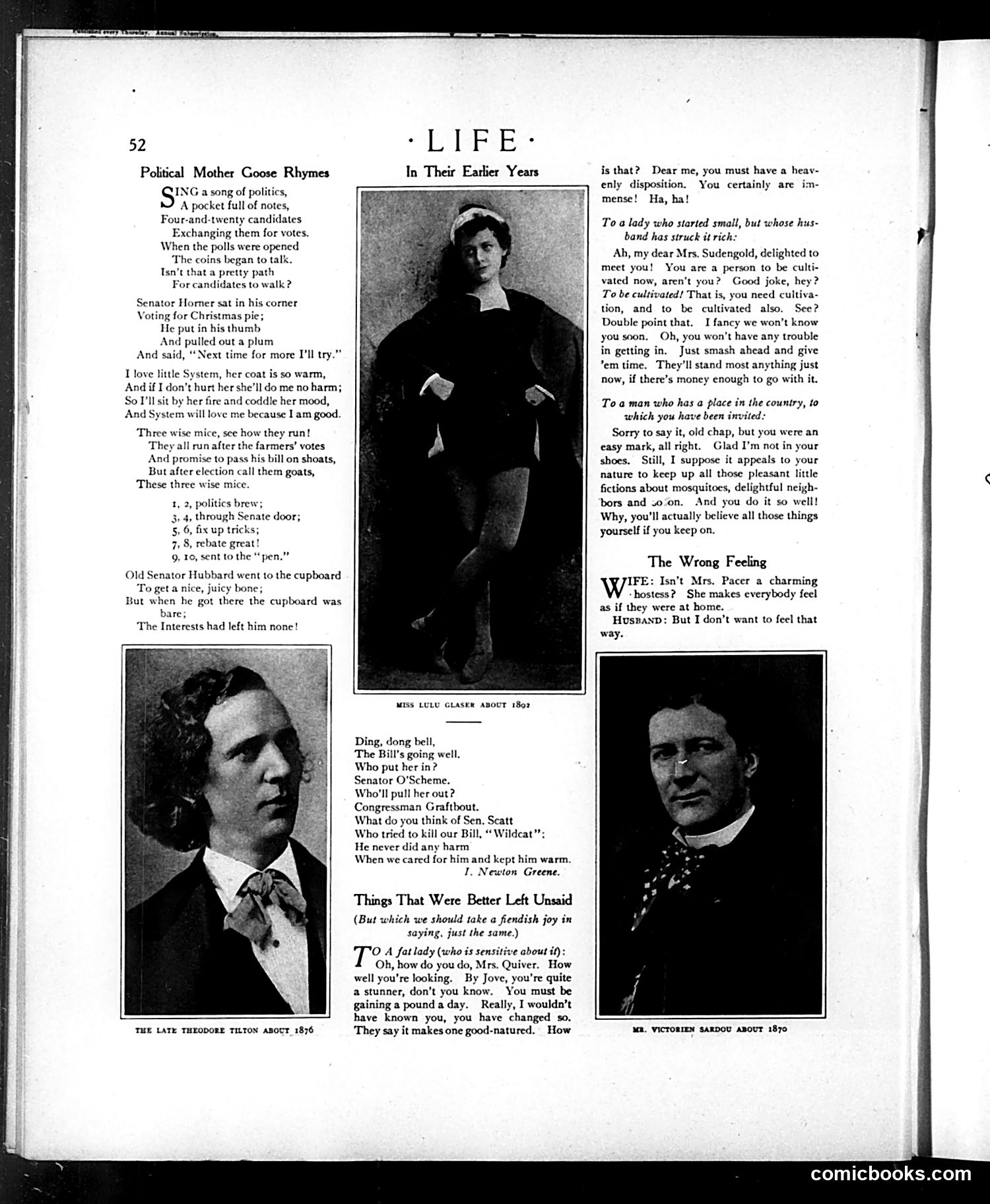
This page satirizes American politics through "Political Mother Goose Rhymes." The main poem mocks the corruption of electoral politics, depicting politicians (particularly "Senator Homer") literally buying votes with coins and bribes—"Voting for Christmas pie" and extracting a "plum" as payment. The rhyme about "three wise mice" appears to reference Senate corruption and backroom dealing ("through Senate door"). The page includes three portrait photographs identified as historical figures from around 1876-1870, likely included to provide gravitas or ironic contrast to the satirical verse. Below is a section titled "Things That Were Better Left Unsaid," offering social commentary on proper behavior and etiquette. The overall message critiques how money corrupts democratic processes and political integrity.
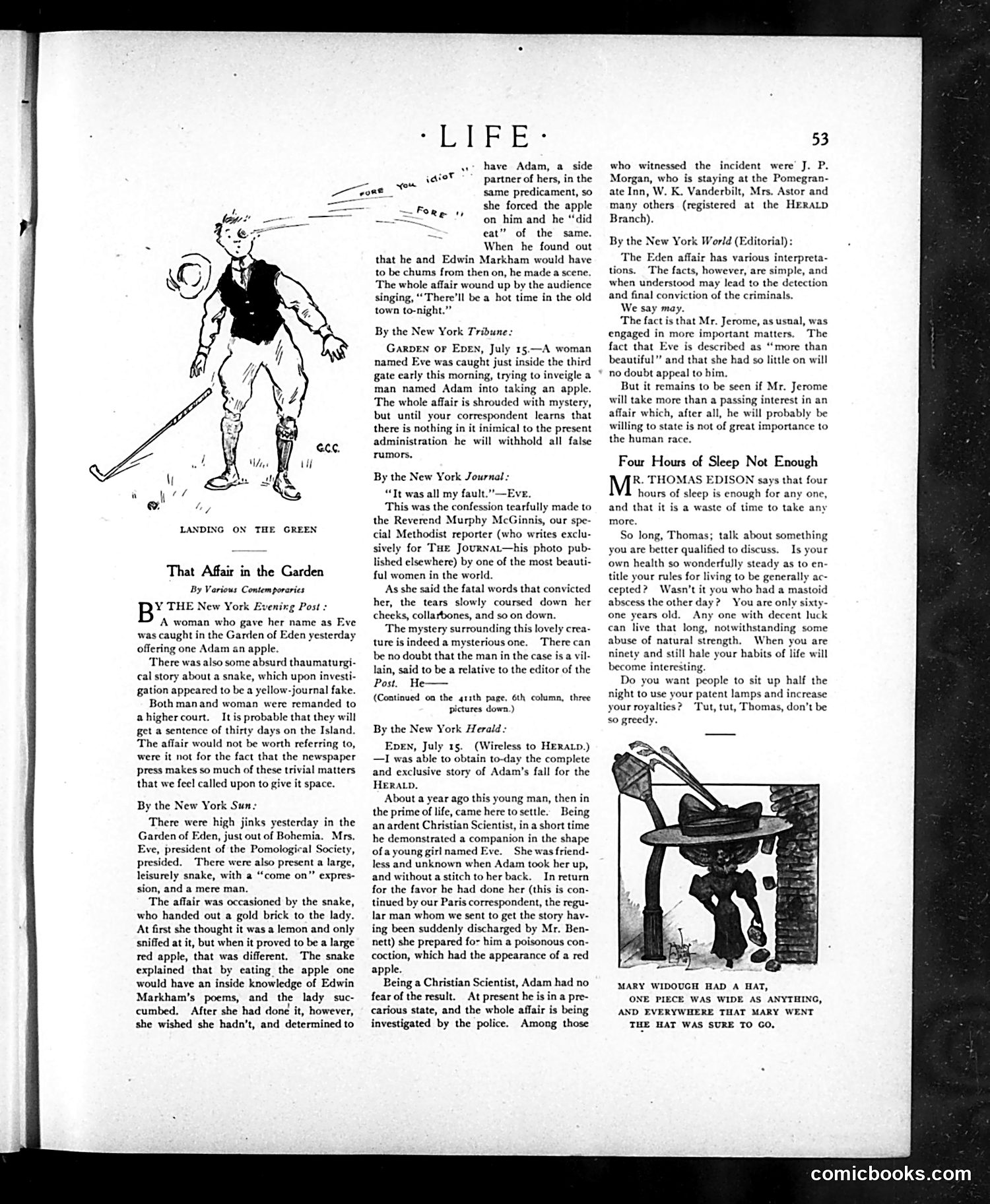
This cartoon depicts a golfer mid-swing, apparently hitting a ball wildly off course. The caption "LANDING ON THE GREEN" appears to be ironic—the figure's exaggerated pose and the chaotic trajectory suggest poor form rather than skillful play. The surrounding text discusses "That Affair in the Garden of Eden," referencing the biblical Adam and Eve story. Multiple newspapers are quoted providing different interpretations of a scandal involving a woman named Eve who offered Adam an apple in a garden setting. The cartoon likely satirizes how newspapers sensationalize and misinterpret events, each offering wildly different explanations—much like the golfer's ball going everywhere BUT the intended target. The "green" may metaphorically reference the difficulty of reaching truth amid conflicting narratives.
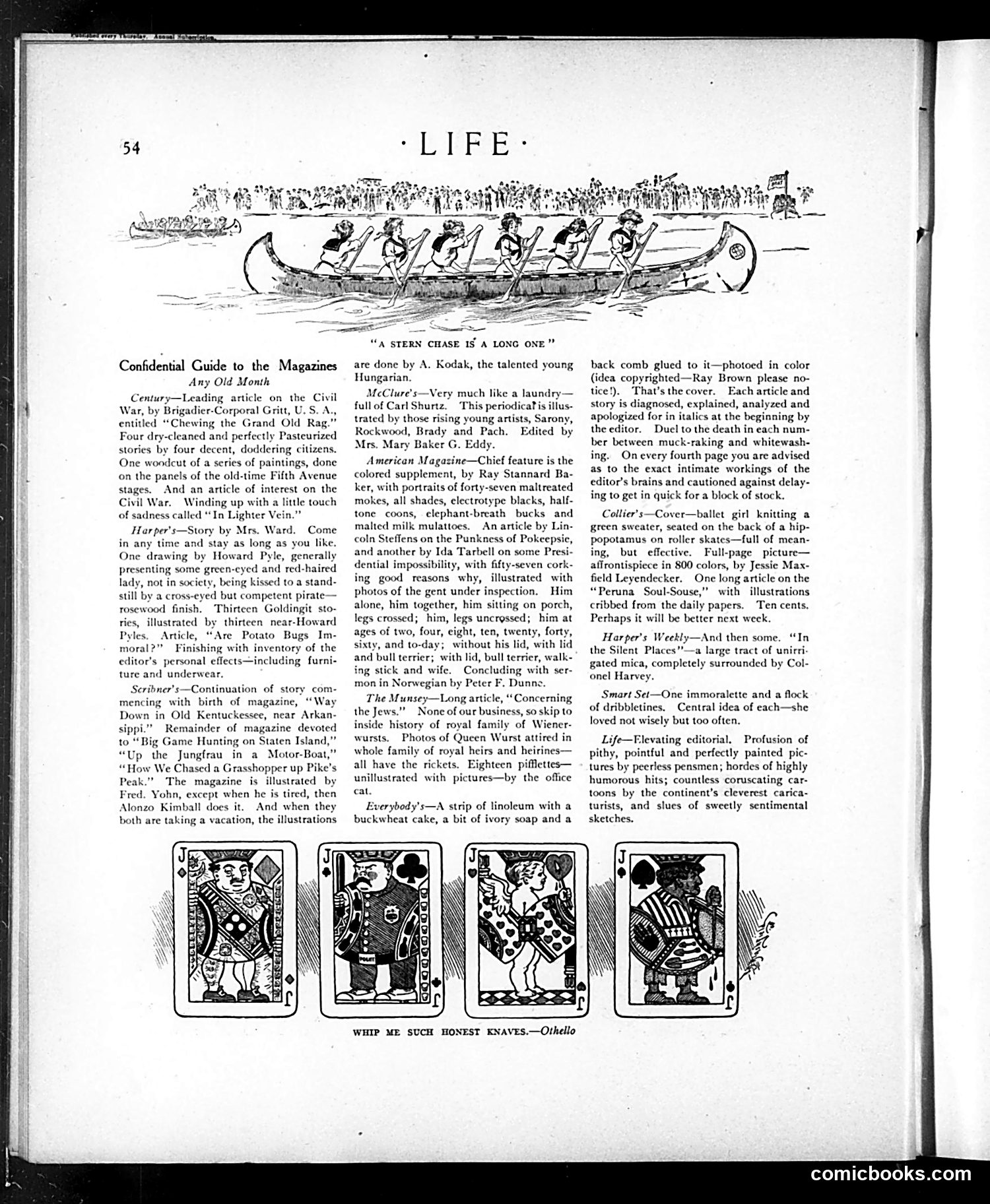
This is a satirical "guide" mocking major American magazines of the era. The top illustration shows a Roman galley—a visual metaphor for these publications as vessels carrying content. The text parodies each magazine's predictable formulas: - **Century**: Civil War nostalgia and safe, dull stories - **Harper's**: Formulaic romance stories with pirates and Howard Pyle's signature illustrations - **Scribner's**: Adventure travel pieces by the same illustrators repeatedly - **McClure's**: Compared to a laundry; attributed (mockingly) to Mary Baker G. Eddy - **American Magazine**: The racist language here reflects period attitudes; satirizes Ray Stannard Baker's illustrated articles about political figures - **Munsey's**: Trivial content about royalty - **Everybody's**: Self-important editorial commentary and financial stock-pushing - **Collier's**: Over-designed covers with absurd imagery The card illustration below quotes *Othello*, likely reinforcing the mockery of editorial pretension. The satire targets these magazines' repetitive formulas and self-importance rather than political positions.
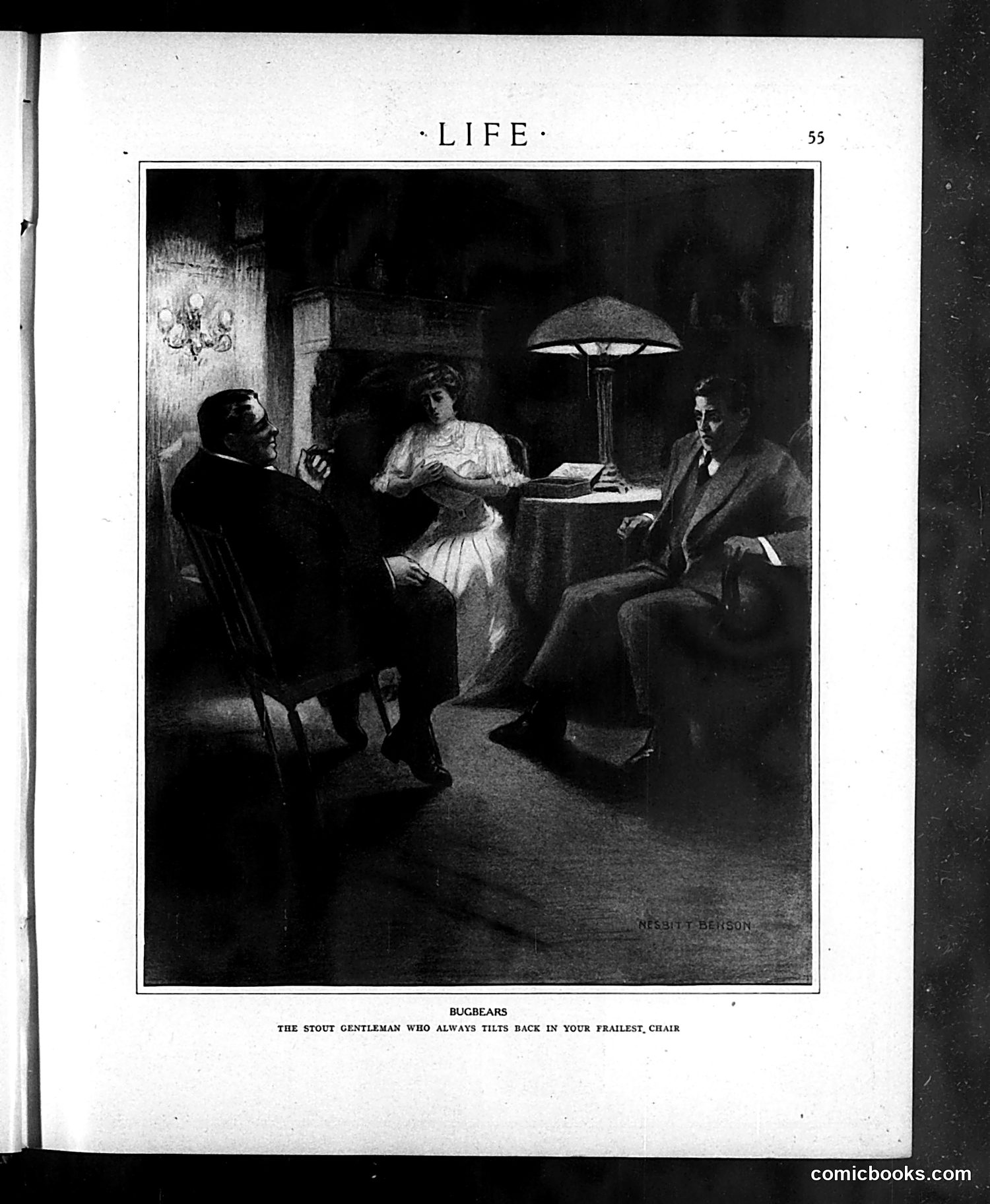
This illustration satirizes a common social annoyance: the inconsiderate guest who tilts back in a delicate chair. The cartoon shows three figures in an interior setting—a heavyset man recklessly tilting back in a fragile chair while a woman and another man observe, apparently concerned or disapproving. The humor targets the "stout gentleman" whose obliviousness to social courtesy (and physics) creates an awkward situation. By labeling this behavior a "bugbear"—a source of irritation or anxiety—Life magazine is mocking a recognizable character type: the insensitive visitor who damages furniture through carelessness or ignorance of proper etiquette. The satire reflects early 20th-century anxieties about manners and social propriety among mixed company in domestic spaces.
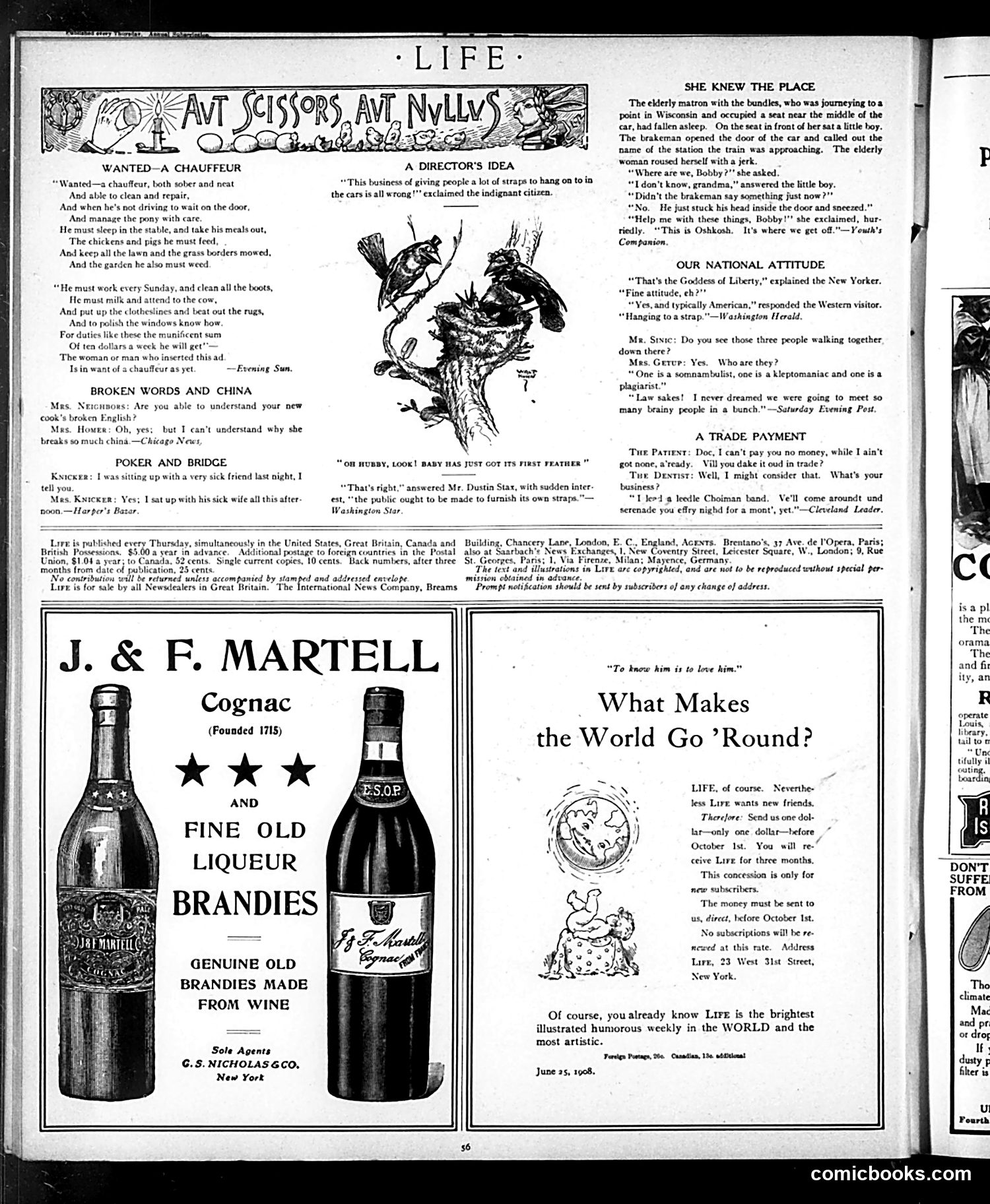
This page contains multiple brief satirical jokes typical of Life magazine's humor format: **"Wanted—A Chauffeur"** mocks the unrealistic job expectations of wealthy employers, listing absurd duties (mowing lawns, feeding chickens, milking cows) alongside driving—all for $10/week. It satirizes both employer greed and the pretensions of the newly motorized upper class. **"Our National Attitude"** jokes about American materialism and pragmatism, showing the Statue of Liberty holding a strap (from streetcars), suggesting Americans value commerce over ideals. **"She Knew the Place"** is a gentle joke about an elderly woman mistaking a sneeze for the brakeman announcing a station stop, playing on deafness and mishearing. **"A Trade Payment"** depicts an immigrant (indicated by broken English dialect) offering to pay a dentist with a band serenade—poking fun at immigrant poverty and cultural differences. The page is primarily **humorous commentary** on class divisions, immigration, and modern American life, with advertising for J. & F. Martell Cognac interspersed. These are lightweight social observations rather than hard political satire.
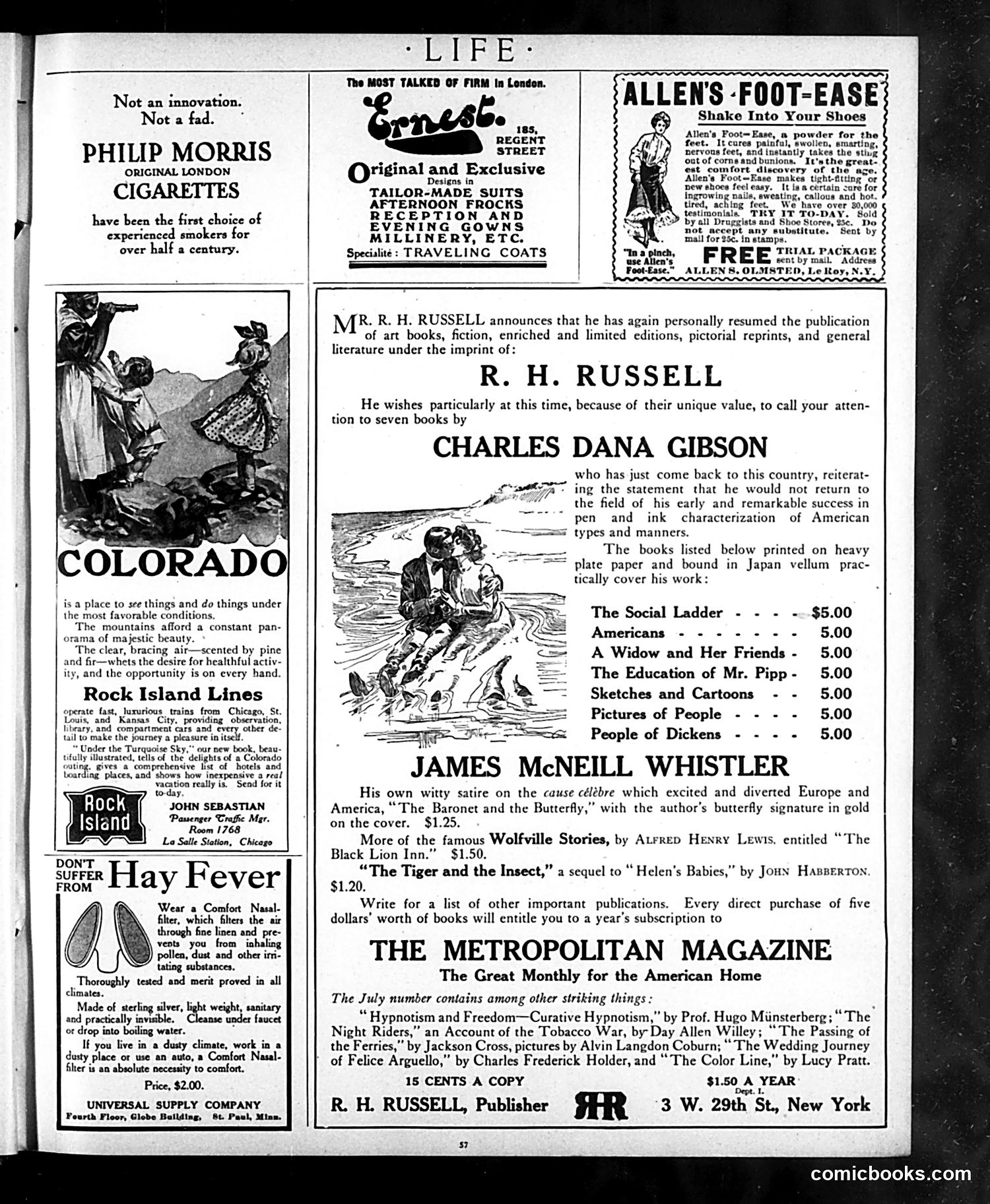
This page is primarily **advertising**, not political satire. It contains luxury product advertisements typical of Life magazine's affluent readership. The largest visual element depicts **"Colorado"** as a tourist destination—a woman and child in period dress enjoying mountainous scenery. The copy emphasizes health benefits (mountain air, activity) and promotes Rock Island railroad lines serving Colorado vacations. Other advertisements promote: - **Philip Morris cigarettes** (claiming 50+ years of preference among "experienced smokers") - **Allen's Foot-Ease powder** (for foot comfort and bunions) - **A "Comfort Nasal-filter"** (a sterling silver device blocking dust/pollen—addressing hay fever) - **Fashion/tailoring services** from a London firm - **Books by Charles Dana Gibson** (famous illustrator of "Gibson Girls") and James McNeill Whistler **No political cartoon appears here.** The page reflects turn-of-the-century consumer culture targeting the wealthy—promoting luxury travel, health products, fine clothing, and literature. The imagery and messaging emphasize leisure, refinement, and modern comfort.
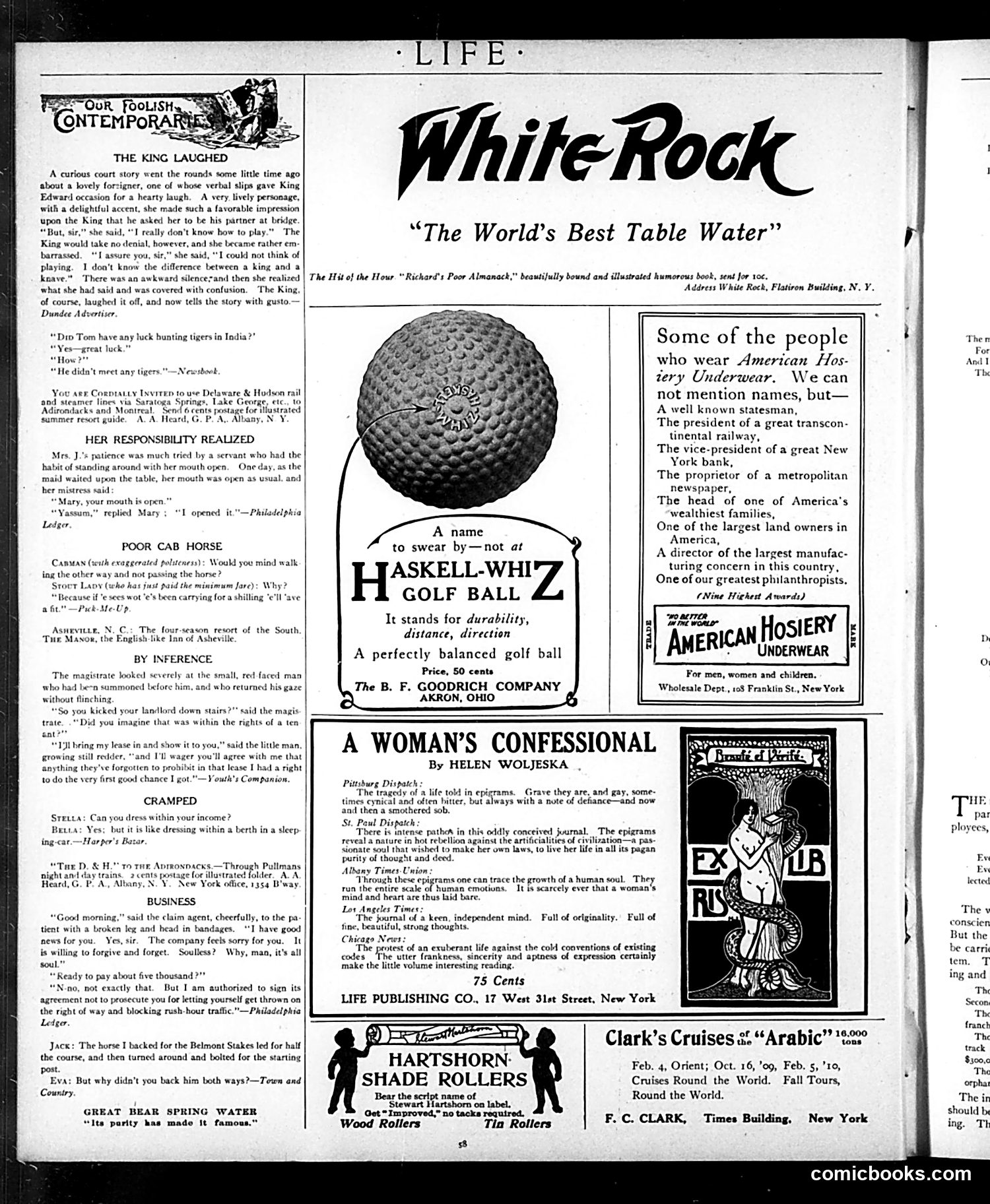
This page from *Life* magazine consists primarily of **humorous anecdotes and advertisements** rather than political cartoons. The content reflects early 20th-century American humor conventions. The jokes satirize social situations: a foreign woman embarrasses herself before King Edward by confusing "king and knave" (a double entendre about royalty and card games); a servant's literal interpretation of instructions; a cab driver's concern his horse will realize its meager wages; and a claim agent's mockery of corporate "compassion." The advertisements promote products like White Rock table water, Haskell-Whiz golf balls, and American Hosiery. One ad lists unnamed prominent individuals who use White Rock—a marketing technique suggesting widespread elite endorsement without actual names. The humor reflects period attitudes about class hierarchies, servant relationships, and gender—topics considered amusing to *Life*'s educated readership. The content is social satire rather than political commentary.
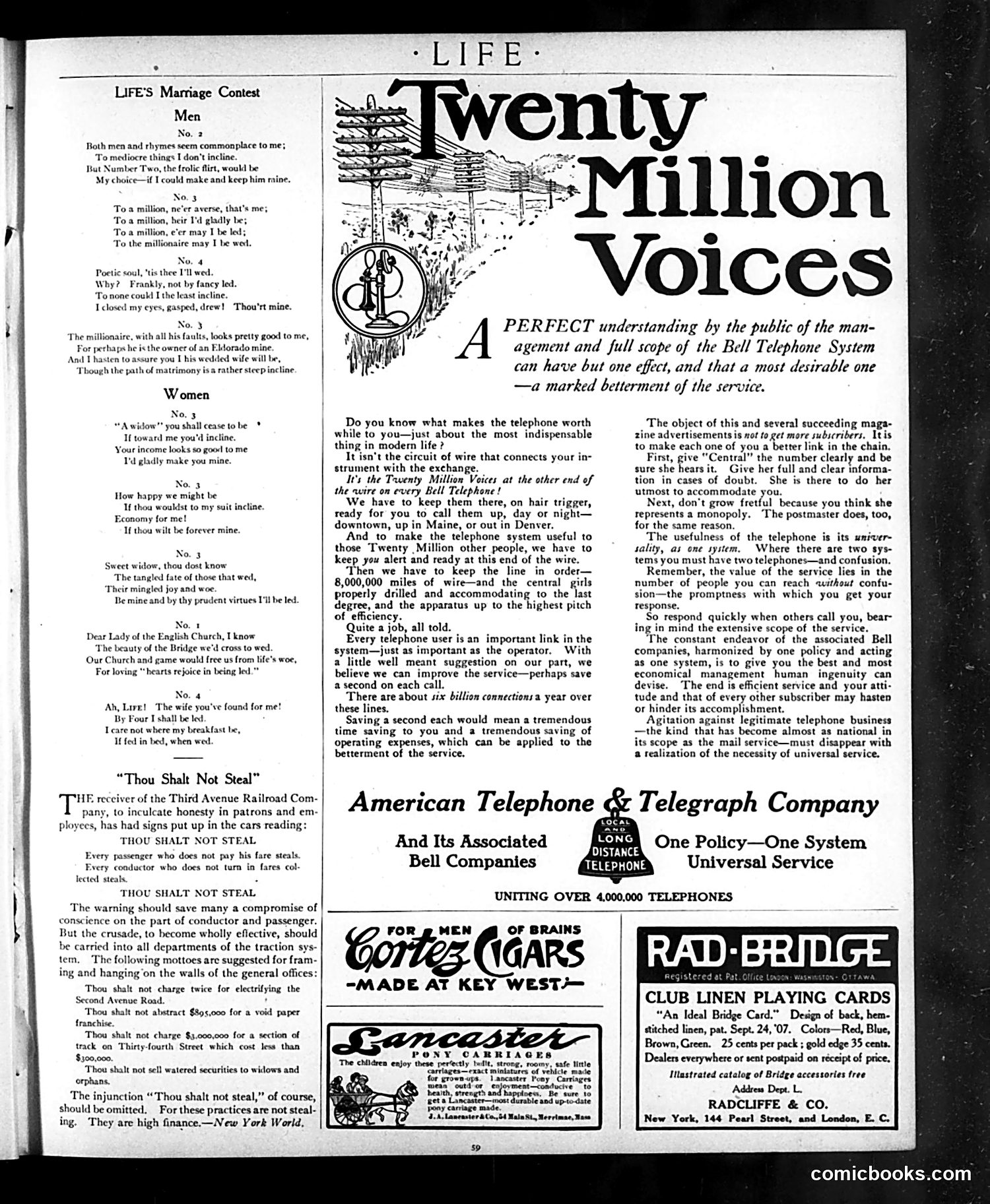
This page contains satirical marriage contest entries and corporate messaging, not political cartoons. **"Marriage Contest":** Life satirizes romantic motivations by presenting contestants (both male and female) with transparently materialistic reasons for marriage. Women seek millionaires or wealthy widows; men pursue women with money or "Eldorado mines." The humor lies in the stark contrast between flowery romantic language ("poetic soul," "hearts rejoice") and naked financial calculation. This mocks both the pretense of Victorian courtship and the reality that marriage often involved economic transactions. **"Thou Shalt Not Steal":** This section critiques railroad management hypocrisy. While the Third Avenue Railroad posted moral commandments to prevent passenger fare evasion and employee theft, Life sarcastically suggests the real stealing occurs at management level—through inflated franchise charges, overpriced track sales, and watered securities sold to vulnerable widows and orphans. The satire exposes how corporations invoke morality for workers while engaging in "high finance" (legalized fraud). The Bell Telephone advertisement emphasizes system reliability and user responsibility—corporate messaging rather than satire.
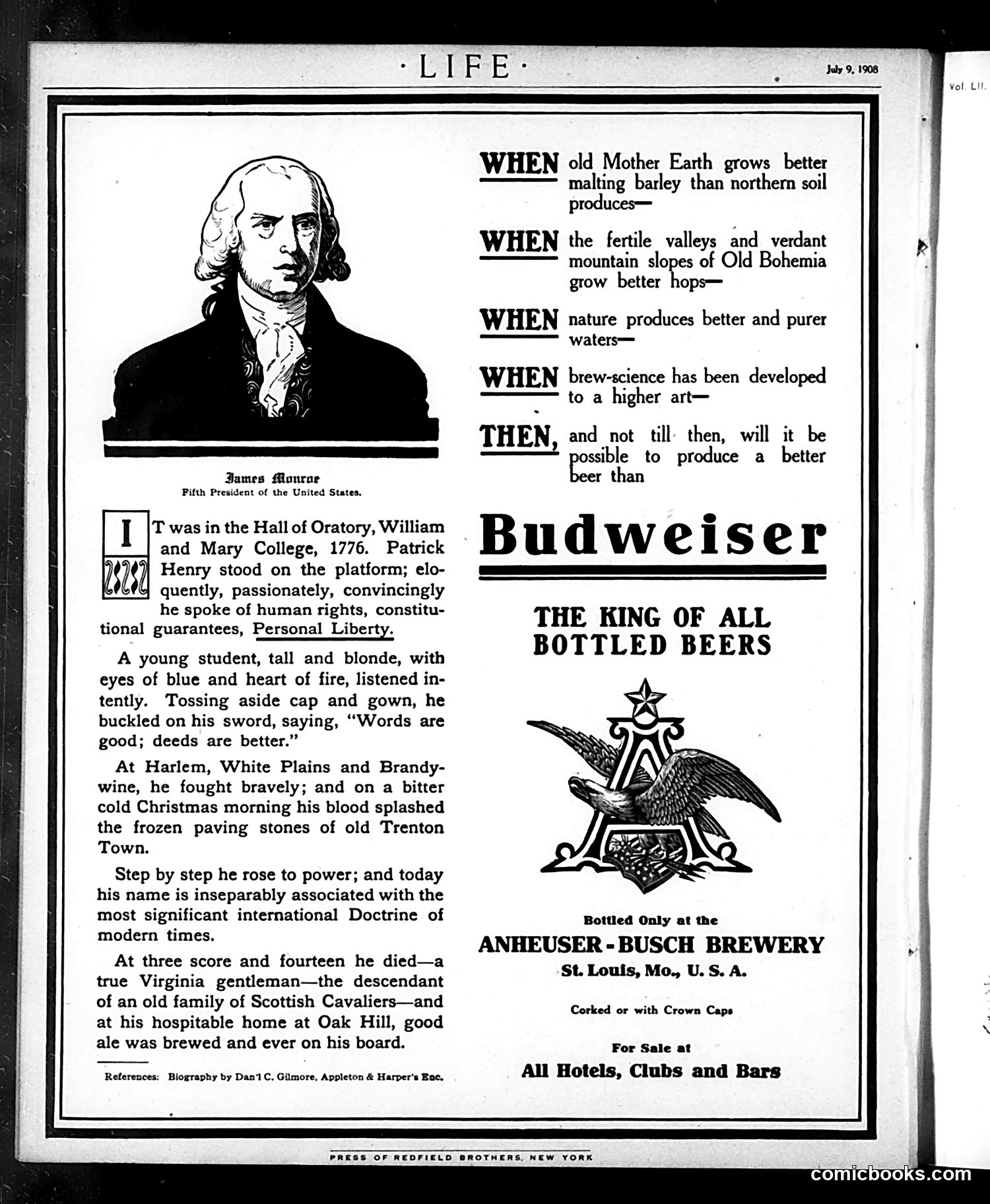
This is primarily a **Budweiser beer advertisement** disguised as historical editorial content, dated July 9, 1908. The left side presents a romanticized biography of James Monroe (Fifth President), emphasizing his patriotism, military service, and gentlemanly character—culminating with the detail that "good ale was brewed and ever on his board." This appeals to readers' patriotic sentiment and suggests beer-drinking is consistent with American virtue. The right side is the actual advertisement: Budweiser claims superiority through a conditional logic device. It asserts that only when conditions become impossibly superior (better barley, hops, water, and brewing science than currently exist) could a better beer be made—*then* Budweiser could be surpassed. Until those impossible conditions occur, Budweiser remains supreme. The juxtaposition conflates American patriotic tradition with beer consumption, subtly legitimizing Budweiser as authentically American and patriotic—a common advertising strategy of the era.