
Life, 1908-07-09 · page 4 of 20
Life — July 9, 1908 — page 4: what you’re looking at
What you’re looking at
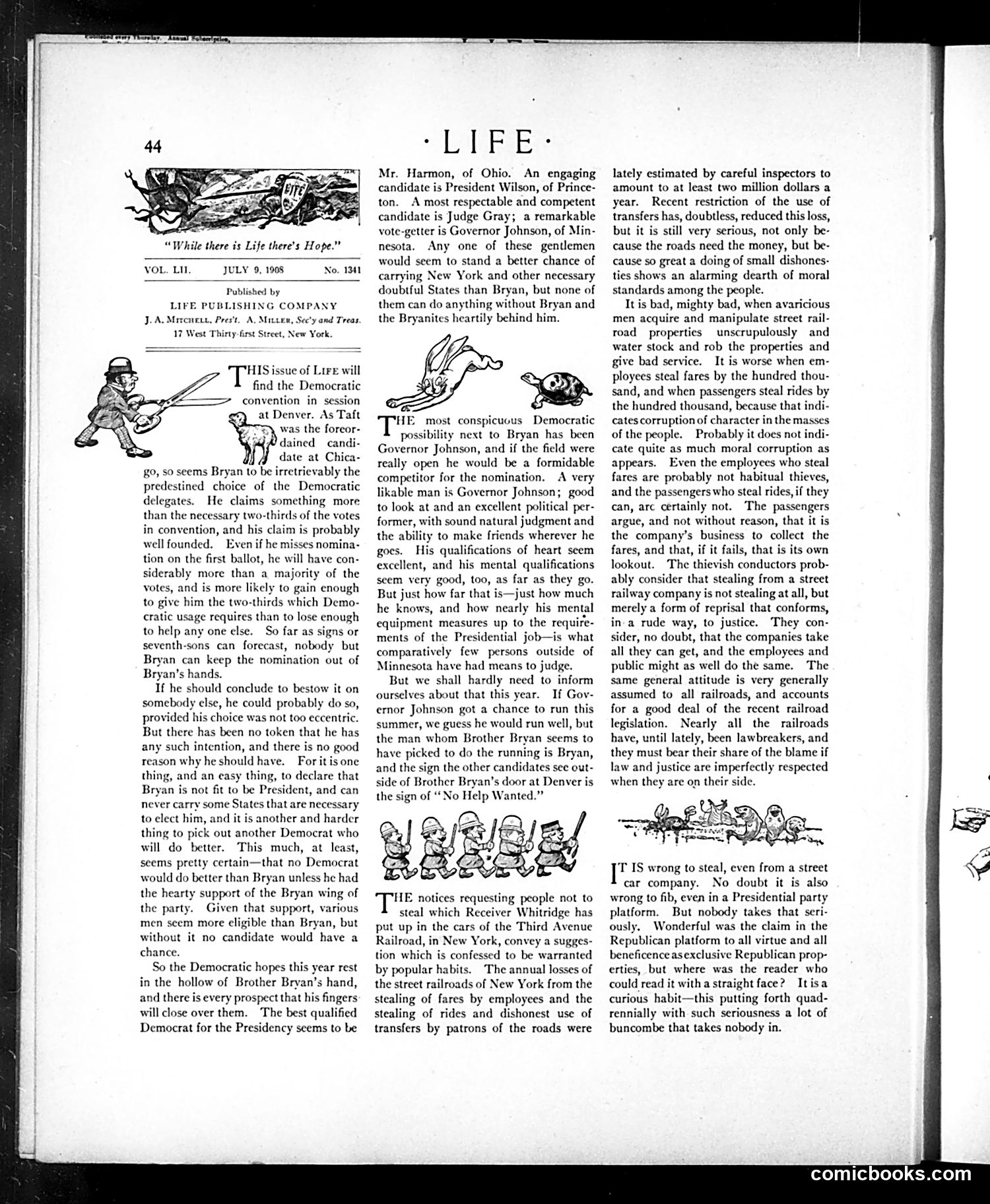
This page discusses the 1908 Democratic National Convention, examining potential presidential candidates as William Jennings Bryan's political influence wanes. The text considers Governors Johnson (Minnesota) and Gray as alternatives to Bryan, debating whether Bryan retains enough party support to influence the nomination. The cartoon at top shows five caricatured heads in a row—likely representing competing Democratic candidates or factional leaders at the convention. The satire centers on whether Bryan can maintain control of the Democratic Party despite his previous electoral losses, and whether Democrats should nominate someone fresh or continue backing Bryan's preferred candidate. The page ultimately questions whether Democratic prospects depend on Bryan's continued dominance.
📄 Transcribed text from this page (OCR, searchable)
Machine-transcribed from the original scan — historical spelling and the odd misread are preserved.
“While there is Life there’s Hope.” VOL. Li JULY 9, 1908 No. 1341 Published by LIFE PUBLISHING COMPANY J.-A. Mrrcuent, Pres't, A, Mitre, Sec’y and Treas. 17 West Thirty-first . New York. 'HIS issue of Lire will find the Democratic convention in session at Denver. As Taft was the foreor- dained candi- date at Chica- go, so seems Bryan to be irretrievably the predestined choice of the Democratic delegates. He claims something more than the necessary two-thirds of the votes. in convention, and his claim is probably well founded, n if he misses nomina- tion on the first ballot, he will have con- siderably more than a majority of the votes, and is more likely to gain enough to give him the two-thirds which Demo- cratic usage requires than to lose enough to help any one else. So far as signs or seventh-sons can forecast, nobody but Bryan can keep the nomination out of Bryan's hands If he should conclude to bestow it on somebody else, he could probably do so, provided his choice was not too eccentric. But there has been no token that he has any such intention, and there is no good reason why he should have. For it is one thing, and an easy thing, to declare that Bryan is not fit to be President, and can never carry some States that are necessary to elect him, and it is another and harder thing to pick out another Democrat who will do better. This much, at least, seems pretty certain—that no Democrat would do better than Bryan unless he had the hearty support of the Bryan wing of the party. Given that support, various men seem more eligible than Bryan, but without it no candidate would have a chance. So the Democratic hopes this year rest in the hollow of Brother Bryan’s hand, and there is every prospect that his fingers will close over them. The best qualified Democrat for the Presidency seems to be Mr. Harmon, of Ohio. An engaging candidate is President Wilson, of Prince- ton. A most respectable and competent candidate is Judge Gray; a remarkable vote-getter is Governor Johnson, of Min- nesota. Any one of these gentlemen would seem to stand a better chance of carrying New York and other necessary doubtful States than Bryan, but none of them can do anything without Bryan and the Bryanites heartily behind him. eh HE, most conspicuous Democratic possibility next to Bryan has been Governor Johnson, and if the field were really open he would be a formidable competitor for the nomination. A very likable man is Governor Johnson; good to look at and an excellent political per- former, with sound natural judgment and the ability to make friends wherever he goes. His qualifications of heart seem excellent, and his mental qualifications seem very good, too, as far as they go. But just how far that is—just how much he knows, and how nearly his mental equipment measures up to the require- ments of the Presidential job—is what comparatively few persons outside of Minnesota have had means to judge. But we shall hardly need to inform ourselves about that this year. If Gov- ernor Johnson got a chance to run this summer, we guess he would run well, but the man whom Brother Bryan seems to have picked to do the running is Bryan, and the sign the other candidates sec out- side of Brother Bryan’s door at Denver is the sign of ‘No Help Wanted.” HE notices requesting people not to steal which Receiver Whitridge has put up in the cars of the Third Avenue Railroad, in New York, convey a sugges- tion which is confessed to be warranted by popular habits. The annual losses of the street railroads of New York from the stealing of fares by employees and the stealing of rides and dishonest use of transfers by patrons of the roads were lately estimated by careful inspectors to amount to at least two million dollars a year. Recent restriction of the use of transfers has, doubtless, reduced this loss, but it is still very serious, not only be- cause the roads need the money, but be- cause so great a doing of small dishones- ties shows an alarming dearth of moral standards among the people. It is bad, mighty bad, when avaricious men acquire and manipulate street rail- road properties unscrupulously and water stock and rob the properties and give bad service. It is worse when em- ployees steal fares by the hundred thou- sand, and when passengers steal rides by the hundred thousand, because that indi- cates corruption of character in the masse: of the people. Probably it does not indi- cate quite as much moral corruption as appears. Even the employces who steal fares are probably not habitual thieves, and the passengers who steal rides, if they can, arc certainly not. The passengers argue, and not without reason, that it is the company’s business to collect the fares, and that, if it fails, that is its own lookout. The thievish conductors prob- ably consider that stealing from a street railway company is not stealing at all, but merely a form of reprisal that conforms, in-a rude way, to justice. They con- sider, no doubt, that the companies take all they can get, and the employees and public might as well do the same. The same general attitude is very generally assumed to all railroads, and accounts for a good deal of the recent railroad legislation. Nearly all the railroads have, until lately, been lawbreakers, and they must bear their share of the blame if law and justice are imperfectly respected when they are on their side. 'T IS wrong to steal, even from a street car company. No doubt it is also wrong to fib, even in a Presidential party platform. But nobody takes that seri- ously, Wonderful was the claim in the Republican platform to all virtue and all beneficence asexclusive Republican prop- erties, but where was the reader who could read it with a straight face? Itisa curious habit—this putting forth quad- rennially with such seriousness a lot of buncombe that takes nobody in. comicbooks.com