
A complete issue · 20 pages · 1908
Life — May 14, 1908
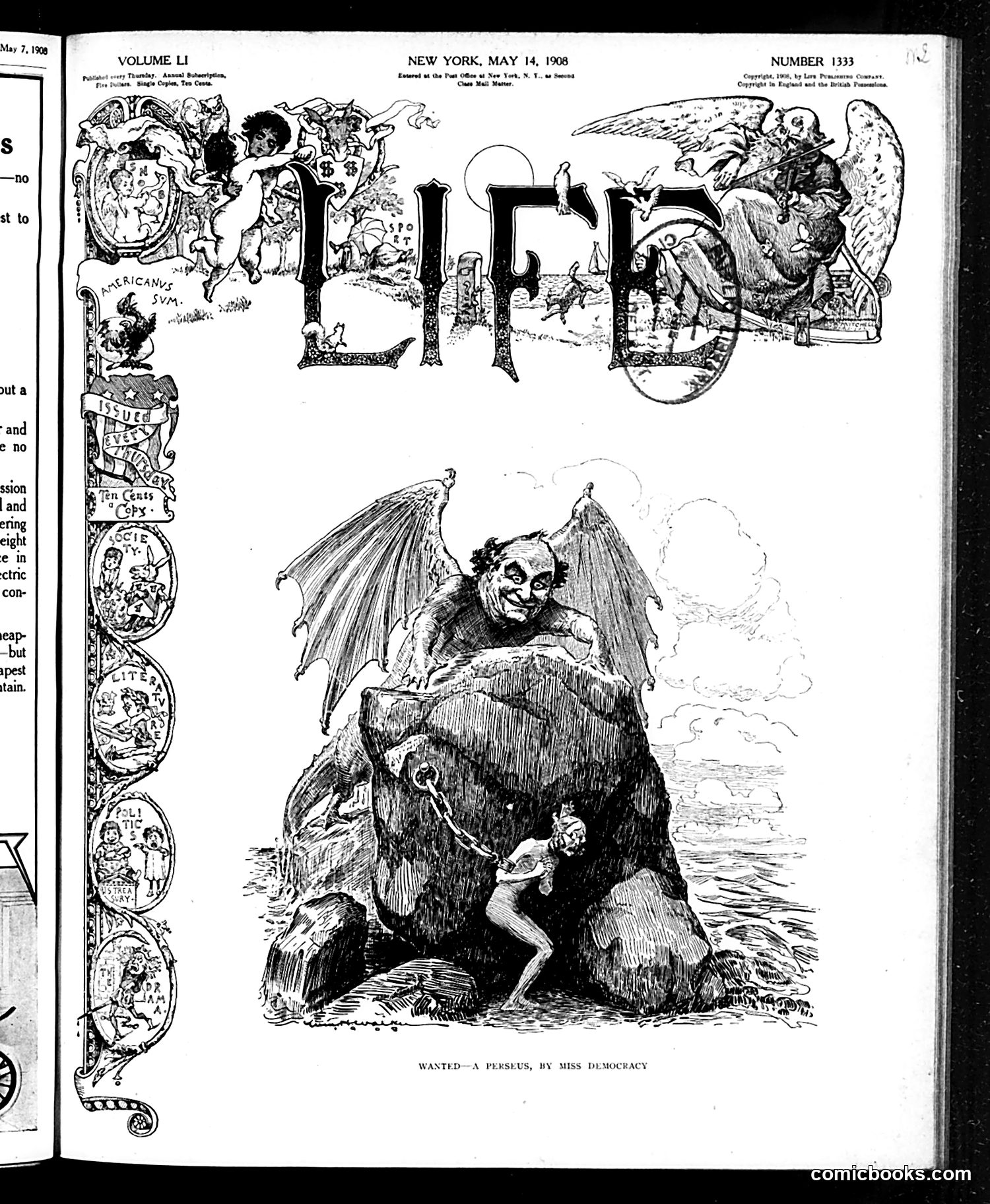
This satirical page features two cartoons critiquing American democracy and politics during the 1908 election period. The top illustration, titled "Life," uses ornate lettering filled with chaotic scenes of political activity and turmoil, suggesting the disorder of democratic processes. The bottom cartoon, captioned "Wanted—A Perseus, by Miss Democracy," depicts a winged demon or devil-like creature labeled as a threat that democracy needs to vanquish. A small heroic figure (Perseus, the mythological hero) confronts this monster, representing democracy's struggle against some malevolent force—likely political corruption or a despised political figure of the era. The artwork employs classical mythology to frame contemporary political anxieties, suggesting that American democracy faced serious threats requiring heroic intervention.
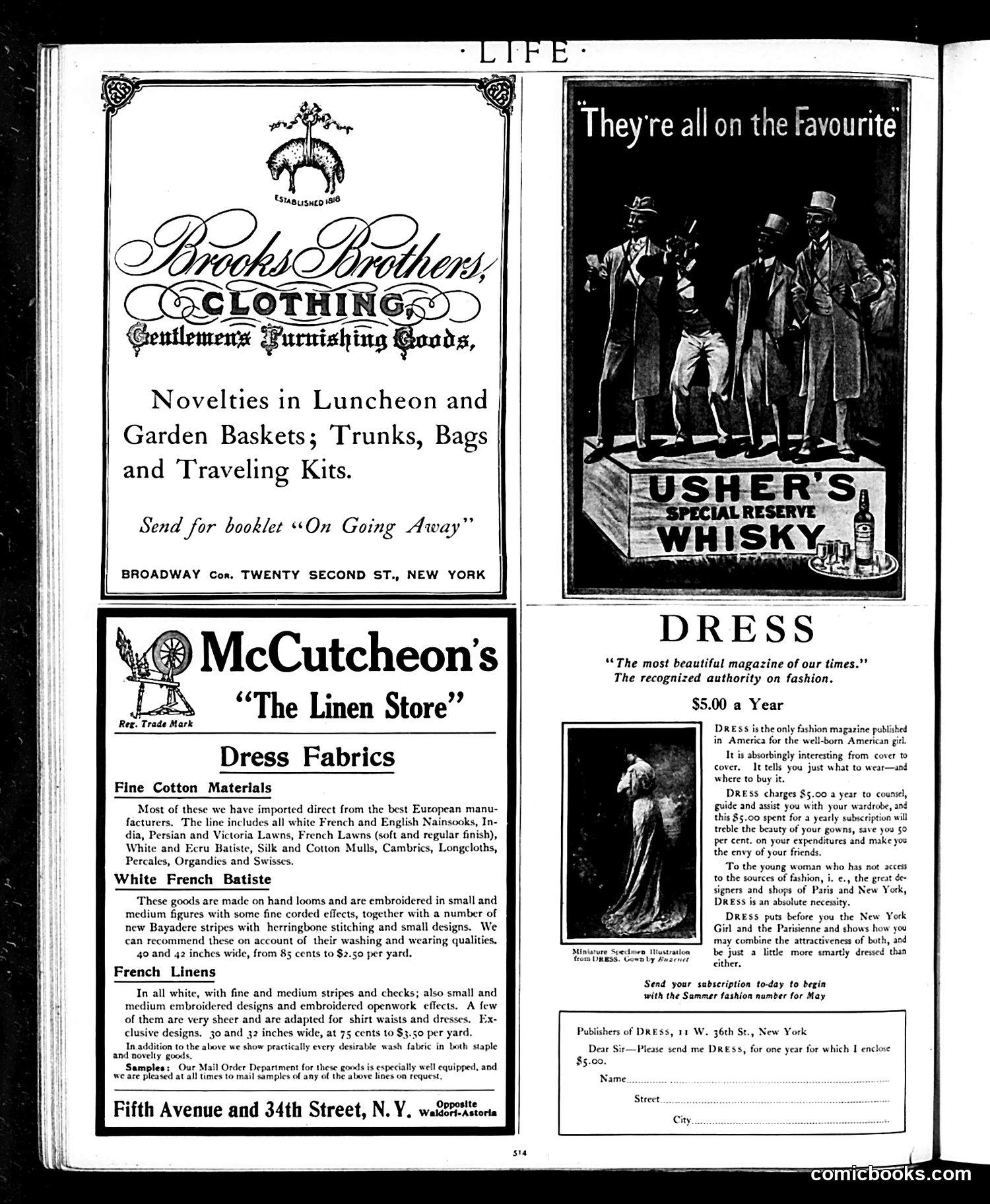
This page is primarily **advertising**, not political satire. The left column contains ads for Brooks Brothers clothing and McCutcheon's linen fabrics. The right side advertises Usher's Special Reserve Whisky and DRESS magazine. The whisky ad's headline "They're all on the Favourite" appears to reference horse racing or gambling, showing well-dressed men—likely suggesting the product appeals to fashionable gentlemen. The image itself isn't a political cartoon but rather a commercial illustration meant to convey luxury and sophistication. The DRESS magazine advertisement emphasizes it as "the recognized authority on fashion" and "the most beautiful magazine of our times," positioned as essential for American women interested in style and Paris fashions. No clear political commentary or satire is evident on this page.
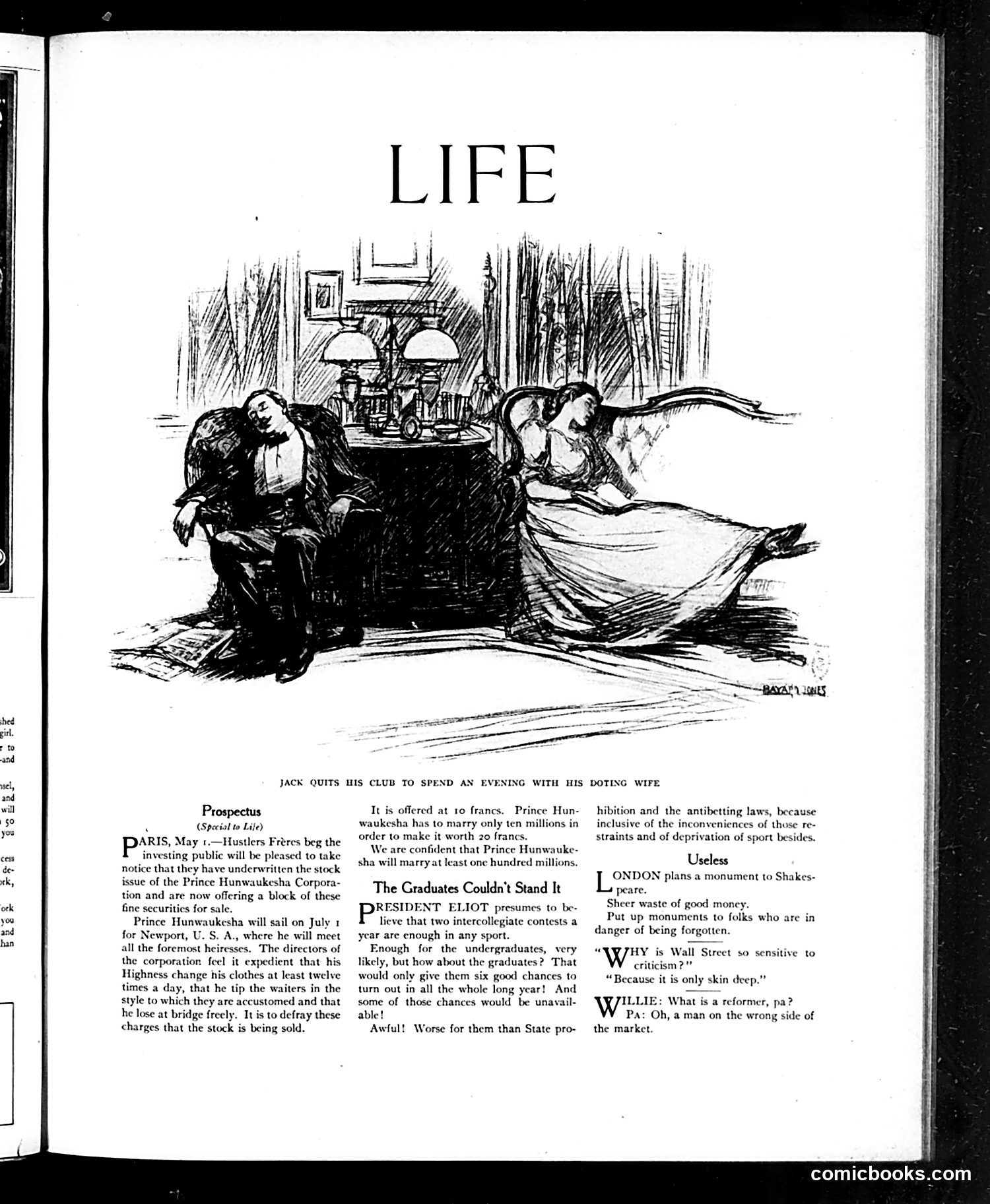
The main cartoon depicts a man in formal attire abandoning his wife to spend an evening at his club. The caption reads "JACK QUITS HIS CLUB TO SPEND AN EVENING WITH HIS DOTING WIFE" — the irony being that leaving the club for his wife is presented as noteworthy, suggesting husbands typically neglect domestic life for male social spaces. The text sections below discuss various topics: Prince Humbert's marriage prospects, President Eliot's concerns about university graduates unprepared for real life, London's Shakespeare monument plans, and satirical asides on Wall Street sensitivity and reform. The overall theme mocks upper-class priorities—male social clubs, financial speculation, and institutional vanity—while critiquing how ordinary domestic duties become remarkable when men actually fulfill them.
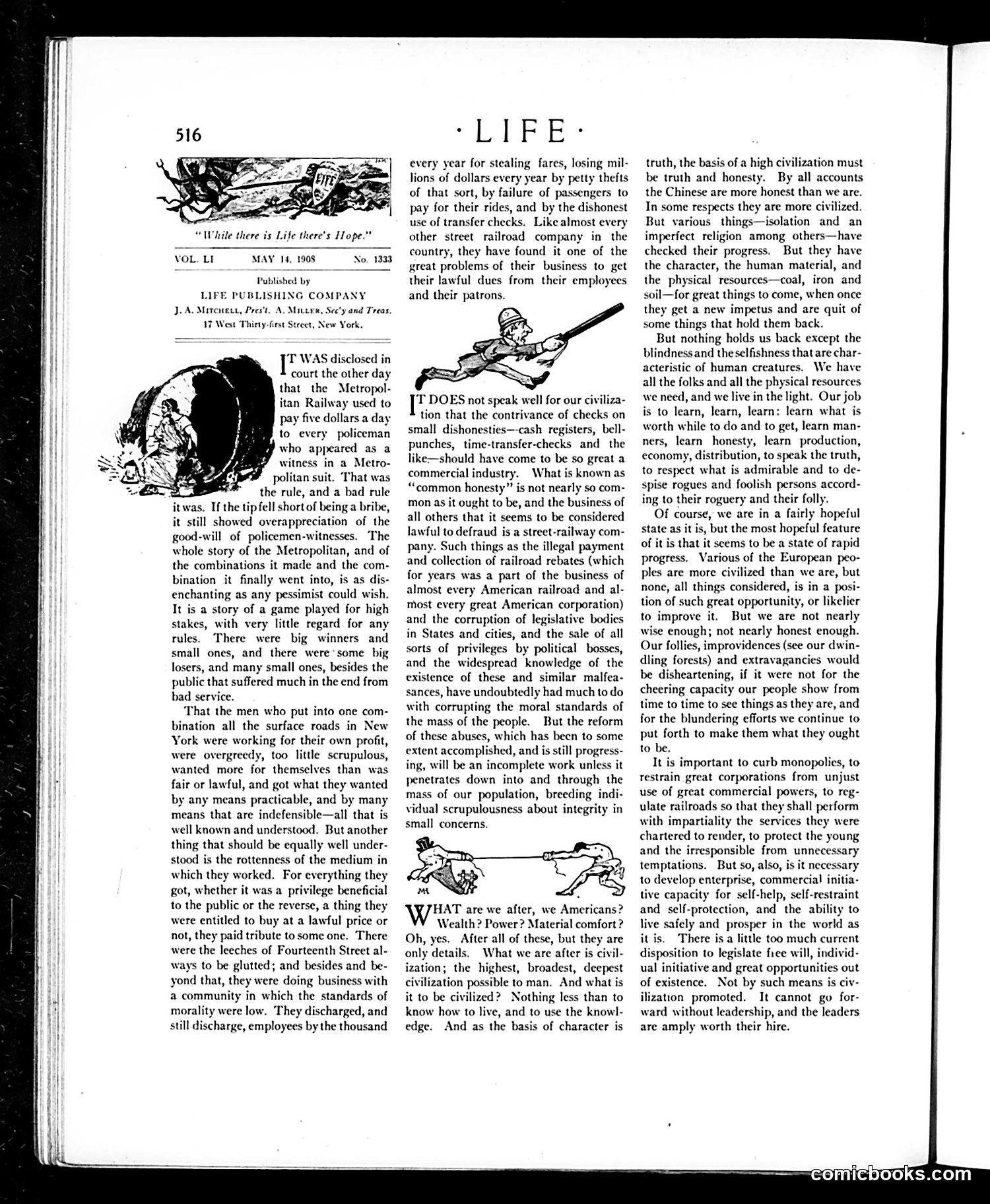
The page contains editorial text rather than political cartoons. Two small illustrations appear—one showing a figure in what appears to be a subway or tunnel setting, and another depicting a figure in motion (possibly diving or falling). The text discusses corruption in American railroads and municipal governance, specifically referencing a Metropolitan Railway bribery case involving five-dollar daily payments to policemen. The author criticizes widespread dishonesty in American business and government, arguing such moral failures undermine civilization. The editorial advocates for reform through honest leadership and self-regulation of commerce, rather than legislation alone. It reflects Progressive Era concerns about corporate malfeasance and civic corruption affecting the early 1900s. The illustrations appear decorative rather than satirical commentary on the main argument.
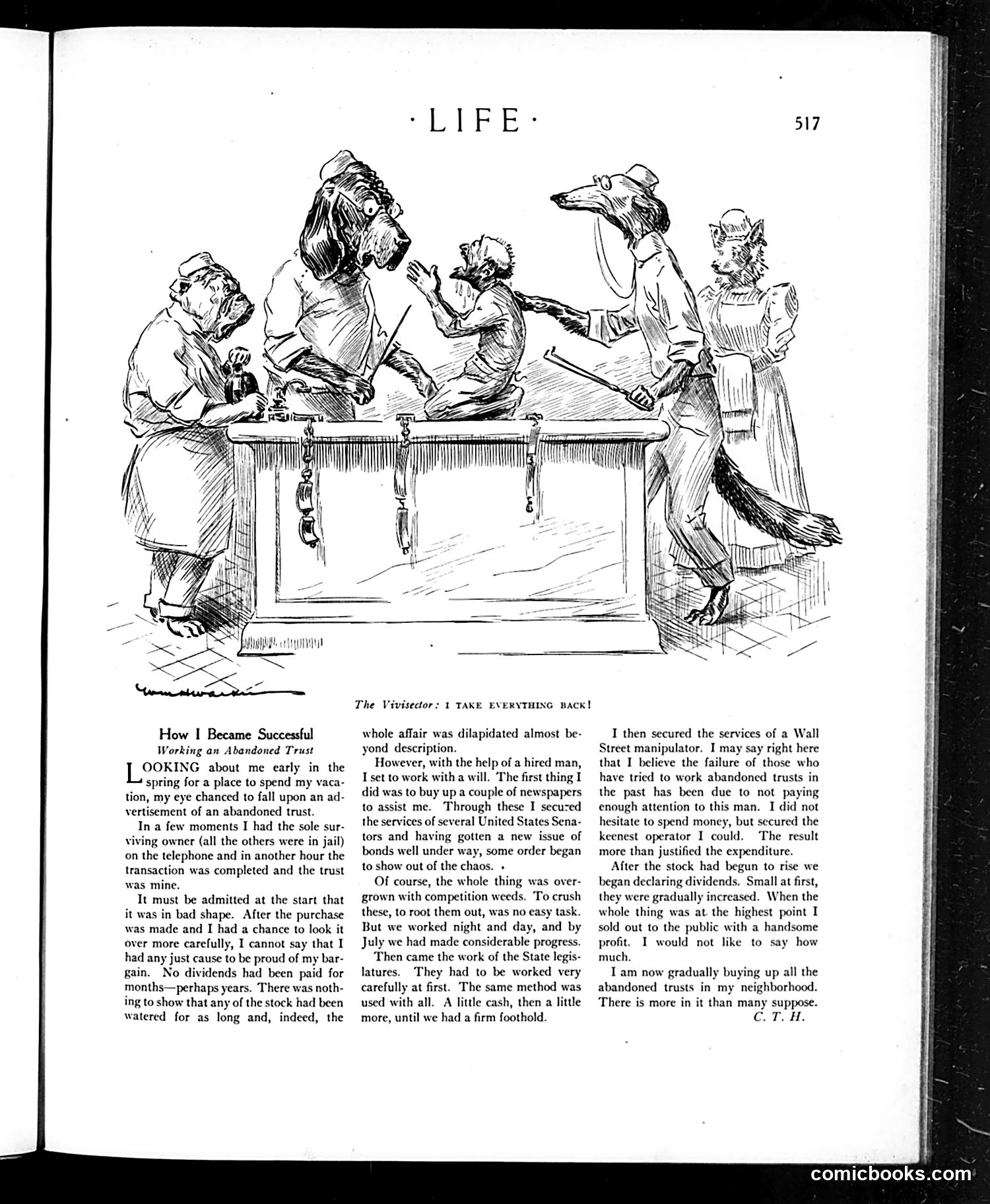
**The Cartoon:** The illustration shows anthropomorphic animals (appearing to be a vivisecter with a dog, and other animal figures) around a table, with the caption "The Vivisector: I TAKE EVERYTHING BACK!" **The Article:** "How I Became Successful Working a Deserted Trust" describes acquiring an abandoned trust through a newspaper advertisement, then manipulating it through hiring help, purchasing newspapers, working with legislators, and gradually liquidating assets to turn a profit. **The Satire:** The cartoon likely satirizes financial manipulation and exploitation—the vivisector (suggesting cruel dissection/dismantling) with animals suggests predatory business practices. The article's protagonist exploits an abandoned asset for personal gain, mirroring how the "vivisector" extracts value. Together, they critique ruthless business tactics and financial opportunism, though the specific historical trust referenced remains unclear.
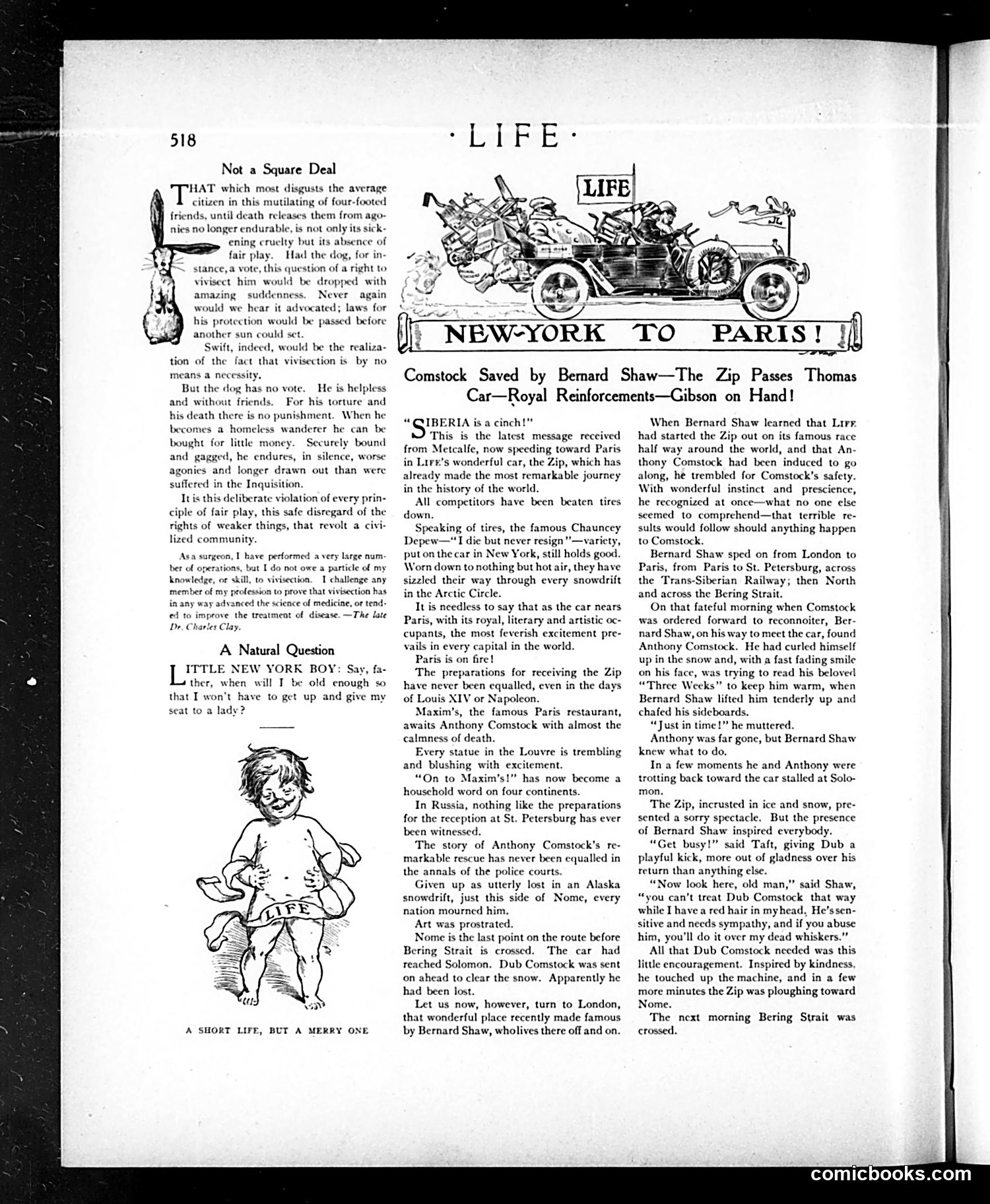
This page contains three distinct pieces: 1. **"Not a Square Deal"** (top left): A brief editorial criticizing the treatment of dogs in society, arguing they deserve legal protections and fair treatment comparable to humans. 2. **"New York to Paris!"** (center/right): An illustrated story about the famous "Zip" car's journey from New York to Paris. It celebrates Bernard Shaw's rescue of the vehicle (named Comstock) during its expedition, highlighting the car's remarkable achievement as "the most remarkable journey in the history of the world." This appears to reference an actual early-20th-century automobile expedition. 3. **"A Natural Question"** (bottom left): A humorous illustrated segment featuring a small child asking when they'll be old enough to ride in a lady's seat—likely a gentle joke about gender roles and childhood curiosity.
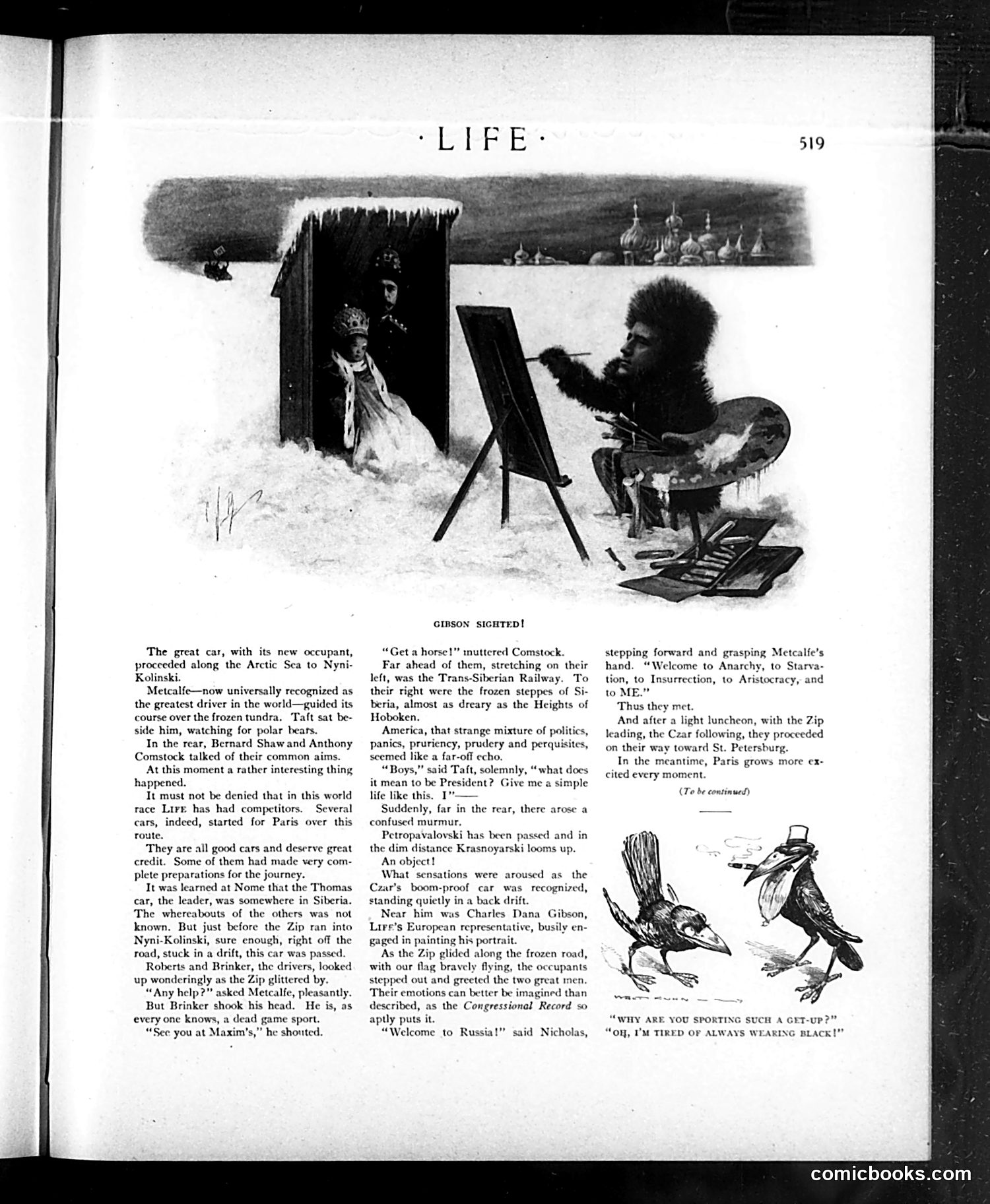
This page satirizes the early automobile era's adventurous long-distance racing. The main illustration shows an artist (Charles Dana Gibson, Life's European representative) painting a portrait while positioned in the frozen Siberian landscape—a joke about the extreme conditions these early motorists endured. The narrative follows a "great car" journey from Paris across Siberia, where characters named Taft, Metcalfe, and Cosntack encounter the Trans-Siberian Railway and frozen steppes "almost as dreary as the Heights of Hoboken." The satire mocks both the absurd pretensions of these automotive expeditions and American provincial attitudes (comparing Siberia to New Jersey). The bottom cartoon captions joke about winter fashion necessities in extreme climates.
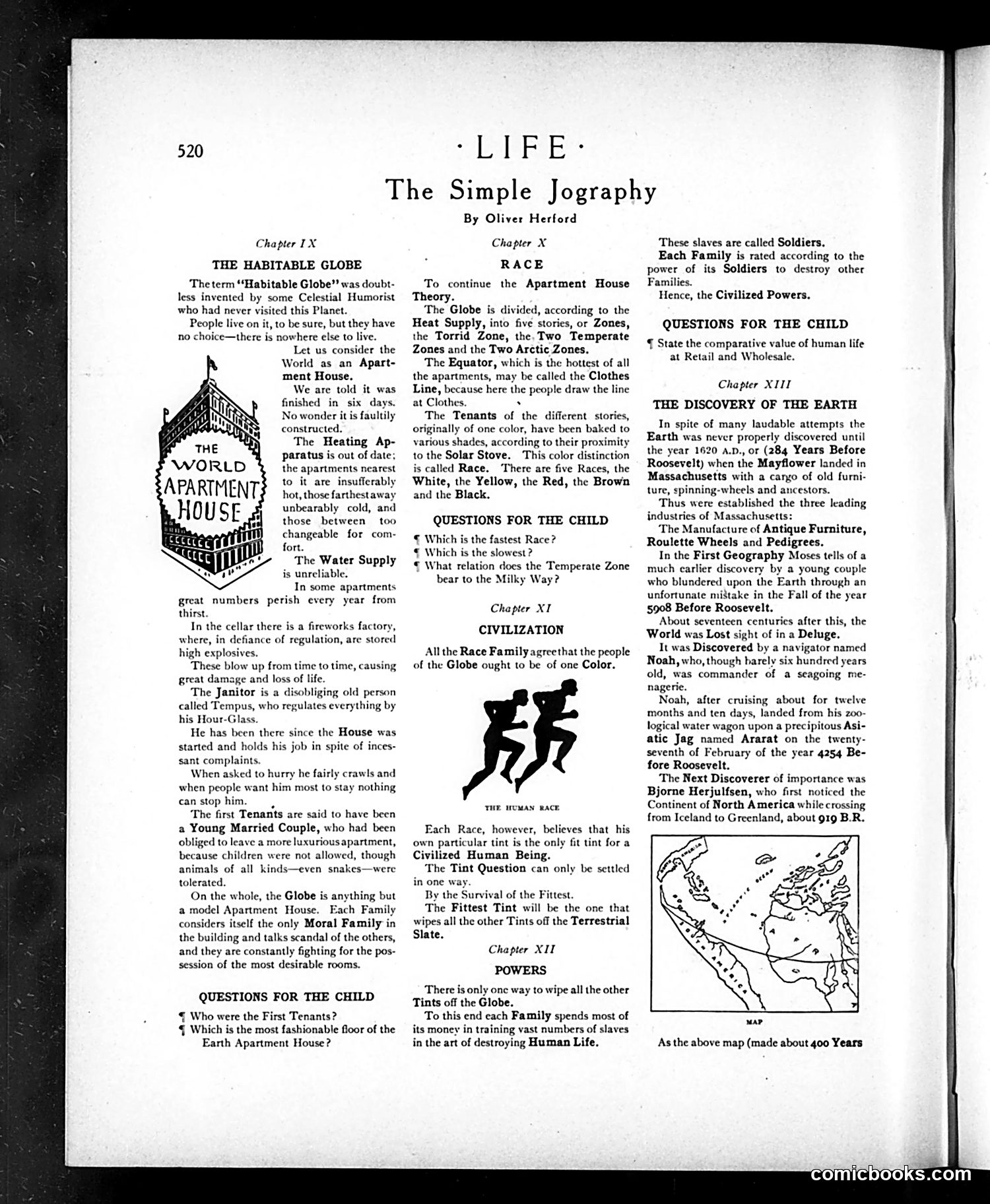
This appears to be a satirical educational series from *Life* magazine using an "Apartment House" metaphor to explain geography and social hierarchy. The building represents Earth divided into zones and "races" (the five main racial categories as understood in early 20th-century pseudo-scientific racism). The satire critiques this racial hierarchy: different "races" occupy different floors based on proximity to the "Solar Stove," with their "color distinction called Race." The text darkly jokes that each "Family" trains "vast numbers of slaves in the art of destroying Human Life"—mocking both racial pseudoscience and militarism. The accompanying map and "Human Race" illustration are part of this allegorical structure. The content reflects Period attitudes while appearing to mock both racist ideology and war.
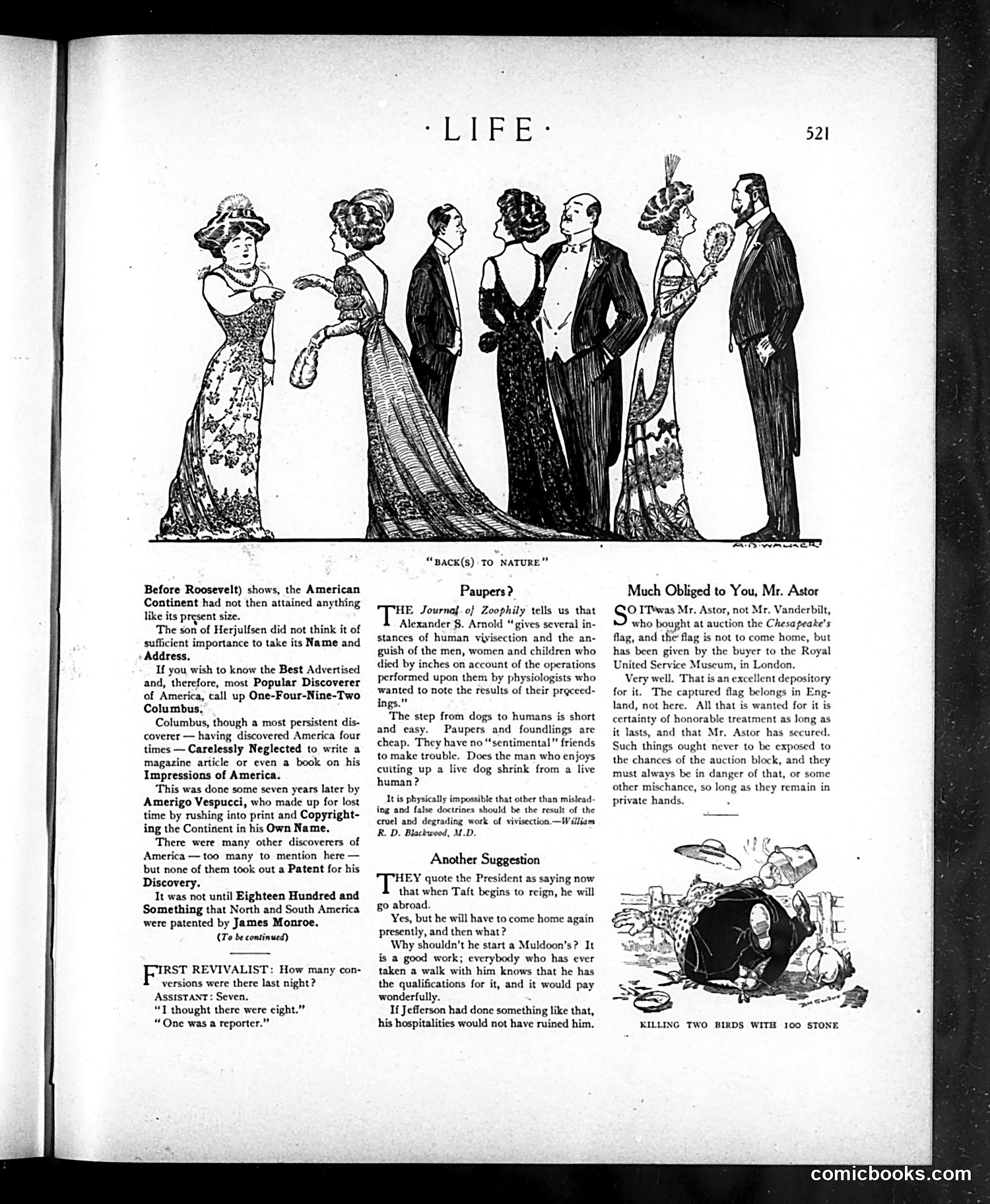
The top illustration titled "BACK(S) TO NATURE" depicts elegantly dressed Edwardian-era figures in formal attire, satirizing high society's pretension. The text sections critique various subjects: **"Paupers?"** discusses vivisection—experiments on human subjects by physiologists—questioning whether such scientific advancement justifies the "degrading work." **"Much Obliged to You, Mr. Astor"** references Mr. Vanderbilt purchasing a Chesapeake's flag at auction, with Mr. Astor's involvement in its donation to a museum. The piece sarcastically praises Astor's "honorable treatment" while questioning wealthy collectors' motives. **"Another Suggestion"** jokes about President Taft potentially going abroad, suggesting he start a Muldoon's (likely a gymnasium or health spa) upon return—a humorous jab at his physical appearance or health. The bottom cartoon illustrates the idiom "killing two birds with one stone."
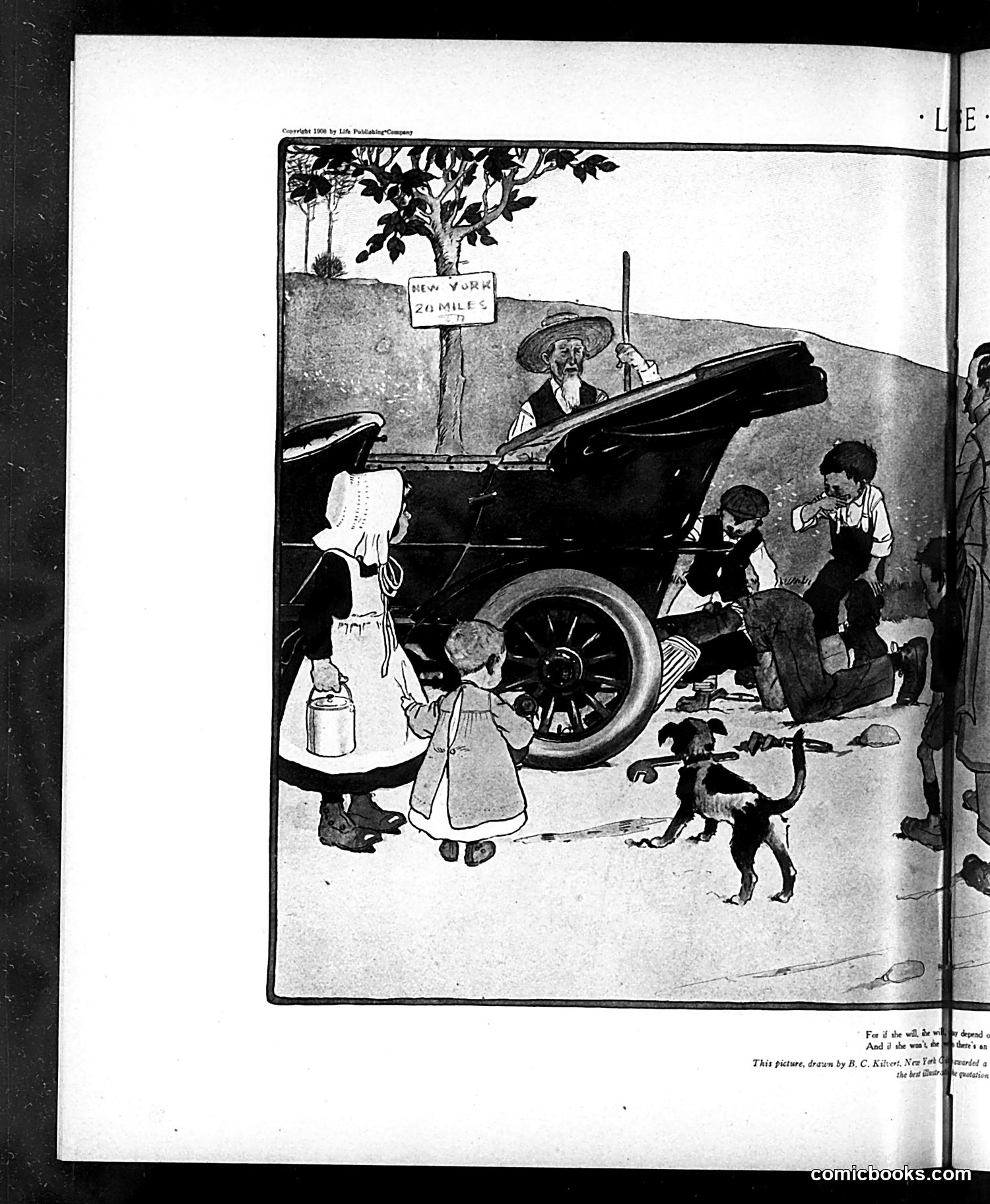
This appears to be a satirical illustration from Life magazine showing a family's automobile journey. A signpost reading "NEW YORK 20 MILES" indicates they're approaching New York City. The image depicts a well-dressed woman with children and a small dog gathered around a broken-down car, with an elderly driver visible in the vehicle. The satire likely mocks early automobile travel—the unreliability of cars, the challenges of long-distance motoring, and perhaps the contrast between aspirational urban destinations and the roadside difficulties encountered en route. The roadside setting and stranded family suggest commentary on the practical frustrations of early 20th-century motor travel, when breakdowns were common and automobile journeys were arduous undertakings rather than reliable transportation.
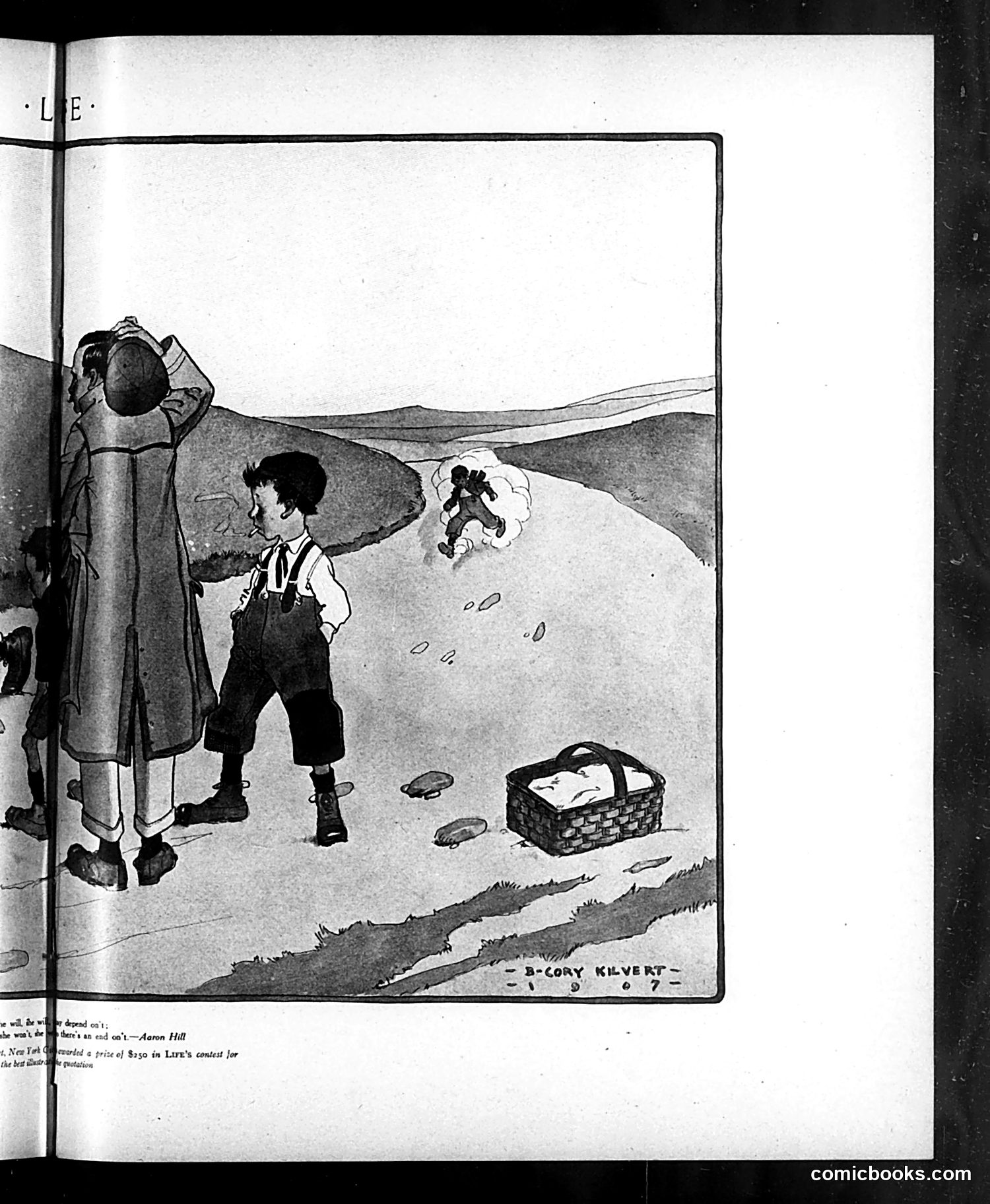
This cartoon by B. Corey Kilvert depicts a domestic scene from what appears to be an early 20th-century children's story or morality tale. An adult figure holds a large basket or container while a child in overalls stands nearby observing another child in the distance. The scattered oval shapes on the ground likely represent eggs or similar objects being collected or lost. The text reference to "Aaron Hill" and "a prize of $250 in Life's contest for best pictures" suggests this illustrated a literary submission or story contest. Without additional context, the specific narrative or satirical point remains unclear, though it appears to comment on childhood responsibility or domestic life rather than political matters.
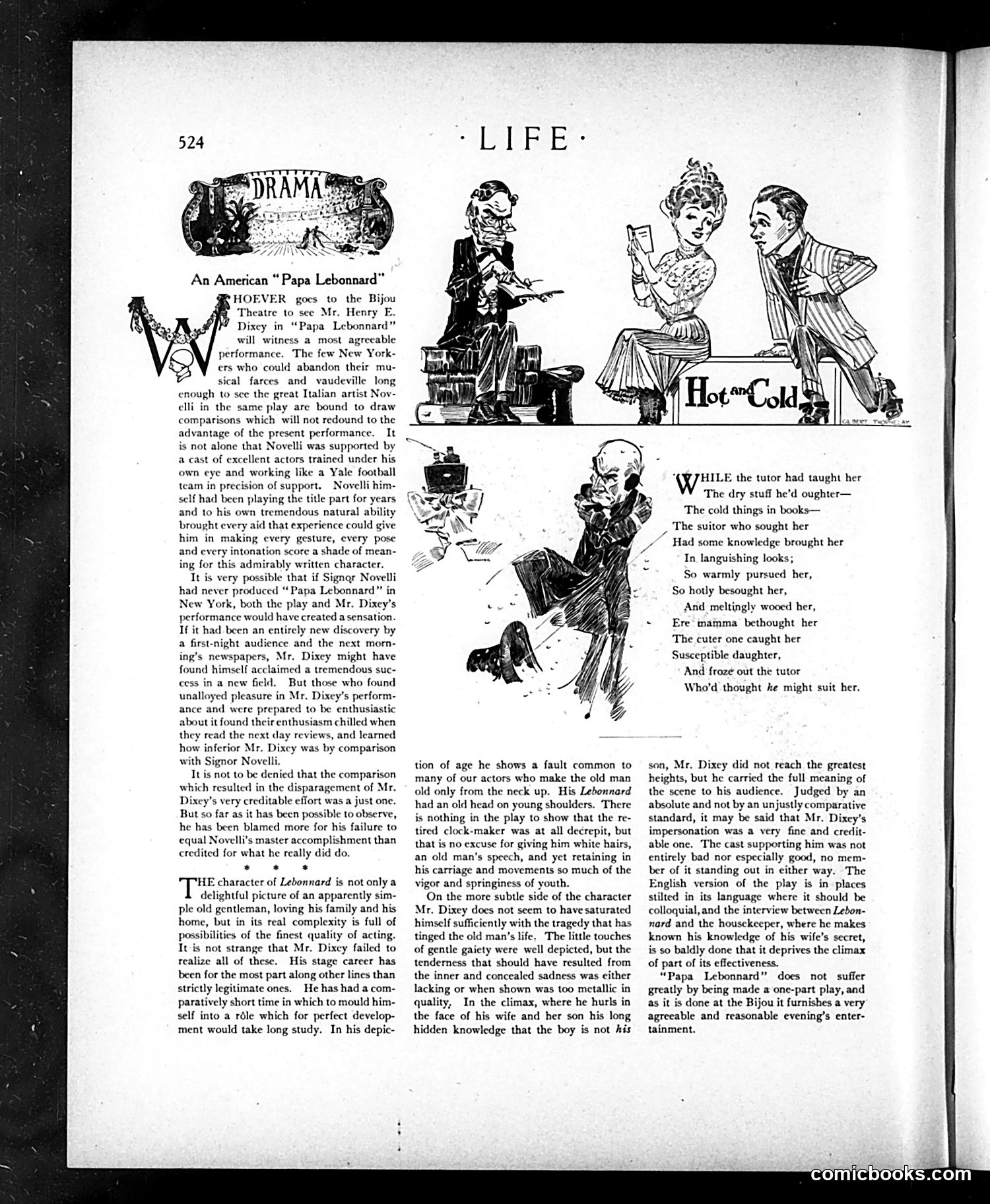
This page reviews a theatrical production of "Papa Lebonard," an American adaptation of an Italian play starring Henry F. Discy. The illustrations show scenes from the performance, including one labeled "Hot and Cold" depicting romantic/comedic interactions between characters. The text criticizes Discy's portrayal, noting he failed to capture the character's tragedy and inner life, instead relying on surface-level acting (white hair, old man's voice, physical movements). The reviewer argues that while Discy performed competently, he didn't saturate himself sufficiently with the role's emotional depth compared to the original Italian actor Novelli. The critique represents early 20th-century theatrical criticism focused on acting technique and character interpretation.
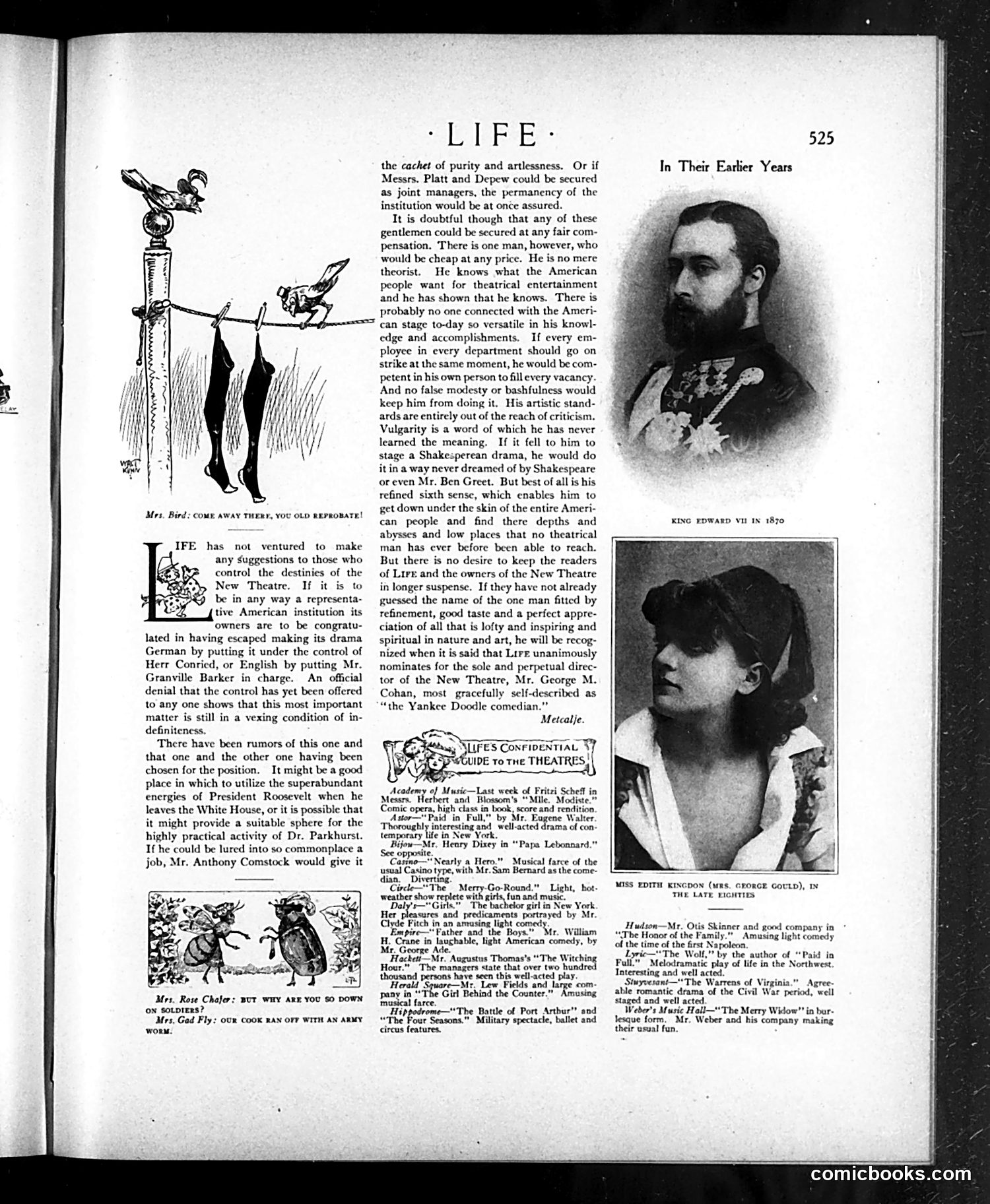
The page features two cartoons mocking theatrical management and performers: 1. **"Mrs. Bird: Come Away There, You Old Reprobate!"** (top left): Shows a woman pulling a man away from what appears to be theatrical attractions, satirizing backstage behavior or moral compromises in theater. 2. **"Mrs. Ben Chabot: But Why Are You So Down on Soldiers?"** (bottom left): Depicts a woman speaking to a man, likely criticizing anti-military sentiment or attitudes among theatrical circles during wartime. The surrounding text discusses theater management control and performer versatility. The page includes photographs of theatrical figures identified as "King Edward VII in 1870" and "Miss Edith Kingston," suggesting contemporary theater personalities. The overall thrust satirizes American theater's pretensions, management conflicts, and attitudes toward both performers and military service.
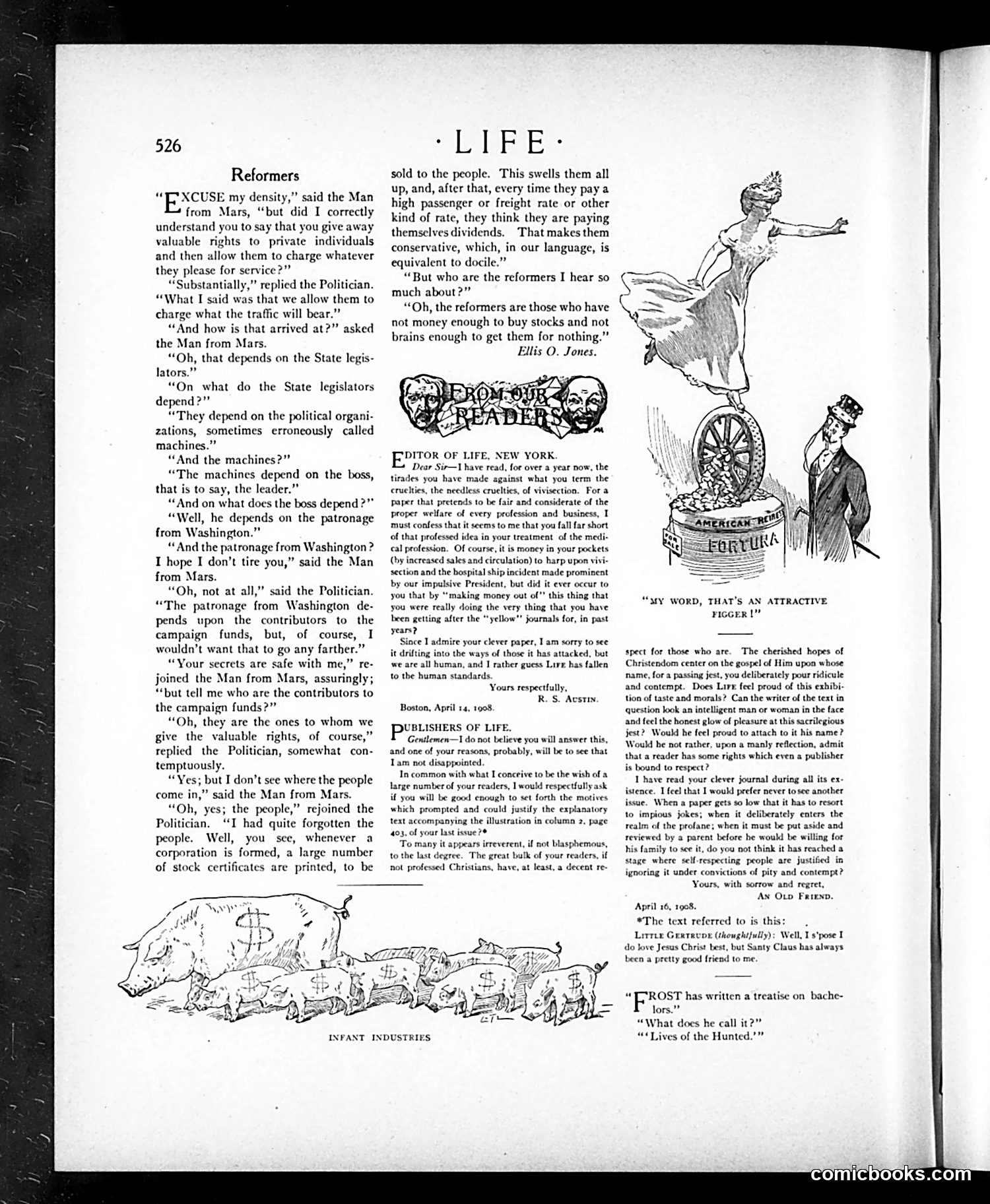
This page features a Socratic dialogue between a naive extraterrestrial visitor and an American politician, satirizing corporate influence and political corruption circa 1908. **The Setup:** The Man from Mars asks innocent questions that expose the circular dependency chain: politicians grant valuable rights to corporations → corporations control political machines → machines depend on party bosses → bosses depend on Washington patronage → patronage flows from campaign contributors → those contributors are the same corporations receiving the rights. **The Punchline:** When the Martian asks where "the people" fit in, the politician explains they're manipulated through stock certificates into believing they own dividends, making them "conservative" and "docile." True reformers, he adds, are simply those too poor to buy stocks or too stupid to get them free. **The Satire:** The cartoon mocks the Progressive Era's exposure of "the machine"—the corrupt interlocking system where corporate interests and political power reinforce each other, leaving ordinary citizens as unwitting pawns rather than genuine stakeholders in democracy.
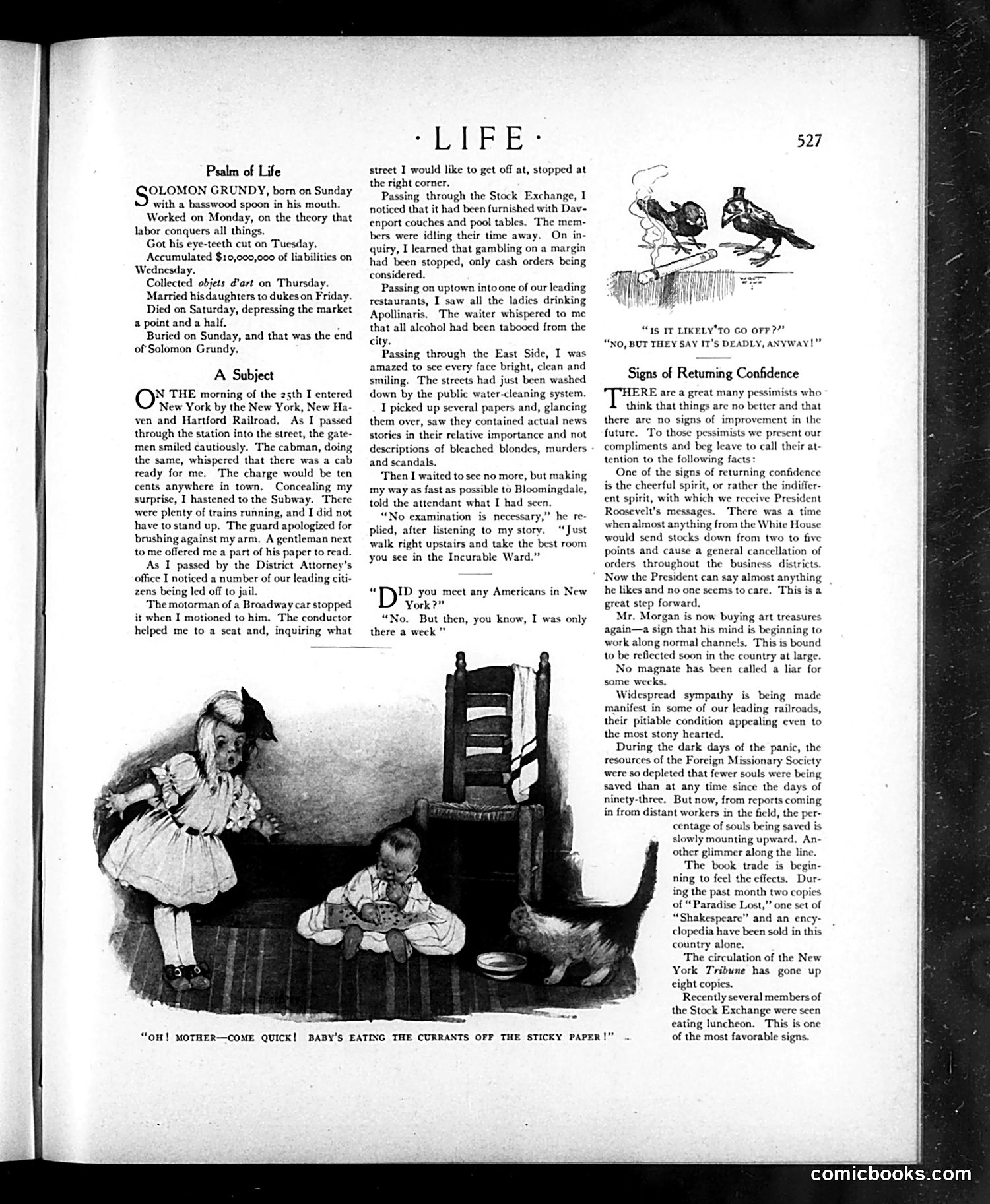
This page contains satirical commentary on early 1900s American society, presented through three pieces: **"Psalm of Life"**: A mock-serious poem mocking Solomon Grundy (a nursery rhyme character) whose life trajectory parodies American business culture—accumulating massive liabilities while collecting art and marrying daughters to nobles, dying and affecting the stock market. **"A Subject"**: A traveler's account describing an absurdly utopian New York where citizens are polite, gambling is banned, women drink only water, streets are clean, newspapers contain real news instead of scandal, and the narrator is so shocked he checks himself into an insane asylum. The satire mocks contemporary New York's corruption, crime, drinking culture, and sensationalist press. **"Signs of Returning Confidence"**: Commentary on economic recovery, noting improving public mood toward President Roosevelt's policies and J.P. Morgan's renewed art purchases as indicators of financial health restoration. The small cartoons depict social absurdities: birds discussing danger, and a mother discovering her baby eating poison from sticky paper—illustrating careless parenting and household hazards.
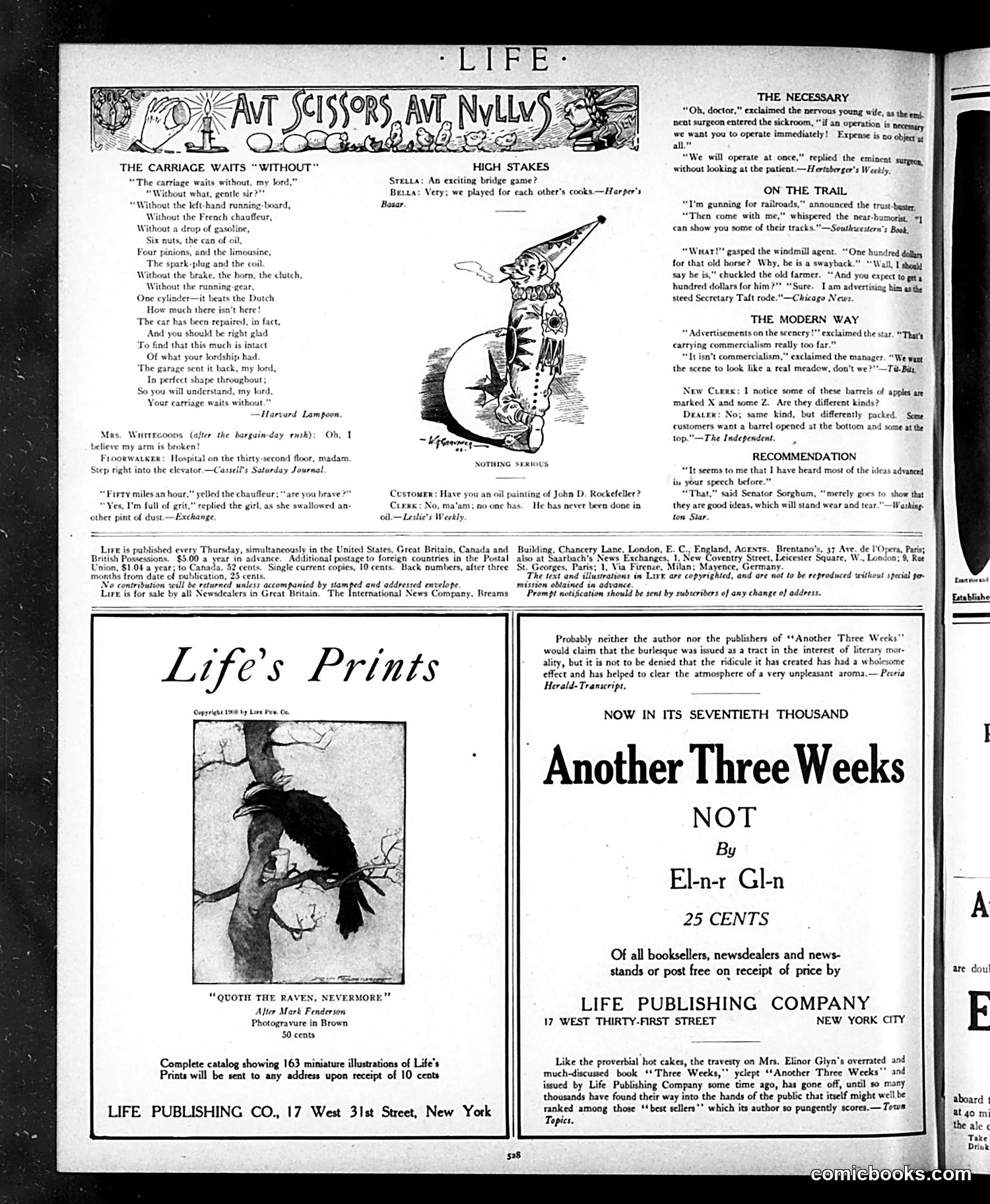
This page from *Life* magazine contains several brief humorous sketches satirizing early 20th-century American life: **"The Carriage Waits Without"** mocks the new automobile age—a lord's car has been repaired so badly that almost nothing functional remains, yet the mechanic presents it as fixed. **"High Stakes"** jokes about bridge players wagering their servants ("cooks"), suggesting domestic staff as gambling currency among the wealthy. **"On the Trail"** contains political satire about a "trust-buster" (likely referencing Theodore Roosevelt's antitrust efforts) hunting railroads. It also mocks Secretary Taft through a joke about an old horse advertised as "the steed Secretary Taft rode." **"The Modern Way"** critiques commercialism in theater—a stage meadow includes visible advertisement barrels because realistic scenery matters less than advertising revenue. The sketches reflect Progressive-era concerns: automobile reliability, class hierarchies, trust-busting politics, and commercialism's encroachment on culture.
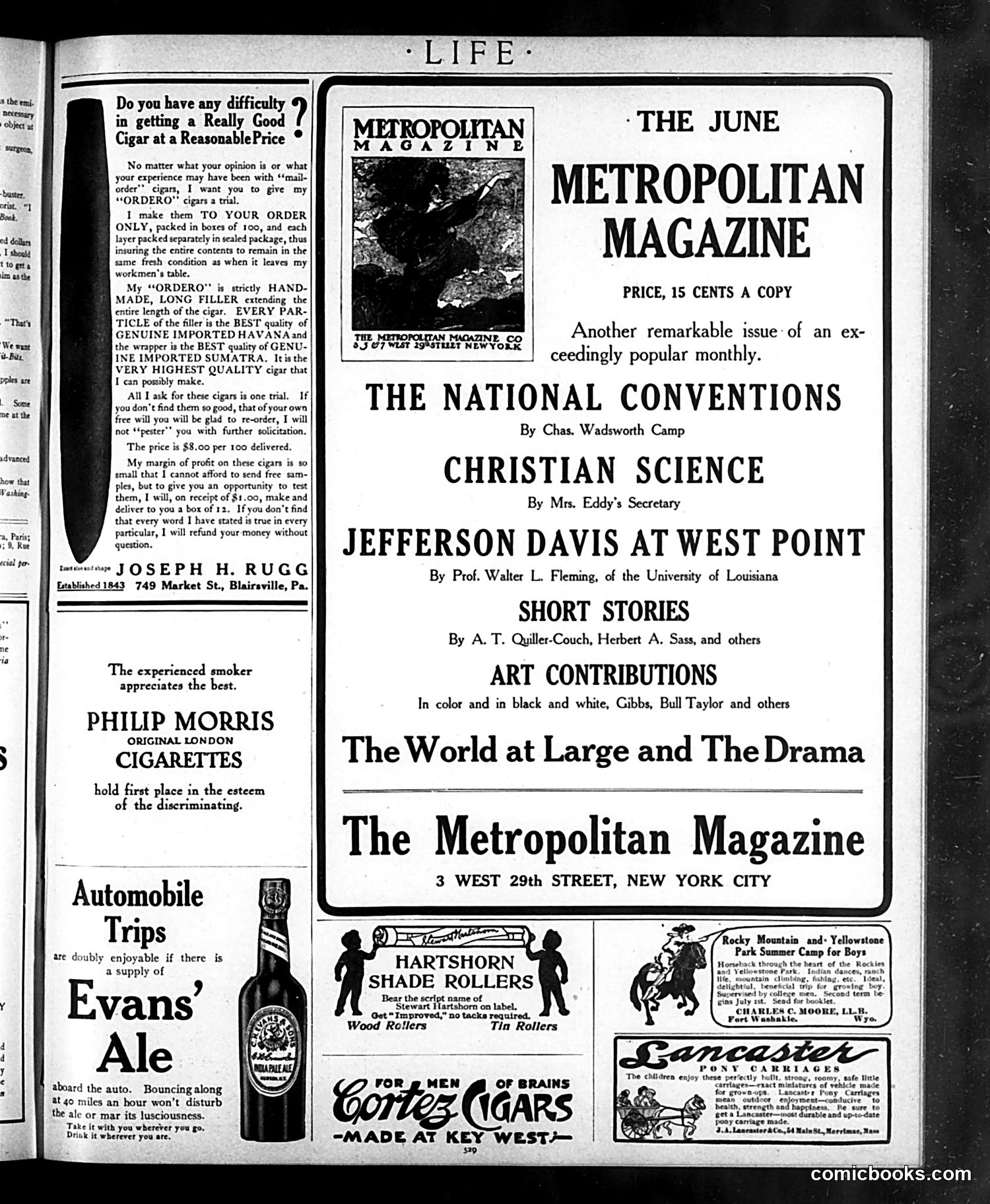
This is primarily a **title/contents page and advertising section** from the June issue of Metropolitan Magazine, not a satirical cartoon page. The page announces the magazine's featured articles, including pieces on "The National Conventions" and "Jefferson Davis at West Point"—likely referencing early 1900s political coverage and historical interest in the Civil War era. The advertisements reveal period consumer culture: **Ordero cigars** emphasize hand-rolled quality and mail-order convenience; **Philip Morris cigarettes** target "discriminating" smokers; **Evans' Ale** promotes automobile travel (a novelty); **Hartshorn Shade Rollers** advertise window hardware; and **Cottez Cigars** use the dated phrase "for men of brains." These ads reflect early-20th-century marketing strategies appealing to middle/upper-class male consumers through claims of quality, exclusivity, and sophistication. The pricing (15 cents for the magazine) indicates this is a relatively upscale publication for its era.
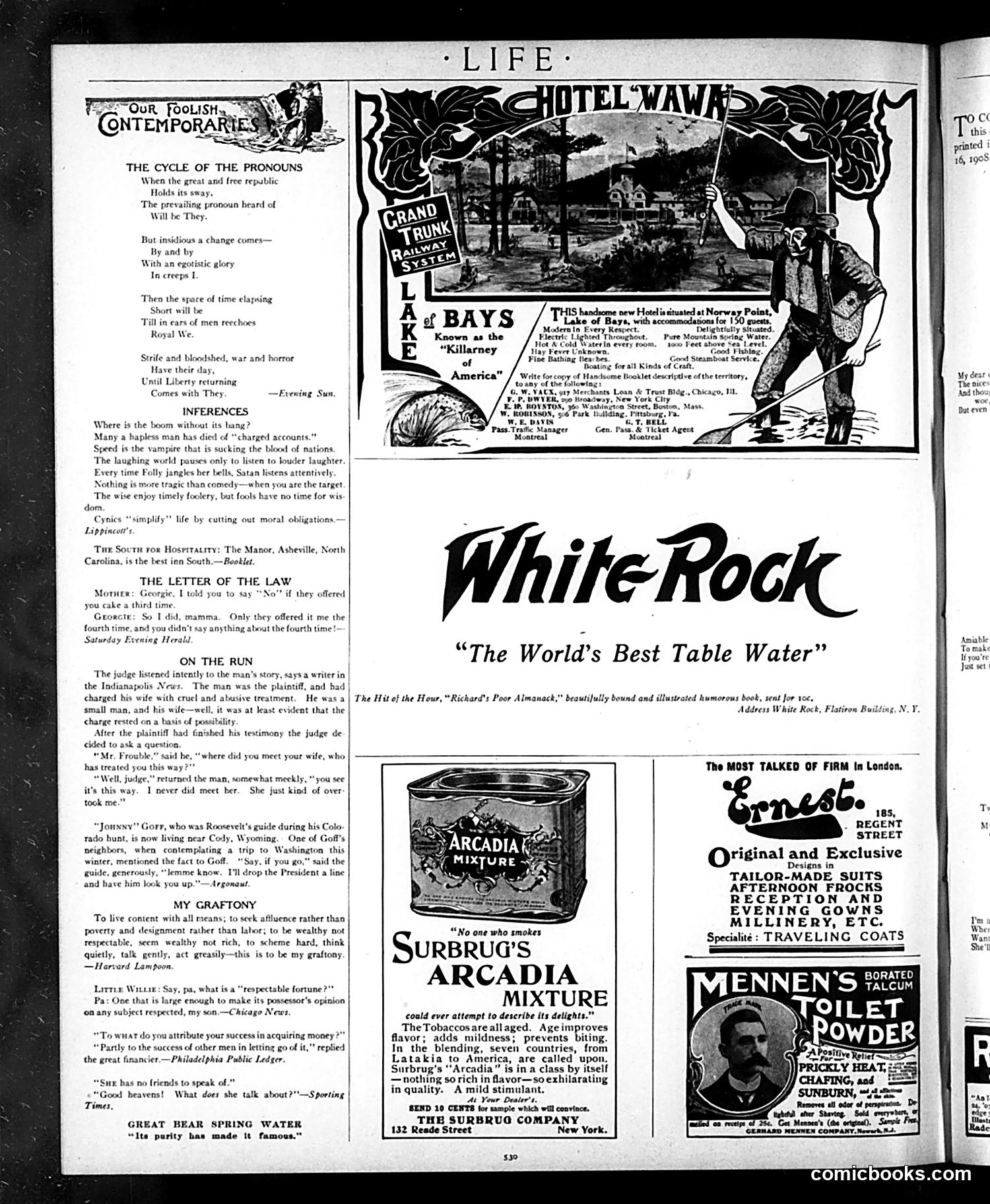
This page from *Life* magazine is primarily **advertising and humorous commentary** rather than political satire. The content includes: **"The Cycle of the Pronouns"** — A satirical poem suggesting democracy's linguistic trajectory: republics use "they," tyrannies progress to "I," then "we" (royal authority), before liberty restores "they." It critiques how language reflects governmental power structures. **Humorous short pieces** — Various jokes about human folly, marital conflict, and social pretension (e.g., "My Graftony" mocks wealth-seeking over honest labor). **Historical reference**: One anecdote mentions "Johnny" Goff, Theodore Roosevelt's Colorado hunting guide, suggesting the magazine's contemporary moment. **Heavy advertising** dominates—White Rock water, hotel promotions, and luxury goods occupy substantial space. The satirical tone targets universal human weaknesses (greed, vanity, hypocrisy) rather than specific political figures or events. For modern readers, the "pronouns" poem offers the clearest political commentary about democracy versus authoritarianism.
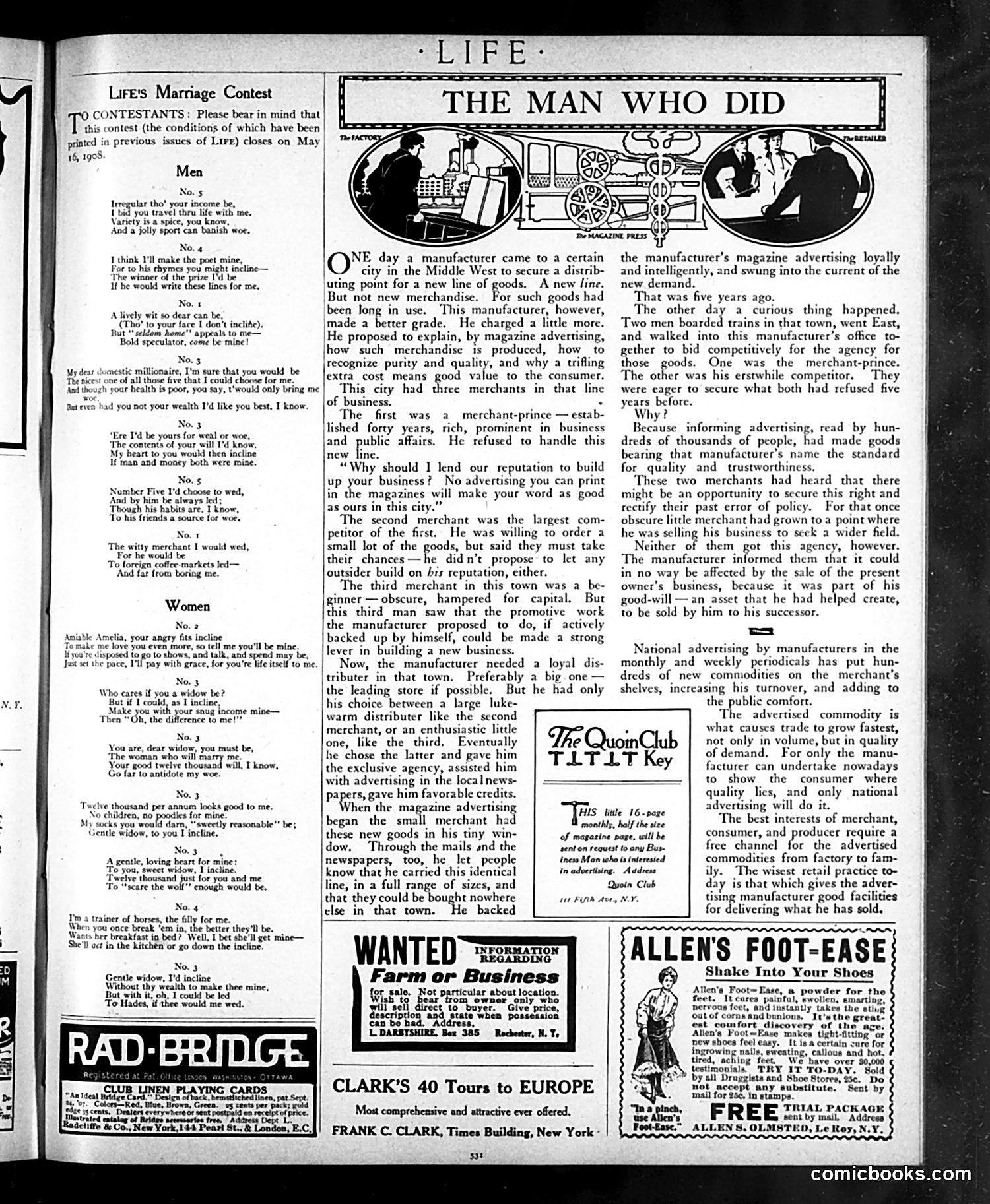
This page features a short story titled "The Man Who Did," illustrating a business parable about merchant competition and advertising. **The Plot:** A manufacturer seeks a distributor for improved goods in a Midwestern city with three established merchants. The first, a prestigious 40-year merchant-prince, refuses—his reputation alone suffices. The second, his largest competitor, conditionally agrees but demands favorable credit terms. The third, an ambitious smaller merchant, embraces the manufacturer's proposal to use magazine advertising to build business. **The Satire/Point:** The story argues that national advertising by manufacturers benefits merchants by creating consumer demand, increasing shelf traffic and public comfort. It champions the value of aggressive marketing and entrepreneurial risk-taking over relying solely on established reputation. The page also includes "Life's Marriage Contest"—humorous marriage proposals from both men and women, mostly satirizing mercenary motivations (seeking wealth, income, inheritances).
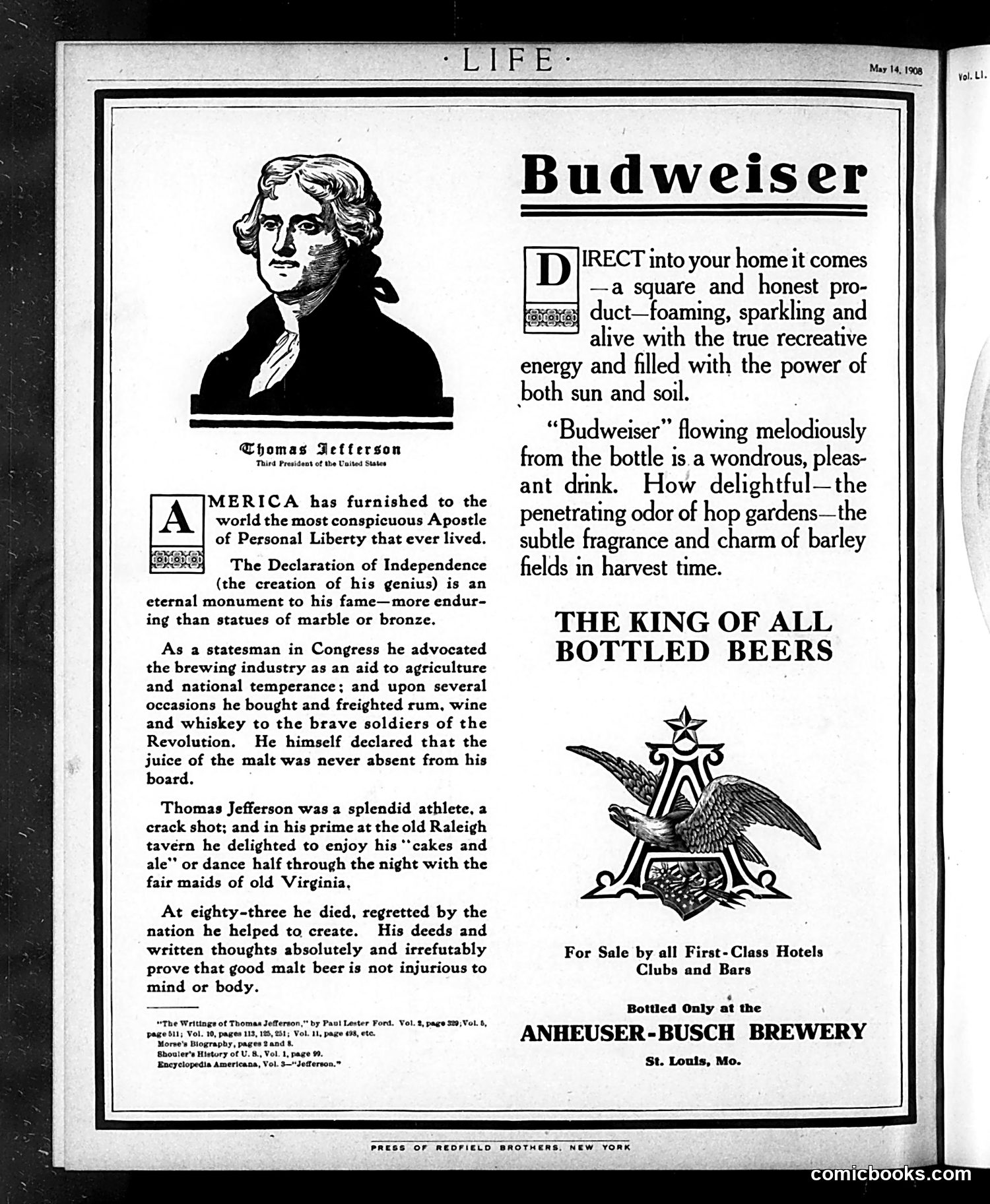
This is a Budweiser beer advertisement masquerading as historical content. The left side presents a biographical sketch of Thomas Jefferson, selectively emphasizing his alleged fondness for alcohol: his support for brewing as "national temperance," his provision of rum and whiskey to Revolutionary soldiers, and his declaration that malt beer was "never absent from his board." The advertisement then pivots to the right, using Jefferson's authority as a Founding Father to endorse Budweiser as wholesome and beneficial to "mind or body." **The satire/manipulation:** This exploits Jefferson's genuine stature to legitimize beer consumption during the Progressive Era, when temperance movements were gaining strength. By attributing pro-alcohol sentiments to America's most iconic liberty advocate, Anheuser-Busch attempts to frame beer-drinking as patriotic and philosophically justified. The sourced quotations appear designed to lend scholarly credibility, though the selective interpretation is propaganda rather than honest history.