
Life, 1908-05-14 · page 4 of 20
Life — May 14, 1908 — page 4: what you’re looking at
What you’re looking at
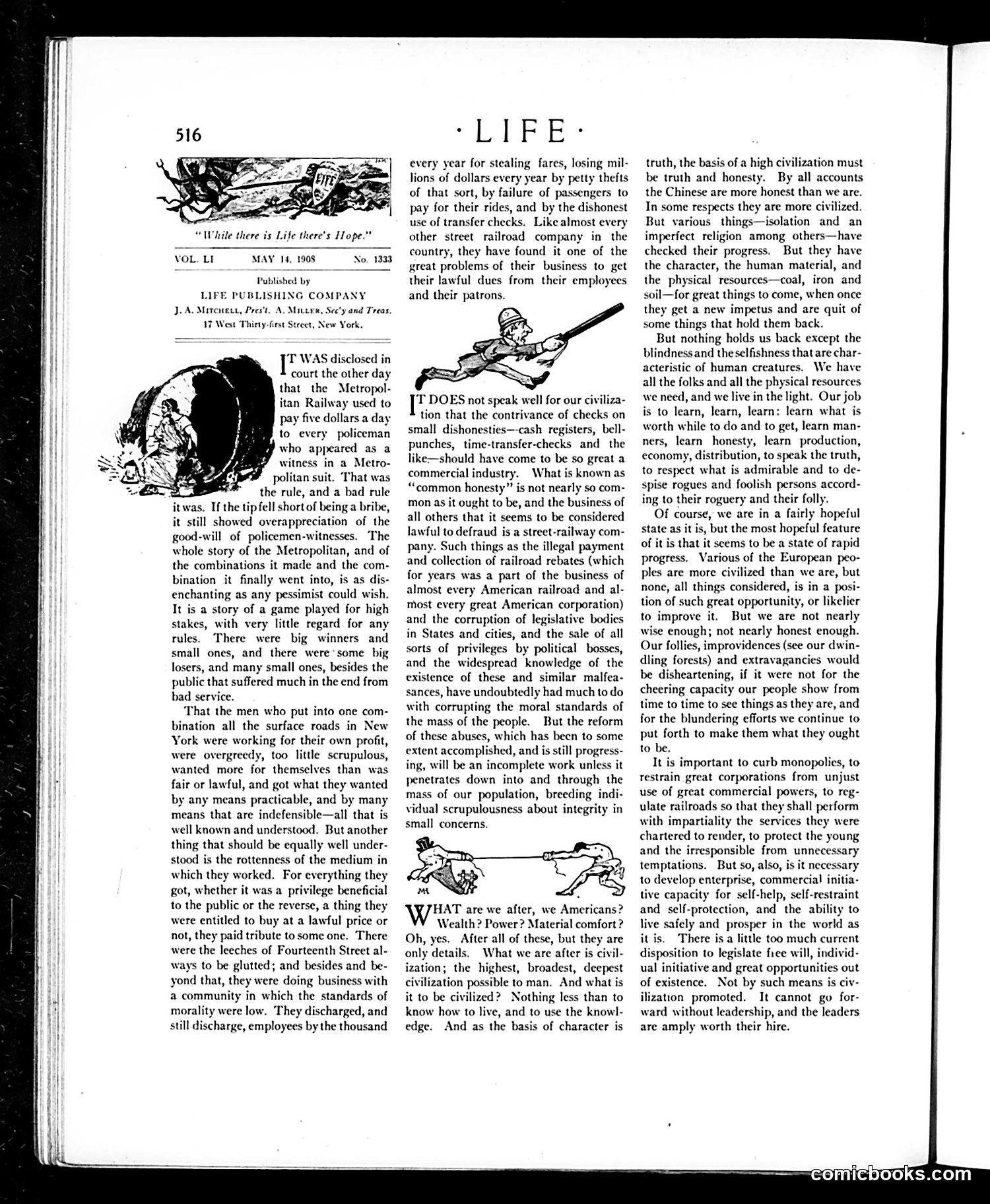
The page contains editorial text rather than political cartoons. Two small illustrations appear—one showing a figure in what appears to be a subway or tunnel setting, and another depicting a figure in motion (possibly diving or falling). The text discusses corruption in American railroads and municipal governance, specifically referencing a Metropolitan Railway bribery case involving five-dollar daily payments to policemen. The author criticizes widespread dishonesty in American business and government, arguing such moral failures undermine civilization. The editorial advocates for reform through honest leadership and self-regulation of commerce, rather than legislation alone. It reflects Progressive Era concerns about corporate malfeasance and civic corruption affecting the early 1900s. The illustrations appear decorative rather than satirical commentary on the main argument.
📄 Transcribed text from this page (OCR, searchable)
Machine-transcribed from the original scan — historical spelling and the odd misread are preserved.
“While there is Life there's Hope.” VOL. LI MAY 14, 1908 Published by LIFE PUBLISHING COMPANY J.A. Miremecte, Pres't, A, Mitr, Sec’y and Treas, V7 West Thirty-first New York, ie Ws isclosed in court the other day that the Metropol- itan Railway used to pay five dollars a day to every policeman who appeared as a witness in a Metro- politan suit. That was the rule, and a bad rule it was. If the tip {ell short of being a bribe, it still showed overappreciation of the good-will of policemen-witnesses. The whole story of the Metropolitan, and of the combinations it made and the com- bination it finally went into, is as di enchanting as any pessimist could wish. It is a story of a game played for high stakes, with very little regard for any rules. There were big winners and small ones, and there were*some big losers, and many small ones, besides the public that suffered much in the end from bad service. That the men who put into one com- bination all the surface roads in New York were working for their own profit, were overgreedy, too little scrupulous, wanted more for themselves than was fair or lawful, and got what they wanted by any means practicable, and by many means that are indefensible—all that is well known and understood. But another thing that should be equally well under- stood is the rottenness of the medium which they worked. For everything they got, whether it was a privilege beneficial to the public or the reverse, a thing they were entitled to buy at a lawful price or not, they paid tribute to some one. There were the leeches of Fourteenth Street al- ways to be glutted; and besides and be- yond that, they were doing business with a community in which the standards of morality were low. They discharged, and still discharge, employees by the thousand “LIP = 'y year for stealing fares, losing mil- lions of dollars every year by petty thefts of that sort, by failure of passengers to pay for their rides, and by the dishonest use of transfer checks. Like almost every other street railroad company in the country, they have found it one of the great problems of their business to get their lawful dues from their employees and their patrons. i DOES not speak well for our civiliza- tion that the contrivance of checks on small dishonesties—cash registers, bell- punches, time-transfer-checks and the like—should have come to be so great a commercial industry. What is known as “common honesty” is not nearly so com- mon as it ought to be, and the business of all others that it seems to be considered lawful to defraud is a street-railway com- pany. Such things as the illegal payment and collection of railroad rebates (which for years was a part of the business of almost every American railroad and al- most every great American corporation) and the corruption of legislative bodies in States and cities, and the sale of all sorts of privileges by political bosses, and the widespread knowledge of the existence of these and similar malfea- sances, have undoubtedly had much to do with corrupting the moral standards of the mass of the people. But the reform of these abuses, which has been to some extent accomplished, and is still progress- ing, will be an incomplete work unless it penetrates down into and through the mass of our population, breeding indi- vidual scrupulousness about integrity in small concerns. HAT are we after, we Americans? Wealth? Power? Material comfort ? Oh, yes. After all of these, but they are only details. What we are after is civil- ization; the highest, broadest, deepest civilization possible to man. And what is it to be civilized? Nothing less than to know how to live, and to use the knowl- edge. And as the basis of character is truth, the basis of a high civilization must be truth and honesty. By all accounts the Chinese are more honest than we are. In some respects they are more civilized. But various things—isolation and an imperfect religion among others—have checked their progress. But they have the character, the human material, and the physical resources—coal, iron and soil—for great things to come, when once they get a new impetus and are quit of some things that hold them back. But nothing holds us back except the blindness and the selfishness that are char- acteristic of human creatures. We have all the folks and all the physical resources we need, and we live in the light. Our job is to learn, learn, learn: learn what is worth while to do and to get, learn man- ners, learn honesty, learn production, economy, distribution, to speak the truth, to respect what is admirable and to de- spise rogues and foolish persons accord- ing to their roguery and their folly. Of course, we are in a fairly hopeful state as it is, but the most hopeful feature of it is that it seems to be a state of rapid progress. Various of the European peo- ples are more civilized than we are, but none, all things considered, is in a posi- tion of such great opportunity, or likelier to improve it. But we are not nearly wise enough; not nearly honest enough. Our follies, improvidences (see our dwin- dling forests) and extravagancies would. be disheartening, if it were not for the cheering capacity our people show from time to time to see things as they are, and for the blundering efforts we continue to put forth to make them what they ought to be. It is important to curb monopolies, to restrain great corporations from unjust use of great commercial powers, to reg- ulate railroads so that they shall perform with impartiality the services they were chartered to render, to protect the young and the irresponsible from unnecessary temptations. But so, also, is it necessary to develop enterprise, commercial initia- tive capacity for self-help, self-restraint and self-protection, and the ability to live safely and prosper in the world as it is. There is a little too much current disposition to legislate fice will, individ- ual initiative and great opportunities out of existence. Not by such means is civ- ilization promoted. It cannot go for- ward without leadership, and the leaders are amply worth their hire. ‘comicbooks.com